


When I first started the Geekerati Media Newsletter, it was my intention to write two to three articles a week. The central article was going to be a weekly rundown of curated content that I had recently encountered and found interesting. I wanted to do a modern version of the magazines like Dragon and White Dwarf (before they became “house magazines”), Wizard, Different Worlds, Twilight Zone, and Space Gamer. All of these magazines contained a ton of geek content from a wide array of product categories, and my pop culture brain didn’t want to focus just on games or comics or fiction or film. I wanted to talk about them all and a weekly newsletter seemed the best way to anchor this desire.
If someone subscribed to the newsletter for film reviews, they’d at least get one film recommendation a week even as in-depth reviews and lists might be rarer. The same would be true of the other categories as well. Even better, the newsletter would provide me with an opportunity to build a positive community. Too much of modern “fan new” is rooted in ragebaiting to drive the clicks and too little is aimed at educating, informing, and recommending excellent content. It’s one thing to provide fair criticism, but it’s another to constantly offer knee-jerk negativism (that often ends up being ahistorical) just to generate revenue on the Tube of You or Twitter/X. Informed critiques can make later products better, but anger for anger’s sake is another thing and it’s something I wanted to combat. To this end, the Weekly Geekly would share other articles from Substack that were promoting awesome things, often things created and sold by those Substackers.
I’m typically very proud of the average Weekly Geekly entry, with one exception. I have not been able to produce them on a weekly basis, and I think this has contributed to a bit of back and forth on subscription growth. People come to the site after someone recommends an article and then the next few emails they get from me have nothing to do with their interests and so they unsubscribe. Don’t get me wrong, the site has a great free subscriber base, but I see people come and go more than I’d like. I want to build conversation, so each unsubscribe leaves a small hole in the overall conversation.
The past week has had so much great content that I was compelled to restart the Weekly Geekly. Without further ado, we’ll start with the Weekly Oddity.

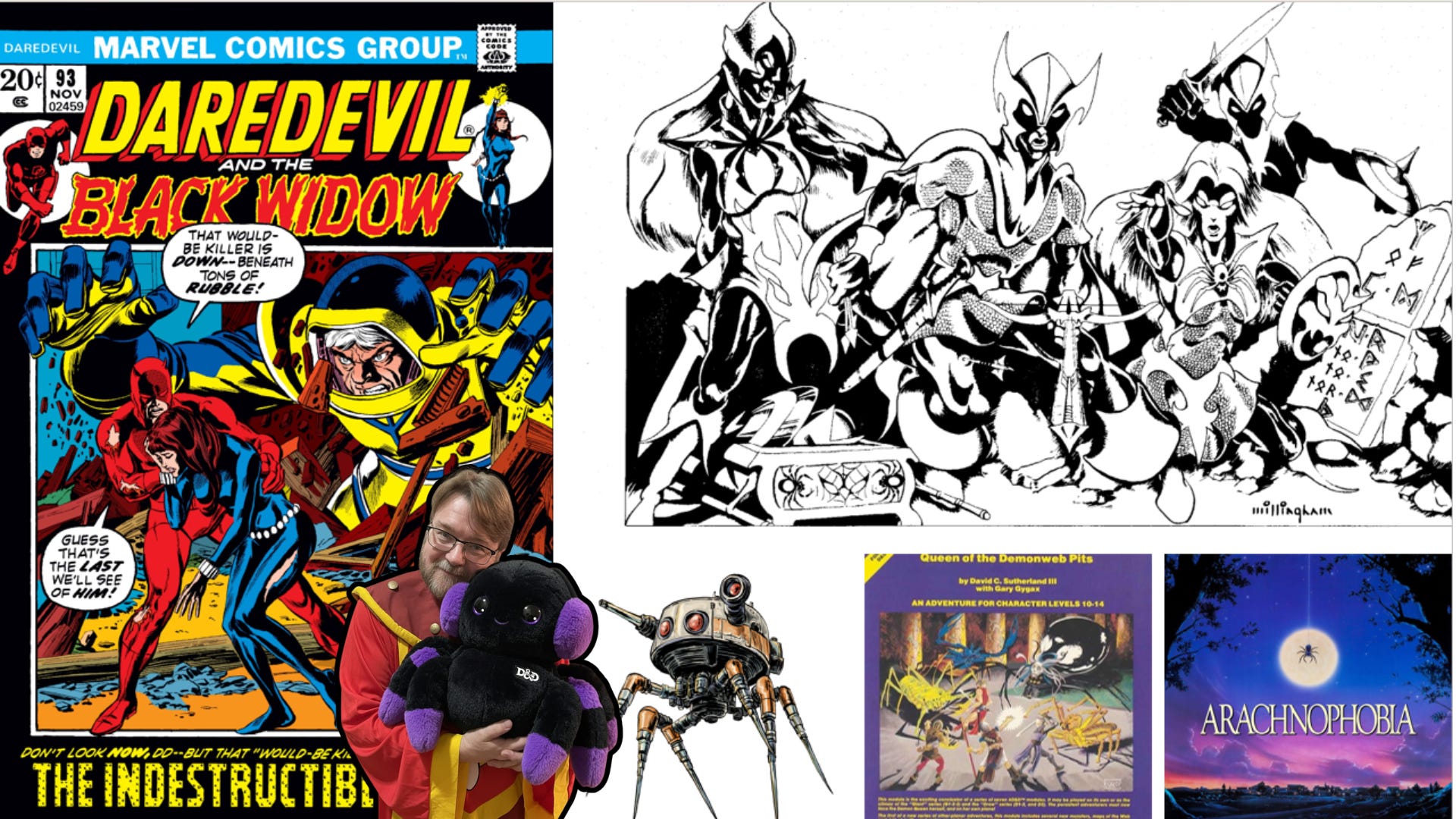
Turns Out Everyone Loves Spiders…Well, Some Spiders Anyway
My wife and I recently watched a video on the Tube of You by Stephanie Sammann that blew our minds. For most of my life, spiders have really freaked me out and when I say spiders I mean ALL spiders. That all changed last year when I looked at the wall, behind my double-monitor set up, at work one day and saw a very little spider watching me. I didn’t know what kind of spider it was at the time, but it moved differently than any other spider I’d seen and it seemed friendly. I know, I know. That’s some major anthropomorphizing, but I swear that the little fellow was actually interested in what I was doing and it came back day after day.
I eventually learned that it was a jumping spider and that I wasn’t alone in thinking that they were friendly. That’s where Stephanie’s video comes in. The video doesn’t argue that jumping spiders are the cutest and friendliest spiders, but it does demonstrate that these tiny arachnids are far more intelligent than I ever imagined and with that intelligence comes the possibility that they might just be friendly.
I Can’t Believe I Streamed
Last week, I asked if any of my Substack friends would be willing to watch if I did a live stream of me playing the original Pool of Radiance computer roleplaying game if I included some of them as the characters. The post got a lot of positive response and so, I ventured into the Streets of Phlan for the first time in decades directing my friends Luke Y. Thompson, Mark Finn, David Perlmutter, Matt Thompson, Rebekah King, and James M. Spahn on our first adventure. The initial stream was about 30 minutes long and James Spahn dropped by to add some advice in the chat. I’ve included a clip of the content below, but if you want, I can post a write up of the full 30 minutes in another post. Regardless of the answer to that poll, I won’t be doing posts for every time I stream though I do plan to stream and if you want to be invited as a guest to chat and add your voice to the gameplay let me know. I’ll be happy to have you.

The Lamentations of Luke Y. Thompson
Luke Y. Thompson is one of the biggest He-Man and the Masters of the Universe fans I know. He has great enthusiasm for the franchise and when most recent film was released earlier this year, he did yeoman’s work trying to get people to watch it. Sadly, like the more recent Dungeons & Dragons movie, which I’ve seen about ten times now, it received a lot of pre-negativity that affected the early box-office. It looks like both films garnered enough streaming fandom that sequels are not out of the question, though whether they are likely is another question. Luke’s review of the new Masters of the Universe film is a good one, though when he talks about the computer-generated He-Man that was released on Netflix and why it failed, I am compelled to give a little pushback.
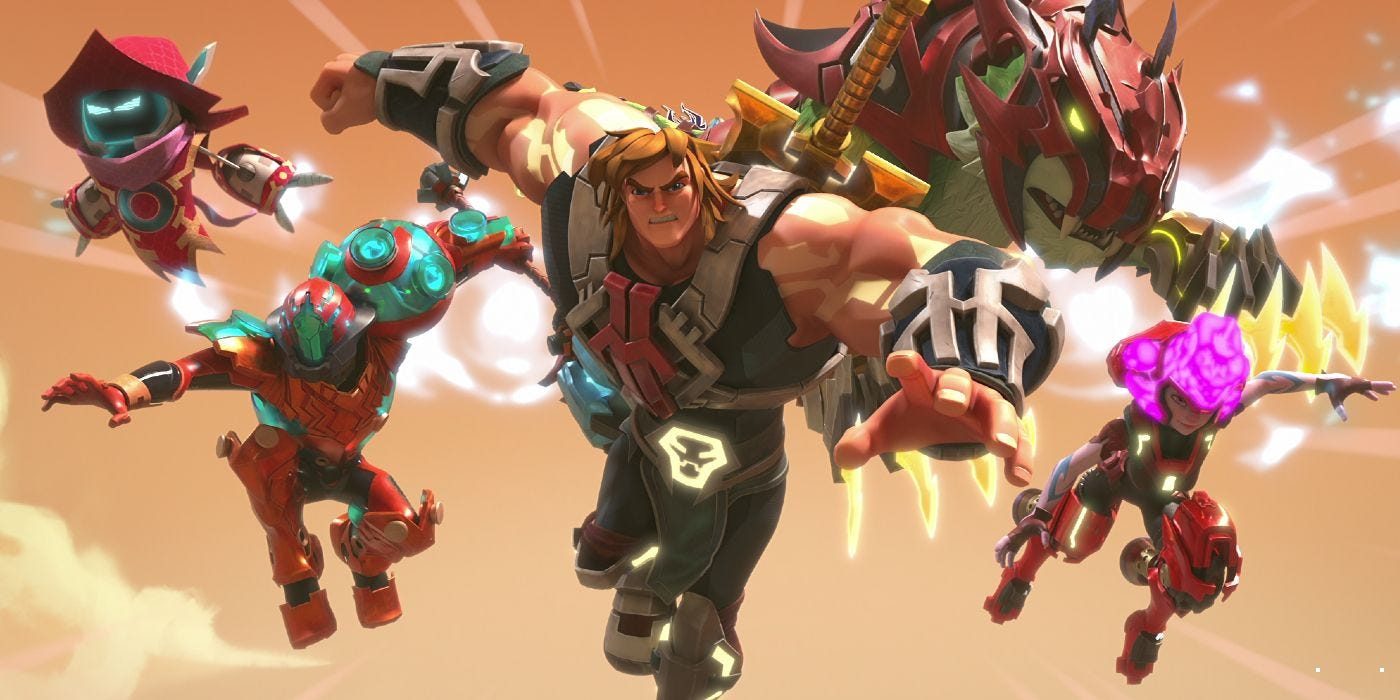
I don’t think it was just canonical deviations that resulted in low ratings for the computer-generated He-Man, I think marketing had a lot to do with it too. There was no real effort to differentiate it from other shows in the market that were out there at exactly the same time. It’s partially a case of “cannibalizing” a brand. I believe that the computer-generated He-Man and the Masters of the Universe was unpopular less because of its own deviations from canon, but because people thought it was the Kevin Smith series. They were both released at the same time, with different intended audiences, but most people I talk to don’t even know the computer-generated He-Man series exists. It’s too bad too, because it is significantly better than Kevin Smith’s version. I’m not just saying that because my friends Shawna and Julie Benson worked on the show. I’m saying it because it captured the wonder of the original in a new way. The changes to Cringer were really cool and having Yuri Lowenthal as Adam was fantastic.
It reminded me of the young reader novels that Games Workshop release for their Warhammer games. They didn’t do particularly well financially, but Cavan Scott and the other writers did a bang-up job on presenting the Warhammer Universe for a future generation. Cavan’s description of the Ultramarines arriving to fight Necrons, and thus saving the lives of our young adventurers, he described it as if the Emperor’s Angels were falling from the sky. It perfectly captured the propaganda of the setting. It lacked the irony of the games, but those are filled with Horus’ anti-imperial propaganda.
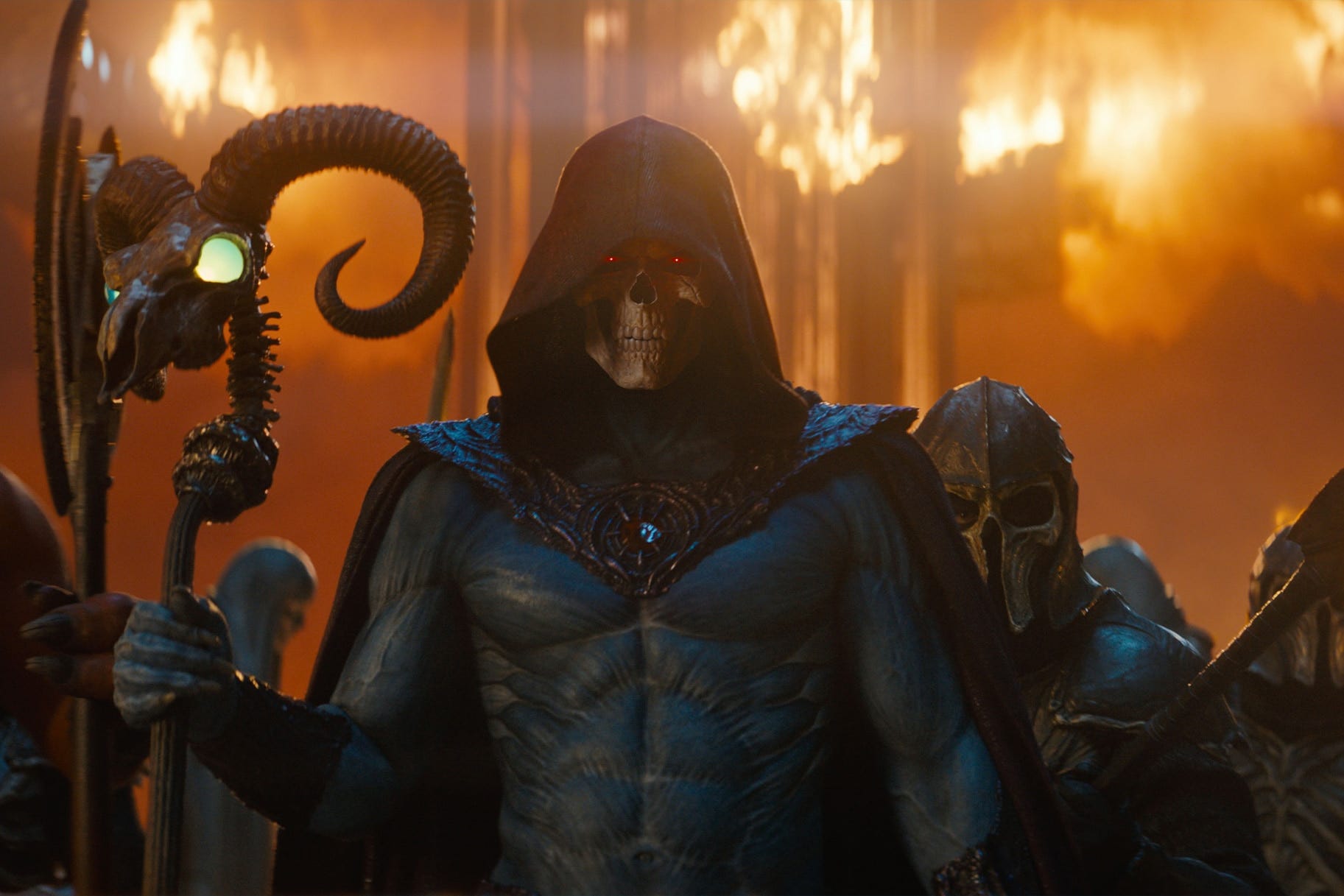
Enough of my own nostalgic wanderings. I’m here to promote Luke’s review of Masters of the Universe. The movie was a fun ride and Luke does a good job selling it.

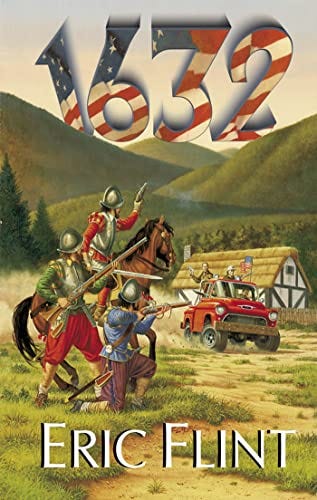
I’ve long been a fan of the 1632 (aka Ring of Fire) series of books by Eric Flint. In these books, the fictional town of Grantville, West Virginia (circa 2000) is shifted in time and space so that it is now located in the Thuringian Forest of 1631. As the townsfolk soon learn, they have been transported into the middle of the 30-Years War, and they use all of their wit and skills to survive and change the course of history. The books in the 1632 series are part of a long tradition of “fish out of water” tales that include some of my favorite stories ranging from Edgar Rice Burroughs’ A Princess of Mars and David Drake’s Redliners to Jerry Pournelle’s Janissaries series and Harry Turtledove’s The Misplaced Legion. All of these stories take people from one time and place and transport them into another to see how they would react and it is always interesting to see how and whether the people survive.
The End of Oak Street is more along the lines of the 1632 series than some of the other entries, in that it transports regular people from suburban tranquility into the violence of the Jurassic Era…before they’ve even had the chance to watch Jurassic Park. As Luke describes it in his review:
The premise that eventually kicks in is the sort of thing I might have come up with as a play scenario at age six or thereabouts: “Pretend our neighborhood is now back in dinosaur times!” It’s a fun idea that would let us kids imagine being chased by dinosaurs, or being dinosaurs and eating people, without the need, necessarily, for some grand explanation. I’m happy to say it makes movie dinosaurs fun again, which the Jurassic World franchise couldn’t even manage to do by adding Scarlett Johansson and Mahershala Ali.
As you can see, he’s given the film a positive review and I am eager to see it as a part of my Scary Movie Marathon this October. I normally have a two-month horror marathon, but my wife reminded me that our busy summer meant that we missed out on Christmas in July and if we only share one month of heartwarming syrupy sweet romance, we only get one month of frights. It was a fair trade this year. Our daughters started college this fall and we crammed in a lot of staycation goodness this year. I do have to say that I hope that the title isn’t too much of a double entendre. I would like the families, or at least most of them, to endure and adapt. I just rewatched Centurion and have experienced enough hopelessness and despair for the year.
I don’t mean to give Luke’s review of the most recent Resident Evil too much of a TL;DR summary, but his main argument is “If you tell the story from the video game, they will come.” It’s a tried and true formula that Hollywood seems to keep forgetting. Heck, even the first to profit from doing it forgot the lesson. When I first saw Paul W.S. Anderson’s (the initials are needed because of all the Paul Anderson’s making films) Mortal Kombat film, I was impressed. It wasn’t the best martial arts film I’d ever seen (at the time that was probably Drunken Master 2), but it was solid, fun, and followed the video game. That’s all I wanted and that’s what I got. In a world of Super Mario Bros. movies, it was Citizen Kane. Over time, Hollywood has made a lot more movies that were as loyal to the source material as Super Mario Bros. and far too few that were as close as Mortal Kombat.
It’s almost always a bad choice to re-imagine the source material. It’s true when adapting literature and it’s true of adapting video games. The core must be true to the source. Clueless adapts Emma, but the core is true and only the era has changed. Autumn de Wilde directed a visually stunning and era appropriate Emma in 2020 but gave us nose bleeds and introversion that pulled me out of the film. Great cast, visually beautiful, and a better adaptation of Amelie than Emma. The first two partially explain why it gets as much love as it does (it’s also well-acted and directed aside from the self-insert moments), but I think most of the praise is due to the fact that the late 2010s were a wasteland when it comes to good romances. So much for a brief intro to Luke’s review. Read it and enjoy.

Natalie Jackson has renamed her Substack to the more professional Stuck in the Middle since I first read her piece on Partisanship and Ideology. It used to be called Herding Cats and Polls, and I prefer that, but I understand the name change. The article (8 months old now) does a good job of presenting a phenomenon that political scientists have understood for some time now. People who we classify as “leaners” are far more partisan than those we classify as “moderate” voters. Normally on a left to right partisan distribution, you’ll see something like the following:
Strong Dem - Weak Dem - Lean Dem - Moderate - Lean Rep - Weak Rep - Strong Rep
The implication of such visualizations is that “Leaners” are more centrist than “Weak” partisans and that couldn’t be further from the truth. In a classic article from 1986, Keith, Magleby, Nelson, Orr, Westlye, and Wolfinger argued that leaners vote more like outright partisans. In case you are wondering, and I know you are, Raymond E. Wolfinger is the political scientist who coined the phrase “The Plural of Anecdote IS data.” That’s right, data IS the plural of anecdote and all the internet scientists who argue that it isn’t show a fundamental misunderstanding of data and the philosophy of science. Never mind that every experiment is an anecdote (in that it is a single example) and that meta-studies take these anecdotes and test to see if the anecdote is generalizable, Ericcson and Simon (1980) have a good rundown of how verbal reports are used as data. It’s a good thing that the plural of anecdote is data, otherwise all of public opinion research is Quatsch and Unsinn. Now, it is fine and true to argue that inducting from a single occurrence is bad causal inference. A single case proves nothing. That’s what the “Well Ackshually” Scientists mean, but that’s not what they are saying and what they are saying is wrong.
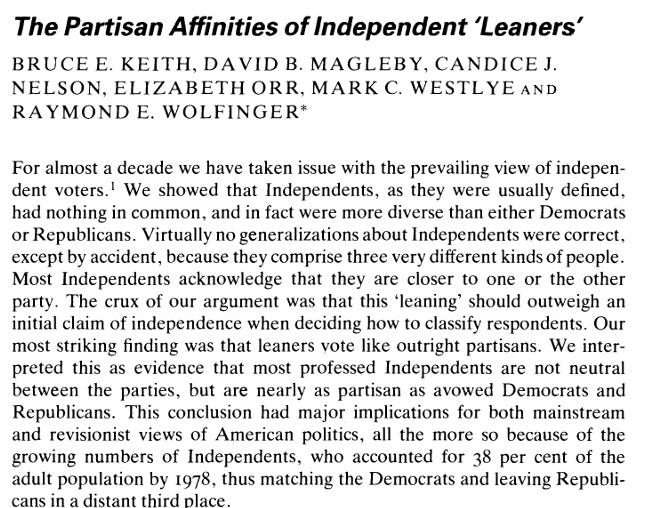
Anyway, Natalie Jackson’s excellent article is now hidden behind a paywall, and I weep for not sharing it sooner. She has some more recent articles about the current election and I recommend looking at how a pollster looks at elections. It’s a bit different from your typical pundit.

While he might disagree, I think that Rob Liefeld is one of the most important figures in the history of comic books. He is a seemingly endless font of ideas who created many of today’s most popular characters, but more importantly his participation as a founder in Image comics changed comics forever. Sure, there had been great indie titles before Image, but they were often resume builders before artists and writers made it to “the show” and worked for DC and Marvel. Image was an independent publisher that was launched by some of the biggest artists of the day and made independent publishing “the show.” He has never stopped advocating for creator rights and in a recent Robservations, he discussed the lawsuit Marvel brought against Jack “The King” Kirby. Rob is an artist who knows the business, not just the history and lore of the industry, but the ins and outs of the financials.

Joel J Miller wrote a wonderful horror short story a couple of weeks ago. By horror story, I mean he wrote an essay reminding us that tempus fugit and we don’t actually have time in our lives to read as many books as we might desire. Given that I subscribe to the Eco-ian/ist philosophy of having a personal library, I refuse to call it an “anti-library” when it is in fact a library, I’m not particularly panicked by the thought. It has, however, made me evaluate how I want to balance my actual reading time. This prompted me to buy a copy of Moby Dick (to actually read) and think about starting a parallel Substack where I discuss central works in political philosophy and political science. Too much of the “political” discourse in the modern era is wrapped up in what Daniel Boorstin called Pseudo-Events or without acknowledging what Walter Lippmann called our Pseudo-Environments and I think a discussion of the genuine classics of political philosophy and political science (with an Americanist focus) would be of some value.
I will be starting up the Substack soon, it will be called Politics: The Master Science, and I’ll be starting with a bit of Plato. I’ll post a link to the Substack in a future post, and all the articles will begin as Substack Live chats where you are invited to join in and contribute. Before we chat about the Plato though, make sure you check out these paragraphs from Plutarch’s Life of Alcibiades.
While still a stripling, he served as a soldier in the campaign of Potidaea,15 and had Socrates for his tent-mate and comrade in action. 3 A fierce battle took place, wherein both of them distinguished themselves; but when Alcibiades fell wounded, it was Socrates who stood over him and defended him, and with the most conspicuous bravery saved him, armour and all. The prize of valour fell to Socrates, of course, on the justest calculation; but the generals, owing to the high position of Alcibiades, were manifestly anxious to give him the glory of it. 195Socrates, therefore, wishing to increase his pupil’s honourable ambitions, led all the rest in bearing witness to his bravery, and in begging that the crown and the suit of armour be given to him.
4 On another occasion, in the rout of the Athenians which followed the battle of Delium,16 Alcibiades, on horseback, saw Socrates retreating on foot with a small company, and would not pass him by, but rode by his side and defended him, though the enemy were pressing them hard and slaying many. This, however, was a later incident. — Plutarch, The Life of Alcibiades
In my first, pre-chat, video I’ll give a poll asking what Plato we should start with, but we’ll definitely do The Republic, The Laws, and The Symposium as well as a couple of shorter works.

Boy oh boy is James M. Spahn producing a lot of very cool stuff right now. He’s got a Necromancy sourcebook out for Shadowdark, just in time for Halloween and he’s publishing some really nice printings of his White Box books. If you are looking to play some great “Folk D&D,” James’ books are the place to be.
There has been a great deal of talk over the years of what exactly the “OSR” movement in role playing games is and what OSR games are. James gives a very good rundown here in his James M. Spahn's RPG Musings. He discusses the difference between early OSR, which printed reference documents meant to substitute for/replace the old Basic/Expert, AD&D, and BECMI rulebooks. The books were out of print and Wizards of the Coast had removed many of them from digital reprinting, but the OGL (Open Game License) allowed people to reprint “just the rules” under legal protections that were clearer than the vague “rules cannot be copywritten” mantra. The mantra is true, as far as it goes, but specific expressions of rules can be copywritten and the OGL expanded what could be done. Since the old rule books were often expensive, OSRIC and other resources were a godsend for gamers who wanted to play older style games. It didn’t take long though, for these games to incorporate “Heartbreaker” changes making them their own games.
Speaking of OSR, Beau Rancourt has a discussion of his experiences running OSR games now that he’s playing 4e 2.0 (aka Draw Steel) with his group. Draw Steel is a fun game and is one of a number of games that were influenced by D&D 4e that I really enjoy. The others are 13th Age and Shadow of the Demon Lord. It’s a different play experience than the OSR experience, but they are compatible in play groups which is one of the reasons I keep playing around with my Heroes of Karameikos idea.

It’s Solo September and there is no better place to go for a look at solo and cooperative games than The Soloist - an indie RPG newsletter. It’s one of my favorite Substacks and I recommend checking out the games on offer.

Speaking of solo RPGs, I love reading a good rundown of a gaming experience and Jennifer M. Baldwin has a write up of her experience with the Pocket Fantasy RPG. It’s a nice read and I recommend following her Substack if you’ve got the time.
Okay, I am recommending a ton of stuff here, but I had to add Tom Grant from the Ancient Geeks Substack. He and his co-author Steven L. Taylor have been writing a number of articles on Gen X geek culture and last month Tom discussed the Dying Earth genre of fiction and SF fiction where Fantasy and Science Fiction are blended together. The genre is as old as Frankenstein, but hit its pinnacle with either Edgar Rice Burroughs’ Martian Tales or Jack Vance, depending on your preferences. Ancient Geeks is a definite must follow and I really have to try and schedule a chat with them at some point.

Donald Featherstone is one of the most important personalities in the history of gaming…period. He influenced roleplaying games and he is a cornerstone figure in miniature wargaming. Thomas over at Splendor of Fire has a nice rundown of Featherstone’s rules for the American War of Independence. Featherstone published a ton of rules in his lifetime and I still remember the first time I opened a copy of his book War Games and saw the words “Saving Throw” and realized that D&D really was a descendant of wargaming.

When she’s not adapting Shakespearian plays so that they can be performed on replicas of Sir Francis Drake’s famous ship, Rebekah King is writing libretti for Operas about fencing. When she’s not doing that, she’s writing one of the most engaging Substack newsletters on the platform Dr King's Curiosities. While she has some more recent posts, including one about her fall reading list, I found her recent article about the Game of Thrones play to be very engaging. I have a love/hate relationship with George R.R. Martin’s unfinished series. I started it when I was obsessed with edgy and dark fantasy and held the opinion that morally gray fiction was superior to morally forthright fiction…because…reasons. I have since grown out of my edgelord phase and have read more of the fiction and history he used as a foundation for his series and he pales in comparison. I’d rather read of the Winter King than about how Winter is Coming, in part because one actually happened and the other likely never will.
All that aside, the play sounds like fun and I enjoyed reading about how various technical aspects of production were handled. There really is a difference when you read a review written by someone who has actually made things, versus when they have only experienced them. You get “eine Gesamtkunstkritik,” rather than lazy plot rehashes. Dr. King’s review is definitely Gesamtkunstkritik.


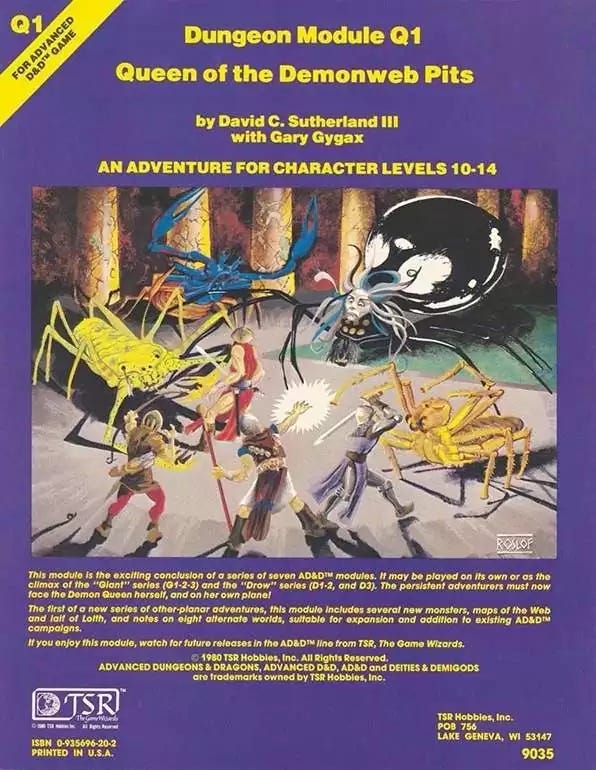
Queen of the Demonweb pits is a great example of how older D&D modules handled sequential adventures, campaign threats as characters gained levels, adventure themes, and what alignment really means in AD&D. It also includes both fantasy and science fictional elements, it’s a true depiction of Appendix N style storytelling.
The adventure marks the culmination of a conflict that started with giants attacking the lands of men, only for the heroes to discover they were doing so because they were being pushed out of their lands by Drow, and eventually battling those Drow and discovering a dimensional portal to the Demonweb Pits where their Goddess Lolth lives. According to Shannon Appelcline, Gary Gygax had initially intended the Drow to be worshipers of the Elder Elemental God, but by the time Dave Sutherland took over writing duties the Spider Queen had become the new big bad. The map of the Demonweb Pits, and the Goddess herself, are truly iconic and I highly recommend running this adventure at some point.

The Paradox has a new video where they perform their latest single, “That’s Not Fair.” Where most of their music has evoked the pop-punk sounds of bands like Bowling for Soup, this one has a dash of Black Flag and the hardcore seen. It still has pop-punk vibes in the chorus, but the rest of the song is pure Los Angeles 1979 and the band is waiting for their bassist to finish her final exam so they can go on tour.
When I wrote that The Paradox was channeling a bit of Black Flag, you were probably picturing something angry and filled with hatred of society and “The Man.” That’s not what I meant. I meant songs like TV Party, a song with so many pop culture references from the 70s Gen Z will need Claude to keep up.
Wagon Wheel is a song based on an unfinished song Bob Dylan wrote while composing songs for Pat Garrett and Billy the Kid. Ketch Secor of Old Crow Medicine Show added additional lyrics to the song 25 years later and the result is a fantastic song. For my money though, Darius Rucker of Hootie and the Blowfish does the best version of the song. It’s catchy and full of heart.
When my wife was in film school, one of her classmates made a short film inspired by T.S. Eliot’s poem The Hollow Men. The film was well shot and had a lot of interesting visual ideas and was clearly influenced by the films of David Lynch. To this day, my wife and I find ourselves quoting the young girl her classmate had read the poem because of how she pronounced the lines of the poem. Instead of a clearly articulated, “There are no eyes here” we heard a mournful “There are no Ys here.” Not “whys,” but “Ys.” We have come to think of the voiceover as a kind of haunting Lynchian Sesame Street episode. None of this is intentional, nor was it really there when we watched the film later. But when we were sitting in the editing bay, having not slept for 24 hours, listening to the voice over, that’s what we heard and imagined. As I wrote, the film was well shot and edited, but I prefer our imagined version better.
I only write all of that because I recently watched the Barnaby Clay directed Yeah, Yeah, Yeahs concert video Hidden in Pieces on Criterion Channel. I had to look twice to see if Jody’s classmate had directed the film. The style was spot on. Alas and alack, it was another person. All of which made me want to recommend a song by the band for this entry. I often find myself listening to Maps, but today it’s all about Zero.
I’ll leave of with a “how the hell did that happen” inspired video. The other day, I was playing a mix of YouTube music videos on our television and Duncan Sheik’s Barely Breathing came on. My wife and I, who are new empty nesters, found ourselves singing the song to each other and remembering our dating days. It was a wonderful moment of loving nostalgia. Duncan Sheik died the very next day. I know that these things are unrelated, but there have been so many deaths this year of people far too young. Sheik went on to write for Broadway, but his first hit is a banger and it’s mournful enough that it makes a good tribute.

This is a very long Rundown, so I’ll keep this short. I love “Spider” movies. Ever since I first saw Kingdom of the Spiders with William Shatner as a kid, I’ve been kind of obsessed with them and have watched everything from Tarantula to Eight Legged Freaks. All of them pale in comparison to Frank Marshall’s Arachnophobia. If you wonder what film both Madame Web and Morbius (it’s Morbin’ Time!) were ripping off with their jungle scenes, this is it.