A couple of years ago, I rekindled my interest in making a game inspired by the Moldvay/Cook Basic and Expert boxed sets for Dungeons & Dragons. I had been aching to do a game inspired by the excellent B/X rules that incorporated some of what I thought were the stronger elements of Fourth Edition Dungeons & Dragons. In particular, I wanted to bring in elements similar to the two Essentials player books (Heroes of the Fallen Lands and Heroes of the Forgotten Kingdoms) and the very thematic books that came after the Essentials launch (in particular Heroes of Shadow and Heroes of the Elemental Chaos). Eventually, work and my dissertation led to me petering out before I could really get into stride, but recent comments by someone I follow on Twitter about how running an OSR game for their group didn’t work out because of how most OSR games lacked cool abilities that set each character apart. That gamer’s lament reminded me that I was not alone in seeking a game that balanced new and old. The Essentials tier of 4th Edition had a lot of cool abilities that distinguished each character and if those are combined simplicity of B/X it could be something truly magical.
I discussed a lot of the original inspiration for the project in my “Combining New School and Old School” article, where I mention that one of the people who inspired me was George Strayton, who had worked on West End’s Star Wars role playing game. George was also a writer on Xena/Hercules for a period of time, I’ll have to ask him if he wrote before or after West End published the Xena/Hercules role playing game, as well as the Dragonlance animated movie. While I know that my love of that film is in the minority, the one thing I can assert with full confidence is that whatever the flaws of the film are it was written by someone who played a lot of D&D on Krynn.
Christian Lindke's Geekerati Newsletter is a reader-supported publication. To receive new posts and support my work, consider becoming a free or paid subscriber.
George was also the lead designer on the one Fantasy Heartbreaker project I worked on as a developer, The Secret Fire. The game was written expressly to be a Heartbreaker, though we hoped it would be a successful one, in that it evoked the narrative style of many of those that came before. Since it is a product of the self-publishing era, rather than the print a ton of books and lose money era, it isn’t truly a Heartbreaker since what led Ron Edwards to call them that was his lamenting over how much money people often lost in the production of the older games. That’s not the case with The Secret Fire, from which I will be borrowing a couple of ideas (since I contributed them), but the game never did catch on as much as I wish it had. Playing it, and playtesting it, was one helluva good time though because George is a fantastic DM.
In my second post on Heroes of Karameikos, I moved out of storytelling and justification mode and began to present both my basic philosophy and how I was going to treat character attributes in my B/X inspired game. Like James M. Spahn did with his upcoming Blades of Power game (back it on Kickstarter like I did), I am starting with B/X but know I’m going to end up somewhere very different. James talks about how he began with B/X and ended up making his own thing in an interview with Agranak Studios, and I imagine I’ll end up in an equally different place.
Anyway, the nuts and bolds of my second post were that I wanted to design a game that had defined roles, abilities that interact with each other and the environment, and to provide a feeling of being heroic while still having it feel like the characters are in danger. I wanted options, but I didn’t want an avalanche of powers, feats, and magic items that could turn character building and advancing into a spreadsheet. Fourth edition has options and choices, but B/X has archetypes and I believe if I use archetypes to frame options I can create something really interesting. A example of how I wanted the characters to feel heroic, but still vulnerable, was in my recommended attribute system. I recommended picking a class first, which empowers the player. After that, the player gets to roll 4d6 and pick the best three dice for ONLY their Prime Requisite attributes. That means that the characters are better than average at the things that fit their archetype, but are more than likely average everywhere else.
I also talked a bit about when and how characters can die, but hadn’t flushed that out mentally yet. In fact, I’m still working on that as I am writing this. I’ve got a few ideas I still want to try out…and convince you all to playtest. One thing I’ve been putting a lot of thought into is the skill system I want to use. One of the critiques of 4e was that it didn’t have rules for “role playing,” but I’ve already responded to that accusation when I wrote about how 3rd Edition brought in a lot of the feel of GURPS and Hero with a mechanics based mindset. In doing so, gamers who were used to “roll playing” where you roll to see if you persuade or find a secret door using a skill, thought that a game that minimized those all of a sudden didn’t have role playing elements when the exact opposite was true. That’s a discussion to return to another time though, in part because I really like GURPS, Hero, and 3rd Edition style roll playing.
Having done all of that other leg work though, it’s time to finally start putting together the underlying structure of the game. It’s time to present the foundation and my philosophical design pillars.
Opening the Door to the Four Pillars of Heroes of Karameikos
The purpose of this article is to we build the skeleton upon which all of my game design articles for Heroes of Karameikos will add layers of muscle. I want to lay out everything the basic class entries do. What are the primary roles for the Fighter, Thief, Magic-User, and Cleric. How does this change when I eventually bring in the Elf that is several classes combined? While I may have written about how abilities work in the last entry, this is where the true work begins and I’ll be covering several topics. I want to provide the design pillars, add a small handful of universal rules that produce the 4e feel, give a brief overview of what full character-creation will look like, and provide a template for every class article that will follow.
I’m want to make one promise right up front though. I want to make sure that the B/X rules I love stay B/X. I am keeping descending Armor Class, the attack matrix, race-as-class, Lawful/Neutral/Chaotic, and the prime-requisite XP bonus. I am not throwing any of that out. The new-school feel comes from a thin layer added on top, not from rewriting the engine underneath. I want to be clear. The 4e additions are going to be chrome adding to the game, but not overwhelming it. The key is to keep it simple and allow for fast and fun gaming experiences. If you want furious, you’ll have to play Savage Worlds.
The Four Pillars
Everything in this game answers to four core design pillars. When I wonder if a rule is should be included or not, these pillars are how I will break the tie and decide.
1. Old bones, new muscle. The B/X engine is the engine. I will add muscle. I’ll clarify roles, add signature maneuvers, a provide a new survival mechanic, but I won’t replace the skeleton. If a thing already works in Moldvay (it I think most usually do), it stays.
2. Everyone has a role. This is the heart of the 4e feel. Every character has a clear job in a fight. That version of D&D used the language of Massive Multiplayer RPGs to describe the roles (Defender, Striker, Controller, or Leader), but those were already there under different concepts from the table top days. We either called them different things like “meat shield” or had yet to fully classify them in D&D terms, though Champions by Hero games moved a long way towards creating official definitions with things like Brick and Blaster. I want to use these newer definitions of roles because they are easy for non-table top gamers to understand, they allow for me to create different archetypes within the four classes (something Daggerheart does too), and I want to make sure that the things characters do make the party better, not just the individual characters. It’s the kind of balance that Dr. J. Eric Holmes, author of the original Basic Set, argued that D&D used to create meaningful play experience in his book Fantasy Role Playing Games. He argued that a “balanced” party wasn’t one where everyone was just as powerful as everyone else, rather that every character filled a role. The four core B/X classes already embody the four roles almost perfectly, though I’ll be tweaking here and there and creating different roles within the classes. Using these “roles” mostly just renaming concepts that have been there form the beginning and sharpening them.
3. Heroic but mortal. I want the survivability of High Fantasy without removing the teeth of Sword & Sorcery. My favorite setting, Mystara, has steam-powered gnome zeppelins AND gritty back alley executions. The player characters in Mystara are not 0 level characters going through a Dungeon Crawl Classics funnel, they are something more. A wizard dying in a fight with a common house cat due to a graze feels wrong for that world. So characters will get a little more cushion, but death is still on the table and bad luck still bites. I also want a mechanic that stays relatively flat in its benefit across levels in a narratively interesting way.
4. Archetypes over algebra. This is the Essentials lesson. A player should make a few evocative choices and then go play, not optimize a build across forty splatbooks. Classes get a small number of strong, flavorful options. I want archetypes instead of feat trees. I don’t want players to have to pour through books every level in order to go power shopping. If you can’t fit a class on a couple of pages, it’s too complicated. If players want more options, then design classes that fit them. Kind of like I’ve done with my Swashbuckler, and other, classes for B/X already.
The Skeleton: Five Rules that Provide the Foundation
I want to keep the old school as much as possible, so here’s the entire “new-school” layer in five easy pieces. Five rules. That’s it. Read them once and the class entries will make sense immediately.
Rule 1 — Roles
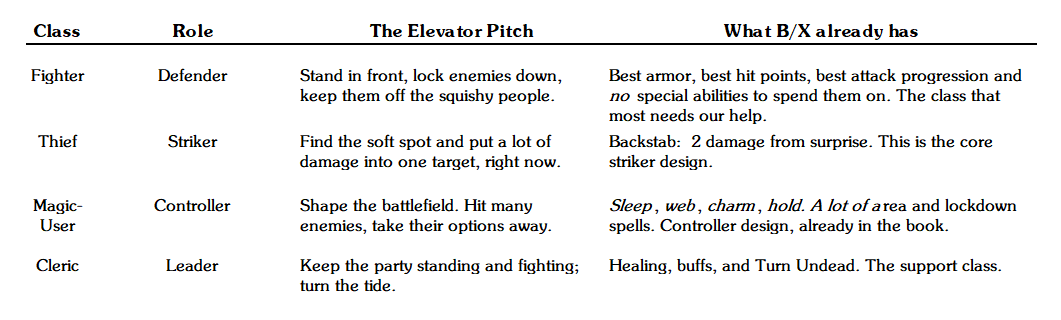
Every class has a role, and the role tells you what your abilities are for. The four core classes as presented in Basic and Expert line up like this. It is important to note that these are as presented in B/X and not the later BECMI. Fighters in BECMI eventually get multiple attacks, that never happens in B/X… which adds to the critique the group I read about on Twitter gave. I want to do a version of this game based on BECMI later, but for right now I want to stick as close to B/X as possible.
Notice what this isn’t. This is not four new subsystems. I am merely doing a quick breakdown of the classes using the “role” lens. Looking at them briefly, I think that the Fighter is the only class that needs genuinely new toys in order to make modern gamers feel they have options. Yes, they can pick different weapons and armor, and those choices matter, but that’s still more limited than a lot of modern gamers like. The baseline in Moldvay is that fighters “have no special abilities” and I want to shift that a little. Everyone else mostly needs their existing kit framed as a role and given one signature interaction. That signature interaction is what makes each new archetype (combining class and role) feel a little different. In my first pass, each class entry will define exactly one of them. As I expand design, I might add new signature interactions to each role, but most archetypes will only get one…even when we are talking about race as class cases like the Elf.
Defender → Mark. When you mark an enemy, it’s worse at attacking anyone but you, and you get to punish it for trying.
Striker → Quarry. Pick a target and you do more damage to it under the right conditions (backstab, generalized).
Controller → Hinder. Your area effects don’t just damage the opposition. They also impose conditions and shape the battlefield. I want a little bit more than Breach, Sleep, and Clear to happen for these roles, but that combination is iconic and will remain. We all love kicking open the door (breaching), using Sleep, and clearing (murking the gobbos) Rainbow Six style.
Leader → Inspire. You can hand out your healing and your luck to your allies. You can increase the morale of retainers and followers on a temporary basis.
We’ll define the way the signature interactions work precisely in the corresponding class entry. For now, just know that “role” is a real, mechanical thing here, not flavor text.
I want a couple of rules that increase survivability and extends adventuring beyond the single encounter workday at first level. Breach, Sleep, and Clear only happens once a day when you are starting and characters can get hurt in combat. I have lifted from 4e and tuned to make Constitution matter for every class (Pillar 3, and remember: no dump stats).
Second Wind. You can catch your second wind a number of times per day equal to 1 + your Constitution modifier (minimum 1, maximum once per encounter).
You may take an action on your turn to catch your second wind. You regain hit points equal to one roll of your Hit Die Type + your Constitution modifier (minimum 1), and you gain +2 to Armor Class until the start of your next turn as you guard and recover.
I am considering limiting this to just defender archetypes, but it does two things that I might want every class to benefit from. First, it gives every character a self-rescue button, so one unlucky round doesn’t end someone’s day. Second, it turns Constitution into the survival stat for everyone. The high-Con Fighter is a rock, and the low-Con Magic User gets some benefit from it but can’t lean on it. That’s exactly the “every attribute matters” texture B/X is quietly famous for and it provides a real benefit to the lucky Magic User who has a high Con.
This isn’t too far removed from the Basic OSR design. Moldvay Basic already prints an optional survival rule on page B6 where you reroll a 1 or 2 for first-level hit points. I’m just being more generous about it and besides taking an action to roll 1d4 plus Constitution modifier isn’t game breaking at low levels and it doesn’t scale upward. It’s only a single die worth of recovery. At higher levels, this isn’t even a round of attacks from a monster but it makes a big difference at lower levels.
Rule 3 — Dying and Death
In B/X you die at 0 hit points. Sure, the module Keep on the Borderlands says that you can allow your players’ characters to be merely captured at this level, but the baseline is “above 0 = alive and fully healthy and zero and below = dead.” That’s really stark. I move the goalposts a little, but we keep the danger closer to old-school by leaning on a number already in the rules. Instead of having a death save be a 55% likely sucess like in 4e and 5e, a character makes a saving throw vs. Death Ray or Poison. I tie the death save to the iconic “am I about to die?” save.
Dying. At 0 hit points you fall Dying. You are unconscious and helpless. You are not dead until you take damage equal to your Constitution score, below zero (a Constitution 13 character dies at −13). Any single blow that drops you past that threshold kills you outright.
Death Saves. At the start of each of your turns while Dying, make a saving throw vs. Death Ray or Poison.
Failure: you die.
Success: you cling to life, but you are not safe. Roll again at the start of your next turn, and every turn after, until you are healed or stabilized.
Natural 20: a surge of will. Spend a Second Wind, if you have one, and act normally this turn. If not, you stabilize and are unconscious.
Any healing ends the Dying condition and restores you to the hit points healed. An ally can also stabilize you with an ability like a cure spell, a Leader’s Inspire (see the Cleric later), or a successful Heal knack. This ends the need to roll. If you went below 0 hp, and the healing roll only increases you up to 0 hp or less, you remain unconscious at 0 hp until healed or the fight ends.
This shift of the 4e/5e death save does three jobs at once. It reuses an existing B/X saving throw instead of inventing a death save table or using the overly kind death save rules from modern editions (Pillar 1). It’s class-flavored. The sturdy classes (Cleric, Dwarf, Halfling) have the best Death Ray/Poison saves and cling to life longest, while the Magic-User who has the worst save and fewest hit points really should not be lying on the floor.The rule also scales the way I want. At 1st level your save target is 10–13, so an unaided dying character is on a roughly two-round clock and the party’s Leader had better hurry. As your save improves across the levels, veterans cling to life far more reliably, but they are still vulnerable to death from monsters because monsters do larger amounts of damage. Higher level characters die because of the one catastrophic blow that punches past their Constitution buffer and not to a goblin’s lucky scratch. Lower level characters, who fight monsters who do less damage, die from the scratch more than the catastrophic. The static negative Constitution cushion quietly shrinks in importance as monster damage climbs. It is generous exactly when you need it at low level, but no longer much of a net once the dragons come out. Just like the second wind rule.
Rule 4 — Skills, In Brief (full system later)
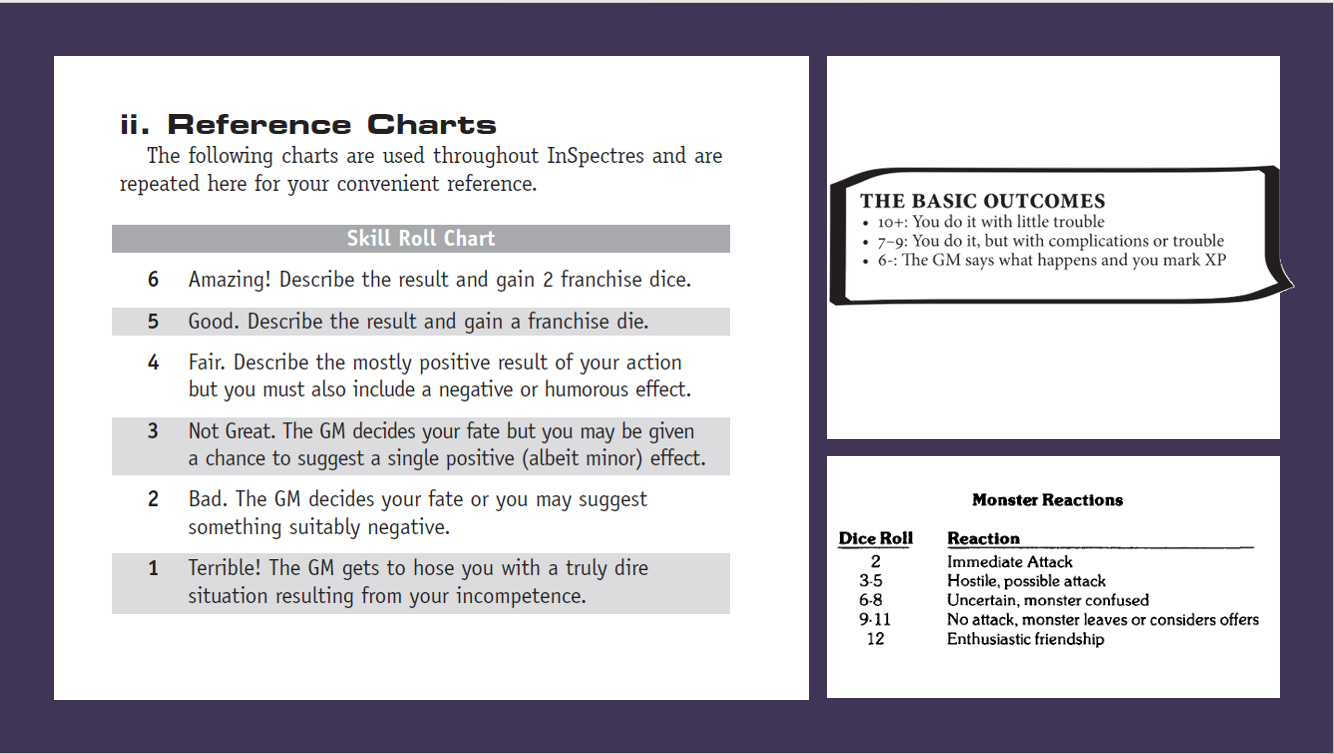
The second post in the series (the first with any mechanics) promised a skill system, and I am working on those, but I’ll be presenting the classes before the skills and combat articles so I want to give you a glimpse of what I am thinking. I’ve made another “informed by the modern” choice here that, more than any of the other choices, shifts whether this game feels like one more retroclone or like its own thing. At first, it’s going to look a little like Inspectres, or Powered by the Apocalypse, but then you’ll see it’s really B/X inspired.
I do not want to use the common roll a d20 under an ability score for skills. Instead, I’d like to roll 2d6.
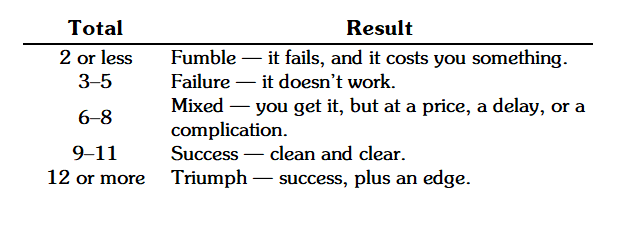
The Skill Roll. To attempt something uncertain, roll 2d6, add the modifier of the governing ability (−3 to +3), and add any knack bonus from your class if you’re trained. Read the total on the table:
Difficulty shifts the roll: Easy +2 · Moderate +0 · Hard −2 · Brutal −4.
If that table looks familiar, it should. These are the exact breakpoints of the B/X reaction roll (2 / 3–5 / 6–8 / 9–11 / 12). The reaction die, the morale die, the loyalty die all use these. B/X has a resolution mechanic for a lot of uncertain human outcomes using 2d6. All I am doing is making this same table more universal in practice so that it applies to skills as well. This isn’t a mechanic imported from InSpectres, Dungeon World or the Powered by the Apocalypse family. It’s the reaction die B/X has used since 1981, promoted to full system integration. The bell curve does more than what a d20 can. It centers outcomes on the mixed result without needing a huge range of numbers. So the interesting answer (”yes, but…”) is the most common one, and a single point of modifier has massive effects rather than being a 5% a rounding error.
Two more things fall out of it, both of them features rather than flaws. The roll is roll-high-is-good, matching your attacks and saves instead of inverting them. And the math is flat across levels. In this case the modifiers come from abilities and training, not from a level-scaling table that cancels itself out. This explains how 0-level carpenters can be masters of their craft and doesn’t require every NPC to be superhuman just to do their job. That’s the same anti-treadmill instinct behind the whole project. It also pairs naturally with the one-tier B/X narrative frame. B/X characters don’t go from gongfarmer to gods like they can in BECMI or 3.x. They always remain vulnerable. So for this system, the difficulty axis is just Easy / Moderate / Hard (Brutal for the truly desperate). Anything beyond what 4e calls Heroic scale simply isn’t a thing mortals do in this game. (The eventual BECMI variant, climbing to level 36, will likely layer the Heroic/Paragon/Epic tiers back on, because across that range the narrative arc genuinely changes from gongfarmer to god. For B/X, one axis is plenty.)
How a knack plugs in. Knacks are what I am calling skills in this rules set, because I like the sound of a player saying “I have a Knack for that.” Knacks are written using GAZ1’s own Skill (Ability) notation, so you’ll see things like Knowledge of City Guard Tactics (Int), Riding (Dex), Persuasion (Cha). The ability in the parentheses tells you which modifier to add. Being trained in the knack adds a flat +2 on top (a number we’ll tune in play because that might be too much of a benefit). If you have no knack for the task, you roll anyway, raw 2d6 plus the bare ability modifier, because in this game, as in Moldvay’s, there is always a chance. Each class grants a few knacks, and each character’s background grants a couple more. The Thief’s percentile skills survive intact as that class’s signature kit, untouched by all of this because I genuinely like that B/X is a game of multiple subsystems.
Rule 5 — Encounters and Exploits
Finally, we get to the 4e’s “cool thing every fight” mechanical feel without 4e’s binder of powers.
In my game, most of what a class does is at-will. Characters have basic attacks and might have a stance they adopt or the ability to use a role’s signature interaction. On top of that, each class gets a small number of Exploits. These are stronger maneuvers you can pull once per encounter (martial classes) or that cost a spell slot (casters). Following from Robert Schwalb’s article on formatting and his formatting template, I might just make this 3 times a day or 1 + Prime Requisite Bonus a Day, but I’m not sure yet. I discussed this dilemma last year.
“Once per encounter” is the resource that paces the cool benefits. Players want things like disarm, rallying shouts, and perfect backstabs, and an encounter is a good pace for that, but so is an x # of times per day mechanic and that might feel more old school and less 4e. One benefit to once per encounter is that so there’s no new bookkeeping. A typical low-level character in my game will have one stance and one or two exploits. I’m basing that on the Essentials presentation of 4e, which simplified things so that classes had a few pieces, all of them good, and didn’t need a spreadsheet.
Okay, that’s the skeleton. Now let’s build someone.
Making a Character
Making a character takes about ten steps. If you’ve made a B/X character, eight of these are from the earlier rulebook, but the new-school flavor is concentrated in Steps 1, 2, and 4.
Step 1 — Choose your class, and meet your role. Pick from Fighter (Defender), Thief (Striker), Magic-User (Controller), or Cleric (Leader). The first classes offered with be those combinations, but later classes will mix class and role to interesting effects. Players choosing first means they know which ability score to favor before they roll and players know your job within the party.
Step 2 — Roll your abilities. Roll 4d6, drop the lowest die, for your class’s prime requisite. Roll 3d6 in order for the other five abilities. If your class has two prime requisites (the Elf will), choose which one gets the 4d6 roll and the other is rolled straight 3d6 in order. This nudges you toward being good at the thing your archetype is about, while keeping you pleasantly average everywhere else.
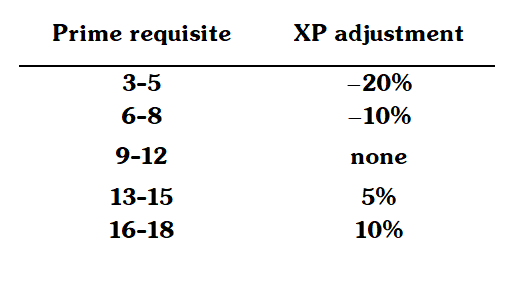
Step 3 — Note your prime-requisite XP bonus. Unchanged from B/X:
The 4d6 roll in Step 2 exists partly to make this bonus more likely. Heroes should feel a little better than everyone else.
Step 4 — Roll hit points (with a heroic floor). Roll your class Hit Die and add your Constitution modifier (minimum 1 per die). At 1st level, take the maximum die result instead of rolling. First level is where B/X is cruelest, and a maxed first die is my preferred fix. If you prefer to roll, you can use the Basic book’s own option and reroll any 1 or 2. Your table, your call.
Step 5 — Set your Second Wind. Your Second Wind heals one Hit Die + Con modifier, and you have 1 + Con modifier uses per day (minimum 1). Write the value down and change it if your Con modifier ever changes due to magic.
Step 6 — Armor Class. Buy armor in Step 9, then read AC off the B/X armor table as normal (descending: lower is better). If your table prefers ascending AC, convert with Ascending AC = 19 − Descending AC, and “to hit” becomes “roll d20 + bonuses ≥ target’s ascending AC.” Both produce identical results. I default to descending because I want to pay homage to the original rules.
Step 7 — Attack and saving throws. Use the B/X Character Attacks table and the Saving Throws table for your class and level. Nothing changes here.
Step 8 — Pick a background. Choose a heritage. For Karameikos this will be Traladaran, Thyatian, or a demihuman people. Your heritage grants a language and one knack (a trained skill like fishing because a fisher knows rivers and weather where a Thyatian gentry-child knows letters and heraldry). Pick one more knack that fits your character’s history. These are your first entries in the skill system, and they’re the seeds of who this person is in the Grand Duchy.
Step 9 — Buy equipment. Roll 3d6 × 10 gold and shop the B/X equipment lists. Armor, weapons, torches, iron rations, a ten-foot pole. Don’t forget that ten-foot pole.
Step 10 — Alignment and name. Law, Neutral, or Chaos. Then name your hero. You’re done, and you should be able to do it in about the time it takes to make a Moldvay character.
The Class Template
So that the class entries stay consistent (and stay short), each one follows the same template. Here’s the outline, so you know what’s coming when the Fighter and Cleric arrive next entry:
Role & Tagline — Defender/Striker/Controller/Leader, and the one-line description.
Prime Requisite(s) — what gets the 4d6 roll.
The B/X Core — Hit Die, allowed armor and weapons, save category, the XP/level table.
Role Feature — the signature interaction (Mark, Quarry, Hinder, or Inspire), with mechanical specifics.
Stance — an at-will choice that’s always on in an encounter after the player activates it.
Exploits — the small set of once-per-encounter maneuvers (or spell-fueled tricks), gained as you level.
Knacks — the class’s trained skills.
Progression — what you get at each level, at a glance.
The game will start with four classes and four roles that use this template, but we already have the option for 16 classes by combining class and role. A party with one of each should feel like a 4e party while playing like a basic party. You’ll have the Defender holding the line, the Striker deleting a threat, the Controller bending the room, and the Leader keeping everyone upright. All with rules that play fast, are lethal-enough, and can be learned in an evening.
Next: The Fighter and the Cleric
I am starting with the Fighter in the first class article because it’s the class B/X left empty-handed without special abilities. This gives me the best opportunity to give a clean demonstration of my whole method. I’ll take the bare-bones Basic fighter and turn it into a proper Defender with a Mark, a stance or two, and a couple of exploits and I won’t alter the underlying mechanics significantly. If the Fighter works, the rest is downhill, because the other three classes are already better fits with the core roles.
Please tell me where I’ve got it wrong in your opinion. What would you change? The survivability dial in particular with maxxed first-level HP, Second Wind capped by Constitution, and dying at negative-Con is the one knob I’m most willing to dial down to more lethal or at least provide options. So if it feels too soft or too generous for the game you want to run, now’s the moment to say so.
Christian Lindke's Geekerati Newsletter is a reader-supported publication. To receive new posts and support my work, consider becoming a free or paid subscriber.








This is awesome. Thank you.
I always leave my stance in default mode in my own bx house rules rarely thinking to use the different ones.