


Winter Solstice and Advent are the perfect time to talk about Elves in their mythic and role playing incarnations. A little more than a year ago, I wrote the first article in what I have always wanted to be a series of articles that asks questions about Elves in fantasy role playing and about Dungeons & Dragons Elves in particular (link to White Box OD&D version). The first article was a relatively deep examination of why Elves might be immune to the paralysis ability of Ghouls and I’m pretty fond of that article.

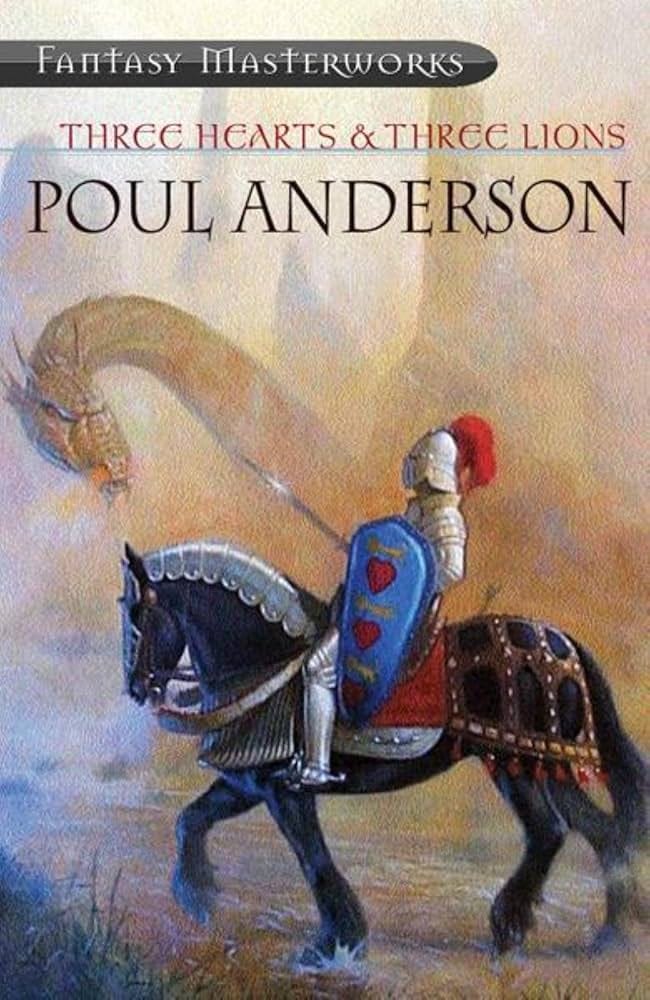
Shortly after writing that article, I was engaging in one of my annual re-reads of Poul Anderson’s fantasy masterpiece Three Hearts and Three Lions. The book is easily one of my favorite fantasy tales and it was also one of the stories that inspired the Paladin class (my favorite class) in Dungeons & Dragons. I would say “the story,” but one must always keep in mind the Grail Knights when thinking of the Paladin. I know, I know, you are saying, “But The Matter of France and the Chanson de Roland!” That’s true, but Three Hearts and Three Lions is inspired by The Matter of France, with a dash of Germanic pagan folklore, so mentioning both seems a bit redundant except as historic background for discussing Three Hearts and Three Lions.
In Three Hearts and Three Lions, Poul Anderson tells us the tale of a resistance fighter in WW II Denmark named Holger Carlson. At some point during the fog of war Holger is transported from the Denmark of our world and into one that borders on the lands of Faerie and Chaos. Holger is no longer a mere resistance fighter, but one of the Paladins of Charlemagne’s circle…Ogier (Holger) the Dane. While Holger fought alongside Roland, in the service of Charlemagne, Anderson is drawing on the more Arthurian aspects of the Dane’s tale which states that in a time of Denmark’s greatest need Holger will awaken from his sleep to defend the people of Denmark from a great evil.

As an aside, I keep finding myself wanting to write Ogier (the French version) instead of Holger (the Danish one). I’ll have to institute an “anti-Arminius” rule in my headcanon to make sure that I use the Danish in this case because I am talking about a tale that uses the Danish version and not the French one. I say “anti-Arminius” rule because I tend to refer to Arminius using the Latin version of his name when discussing the Battle of Teutoberg Forest. Arminius is referred to as Hermann in Germany, but was called Arminius by the Romans and most versions of his story (outside the fun German TV series Barbarians) call him Arminius.
Since Poul Anderson is telling the story from a Danish position and has named the character Holger, and because he wrote a good number of stories about Danish lore, I’ll use the name Holger for the rest of this relatively brief think piece.
Having found himself transported to a version of Denmark that borders the Kingdom of the Fae, Holger also discovers that he is the living embodiment of Holger the Dane and that it is his holy duty to fight against the forces of Chaos in defense of Law. This distinction between Law and Chaos, along with a similar one in The Dark World by Henry Kuttner (and likely C.L. Moore), was very influential to both Dungeons & Dragons and Michael Moorcock in their depictions of the struggle between Law and Chaos. Ganelon, the villain/hero of The Dark World, is named after the knight who betrayed Charlemagne’s Paladins so those novels are connected in more ways than one. The Dark World was initially published in the July 1946 issue of Startling Stories and Three Hearts and Three Lions was originally published in the September and October issues of The Magazine of Fantasy and Science Fiction in 1953.
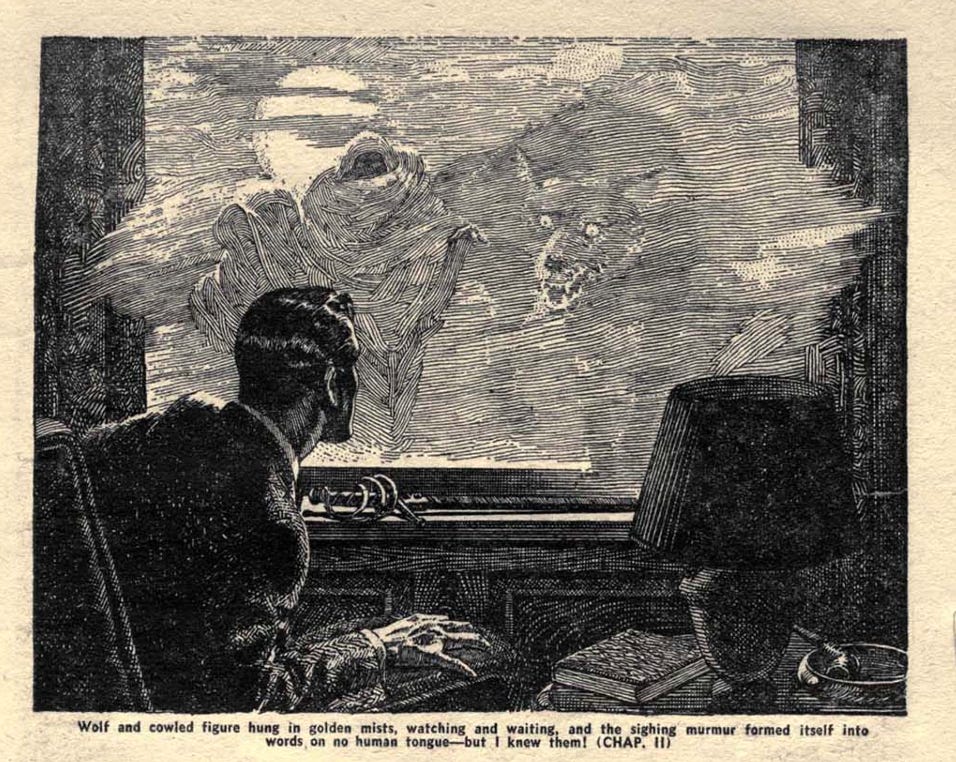
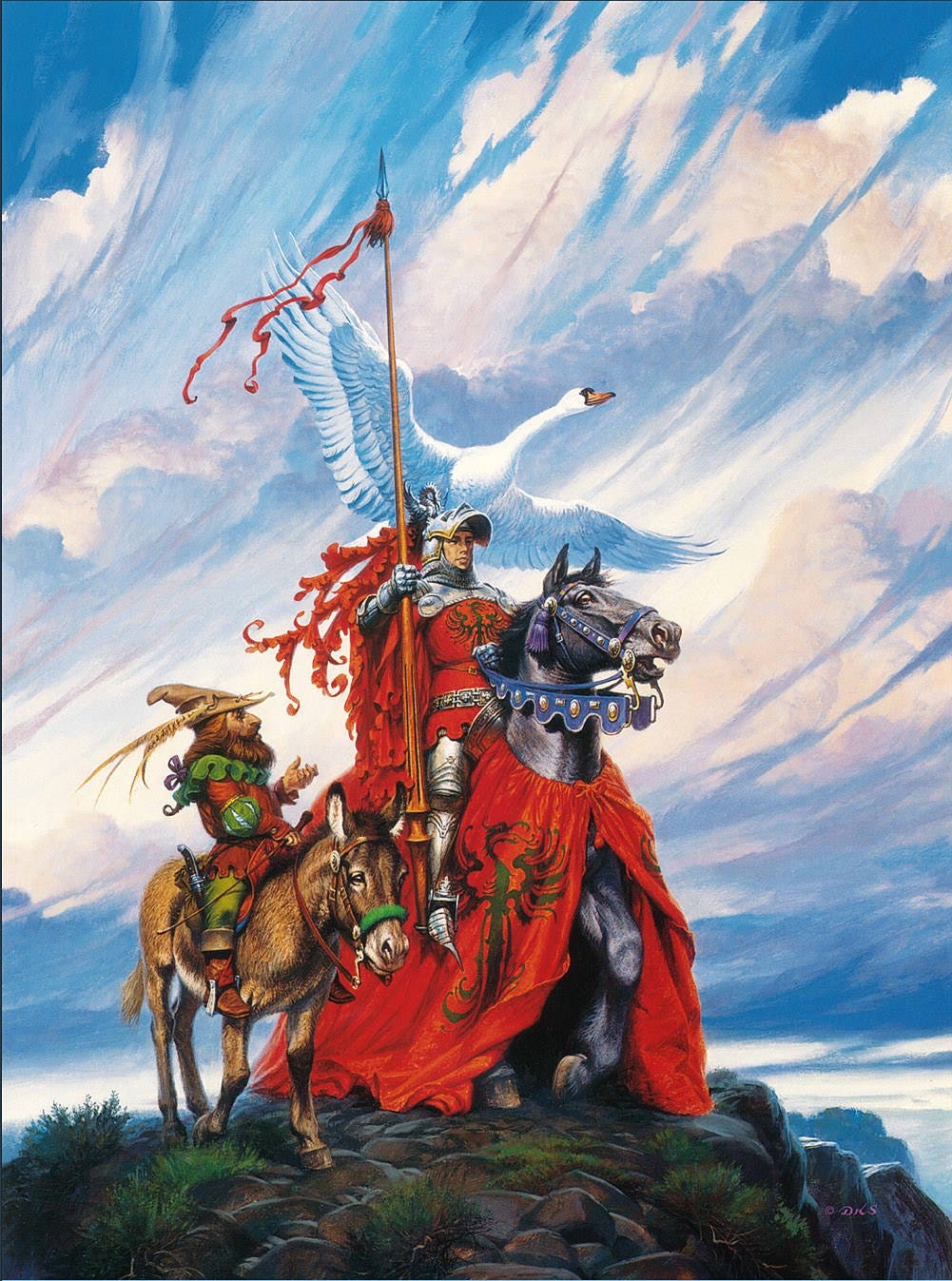
The conflict between Law (Christendom) and Chaos (Faerie and the Forces of Hell) parallel’s the conflict between Western Europe and the Nazis in Three Hearts and Three Lions and given Hitler’s obsession with Germanic legends and the Occult, it seems to me a perfect parallel. It should be noted that the Faerie in Three Hearts and Three Lions aren’t the worst of Chaos, they are soldiers who exist on the edge of Chaos but they are creatures of Chaos regardless. As with Anderson’s depiction of Faerie in The Broken Sword (which is more deeply rooted in just Viking lore), the Elves are morally complex creatures that can be sinister or sympathetic and in Three Hearts and Three Lions, two of Holger’s companions are not purely of Law. Both Hugi the Dwarf and Alianora the Swan Maiden (she’s the Swan in the image above) are creatures of neither Law nor Chaos. They are also Holger’s best friends, and in the case of Alianora the romantic interest, in the story.1
Early in the novel, Holger finds that he must have a discussion with a Faerie Lord and he is given some advice by his woods dwarf companion Hugi:
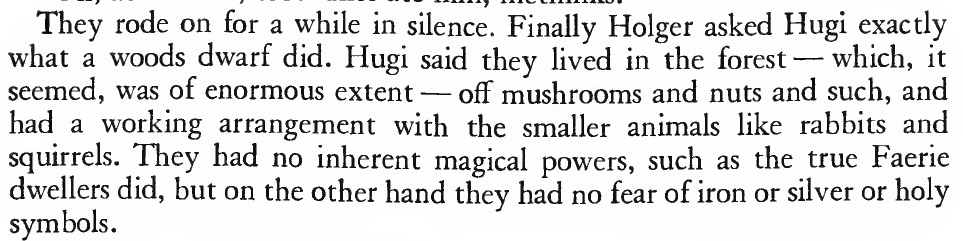

This interaction, and the fact that Holger is the inspiration for the D&D Paladin, got me to wondering whether Elves in D&D (or at least in my setting) should be able to be turned by Clerics of Law. I think the answer would depend on the Alignment of the Cleric and the Alignment of Elves in the game, but I think if I was to adopt Anderson’s Elves and the Elves of Pagan myths then the answer would have to be Yes.
I’ll write a post later about what Alignment means to me and how it differs from how it evolved over time, a fact that I mostly blame Steven Marsh for because he added the Good/Evil axis to Alignment and added moral alignment to the equation and took away the “Cosmic Battle” element.
What are your thoughts? Should Elves be able to be turned by Clerics?
Yes, this is where Neil Gaiman likely got the name for the character in Sandman. Gaiman borrows all the time.
This is an excellent idea. You may also want to read (or skim) Margaret St. Clair's "The Shadow People" which is also an Appendix N story. The Elves are not nice guys. Gygax was being generous in Chainmail when he categorized them as Neutral with Lawful tendencies more akin to Tolkien's elves than traditional faery folk.
I am also a fan of 3H&3L, and of CL Moore, though I have not read THE DARK WORLD.
https://randallhayes.substack.com/p/q-and-a-with-allan-liska-cyber-security
I know Ganelon is a bad guy but I mostly remember the name from Zelazny's AMBER series.
I love the idea of turning Elves, but then you'd have to apply it to Goblins and Trolls and Giants and basically every creature of Chaos, wouldn't you?