


An Old Post Revisited
I’ve been at this Substack thing for a while now and my audience has grown significantly. It hasn’t grown as fast or as large as any of the outrage mongers who have migrated here from other spaces and begun to affect the writings of so many voices here in what was a largely collegial discursive space (including some I really care about and read). I still curate and write for collegiality, but with that comes a lack of virality and profit sharing. Such is life, but while my space may lack the topicality and rage that is so popular I believe it will better stand the test of time. Speaking of time, lately I’ve been reading a lot of posts by writers like P. J. (Connor) Hoover at Turn to Page..., older articles by Patrick Buechner at The Soloist - an indie RPG newsletter, and a number of other solo gamebook and rpg authors lately (more will be mentioned later in the piece).
All of this reading got me thinking about a piece I wrote early in my Substack days, back when I had only 25 subscribers (thank you all). It was a brief essay talking about my first “real” experience playing a roleplaying game. That experience shares a bit with what P.J., Patrick, and others write about, so I thought I’d share my experience in an updated article.
RPGs Don’t Require a Group to Be Fun
My very first experience with roleplaying games was a session of Dungeons & Dragons in which I experienced the full horror of a certain kind of bullying DM. I have discussed that experience in the past and will update it with some of the lessons it taught me about how to DM in the next couple of months. That experience was truly awful, but at least the memory of it resulted in me having ample material when I was hired to write a piece for The Munchkin Book. Needless to say, the most recent D&D movie featured a creature that induced flashbacks to that dreaded first game and not from the creature you are probably imagining.
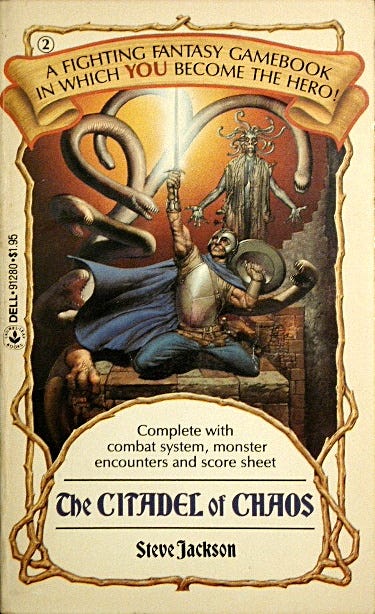
That horrible Dungeons & Dragons experience wasn’t my first “real” experience with roleplaying games. It was my first “group” experience to be sure, but it was such a bad experience and so unreflective of the hobby that I don’t think of it as my “real” first experience. The honor of first “real” experience goes to Citadel of Chaos by Steve Jackson. This is Games Workshop’s Steve Jackson, and not the Steve Jackson of Steve Jackson Games, though Steve Jackson Games’ Steve Jackson did write (also discussed here) the Scorpion Swamp adventure. The dual Jacksons Steve isn’t confusing at all, especially now that Steve Jackson Games is republishing all the Fighting Fantasy Gamebooks and even has a Satanic Panic post up about them today.
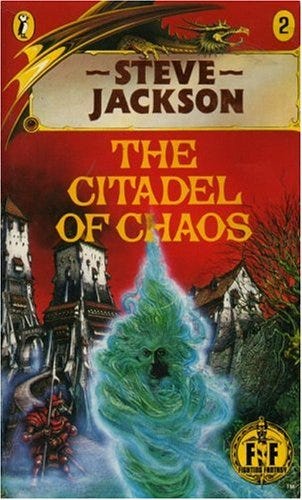
Citadel of Chaos was the second volume in the Fighting Fantasy Gamebook series created by Ian Livingstone and Steve Jackson, but it was the first volume that I purchased. I bought the book at a local bookstore shortly after my parents purchased me the D&D Basic Set for Christmas. I had read the D&D rulebook several times, but I had not yet played the game so there were some gaps in my understanding of just how roleplaying games worked. Sure, there was the excellent example of play within the Basic Set, but it was still hard to imagine the array of choices that are available within a roleplaying game and it was Citadel of Chaos that provided the perfect demonstration of how rules affected narrative.
By the time I picked up Citadel, I’d already read a number of Choose Your Own Adventure books. I was comfortable with interactive fiction as a concept, so the Fighting Fantasy Gamebooks would have interested me even if I hadn’t received the Basic Set as a gift, but there was something that set the Fighting Fantasy Gamebooks apart. They didn’t just have a pick your path narrative, they also had rules for combat, magic, and interacting with the world. At least, Citadel of Chaos did. Warlock of Firetop Mountain, the first Fighting Fantasy Gamebook only has rules for combat and interacting with the world, it lacks a magic system and is more of a Sword & Sorcery tale compared to Citadel of Chaos’ more high fantasy feel. I’ve discussed how well Warlock of Firetop Mountain works as a “full” roleplaying game in a past essay. It works, but only within the magic-less constraints of the tale.

Had Warlock been my first encounter with the genre, I don’t think I’d have had the same excited reaction to the concept. In addition to lacking a magic system, the adventure in Warlock has only a single solution. There is only one way to complete the adventure successfully and the adventure is quite challenging. When I finally played Warlock, it took me more than a few playthroughs to get it right and I still died the first couple of times I was on the proper path for the solution.
That wasn’t the case with Citadel. There are a couple of ways to have a happy ending playing Citadel and this fact kept me coming back to the book and replaying the adventure several times. By having a magic system and multiple paths to a successful conclusion Citadel gave me a better sense of how roleplaying games worked.
Sure, the mechanics of the Fighting Fantasy Gamebooks are simple to the point of being almost simplistic, but they are surprisingly flexible and have resulted in a complete roleplaying game that holds its own and that has a good fanbase. That fanbase has expanded to include members of the Troika! community. Troika!’s mechanics are heavily influenced by Fighting Fantasy and that’s a really cool legacy.
I don’t want to reveal too much about Citadel, only to say that it is worth checking out and that by bridging the gap between Choose Your Own Adventure books and full Roleplaying Games, it makes a perfect introduction. Steve Jackson, unlike that cruel first Dungeon Master, wasn’t arbitrary in his plot design. He wasn’t cruel at all. That doesn’t mean Jackson didn’t provide challenges, he did. He also created an interesting and fun narrative that allowed sufficient choices that multiple plays resulted in different experiences. This fact alone, that the same book could result in different stories, was the revelation I needed to completely understand roleplaying games as a kid. They were stories, often starting in the same place and with the same modules, but where the players shaped what the end story would be.
After that, I was hooked.
A Temporary Genre or Just for Kids?
When I was a kid, I didn’t have the vocabulary to describe the genre that Steve, Ian, and Steve had introduced me to. I hadn’t yet discovered Tunnels & Trolls, with its solo adventures, so I didn’t know that Citadel of Chaos had introduced me to what was to become a rich and sophisticated branch of the roleplaying hobby, solo roleplaying. Even after I discovered Tunnels & Trolls, and had a name for this category of gaming, I thought that I’d leave it behind when I found a regular group to play with. I initially thought it was a genre of gaming that was purely introductory and just for kids. When I did eventually find a regular group to play “elf games” with, I never stopped playing solo games and thankfully neither did the hobby.
The solo side of roleplaying games has continued to grow in options and sophistication and is currently the healthiest I’ve ever seen it in my lifetime. In recent years you’ve seen a rise in not only traditional game books, but new mechanics as well. There are journaling games, oracle-driven adventures, and an entire “#soloRPG” corner of the internet that exploded in size during the pandemic when fans couldn’t meet in person. Though that corner developed during the pandemic, it shows no signs of slowing down in its growth. The benefits of solo gaming that appealed to me when I was younger, are as powerful as they ever were. Solo roleplaying games don’t require a group and so there are no scheduling problems. The rules are often simple on their own, or streamlined versions of more complex games, and thus have a low barrier to entry. Then there’s the greatest benefit, your imagination gets to do all of the work. There is no “misinterpreting” of what happened, no disagreement between players, because you are the only one experiencing the story. Your experience IS the story.
What has changed is the amount of player agency involved in solo games. Where Fighting Fantasy games have a fairly rigid branched path structure that is constrained by the 400 entries in every book, branches that often have a single solution, new games like Shawn Tomkin’s Ironsworn allow for tremendous agency. The Jacksons Steve are no longer the authors in games like Ironsworn, you are thanks to a combination of “oracles” (read…tables) that provide the odds of something being yes or no and provide evocative prompts that you can expand upon. You aren’t merely choosing among existing paragraphs on a branch; you are randomizing events and creating the story as you go. You, and the dice, are the Dungeon Master and not an unseen author. The addition of dice as co-author takes the concept of “random dungeons” in the old Dungeon Masters Guide (sic) and transforms it into narrative game play. Products like the Mythic Game Master Emulator allow you to play nearly any game on your shelf as a solo roleplaying game.
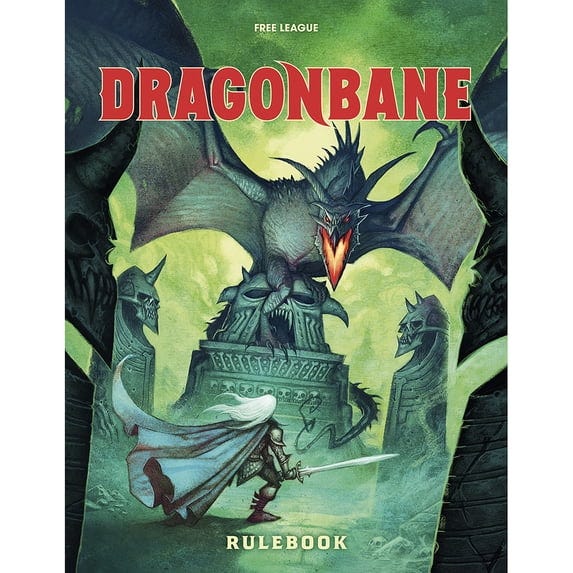
Many modern games, and I’m thinking of Dragonbane in particular here, have expanded on the older solo play examples like those featured in the Mentzer Basic Set (you still suck Bargle and I’m glad you are dead) or Black Box Basic and expanded them into fully solo playable adventures, there for the story and not just the pedagogy. I’ve written at length about the origins of Dragonbane, but I didn’t mention Alone in Deepfall Breach, the solo adventure included in the box to teach you the basics of the game. That adventure is far from a simple pick-a-path adventure and includes an oracle table and a complete set of inspiration tables. In a few short pages, you’ve got a mini campaign of fun. A decade ago, this kind of solo support would have been something a fan created on their WordPress or personal website, maybe their itch.io page, but now it’s something a major publisher thinks is central to the play experience.

One thing to keep in mind about playing Dragonbane, solo or in groups, is to not let the inclusion of Donaldesque Ducks fool you. Bloggers and Substackers who play the game, solo or in groups, have been honest about this. This game can be brutal. It has the potential for high character mortality that was common in Old School games but is rarer today. Even so, it is such a delight to read through the monster attack tables and see how merciless they can be when your character is the only target available. The fact that Dragonbane’s mythical monsters choose their attacks based on evocative and delightful tables, rather than the choices of Game Masters, makes the game highly playable as a solo game. It also makes it fun to run as a GM because if things go bad, players know it wasn’t personal. Sure, Orcs and other humanoid monsters are still fully controlled by GMs, but Dragons and other really lethal foes have their attacks decided by fate. It’s a really nice feature and one that makes it rich for solo play.
Of course, that lethality means that many a solo player has watched their promising characters die fast and early in a gout of Dragon fire or pierced by dozens of Manticore spikes. None of this is a reason to avoid the game. I love the sense of danger and desperation it evokes, but you do have to go in with open eyes and reading reviews of people who’ve actually played the game is much better than basing your expectations on a few “readviews.” Dragonbane can be lethal, but it’s a blast if you know what you are facing.
There are two newsletters I highly recommend following if you are interested in how Dragonbane plays, or in solo gaming in general. Jake Zemeckis’ Substack The Lone Bard has sadly migrated away from the Stack, but it contains a wonderful look at how solo procedures produce meaningful game play in his “Lantern of Solitude” campaign. If you like those, you can follow him to his new site (The Lone Bard) where you can follow his coverage of a multitude of game systems. I’d also recommend chrispychickin’s site A Dungeon Of One's Own where he’s done a great job discussing Dragonbane, and has been sharing his attempts to complete Caverns of the Snow Witch…a classic Fighting Fantasy Gamebook. Between these two sites, as well as those I mentioned at the top of the piece, you’ll get a good look at the solo gaming hobby.
A Brief Genealogy of Solos

As much as the Fighting Fantasy Gamebook series was my introduction to solo roleplaying, it wasn’t the progenitor of the genre of play. Flying Buffalo shipped Buffalo Castle, the first solo roleplaying game module, six years before Warlock of Firetop Mountain hit the shelves. Rick Loomis, owner of Flying Buffalo, had been running play by mail games (and eventually computer moderated PBM games) since 1970 when he used a Raytheon computer to run games for paying customers. It’s no accident that someone who turned play by mail into a profession would be the one to translate roleplaying games into a solo experience. Ken St. Andre’s and Mike Stackpole’s later T&T adventures, especially Arena of Khazan and City of Terrors, might have been superior play experiences, but they wouldn’t have happened without Loomis’ vision. Loomis himself was building on the Diplomacy PBM games and Tony Bath’s campaign models, but his Starweb PBM game is possibly the first true 4X game.
When I cracked open Citadel of Chaos as a kid, I was joining a gaming tradition that had already existed for decades. The line of solo gaming goes back further than we know, and if we include journaling goes back over a century. That genre gave me a look at how rich the roleplaying game hobby is and I’m still rolling dice alone today.
I think that, more than anything else, is what I’ve come to love about the hobby. The hobby isn’t about games and game styles dying and being replaced, it’s a hobby that keeps so much history alive and builds on the beauty of the past. At least that’s what the best of the hobby does.
I've been porting my subscriptions here to RSS (I'm unsubscribing via email. Here's a screen with a few of them: https://imgur.com/vGFvZn9).
You can't imagine my surprise when reading your latest and seeing my name being mentioned. In a positive light! That was not on my bingo card.
Had to come over to thank you, Christian. It really means a lot to me.
Keep up the great stuff.
Similar story here. Started almost 30 years ago with Demons of the Deep (written by Steve Jackson--the American one); soon I was simulating battles with the FF rules and running my own proto-adventures to other players.