


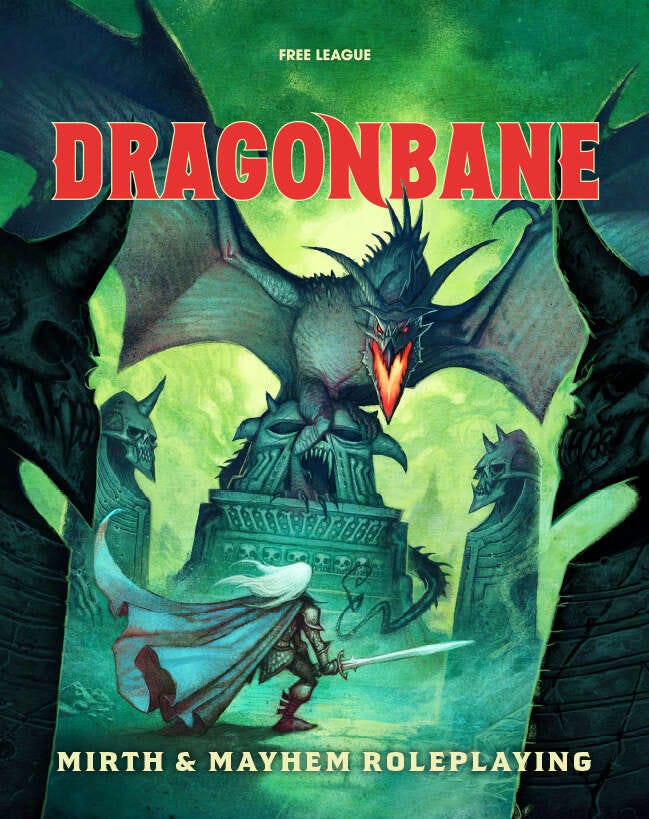
There is a particular pleasure in watching a game begin as a translation and evolve into something completely new, that gets translated into the language of the game that originally inspired it. If you were to ask me what my current favorite role playing games are, the list would certainly include D&D Basic/Expert, DC Heroes, and Dragonbane. Two of those games are currently out of print, but Free League’s 2023 fantasy roleplaying game is currently in print and keeps gaining new fans. Dragonbane was published in English after a successful Kickstarter campaign that raised 7,820,052 kr (approximately $831,529) in celebration of the 40th Anniversary of “Scandanavia’s first and biggest role playing game.”
The end result of that campaign was a new and shiny boxed set with wonderful art by Johan Egerkrans that included monsters and mallard adventurers. The game featured a brisk d20 engine and the kind of production polish that has made Free League the envy of the hobby. The product was new, but the game itself was only truly new to English speaking audiences. It was advertised as a translation of Drakar och Demoner (Dragons & Demons), which was to Scandinavia what D&D was to much of the rest of the world. Dragonbane wasn’t the first attempt to bring Drakar och Demoner rules to English speaking gamers, that was attempted earlier by Trudvang and Ruin Masters. It was, however, the first that truly clicked with modern English speaking gamers. Why Drakar och Demoner became Scandinavia’s D&D, and what that means for the game mechanics, is itself a fascinating piece of secondhand Chaosium history. And the reason that Dragonbane succeeded where others failed, is related to the reasons for Drakar och Demoner’s initial success in Scandinavia.
Any honest review of Dragonbane must follow the game’s bloodline back about forty-five years, across an ocean and a translation, to two slim Chaosium booklets and a playtester who launched a game company. I had long heard that Drakar och Demoner was an adaptation of Chaosium’s Magic World rules from their Worlds of Wonder boxed set, but it wasn’t until I looked at a copy of the game myself (received in pdf form as a part of a RiotMinds Kickstarter project for an earlier English adaptation of Drakar och Demoner) that I began to suspect that early Drakar och Demoner wasn’t merely an adaptation of Magic World and Basic Role Playing, but a translation of them. This was something I was able to verify fully after working with Claude to translate the Drakar och Demoner first edition pdf.
What the First Edition of Drakar och Demoner Was
A while back I did something that only faintly obsessive gamers do. I followed up “gaming lore” and worked with Claude to produce a complete English translation of the 1982 first edition of Drakar och Demoner. In the process, I discovered that the game was not, as gaming lore often claimed, “based on RuneQuest.” It was a direct Swedish translation of two specific books that were a part of Chaosium’s Worlds of Wonder boxed set. Part 1 of Drakar och Demoner, aka Del 1, translated Greg Stafford and Lynn Willis’s Basic Role-Playing (the 16-page “BRP” booklet from the 1980 Worlds of Wonder boxed set) and Steve Perrin’s Magic World (the fantasy role playing game in that same boxed set).
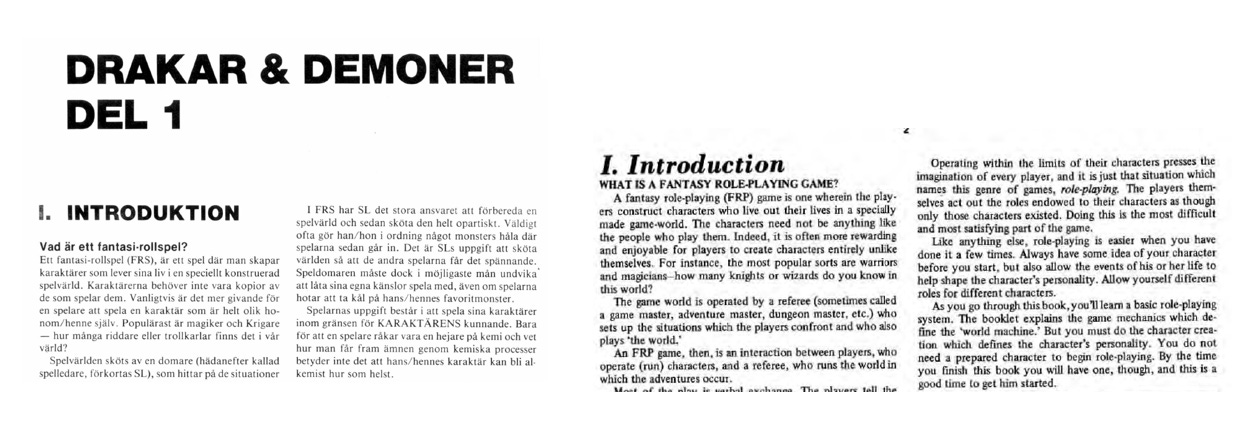
You can see the seams if you put the books side by side. The 1982 DoD introduction, the dice-reading lesson, the farm-boy-goes-to-town example, the coal-shovel-versus-rat fight, the wagon-loading list of objects to lift against the Resistance Table, the arm-wrestling example with three named opponents are all there. These are not “inspired by” Basic Role-Playing, they are Basic Role-Playing, rendered into Swedish almost word for word. As with any translation, there is some localization in the rule book but other than that it’s a licensed clone…yes, licensed. Once the Swedish text moves past character basics into professions, magic, and monsters, in Part 2 (Del 2), it is just as plainly Magic World. The warrior/rogue/sage trio (lightly renamed warrior/outlaw/scholar when I translated it back into English, but that’s just Claude picking synonyms), the Sorcerer’s Guild, the spell list from Blast and Fire/Frost to Conjure Elemental, the chimera and manticore and demon-with-1d6+1-random-traits is all there, reorganized and localized.
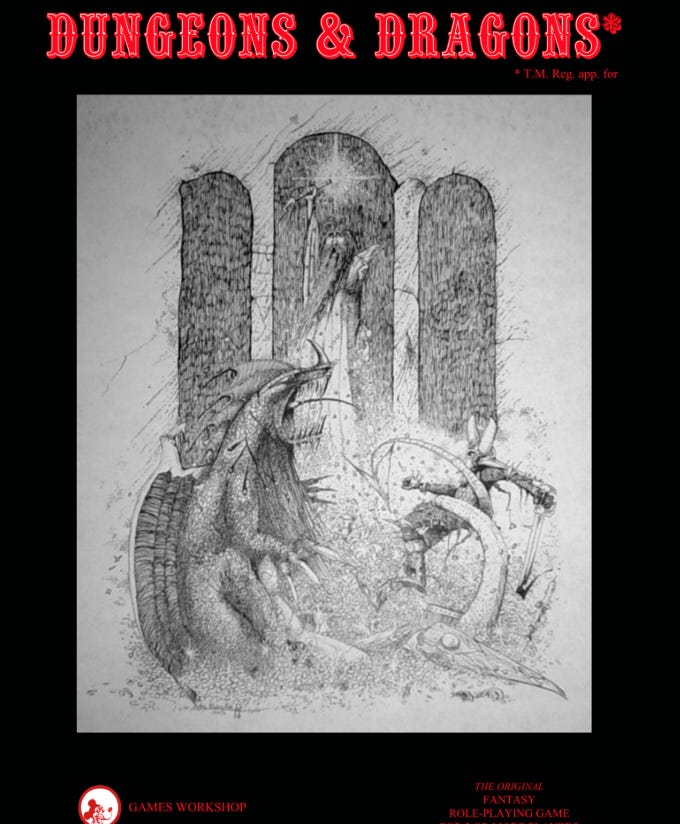
I’m not highlighting this as a criticism, any more than I would knock Games Workshop for publishing their own English printing of Dungeons & Dragons (which they did and it features a beautiful John Blanche cover).
Translating a role playing game is perfectly honorable thing to have done in 1982. It’s also an honorable thing to do today, so long as you license the game and Target Games AB (yes, the same one that later made Mutant Chronicles) did just that. While it is true that Basic Role Play is an offshoot of Runequest, it lacks a lot of the granularity that often alienates people from that excellent game. Runequest melee combat can take a very long time to play and Basic Role Play streamlines that process and that streamlining is also why Dragonbane exploded while Trudvang and Ruin Masters had only limited success. Those two games included a lot of granular elements from Runequest combat, while Dragonbane took influence from the “Expert” editions of Drakar och Demoner and shifted from percentile to d20 (still roll low) and kept the combat system simple. Drakar och Demoner succeeded in Scandinavia because it was more coherent than early D&D, but also because it was easy to play. Dragonbane is also coherent and easy to play where Trudvang and Ruin Masters are arcane and take time to learn.
Why Does No One Talk About Fredrik Malmberg?
When I read histories of the role playing game hobby, there is one name that stands out to me for its absence in most histories. It’s a name that is associated with so many wonderful gaming products, and more than a few pop culture products. Not only was this person responsible for Drakar och Demoner, but he is the reason for the Mutant Chronicles role playing game (and connected board games and skirmish miniature games). He’s the Swedish equivalent of Gary Gygax, Dave Arneson, Steve Jackson, and Ian Livingstone, all rolled into one person. Yet most accounts of Dragonbane‘s heritage breeze right past his name. Which is all the more odd, given this person’s business acumen. Not only did he create a gaming company empire, that had its ups and downs like any other game company, but he eventually became the CEO of the company who owns the rights to Conan and a host of other Robert E. Howard characters. You can find him if you flip to the credits page of Magic World (1982) and look down in the playtester list. First, you’ll find the names Alan LaVergne, Keith DeBisschop, Charlie Krank, Tadashi Ehara, and the rest of the Chaosium Berkeley crowd, but you’ll also see another name, Fred Malmberg.
That’s the same Fredrik Malmberg, who is credited on the 1982 Drakar och Demoner as one of its Swedish adapters (alongside Tomas Björklund and Lars-Åke Thor). His copyright line sits on the bottom of the Drakar och Demoner title page. A man who helped playtest Magic World for Chaosium in California is the same man who carried that exact material across the Atlantic and turned it into the foundational Swedish RPG. The first edition of Drakar och Demoner wasn’t created by a stranger who stumbled across Chaosium’s work. He was a playtester who brought the game home for his friends and fellow countrymen to play. Whether he playtested the game at a convention, like GenCon, and thought it would be a better fit for his home market is something I can only guess. But that is, in fact, my guess.
So when Dragonbane opens its rulebook in 2023 and tells you, gently, that it has “one foot firmly planted in the heritage of decades of Swedish gaming,” understand that the heel of that foot is still standing on a Steve Perrin booklet that Fredrik Malmberg helped playtest.
How a BRP Game Learned to Roll a d20
The most interesting thing about Dragonbane mechanically, and the thing reviewers tend to either celebrate or quietly resent depending on which decade they started playing role playing games, is that it is a roll-under game played using a d20. You have a skill value that is usually somewhere in the 5–18 range. If you want to do something in the game, you roll a twenty-sided die and you want to come in at or beneath your number. A natural 1 is a “Dragon” (critical success), and a natural 20 is a “Demon” (fumble). It feels, to a Call of Cthulhu or Runequest veteran, like BRP wearing a borrowed jacket. You’ve still got the skill use based advancement and the roll under mechanics that are very Call of Cthulhu/Runequest in feel, but you also have a strange class-based foundational architecture and a lethal but not grinding combat that are all unmistakably Basic Role Playing. There is also one major difference, the percentile dice are gone.
This is not Free League’s invention, and it is important for understanding what Dragonbane is and why it connected so when with modern English speaking gamers. The d20 conversion happened in Sweden in one version of the Drakar och Demoner game. In 1985, Malmberg and crew published a product called Drakar och Demoner Expert (or EDD, as I imagine Swedish grognards still call it), which interestingly enough given recent developments features a familiar Albino Sword & Sorcery character.
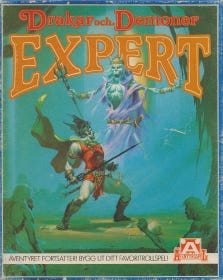
Classic Drakar och Demoner like its BRP parent, expressed skills in percentages moved in increments of 5%. If every meaningful step on your skill ladder is a multiple of five, then your d100 is in practice no different than a d20 roll because a d20 will resolve exactly the same probabilities with one die instead of two and no mental arithmetic. The Expert rules swapped the percentile dice for a d20 roll-under, complicated a few subsystems, and effectively spun off into a self-contained game. From 1985 forward, most published DoD material was statted for Expert, and the later editions kept the d20 straight through RiotMinds’ sixth and seventh editions and the Ruin Masters remake. Eventually it came into Free League’s hands when they bought the rights and produced the English-language Dragonbane, though Dragonbane removed some of the more complex stumbling blocks from Ruin Masters and Trudvang. In some ways, Dragonbane is a Basic version of Drakar och Demoner Expert, which is a simpler (and more complex in some areas) version of Drakar och Demoner.
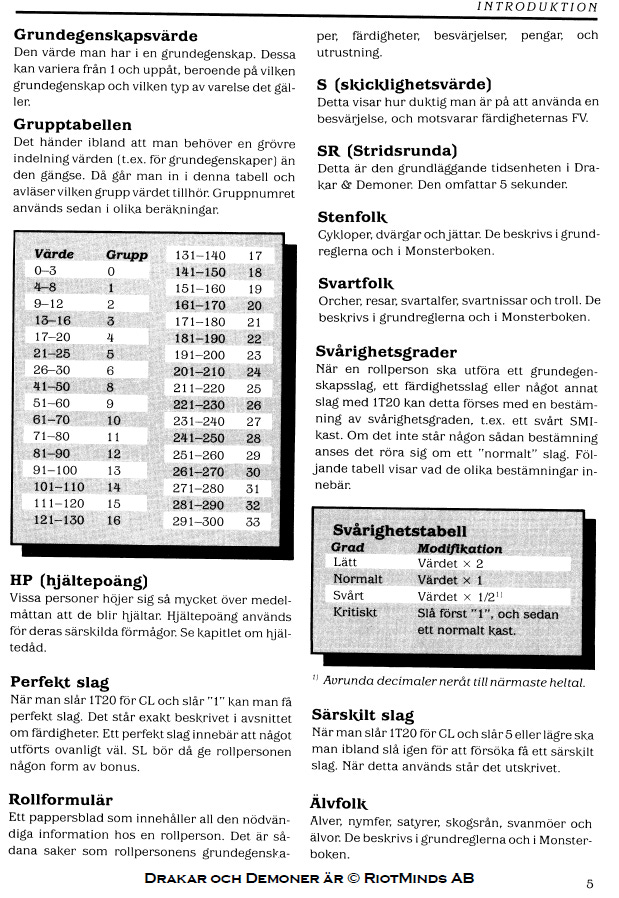
Free League did not graft a fashionable d20 onto a percentile corpse. Instead, they further adapted a forty-year-old Swedish design decision and modernized around it for modern gamers who liked the streamlined rules of D&D 5th edition and other recent role playing games. The new rules folded in a deck-of-cards initiative, a boon/bane advantage mechanic inspired by 5e, a tighter one-action combat economy, and a Year Zero Engine sensibility for conditions and pushing. The result reads, to my eye, as the most playable descendant the BRP family has produced for any genre. It starts with BRP’s skeleton but adds some interesting additions. The weapons of Dragonbane may hit harder and the armor protects less, but healing is far more forgiving than the brutal one hit point per week recovery the 1982 rules inherited from Magic World. Purists can mourn the loss of attritional grit. I find it a fair trade for a game you can actually convene four busy adults to play on a weeknight. I’m especially fond of the way that monsters work in Dragonbane. The rules don’t require the GM to be tactically cruel and use tons of cognitive load ensuring the monsters behave in optimal manners. Instead Dragonbane has “true monster,” as opposed to humanoids, use random charts to determine their actions. This ensures fairness and simplicity, and makes the game perfect for solo play as well. Make no mistake, dragons are still a nightmare for player characters, but statting them up and running them doesn’t take hours of investment.
Elric Comes Round Again
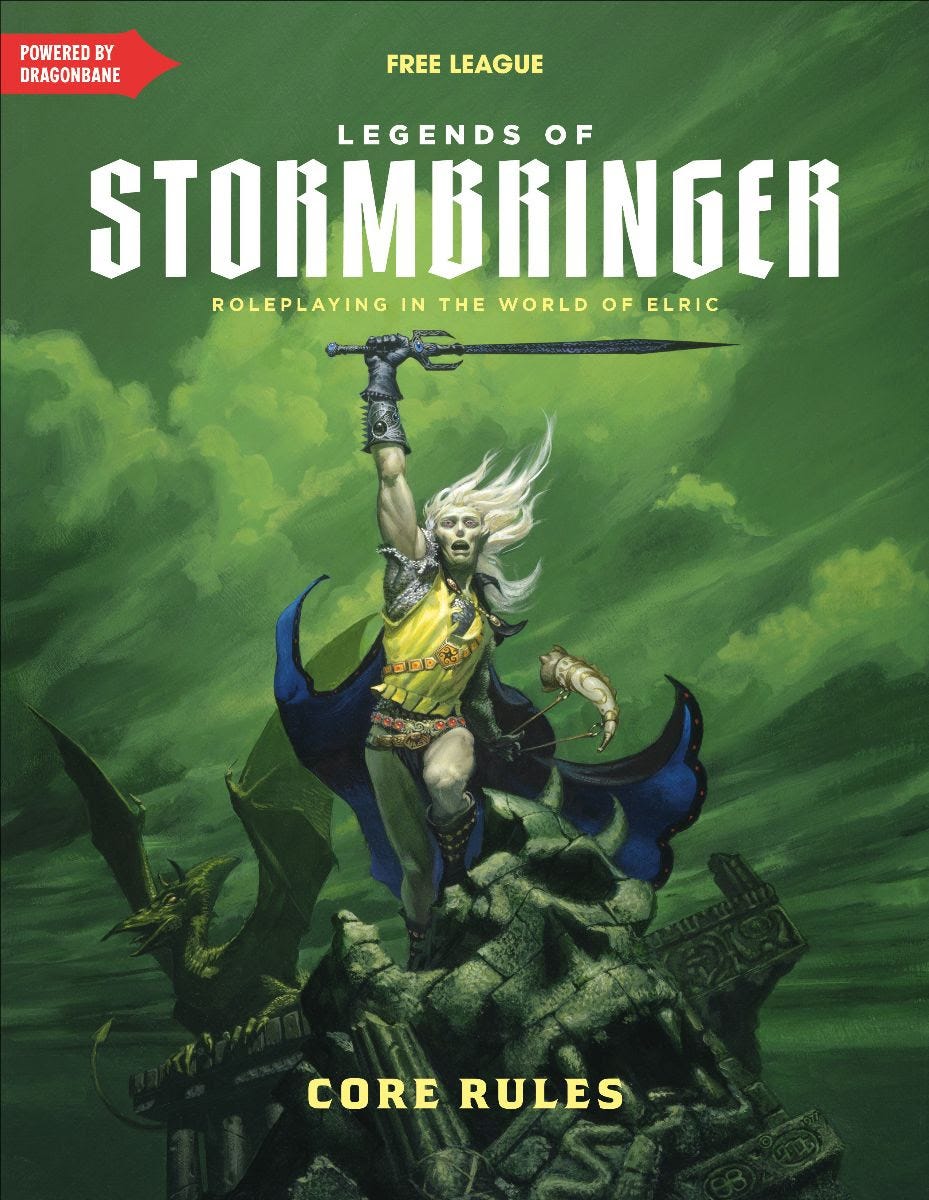
Remember when I said it was interesting that a certain Albino Emperor was on the cover of Drakar och Demoner Expert? In May of this year, Free League announced they would be releasing Legends of Stormbringer: Roleplaying in the World of Elric. It’s an officially licensed Michael Moorcock game built on the Dragonbane engine, with veteran Stormbringer hand Richard Watts leading the setting work. You can read the announcement straight from the press release. The preliminary cover art is the classic Michael Whelan cover of the Elric novel Stormbringer. Michael Whelan is the same artist whose Elric featured prominently on those old Drakar och Demoner boxes for a decade. Now that same art is finally being featured on a version of the rule actually committed to that character.
That a Swedish BRP-derived d20 engine is now going to have an Elric role playing game is even more interesting because Elric and BRP were entangled from almost the beginning. That entanglement featured the same designer who wrote Worlds of Wonder and Basic Role Playing. Who is also the man responsible for the “Perrin Conventions” that form the core of D&D “folk” play, but that is a discussion for another time and post.
Elric’s first appearance in any roleplaying product was not a dedicated game at all. He first appeared in TSR’s Gods, Demi-Gods & Heroes (1976) for the original Dungeons & Dragons. When he, more famously, appeared in the Melnibonéan Mythos chapter of Deities & Demigods (1980) for AD&D, a legal kerfuffle emerged. That section was soon subject to cease-and-desist letters from Chaosium because they believed they had exclusive rights to using the character in role playing games. I won’t go too deep into the weeds here, but I will say that the legal issues are more complex than many gamers imply. Michael Moorcock told both Chaosium and TSR that they could use his character and in the end didn’t receive any royalties (until recently because James Lowder is the best) for those early products.

Just in case you think that only Chaosium dropped the ball, TSR eventually pulled Elric from later printings for a kind of crappy reason. It wasn’t just because Chaosium already held the Moorcock license, because TSR and Chaosium came to an agreement that so long as TSR included a “Thank You” then they could use the characters. The Blume brothers thought this was too much, so they dropped the character from Deities & Demigods (though not the thank you for one printing which is odd in itself). In the end the first full roleplaying game built around Elric was Chaosium’s Stormbringer (1981), designed by Ken St. Andre and, once again, Steve Perrin. Stormbringer was built solidly on the pure Basic Role-Playing chassis, rather then the advanced Runequest one.
As I said at the beginning, it’s interesting to watch a game’s journey from one language to another and back again through both translation and rules evolution. Steve Perrin distilled RuneQuest into BRP and Magic World. Perrin then co-writes Stormbringer, the first Elric RPG, on that same BRP foundation. Fredrik Malmberg playtested Magic World, and then adapted it (with BRP) into Drakar och Demoner. DoD goes d20 with the 1985 Expert rules and uses Whelan’s Elric on its covers for ten years. Free League revives DoD as Dragonbane. And now Dragonbane will host Elric again, under a Whelan cover, forty-five years after Perrin first put the Black Sword to a percentile roll.
Dragonbane is a wonderful game on its own terms. It’s fast, lethal, charming, and genuinely easy to teach. It combines old school and new school mentalities in wonderful ways, but another reason to love the game is that it closes a loop much of the hobby, especially newer players, might not know was open. Buy the box for the ducks and the streamlined combat. Keep it for the fact that, in your hands, you are holding the long Swedish echo of a Steve Perrin booklet, and that the echo is about to start singing Elric’s doom-song one more time.