


“He was born with a gift of laughter, and a sense that the world was mad.”
— Rafael Sabatini, Scaramouche (1921)
Why Are So Many B/X Articles in Christian’s Draft Article Queue?
One of the things I love about the Moldvay, Cook, and Marsh versions of the D&D Basic and Expert sets is how they approached character archetypes in play. The original version of Dungeons & Dragons had Fighting-Men, Magic-Users, and Clerics as the core archetypes to build from, but things became a bit muddy when someone wanted to play an Elven character. They could start as a Fighting-Man or Magic-User and freely switch between them, “from adventure to adventure, but not during a single game.” What this meant, and how it worked, has been much discussed on the Dragonfoot and other forums, so I won’t go into detail. I’ll just say that it led to enough published differences between gaming groups in places like Alarums & Excursions that Gary Gygax made significant clarifications on how multi-class characters work when he wrote the Advanced Dungeons & Dragons Players Handbook (sic).
Gary’s solution is wonderful, but like a lot of AD&D it adds tremendous complexity to the mechanics of the game. AD&D was designed with the specificity that Gary believed large scale convention play needed so that players at one table had the same experience when they played at another table. That’s a noble goal and AD&D largely succeeds at it. The interesting thing is that both the Moldvay, Cook, and Marsh and Mentzer BECMI versions of D&D manage to do it too, but without the complexity. This is what makes old school D&D so wonderful. You can play an easy to learn and master version (1981 and later Basic D&D) or a rich and deep version with wonderful subsystems that aid in developing a fully realized world. One is broad (D&D) and the other is granular (AD&D), but both allow for consistent play in ways that OD&D didn’t offer. I won’t dive into the how to use Chainmail for combat discussion here, but I have written on it in the past and some early players thought saving throws were rolled on 2d10 added together creating a bell curve (Lee Gold in Alarums & Excursions #2) or that spell casters could cast the spells they memorized an unlimited time each day (Ted Johnstone APA-L 513) . It’s no wonder they thought Magic-Users were too powerful in the early days of the game.




These kinds of misinterpretations were common, and easy to do, given the vagueness of those early rules. Both Basic D&D (Moldvay and later as Holmes has his own vagaries where everyone should wield daggers) and AD&D made huge improvements in rule clarity and I love both editions of the game. There is something that keeps calling me back to the clear simplicity of B/X and BECMI where each new interpretation of an archetype gets its own class. Moldvay’s Elf is a combination fighter/magic-user and gains all the benefits all the time. Moldvay’s Halfling is a fighter, but with nature abilities that make him a fantastic outdoor companion. So much so, I based my B/X Ranger on the class.

I’m not the only one to have a soft spot for the B/X and BECMI focus on archetypes over add-ons. Alexander Macris’ Adventurer, Conqueror, King System takes the B/X approach, as does JV West in his gonzo Black Pudding zines and his Doomslakers! roleplaying game. Where D&D 3rd edition and 4th edition use things like feats and prestige classes to emulate narrower interpretations of archetypes, these newer games (and 4e) take the B/X and BECMI approach and develop new classes modeled on existing ones for each new archetype. It’s a kind of “common law” approach to class design instead of the engineer’s approach of 3e and 5e. In the common law approach, you ask the player (or speculate as the DM) what they want their character to be like. Then you look at existing classes to see if they do the job. If not, you find one to serve as a foundation and make adjustments to the theme while trying to keep some balance. That balance is different in B/X and BECMI, with BECMI allowing multiple attacks for higher level fighters while B/X never does, so that has to be taken into consideration when making a B/X character class.
Like West and Macris, I love the older approach, so I’m writing up a bunch of classes for B/X inspired by the fiction and genres I enjoy. It’s all part of an effort to include more gaming content in this newsletter. I’ll still be writing reviews and scheduling more interviews, but I’ll be upping my “White Dwarf” game and bringing in more game content too. Oh, and I’ll probably bring in some BECMI versions of the classes I’m making later, but today’s class is Moldvay, Cook, and Marsh all the way.
Let me present to you…The Swashbuckler.
The Swashbuckler

When I think of literary and cinematic Swashbucklers, there are four characters who immediately come to mind to capture this archetype.
The first is Rafael Sabatini’s Scaramouche aka André-Louis Moreau. He was born a nobody, becomes one of the finest swordsmen in France not through noble blood or magical talent but through intelligence, observation, and a particular willingness to be laughed at while he learns. He studies his enemies and beats them at their own game. Along the way he is, at various points, a lawyer, a playwright, a circus performer, a revolutionary politician, and a fugitive. Sabatini puts it in the first sentence, quoted at the top of the article. He has the gift of laughter and a sense that the world is mad. That is the swashbuckler’s core. The world is absurd and dangerous, and the swashbuckler has decided to find this funny and to act with panache.
Peter Blood, also a Sabatini creation, is the second who comes to mind. Okay, it’s Errol Flynn who comes to mind and this is one of his iconic swashbuckling roles. Peter Blood is a physician pressed into slavery who becomes a pirate captain and eventually, against his own better judgment, a defender of the English crown in the Caribbean. He is educated, principled within limits, possessed of a dry wit that functions as both weapon and shield, and absolutely lethal with a blade when pushed past those limits. Blood is the gentleman outlaw with a code. He doesn’t have Robin Hood’s code of righteous redistribution. Instead he has a private moral ledger that he maintains regardless of which side of the law he currently inhabits.
Maybe my favorite swashbuckler is Sir Percy Blakeney. He’s the foundation for so many heroic characters and is perhaps the most sophisticated version of the swashbuckling archetype because he is operating on two levels simultaneously. As the Scarlet Pimpernel he is one of the most daring operatives in Europe, extracting aristocrats from Revolutionary France under the noses of Fouché’s agents. As Percy Blakeney he is a famous fop. He’s vain, slow-witted, obsessed with his cravat. He’s the model for the Bruce Wayne and Batman dichotomy. The gap between those two personalities is the core of the conflict in the first novel and shows the genius of Baroness Orczy’s creation. Blakeney isn’t just a swashbuckler. He’s a swashbuckler who has thought through the social mechanics of being a swashbuckler and built a disguise around the expectations everyone has of what he ought to be. His moral code, and the fear that the woman he loves doesn’t share it, almost cost him his life, yet he remains a happy warrior.
And then there is the Gray Mouser, the most “D&D” of swashbuckling characters. He is featured in Fritz Leiber’s contribution to the Appendix N canon that underlies a lot of the articles I’ll be writing in the coming months. He is Fafhrd’s partner, the urban half of one of fantasy literature’s great double acts. The Mouser is a former hedge-wizard’s apprentice who found that a quick blade and quicker wits served him better in the alleys of Lankhmar than any cantrip. The Mouser is the archetype at its most stripped-down and honest. No noble birth, no physician’s education, no aristocratic double life. Just a very small man with a very fast sword and the permanent conviction that he is probably the smartest person in any given room, which is often enough correct to be dangerous. In Tunnels & Trolls, he serves as the foundation for the Rogue class and he is why D&D’s Thief Class can read scrolls. He’s too good a swordsman to be a mere Thief though, so I’ve never found that adaptation quite satisfying.
These four characters don’t share a class in the B/X or BECMI versions of Dungeons & Dragons that truly captures them. They should, but the one attempt (the Rake) didn’t cut the mustard for me.
The Problem with the BECMI Rake
The Dawn of the Emperors boxed set introduced the Rake as “the non-thief thief.” It is a swashbuckling variant for characters from the Pearl Islands of Thyatis who admire the Thief’s agility without wanting the profession’s criminal associations. The Arena of Thyatis module improved on the base version by replacing Backstab with a Dodge ability (equal to Hide in Shadows percentage) and adding a Charisma bonus in an attempt to make the class more playable.
The general concept is right. It is an attempt to create a combat-capable social operator who uses skill and wit rather than raw muscle is exactly what the swashbuckler archetype requires, and Aaron Allston and John Nephew deserve credit for identifying the need. Nephew’s version in Arena of Thyatis is pretty good, but I wanted something that had a little more action oriented.
The execution is the problem. The Rake is built entirely on the Thief chassis and that’s a very weak combat chassis in Basic D&D. The Rake has the same 1d4 hit dice, same THAC0 progression, and the same XP requirements. Stripping out Pick Pockets and Backstab and adding one combat option makes it mechanically worse than the Thief in almost every situation except dodging spells. You end up with a character who can’t take a hit, can’t fight effectively, has fewer skills than a Thief, and gets a Dodge ability that only works when they’re not attacking. The Rake as published is less a swashbuckler and more a description of what a swashbuckler might theoretically be, without any mechanical support for actually being one.
Common Law Class Creation: The Mystic and Halfling as Starting Points
When I built the Venusian Scout, I used the Elf as the chassis with its hybridization of the Fighter/Magic-User because the Scout needed genuine Fighter combat ability paired with a secondary toolkit. The Swashbuckler needs the same thing, but the secondary toolkit is different and the flavor is entirely different.
Taking the common law class creation approach I discussed above, the first class I looked to as a foundation was the Mystic from the BECMI Rules Cyclopedia. The Mystic is a martial artist class that gets Fighter combat progression, 1d6 hit dice (between the Fighter’s 1d8 and the Thief’s 1d4), can’t wear armor, has a limited weapon selection, special combat abilities that unlock at various levels, and a small set of thief-adjacent skills. It is, in other words, a Fighter/Thief hybrid with class-specific special abilities. This provided a good model for the architecture the Swashbuckler needs. It’s also the model I used in my first draft of rules for the Teenage Mutant Ninja Turtles, though I’ve got a revision of those coming soon.

The differences between the Mystic and the Swashbuckler are substantial. The Mystic is an unarmed specialist whose special abilities are oriented around open-hand combat, deflecting missiles, and moving without sound. The Swashbuckler is a weapon specialist whose special abilities are oriented around blade control, social manipulation, and maintaining a persona. The Mystic is ascetic and inward. The Swashbuckler is theatrical and outward. But the mechanical skeleton is the same: Fighter combat + restricted gear + special unlocking abilities + a few thief skills.
The Halfling also serves as a reference point, as it did for the Ranger. The Halfling’s attack-based hiding mechanic is an example of how B/X can encode a class’s particular survival strategy into a special ability rather than just borrowing wholesale from the Thief table. The Swashbuckler’s Riposte ability (see below) does something similar. The Riposte encodes the swashbuckler’s fundamental combat logic, use the opponent’s aggression against them, into a mechanic rather than borrowing the Thief’s Backstab.
Designing for My Four Reference Characters
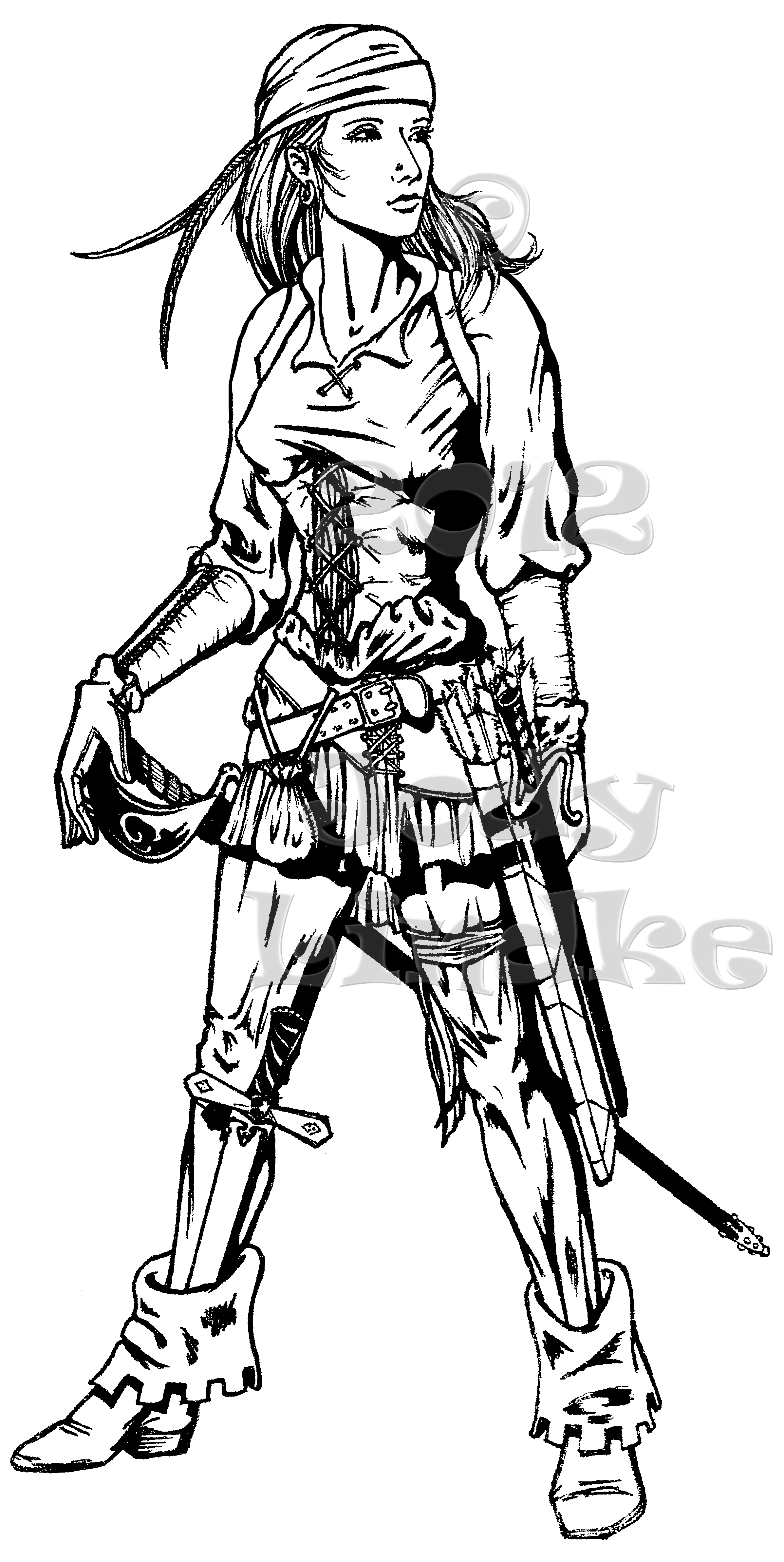
The four characters I mentioned earlier share specific demonstrable capabilities. They are all exceptional swordsmen, have some prowess in social situations, are light and mobile, and good at improvization.
Exceptional swordsmanship — The Swashbuckler is a skilled duelist. Their approach not Fighter-level hack-and-slash of Liam Neeson’s Rob Roy, but precision and technique of Tim Roth’s Cunningham. André-Louis Moreau’s fencing scenes in Scaramouche are specifically about exploiting openings. Captain Blood’s dueling reputation is what makes him dangerous.
Social performance — Blakeney’s fop is the clearest example, but all four operate in social environments where how they’re perceived matters. The Mouser’s “innocent” face and quick tongue often get him out of trouble that his sword got him into.
Light and mobile — None of them wear plate armor. None of them fight shield-and-sword. They’re fast and they stay that way.
Improvisation — Captain Blood improvises constantly. The Mouser uses environmental features. Blakeney’s plans depend on reading a situation and adapting.
A private moral ledger — This is tonal rather than mechanical, but all four operate outside conventional law while maintaining their own code. The class needs to feel like it belongs to a person with principles rather than a hired blade.
None of these characters have significant supernatural abilities (though Mouser has Hedge Magic so I’ll likely keep the Read Scrolls ability), tracker skills, religious connections, or any particular interest in wilderness survival. This class is urban and social in the way that the Ranger is rural and solitary.
The Swashbuckler
Requirements: DEX 9, CHA 9
Prime Requisite: DEX and CHA
Hit Dice: 1d6
Maximum Level: 10
Armor: Leather armor only; no shield. At higher levels the Dueling Blade stance (unarmored, off hand empty) surpasses leather (See Special Abilities). Weapons: Any sword, dagger, hand axe, short bow, crossbow; no two-handed weapons, no pole arms, no military weapons requiring Strength to wield effectively
Languages: Common plus one additional language of the player’s choice reflecting the character’s background in addition to bonus languages from Intelligence.
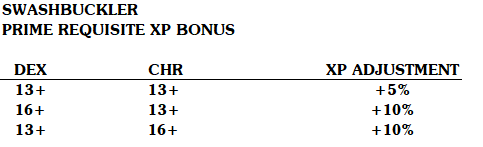
Prime Requisite XP Bonus
Experience and Level Advancement
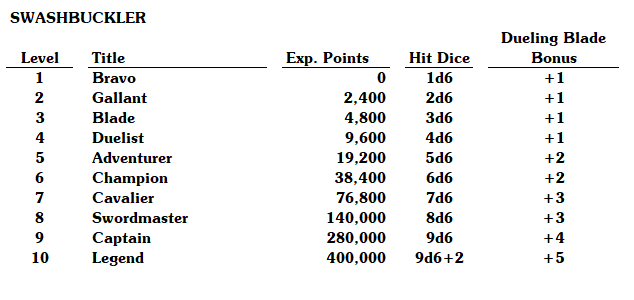
After level 9, the Swashbuckler gains +2 HP per level and no longer rolls HD. All other advancement is frozen at level 10 values. The title “Captain” at level 9 is intentional. Captain Blood reached that level.
Attack Bonus / THAC0
The Swashbuckler attacks as a Fighter of the same level through level 10.
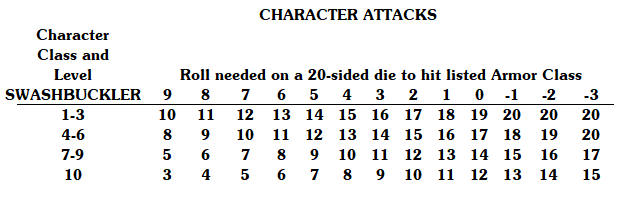
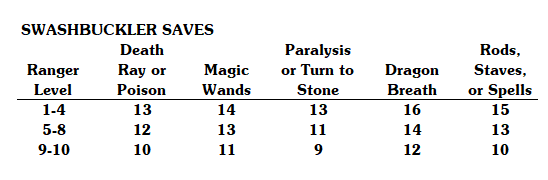
Saving Throws
Swashbucklers use the Thief saving throw table, reflecting the lightning reflexes and situational awareness that keep them alive where a Fighter would rely on armor and toughness.
Thief Skills
The Swashbuckler has access to a narrow set of Thief skills reflecting the practical skills of a person who lives by wit and observation rather than burglary. They have no access to Find/Remove Traps, Open Locks, Climb Walls, or Backstab. Move Silently and Hide in Shadows are available but advance more slowly than for a Thief, reflecting that the Swashbuckler’s survival toolkit is social rather than stealthy.
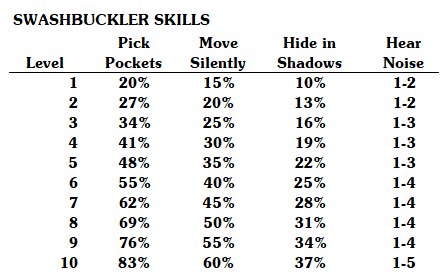
Design Note: Pick Pockets for the Swashbuckler represents sleight of hand broadly. This includes things like palming objects, concealing weapons on their person, lifting a key without detection, slipping a document from an inside pocket. It is less about petty theft and more about the manual dexterity of someone accustomed to operating in close social quarters.
Special Abilities
Dueling Blade
When fighting with one weapon in the primary hand and the off-hand completely empty, the Swashbuckler may choose to fight without armor. While unarmored in this stance, they gain an AC bonus. This bonus is from superior footwork, reading an opponent’s center of gravity, and simply not being where the blade arrives that accompanies increases in character level.
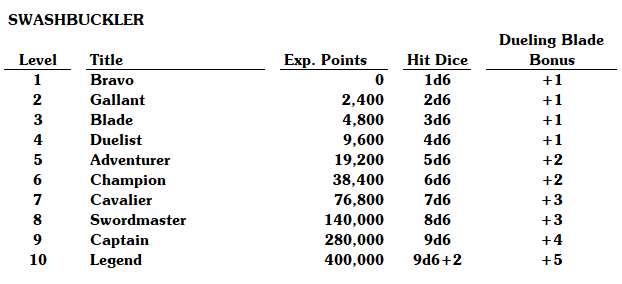
All AC values before DEX modifier. DEX bonus applies in any case and stacks with the Dueling Blade bonus.
Design Note: Through level 4, leather armor (AC 7) provides better protection than the Dueling Blade stance (AC 8). A Swashbuckler in their first years of practice wears leather and learns. At levels 5–6, the stance brings unarmored protection exactly level with leather; the choice is the player’s. At level 7, the calculation inverts and a Swashbuckler in the Dueling Blade stance (AC 6, plus DEX modifier) outperforms anything leather can offer. Most Swashbucklers at this point hang the armor up for good. Rings and Cloaks of Protection are the main protective items at this point.
This progression mirrors the Mystic’s AC bonus from the BECMI Rules Cyclopedia, which improves by 1 per level through bodily discipline. The Swashbuckler’s improvement is half that rate because their protection comes from technique rather than transcendence but technique, at its apex, is a protection the body builds by doing the same things correctly ten thousand times until they become automatic. The Mystic trains their body to be armor. The Swashbuckler trains their body to be elsewhere when the armor would have been struck. Additionally, it the “jewelry and finery” nature of a lot of protective magic items fit with the class thematically and I wanted to encourage their use.
Riposte
When an opponent in melee misses the Swashbuckler with an attack roll, the Swashbuckler may immediately make one free attack against that opponent. This costs no action and is a reactive strike exploiting the opening created by the missed blow.
Restrictions: The Riposte only applies to melee attacks. Missile attacks, spell effects, and area attacks do not trigger it. The Swashbuckler may only make one Riposte per round regardless of how many opponents miss. The Swashbuckler cannot Riposte if they are wearing medium or heavy armor (leather and buckler remain eligible).
Design Note: This is the mechanical expression of the fencing tradition all four reference characters embody. André-Louis Moreau wins his crucial duel not by attacking harder but by reading the moment his opponent is vulnerable. The Riposte encodes that the Swashbuckler is most dangerous when their opponent is overextended.
Social Ease
+1 to all reaction rolls with intelligent beings. This increases to +2 at level 5 and +3 at level 9.
Design Note: Unlike the Venusian Scout’s similar ability, which reflects Venusian racial charm, the Swashbuckler’s Social Ease is entirely cultivated. It is the result of practice, observation, and the kind of confidence that comes from being very good at something that could get you killed. It applies equally in taverns, noble courts, and criminal dens, because the Swashbuckler has learned to read rooms.

At Level 3: Feint, Disarm, and Persona
Feint
At 3rd level, the Swashbuckler gains the ability to Feint. Once per round, instead of attacking, the Swashbuckler may declare a Feint against one opponent in melee range. The target must make a saving throw vs. Spells. On a failure, the target’s AC is treated as 2 points worse for the Swashbuckler’s next attack against them (this round or the next). On a success, the Feint has no effect and the Swashbuckler’s action for the round is spent.
At level 5, the saving throw penalty improves to 3 AC points on a failure. At level 8, it improves to 4.
Design Note: The Feint is Percy Blakeney’s weapon applied to combat. The fop persona is a Feint. The confused look, the dropped handkerchief, the apparent incompetence. All of this is misdirection that creates the opening. In mechanical terms the Feint is an investment that is common in D&D combat actions, you sacrifice an action to impose a condition that makes your next attack more likely to land.
Disarm
Starting at 3rd level, once per combat, the Swashbuckler may attempt to disarm an opponent wielding a weapon. This replaces their normal attack. The Swashbuckler makes a normal attack roll against the opponent’s AC. On a hit, no damage is dealt. Instead the target must make a saving throw vs. Paralysis or their weapon is knocked free, landing 1d6 × 5 feet away in a random direction. Creatures of greater than human size (ogres, giants, etc.) save at +4. Creatures with no discernible grip (undead, slimes) are immune.
Design Note: Captain Blood doesn’t just want to win the duel. He wants the other man to leave alive, ideally humiliated and aware of how close they came. The Disarm is the mechanical expression of that preference. a swashbuckler who chooses not to kill is not weaker than one who does, just differently motivated.
Persona
At level 3, the Swashbuckler may establish and maintain a false identity, a Persona, with a completely different apparent personality, mannerisms, and social standing from their own. Maintaining a Persona requires preparation (at least one day establishing the disguise and backstory) and is broken if the Swashbuckler fails a saving throw vs. Spells when placed under direct, sustained scrutiny from someone who knows them in their true identity.
The Persona does not require a physical disguise, though one helps. It is primarily a performance. Percy Blakeney’s fop is not a physical transformation, it’s a character he inhabits completely.
A Swashbuckler may maintain one Persona per 3 levels (one at level 3, two at level 6, three at level 9). Established Personae do not need to be rebuilt from scratch. They exist as available identities the Swashbuckler can slip into.
Design Note: This is the ability that separates the Swashbuckler from the Venusian Scout most clearly. The Scout has supernatural awareness. The Swashbuckler has social engineering. Blakeney’s genius isn’t that he’s the best fencer in England, plenty of men are good fencers. His genius is that he built a cover identity so convincing that his own wife didn’t see through it.
At Level 4 (Optional): Read Languages and Read Magic Scrolls.
A Swashbuckler who reaches 4th level can read languages (including simple codes, dead languages, treasure maps, and so on, but not magical writings) with an 80% chance of success. If the attempt to read a piece of writing fails, the Swashbuckler must gain at least one level before another attempt to read it is allowed. At 8th level, the Swashbuckler gains the ability to read magic-user or elf scrolls of levels 1 to 3. However there is a 20% chance the spell will backfire, creating an unexpected result due to the Swashbuckler’s imperfect understanding of magical writings. This ability only allows the Swashbuckler to cast spells from existing magic scrolls.
Design Note: The Gray Mouser is a former Hedge Wizard and Swashbuckler’s are dabblers. This is less useful than the Thief version of the ability, but it may not fit your vision of the class. If it doesn’t abandon it, but I’d recommend keeping the non-magical reading of languages and maps regardless.
At Level 9: The Company
A Swashbuckler who reaches level 9 and establishes a base of operations attracts a small band of loyal followers. These followers include 2d6 characters of levels 1–4 that will be a mix of fighters, thieves, and other swashbucklers drawn to the character’s reputation. These are the crew of the Arabella, the League of the Scarlet Pimpernel, the companions who follow because they believe in the person leading them.
Unlike the standard Fighter stronghold followers, these companions are not professional soldiers. They are loyal, capable, and personally invested. They are more dangerous in situations requiring improvisation and discretion than in formal siege warfare. Their Morale is based on the Charisma of the character as per usual.
Design Notes
Why max level 10 instead of 8? The Ranger and Venusian Scout classes I designed capped at 8 because they’re designed around classes that tend to remain solo and name level and higher classes often have followers. Captain Blood commands a pirate fleet. Blakeney runs a covert intelligence operation across national borders. Level 10 reflects a longer career arc without pushing into the superhero territory that B/X generally avoids.
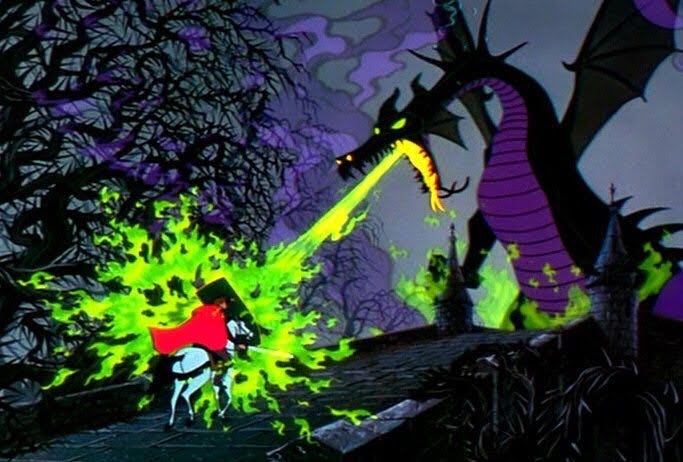
Why Thief saves instead of Fighter saves? Same reasoning as the Venusian Scout from earlier in the week. Thief saves are better against Death/Poison and Paralysis, worse against Breath and Spells. The Swashbuckler’s survival model is reflexes and awareness, not armor and endurance. One might argue that the Save vs. Breath should be better due to the reflexes component, but I’ve always imagined Prince Philip vs. Maleficent and his use of the shield is heroic, but not Swashbuckler in nature.
Why no Backstab? Because Backstab is the Thief’s defining combat feature and giving it to the Swashbuckler collapses the distinction. More importantly, none of the four reference characters are backstabbers. The Mouser occasionally gets the drop on someone but he fights face-to-face. Blood insists on honorable dueling conditions in his most important fights. André-Louis wins by being better, not by striking from behind. The Riposte does more to capture how these characters actually fight than Backstab ever would.
The Scaramouche Problem: Levels 1 and 2. André-Louis Moreau spends the first half of Scaramouche being terrible at swordsmanship. He is intelligent, observant, and determined, but he has not yet learned the technique that will make him dangerous. This is worth naming explicitly because it is a legitimate feature of the class, not a flaw. A level 1 Bravo has Fighter combat rolls (so does everyone else in B/X), few special abilities, leather armor, and 1d6 hit points. They are survivable but unimpressive. That is the learning-on-the-streets phase. The Riposte and Dueling Blade unlock at level 1, though the Dueling Blade ability is worse than the protection offered by Leather Armor. These is the first techniques a student of the blade learns, exploiting an opponent’s missed swing and defending one’s self, but the Feint, Disarm, Persona, and improved Dueling Blade all require experience to fully develop. A Swashbuckler is not born. They are made through accumulated close calls and deliberate practice. Referees should read the early levels as the Scaramouche arc. At this time they represent a character who is already more capable than most but has not yet become the person the later levels describe.
On the Rake again. The Arena of Thyatis Rake is a genuinely interesting design idea and it deserves the acknowledgment it gets. The Dodge mechanic is clever. The problem is that it’s trying to be a swashbuckler class without giving the character Fighter combat, which means you’re building on a foundation that can’t support the structure. With this particular Swashbuckler design, I attempted to create something that was roughly equivalent in combat power to a Fighter at the same level. The character has slightly less HP, slightly better saves, and meaningfully more interesting things to do in a fight.
A note on the Mystic comparison. If you’re running a BECMI game and want Swashbuckler characters in the mold of Scaramouche as a trained swordsman, the Mystic unarmed combat abilities can serve as an optional variant. You’d have to re-theme them to reflect the use of a dueling weapon of some sort, but there is room for lifting more from that class if you wish.
Sample Character: The Gray Mouser
Fafhrd’s companion, Lankhmar’s most self-satisfied survivor. 8th-level Swashbuckler (Swordmaster)
STR 11 | DEX 17 | CON 12 | INT 15 | WIS 10 | CHA 14
HP: 29 | AC: 4 (unarmored, DEX −2, Dueling Blade +3) | THAC0: 14 Save: Death 12 / Wand 13 / Paralysis 11 / Breath 14 / Spell 13
Thief Skills: Pick Pockets 69% | Move Silently 50% | Hide in Shadows 31% | Hear Noise 1–4 on d6
Attacks: Scalpel +2 (thin sword, treat as short sword: 1d6+2); Cat’s Claw +2 (dagger: 1d4 +2).
Special:
Riposte: free attack when opponent misses in melee
Feint: target saves vs. Spells or -3 AC on next attack (level 5+)
Disarm: attack roll, target saves vs. Paralysis or weapon flies free
Social Ease: +2 to reaction rolls (level 5+)
Persona: can maintain two false identities simultaneously (level 6+)
Dueling Blade: +3 AC when fighting unarmored (level 7–8)
Languages: Common, Thieves’ Cant, enough Lankhmarese to get into trouble
Notes: The Mouser is currently waiting for Fafhrd to finish whatever ill-considered scheme he’s hatched this week. He has two Personae established: a minor Lankhmarese merchant named Kreshmar, and a Mingol horse-trader he uses for dealing with people he doesn’t trust. He has just abandoned his priest identity, having reconnected with Fafhrd. He is currently wearing his usual grey cloak and does not wish to discuss any previous adventures.
A note for future consideration. Since Leiber’s Mouser served as apprentice to a Hedge Wizard in the first story, and used some pretty nasty magical abilities, I might put together a future variant for just him. It might be called the Hedge-Blade, and might trade the Persona ability for a small cantrip list of 1st and 2nd level Magic-User spells, representing that residual apprenticeship. The Mouser as statted above is the version who has put the magic mostly behind him. The version who hasn’t would be a different class entirely and deserves its own article.
Sample Character: Cyrano de Bergerac
Cadet of Gascony. Poet. Duelist. The most accomplished swordsman in Paris and the least willing to say so to the one person whose opinion he values. 10th-level Swashbuckler (Legend)
STR 12 | DEX 16 | CON 13 | INT 17 | WIS 12 | CHA 15
HP: 41 | AC: 2 (unarmored, DEX −2, Dueling Blade +5) | THAC0: 12 Save: Death 10 / Wand 11 / Paralysis 9 / Breath 12 / Spell 10
Thief Skills: Pick Pockets 83% | Move Silently 60% | Hide in Shadows 37% | Hear Noise 1–5 on d6
Attacks: Rapier + 3 (treat as sword: 1d8+3)
Special:
Riposte: free attack when opponent misses in melee
Feint: target saves vs. Spells or -4 AC on next attack (level 8+)
Disarm: attack roll, target saves vs. Paralysis or weapon flies free; resets after landing a hit
Social Ease: +3 to reaction rolls (level 9+) — see note below
Persona: can maintain three false identities simultaneously (level 9+): see note below
Dueling Blade: +5 AC when fighting unarmored (level 10)
Languages: French, Spanish, Latin, enough Italian to insult a man in his own language
Social Ease (Special Note). Cyrano’s +3 reaction bonus applies fully with soldiers, poets, philosophers, rivals, and enemies. He charms essentially everyone, with one key exception. Roxane, with whom he imposes a -4 penalty on himself, as though her were working actively to undermine his natural Charisma. This is not a mechanical rule. It is a character note. A Referee running Cyrano as an NPC should apply this self-sabotage only when Roxane is directly involved; in every other social situation he is exactly as charming as the numbers suggest, which is formidably so.
Persona (Special Note). Cyrano has three Personae established at level 10. The first is himself. This is not a disguise, but a conscious performance of “Cyrano de Bergerac” that he maintains with full awareness that he is playing a character who happens to share his name. The second is Christian de Neuvillette, the young Gascon cadet whose love letters Cyrano writes, whose words under Roxane’s balcony are Cyrano’s words spoken by another man’s voice. Cyrano does not wear Christian’s face. He writes Christian’s soul. In this case the Swashbuckler is building an identity not for himself but for someone else, and inhabiting it one step removed. The third Persona is that of a Spanish nobleman useful for moving through besieged Arras without attracting attention and it is more conventional and sees less use.
Equipment. One rapier, worn smooth at the grip. An inkwell and several sheaves of paper, always. A plume for his hat that he has replaced four times. No money.
Notes. Cyrano is currently in the Siege of Arras with the Gascon Cadets. He is intercepting the letters Roxane sends to Christian, adding to them, and then personally running the Spanish lines every night to deliver them. His level 9 Company consists of the Cadets of Gascony, who would follow him into hell with good humor and have been doing so for several years. He has not told Roxane anything. He will not. He is working on a poem.
Roped me in when you mentioned Rafael Sabatini. My gaming group went through a pirate campaign phase, which peaked during 2E when they added it as a kit. This makes me want to launch a new fantasy pirates games.
4AD has a swashbuckler. It's an interesting class.