


Designing a Fighting Fantasy Inspired Superhero Game
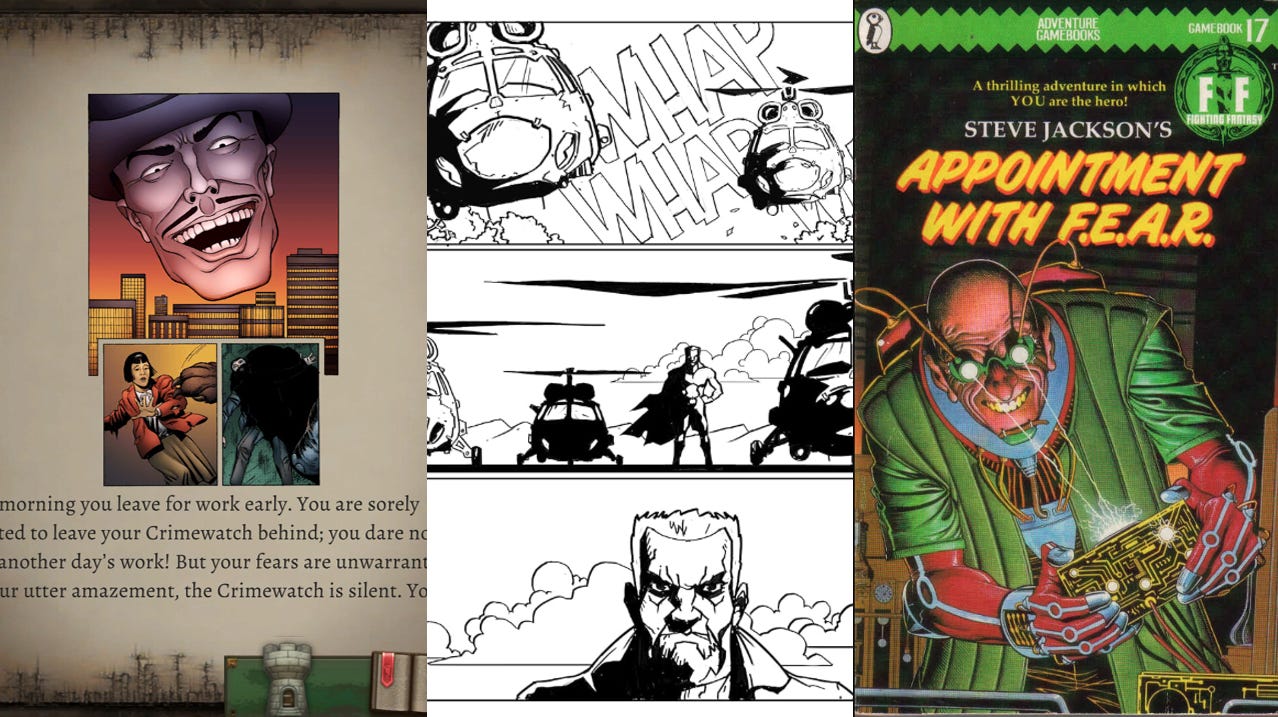
Last time I laid out a gaming gap that I wanted to fill for my own enjoyment. I’m a fan of the Fighting Fantasy gamebooks and the mechanics used in those books have been proven, by Puffin and then by Arion, to provide a solid skeleton for a real set of tabletop role playing game rules, but primarily for fantasy and Star Trek style science fiction. The one superhero gamebook in the line, Appointment with F.E.A.R., has never been officially turned into a fully realized set of role playing game rules. In its own way Fighting Fantasy is in its “Superhero 2044” stage, where it has mechanics that work well but has no robust character design rules.

I have argued in the past, and still believe, that the reason these rules don’t exist isn’t due to laziness or a lack of desire. It’s that it’s hard to design a set of rules to emulate all the powers comic book heroes display on a regular basis. Additionally, superheroes ask more of the 2d6 engine than fighting dragons typically does. When Superhero 2044 was released, it was inspired by a superhero game that “Mike Ford” (aka John M Ford the author of The Dragon Waiting) ran for his friends. Mike supposedly used the D&D rules as a basis for that game, but that’s not the system that ended up getting designed. Donald Saxman’s rules are revolutionary and move beyond the twenty-sided die and the game uses multiple systems to emulate different kinds of combat. As complex as it is though, Superhero 2044 doesn’t have rules for designing superpowers.
It took work by Wayne Shaw to create a fully flushed out power system, although a small power system was published in a very small print run “Deluxe Edition” that Lou Zocchi printed in the 2010s. Those are hard to find, but most of the “Deluxe” material was printed from James Maliszewski’s complete history article, the Super Rules for Superhero 2044 and other articles at Thoul’s Paradise, Different Worlds #23, and my own 2010 blogpost about the game. Yes, my more recent review is an update of that older blog post. The Deluxe Edition did include a small set of powers, but Wayne Shaw’s rules were robust enough to inspire the Champions role playing game.

Superhero 2044 needed the addition of a power system before it could be a fully playable game. While it ended up inspiring many other games, it never got its fully playable edition. That’s a future project for me, and I got permission from Wayne Shaw to update his specific rules for that purpose. I eventually want to take those rules and build a retro-clone of Superhero 2044 that is fully playable. Before I do that, though, I want to try making a superhero game based on the simpler Fighting Fantasy system. Keeping in mind the limitations of the game’s mechanics, I’d like to do it as a template/selection power system, rather than point based, system, I think working with Fighting Fantasy a good place to start on a collaborative design, and I’d like you to join along. So this post is about the first and, I’d argue, the most important foundation for a superhero game: powers.
Where Do You Start Conceptually With Powers?
Let me start where I always start when I think about superhero games. I start with Captain America, and with a designer who understood him better than most.
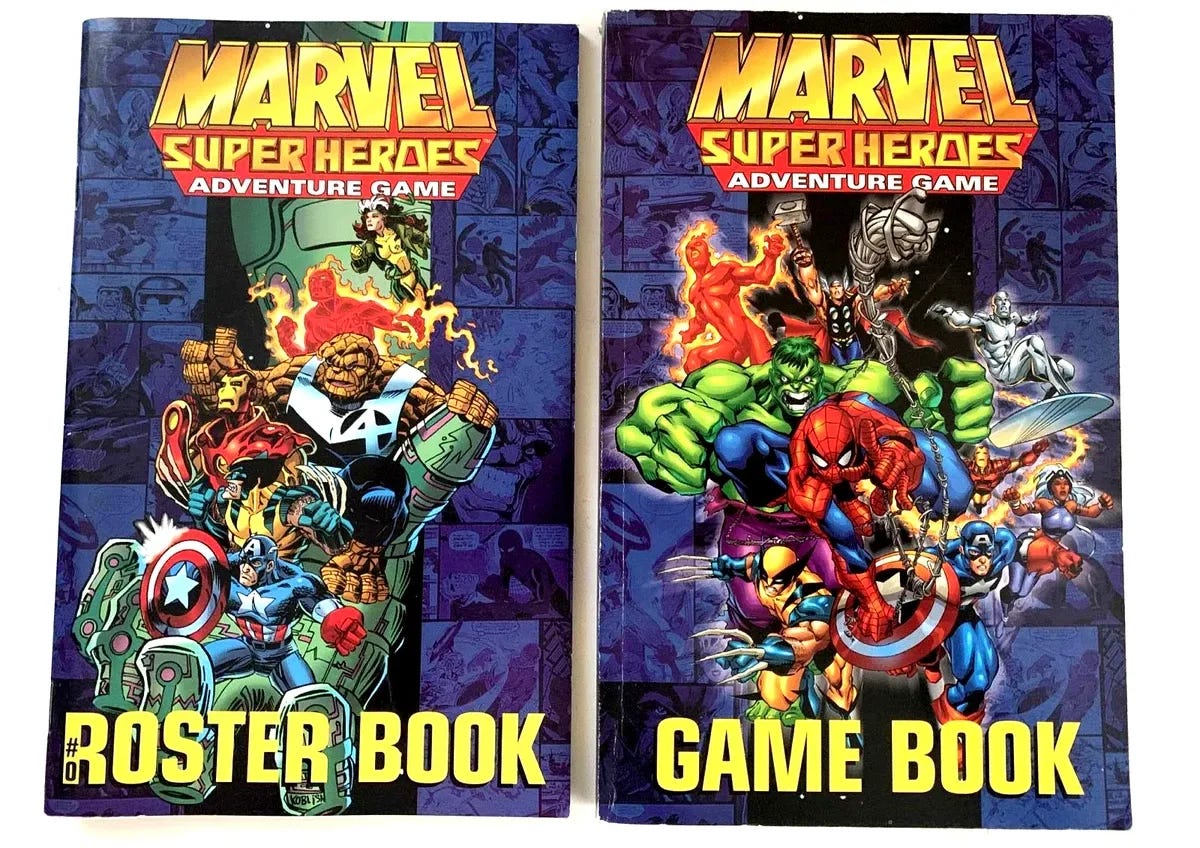
In his introduction to Marvel Heroic Roleplaying‘s Premium Civil War event book, Mike Selinker tells a story about an earlier project of his, the Marvel Super Heroes Adventure Game, and confesses a deliberate piece of design heresy. He had made Captain America the single most effective hero in that game. Not Thor, not the Hulk, not Doctor Strange. Cap. The powerhouses had powers; Cap had something Selinker rated higher, which he called heart, and the way heart cashed out at the table was beautifully concrete. Cap, he wrote, “used that heart to power through more options than any other hero.” When the chips were down, the hero you wanted to be playing was Captain America.

Hold onto that phrase… more options. It is going to turn out to the core piece of my answer to the design problem in this post. That’s probably no accident as Marvel Super Heroes Adventure Game is one of my favorite superhero games. Heck, it’s one of my favorite games, period. Its card based mechanics enable both random failure and player agency in extremely interesting ways, but that is fodder for a future post.
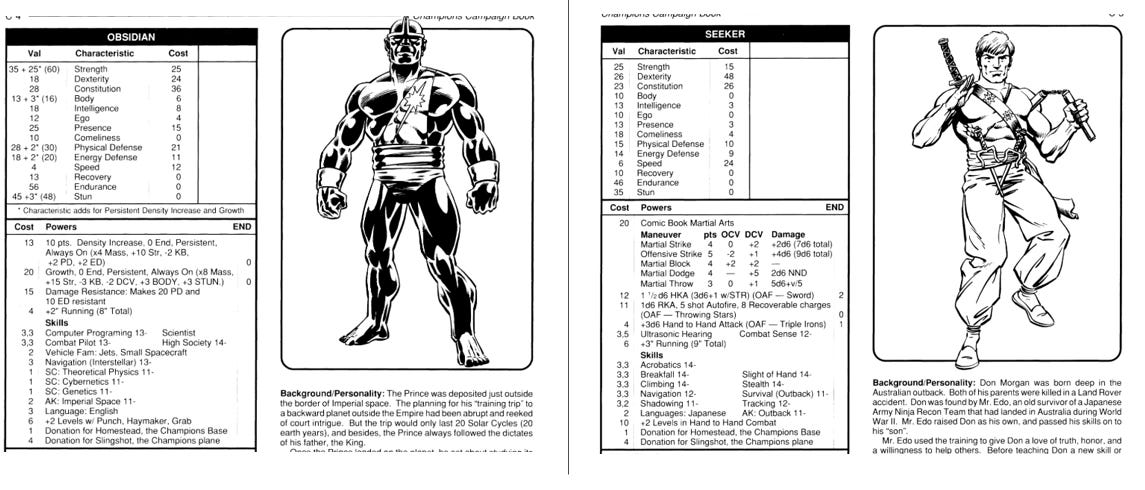
Having a system that makes a character like Captain America matter is the primary game design job for anyone attempting to tell superheroic tales. A superhero game does not succeed because it can model Galactus. At its most basic modeling Galactus is easy, you just write big numbers. Superhero games succeed when the man with a shield and a plan is as worth playing, at the same table, as the god with the hammer. If your system can’t do that, nothing else about it matters. And the thing standing between the Fighting Fantasy engine and that goal is exactly the way it would instinctively want to handle a “power.” It’s one of the things that I’ve been less that satisfied with in more recent editions of Mutants & Masterminds. In the first edition, you could make both Batman and Superman as Rank 10 characters who focused on different things but operated within the same mechanical restraints, kind of like how early Champions assumed all superheros were built on 250 points an where the “Brick” and “Martial Artist” were equally effective in combat. In Champions, Obsidian and Seeker the amount of damage (Obsidian does 12d6 and Seeker 12d6 w/his Triple Irons), but Seeker is more likely to hit his opponents while Obsidian is more likely to resist damage. And there’s the little fact that Obsidian can lift 100 tons. The game is balanced so that Cap Matters.
Powers Aren’t Merely a Skinning of Gear…or Are They?
In the gamebooks, almost everything a hero can do runs through the same small set of numbers. Your sword is a SKILL check. The locked door is a SKILL check. The pit you leap is a SKILL check, maybe a Test of Luck if you’re feeling generous. Equipment, in this engine, is mostly a permission slip or a modifier. Equipment either lets you do something you couldn’t do without it (use a rope to climb), make a roll you couldn’t otherwise make (Thieve’s Tools for a lock), or it bumps the roll you were already making.
In some ways a superpower is a different conceptual animal. A fantasy hero carries a sword, but a superhero is their power. When Energy Blast goes off, it shouldn’t feel like “+2 to your attack.” It should feel like the world and the situation around the characters just changed. There’s suddenly a way to hit the gunman across the rooftop, to blow the door off its hinges, to end the fight from forty feet away, or to produce fire that can burn a book the villain is holding. Powers belong in the same conceptual drawer as magic spells and possibly “special” weapons, not in the drawer with ordinary swords and lockpicks. They alter what is possible, not merely what is probable. If they are a kind of equipment, and if we follow a Knave or Mausritter model they can be, then they are equipment that can alter the environment and are more than bonuses. They are special effect driven, even if they involve mechanics.
So the design problem splits cleanly into three questions, and I think the should be answered in this order:
What does the power actually do. What new possibility does it put on the table? (The Effect)
How does it turn on? What does it cost to use, and can it fail? (The Cost)
How is it balanced? Both against the other powers, and against that narrow, treacherous 2d6 curve. (The Challenge)
The middle question is the one I initially underestimated, so I want to give it the spotlight.
How Does a Power Turn On?
Every superhero RPG, whether it admits it or not, picks an activation model. There are four primary models, and each one has a narrative or mechanical price.
Always-on. The power is just there. Super Strength means you are strong, full stop. You add it to the relevant rolls and never think about it. You can lift more than mortal men. Maybe it costs endurance to use, but that depends on the game. This is how the gamebook and AFF would instinctively handle Super Strength and some other powers. In AFF, Super Strength would basically be a Special Skill that’s always live. Of course, if there’s no cost, this can become a problem. A power with no cost and no off-switch quietly becomes the correct answer to everything, and the player who took it stops making interesting decisions. (We’ll come back to how badly Super Strength in particular breaks the Fighting Fantasy math as it currently stands.)
Roll-to-activate. In Advanced Fighting Fantasy you would Test against SKILL, or a dedicated power attribute, every time you want the power to work. This is dramatic and it feels uncertain, which is appropriate for many settings. However that can be a fatal flaw in design for this genre. Nothing kills the four-color mood faster than your one defining ability whiffing. Spider-Man does not roll to see whether he sticks to a surface. That just happens, unless there is a specific narrative reason it doesn’t. If the Silver Crusader’s Energy Blast fizzles on a bad 2d6, the table wouldn’t feel tension, it would feel cheated.
Resource-cost. The power always works, but using it spends something from a pool. This can be Hero Points, Endurance, an energy track, or whatever. This is the model that Champions uses and one that could be incorporated in a game inspired by Appointment with F.E.A.R. if we shift what Hero Points represent. In Appointment, they were merely a way to track how well you performed as you played the game, but maybe they are a resource you spend instead. I like this because it falls between activation and a complex endurance system. It solves the whiff problem and the always-on problem at once. Your power is reliable but finite. You will get your dramatic blast; you just can’t get it eleven times in a row. In Champions, most well designed characters have plenty of Endurance, but some have Charges and the players who have that limitation tend to not be as one note in combat.
Narrative permission. Some effects shouldn’t be a roll or a cost. Instead, they should just be things you can now do because of who you are. Flight isn’t a check. If you have Flight, you can fly. ESP doesn’t fail, but there is a question regarding what it’s allowed to tell you, and that’s a ruling, not a die. The trick is knowing which powers are “permissions” and which are “actions.” See…powers kind of are equipment.
My strong opinion, and the one the game I’m building (and hope you will help design) runs on, is that I want a hybrid rather than a single model. A power’s baseline use should be reliable. I want four-color feel and so with rare exception powers should require no roll to turn on, because reliability is what makes a hero feel heroic. However, pushing a power past its baseline should cost a resource. If you want to use a called-shot Energy Blast, do a Super Strength feat that should be impossible (like hold up a mountain range), engage in a deep telepathic dive, that’s where you let the dice back in. Ideally as a Test made with Advantage/Disadvantage rather than a coin-flip. You get reliability for the signature move and tension for the reach. Cap always throws the shield. He doesn’t always make the impossible throw, but he makes it frequently enough that he regularly attempts it.
The Tyranny of the Flat Curve and Why I Don’t Want d20
I know that a lot of modern gamers are used to the d20 default, so I’d like to wander into how different mechanics alter probabilities and how d20 based games have a specific feel.
In Part 1 (well, Part 3a, but who’s counting?) I went down a probability rabbit hole discussing the 2d6 bell curve, because it’s a foundation of Fighting Fantasy’s game system. On 2d6, a flat numeric bonus alters the probability of success very differently depending on where you sit on the curve. A +2 near the median of 7 is gigantic, but the same +2 out at the top of the scale barely moves the needle. Heroes, by definition, sit near the top of the scale. At least if we want to have our game be “portable” to other Fighting Fantasy games, but that’s a different conversation. Because heroes are at the top of the scale, it means the single laziest way to build a power (“this power gives +2 to SKILL”) is also the worst, because it does almost nothing for the people most likely to have it, right up until the moment it does too much.

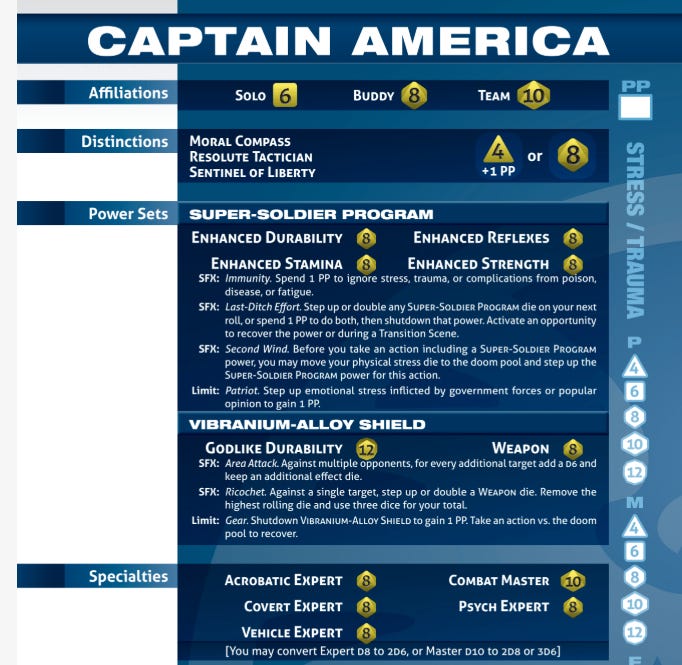
This is why I couldn’t use the same step-die mechanic of Marvel Heroic Roleplaying using the Fighting Fantasy engine. It just can’t effectively adopt a step-die system with its basic assumptions. Margaret Weis’s designers (Hi Cam, Rob, Mtt, Will, Phillipe, and Jesse!) threw out fiddly realism and gave each tier of ability its own die size. A character was Captain America strong at a d8 and the Thing strong at a d12. The gap between a strongman and a powerhouse was represented by the dice you rolled, and they layered Affiliations (Solo, Buddy, Team) and a plot-point economy on top of the step-die system. This made it so even a street-level hero could still grab the spotlight, especially if his or her Solo Affiliation was high enough (like the d10 for Moon Knight).
Marvel Heroic used a step-die system where attribute increases are represented by higher dice. I can’t do that with the Fighting Fantasy system. I am welded to two six-sided dice and a flat stat, and no amount of wishing changes the shape of that curve. In large part because Skill works on a “roll + to roll over” mechanic in combat, but SKILL and LUCK works on a “roll under” mechanic in other situations. If we did a die step mechanic, then the more effective you were at combat, the less lucky and the less skilled you would be in general. While that mechanic might work for some versions of The Hulk, it doesn’t work for Iron Man or Superman.
So my Fighting Fantasy inspired supers engine has to solve the spotlight problem a different way, and one of the best ways is to remember that powers aren’t merely stat bonuses. I need to stop expressing powers as flat bonuses to the core stats. A good power on this chassis should do one of two things. Either it grants a new option such as a thing you can now do that no roll on the standard table could accomplish (fly, read a mind, drop a force wall between the bus and the bomb). The other way could be that it changes the dice themselves in a narrower lane than a die step system. Maybe you roll with Advantage, reroll a failure, auto-succeed at a thing others must Test. Options and dice-shaping scale gracefully on a bell curve. Flat modifiers do not. That single principle quietly resolves most of the balance headaches before they start.
The Action Economy and the Currency
Which brings us to the concept of Hero Points. They are a mechanic that is used in many ways in many systems. Whether they are Fate Points as they are in Warhammer Fantasy, Bennies as in Savage Worlds, Hero Points like in DC Heroes, or Marvel’s Karma, super hero games love Hero Points. And the wonderful thing about Hero Points is that they help address another of baseline Fighting Fantasy’s weaknesses. The default in Fighting Fantasy is that 0 Stamina means death, and four-color heroes (even when they are the best at what they do) don’t kill...just ask the hardcore FASERIP player.
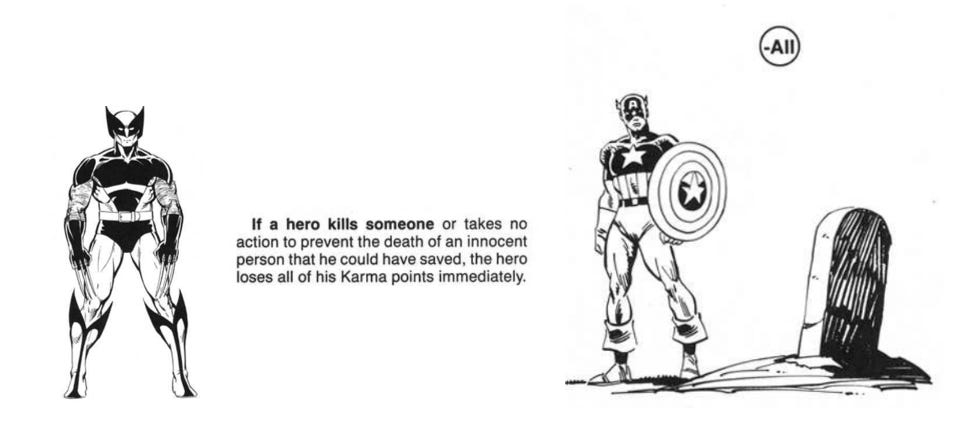
Here’s the elegant thing about choosing the resource-cost model for powers, it hands you the enforcement mechanism for the hero’s code for free. If Hero Points are both the fuel for your biggest powers and the reward for behaving like a hero then “a hero doesn’t kill” stops being a sentence in the introduction that everyone ignores in the first fight. It becomes the thing that lets you blast again next round. The four-color morality isn’t a lecture in this case, it’s the action economy. Players are rewarded for pulling the punch, for saving the bystander instead of stopping the villain, and for finding the non-lethal way to solve a problem. But that’s a whole post of its own, and I’ll address it when I finally get to actually building heroes.
For now, the takeaway is the question in the title. Before you stat a single power, before you draw up a single hero, you have to decide how powers turn on. You have to decide it knowing that this engine can’t widen its dice the way the big supers games do. If I get that right, then I can design a system that builds outward from reliable baselines and option-granting effects that are paid for out of a heroic currency. That action economy would let the Silver Crusader (regardless of build) can stand at a table next to a brick and a blaster and a telepath and matter. If I get it wrong, I’ve just built a fantasy game where one guy is inexplicably strong. That’s the difference between a superhero game and a game with superheroes in it. Champions, Marvel, DC Heroes, and more are superhero games, but GURPS Wildcards is a game with superheroes in it.
So here’s my question for you this time, because I genuinely go back and forth on it. Do you want me to design a game where your powers can fail? Some of you will want the drama of a blast that might not fire. Others will say a hero’s signature move should never whiff, and the only real cost should be how often you can reach for it. Tell me in survey or in the comments, because the answer will change how the whole power system gets built, and you’re helping me build it.
Next in the series: Building Heroes. I’ll cover origins and discuss the point-buy-versus-dice fight all over again. Then I’ll get more specific regarding how the Hero Point economy turns “a hero doesn’t kill” into a rule with teeth.
The Geekerati Newsletter: Thoughts on Games & Pop Culture is a reader-supported publication with no paywall. To receive new posts and support my work, consider becoming a free or paid subscriber.

If you liked this post, you might consider buying Tiny Supers. It’s one of the games that will be informing my design choices as we go through this series and it’s a very playable game that also approaches Supers with a very constrained mechanical foundation.

Kryptonite leads to more interesting stories than Superman (join us next time in Action Geology!), so I think some chance of failure makes for interesting plot options. Not in a 'roll to succeed' fashion, but certainly: 'I can't channel demonic lifeforce on holy ground'.
It's all just energy, right? That's what all superpowers boil down to: generation, re-appropriation, channelling, absorption, and manipulation of energy. If a hero, or villain, taps into an energy source, some may be easier or more reliable than others. Lots of heroes have kinetic powers, fewer can access magical and cosmic energy, and fewer still know the secrets of probability and time.