


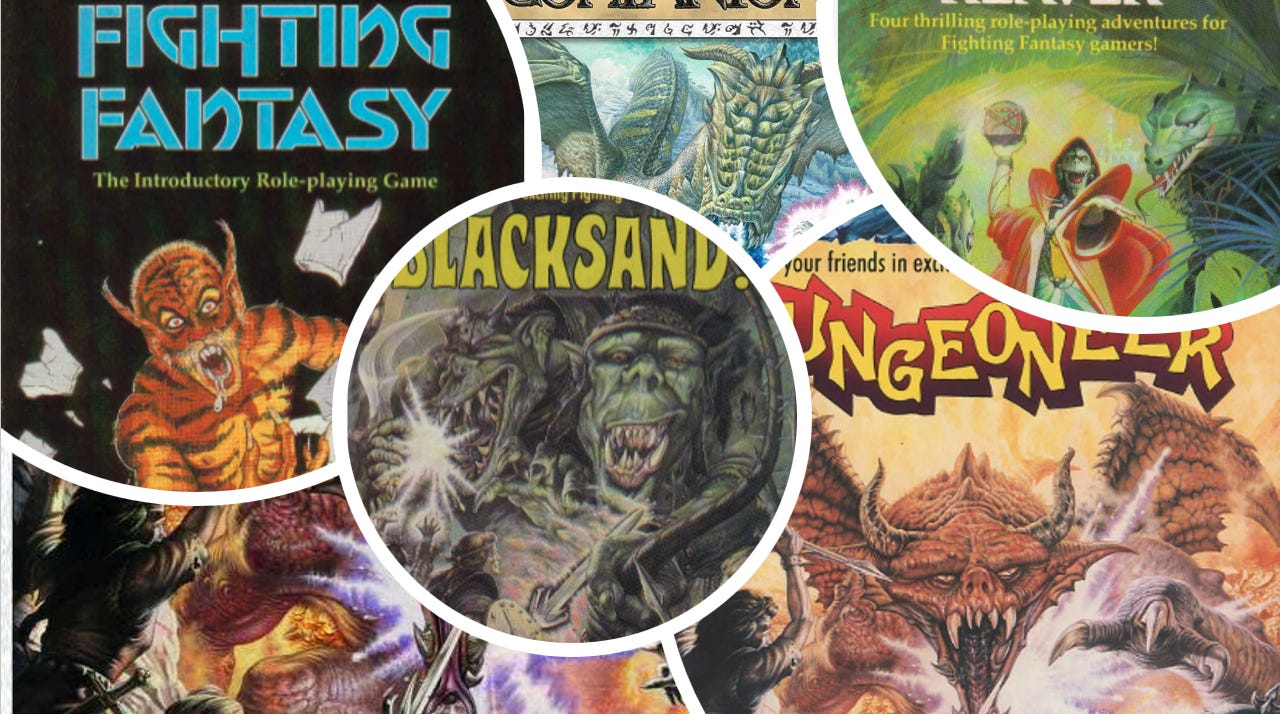
A while back I discussed what I called “My First Real Roleplaying Experience." Because my first in person role playing experience was terrible, and served as the source material for my entry in The Munchkin Book, my early experience with role playing games was through fantasy gamebooks like the Fighting Fantasy and Lone Wolf series. Sure, there were very good computer role playing games available when I was a kid, but you had to own a computer to play those and I didn’t get my first computer until I was an undergraduate. This experience gave me a life long love of gamebooks and I’ve played a lot of them over the years. The aforementioned Fighting Fantasy and Lone Wolf series are great, and both are still in print today with Steve Jackson Games releasing a very nice new edition of Fighting Fantasy gamebooks and Holmgard Press publishing (and continuing) the Lone Wolf series.

Writers like Dave Morris, Joe Dever, Ian Livingstone, and Steve Jackson (both US and UK), Gary Gygax, Flint Dille, Rose Estes, Ken St. Andre. and many more authors provided me with countless hours of fun, both before and after I finally found a table top role playing group that “fit” my style of play. Even as in person gaming came to dominate my role playing experiences, the love of the gamebooks remained and a big reason for that is that (in addition to engaging writing) they often had excellent underlying game mechanics. I started my Adventure Gamebooks as RPGs series as a kind of defense of these books as games. I think the writing is of high enough quality, more so with some than others, that that needs no defense. It’s the game aspect I’ve always believed got short shrift in people’s assessment.
When I put The Warlock of Firetop Mountain under the microscope a while back, I left a promise sitting on the screen. I noted that the Fighting Fantasy gamebooks had eventually thrown off two complete tabletop rule sets. Puffin first published a standard paperback version of Fighting Fantasy: The Introductory Role-Playing Game that was supported with an adventure book called The Riddling Reaver, a setting book called Titan, as well as a “monster manual” called Out of the Pit. They followed this up with the larger format Advanced Fighting Fantasy series that included Dungeoneer, Blacksand!, and Allansia. If you look at the prices of those links and say “Good Grief Christian! You expect me to buy those?!” No, I don’t. Thankfully, there has been a fresh edition of the latter published by Arion Games in 2016 that you can buy cheap in pdf or affordable in hardcover. Arion has reprinted all of the original material and has greatly expanded the line and I’ll be reviewing some of their books in the relatively near future.
I wrote that article promising to write another one later two years ago, so I think we can say that later has arrived. This series is overdue for its next installment, and in the spirit of full disclosure I have an ulterior motive in writing that next Gamebook as RPG article, but I’ll get to that a little later. The question driving these posts has always been the same one: “how much fun would this particular rule set be as the foundation for a campaign?” With most gamebooks, the honest answer was “promising, but you’d have to build a lot yourself.” The Advanced Fighting Fantasy rulebooks are what happened when somebody actually did the building and this series is my small way of emulating what that series did, but with gamebooks that have been overlooked as role playing games.
A Quick Refresher (and an Old Diagnosis)
If you missed the Warlock entry, here’s a brief glimpse at the underlying engine of the system. Every Fighting Fantasy character lives or dies by three basic attributes: SKILL, STAMINA, and LUCK. Combat is a beautifully simple opposed roll. Both sides roll 2d6, add SKILL, and the higher total lands a blow for 2 points of STAMINA. Out of combat, you roll 2d6 and try to come in at or under a stat in order to succeed but only SKILL and LUCK are used in these tests. If you test your LUCK, the stat ticks down by one whether you succeed or not. Those are the mechanics of the game. They are elegant and a great introduction to roleplaying games, but they are far from granular.
I had two critiques when I asked whether you could build a campaign using solely the rules in the gamebook. First, a single all-purpose SKILL stat does everything from fighting, climbing, balancing, picking locks, which means the character with the highest SKILL is quietly the best at the entire game. On a 2d6 bell curve, a two-point SKILL gap isn’t a small edge. It’s the difference between a hero who shines and a hero who watches. Second, rolling 1d6+6 for that all-important number bakes the disparity in at character creation, before anyone has made a single decision. My suggested fixes were to break SKILL into more granular areas so different heroes could be good at different things, and to move from random generation toward point-buy so nobody got stuck as the table’s understudy. I still like the idea of breaking up SKILL into a couple of categories, but I’m less bothered by the random roll now…so long as we can have character advancement later.
Fighting Fantasy Grows Up
The gamebooks were not meant to be a multiplayer RPG when they were originally published. They were a solo experience, a Game Master made of paper. They were hugely popular when they were initially published and still have a fan base, so the demand for a group version is obvious, and it arrived in the two waves mentioned above.
The first was Fighting Fantasy: The Introductory Role-Playing Game written by Steve Jackson in 1984. It provided a gentle on-ramp that took the gamebook engine and added a referee and a party, but not much else. The second, and the one that inspired this series, was Advanced Fighting Fantasy. The first edition of Advanced Fighting Fantasy was developed by Marc Gascoigne (one of the most underappreciated figures in gaming history and I’ll need to do a post on just him some day) and Pete Tamlyn in 1989 and it greatly expanded what could be done with the Fighting Fantasy engine.
Arion Games revised, rewrote, and re-released the second edition of Advanced Fighting Fantasy penned by Graham Bottley in 2011. This initial release was expanded into the current Deluxe edition. Arion did us all a great service when they rebuilt and published the system you can use to run adventures for other people. Larger publishers have been publishing the solo gamebooks for decades, but it took a small company that started as a provider of paper miniatures to bring back the full table top experience to the public.
Advanced Fighting Fantasy was explicitly designed to hand the Game Master the keys and say now go write your own Titan. Arion have published a ton of brand-new material built for the system, though they do have couple of conversions of the famous gamebook stories like Warlock of Firetop Mountain, Citadel of Chaos, and Forest of Doom. One of the best new products is their Adventure Creator System that can be used as a Game Master or for your own solo play. It gives the full Fighting Fantasy experience allowing gaming with friends or playing when “You are the Hero!” They’ve got books for fantasy and for science fiction, but there’s a hole I’ll be addressing.
What AFF Actually Did to the Engine
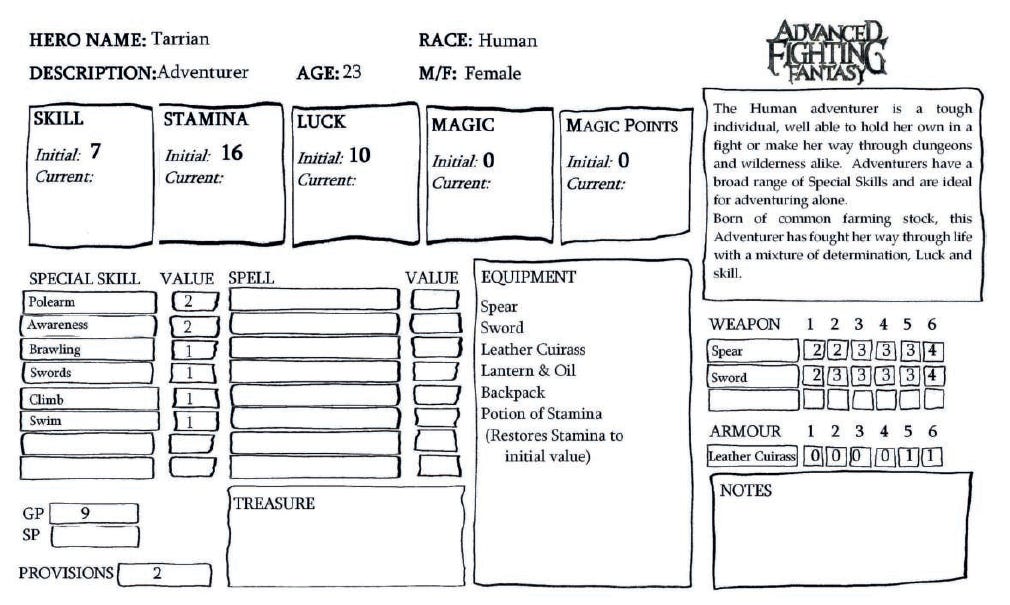
Crack open Advanced Fighting Fantasy and the foundation is reassuringly familiar. SKILL, STAMINA, and LUCK are still the holy trinity. Combat is still 2d6 + your number versus 2d6 + theirs. If you played the gamebooks, you already know 80% of how to play AFF. The other 20% is where the design earns its “Advanced.”
Change one: Special Skills. Instead of one stat resolving everything without modification, AFF layers a set of Special Skills on top of that foundation. Players spend points on skills like Swords, Stealth, Awareness, and dozens more. The value in these special skills are added to your SKILL for the specific thing you’re doing. A Hero with SKILL 7 and a Swords skill of 2 attacks at an effective 9, but only when swinging a sword. Their lockpicking is still a 7. They also added another basic attribute MAGIC that is used for the mystical arts, which is a good move. I do wish they’d split SKILL up a bit more, but this allows for far more variation of characters and is a significant improvement for a home game.
Change two: Point-buy instead of dice. Second-edition character creation isn’t random anymore. SKILL, STAMINA, and LUCK start at base values and you spend a pool of points to raise them, then distribute your Special Skills and choose a Talent. Starting SKILL is deliberately lower than the old 1d6+6 heroes, which leaves room to grow over a campaign. No more rolling an 8 while your friend rolls a 12 and spending the next year as the sidekick.
The book doesn’t stop there. Talents function like feats or edges. These are small rule-benders such as a damage-boosting Strongarm or a Dodge-enhancing Swashbuckler that give heroes greater variety. The game also features a real magic system at last (Minor Magic, Wizardry, Sorcery, and Priestly abilities), which neatly answers the “Warlock has no magic” critique, though it should also be pointed out that magic is much expanded from the Fighting Fantasy books that did include magic like Citadel of Chaos. Combat gains decisions beyond “swing again” by including rules for dodging, weapon groups, an armor system that actually reduces damage.
So, how would I evaluate Arion Games’ work with regards to the series question of how much fun would Advanced Fighting Fantasy be as the foundation for a campaign? This time the answer is unhesitating. It keeps everything that made the gamebooks feel alive at the solo table, the fast, legible, tense system, and bolts on exactly the differentiation and fairness a group game needs. It is, to my mind, the best argument that the Fighting Fantasy engine was always a real RPG wearing a paperback disguise.
The One Hero Nobody Adapted
But this isn’t just a review of how someone else took a gamebook and turned it into a role playing game. This is a part of a series where I discuss how I would convert a gamebook if I was to turn it into a full role playing game and there is still room to do that in the Fighting Fantasy series.
Advanced Fighting Fantasy adapted the fantasy engine (with sourcebooks for Science Fiction), because fantasy is what the gamebook line overwhelmingly was. Most of the books told stories of swords, sorcery, and dungeons that took place in the world of Titan, but the Fighting Fantasy catalog had one glorious outlier. In 1985, Steve Jackson (the British one) wrote Appointment with F.E.A.R., the only entry in the series to cast you not as a nameless adventurer but as a costumed superhero named the Silver Crusader. In the adventure you spent your time, patrolling Titan City, hunting the Federation of Euro-American Rebels and their leader, the Titanium Cyborg. At the start of that book you got to choose a single super-power: ESP, Energy Blast, Super Strength, or Psionics. That choice rippled through the entire book. Different powers opened paragraphs closed to every other build. This also affected how many Hero Points you could earn during play. These were points given out in some sections that let you compare how heroic you were during each replay of the book and they added greatly to replayability.
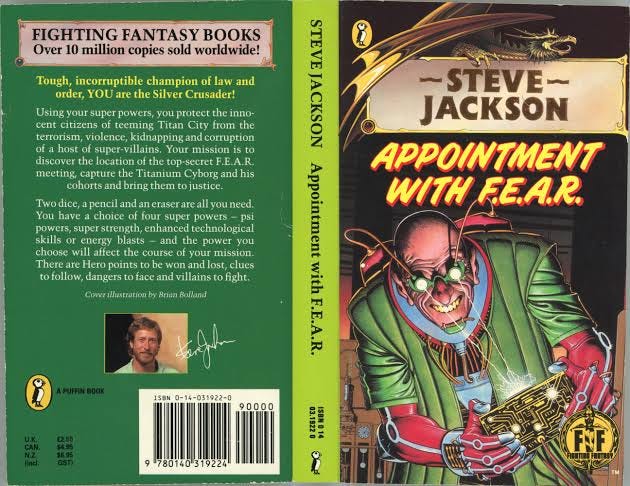
Appointment with F.E.A.R. is a superhero RPG hiding inside a gamebook, and you know how much I love superhero roleplaying games. Other than one series of posts I found online where a fan shared their own homebrew rules, nobody has ever turned Appointment with F.E.A.R. it into a multiplayer game in the past 40 years. Advanced Fighting Fantasy will happily help you run a barbarian or a wizard, but it has nothing to say about running the Silver Crusader at a table with three friends.
That’s the gap and, to be fair, it’s a genuinely hard gap to fill. But I think that this challenge is half the fun of this series. How do we expand a simple role playing game skeleton so that it can emulate other stories in the same genre? The Fighting Fantasy engine has at least three weaknesses when it comes to emulating superheroes:
Powers aren’t gear. A fantasy hero carries a sword, but a superhero is their power. How does a power get declared, activated, and paid for, without turning every turn into bookkeeping? The gamebook hand-waved this with a single chosen ability and a campaign can’t. Powers should feel different than +2 to SKILL or LUCK. Like Magic spells, they should affect the world around the characters.
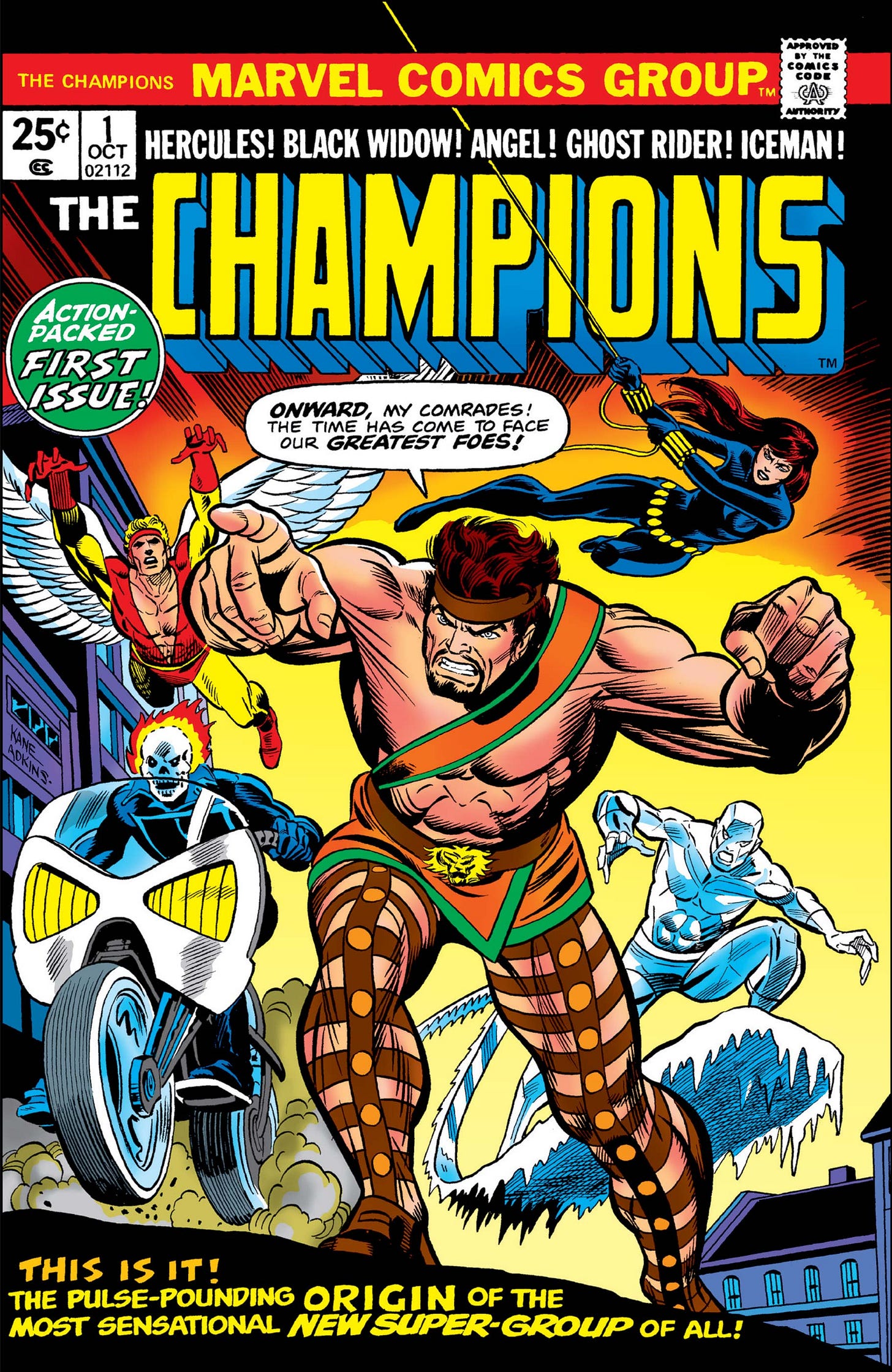
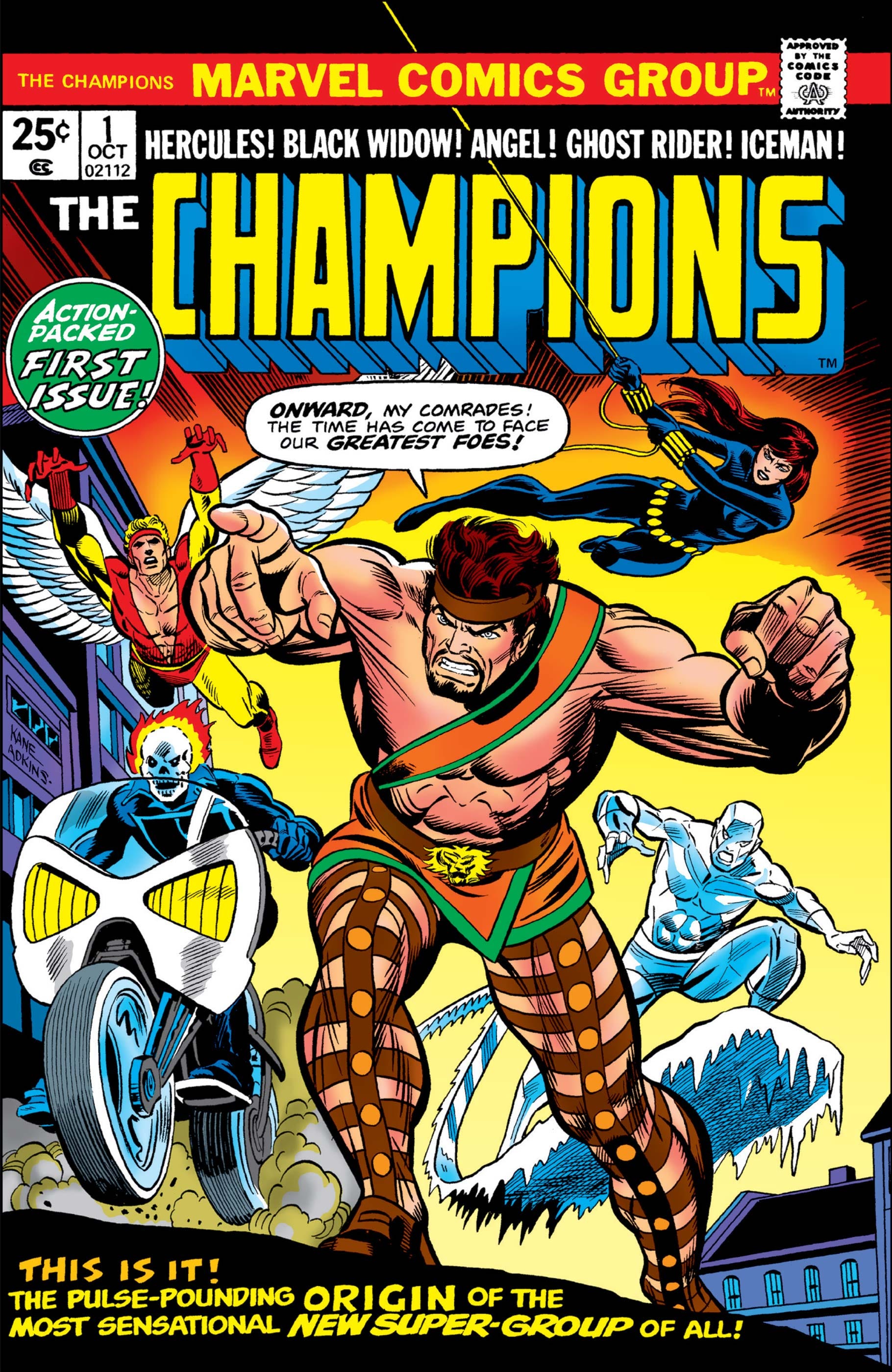
The genre is replete with power gaps. Comic book heroes run from a guy in a trench coat to literal gods, and they hang out with one another. My favorite classic Marvel team, The Champions (of Los Angeles) have one of the craziest rosters of all-time. We’ve got Angel, who can fly but is a mid-fighter and is as strong as…a regular person. Black Widow who is a trained assassin and martial artist. Ghost Rider, the Spirit of Vengeance whose stare causes even the bravest to quake. Iceman, because two X-men mean a title will sell, and Hercules the Prince of Power. Hercules is a literal god who will “Bestow the Gift of Battle” on foes well out of the league of his companions.
This is a viable team in the comics, but 2d6 is a narrow band. The same bell curve makes it so that a two-point SKILL gap feels enormous in Warlock of Firetop Mountain. This disparity is merely a bug in a fantasy setting, because 2d6 produces a bell-shaped curve rather than a flat line. A +1 to SKILL isn't worth the same amount everywhere, as it is in a d20 game like D&D. It all depends on where your stat sits on the curve. The benefit of each extra point is largest in the steep middle of the range, around the median roll of 7, and shrinks as you move toward either extreme. A +1 when you have a SKILL of 6 swings your odds far more (+16.67%) than a +1 when you already have a 9 (+8.33%). At the top of the scale the curve flattens and extra SKILL buys less and less. That same mechanic, a nuisance when you're just trying to balance a party of adventurers, becomes a genuine design constraint you have to engineer around in a supers game, where the whole point is to make a god and a street-level brawler share a roster.

The line you won’t cross. Appointment with F.E.A.R. gave us Hero Points and a hero’s code because it is deeply rooted in Four Color comics aesthetics and morality. It is a Comics Code Authority compliant adventure, which is interesting coming from an English design team. How do you make “a hero doesn’t kill” an actual mechanic, something with teeth, rather than a sentence in the introduction that everyone ignores in the first fight?

Where I’m Headed
Boy, that’s a lot of set up for my plans for “Part 3” in the Adventure Gamebooks as RPGs series. Because this is already getting long, I’m going to have to cheat on this being a solo part 3 and make this a kind of part 3a…did you notice the “a” in the title. That’s there because I need your help. It has already been established that the Fighting Fantasy engine can absolutely carry a campaign. Puffin proved that back in the day and Arion made it even better. What I want to do is to find out whether it can carry a superhero campaign, the one application that very few have actually attempted. Over the next few posts I’ll work through it in public and I’ll want your feedback. Here’s the basic outline of articles:
The Superpower Problem — how powers get built, activated, and costed on a 2d6 chassis, and why “how does a power turn on?” is the question that makes or breaks a supers system.
Building Heroes — character creation, origins, and the point-buy-versus-dice question all over again, now with capes.
The Game Itself — the full rule set, presented and playable, inspired by Appointment with F.E.A.R. but standing on its own two feet. By the time we are done, we’ll have filed enough of the serial numbers off that this will be its own game.
The Stress Test — Here I will stat up a handful of Marvel and DC icons and throw them at the system to see where it soars and where it falls.
One question to send you off, because I genuinely want to know before I start designing: back in the day, which power did you pick in Appointment with F.E.A.R.? I was an Energy Blast kid myself, and I’ve always suspected your answer says something about the hero you wanted to be. Tell me in the comments — your votes may very well shape how powers work when we build the thing.
You can purchase the Deluxe Version of Arion’s Advanced Fighting Fantasy rulebook at DriveThruRPG. The pdf is affordable, but the hardcover is a bit pricey.
The Adventure Gamebooks as RPGs Series


The Geekerati Newsletter: Thoughts on Games & Pop Culture is a reader-supported publication that has no paywall. To receive new posts and support my work, consider becoming a free or paid subscriber. If you liked the article, you can even buy me a coffee/book/pdf.

Great post. I bought the original Advanced Fighting Fantasy books, but never got around to playing an actual game -- when they were being published I was just about hitting the age where I was only interested in playing the guitar and falling in love (and neglecting my schoolwork, incidentally). Those books are notable in containing some really brilliant artwork by Russ Nicholson.
Re Appointment with FEAR... I tended to go with the gadgetry skill, whatever that was called. Perhaps with a sneaky SKILL of 12 that the dice just happened to give me, to simulate some martial arts abilities.
... and can I note that the way Appointment with FEAR was structured was really exceptional -- the special power you chose didn't simply change the way you resolved each encounter, but utterly redirected the story so that you found different key clues according to which power you possessed. Like this, the various clues that you'd (hopefully) picked up sent you off in different directions at the story's finale, so that the final confrontation with the big baddie, the Titanium Cyborg, happened in a range of different ways. I don't remember them all -- if you had strength/flight, you had to confront him on an aeroplane in the sky; if you had gadgetry you had to learn to construct some widget that would shut down his cyborg components...
Some of Steve Jackson's Fighting Fantasy books were outstanding.
In one of the encounters in 'Fighting Fantasy: The Introductory Role-Playing Game,' an NPC offers you a bowl of nuts. If I remember rightly, you have to roll a die and, if you score a 1, then you've received a bad nut, and you lose 1 STAMINA point from eating it.
Now, in the year 2026, I enjoy snacking on nuts. I'm not a big fan of chocolate or sweets, but I can eat nuts all day long. So from time to time I'll accidentally eat a bad nut.
And, to this day -- coming up forty years later, mind -- when this happens I'll still think to myself, 'I just lost a STAMINA point.'