



Before I get into this week’s Weekly Geeklist I thought I’d point out that I’m trying something a little different with this particular feature of the newsletter. For the past two weeks, I’ve launched unscheduled live chats on Substack. The first one, last week, was just me futzing around to see how uncomfortable it was to talk to a camera without any (or at least minimal) interaction from an interlocutor. The live videos are completely unscripted, though I did think up a topic that I wanted to focus on before I hit the button to go live.
It was an interesting experience and both launches saw a couple of people join in to watch me ramble. I’m not sure how many stayed, because there wasn’t a lot of action in the chat, but I think it was worth doing. In part because it’s a great way for me to share some random thoughts and touch base on what I’ve got lined up in the future. Which, in this case, includes reviews of the movie Megaforce as well as the new documentary (still making the film festival circuit rounds) Making Megaforce.
I do want to take a moment to thank everyone who tuned into my live video! Yes, I’m looking at you Kevin Vasquez. Since I’ll be doing these from time to time, if you’re interested in participating in a chat make sure you join me for my next live video in the app. You can join in while I’m live or we can schedule a live chat. I’m happy either way.


It was tough to decide what to highlight as this week’s Geeklist Oddity. I’ve been wanting to share my thoughts on the Idaho Horseshoeing School and/or The Hoof GP for some time. I don’t know how they first showed up in my YouTube feed, but they did and they’ve become a little bit of an obsession with our household. I really like how they show how important regular care of animals is for rural communities. The Horseshoeing School videos, in particular, highlight how even minor neglect can lead to some pretty significant issues. Before living in Idaho, I never thought that people might have the same semi-neglectful attitude that we commonly see with Easter “Bunny” gifts or Dalmatian Christmas pets, but with horses. I thought everyone knew that horses were a significant investment of time and money. Similarly, the Hoof GP shows how there are fake videos with “crises” that are far more dramatic than what hoof-trimmers typically encounter.
I think my favorite Idaho Horseshoeing School videos are the ones where the instructor makes his own horseshoes. Since finding the school (which is in Eastern Idaho on the far side of Craters of the Moon from me), I’ve watched some other farriers and they usually start with manufactured shoes and then fit them to the horse. This is good as far as it goes, but when Riley Mickelsen goes to make his shoes he starts with a piece of iron and gets to work. It’s amazingly soothing to watch. He’s skilled at the blacksmithing involved and makes some customized shoes, often to treat some orthopedic benefit to the horse. The combination of sound and visuals is one of my favorite ways to relax. On another note, that shows how amazingly connected our world is today, Riley is working on his Master’s Degree in Equine Science from the University of Edinburgh.
Speaking of Edinburgh, okay of Scotland anyway, Graeme Parker is the “Hoof GP” and is probably the worlds most famous cattle hoof trimmer. His videos about hoof trimming are, like the farrier videos, soothing and meditative, but Graeme’s shows are about more than cow health. He also talks about his own struggles with bipolar disorder. The show is the bovine equivalent of Dr. Pimple Popper, but with added discussion about mental health and animal health and it’s got some beautiful shots of Scotland to boot.

The Lamentations of Luke Y. Thompson
Back when I started the Weekly Geeklist (then Weekly Geekly), I made sure to include articles and reviews by Luke Y. Thompson. There were three main reasons for his inclusion and I’ll list them in order of importance. The first was that he’s a damn good film reviewer who knows his Bresson and his Corman and finds things to appreciate in both; he’s a true geek reviewer with a real love of pop culture and cinema. Second, he’s a friend and I care about him and his success. The film review circuit is a rough gig and he’s navigated those stormy seas for quite some time. Sometimes with pretty darn good success, but he’s been pushed aside at other times. Lastly, he was my editor when he worked for Village Media and ran their The Robot’s Voice website for a good amount of time.
As society became less edgy, and more sensitive, he changed the title to The Robot’s Voice from its original title Topless Robot. He did so in part because the WWE, and other properties, didn’t want to promote their products on a publication with that name. I’ll admit that I winced a little at the website’s original title as a freelancer because I was working for a non-profit at the time and the title would not have been one my bosses liked. I find it particularly odd that the WWE, who famously featured a match where Goldust (the son of “The American Dream” Dusty Rhodes) would have his wife become the property of Brian Pillman if he lost, was upset that something was too edgy for kids. You read that right…oh, and Goldust lost. There’s a reason I didn’t watch the “Attitude Era.” It wasn’t just the WWE though, and such stipulations make sense for Disney and other pop culture properties and so Luke proposed the change. It was the right move, but the Voice soon folded and the site died with it.
Luke was one of the first wave of Geek critics. He wasn’t hte only one, but he was the first to cover Comic-Con in a serious way and man did he go all in. His coverage was more than just the lazy Hall H coverage you tend to see, to this day, and he got all kinds of interviews and covered a lot of what was happening all around the Con. He never wandered into the Mysterious Galaxy panels, but he was almost everywhere else.
He recently wrote a post apologizing for “ruining” film criticism, but I think he’s being unfair to himself with that framing. He was never a rage baiter, nor was he a mere shill, like so many of the modern “Geek” critics seem to be. He was someone who took the material seriously and who worked for some of the biggest names in the Geekosphere and the Hollywood Journosphere (Nikki Finke was a big deal). You can read Luke’s origin story below, and you should. I don’t always agree with him on a host of things, but I always love him and I’m always grateful to him for providing me freedom as a freelancer.

In addition to Luke’s time as a film reviewer, he was also a regular reviewer of fast food. I don’t know what prompted him to become the Jonathan Gold of fast food chains, but Luke tried of lot of sketchy food so thta you and I didn’t have to. Well, he’s got a new article about McDonald’s Big Arch sandwich and it’s perfectly timed with all of the viral hype. Unlike McDonald’s CEO, Luke ate the whole thing and he’s got some thoughts on the quality of the burger.

I don’t do a lot of “blegging” on my Substack. It’s just not in my personality. I’m not one of those reviewers/commentators who puts my good stuff behind a paywall or spams you with requests for subscriptions. Don’t get me wrong, I am grateful to all my subscribers and I’m coming up with a way to thank them for their contributions to my gas bill, but I’m primarily here for the community and the commentary and to build community.
Today marks my first real exception to the blegging phenomenon, but because I am so proud of my daughters I couldn’t refrain from asking for others to help them. Both Nora (Mystery) and Clio (History)…yep, those are the names behind the nicknames and you get bonus points if you know why Nora’s nickname is Mystery…are one small step away from their Eagle Badges and we just need a little help to get them over the line. Clio is building shelves for a no-kill Cat Shelter and Adoption Center and Nora is building a Chicken Coop for the Idaho Humane Society because in Idaho the Humane Society gets abandoned Chickens (especially after Easter).
These projects are a little pricey, the kits and materials for the Coop and shelves as well as the paint and supplies add up, so I’d really appreciate it if you would consider donating to their Eagle Projects. Any money that we don’t spend directly on the Eagle Projects will be donated to the shelters.

And now for our regularly scheduled Internetowebosphere sharing. As always, Matt Thompson has been banging out interesting articles on his Critical Hit Parader Substack and this most recent one includes a discussion of a role playing game based on a “cassette play list” mechanic. Tales from the Tape Deck adventures come in cassette tape cases and each features a “mix tape” of music for you to use as you play the themed adventures. There are multiple genres being planned and it looks absolutely fantastic. Oh, and Matt provides what, for me at least, was a relatively deep cut Kool & the Gang song.

If you’ve ever wondered how role playing games evolved from wargaming, there is no better YouTube channel for you to follow than Yogscast’s Games Night. They run themed miniature skirmish adventures that echo the old Tony Bath Hyborian campaigns, except where Tony focused on creating battles inspired by Conan the Barbarian, the folks at Games Night run the gamut of pop culture. One of my favorite examples of what they are doing is their “Predator vs Every Arnold Schwarzenegger” episode where they used the Don’t Look Back horror movie miniature skirmish rules to tell an interesting story. Wargaming has always been a hobby of role playing, but you really see it in skirmish scenarios like this.
Rebekah King has been on a roll lately with her Horror Moments series as she turns her critical eye to the underlying horror of Classic Disney productions. Her recent article on hypnotism and Sleeping Beauty is particularly good as it highlights some of the real horror of that tale, horror that is minimized by more recent live action productions. Maleficent can’t directly attack Aurora and so she manipulates her into a form of self-harm. While Rebekah focuses on other horrific elements in the film, I cannot help but think of the way that social media is used to manipulate people in ways that cause them grief or lead to depression and worse. Maleficent’s evil is in manipulation of the innocent. She wants to kill a child because she wasn’t invited to a birthday. There are also underpinnings of Gothic notions of sexuality, both in the Germanic sense and the literary sense, that add to the horror. Rebekah is a wonderful and imaginative writer and I love reading her thoughts. The fact that she included discussion of The Somnambulist from The Cabinet of Dr. Caligari is just icing on the cake.

Matt Glassman is one of my favorite political scientists and he’s got an interesting discussion of the importance of March 4th in American History and how the early American Political Calendar was very messy. I don’t want to reveal too much, but Glassman gives proper credit to “The Gouv” so it’s worth a read just for that.

Robert F. Graboyes is an economist and journalist who earned his PHD at Columbia University and taught courses on health economics at the University of Virginia and other courses at George Mason University and The George Washington University all while doing other work like working at the Federal Reserve Bank and Chase Manhattan Bank. The life of an academic is not an easy one and side hustles are a part of the gig. He recently wrote a very informative post on the slightly disturbing history of the founders of the discipline of Statistics. Early statistics were very much tied to the eugenics movement and the people who invented tools that have helped the world advance in a variety of ways, including creating the perfect flavor profile for Guinness, have a less than noble past. It’s one of those important essays that touches on morality and science and how it is important to constantly be skeptical of scientific reporting, even as you know that deferring to greater knowledge can be a good thing.


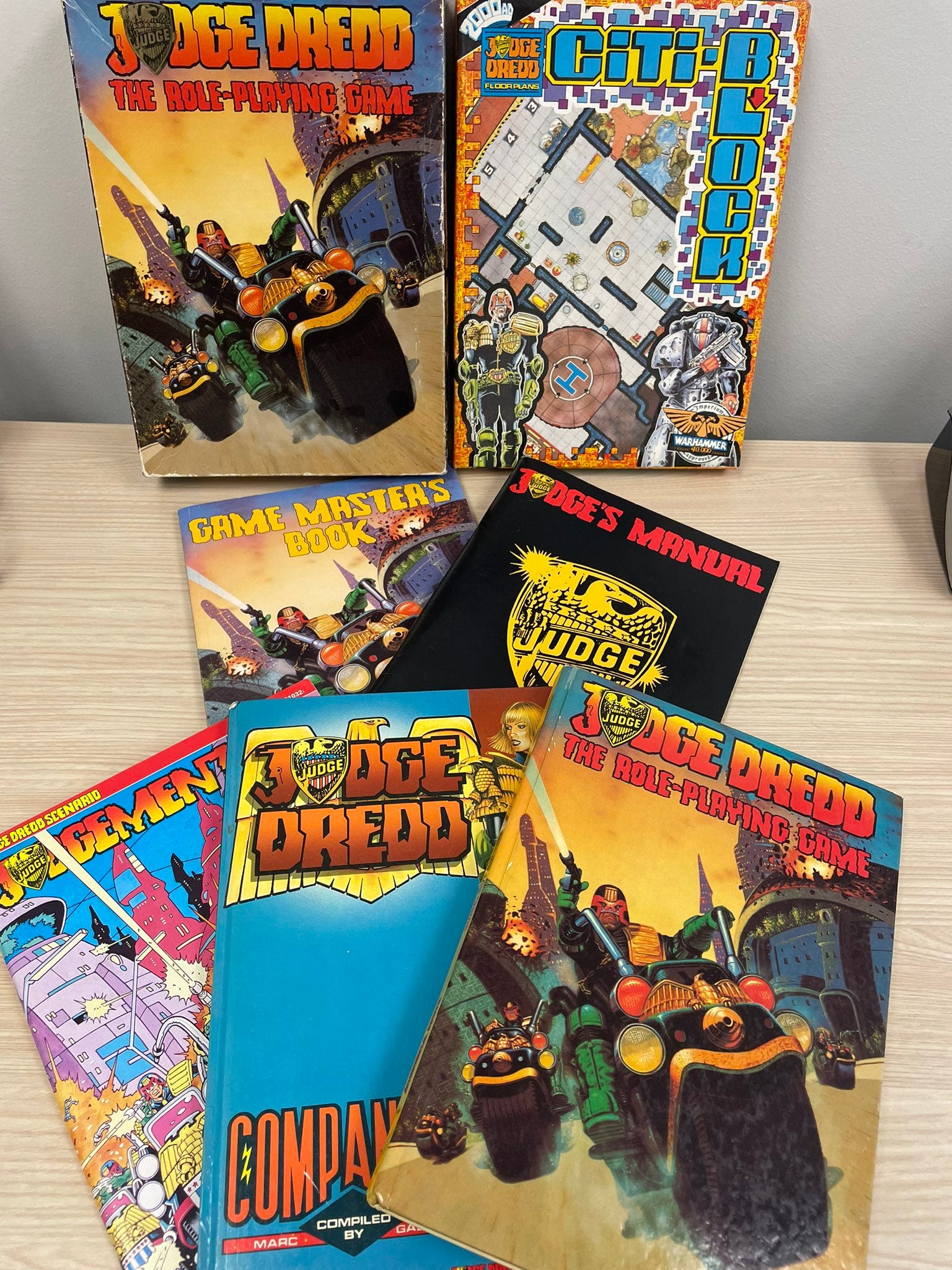
I’ll be writing a full review of this game soon, but I wanted to recommend that you try to find a copy of Games Workshop’s 1985 Judge Dredd Role Playing Game. It’s an interesting attempt to adapt a long standing comic book title to game mechanics. In this case, mechanics that are similar to those of Games Workshop’s Warhammer Fantasy Role Play. That similarity is likely due to the fact that Judge Dredd was Games Workshop’s second in house designed role playing game, but there are some significant differences.
The game is clearly trying to balance approachability with complexity. On the approachability side, the game has only one physical attribute (Strength) which is a combination of physical aptitude and toughness (it’s also how many HP you have) and seven skills that range from Initiative and Combat Skill to Technical Skill and Psionic Skill. Strength is rated 1 to 4 (1 to 3 for Judges and normal humans) while the others are pure percentiles that tell you what percentage chance your character has to perform an action.
While the core mechanics are simple. You state the action you want to take, look at the appropriate skill on your sheet, and roll percentile dice and if the result is equal to or less then the action is successful. On the complexity here are a lot of little fiddly bits that add depth to the basic skills. For example, when our Combat Skill hits 40% (and every 10 points thereafter) you can select one “Special Ability.” These range from the ability to shoot faster or use a “knockout blow” on an opponent. These special abilities are similar to feats in later role playing games and there are enough of them to add variety to the players’ Judges. As I said though, I’ll be giving a full review very soon but it is a game I recommend tracking down.

As I was reading through the Judge Dredd game in preparation of writing about it (yes, I have played it but it’s been a while), I began thinking about a potential soundtrack for game play. Matt Thompson’s articles on music and role playing games probably helped push me in this direction too. I immediately thought music perfect for a Cyberpunk setting would be ideal for a Judge Dredd game and so I went to YouTube and scoured for some hard core 90s Industrial music because when I was young, this is what I thought the music of the future would sound like.
No song captured that better than Skinny Puppy’s song Worlock. The combination of samples from film and television with pounding drums, hard edged guitar sounds, and angry vocals always seemed to me the essence of Cyberpunk. The cyber was captured in the combination of digital and electric sounds and the punk was captured by the anger and when I think of that combination, I think of Skinny Puppy.
I also tend to think of 90s era Ministry. Their combination of Industrial rhythms and speed metal guitar riffs was hypnotic and the political anger they channeled was palpable. It was everywhere in their sound. Sure, early on in their careers Ministry produced music that was an almost parody of Depeche Mode. Yes, I’m talking about Every Day is Like Halloween and the With Sympathy album. By and large With Sympathy is a proficient album (and was popular enough with the alternative crowd that its cover inspired the cover of the Vampire: The Masquerade role playing game.

That early music was soft and “commercial” (if you consider Depeche Mode commercial), but it was soon replaced with pure industrial with the album Twitch (which is a very “Skinny Puppy-esque” album) and then the anger driven Metal-Industrial of Ministry’s later albums. The songs were undeniably angry and often political. Songs like Stigmata hit hard and hold up against the test of time.
Sadly, there most recent foray into political commentary returns to their Every Day is Like Halloween days in a way that turns the whole thing puerile. The song is a critique of authoritarian cults of personality, a great topic for a song, but the song itself comes across as saccharin and soft. I think they were attempting a kind of irony here, but it ends up falling flat and making their commentary feel less serious. Yes, humor can be the most biting tool against authoritarianism, but making light of things can also make your critique seem trite and that’s the case here. I was actually surprised that one of the hardest hitting political bands could put together something so cotton candy and insipid.
Thankfully, there was already a banger song about the damage that cults of personality cause and it came out in 1988 on Living Colour’s debut album Vivid. The song strongly demonstrate guitarist Vernon Reid’s talents as the hard and hypnotic melody transforms into a blazing guitar solo near the end of the song. Corey Glover’s vocals resonate with sincerity and urgency and the whole package combines into one of the great rock songs of the late 1980s and it help set the stage for the later radio expansion of Grunge and Alternative Metal. This isn’t to say that they influenced the bands, most of whom were already making music, rather that Living Colour demonstrated to radio station managers that there was a market for the sound. Given their inclusion in the inaugural Lollapalooza lineup, their alternative cred is undeniable and the chaos of the guitar solo perfectly channels the rage appropriate for a Cyberpunk song.
It never ceases to amaze me that one of the most experimental post-punk bands (Joy Division) transformed into a New Wave Dance Electronica band (New Order) so seamlessly. That is, until I listen to their album Substance. When you hear songs like Ceremony, the Joy Division connection is clear, especially as you listen to the chord structure and phrasings of Ceremony just before listening to Blue Monday. As catchy and danceable as the night club grooves of New Order are, the sorrow and pain that drove Joy Division is still there. As I’ve grown older, I’ve come to realize that this was the first glimpse of what “Cyberpunk” music was and would be in the future. It was music that sounded commercial, and yet had subversive elements within it. More recent performances by New Order also highlight stage shows that evoke futurism and our digital world. These are elements I missed when I first read Mike Pondsmith’s Cyberpunk Role Playing Game as a kid, but that are right there in the descriptions of the music. Rockerboys combine the excesses of corporatism with subversive messaging. I think that’s what Ministry was trying with their recent song, but I still feel their result was more Birdemic 2 than Birdemic, the product is there but the sincerity is completely lacking.
Speaking of sincerity and Cyberpunk…for me the musician who best combines those traits is Gary Numan. I’ve recommended his song Are Friends Electric? before and it’s one of my favorite songs about the difficulties of human connection, but Numan’s catalog is much deeper than that song. It ranges from the commercially successful Cars (which he didn’t appreciate until Trent Reznor told him how awesome it was) to far more obscure songs, but one thing remains constant and that is the sincerity. Gary Numan is Gary Numan and he does not pander in his creations.
Sincerity, subversiveness, and sadness are some of the core elements to Cyberpunk songs to me and there is almost no song that channels Cyberpunk era rage than Kesha’s All That Matters (The Beautiful Life). Like New Order, her song appears to be an anthem for the dance club crowd. In this case about dancing and living “the beautiful life,” but underneath it all is that repeating phrase “All that Matters is…” and it’s a phrase that echoes Nietzche’’s Last Man. This isn’t an anthem, it’s a dirge for a dying society. Like the bacchanal in the second Matrix film, this is a song that shows the banality of the current state of the world. It is one of the saddest and catchiest songs I’ve ever heard and I could totally see Kesha opening for Johnny Silverhand.


I’ve mentioned before that I’m “pretentiously anti-pretense.” I’ve watched a ton of films in my life and have watched the entirety of many lists of “films you are supposed to like.” When my wife was getting her MFA in Film Production at USC, I sat in on all of her film criticism classes and further expanded my film knowledge listening to lectures by Drew Casper and others. It was a great time, but it also convinced me that I was not a big fan of most of French New Wave. Jules et Jim is one of my least favorite films, as is Robert Bresson’s Diary of a Country Priest. I find the first overly indulgent and the second seems somehow incomplete. It’s engaging with challenging material, but in a way that is almost dreamlike and never really connected with me. Too many of the scenes are disconnected from one another narratively and there feel like there are gaps, gaps I want filled.
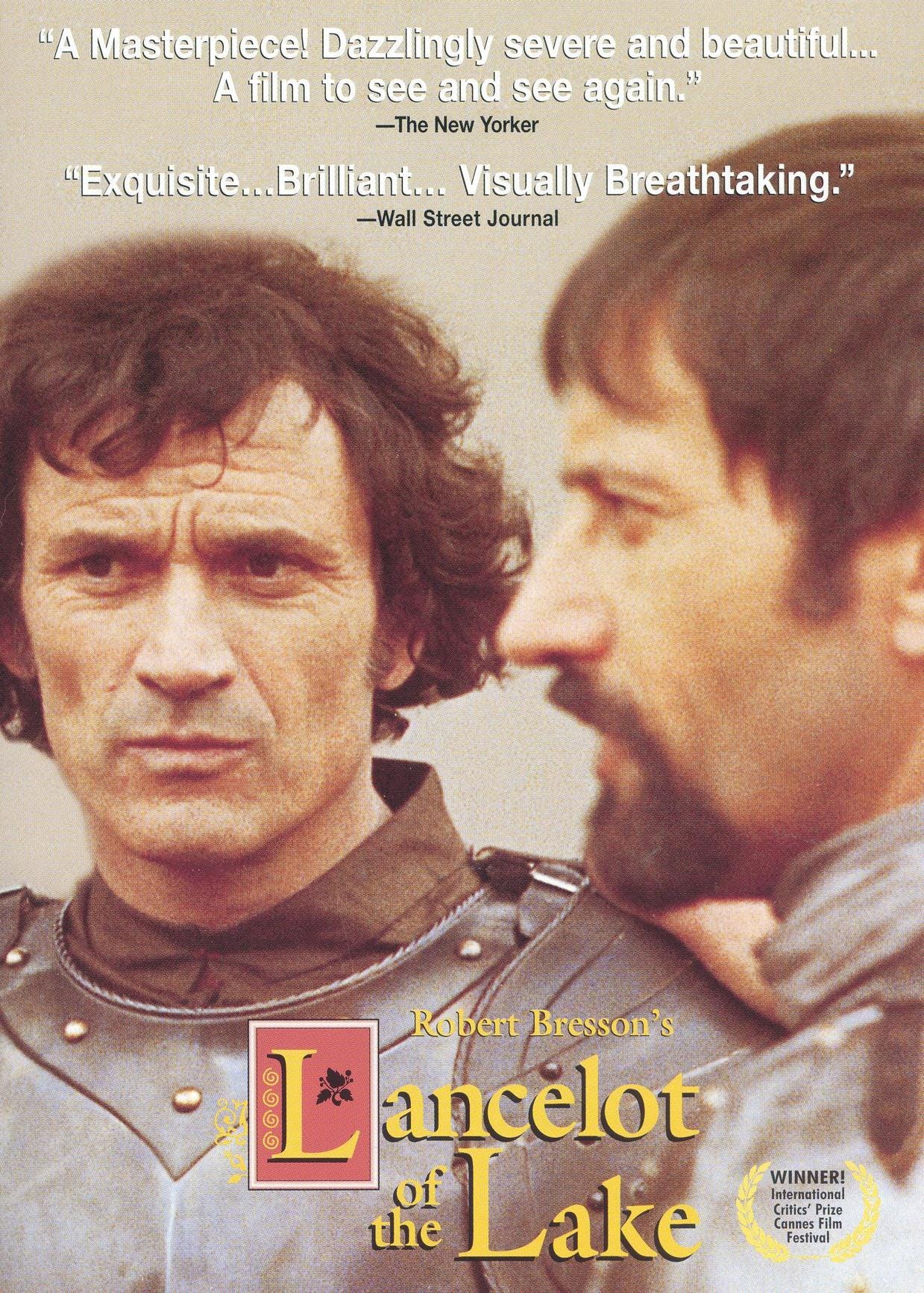
Bresson’s film Lancelot du Lac maintains that dreamlike quality, and has some pretty big gaps narratively, but the result is much more solid in my mind. This is in part because I am more familiar with the underlying material and the conflict’s underlying the characters, but it’s also because Bresson has grown as a film maker.
The film opens at a point of crisis during the Grail Quest period of the “Matter of Britain” (the King Arthur Saga) when most of Arthur’s knights have either failed to find the Holy Grail or have died in the process. One of the reasons so many have died is that Mordred sowed the seeds of discord and distrust and the knights battled and betrayed each other during their quests. In Bresson’s film, Percival (Perceval) has completely disappeared and Lancelot has returned having glimpsed the Holy Grail but been denied the ability to bring it home due to his affair with Guinevere. He has returned to break things off with her and return to the quest. Events, and his continuing feelings for Guinevere, conspire against him as he must defend Guinevere against Mordred’s claims of her infidelity. The claims are true, but the revealing of them will destroy the King and the Kingdom.
His chief ally in Bresson’s film is Gawain. This is ironic for a number of reasons. Not only was Gawain a frequent opponent of Lancelot’s in the tales about the politics of the Arthurian Court, he is also a legacy figure from Welsh legends where he is depicted as one of the greatest of knights. In the Vulgate, and other French and post-French Arthurian tales, he is either diminished in importance or a villain. Bresson has decided to embrace the noble version of Gawain and Humbert Balsan is excellent in the role. He is the single most beautiful person, physically and morally, in the film and is extremely compelling as the one knight truly focused on keeping the Kingdom together. Luc Simon is strong as Lancelot and compellingly balances his passion with his duty. Vladimir Antolek-Oresek is a good Arthur, but he plays a relatively minor role in the film. His dialogue is mostly stage setting and stake establishment. The scenes with Laura Duke Condominas (Guinevere) and Luc Simon are very strong, but they don’t paint Guinevere in a very flattering light.
The cinematography is both beautiful and frustrating. The shot selection in some scenes is absolutely fantastic and you can see how this film clearly influenced John Boorman when he made Excalibur because there are shots in Boorman’s film that are clearly lifted straight from Lancelot du Lac. I think that many of these beautiful shots are a bit underexposed, giving them a bit of a muddy quality but that could also be intentional given the tragic direction this film takes. Camelot is a shadow of itself and that shadow might be reflected in the amount of light Bresson allowed the film to capture. The fight sequences are interesting and you can see how Monty Python and the Holy Grail lifted moments from Bresson’s film, especially the fight with the Black Knight. That’s right, Bresson influenced both Excalibur and Monty Python and the Holy Grail with this one picture. The fights are bloody and brutal. Not as bloody as later films would become, but I think they might have been shocking at the time because the blood isn’t the “bright” blood so often used.
All of this suggests that the film is a great film, and it is, but it also has its limitations. The jousts are not well done, in large part because the stunts would have been too difficult to do with the cast and crew at hand. Most of the action in the jousts is inferred rather than shown and I think this is the right choice given the limitations, but having seen A Knight’s Tale it seems a bit of a misstep but a very forgivable one. The real weakness of the film is in the dialogue. There are no natural conversations in the film. Every line spoken feels like a plot point being revealed rather than a natural moment. As with the jousts though, I find myself forgiving this too because of the dreamlike nature of the film. If I am watching a story being told to me, which I was when I watched this, then does it really matter if the dialogue is too on point? My sense is no, it doesn’t. Sure, it would be more naturalistic for the dialogue to feel like conversation, but it’s not necessary in the land of myth.
Like René Clément’s Purple Noon, Robert Bresson’s Lancelot du Lac pushes me outside my knee jerk rejection of French New Wave and into an appreciation for its contributions to the art of film. Lancelot du Lac is a sad film ith slight imperfections, but it is one I highly recommend.


