



Greg Gorden: Designer Extraordinaire
Way back in September of 2019, I had the honor of interviewing award winning game designer Greg Gorden in Episode 164 of Geekerati Radio. Greg was on the design teams for DC Heroes, James Bond 007, Torg, and many other games. Given the amount of time I’ve spent playing games he designed, or worked on, I don’t think it’s an understatement to say that he is my favorite game designer. In the episode, we discussed a number of the game systems he's worked on in the past and some of the mechanical innovations he's come up with. Two of his major contributions discussed in the episode were "Exploding Die Rolls" and the development of Fate Chip mechanics in Deadlands, a mechanic that has evolved into the Bennies system in Savage Worlds. He was also on the design team that pushed for the incorporation of Die-Step game mechanics into role playing games.
The mechanics that Gorden developed have had a wide reaching impact in game design across the table top role playing game hobby and are worth discussing in some detail. As interesting and wide reaching as the influence of the exploding dice mechanic of DC Heroes has been, that is an innovation that's been around since the first edition of Ken St. Andre's masterpiece Tunnels & Trolls and I’ll touch on that particular mechanic in a future post honoring the very underappreciated design work of Ken St. Andre. His design influences are huge (and include the Fallout series of games), but he is not as well known as he should be in part because people didn’t often cite his influence on their designs. This newsletter post will focus on the second innovation, die-step game mechanics, and why they are one of the best mechanical foundations for any role playing game.
The Most Common Role Playing Game Mechanics
There are several common base mechanics for arbitrating the success or failures of character actions in modern role playing games. Some of the most frequently used are Difficulty Number/Target Number (or what Classic Traveller called a "Basic Throw"), Percentage Chance (as exemplified in Runequest), Success Threshold (which can use narrative dice like Genesys or die pools like Vampire) or a "you, me, or we" Shared Decision Mechanic like Apocalypse World, Inspectres, and many other indie role playing games.
Many of these systems use a "Fixed Die" mechanic as a part of their resolution. For example, all rolls in D&D's Difficulty Number system are resolved using a twenty-sided die, Traveller and Apocalypse World use a roll of two six-sided dice, Vampire uses a pool of ten-sided dice, and Runequest uses percentile dice. The die type doesn't change to reflect the skill of the character or the challenges faced by the character in a fixed die system, only the modifier applied to the roll or the number of dice rolled changes.
Die-Step games take a different approach. Instead of using a single die type for the determination of success or failure of an action, they use various die types that move up or down to reflect the skill/natural talent of the character. For example, a character's Strength might be reflected as a die value ranging from d4 to d12 with a character of d4 Strength being weak and a character with a d12 Strength being very strong.
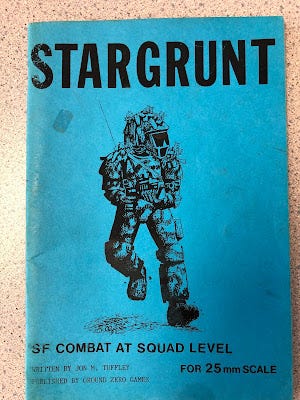
According to Rick Priestley (a major figure in the history of the wargaming hobby), in his book Tabletop Wargames, one of the first wargames to use a Die-Step system was StarGrunt by Jon M. Tuffley. StarGrunt was first published in 1990 by Ground Zero Games and it’s second edition is available in pdf for free at the link above. StarGrunt is a science fiction miniatures skirmish game that is inspired by fiction like Gordon Dickson’s Dorsai, David Drake’s Hammer’s Slammers, the Alien films, and role playing games like 2300 AD. The rules are relatively easy to learn and one of the reasons this is the case is the fact that Tuffley decided to represent the effectiveness of individual troopers with something he called a “Basic Die.” In StarGrunt, each given trooper is rated as either Green, Regular, or Veteran. The rating of each individual trooper is determined at the beginning of play with Green troopers using a d6, Regulars using a d8, and Veterans using a d10 to determine how successful they are at a given task. StarGrunt uses a Target Number system, but does use a Step-Die modifier mechanic called “Basic Die Plus and Basic Die Minus” where the dice used by the troop levels is moved up or down one die type (from d6 to d4 or from d10 to d12) under some circumstances and modified by a additive/subtractive number in other cases (+1 or -1 to the roll).
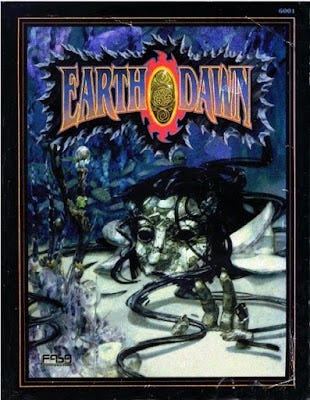
The first role playing game I can think of that used a Die-Step system is FASA’s Earthdawn First Edition published in 1993, with game mechanics designed by Greg Gorden and others. As stated in the Geekerati interview, Gorden was inspired to use a Die-Step system when his boss asked him to design a Fantasy role playing game that had its own system, but that still used all of the polyhedral dice Dungeons & Dragons players were used to using. The goal was to have a unique system while building on a familiar base. While the dice might have been familiar to gamers everywhere, the way they were being used wasn’t.
You can see how Earthdawn knew it was introducing a new concept in the Die-Step system to players who had only experienced games like D&D and Runequest by the way the rulebook first presents the Die-Step mechanic. In Earthdawn, players attributes are rated by a standard value and then given their die based effectiveness rating (yes… as you look at that image below it’s true that Earthdawn used the Papyrus font). Given that one of the character generation methods in Earthdawn, the random roll method, has players roll 4d6 and drop the lowest value, it is clear that the intended audience was D&D players and the authors were giving these players a point of reference for how good a “d8” in an attribute was. Looking at the chart below, we can see that a character with average Intelligence in D&D (10 - 12) would have a d8 rating in Earthdawn.

While Earthdawn is truly innovative, it is also illustrative of a quirk in some Die-Step systems. In some systems you can go from discrete uniform distributions (with “steps”) to more bell curved distributions which means the “kind” of probabilities represented aren’t exactly the same. Rolling a single 12-sided die is very different than rolling two 6-sided dice. Since the individual dice in Earthdawn are also “exploding” dice it is still better to roll 2d6 than 1d12 as you’ll see later.

Another revolutionary role playing game that utilizes a Die-Step mechanic is Shane Lacy Hensley’s masterpiece Deadlands Classic. The first edition was published in 1996, three years after Earthdawn, but the underlying mechanics were designed by Shane Hensley with some additions like Fate Chips from Greg Gorden. During the interview in Episode 164, I erroneously credit Gorden with choosing to use a Die-Step mechanic in this game. Gorden corrects me and let me know that this was all Shane Hensley’s idea. This is a good demonstration how great designers can come up with parallel mechanics, though Hensley had done previous work on Earthdawn so that might have fueled the creative fire a little.
Speaking of Shane Hensley and Deadlands, he is currently running a Kickstarter celebratin’ the 30th Anniversary of the publication of the Deadlands roleplaying game. The Kickstarter is for a new edition that uses the Savage Worlds rules as the core mechanic for the setting which uses a single die step-die mechanic rather than the pooled step-die mechanic of the original Deadlands game. If you want to play the original 1996 rules, you’ll need to track down a copy of the 20th Anniversary book or buy the pdfs from DriveThruRpg. Pinnacle shifted the game from the older system to Savage Worlds in 2006, making this not only the 30th anniversary of the Deadlands setting but the 20th anniversary of the game using Savage Worlds as its foundation.
Deadlands Classic uses a combination of Die Pool and Die-Step mechanics as character attributes and skills are rated by both the quality and number of dice. Thus a person might have a Smarts of 4d4 or of 2d10. The person with the 4d4 rating will roll more dice, but the one rolling 2d10 is more intelligent. Like Earthdawn, die rolls in Deadlands are exploding or “open-ended,” but unlike Earthdawn players select only the highest value from their pool rather than adding them together. This innovation leverages the strengths and intuitive nature of Die-Step systems without adding the shift from uniform to more bell shaped distributions hinted at above. Players in Deadlands who roll multiple dice are getting increased attempts at the uniform distribution of their die type.
One of the primary strengths of Die-Step systems is that they are easy to understand and are intuitive in representing each character’s potential. If a game has a baseline difficulty of 4 for most tasks, it is easy to figure out how likely a character is to be able to accomplish a task merely by looking at the kind of die rolled. As mentioned above, a character with a d6 would have a 50% chance of success and a character with a d8 would have a 62.5% chance.
Another advantage, at least from a simulation perspective, is how modifiers affect Die-Step systems differently than standard fixed die systems. In D&D, for example, a +1/-1 modifier adjusts the level of success by a character by +/- 5%. Some might argue, okay I am arguing, that this isn’t a good simulation of effects. A person who is a highly skilled sniper would be affected by crosswind and distance, but would not necessarily be AS affected by them as someone less skilled due to their knowledge of aerodynamics etc. In a fixed die system, the modifiers are static too. In a Die-Step system, the modifiers are fluid. Some might argue that this makes it more difficult to balance, but I would argue that you should balance for the ordinary and allow the dial to move with greater success.
Let’s take the d6 vs. d8 above as an example and assume that these are the characters’ ratings in their “Shoot” skill and that the base target number for successfully hitting something is 4+. Okay, this wasn’t an exactly random choice since that’s the actual target number in Savage Worlds. Let’s assume that firing at long range adds -1 modifier to the roll. In the case of the lesser trained d6 shooter, this is a penalty of 16.67%. In the case of the d8 person, it’s “only” a penalty of 12.5%. Thus the skill of the characters is coded into the level the modifier affects the character with characters of higher skill suffering lower effects from modifiers. What I like about this is that it means that the probability of success by higher level characters is less random, even when accounting for obstacles and modifiers. And this is done in an elegant way that is embedded in the system.
If you don’t agree with the benefits of a sliding system in Die-Step systems, let me introduce you to rigid modifiers in a multiple die Target Number system like Champions. Because these systems use additive die pools, in the case of Champions rolling 3d6 and adding them together, results are along a bell-curve. This means that each point of modification has a different effect on the probability of the outcome based on the distribution curve of the die combination.
Which brings me back to the quirk in the Earthdawn system; it shifts between the classic uniform discrete distribution and a bell shaped distribution depending on where you are in the step-process. Because Gorden wanted Earthdawn to be able to represent an tremendous range of Attributes, the actual Step/Action Dice table has attribute values going to 100, you quickly end up rolling pools of dice in order to achieve the ability to roll higher outcomes. For example, looking on the chart above you can see that there comes a point where a player rolls a 2d6 and adds them to get a value. This is statistically better than rolling a d12. However a quick glance at the table below illustrates the difference between the normal die distributions quite clearly.

A character rolling 2d6 has a significantly lower chance of a bad roll, but also has a significantly lower chance of a good roll unless the dice explode individually, which is exactly they do in Earthdawn. This both allows Earthdawn to simulate amazing heroic acts that would normally be beyond the capabilities of characters and have 2d6 rolls be better than 1d12 rolls. In this particular case, you get a distribution that looks like the one below.

Note that the d12 roll is flat at each point due to the uniform distribution of the initial curve. This means that there are areas of higher frequencies within the distribution. Yes, those areas tend to benefit the player and are better at getting results in between “jump points” that occur when using a single die. For example you can actually get a result of 12 when rolling 2d6 if each die explodes individually while you can’t if you roll a 12 on the 12-sided die because you would be rolling again and adding that result to your 12. This makes rolling exactly 12 impossible on an exploding d12. Whether you prefer the more or less uniform approach is up to you, but each has its quirks as you can see from the image above. You can also look at the graphs available at this anydice link. If you go to the link, click on “Graph”, and then “At Least” you’ll see that rolling 2d6 where each individual die explodes is more likely to get higher results. You’ll also see there is an interesting “wave” the distribution.
One way to address this quirk is offered by Savage Worlds or Dungeon Crawl Classics which attempt to correct the distribution problem by either adding static modifiers after a person has achieved d12 or manufacturing dice that fill the void between d12 and d20 with the creation of new dice like a d14 and d16. While the use of Die-Step systems may constrain the power curve more than some other systems, these games are well balanced and use the mechanic to very good effect. Savage Worlds, for example, has done an excellent job of adapting a Die-Step system to super heroes as have the Sentinel Comics role playing game and all the super hero games that used the Cortex system.
There are many games and game systems in the table top role playing game hobby. Dungeons & Dragons is a great place to start, but you should check them all out and see what you like.


