


Is It Possible that AI Might Be Fun?
Something happened while I was deep in my scholastic cave editing the chapters of my disseration that has thrown me for a bit of a loop and caused me to question my priors in a very real way. Since Midjourney poked its ugly head out and initiated the trend of AI slop imagery dominating book covers and memes, I’ve been largely opposed to AI. I think that artists, of all kinds, are amazing and deserve credit for what they are doing and I think most AI companies committed massive copyright infringement when they created their initial “learning data” for their various AI engines. I still think both of those things are true. I am also becoming a bit of a fan of AI as a tool.
You see, it all started when I took a break from running regression analysis of Youth-Parent dyads in order to rest my brain. I decided to look at my Substack feed and read some of the articles from newsletters I subscribe to and to some that had been shared on Notes. Someone shared a post by scott cunningham where he discussed his experiments using Claude.ai to help him with his research. Scott’s an Economist and Professor at Baylor University and as I watched him engage with Claude in a couple of his videos, I began to notice a couple of things. First, that while Claude was giving him output in the form of data analysis and slide decks, Scott was doing all the conceptual work and correcting numerous mistakes (in both coding and analysis) that Claude would make along the way. For the most part, Scott was interacting with Claude the same way that I interact with R (or Python) except instead of writing something that looks like this…
hypothesis.3.i <- lm(
  youth.rep.dem.diff.norm ~ father.rep.dem.diff.mc +
    mother.est.rep.dem.diff.norm + parents.agree.norm +
    parent.political.activity.mc,
  data = analysis.data |> filter(is.father == 3))
…he said to Claude that was something like, “Hiya, I’d like to run a linear regression model with the a youth’s difference in sentiment between Republicans and Democrats is the dependent variable and the father’s and mother’s differences, as well as whether they agree politically are the independent variables. Oh, and add the measure of political activity too.” At that moment, I realized that while many of the critiques of Claude and other AI’s were very accurate, it can let you just tell it to do stuff and it will do them, they were also slightly off base. You see, what Scott was doing was programming, iteratively through conversation, with something that translated his English language requests into a programming language.

Yes, you can be lazy and have Claude be the primary driver in this relationship, but Claude and other AIs aren’t really good at thinking in the same way as the human mind. Claude produces better code and better results from someone who knows how the code works and the theoretical foundations of any analysis being done. Claude might forget to mean-center variables (which isn’t actually necessary, but might be prudent) in the right way or might misinterpret a codebook or just make up a variable or information. Heck, it might even make major blunders in creating the code and leave ugly artifacts behind. All of those problems can only be addressed if the person working with Claude knows the material. Working with Claude for analysis is like being handed a Graphing Caluclator you can talk to with all the benefits and dangers. If you hand kids calculators too soon in the process of learning Calculus, they won’t really understand the intuitions and rules. However, once they have a foundation, it speeds things up. In other words, Claude can either make you dumber, or more productive. It is in how the tool is used and not the mere existence of the tool that determines the morality of the act in question. How and why you are using AI is important and so too is the way it got the information from which it learns. I’m still pissed about the copyright stuff, and still think using living artists is better for a lot of reasons, but using Claude to aid in analysis, to copy edit, and to make tools for my home gaming are things I am entirely sold on now.
Let’s start with that first possible use of AI, that of aiding me in analysis. I recently saw a tweet about a paper published in Theory & Society by James Manzi that used a large language model to analyze 600,000 social studies abstracts and place them on a uni-dimensional (that’s on a single line) political ideology scale. The paper found that, “the mean political stance of every social science discipline was left-of-center every year during the period. Second, all disciplines showed leftward movement between 1990 and 2024.” The paper got some immediate pushback from Pippa Norris, a highly respected scholar of democratic institutions, for using “oddly multidimensional” anchors and forcing them into an “invalid unidimensional scale.” Dr. Norris was also shocked at the use of the New York Times as “Progressive” and the Heritage Foundation as “Conservative.”
I won’t go into a lot of detail regarding why her initial complaint about how it is inappropriate to force a multidimensional construct into a unidimensional one, except to say this. Keith Poole designed an innovative way of analyzing partisanship and ideology in “political space” via a method called Nominate. It approaches political views as essentially multidimensional constructs that exist in multiple imaginary dimensions, hence the term political space. His theory combines Hotelling’s analysis of consumer choice in real space, driving distance maps, and probability to create a two-dimensional measure of ideology.

While Poole’s model is multidimensional, he found that due to polarization “a single score that measures how liberal/conservative a member is accounts for most of the choices members make” and thus that it behaved like a unidimensional score. As much as I like what UCLA is doing with their VoteView website, which builds on what Poole did, I find Poole’s clunky old website to be much more useful for learning about polarization and what the heck I mean by “political space.”
My reflexive pushback to Dr. Norris is relatively minor, but that was not the case with Sean Westwood. He’s an Associate Professor at Dartmouth and Director of the amazingly useful Polarization Research Lab and who’s work has been cited FAR more than mine. I’m not doing an appeal to authority there as both he and Dr. Norris are highly regarded, I’m just being humbled by looking at his Google Scholar page. Anyway, Dr. Westwood pushed back by saying that all of Dr. Norris complaints were true of her own V-Dem scale as well. In fact, he was actually being kind to the V-Dem scale by saying it was “just as true of V-Dem” since V-Dem’s only publications admit they use a methodology that creates results that are “overstated and lacking in nuance” due to their subjectivity. That Dr. Westwood gave such strong pushback, led me to ask whether Dr. Norris was right or wrong to say that The New York Times wasn’t “Progressive” and that the Heritage Foundation wasn’t “Conservative.” I haven’t done analysis of The New York Times yet, I’m still looking for “anchors” for data, but a quick look at AllSides’ rating of them has their Opinion Page placed on “The Left” of the scale.
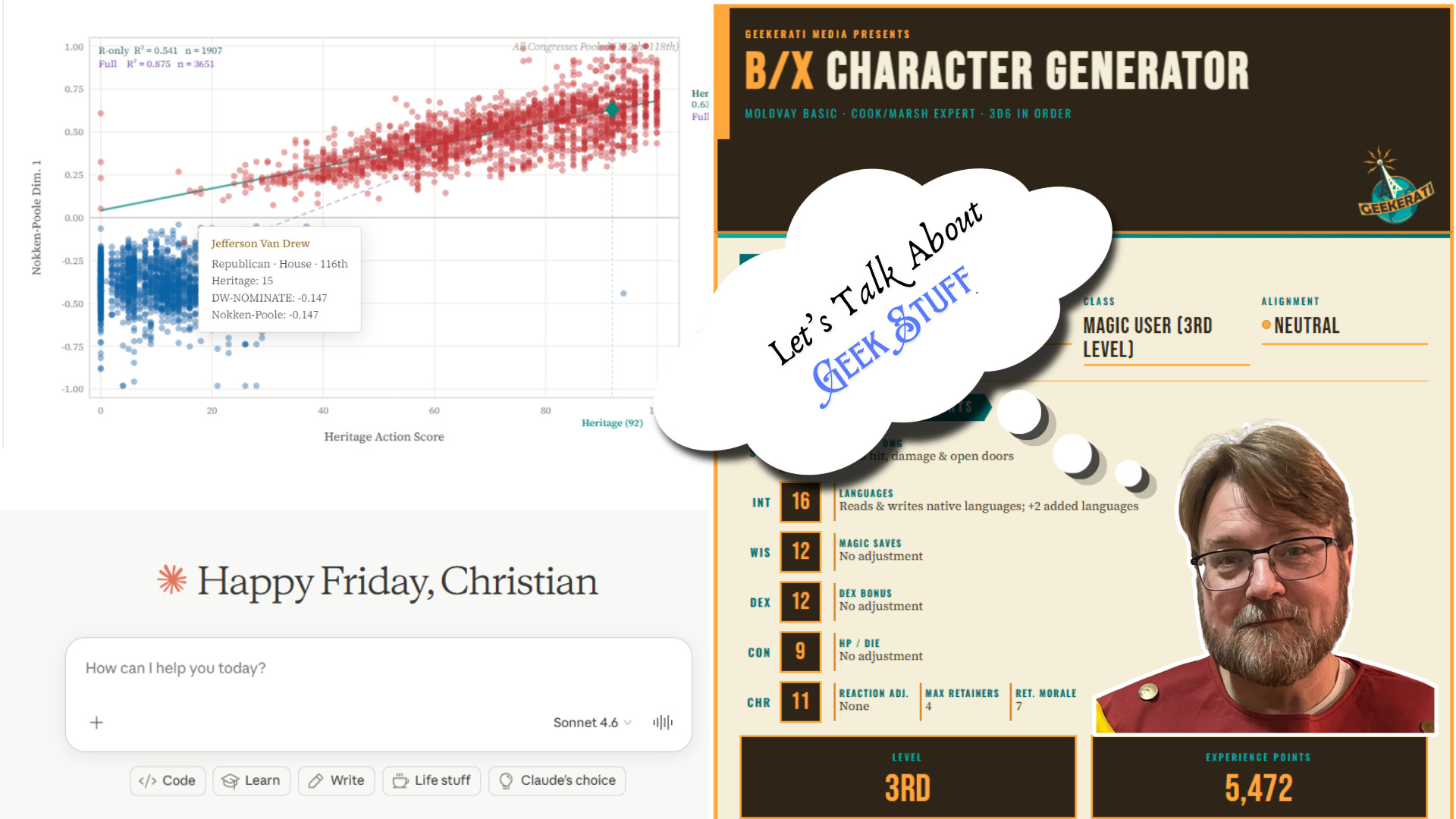
I have, however, done some analysis of The Heritage Foundation and I “dove into Poole” to do it. I followed the work done by Poole and combined it with ideas from Tim Groseclose, Steven D. Levitt (of Freakonomics fame), James M. Snyder, and Jeffrey Milyo to generate Nominate scores for The Heritage Foundation based on how they scored various members of Congress. I used Claude to help me, but all I had it do was run regression to get a coefficient based on the connection between there scores and DW-Nominate (and Nokken-Poole scores which are for individual sessions of Congress) and to use that to get Heritage’s score. Based on that Analysis, they were fairly conservative, but not the most conservative. Certainly, they are Right of the Conservative “center.” I don’t know if I would anchor them at 2 or 3, but it’s close enough for horseshoes. The widget I designed includes four tabs: Estimated Scores & Plots, Overlay: Heritage on Congress (see below), Regression Coefficients, and Methodology. I did it with Claude’s help and I think it wsa very worthwhile and not “slop.”

One the more “fun” side of things, I’ve been designing a number of Moldvay/Cook D&D game aids using Claude. The first was a character creator that determines everything except your equipment. That’s available on my personal website too and I formatted it to be in the brand colors my friend Darran used when he made the new Geekerati logo. I’ve designed a couple of other tools too, but I haven’t uploaded them yet, and am working on an old school dungeon crawl game through an iterative design process. All of these are, and will continue to be, free for your use.

So…I’m thinking Claude.ai and I can be pretty good friends, but if he makes me mad I’m sending Sweet Pickles Bus learning kits to his house and I still think Anthropic should be paying residuals when it uses other people’s text.

The Lamentations of Luke Y. Thompson
One of my favorite old Strong Bad bits was when he did the Olde Timey Radio impersonation and said, “Stay tuned for partial excitement” in a canned 1920s voice. It’s a joke I go back to again and again when I comment on things I only kind of like. Luke channels a bit of that same energy with the headline for his review of the resurrection of American Gladiators from Amazon. That’s right, there’s a new Blaze in town an Luke Y. Thompson is the best person on Earth to review it.

Speaking of beats that were custom made for Luke, he’s got a very good review of the trailer for the upcoming Masters of the Universe film. I have my worries about the film and fear it will lean too heavy into Whedonisms. The first trailer had about 10% Whedonesque “Whoooo!” and snark, but the new trailer has even less Whedonslop and I’m trending towards ALL-IN. I think it’s interesting that Luke begins his review discussing the Sylvester Stallone Judge Dredd film, or rather the trailer, if only because I think I am the only defender of that film (and I don’t think Luke is a defender) in the world. I recently rewatched it and am working up a retro-review for it that will come out after a review of The Man Behind the Gun and Megaforce. Let’s just say that Stallone’s version better captures the actual vibes from 2000AD, and those in the Games Workshop Judge Dredd RPG that introduced me to the character, than the Karl Urban film. In fact, it actually filmically captures Brian Bolland images as moments. Urban’s movie is a better movie overall, but it’s essentially the same film as The Raid. The fact that those Dredd and The Raid are essentially the same plot, they were independently made and are both great. I also think Dredd is a better film than Judge Dredd, but only Stallone’s film captures the Angel family in fun fashion and it’s also the only film where the Dark Judges would fit in.

My buddy Darran Hight has a post about the highly underrated show Almost Human (2013) in his Nerdstalgia Notebook. While I consider myself a Firefly fan, yes even after groaning about Whedonslop because Firefly was MinearGold, the show I really think Fox betrayed. It’s a creative spin on Alien Nation with Karl Urban as a human cop who is partnered with a surprisingly human robot partner DRN-0167 (Dorian) played by Michael Ealy. I’ve been a big fan of Ealy’s since I watched him in Sleeper Cell. If I was to cast someone to play the John Wells character from The Faithful Spy series, he’d be first on my list. Heck, I’d cast him in a lot. he and Urban are great together and the show is rounded out with Minka Kelly, Michael Irby, Mackenzie Crook, and Lili Taylor.

The good folks over at The Power of Us, Dominic Packer & Jay Van Bavel, have done an interview with one of my professors where she discusses some of the ideas underpinning her new book How to Feel Loved. Sonja Lyubomirsky was one of the better mentors I had in coursework at UC Riverside and is one of two Psychology professors (the other being Danny Oppenheimer at Carnegie Mellon) who make me wish Political Science professors modeled themselves on the Psychology department model. As with most of Dr. Lyubomirsky’s mainstream books, they only scratch the surface on the depth of her scholarship. She’s done a great deal of interesting work on happiness and love. Taking her course on happiness built wonderfully on the philosophic baseline I had before on the topic and taught (reminded?) me that happiness is not a goal but a byproduct.

Dr. Rebekah King touches on my favorite horror trope in her most recent exploration of Folk Songs and horror. As a fan of the John the Balladeer stories of Manly Wade Wellman (okay, all of his horror stories) and the mythos surrounding Robert Johnson’s short lived fame. So much so that I am probably the world’s greatest fan of Walter Hill’s Crossroads. Then again, I think Walter Hill is one of the great Hollywood directors. Rebekah does a great job engaging with the genre and ties it to one of the best films (period) of the decade (Sinners). Southern Gothic is one of the richest genres in all of literature and is a central genre to understanding America.

Speaking of Manly Wade Wellman, one of his best friends is one of the best authors of Horrific Sword & Sorcery ever published. The fact that Karl Edward Wagner and Manly Wade Wellman were friend is a bit of a mystery. Wellman was a relatively traditional fellow and Wagner was a hard drinking cocaine advocating Medical Doctor who looked like a biker. Wellman was a member of the Interbellum or Greatest Generation and Wagner was the personification of the Boomer’s darkest shadow. Both are giants on my bookshelf. Folk Music and Metal…yeah, that’s what they were. Just as I love John Ford and Sam Peckinpah, so too do I love Wellman and Wagner.


Fantasy AGE by Green Ronin Publishing
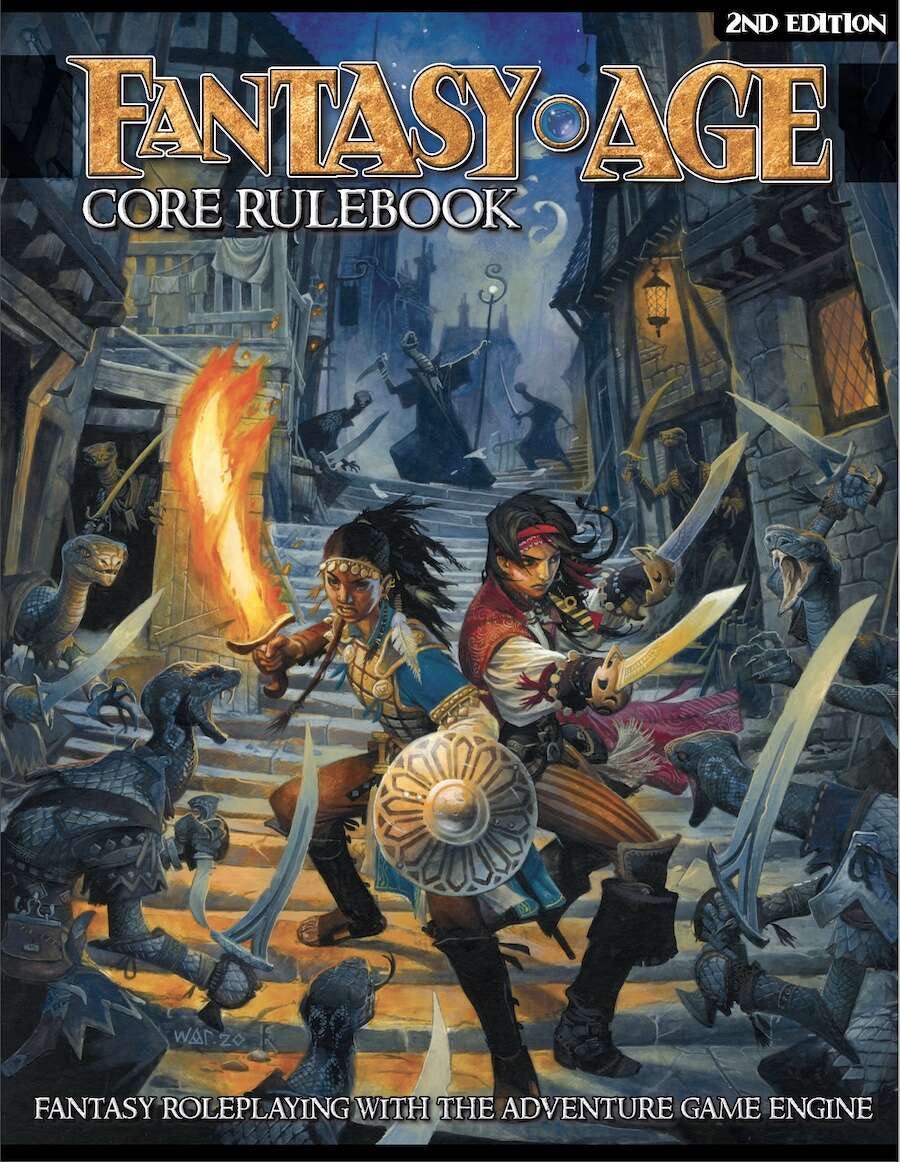
The hardback copy Green Ronin Publishing’s second edition of the Fantasy AGE role playing game just arrived in my mailbox the other day and it is a beautifully illustrated tome. The cover of the book was painted by Wayne Reynolds who’s paintings gave signature style to both D&D 4th edition and Paizo’s Pathfinder role playing game. In this particular illustration, Reynolds has captured a moment of action in Green Ronin’s City of Freeport setting, a setting so deeply influenced by pulp sword & sorcery tales that it includes sinister Serpent Folk.
It should be no surprise that the cover of Green Ronin’s house fantasy role playing game features the City of Freeport, as the Death in Freeport module for the d20 system was Green Ronin’s first product. While Green Ronin, and Freeport, may have started out as a d20/3rd edition D&D company, they quickly branched out. First with the Mutants & Masterminds role playing game, which is nominally d20 but isn’t really and shares more DNA with Champions and DC Heroes than with D&D (more on that in a later review). Then with the True 20 system which took the foundation of the Mutants & Masterminds system and transformed it into a multi-genre system. Finally, with the publication of the Dragon AGE role playing game based on the Dragon Age computer rpg.
The AGE system (Adventure Game Engine) that underpins the Dragon AGE role playing game has continued to grow with the publication of Modern AGE (a contemporary RPG), Fantasy AGE, and role playing games based on The Expanse and Fifth Season properties (you can find a list here of some AGE games).
The AGE system has some elements that will be familiar to players of D&D, but it is a far cry from that game mechanically. It is in no way D&D adjacent in the way an OSR ruleset or Fantasy Heartbreaker is. My gaming group playtested the Blood of Ferelden adventure and the Dragon Age 2 and 3 boxed sets. You can see our credits (after I redacted other playtesters to remove clutter) in the Dragon Age 2 boxed set below.

I mention that I playtested the game, not only to point out that I have a personal connection, but also to highlight how much I like the game. You see, I wasn’t in on the playtest for the first boxed set. It was my enjoyment of the initial game that prompted me to request that my group be allowed to playtest other materials for the game. I fell in love with the game instantly because it offered some really distinct mechanics that I believe make gameplay more dynamic and rewarding.
Two of these mechanical innovations are rooted in the basic resolution mechanic in the game, which is based on rolling three six-sided die against a target number. This is similar to Champions, but with one big twist. One of these dice is called a “stunt die” and so needs to be distinguishable from the other die and it is the source of the two innovations I want to discuss as the die has two different effects.
The first effect that the stunt die has is to determine how successful your character is on an action. Instead of the game having the intensity of success determined by how high the overall result is (say a 15 vs a 19 total being “less successful”), AGE has that intensity determined by the value of the stunt die. So your total could barely hit the target number, but because the stunt die was a 6 you succeeded extremely well. Even though this means that very high rolls will always be very successful (they will have a high stunt die too after all), it means that even lower rolls can be large successes. I like that and think it adds a nice heroic feel.
That brings me to the second innovation, the one that the stunt die is named for and that’s the “stunt system.” If any two of the three six-sided die come up as doubles, then the action generates a number of stunt points equal to the value of the stunt die. Overall, some form of doubles occurs approximately 44.06% of the time meaning that stunts are relatively frequent occurrences.

You can spend these stunt points on a variety of effects, for example if you are in combat you might choose to Disarm your opponent (see the partial list of combat stunts below). There are a wide variety of combat stunt options, and these really make combat dynamic, but stunts exist for non-combat tasks as well and the mechanic is open for expansion in a number of ways.

The stunt system makes Fantasy AGE, and other AGE games, truly unique and worth your time.

I’m working on my reviews of Judge Dredd, The Man Behind the Gun, and Megaforce, so I’ll be brief with this film recommendation. There are two films that shaped my childhood pretty strongly. One was introduced to me by my dad and the other by a friend. They both have a similar message about growing up and dealing with the emotional challenges of being a teenager and they both have almost exactly the same ending, with one exception. Both end with a scream and crashes. In one, the protagonist leaves rage behind and in the other sorrow. I’m picking the one where the protagonist leaves sorrow behind, because of the two films it’s the more beautiful. It’s soft and funny and about love. I’m picking Harold and Maude. Maybe you can guess the other film.
I don't pay any attention to dropping subscribers. The only subscriber numbers I get alerted to are new ones, and it gives me a moment to pause and appreciate the effort of folks who like to check out what I am sharing.
As for AI. It's great! I dig it. Would like to see the implementation of it not use so much power to run. Science and medical applications are wonderful along with statistical. I use it to tighten up what I write, to clean up low rez photos in my articles and to even assist in editing my own art. When I don't have the original PSDs for a piece and I want to work with one of my drawings, I can isolate the subject and remove the color, background, or just have it pull the line art to rework with in another file. For a one person set up, Ai can be a force multiplier... it's a tool, like a pen. It's all in how it ASSISTS you - not do everything for you.
Cheers, Christian!
If I'm not mistaken, the thieving kind of AI is specifically known as Generative AI. The kind you are liking is akin to the kind that studies every x-ray ever filed and can predict cancer better than some doctors -- most people when you point that out are okay with that, at least in theory.