


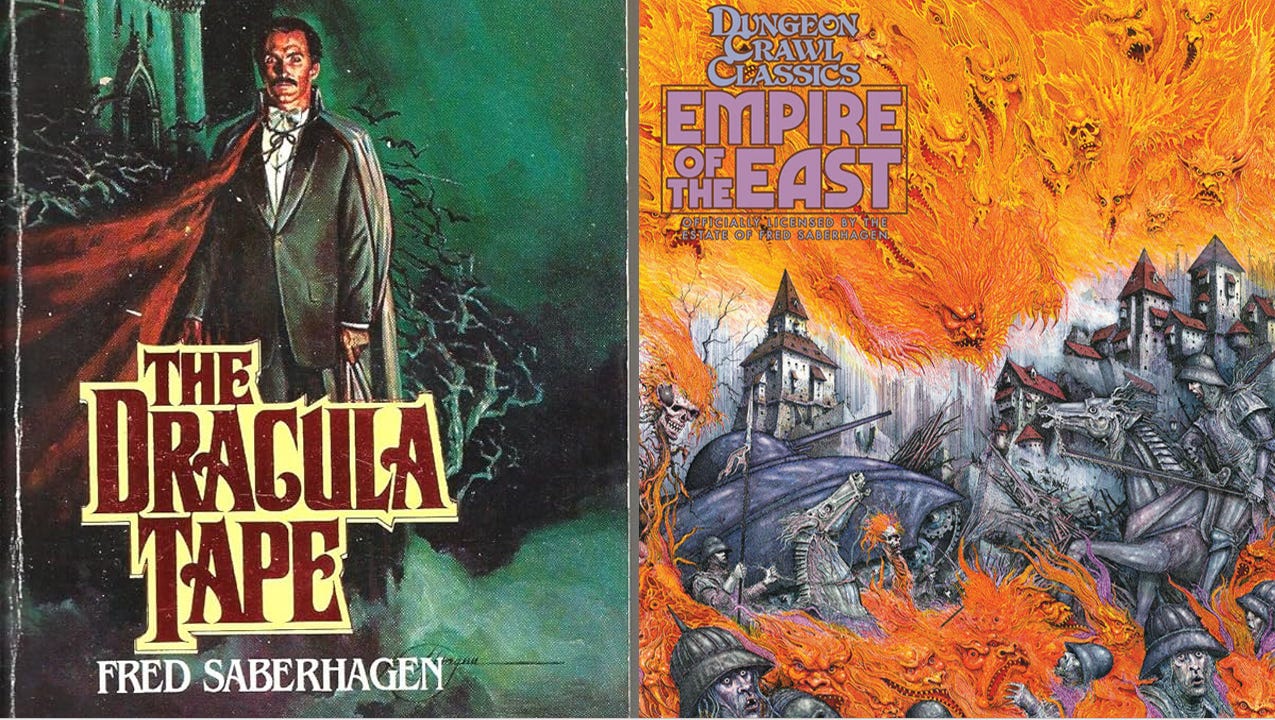
For those who are interested, I have presented Dracula as a Dungeon Crawl Classics Patron at the end of this article.
Yesterday was the birthday of an underappreciated Fantasy, Horror, and Science Fiction author, but it was also my wedding anniversary so there was no way I was going to spend time writing when I could spend it cuddled up on the couch drinking Christmas Spiced Old Fashioneds while watching Twister with my wife. That’s right, Twister. Some couples have a song. My wife and I have a movie and we watch it every year. It’s a true classic of the remarriage genre, with added tornados.
All of which means that my article acknowledging one of my favorite genre authors had to wait a day, but today is that day. Fred Saberhagen was born in Chicago on May 18, 1930, and he spent a lot of his literary life doing something that is more common now than it used to be. He told familiar stories from a new angle. Before there was Pride, Prejudice, and Zombies, there was Saberhagen.
He retold the tales of Dracula and Frankenstein from a sympathetic perspective. He didn’t do this as a mere act of deconstruction, but in part because, as he mentioned in an interview with Ken Rand, he tends to write in the first person and thus seeks to find places where he can find common ground with the character. That personal connection is what led to the more heroic Dracula in his novels.
He even rewrote the entire history of planet Earth with his Empire of the East trilogy. That trilogy (now tetralogy) takes place in a post-nuclear world where the laws of physics have changed and technology is indistinguishable from magic. It’s a setting Gary Gygax read and liked well enough to put it on the reading list that would become Appendix N and it’s a reminder of how much the fiction that influenced early D&D merged science fiction and fantasy.
Stories that re-evaluate villains have become a trend of late with Disney and others giving us sympathetic versions of Maleficent, Cruella, and the Wicked Witch of the West. It’s become so common as a trope that I find it exceedingly dull and evidence of creative laziness, and this makes me a bit sad. It’s a trope that I once loved and was at the core of my literary journey. I am still a big fan of John Gardner’s Grendel and of Fred Saberhagen’s The Dracula Tape, because what separates the older pieces from the newer villainous hagiographies is that Grendel and Dracula are unreliable narrators. They are telling their story, but in the case of Grendel it is clear he is a sociopath. In Dracula’s case though…well Saberhagen blurs the lines nicely.
The Dracula Tape: The Defense That Van Helsing Never Allowed
The underlying premise of The Dracula Tape (1975) is that everything we read in Bram Stoker’s Dracula was the product of motivated reasoning, self-justification, or misperception. Everything we were told through the journals of Jonathan Harker, Dr. Seward, Mina Murray, and the correspondence of Abraham Van Helsing was shaped by their perceptions. It is a mosaic of testimony, assembled to construct a comprehensive account of the hunt for and destruction of Count Dracula. Every major participant gets a voice, except Dracula.
Saberhagen took the opportunity to fill this gap by letting the Count tell his own story, and he did it one year before Anne Rice’s Interview with the Vampire was released. Like Dredd and The Raid (which are essentially the same film), it’s another example of great minds thinking alike. In Saberhagen’s telling, several decades have passed since the events of Stoker’s novel and Dracula records his version of events on a cassette tape found in the back seat of a car that had died somewhere on a remote road. The owners of the car, Arthur and Janet Harker, have been hospitalized for reasons that will be discovered later. For on that cassette tape a man claiming to be Dracula goes through Stoker’s book scene by scene, moment by moment, and offers his account of what actually happened. He never outright contradicts the original version of events, but he does add “context.”
Saberhagen’s Dracula is not a monster. He is a man of ancient codes and genuine feeling who has been badly misrepresented by frightened and fanatical adversaries. The twist on Lucy’s illness is one of my favorite changes in the novel and it fits well with imagery in the 1970s Frank Langella version of Dracula. Lucy isn’t ill because Dracula attacked her. Instead, her illness is the result of incompatible blood transfusions administered by Van Helsing. Saberhagen uses the lack of scientific knowledge regarding blood types during the Victorian and Edwardian eras to great advantage here. Van Helsing was killing Lucy. Dracula turned her because it was the only way to save her life (wink, wink).
As for the relationship with Mina? Well Saberhagen relies on the now overplayed trope that she and Dracula were in love. This is the weakest part of the novel and undermines the real hero of Stoker’s tale in ways that often aren’t appreciated. If you come at it assuming Dracula is an unreliable narrator it still works, and once I got deeper in the series I came to forgive it. The novel’s strongest elements are in how it addresses Van Helsing and his allies. Saberhagen presents Van Helsing as well-meaning in the worst possible way. He’s the kind of righteous zealot who causes catastrophe while absolutely convinced he is preventing it. Every piece of damning evidence in Stoker’s novel gets reinterpreted. Every sinister act gets a rational explanation. And Dracula, as a narrator, is droll, patient, and possessed of a dry wit that makes the whole enterprise immensely readable.
As I mentioned, the book predates Anne Rice’s Interview with the Vampire by a year and I mention this because I think it matters. The sympathetic vampire is often credited to Rice. We are often told that she is responsible for showing us the monster with an inner life, with a genuine perspective, with grievances the reader might actually find reasonable, but Saberhagen got there first. Or, given that Rice had been working on the idea for years before the publication of Interview, he arrived at it at the same time. Saberhagen’s Dracula is more courtly and less tortured than Rice’s Louis. He is more confident in his own nature, and frankly more fun to spend time with. He’s a less hedonistic Lestat, though we don’t get his side in Rice’s first novel. Where Rice’s vampires tend toward the operatic and the self-lacerating, Saberhagen’s Count has the unflappable dignity of someone who has lived through enough centuries to have developed perspective on human hysteria.
The thing that keeps me returning to the book, is that Saberhagen never quite resolves the question of whether Dracula is telling the truth. The Count himself acknowledges that his account is self-serving. He knows you might not believe him. He asks you to consider the evidence and judge for yourself. He is, in other words, an unreliable narrator who flags his own unreliability, which is a different and more sophisticated thing than an unreliable narrator who doesn’t know he’s unreliable. The book is structured as a legal brief from a defendant who concedes that defendants always shade their testimony, but argues that this doesn’t make the testimony false. Though I have to say, there are moments like his description of the Demeter that show he’s willing to be the blatant fabulist when it suits him.
The rest of the Saberhagen Dracula sequence builds upon this foundation. The Holmes-Dracula File (1978) is my favorite of the sequels and it pairs the Count with Sherlock Holmes in alternating chapters. Holmes is, as always, narrated by Watson and Dracula narrates his own experiences as the two iconic figures adventure in a London threatened by a different kind of vampiric predation. Holmes and Dracula make an extraordinary team. We get the world’s greatest detective and the world’s oldest predator, both of them operating by codes that the ordinary world can’t quite parse, and both of them more interested in justice than in the law’s opinion of justice. Saberhagen’s alternating chapters maintain an excellent tonal contrast between Watson’s earnest reliability and Dracula’s sardonic self-awareness. The effect is genuinely funny and it’s easy to see why an author who wrote so many novels featuring Dracula never thought of himself as a horror author.
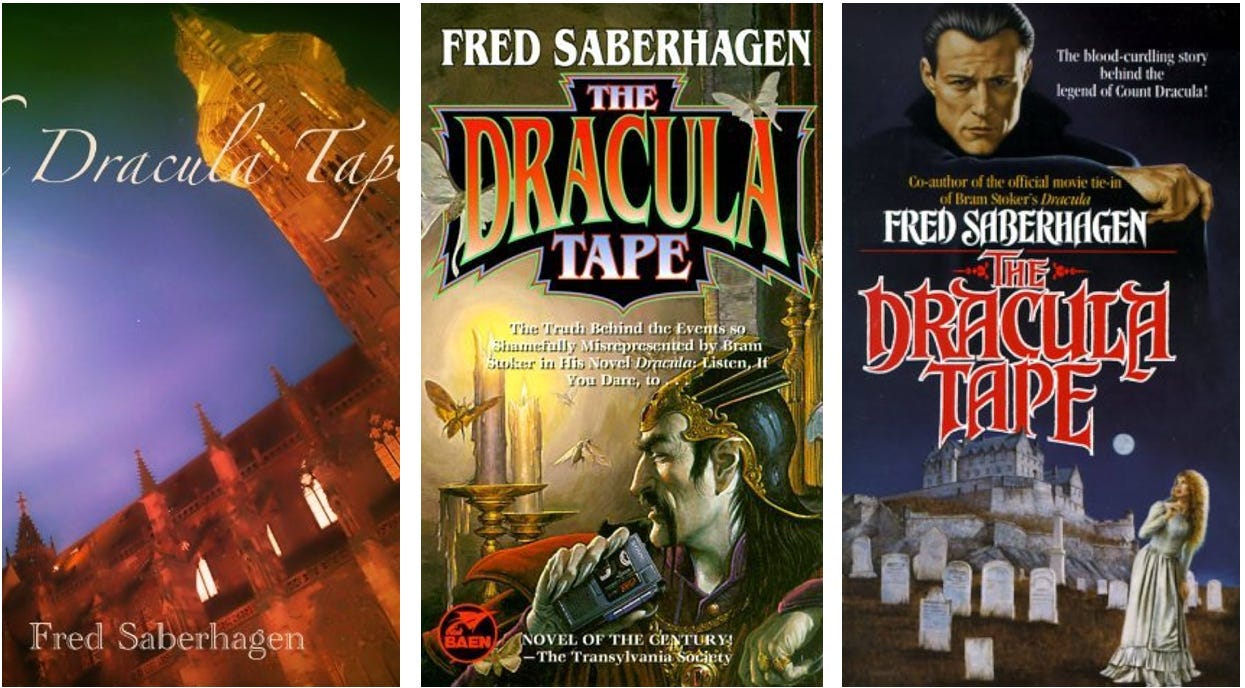
Saberhagen would return to Dracula repeatedly over the following decades and wrote ten novels in the Dracula sequence before his death in 2007. The quality is uneven across the run, as it tends to be with any long series, but the foundational idea holds up. The series is not widely read today. Though entries have been published by Tor, the biggest fantasy/sf publisher in the industry, it languishes so much that the current kindle book covers are bland and unwelcoming. When your cover makes the Baen cover look good, and Baen are notorious for their covers, you know you are languishing in the forgotten pile.
Why the Dracula Tape Matters Beyond the Horror Shelf
The revisionist-narrator novel is a common enough form now. We’ve had Jean Rhys’s post-modern Wide Sargasso Sea giving Bertha Mason from Jane Eyre her own story. Gregory Maguire gave us the Wicked Witch of the West’s perspective in Wicked. Tom Stoppard sent Rosencrantz and Guildenstern to center stage while Hamlet played out behind them. We even have marketing campaigns selling Wuthering Heights as a romance for the ages. It’s a great book, but Heathcliff isn’t the ideal romantic partner. The “what was the villain’s actual experience” novel has become its own genre.
But in 1975, the genre was still in its relative infancy. Saberhagen’s execution of the idea has a specific quality that the later iterations often lack. He never loses track of the fact that Dracula is actually a vampire. This Dracula is sympathetic, but he is not defanged. He lives by a code that is genuinely alien to ordinary human morality. He has done things that are, by any human standard, monstrous. Yet he provides the reader explanations for them that he, though not always the reader, finds adequate. The book is not a rehabilitation in the sense of making Dracula good. It’s a rehabilitation in the sense of making him comprehensible from the inside, which is a different and more interesting narrative than we are often given in the genre.
This is a useful approach for fiction writers and game masters alike. One of the recurring problems in tabletop RPGs is the villain who is evil because the adventure says he is evil. The novice DM will often run the monster in the dungeon as if his sole motivation is that “he’s a monster.” Saberhagen’s method is a corrective to this approach. Every antagonist has a version of events in which they are the protagonist. The vampire hunter who stakes an innocent creature is a murderer in that version of the story. The ancient evil defending its lair is protecting its home. The game master who has internalized The Dracula Tape asks, for every villain they create: what does this character’s version of the tape recorder transcript sound like?
Changeling Earth and the Appendix N DNA
Now for the other Saberhagen, the one Gary Gygax put on the list.
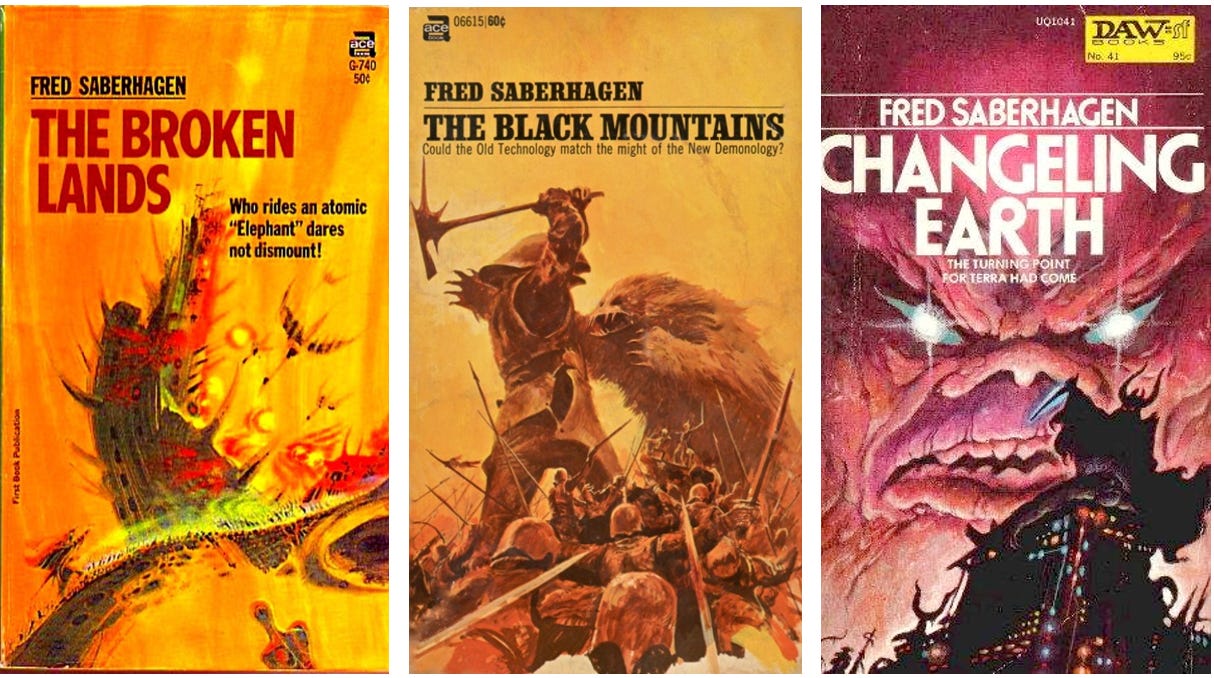
Changeling Earth (1973) is the third volume of the Empire of the East trilogy, following The Broken Lands (1968) and The Black Mountains (1971). Gygax’s choice to cite the third volume specifically, without mentioning the first two, has puzzled Appendix N scholars for quite some time. The most likely explanation is simply that Changeling Earth is where everything the series has been building toward finally detonates, and it’s where the big idea of the trilogy is fully revealed. The Reactor review of the novel, which I used as a refresher before writing this article only to find that it contains one big error, doesn’t mention that modern versions of the tale aren’t the version originally published. If you can, track down a copy of Changeling Earth and not the revised version which is entitled Ardneh's World. It’s not that the revision is bad, it isn’t and it’s what you get in the Empire of the East compilation volumes, but that’s not the version Gygax read when he was inspired to add it to Appendix N.
The big idea driving the narrative in Empire of the East is that fifty thousand years in our own future, a global nuclear war triggered a change in the fundamental laws of physics. Atomic weapons ceased to function. Technology failed or became unrecognizable. In their place, magic arrived. This was real magic, or at minimum psionics, with all the implications that carries. However, the technology didn’t simply vanish. Instead, it transformed. Nuclear weapons have become entities of pure destructive supernatural force. One of them even shares a name with a major Dungeons & Dragons Big Bad Guy. Most importantly, ARDNEH (Automatic Restoration Director — National Executive Headquarters) became a benevolent god, a vast protective intelligence that has been quietly guiding humanity through the dark ages that followed the Change. ARDNEH maintains the conditions under which civilization might eventually recover.
In Changeling Earth, ARDNEH faces off against his opposite number. Orcus, I told you there was a D&D Big Bad, is the physical embodiment of the other side’s nuclear arsenal and the demon king of the East. He is a force of pure destruction, in both desire and form. Their confrontation is the climax of the trilogy and it is fought on a scale that makes human military campaigns feel like footnotes.
As Tim Callahan points out in the Reactor review I told you to read after you read the book, Changeling Earth is listed in the proto-Appendix N that Gygax published in the fourth issue of The Dragon magazine. The question of why Gygax loved it is worth sitting with. Callahan found the human-scale action of the novel less compelling than the cosmic stuff and I think that’s the right read. It’s a reminder that when playing early D&D, the cosmic stuff is exactly the point. From Elric’s multiversal struggles to Changeling Earth’s god-like super-intelligences, Gygax wanted D&D to be more than elves and dwarves.
Consider what Saberhagen is actually doing in the Empire of the East. He is taking the familiar materials of pulp fantasy like the evil empire, the plucky rebel, the sword-wielding hero, the ancient evil in the citadel and grounding them in a cosmology that explains why these things exist. The demons are not supernatural intrusions into a natural world. They are what happens when human technology exceeds human wisdom. The gods are not arbitrary authorities. They are the systems humanity built to protect itself, grown vast and strange over millennia. Magic is not mysterious. It is physics operating under different rules, rules that human ingenuity created and can never take back.
Reading these books, one can easily see the influence on Dungeons & Dragons, with its early penchant for mixing-and-matching elements from both traditional fantasy and science fiction literature. The Greyhawk setting, from its earliest days, had a similar quality. Oerth was a world where the categories of “fantasy” and “science fiction” were more porous than the genre labels suggested. Dungeons in D&D have always been full of things that don’t quite belong to a single genre. A golem that operates like a machine (or is a machine in the case of Barrier Peaks), a spell that behaves like a technology, a demon that seems to follow rules more consistent with nuclear physics than with medieval cosmology. The Empire of the East is one of the clearest sources for that aesthetic, the place where the Dungeon Master who asks “what if the demon IS the bomb?” can see it fully worked out.
The inclusion of Changeling Earth in Appendix N, while omitting the two earlier volumes of the same trilogy, tells you something about what Gygax was actually responding to. He wasn’t cataloguing the Empire of the East as a series. He was pointing at a specific quality that detonates in the third book. He wanted to focus on the moment when the cosmological stakes become undeniable, when ARDNEH and Orcus face each other and the full implications of Saberhagen’s world-concept become clear.
How much did Gygax love Empire of the East? In October 2007, when a poster named “loseth” on ENWorld’s long-running Gygax Q&A thread asked him to rank the authors most influential on D&D, he produced a list of ten. That list had Saberhagen on it, ahead of Tolkien, ahead of Poul Anderson. Many Appendix N authors like Burroughs, Farmer, and Gardner Fox are missing from the list even as their influence is clear.

Col Pladoh Sunday, 28th October, 2007, 10:48 PM
Quote:
Originally Posted by loseth
Colonel,
I used to assume that D&D was based on Tolkien, but doing a study of typical themes and elements in Howard’s Conan stories, I quickly realised
that I had been mistaken, and that (1b) D&D was, in fact, far more Hyborea than Middle Earth. So, I’m dying to know: If you had to rank the
degree of influence the following four authors had on you when you designed AD&D, would this ranking be accurate?
1. Howard
2. Leiber
3. Vance
4. Lovecraft
And part 2: Is that list of 4 missing any very significant influence(s)? Are any of those authors not deserving of the title ‘very significant influence on D&D?’
Thanks,
loseth
It is hard to rank such infuence, but I’ll take a stab at it.. .and add authors as well. Some on the list below are virtually tied as I consider them:
Howard
De Camp & Pratt
Vance
Leiber
Moorcock
Merritt
Lovecraft
Saberhagen
Poul Anderson
Tolkien
...and a score of others ;)
Cheers,
Gary
When another poster expressed surprise at Saberhagen’s high placement, Gygax clarified: “Saberhagen is listed for his ‘Empire of the East’ that I very much liked. None other of his novels struck me in this regard.” He added that Empire of the East called to mind Stanley Weinbaum’s The Black Flame. He provided us with two science-fantasy novels in dialogue with each other across thirty years, both making the same argument about what happens when technology becomes mythology.
There is one more thing from that thread worth knowing. Fred Saberhagen died on June 2, 2007. When Gary was asked about a heraldic detail in Greyhawk on July 13th, 2007, he made a connection that was swift (he responded to the message board question within 4 hours) and personal, “With the sad news of Fred Saberhagen’s passing fresh in my mind, I must say that the Great Kingdom I pictured as akin to John Ominer’s Empire of the East.” The decaying empire where “wicked insanity rules” in 576, the Great Kingdom, was conceived in the image of Saberhagen’s fiction. It is a book about what happens when you push a fantasy world’s cosmology to its logical extreme and find that the extreme is stranger and more interesting than the starting point.

The Books of Swords that followed take place after the events of Empire of the East and explore what that extreme looks like from the inside, after ARDNEH has become legend. Those books are easier to find and were my entry point to the series, rather than the Empire of the East. But the Empire of the East is the foundation, and it reads like a D&D campaign that someone played without ever calling it that. So much so that Goodman Games produced licensed supplements for Dungeon Crawl Classics based on Saberhagen’s Empire of the East novels.
And now for your regularly scheduled game content!
Running the Count: Saberhagen’s Dracula as a DCC Patron
I’ve done a couple of bonus game content features now and they are usually B/X or AD&D, but this time I’m going for Dungeon Crawl Classics for a couple of reasons. First, it’s built on Appendix N DNA. Goodman Games even released an officially licensed Empire of the East sourcebook for DCC, which brings the full weight of Saberhagen’s cosmology into the game’s gonzo science-fantasy idiom. More to the point, DCC’s Patron system was designed precisely for beings like Saberhagen’s Dracula. These are powerful, morally complex entities who operate by codes the players can learn but never fully predict, who grant extraordinary abilities in exchange for a relationship that is never quite comfortable. It helps to fix the Deities & Demigods problem where a list of powerful entities becomes nothing more than a list of monsters to kill. Saberhagen’s Dracula isn’t a foe to be fought, but he might be a patron to serve.
What follows is a full patron write-up for Saberhagen’s Count. He is not Stoker’s monster or the Hammer Horror sexually powerful predator, but the figure from The Dracula Tape. He’s ancient and honorable after his own fashion, possessed of genuine feeling, and deeply tired of being misrepresented.
A wizard who bonds with the Count is not pledging service to evil. They are entering into a relationship governed by the oldest social contracts in human history. They are binding themselves to the principles of hospitality, reciprocity, the obligation of the host and the guest. The Count keeps his word. He does not deceive those he has acknowledged. He will not ask those he patronizes to do anything he considers dishonorable, and his definition of honorable is both more expansive and more alien than most humans expect. He will, however, expect to be consulted eventually. He keeps records of everything.
THE COUNT
Patron of the Old Blood, The Dragon Unjustly Maligned, Lord of Shadows and Thresholds
Invoke Patron check results:
1: Lost, failure, and worse. Roll 1d6 modified by Luck: (3 or less) corruption + patron taint; (4-5) corruption; (6+) patron taint. Corruption will typically be in a vampiric direction.
2-11: Failure. Unlike other spells, invoke patron may not be lost for the day. Depending on the results of patron bond, the wizard may still be able to cast it.
12–13: The Count is aware of your need but occupied with older concerns. He sends a fraction of his attention. You gain the ability to see perfectly in total darkness for 1 hour. Additionally, you may ask one yes/no question and receive an honest answer. The Count does not lie to those he has acknowledged, though he reserves the right to decline and the truth will reflect his understanding.
14–17: A shadow peels away from the nearest wall and interposes itself between you and one attacker. The shadow absorbs up to 1d8+CL points of damage from a single blow before it dissipates. For the remainder of the encounter, your footfalls make no sound. Stealth checks are made at +4, and enemies attempting to track you by sound alone automatically fail.
18–19: The Count’s voice speaks through you; not in words, but in presence. You gain the ability to issue one Dominate command (as per Charm Person but with no duration limit) that persists until the target is commanded to harm themselves, their loved ones, or their deepest-held principles, at which point the compulsion breaks. Additionally, for 1d4 rounds you radiate an aura of absolute social authority. All NPCs who are not actively hostile must make a DC 12+CL Will save or treat you as their superior in any dispute currently underway. Fanatical zealots, professional inquisitors, and Van Helsing-types receive +4 to this save. The Count finds them tiresome but respects their conviction.
20–23: Blood of the Old Country. The Count lends you a fraction of his vitality. You immediately recover 2d6+CL hit points. For the next 24 hours you require no food, water, or sleep. Any mundane poison or disease currently affecting you is suppressed, not cured, but silenced, for this period. When it returns it will do so all at once. The Count considers this a loan, not a gift, and will remember that your body required the assistance.
24–27: The shadows are his domain, and for a moment, yours. You and up to CL companions step into a shadow of any size and may emerge from any other shadow within 300 feet as a single movement action. Creatures witnessing your disappearance must make a DC 15 Will save or be shaken (−1 to all rolls for 1d4 rounds). If used to escape pursuit, all tracking attempts against you in the next hour are made at −4. Bloodhounds and similar supernatural trackers simply find nothing.
28–29: The Count moves through you. For 1d4+1 rounds you take on aspects of Saberhagen’s Dracula at his most formidable. You gain +4 to all melee attacks, unarmed strikes deal 1d6 damage and drain 1 point of Stamina from targets on a hit (recovered after a full night’s rest), and you are immune to fear effects of any origin. Additionally, one enemy within 60 feet who meets your gaze must make a DC 18 Will save or stand completely motionless for the duration. They are not unconscious, not unaware, simply unable to move. They can watch everything. The Count considers this mercy.
30–31: The Count calls in an old obligation from the night itself. 2d6 giant bats materialize from the darkness (use stirge statistics; they obey your commands for 3 rounds before departing on their own business). Simultaneously, a dense fog rolls in from no visible source, reducing all ranged visibility to 10 feet. You and your companions are unaffected. When the bats leave, they take the fog with them. The Count will not explain where either came from.
32+: The Count himself takes notice. A figure in archaic formal dress stands at the precise edge of where the lamplight fails, watching. For the remainder of the encounter, you function as an extension of his will. You are immune to all mind-affecting effects. You may make a single Dominate attempt (DC 20 Will save) against every sentient creature you can see simultaneously. Any undead in the area immediately recognize you as acting under the Count’s authority and will not attack you or your companions unless commanded to by a force more ancient than the Count himself, which is rare. After the encounter, the Count will want to discuss the circumstances that required this degree of direct involvement. This is not a threat. It is an expectation.
Patron Taint: The Count
When a Patron Taint is indicated, roll 1d6:
1. The smell of blood becomes intoxicating. When you witness bloodshed, any creature taking damage within 30 feet, make a DC 10 Will save or spend your next action moving toward the source of the blood rather than your intended action. This compulsion worsens with each subsequent taint: DC 12, then DC 14. On a third result of this taint, the compulsion becomes permanent unless the Count intervenes.
2. Your shadow begins to behave independently. It gestures when you are still. It points at things you haven’t looked at yet. It occasionally refuses to follow you into direct sunlight, pooling at the threshold like a reluctant dog. NPCs who observe this react with unease (−1 to all reaction rolls with strangers). The Count considers this an aesthetic bonus. You may not agree.
3. Direct sunlight becomes genuinely uncomfortable. You take 1 point of damage per round of unobstructed sun exposure. Shade, cloud cover, glass, and indoor lighting are all fine. This is not undead vulnerability, you are not undead (yet). It is simply what happens when you spend too long at the margins of mortality.
4. You may not enter any private dwelling without an explicit invitation. Public spaces, inns, taverns, temples, and ruins are unaffected. If you attempt to cross an uninvited threshold, you cannot. You are stopped as surely as by a wall of force. You may stand in the doorway and speak. You may request entry. You may wait. This is, the Count would note, basic courtesy made law. He has always followed it voluntarily.
5. Your connection to ordinary sustenance weakens. Food provides only half its usual restorative benefit. Water tastes of nothing. You find yourself noticing blood. You do not crave it, not yet, but you are aware of it in a way you were not before. The Count has made no request. He is simply watching to see what you do with the awareness.
6. A figure has been observed near your companions’ lodgings. It is not threatening, simply watching from a polite distance, in formal dress. The Count is evaluating whether you warrant his deeper investment. He will not explain his criteria. Your companions have noticed the figure. They have opinions about it. The Count will expect you to handle their concerns without troubling him.
Spellburn: The Count
When a wizard under the Count’s patronage burns Strength, Agility, or Stamina, roll 1d4:
1. Your veins darken visibly beneath the skin as the Count draws on your vital energy directly. The burned points represent a debt of blood. It is not extracted now, but registered. The Count does not forget what is owed. He has never, in six hundred years, forgotten what is owed.
2. Your eyes shift to a deep crimson for the duration of the spell’s effect. Animals within 30 feet react to you with either terror or submission (your choice, once per scene) for 24 hours after the casting.
3. You age momentarily and visibly. Maybe a lock of hair turns white, the lines at your eyes deepen, or your hands look older than they did this morning. Then it passes and you are yourself again. The Count has accelerated your mortality by the precise amount required and redirected that energy. You felt the years move through you. Some of them were interesting.
4. The burned stats represent vitality drawn from the Count’s own reserves and lent to you. You will feel it return over the coming days as the score recovers: a warmth that moves against the direction of your heartbeat, arriving just slightly after it should. The Count has said nothing about this. He will say nothing. It is, by his standards, a small favor between people who have an understanding.
Patron Spells: The Count
Level 1 — The Vindicating Tongue
The wizard speaks the Count’s truth into a contested situation. This is not deception, the Count does not deal in deception, but it is reframing. The wizard gives a presentation of events from the perspective most favorable to the caster’s position, delivered with the full weight of six centuries of practice. All creatures within 30 feet who hear the wizard speak must make a Will save (DC 10 + CL) or believe, at a bone-deep level, that the wizard is the wronged party in any current dispute. This does not compel action. It shifts disposition: hostile creatures become wary, wary creatures become neutral, neutral creatures become sympathetic. Duration: 1 turn per CL. Fanatical inquisitors, professional witch-hunters, and those who have already decided the wizard is guilty receive +4 to their save. The Count finds such people tiresome but respects their consistency.
Level 2 — Blood Remembers
The wizard touches freshly shed blood, from any creature, any amount, and reads its history. A successful spell check reveals the following, depending on the result:
Result 1: Lost, failure, and worse! Roll 1d6 modified by Luck: (0 or less) corruption + misfire + patron taint, (1-2) corruption, (3) patron taint (or corruption if no patron), (4+) misfire.
Result 2-13: Lost. Failure.
Result 14–17: The creature’s approximate age, general health at time of injury, and emotional state in its final moments.
Result 18–21: The above, plus one significant sensory memory from the creature’s last 24 hours . From the blood, the caster gets a memory of a face seen, a place visited, a conversation overheard.
Result 22–25: The above, plus the caster may ask one direct question of the blood. Where was this creature going? Who sent it? What was it afraid of? The blood answers from the creature’s own knowledge, honestly, without interpretation.
Result 26+: The above, and the blood volunteers information the caster did not know to ask for. The Count considers this a courtesy. He believes people deserve to know the relevant facts of the situations they are in.
Level 3 — The Old Invitation
The wizard extends the Count’s own hospitality to a target creature, invoking social contracts so ancient they predate every civilization currently operating in the campaign world. The target must make a Will save (DC 12 + CL) or be bound as follows for 24 hours. They must answer one question put to them honestly and completely; they must accept one gift from the wizard without causing it harm; and they may not commit violence against the wizard or the wizard’s explicitly designated companions for the duration. This is not mind control. The Count finds mind control a vulgarity. It is the enforcement of hospitality. The target will remember every word of what transpired. They will know they answered honestly. Whether they resent this is a matter between them and their own conscience. The Count is unavailable to adjudicate that particular dispute.
The Hidden Story, Both Ways
Fred Saberhagen worked in two registers that seem different but share a deep structural commitment. In the Dracula books, he takes a villain’s story and asks what it looks like from the villain’s perspective. In the Empire of the East books he takes the world we know and asks what it would look like from fifty thousand years of distance, after the categories we use to organize it have been transformed beyond recognition.
Both projects are exercises in estrangement. Both ask you to look at something familiar and find it strange. Both reward readers who are willing to suspend their certainty about who the protagonists and antagonists are. Both, in their different ways, left marks on the imaginative DNA of tabletop roleplaying.
That is not a small legacy for a writer who remains, despite Gygax’s endorsement and a genuinely distinguished bibliography, somewhat underread outside the circles where his name gets cited. He deserves a better fate than “the Appendix N author you haven’t gotten around to yet.”
May 18 was his birthday. The Empire of the East omnibus edition is in print. The Dracula Tape is available. Worlds await you.
Further reading: For more on Appendix N and the literary DNA of D&D, see the growing Geekshelf series that starts with 13 RPGs from the 1970s You Should Own.

For more on sympathetic monster narratives in RPG design, the Amber Diceless piece covers related terrain. What happens when you build a game around the possibility that the “villain” is the one telling the truth.
