


Before I get into the article proper, I wanted to ask a quick survey question. I have a number of extra codes for some Steam RPGs (Baldur’s Gate 1 and 2, Pathfinder Wrath of the Righteous), as well as a number of duplicate paperback collections and review copies of books, and I was wondering if I should do a once a month “opt in” raffle where I put up a survey where those who are interested can sign up to be included.
What do you think?
The Challenge of Emulating Super Powers
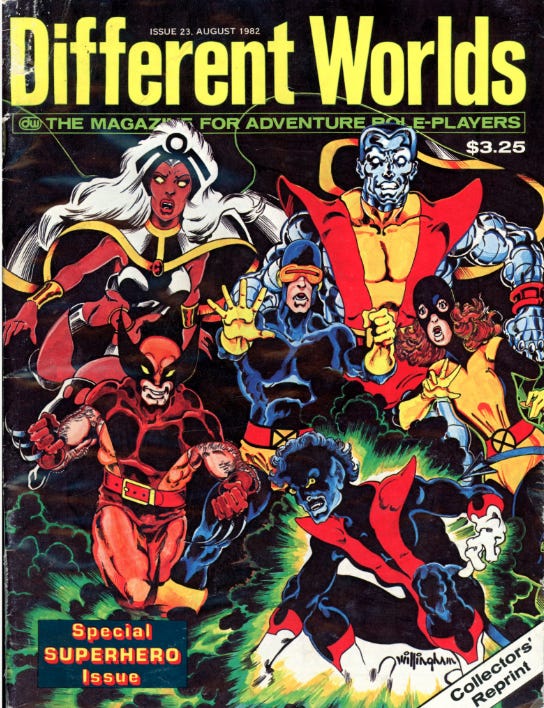
Those of you who read this blog on a regular basis know that I consider Different Worlds magazine to be one of the great publications of what James Maliszewski calls the Golden Age of D&D. The magazine ran from 1979 to 1987. It was initially published by Chaosium, then by Sleuth Publications, and finally by Different Worlds Publications. Two of those companies are still around today, and one is going very strong.
I was particularly impressed with Different Worlds Issue 23 and wrote the first in what I want to be a series of deep dive articles into that magazine. That issue was a “Special Superhero Issue” that contained articles by the designers of Champions, Villains & Vigilantes, Supergame, Superworld, and Superhero 2044 (which I really need to finish my Retroclone of soon). That’s right, the designers of all the major superhero rpgs of the time had an article in that issue. Add to this a cover illustrated by Bill Willingham and stats for the X-men in three different game systems (V&V, Champions, and Superworld) by the game designers, and you have a truly special magazine issue. I would argue that it is the single best issue of a gaming magazine published to date.
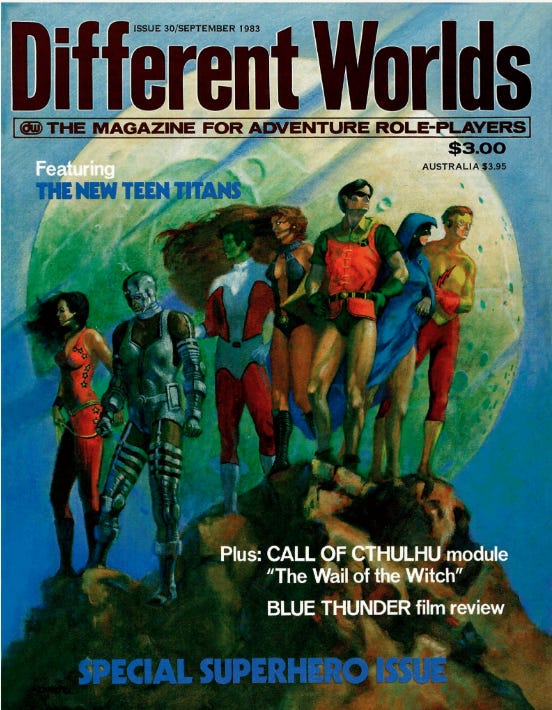
The success of this issue led Tadashi Ehara, the magazine’s editor, do make the Special Superhero issue a somewhat regular feature, and a year later with issue 30 in September of 1983 the magazine had a special “New Teen Titans” issue. This issue provides statistics for the New Teen Titans, Nightwing and crew, though he was still Robin at the time of publication, for Champions, Villains & Vigilantes, and Superworld. I’ll be doing a full issue breakdown later as a part of my series on older gaming magazines, but I wanted to go into a little deeper dive into these three game systems.
Each of these three systems is very different in how they handle super powers, combat, and skill resolution, but that are all workable systems. In fact, I am a big fan of all three of these game systems. In this particular case we get a unique glimpse into how and why the designers made the choices they did because the statistical representation of the characters in Issues 23 and 30 are done by the system designers themselves. This reveals interesting things about the mechanics and game design philosophies. This is especially true for the character of Changeling. As a shape shifter, his powers are a significant challenge to emulate.
How do you design a character who can become any animal? It’s a difficult design question, but one that comes up from time to time in the comics. The biggest problem associated with shape changing powers is that if they include things like the ability to turn into animals, they effectively require multiple sets of powers to model different animals. You need to have flight or super strength as possibilities, but not every animal has both of those. The design question is complex enouth that it eventually led Champions to adopt the “Multiform” power in Champions III, a solution that I’ve never been fond of because it requires the player to design a new character sheet for each animal and increases the “homework” necessary for play.
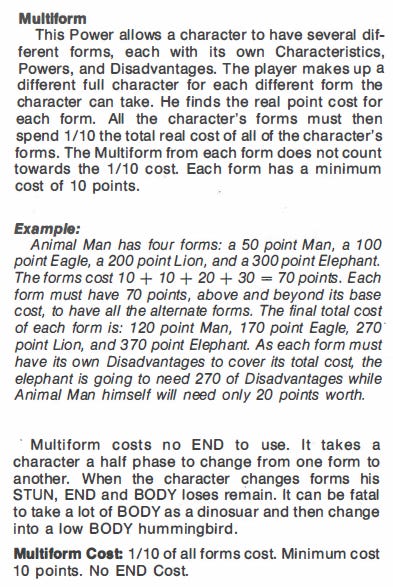
Issue 30 of Different Worlds was printed before Champions III was published so the Champions version of Changeling created by Steve Peterson is represented as a relatively normal heroic character in his base statistics, with all of his shapechanging powers put into in a single large (200 point) multipower. Each of the abilities are represented “multi” slots, which allow the player to mix and match the levels so that the total amount used at a time is never more than 200 points. So the player might turn into a bird by using 40 points of Shrinking, 50 points of Flight, and a number of Enhanced Senses. So long as the total is 200 points or less, then the character is good to go. The solution requires familiarity with the system, but it’s very flexible.
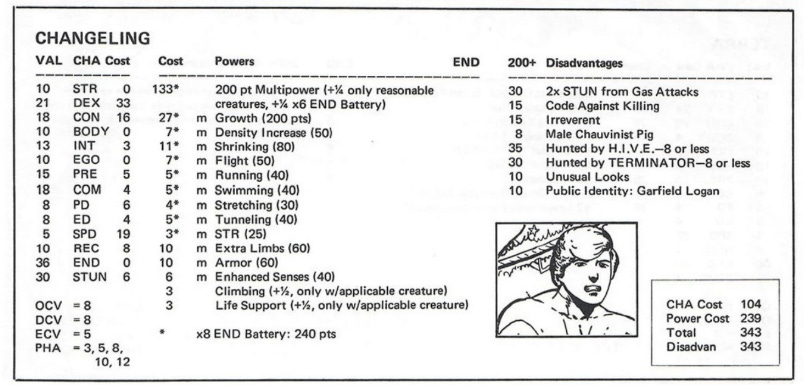
While I have always liked the use of a multipower in order to simulate this kind of ability, I would use one of two options not presented by Steve Peterson here. First would be the each “animal” is a different “ultra” slot in a multipower. Ultra slots require that you use all of the points in a slot at their full value, but can contain multiple powers within them. Thus a Gorilla would be one slot and a Monkey another. The other way would be to have several multipowers. One for offensive abilities, a second for defensive, a third for movement, and a fourth for “variable senses and options.” Any of these can work, but as you can see any version also requires a lot of work by the player to get what they want. The goal of any of these choices would be to minimize the amount of time the player has to spend “thinking” about their choices during a game session. Of course, Peterson’s solution above allows the player to turn into any animal and that’s pretty darn cool
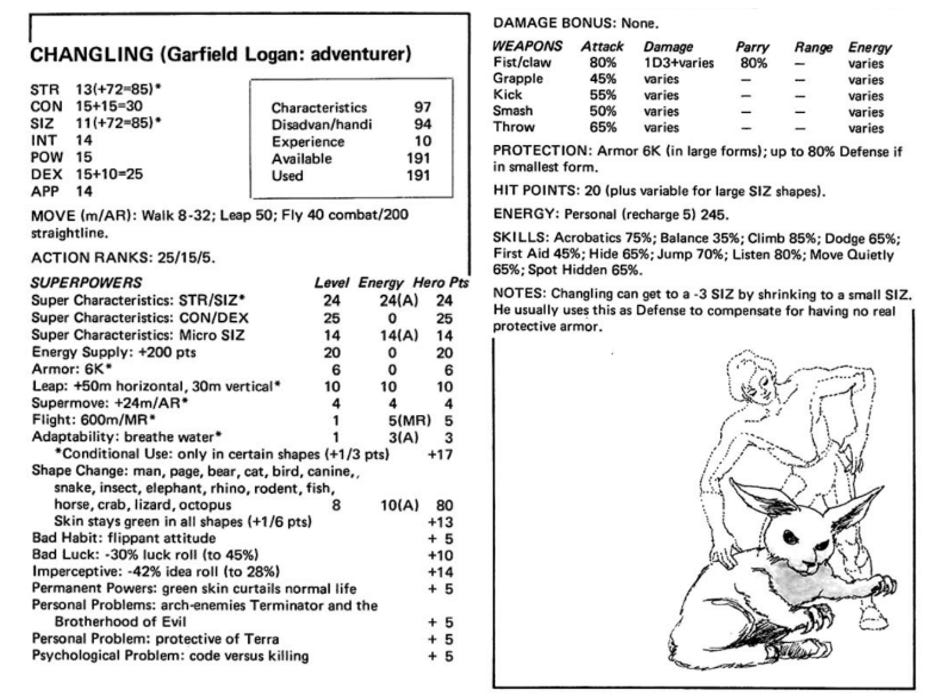
Steve Perrin’s Superworld decision was to just give Changeling all of the powers: heightened strength, shrinking, growth, armor, movement, etc., but to give each a conditional use modifier of “only in certain shapes.” This is followed by a list of shapes that Changeling can assume: man, bear, cat, bird, canine, snake, elephant, octopus, and so on. Any animal that he has listed, he can become. And the GM and player can discuss which powers are appropriate to the form. This is a pretty good solution, but it also requires bookkeeping with regard to building and then maximizing each form. In some ways, this is the Multiform solution and it requires the player to have several character sheets. It’s effective, but no elegant.
Jack Herman in his Villains & Vigilantes adaptation highlights the “rulings over rules” nature of the V&V system. In this game, there is not shapechange power that quite captures Changeling’s ability. So Herman creates a “Body Power” for Changeling called Transformation that covers most of what Changeling might want to do.
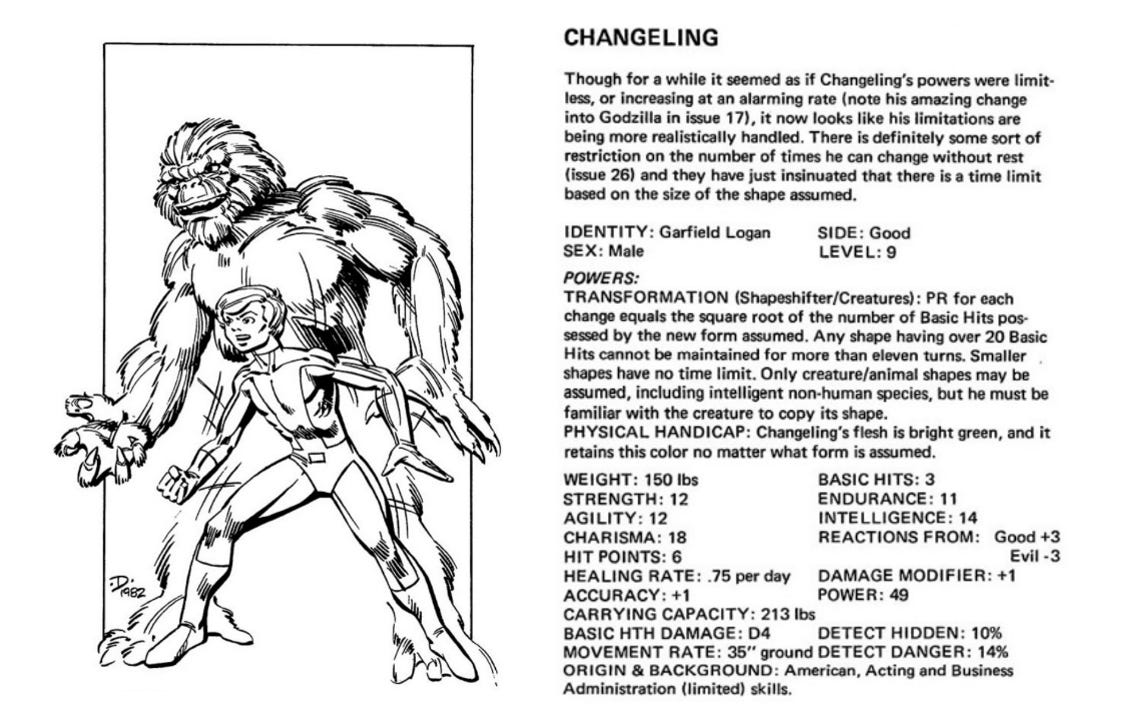
TRANSFORMATION (Shapeshifter/Creatures): PR for each change equals the square root of the number of Basic Hits possessed by the new form assumed. Any shape having over 20 Basic Hits cannot be maintained for more than 11 turns. Smaller shapes have no time limit. Only creature/animal shapes may be assumed, including intelligent non-human species, but he must be familiar with the creature to copy its shape.
That’s it. Leaving the player and GM to design each and every animal the player can turn in to. Other than having to design a lot of animal stats, this is a pretty nice adaptation. It is also one that Herman had to invent as the power isn’t in the rulebook. That’s the nature of V&V though. House rules rule the day.
When the DC Heroes RPG eventually came out, they represented Changeling in the following way, using a single power in a way that is similar to V&V but is a bit more elegant and flexible.
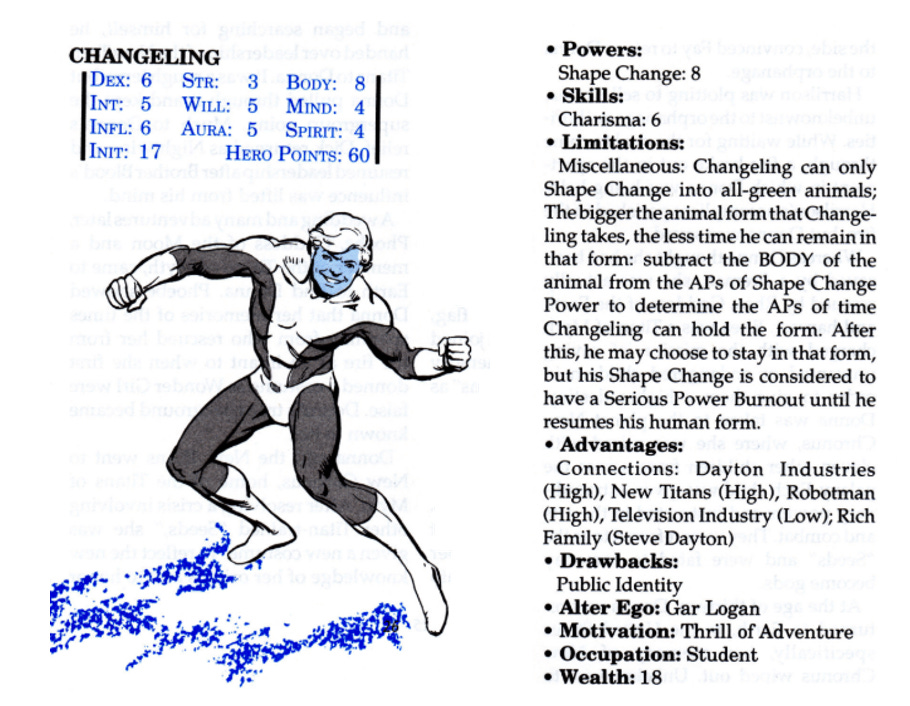
Changeling’s bas statistics that are at the high end of normal human ability, except for his Body stat which is beyond the normal human range and makes him as hard to damage with normal weapons as a brick wall. His shape change power is represented by… well... the Shape Change power which changes a bit between the 2nd (my favorite) and 3rd editions of the game:
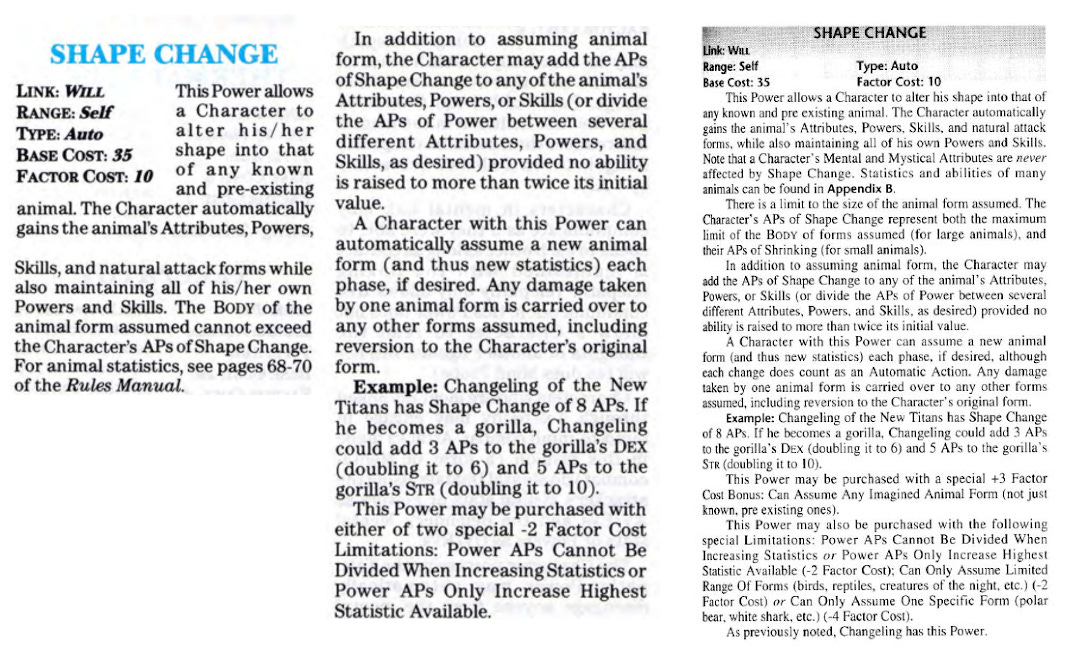
The main difference between the editions is to add clarification of the time limit for the power and to make it easier to understand which animals the character can turn into. The mechanics of the power fall nicely between the formality of Champions and the DIY nature of Villains & Vigilantes. One difference from both of those prior systems is that the rank in the power acts as both a determinant of which animals the person can transform into as well as the number of bonus points the character can add to make the animals “super” versions. DC Heroes is an exceedingly elegant system that is easy to understand and run. It also happens to have a pretty good list of animals in the main rulebooks. For example, Gar could turn into any of the following animals and his Elephant could be damned strong (Max 14 STR).
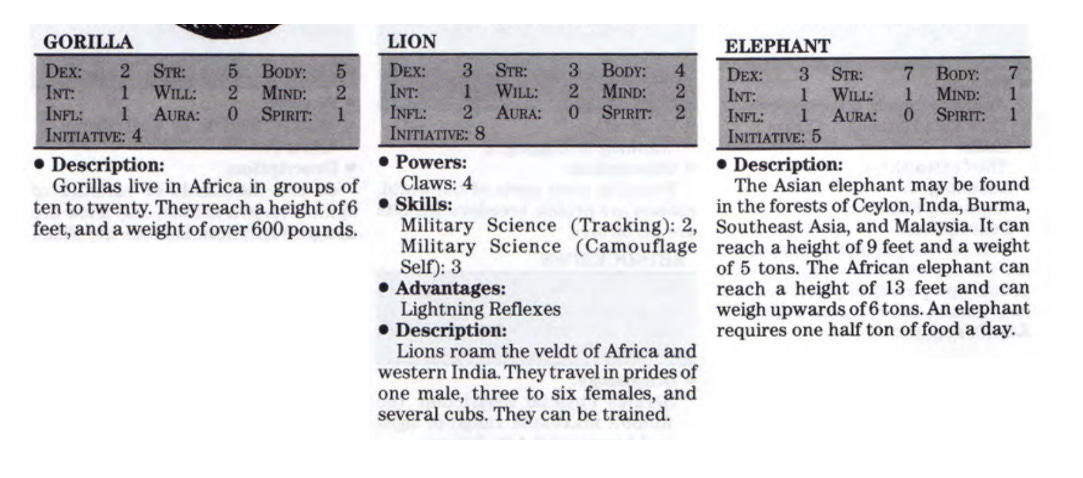
As you can tell, I am a big fan of the DC Heroes solution. It is similar to Mark Herman’s, but has been subjected to mechanical balance. It is a very expensive power to have at high levels, but low levels are inexpensive enough for a starting character to purchase it at character creation. It limits abilities to existing animals, but the power can be modified to include “imaginary” creatures. Like all of the previous options though, it does require a player to have a number of character sheets at the ready to represent Changeling in multiple forms.
I think it is interesting how the different games each approached the design challenge that a shape changing character brings. I don’t know that any has a perfect solution. I like DC Heroes’ solution, but only because their underlying AP rules structure means that each numerical value has a very specific meaning that is easy to understand and intuitive once you understand the game system. In the coming weeks, I’ll look at how some more modern systems address this problem and provide full statistics for early era Changeling in those games as well.
What are your thoughts? Which system do you prefer for this complex power?
I can't wait to see your Superworld Retroclone. I may have notes.