


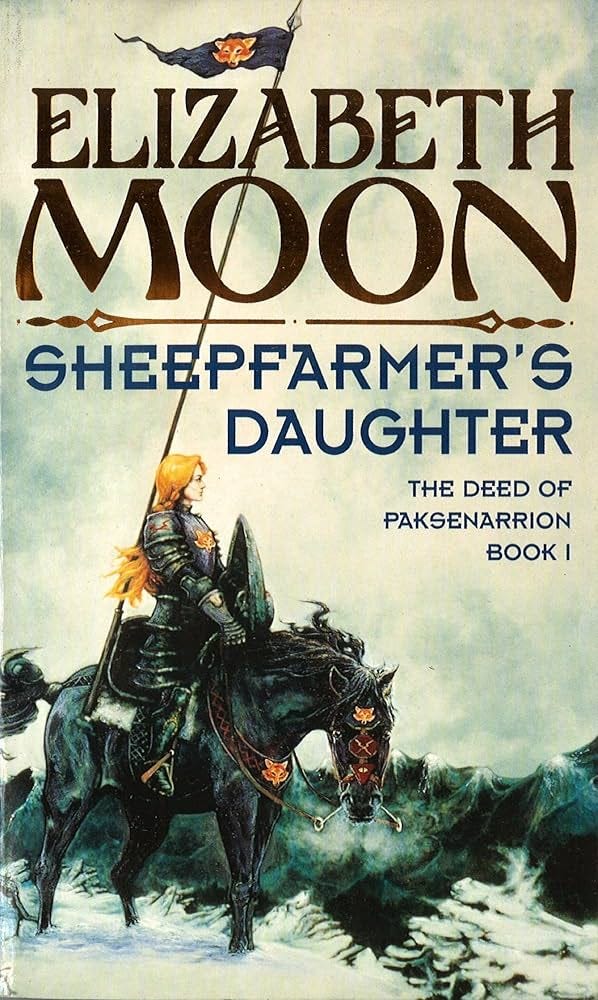
I want to stake a claim right at the top of this piece, before I get into the weeds of world-building and military logistics and the peculiar genius of Elizabeth Moon. Sheepfarmer’s Daughter is one of the most important fantasy novels written in the past forty years, and it has been absurdly underserved by the broader cultural conversation about the genre. When people talk about the books that changed fantasy, they talk about Tolkien, Jordan, Martin, and Le Guin. Sadly, Moon’s name rarely makes the list. That’s wrong. It’s been wrong since 1988, when Baen Books first published this novel, and it keeps being wrong every year that passes without someone shouting it from a rooftop.
So here I am, on a rooftop, shouting.
Let me tell you why this book matters, why it should matter to you as a fantasy fan and even more if you are a fantasy role playing gamer. After the review, beecause this is Geekerati and I’ve have decided to follow the old Google+ rule of providing gaming content when appropriate, I’ll give you stats and an mini-scenario so you can bring a piece of Paks’s world into your own campaigns.
Fantasy Authors and the Authenticity Problem
It is often said that writers should “write what you know,” but I find that far too many authors write about things they know absolutely nothing about in ways that hinder the experience. Yes, I know we are talking about fantasy and no one has actually encounter elves or fairies. At least not since Elsie Wright and Frances Griffiths met faeries outside the village of Cottingly in 1917. But even fantasy authors should have some knowledge about the mundane elements within their fiction. They don’t have to have lived experience, but genuine scholarship goes a long way and is greatly appreciated on my end.
As much as I love Brandon Sanderson, the “heist” in the first Mistborn novel felt flimsy in large part because he didn’t have any real understanding of how conspiracies and heists work. Heck, he didn’t even seem to have an Oceans Eleven level understanding. What he does understand, and this very much saved the novel, is how people interact with religion. Most of his fantasy is grounded in rich theological cosmology that draws on his real beliefs, and it shows. Authors like David Drake, Glen Cook, Jerry Pournelle, and Gene Wolfe have real world military experience and it shows in their writing. Heck, the fact that David Drake did his own translations of Ovid carries over into his fantasy Lord of the Isles series. When I read a hand to hand combat scene written by Steven Barnes, his long history of martial arts training shines through.
Like many of those I listed above, Elizabeth Moon has prior military service and is a former United States Marine. She also has degrees in biology and history. You can see her experience in these areas in both her fantasy and science fiction writing. That’s right, she’s one of those authors who is as comfortable writing personal stakes fantasy fiction as she is writing sweeping military science fiction. She is, by any reasonable measure an accomplished author and she is also one of the most versatile science fiction and fantasy writers of the last half century.
Sadly, she is not talked about enough. Late last year there was an attempt to crowdfund a role playing game based on her Deed of Paksenarrion saga and it failed on the first attempt. When it did succeed, it did so at a very modest level that is low enough I’m not certain that Brittannia Game Designs be able to deliver all of what they promised. Thankfully, they are fulfilling the game through DriveThruRPG, so I am probably being overly pessimistic.

I think part of the reason Sheepfarmer’s Daughter gets undersold is because it solves a problem that a lot of readers don’t realize fantasy has. The problem is the authenticity I mentioned earlier. Specifically, fantasy literature has always had a complicated, often fraudulent relationship with military life. The default mode of fantasy military fiction, from pulp sword-and-sorcery through the high epic tradition, is to treat soldiering as a series of dramatic moments strung together by logistics-free travel. Heroes fight, heroes win, heroes rest up and do it again. The grinding daily reality of actual military service, the training, the hierarchy, the boredom, the institutional culture, the specific and detailed ways that violence breaks human bodies, gets compressed or skipped entirely.
Like David Drake and Glen Cook, Moon makes sure to not skip any of it.
This is a woman who knows what basic training feels like from the inside, and she incorporates that into her protagonists journey. She knows what it means to subordinate your individual judgment to unit cohesion. She knows what a chain of command looks like when it’s working and when it isn’t. And when she sat down to write a fantasy novel about a young woman who runs away from an arranged marriage to become a soldier, she brought all of that knowledge with her.
The result is a book that feels, in a very specific and irreplaceable way, true.
What the Book Is, and Why It Hits Different as The Kids Said a Decade Ago
Paksenarrion Dorthansdotter, Paks, to her friends and to the reader almost immediately, is the daughter of a Three Firs sheepfarmer who decides she would rather march to war than marry. She defies her father and flees until she makes it to Duke Phelan’s recruiting sergeant, impresses him, and joins his mercenary company. Sheepfarmer’s Daughter, the first volume in The Deed of Paksenarrion, follows her through roughly two years of actual soldiering. We accompany her through her initial training, her first battle, a promotion, a physical assault and its aftermath, a long campaign in the South, capture, escape, and finally the confrontation with a villain called the Honeycat whose predations have been the operational context for much of the book’s second half.
What I want to emphasize is how unglamorous a great deal of this is, and how that unglamorousness is the book’s whole point. Paks makes beds. She digs ditches. She learns to march in formation without breaking step. She gets promoted to file leader and then has to figure out what that means for her relationships with the people she was a recruit alongside. She buys a horse for her friend Saben with her first real pay. She learns to barter. She sits watch. She is exhausted, and muddy, and professionally competent in ways that mount up slowly across hundreds of pages until you realize you have been reading a masterclass in what it actually means to become a soldier.
This is the achievement the genre almost never pulls off. The process of military professionalization is rendered so convincingly that you feel like you’ve been through part of it yourself. The first book is the opposite of modern “progression fantasy” where we can almost count the experience points our protagonists earn, if they aren’t given to us outright, as they go from zero to hero. This first novel is truly low fantasy and very down to Earth. Yes, there is magic. At first, it looms in the background and it emerges more and more as the threat of the Honeycat grows, but Paks is digging ditchs and suffering the aftereffects of concussions.
It’s refreshing to read something that portrays the mundane, and mundane threats, in a real and thoughtful way. Paks is a protagonist we worry about, even as we know from the opening (and the fact that there are more books) that she will survive. When Patrick Rothfuss wrote his novel of a young man’s experience with homelessness and the acquisition of student loan debt (The Name of the Wind), he was following in the Moon tradition. She was there first, and she finished her series.
The D&D Connection
A lot of commentators discuss the connection the second novel in the series, Divided Allegiance, has with the AD&D adventure The Village of Hommlet. Since, I’m reading that section right now, I can see that connection, but the D&D elements are deeper than mere inspiration in my mind.

Sheepfarmer’s Daughter reads, in certain crucial respects, like what happens when someone who actually understands military history and culture sits down to write the fantasy novel that presents the world Dungeons & Dragons kept gesturing at but that modern gamers ignore. I mean that as a compliment to both Moon and the game as it was once played. James M. Spahn recently discussed hearing some one call modern D&D (and by extension modern progression fantasy) “Pop Fantasy,” Like him, I agree that this is what the genre has become.
Pop fantasy happens when your inspirations and frames of reference is wholely within self-reflective as a genre. In the case of D&D, it was initially inspired by Burroughs and Howard with Tolkien being added to that mix as flavoring early on. Eventually, later versions of D&D (and D&D fiction) were inspired by D&D. Ask a modern gamer what their favorite Burroughs story is or what they think of Lin Carter’s Ballantine series of fantasy novels and you’ll likely get blank stares. Ask them about Drizzt or Matt Mercer and you’ll have a wonderful conversation. I like both the Carter era and the modern one, but I do wish the modern one would engage with the past a bit more.
D&D, especially the Basic/Expert game I grew up with, the one Gary Gygax and Dave Arneson built and Tom Moldvay, Dave Cook, and Steven Marsh refined, has always been animated by a kind of romantic militarism. You play warriors, you join companies, you march through hostile territory, you fight, you loot, you survive. The game gives you a Fighter class with hit points, a good to-hit progression, and a list of weapon proficiencies (not called proficiencies in B/X because Fighters in that game are proficient with all weapons), and it gestures at a whole life of professional violence that it doesn’t have the bandwidth to fully simulate. That’s fine. Games have to abstract. That’s what games are for. The whole point of my recent article on Charisma as “power stat” is that player characters were companies, not parties. They were more Black Company than Fellowship. So much so, I can see why Gygax constantly bristled when people said D&D was Tolkienesque.

But Moon doesn’t have to abstract. She can show you every single thing that the Fighter class represents in actual embodied practice. When Paks struggles with spear training and excels at marching, she is demonstrating in lived narrative form exactly the kind of differentiation that hit dice and proficiency slots are trying to capture. When the trial of Corporal Stephi plays out through two chapters of careful institutional procedure, Moon is illustrating the whole social infrastructure that keeps a mercenary company from devolving into chaos. She is showing us the stuff that happens between the adventures and giving us a fiction outline for how to role play downtime.
Sergeant Stammel, who is one of my favorite characters in the book, is what a really good NPC sergeant should look like. He’s competent, fair, genuinely invested in his recruits’ development, capable of both warmth and iron severity. He is the idealized NCO that every good DM is trying to channel when they run a military campaign. Moon gives him to you in full color and lets you watch how he actually works. He’s not the stereotypical NCO played by R. Lee Ermey. He reminds me far more of my Sgt. Major Opa. He’s tough and demanding, but there to guide you in a stern but positive way.
The Honeycat, Count Siniava, the villain of the book’s second half, is what high level monster design is trying to get at when it builds a villain with political power, personal menace, magical resources, and a genuine strategic intelligence. He doesn’t just threaten Paks. He threatens the whole operational situation. He is the kind of antagonist who makes everything harder without ever being in the room. He demonstrates the value of “domain play,” which was a major focus of earlier editions of D&D but has faded away with newer editions of the game.
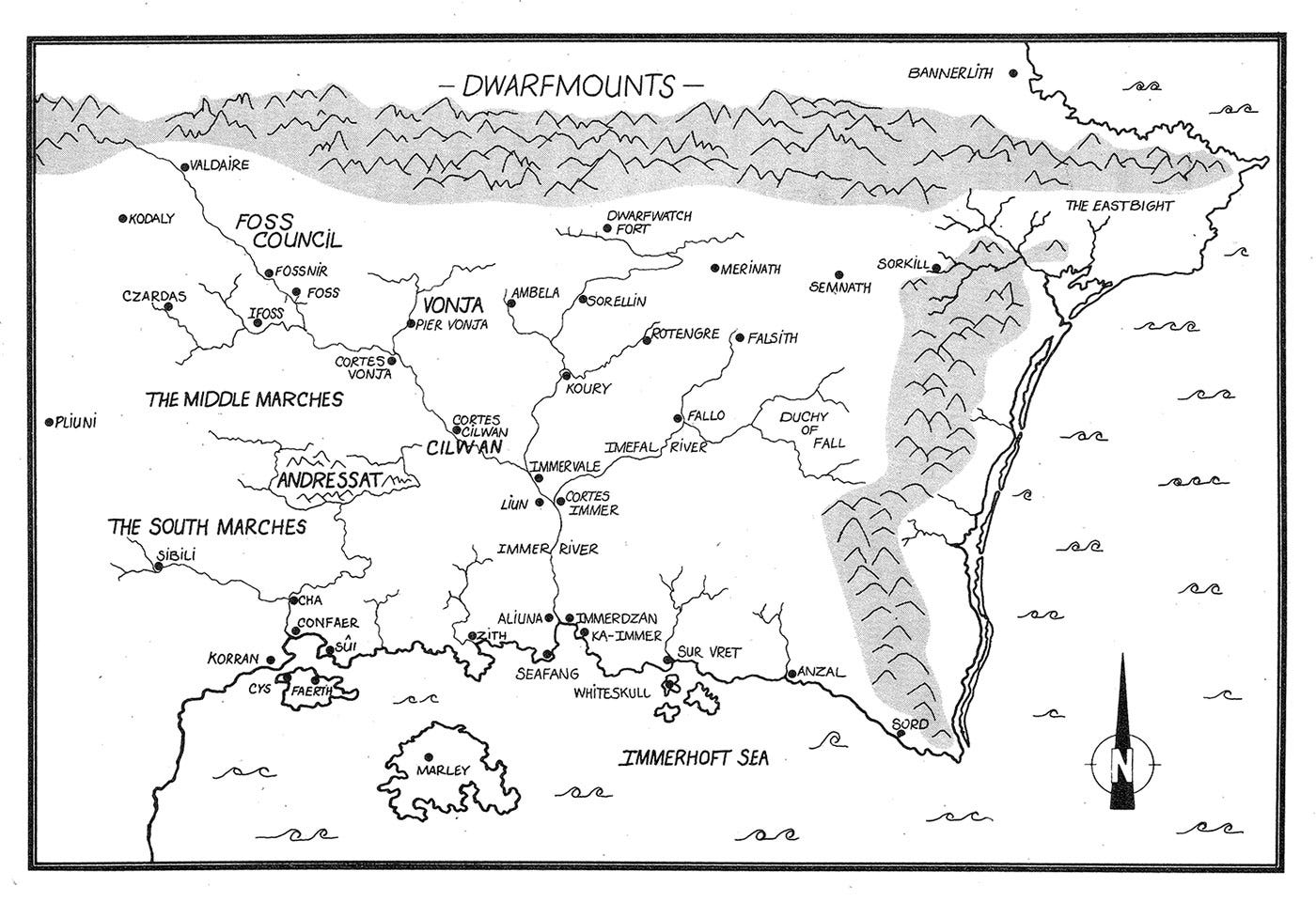
And the world itself, Paksenarrion’s world, is constructed with exactly the kind of internally coherent economic and political logic that the best D&D settings aspire to. The mercenary company system makes sense. The way cities are distributed along trade routes makes sense. The relationship between mercenary ethics and the proto-just-war agreements between companies makes sense. This is not a fantasy economy bolted onto a video game map. This is a world that could have existed.
The Escape Sequence (Chapters 14-18): Where the Book Becomes Something Else
I want to pay particular attention to the central sustained narrative in the book’s second half, because it is where Sheepfarmer’s Daughter shifts registers in a way that I find genuinely remarkable.
Paks, Saben, and Canna Arendts are sent by Duke Phelan to garrison a fort called Dwarfwatch in the middle of the book. It’s meant to be an easy duty rotation, but they end up encountering the forces of another mercenary force (the Halverics) who defeat them and hold them for ransom. It’s an interesting sequence because it highlights how the “Lawful” mercenary companies behave. Paks and her allies surrender and give their parole, after which they are given a great deal of freedom until their ransom is paid. That ransom is never paid though because when Paks and her friends are picking berries outside their garrisoned fort the Honeycat’s forces attack the fort and kill almost everyone outside the fort. Those aleady inside are undersiege and Paks and her friends are cut off. They are unarmed except for daggers. Canna has an arrow wound that might get infected, and they have to travel through enemy-held territory to find Duke Phelan in order to break the siege.
What follows across four chapters is a sustained survival narrative. We are there for every moment of their evasion, foraging, and improvisation under pressure. This section reads nothing like the action sequences that dominate the rest of the book. It reads like medieval version of Lone Survivor. The stakes are intimate. The decisions are granular. The tension comes not from set-piece combat but from the ongoing problem of determining where they sleep, what they eat, how they get past that patrol.
Canna Arendts, and not Paks, is the hero of this section. The “Deed” may be Paksenarrion’s, but the moment is Canna’s, and she doesn’t survive it. She is a veteran soldier whose knowledge keeps the other two alive. She knows how to read the enemy’s movements, how to use terrain, how to pace a march with a wounded member. Her death, which only gets revealed later, hits with real force because Moon has made her real. Canna Arendts is the Michael Murphy of Paksennarions Deed. The book is filled with characters who like who might not make it to the end of any encounter. Paks makes it to the Duke alone uncertain of her friends’ fates.
The scene at the lone trading post, where the woman running the shop tries to rob them and the confrontation turns violent, is particularly good, It’s a reminder that the civilian world is not automatically safe, and that exhausted, unarmed soldiers are vulnerable to ordinary human predation as well as military threat. Moon earns Paks’s grief for Saben and Canna. She earns it across four chapters of detailed shared survival. That’s good writing.
And then there is the scene I want to single out, because it is the key to everything about how this book should be read by anyone who cares about what class Paksenarrion Dorthansdotter actually is.
Canna’s wound is infected, or heading that way. She needs a healer. They have no healer. Paks says she wants to try praying to Gird using Canna’s medallion. Canna is skeptical, “It takes a Marshal or a paladin to heal, though.” Then she says, in a tone that contains one of the novel’s most important lines: “What are you, a paladin in disguise? You aren’t even a Girdsman.”
She says it almost sarcastically. She says it as if it’s absurd.
Paks holds the medallion over the wound and prays anyway, stumbling, unpracticed, not even a proper Girdsman invoking a god she doesn’t officially follow. Canna says “Ouch! What did you poke it for?” Paks didn’t poke anything. The sharp pain is gone. Canna can breathe easier. The next morning, the wound is dry and pink. There is no inflammation, no fever, no infection. It’s better than it has any right to be.
Neither Paks nor Canna names what happened. Neither of them says another word about it. Moon doesn’t explain it either. She trusts the reader to understand that Canna asked the right question, and that the answer was yes. The depiction of the paladin, even a nascent one as Paks is, in Sheepfarmer’s Daughter is second only to Poul Anderson’s depiction of Holger Carlsen in Three Hearts and Three Lions. Sadly, these are two novels too rarely read today.
The Bottom Line
Read Sheepfarmer’s Daughter. Read it if you love fantasy, read it if you love military fiction, read it if you play D&D and want to understand what your Fighter character’s life actually looks like between the dungeon sessions. Read it if you want to see why you don’t need a detailed backstory and want to see how the adventures you play at low levels ARE your backstory. It is one of the genre’s genuine accomplishments, and it has been waiting patiently on the shelf for decades for more readers to find it.
The sequels, Divided Allegiance and Oath of Gold, take Paks in directions that this first book doesn’t obviously predict and that might eventually satisfy fans of progression fantasy. Though, Paks suffers a lot more than your typical protagonist in LitRPG or progression fantasy novels. I’ll be reviewing those two later, but start here. Start with the sheepfarmer’s daughter who ran away to be a soldier and ended up becoming something considerably more than that.
What’s her backstory? She’s a sheepfarmer’s daughter, and that’s enough.
And now, for the two Appendices!
Game Appendix A: The Paladin
A Character Class for B/X Dungeons & Dragons
Designed for use with the World of the Deed of Paksenarrion and compatible with any B/X campaign. BECMI already has its Paladin class.
Overview
The Paladin is a holy warrior, a fighter touched by divine favor, serving Law and the gods who uphold it. In the world of Paksenarrion, this most often means a follower of Gird or another Lawful deity, though the divine connection may not be understood by the Paladin herself, or by anyone else, for many years.
Paladins fight as Fighters, but their divine gifts set them apart: they heal by touch, resist disease, sense evil, and can in time pray for miracles. They are not Clerics. They do not turn undead. They do not serve the church institutionally. They serve through the church, or alongside it, or sometimes far ahead of it, doing what needs to be done.
A Paladin class is difficult to achieve, the divine chooses who it will, and demands much of its members. A Paladin who falls from Lawful alignment loses all class abilities until atonement is made. A Paladin who commits an act of Chaos loses them permanently, reverting to a Fighter of equivalent level with no divine gifts.
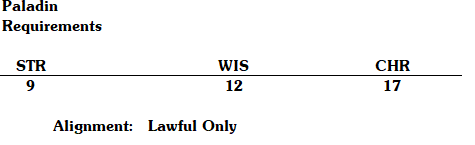
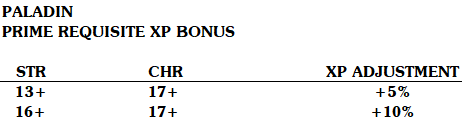
Prime Requisite: CHR and STR. All Paladins are required to have a CHR 17 or higher, so they only receive bonuses when their STR is sufficiently high.
Races: Human only, in the tradition of B/X. The divine call in this setting is particular to human experience; Referees may allow exceptions at their discretion.
Class Features
Hit Dice: d6 per level, up to 9th level. +2 HP per level from 10th onward (no Constitution bonus applies to these fixed HP gains).
Attack Progression: As Fighter. Paladins advance in combat at the same rate as Fighters.
Weapons and Armor: Paladins may use any weapon and any armor, including shields. They are not restricted by weapon type.
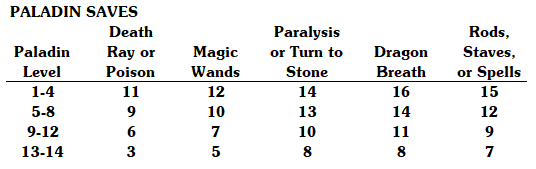
Saving Throws: As Cleric. The Paladin’s divine protection manifests in exceptional resistance to magic, poison, and petrification. The Cleric’s saving throw table best represents this.
Special Abilities
Lay on Hands
Once per day, a Paladin may heal a touched creature by laying hands upon it. The Paladin heals 2 HP per character level (so a 3rd-level Paladin heals 6 HP; a 9th-level Paladin heals 18 HP). This healing may be used on the Paladin herself. The Paladin may choose to split the healing between a disease cure and hit point restoration (see Cure Disease below).
Cure Disease
Once per week (at levels 1–8) or twice per week (at levels 9–14), a Paladin may cure any natural disease by touch. Magical curses, lycanthropy, and supernatural afflictions are beyond the reach of this ability unless the Paladin is of high enough level to pray for the appropriate Cleric spell (see Spells).
Immune to Disease
A Paladin cannot contract any natural disease. They may carry and transmit diseases (if this is relevant to the Referee), but they do not suffer the effects.
Detect Evil
A Paladin can sense the presence of Evil (Chaotic intent, creatures aligned with Chaos, or items imbued with dark magic) within 60’. This ability requires concentration. The Paladin must declare she is focusing her attention, and cannot move faster than a walk, attack, or cast spells while doing so. The ability reveals the general direction and rough intensity of Evil in range, but not its precise source until she approaches within 10’. Duration: as long as the Paladin concentrates, up to 1 turn per level per use. No daily limit.
Referee note: In B/X terms, “Evil” often means Chaotic alignment (or Chaotic creatures and items). Neutral creatures do not register unless they are actively committing Chaotic acts at that moment. Lawful creatures do not register.
Cleric Spells (6th level onward)
Beginning at 6th level, a Paladin may pray for and cast Cleric spells. These work exactly as described for the Cleric class. The Paladin has access to the complete Cleric spell list and selects spells through prayer each morning, as a Cleric does. The number of available spell slots is given on the table below.
The Paladin does not receive reversed (dark) versions of Cleric spells. A Paladin who prays for a reversed spell immediately loses all class abilities until she undertakes atonement (as adjudicated by the Referee). This is not a punishment, it is how the divine connection works.
Lawful Alignment (Required)
A Paladin must maintain Lawful alignment. Performing a Chaotic act results in the immediate loss of all Paladin class abilities. Minor transgressions can be atoned for through service, charity, or a quest determined by the Referee. A single deliberate and premeditated act of Chaos costs the Paladin all class abilities permanently; she becomes a Fighter of equivalent level and retains all physical skills and HP, but the divine connection is severed.
Referee note: This is a serious consequence and should not be applied for momentary lapses of judgment under stress. A Paladin who kills a prisoner in panic is not the same as a Paladin who tortures a prisoner for information. Use this rule with care.
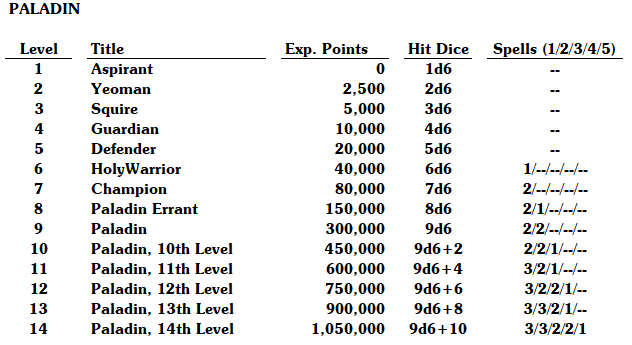
CON bonus applies to each d6 rolled at levels 1–9. No CON bonus applies to fixed HP gains at levels 10–14.
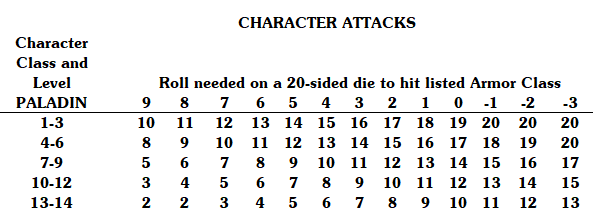
Paladins use the standard B/X combat matrix as Fighters of the same level.
Starting at Name Level (9th)
At 9th level, a Paladin reaches Name Level and may found a chapter house or small temple. The divine authorities governing the Paladin’s faith will provide nominal support, enough to establish a modest structure, but the Paladin is expected to finance construction from her own resources or those of her companions.
A 9th-level Paladin may attract followers: 1d6 × 5 men-at-arms (0-level humans) and 1d4 Aspirant-level Paladin candidates (level 1 Paladins who seek mentorship). These followers serve the Paladin’s holy cause, not her personal wealth. They will not perform Chaotic acts. If the Paladin falls from grace, her followers disperse.
Paladin Spells Available
Paladins draw from the standard Cleric spell list. They do not have access to reversed spells.
Suggested First Spells for a New Holy Warrior (Level 6): The following are the most dramatically appropriate choices for a Paladin just coming into her spellcasting ability. The Dungeon Master and player should discuss which divine tradition the Paladin follows; the spell selection should reflect that.
Cure Light Wounds — the most common choice and usually the right one
Detect Evil — she already has an innate version; the spell version reaches farther and gives more information
Protection from Evil — extends her natural shielding to companions
Light — practical and symbolically appropriate
Purify Food and Water — useful in the field, often overlooked
The Unrecognized Paladin
In the spirit of Paksenarrion herself, the Referee may choose to have a Paladin character not know she is a Paladin until later in her adventuring career. Under this variant:
The player knows the character’s class and abilities.
The character in the fiction does not have a name for what she is.
Lay on Hands manifests as something she “wills” by stubborn intent. She doesn’t discuss it.
Detect Evil presents as a vague unease or certainty that “something is wrong here.”
The excellent saving throws are attributed to constitution and luck by her companions.
A Marshal, Patriarch, or high-ranking divine figure may eventually recognize the Paladin’s nature. Perhaps this happens after witnessing her survive something she should not have survived, or after observing Lay on Hands at work. This recognition is a campaign event, not a mechanical trigger.
Canna Arendts asked the right question once, in a tone she meant as a joke: “What are you, a paladin in disguise?” She did not know she was asking the most important question anyone would ask for the next several years.
Design Notes
This class is designed to fit the tone of Elizabeth Moon’s Sheepfarmer’s Daughter and the larger Deed of Paksenarrion trilogy. Key decisions:
Why no Turning? The Paladin’s divine power in this setting is expressed through protection, healing, and combat and not spiritual authority over undead. Turning is a Clerical function specific to the church hierarchy. A Paladin is a warrior first; the spiritual authority comes later, if at all. While there is a scene in the second novel of a Paladin wielding a Holy Sword and doing some amazing things, it doesn’t include turning undead.
Why Cleric saves instead of “+2 to all saves”? The “+2 bonus” is an AD&D 1e mechanical layer that doesn’t translate cleanly to B/X’s class-based save tables. Using the Cleric table is functionally similar (Cleric saves are generally better than Fighter saves in the critical categories), simpler to apply, and removes the need for a house rule.
Why d6 HP instead of d8? The Paladin is not a fighter’s fighter, she is a person of faith who fights. The Cleric’s d6 represents this. She survives through divine grace and tactical intelligence, not brute endurance.
Why spells at 6th, not 9th? The AD&D 1e Paladin gets spells at 9th level, which in practice means most campaign Paladins never cast a spell. B/X campaigns rarely go past level 9. Moving spells to 6th level ensures the ability sees actual play and reflects the divine development arc of Paks’s story across all three books.
What about higher levels? This class goes to 14, the B/X maximum for humans. The Deed of Paksenarrion spans three books and a substantial level range. If you’re running a full trilogy campaign, consider what lies beyond 14th and consider using BECMI. The Companion Set has rules for Paladins that are quite good and reflective of that edition’s baseline mechanics. The Referee’s discretion applies, and the divine escalation in Oath of Gold suggests that the story goes places no table can cleanly map.
Game Appendix B: Characters, Stats, and an Adventure
Because we’re gamers, and the best reviews leave you something to play with. I am providing B/X D&D, AD&D 1st Edition, and Dragonbane Stats.
Key Character Statistics
The following stat blocks cover Paksenarrion, Saben, Canna Arendts, The Honeycat (Count Siniava), Sergeant Stammel, and Duke Phelan as they appear at the time of the escape sequence (Chapters 14-18). I’ve noted where equipment differs from standard due to the circumstances of the scenario.
PAKSENARRION DORTHANSDOTTER (”Paks”)
Human Paladin (unrecognized), Age 18. A sheepfarmer’s daughter turned soldier, roughly one year of professional military experience. Private in Duke Phelan’s company. Promoted for battlefield performance. Paks is a Paladin who does not know she is a Paladin yet. Her divine gifts manifest as what she and everyone around her takes for exceptional luck, constitution, and will. The High Marshal who meets her later suspects, but no one yet confirms it and she has received no training. At the time of the escape she is unarmed except for a dagger, unwounded at the start, suffers a broken rib during a hilltop skirmish (Chapter 16) and an arm wound in the trading post encounter (Chapter 17).
B/X Dungeons & Dragons
Class/Level: Paladin 3 (”Warrior” — per the B/X Paladin class in this article)
Alignment: Lawful
Experience Points: 7,000 (mid-3rd level; needs 10,000 for 4th)

Hit Points: 17 (3d6 + 3 CON bonus; CON 15 grants +1 per die)
Armor Class: 9 (unarmored; 5 in full military kit: leather + shield + Dex Bonus)
Movement: 120’ (40’)
Attacks: 1 (as Fighter)
Damage: 1d4 + 1 (dagger); 1d8 + 1 (sword, when available); 1d6 + 1 (spear)
Saving Throws (Paladin 3, as Cleric levels 1–4):

These are meaningfully better than a Fighter 3’s saves across most categories. This is the most observable sign of Paks’s nature, and no one yet has a name for it. She is shown to be very resistant to poison in the novel.
Paladin Abilities (as of 3rd level):
Lay on Hands: Heals 6 HP (2 HP × level 3) once per day, by touch. This is the ability Paks channels through Canna’s Gird medallion during the escape. She does not understand what she is doing. The Referee should apply it quietly and let the fiction discover it. It is likely, based on the combat descriptions, that she used this on herself during battles. She took blows that should have killed her, but lived with only injuries.
Cure Disease: Once per week, can cure any natural disease by touch. May be used in place of or in addition to Lay on Hands in the same day.
Detect Evil: Active within 60’, requiring concentration. Paks cannot move faster than a walk, attack, or cast while using it. Duration: up to 1 turn per level (3 turns at 3rd level). This presents as unease, certainty that something is wrong, a pulling sense of wrongness she cannot explain. No daily limit. Until she gets Canna’s amulet of Gird, she never uses this ability.
Immune to Disease: Cannot contract any natural disease.
(Cleric spellcasting begins at 6th level — “Holy Warrior” on the Paladin advancement table. Paks has no awareness of any divine connection at this point in the story.)
Languages: Common
Equipment (escape): Dagger, traveling clothes, minimal rations
Equipment (full kit): Chain mail, shield, short sword, spear, dagger, military pack
Special Notes:
The Referee should apply Paks’s Paladin abilities as silent features of the world. They are real, they work, and nobody in the fiction announces them. The excellent saves are attributed to luck and constitution. The Lay on Hands is something she tries on a whim, but doesn’t believe in. The Detect Evil is a bad feeling she can’t shake or a weight from Canna’s necklace. Canna asked the right question once and didn’t know it.
Advanced Dungeons & Dragons, 1st Edition
Class: Paladin
Level: 3rd
Alignment: Lawful Good
STR     INT     WIS     DEX     CON     CHA
 16         11         13         14         15          17
Hit Points: 24 (Paladin uses d10; CON +1 bonus applies)
Armor Class: 9 (unarmored); 5 (leather armor, shield, Dex bonus)
Movement: 12” / 9” in armor
THAC0: 18
Number of Attacks: 1
Damage by Weapon: By weapon type; +1 STR damage bonus at STR 16
Saving Throws (Paladin 3rd — all categories +2 from class ability):
Paralyzation/Poison/Death Magic: 12 | Rod/Staff/Wand: 14 | Petrification/Polymorph: 13 | Breath Weapon: 15 | Spell: 15
Paladin Abilities:
Lay on Hands: 6 HP (2 × level 3) healed, once per day. She does this for Canna during the escape. She has no name for it.
Cure Disease: Once per week by touch.
Detect Evil: 60’ continuous, 1 round concentration to identify source.
Protection from Evil: 10’ radius, continuous. All companions in her immediate presence benefit.
Turn Undead: As Cleric 1st level (untested — she has not encountered undead in this narrative).
Immune to Disease.
(Cleric spell access begins at 9th level.)
Weapon Proficiencies: Sword (long), Spear, Dagger
Non-Proficiency Penalty: -2
Special Notes:
Paks does not know she is a Paladin. No one in her chain of command has recognized it yet. The Marshal who encounters her later is the first to form a theory. The Referee applies these abilities as features of the character, not as announced powers. Her exceptional saves are the most visible sign; the healing is something she does quietly and does not discuss.
Languages: Common (one dialect), Trade Tongue (partial)
Dragonbane
Type: Human Holy Warrior (Unrecognized)
Movement: 10
Hit Points: 15
Attribute     Score
STR                  14
CON                15
AGL                 14
INT                  11
WIL                 14
CHA                 17
Armor: None (escape scenario); Studded Leather (full kit) — DR 3/5
Skills:
Swords 16 | Spears 14 | Knives 13 | Evade 13 | Sneaking 10 | Awareness 12 | Endurance 14 | Persuasion 13 | Healing 13
Traits:
Brave: Paks never makes a WIL check in the first round of combat, regardless of circumstances.
Lay on Hands: Once per day, Paks may touch a wounded character and restore 1d6 HP. She does not understand this as a divine ability. This is how Canna receives some relief from her wound during the escape.
Blessed Resilience: Paks gains +2 to all Conditions saves against poison, disease, and magical effects. She is immune to natural disease. This is the ability her comrades have noticed without explaining.
Hard Marcher: Paks may travel one additional hex per day of wilderness travel without fatigue penalty.
Weapons: Knife (1d6), Sword (1d8, +2 push), Spear (1d8, reach)
Special Conditions (Escape Scenario):
Broken rib: AGL reduced to 11, movement reduced to 8. Arm wound: Swords and Knives skills reduced by 3.
SABEN
Human Fighter, Age 19. Fellow recruit and close friend of Paksenarrion. Cheerful, dependable, deeply loyal. At his best, he is a competent soldier one step behind Paks in terms of raw talent but her equal in courage.
B/X Dungeons & Dragons
Class/Level: Fighter 2
Alignment: Lawful
STR     INT     WIS     DEX     CON     CHR
  14        10        11         13          13          14
Hit Points: 13
Armor Class: 9 (unarmored)
Movement: 120’ (40’)
Attacks: 1
Damage: 1d4 (dagger)
Save As: Fighter 2
Morale: 11
Advanced Dungeons & Dragons, 1st Edition
Class: Fighter | Level: 2nd | Alignment: Lawful Good
STR     INT     WIS     DEX     CON     CHA
  14        10        11          13         13          14
Hit Points: 16
Armor Class: 9 (unarmored)
Movement: 12”
THAC0: 19
Attacks: 1
Damage: By weapon type
Saving Throws: As Fighter 2
Weapon Proficiencies: Spear, Short Sword, Dagger
Dragonbane
Type: Human Soldier
Movement: 10
Hit Points: 13
Attribute     Score
STR               13
CON             13
AGL              13
INT               10
WIL               11
CHA              14
Armor: None (escape) / Light leather DR 2 (full kit)
Skills:
Spears 13 | Swords 12 | Knives 12 | Evade 12 | Sneaking 10 | Awareness 10 | Endurance 12
Traits:
Loyal: When fighting alongside Paks, Saben gains +2 on all WIL checks.
Steadfast: Saben will never voluntarily leave a wounded companion.
Weapons: Knife (1d6), Spear (1d8, reach)
CANNA ARENDTS
Human Fighter, Age ~28. A female veteran of Duke Phelan’s company, several years Paks’s senior in both age and experience. Practical, unsentimental, possessed of exactly the kind of hard-won tactical wisdom that keeps people alive in bad situations. She is the group’s de facto leader during the escape, despite being its most severely wounded member. She dies covering Paks’s final run to safety.
B/X Dungeons & Dragons
Class/Level: Fighter 5
Alignment: Lawful
STR     INT     WIS     DEX     CON     CHR
  14        13        14          14          14          12
Hit Points: 30 (currently 18 — arrow wound)
Armor Class: 9 (unarmored; arrow in shoulder, movement penalty applies)
Movement: 90’ (30’) (wounded)
Attacks: 1
Damage: 1d4 (dagger)
Save As: Fighter 5
Special Notes:
Canna provides a +1 bonus to all navigation and evasion decisions made by the group if you use the optional ability check rule from The Art of Dungeon Mastering section. She is more experienced than either Paks or Saben and her tactical judgments are sound. She knows the general layout of this region from earlier campaigns.
Advanced Dungeons & Dragons, 1st Edition
Class: Fighter | Level: 5th | Alignment: Lawful Good (Girdsman
STR     INT     WIS     DEX     CON     CHA
  14        13        14         14          14          12
Hit Points: 35 (currently 21 due to arrow wound)
Armor Class: 9 (unarmored); 2 (full kit: chain mail, shield, Dex bonus)
Movement: 9” (reduced from 12” due to wound)
THAC0: 16
Number of Attacks: 1
Damage: By weapon; no STR bonus
Saving Throws: As Fighter 5
Weapon Proficiencies: Sword (long), Dagger, Spear, Crossbow (light)
Special Abilities:
Multiple attacks (5 per round against opponents of fewer than 1 HD)
Tactical assessment: Canna has an effective Intelligence of 15 for purposes of evaluating military situations (battlefield experience)
She may roll once per day to recall relevant knowledge of the region from prior service (Referee discretion)
Special Disadvantages:
Arrow wound: -2 to all attack rolls, -3” movement, cumulative fatigue effects on long marches prior to being healed by Paks.
Dragonbane
Type: Human Veteran Soldier
Movement: 8 (injured; normally 10)
Hit Points: 14 (currently 8 — arrow wound)
Attribute     Score
STR                13
CON              14
AGL               13
INT                13
WIL               14
CHA              12
Armor: None (escape) / Chain DR 4 (full kit)
Skills:
Swords 16 | Spears 14 | Knives 15 | Evade 13 | Sneaking 13 | Awareness 15 | Endurance 14 | Healing 13 | Leadership 14 | Lore (Military) 14
Traits:
Veteran: Once per combat, Canna may reroll any single die result (attack, defense, or damage).
Tactical Mind: When the group makes a group decision about evasion, navigation, or ambush avoidance and follows Canna’s recommendation, they gain advantage on the relevant check.
Self-Sacrifice: Canna will never abandon an ally who cannot move under their own power. This trait cannot be overridden by morale or fear.
Weapons: Knife (1d6), Short Sword (1d8)
Current Condition: Arrow wound in shoulder. All STR and AGL-based checks are made at -2. She is losing 1 HP per day without medical attention. A successful Healing roll halts this progression. All penalties are removed when/if Paks heals her.
THE HONEYCAT (Count Siniava)
Human Fighter (Lord), the book’s primary antagonist. A southern count who has built a career on manufacturing conflicts that he then profits from. He hires out his troops to multiple parties, manipulates political situations, and vanishes before consequences arrive. He is charming, intelligent, militarily capable, and utterly ruthless. He holds a dark pact that grants him one supernatural ability. He can assume the form of a large predatory cat. He travels with a personal mage who handles his arcane requirements. He is the kind of villain whose menace is largely institutional. You feel the weight of his organization before you ever meet him in person and that is exactly the right design for this kind of antagonist.
B/X Dungeons & Dragons
Class/Level: Fighter 9 (Lord)
Alignment: Chaotic
STR     INT     WIS     DEX     CON     CHR
  17        17         14         16         14          18
Hit Points: 58
Armor Class: 1 (plate mail +2, Dex bonus, ring of protection +1)
Movement: 60’ (20’)
Attacks: 1
Damage: 1d8+4 (magic sword +2, STR bonus +2)
Save As: Fighter 9
Morale: 11 (12 commanding his troops; 8 when personally cornered with no prepared escape)
Dark Pact — The Cat’s Form:
Once per day, Siniava may transform into a large predatory cat. This is not a spell, but it can be dispelled. Due to the weakness of the cat form, in comparison to his real attributes, he will revert to human form if attacked.
In cat form:
AC: 5 | MV: 180’ (60’) | Attacks: 2 claws (1d4+1) / bite (1d6+1)
He retains his own Intelligence and WIS but cannot speak or use weapons or items
He may return to human form at will; doing so takes one full round
He uses this ability to escape, not to fight. Siniava is a general and a politician. Shapeshifting when cornered is an admission that the plan has failed.
His Mage:
Siniava keeps a personal mage (Magic-User 6, Chaotic) on his staff who handles all arcane requirements. The mage is a member of the Lender’s Guild and casts battlefield spells, communications enchantments, minor divination. In particular, he uses Sleep on Duke Phelan’s troops to aid him and Siniava’s escapes. Any magical effects not attributable to the dark pact should be sourced to this figure. He also has allies who are Clerics of Liart, the god of torture.
Treasure: Plate mail +2, magic sword +2, ring of protection +1, various gems and political correspondence of significant intelligence value.
Advanced Dungeons & Dragons, 1st Edition
Class: Fighter
Level: 10th
Alignment: Chaotic Evil
STR     INT     WIS     DEX     CON     CHA
  17        17         14         16         14          18
Hit Points: 74
Armor Class: -1 (plate mail +2, ring of protection +2, Dex bonus)
Movement: 6” (armored)
THAC0: 11
Number of Attacks: 3/2
Damage: 1d8+5 (+3 STR bonus for STR 17, +2 magic weapon)
Saving Throws: As Fighter 10
Special Ability — Dark Patron Grant (The Cat’s Form):
Once per day, Siniava may assume the form of a large predatory cat. This functions as Polymorph Self but is a granted power, not a memorized spell. It requires no components, but can be dispelled and is available to him as a gift from the dark pact he made with evil gods. In cat form: MV 18”, AC 5, attacks 2 claws (1d4+2) / bite (1d6+2), retains INT and WIS. He uses this to escape, not to fight. The distinction matters for how the Referee runs him. The cat form is weaker than his normal form, but it can allow him to sneak out at night.
Special Defenses:
Ring of protection +2; effectively never surprised in situations his intelligence network has been monitoring (1-in-10 chance of surprise rather than standard).
His Mage:
A personal Magic-User (8th level, Chaotic Evil) travels with Siniava’s inner retinue and provides all arcane support. Any magical effects encountered in Siniava’s operations that go beyond the dark pact ability are this figure’s work, or the work of one of the many evil Clerics allied with Siniava. Make sure that one of his spells is Sleep because he uses that spell in the final battle.
Magic Resistance: Nil
Intelligence: Exceptional (17)
Alignment: Chaotic Evil
Weapon Proficiencies: Sword (long), Sword (broad), Dagger, Crossbow (heavy), Mace, Lance
Personality: Charming, politically sophisticated, and apparently reasonable. He is not reasonable. Personal morale 10 in command situations. This drops to 7 in direct, uncontrolled combat where his political leverage is absent.
XP Value: 5,200 + 14/hp
Dragonbane
Type: Dark Nobleman / Sorcerer-Warrior
Movement: 10
Hit Points: 14
Attribute     Score
STR                 16
CON               14
AGL                15
INT                 17
WIL                16
CHA               18
Armor: Plate Mail — DR 6
Skills:
Swords 18 | Evade 15 | Persuasion 18 | Awareness 17 | Sneaking 14 | Manipulation 18 | Lore (Magic) 15 | Leadership 17
Traits:
Shapeshifter (Dark Pact): Once per day, Siniava may transform into a large predatory cat. In cat form: MV 14, HP as normal, Armor DR 2 (natural hide), attacks Claws 1d8 / Bite 1d10. He retains his INT and WIL but cannot speak or use items. He returns to human form at will (one action).
Dark Patron: Once per combat, Siniava may call upon his patron for a Fear effect on all enemies within 10 meters. All affected must make a WIL check or spend their action fleeing.
Commanding Presence: Enemies who attempt to directly defy Siniava’s verbal orders must make a WIL check at -2 or hesitate for one action.
Political Web: Siniava always has a prepared escape route in any situation he has had time to plan. Catching him unprepared is the only reliable method.
His Mage (Companion NPC):
Siniava’s personal mage travels with his inner retinue and handles all arcane requirements. Referees should assign this figure MV 10, HP 9, Armor DR 1, INT 16, WIL 14, Lore (Magic) 18, and the following spells usable once per combat each: Sleep (WIL vs. 14, 2d4 HD affected), Hold (WIL vs. 15, one target), Phantasm (creates an illusory threat, Awareness vs. 15 to disbelieve). The Sleep spell was used in the final battle with Siniava.
Weapons: Longsword (1d10, +1 push/sweep), Dagger (1d6)
SERGEANT STAMMEL
Bonus inclusion because leaving him out would be criminal. I might do a full write up later, but Stammel is a great example of a Lawful non-paladin character. At the beginning of the second book, he is troubled by many actions taken by Duke Phelan but unlike Paks he doesn’t get physically ill and remains with the company.
B/X D&D
Class/Level: Fighter 7 | Alignment: Lawful | HP: 42 | AC: 3 (chain +1, shield) | MV: 90’ | AT: 1 | D: 1d8+2 | SV: F7 | ML: 12
STR 16 | INT 13 | WIS 15 | DEX 12 | CON 15 | CHA 16
AD&D 1e
Fighter 7 | Align: LG | HP: 52 | AC: 1 | MV: 9” | THAC0: 14
STR 16 | INT 13 | WIS 15 | DEX 12 | CON 15 | CHA 16
Proficiencies: Sword (long), Spear, Dagger, Crossbow (light), Mace
Dragonbane
MV: 10 | HP: 15 | Armor: Chain DR 4
STR 14 | CON 15 | AGL 12 | INT 13 | WIL 15 | CHA 16
Swords 16 | Spears 15 | Leadership 18 | Awareness 15 | Persuasion 15
Traits: Inspiring Leader (allies within 10 meters gain +2 on WIL checks), Veteran, Never Quit
The Long Road to Phelan
A Mini-Adventure for 3 Characters (Pregenerated or Player-Created), Levels 2-4
Adaptable for B/X D&D, AD&D 1st Edition, or Dragonbane. System-specific notes provided where relevant.
Background
Three soldiers of Duke Phelan’s Company are on the wrong side of a military catastrophe. Their garrisoned fort of Dwarfwatch has fallen to the forces of Count Siniava, the Honeycat. The soldiers were deep in the brambles south of the fort picking berries when the attack came. Siniava’s troops killed everyone they could find. The portcullis crashed down before the characters could reach the gate. Their own men are visible on the walls, armed by their once foes, and now allies, the Halverics. The fort is holding, but the group is cut off. The Honeycat’s sweeps are already moving through the surrounding area. He’s preparing to take the majority of his army south and leave a contingent to siege Dwarfwatch. It’s up to the PCs to get word to the Duke.
The PCs are in a rough spot though. All they have their daggers and the small amount of provisions they brought for lunch. Canna has an arrow wound in the big muscle between her neck and shoulder from when Siniava’s troops fired arrows blindly into the brambles. Canna remained silent when she was hit, so the PCs are undetected. Paks and Saben pulled the barbed head out and bandaged it with a strip of cloak and a folded section of the berry sack. Thankfully, the arrow hadn’t gone in deep enough for the barbs to do their work but the injury is serious. They have waterflasks, a tinderbox in Canna’s pouch, and a pail with some berries left in it. That is all.
Duke Phelan is to the south, at the siege of Rotengre. A city that is somewhere between six and eight days’ march through country that Siniava now controls.
This adventure works as a narrative scenario for one Referee and three players (each running a pregenerated character from the stat blocks above), or as a solo scenario with the Referee running Saben and Canna as NPCs and the player controlling Paks. The pregens are provided with this article; stat blocks appear in the Game Appendix. You can also run the scenario allowing your players to use their own characters. I think this might be a great way to start a campaign, in medias res.
Tone: This is a survival thriller, not a dungeon crawl. Resources matter acutely. Evasion is preferred over combat at almost every point. Every fight costs something the group doesn’t have to spare. Each encounter costs them in health, equipment, time, or noise. The Referee’s job is to make the pressure felt without making the scenario feel hopeless. Moon’s version of this story is tense and cold and hungry and ultimately worthwhile. That’s the target.
Party Resources at Start:
Three daggers (belt daggers, standard issue)
Canna’s tinderbox
Waterflasks (full)
The berry pail (mostly full — food for one day for three people, or less)
Canna’s tactical knowledge and Gird medallion
No armor. No swords. No shields.
Canna’s Wound: She has lost blood and is operating at reduced capacity. Apply her wounded statistics from her stat block. Without treatment (binding, cleaning, wound ointment), she loses 1 HP per day as infection sets in. The wound is the adventure’s primary clock; not Siniava’s column, not the patrol schedule. It’s Canna.
Encounter 1: First Night — Hiding in the Woods
The first night after the fort falls. The group has made it into the tree line south of the fort. Fog settles in. Horse patrols move through the area.
The group overhears two of Siniava’s horsemen riding through the fog nearby, complaining to each other. This is how they learn the enemy’s name:
“My lord Siniava will be up to his usual tricks, no doubt.”
Canna recognizes the name. “The Honeycat,” she says quietly.
The Situation: No combat is likely this night if the group is sensible. The challenge is noise discipline, cold management, and watch rotation. Canna is feverish and losing heat fast. The fog both hides them and disorients movement.
Key Decisions:
Do they move at night? If she’s an NPC, Canna says no. The fog will cause them to blunder and make noise. They sleep in shifts. (If players insist on moving: each hour of night movement requires a DEX check in B/X or an AGL check in Dragonbane. A failure means audible noise and a Siniava patrol check. Roll 1d6; on a 1-2, a patrol investigates.) If the party fights and kills a patrol, all future patrol rolls are on a 1-3.
Who keeps watch? Paks should take first watch; she is the least wounded. Canna needs sleep more than anyone.
Canna’s prayer at night: Canna asks both of them to join her in a prayer to Gird. “He welcomes all honorable warriors.” Paks and Saben both repeat the prayer after her: “Courage to our friends, and confusion to our enemies.” This is not a mechanical effect, it’s a character moment, and the Referee should play it as one. How they respond in this moment will affect the special scene below. If the Paks player (you probably should make a fake character sheet for that player) agrees to pray, then she can attempt the healing later. If not, she cannot.
Siniava’s Mounted Patrol (2 horsemen passing nearby):
B/X: AC 5, HD 1, HP 5, MV 240’ mounted, #AT 1, D 1d8 (sword), SV F1, ML 8, AL C. If they hear the group, they investigate and call out; they will not dismount to chase into thick woods.
AD&D 1e: AC 5, 1 HD, HP 5, MV 24” mounted, THAC0 20, D 1d8. ML 8.
Dragonbane: MV 12 (mounted), HP 5, Armor DR 2, Swords 12, WIL 10. If they hear noise: Awareness 12 check. On success, they stop and call out; if no answer, they investigate with torches.
Note: Canna should not take a watch this night. If the Referee runs her as an NPC and she insists, she collapses partway through and you should make another Patrol check. She’s more hurt than she’s letting on.
Encounter 2: The Raided Farm — Scavenging in Silence
The next day. In the afternoon they smell woodsmoke and see a farmstead in a clearing. It’s a cluster of huts, a barn, a stock fence. Saben scouts and comes back gray-faced.
Read or paraphrase:
“They’re there,” Saben says in a strange choked voice. “I counted twelve horses—they’ve killed the farmers—and their families. The bodies are just—lying around. Like old rags—”
The soldiers, twelve horses’ worth of them, are there eating a cow they’ve slaughtered and roasted over the farm’s fire. But wait! One horse arrives hard at a gallop. A messenger. Twenty minutes later, all twelve horses are gone, ordered back to the fort. The messenger told them they’re marching south in the morning.
The farm is empty of soldiers. And there is an entire half-roasted cow cooling over a dying fire, and bread baking in the huts.
The Situation: This is a scavenging encounter under time pressure. The soldiers are gone, but they might return. Leaving obvious signs of their presence is dangerous. Siniava will know someone got out. Taking too much, or leaving clean knife cuts in the meat, will give them away. Don’t tell the players this. Let them make their own decisions and increase patrols in accordance with need.
Canna’s decision: She sends Saben. One person only, to minimize their footprint. Paks and Canna wait in the tree line.
The Saben Scavenging Roll:
B/X: DEX check to move through the farm quietly. WIS check (Intelligence-adjacent) to take food without leaving obvious evidence (no clean cuts in the meat; scatter the bread you take; leave some chaos behind). Failure on either means Saben is spotted by a passing patrol (2-in-6 chance, roll each 10 minutes).
AD&D 1e: Dexterity check at -2 (unfamiliar environment) for quiet movement. Intelligence check to scavenge without leaving traces. Success on both = full haul; success on one = partial; failure on both = patrol check.
Dragonbane: Sneaking check (Awareness vs. Sneaking from any patrol within 200m). Lore check (any relevant background) to scavenge intelligently.
If Saben succeeds: He returns with: three round loaves of dark bread, half a small cheese, six apples, eggs (Careful! They break), onions, a few redroots, strips of half-roasted beef from the cow, additional cheese, strips of soft linen (Canna’s wound gets properly wrapped and this slows daily HP loss to every other day), a small crock of wound ointment (treated as a healing poultice: restores 1d4 HP to Canna when applied properly, takes one turn), a short sword (now Canna has a real weapon).
If he’s caught or forced to flee: He brings only what he could grab; one cheese, some bread. The patrol is alerted. Siniava’s column will be more aggressive in screening the woods.
Wound treatment: With the linen strips and ointment from the farm, Canna’s wound can be properly dressed for the first time. This is a meaningful moment because the infection risk is reduced. In game terms: daily HP loss slows down to every other day. The wound is not healed, but it’s stable.
Siniava’s Patrol Soldiers (if encountered — 2-4 men returning to check the farm):
B/X: AC 7, HD 1, HP 5 each, MV 120’, #AT 1, D 1d6, SV F1, ML 8, AL C
AD&D 1e: AC 7, 1 HD, HP 5, MV 12”, THAC0 20, D 1d8, ML 8, XP 15 each
Dragonbane: MV 10, HP 5, Armor DR 2, Swords 12, WIL 10
Special Scene: “What Are You, a Paladin in Disguise?”
Dawn of the second full day. They have camped in a rock hollow. Canna fell during the evening’s march; she seems weaker than she lets on. Paks and Saben are looking at her as she wakes.
This is not a combat encounter, but it is a pivotal scene if the players qualify to play it. The Dungeon Master should take it seriously and only run this scene if the Paks or Saben player has prayed with Canna and if they think of it.
In the book Paks had been thinking. an old friend, back at the stronghold, venerated Gird. Canna has the medallion and says “It takes a Marshal or a paladin to heal,” Paks, in desperation responds, “But we need you to be well.” s
Canna handed her the medallion, a metal crescent on a chain. “If you want to,” she said. She sounded doubtful. “It can’t do any harm.”
Paks took the metal crescent and held it a moment, thinking. Then she laid it on Canna’s shoulder, over the bandaged wound.
“St. Gird,” she began. “Please heal this wound. This is Canna, who is your follower, and she was hurt by an arrow. We are trying to escape to tell our Duke of the Honeycat’s treachery, and we need Canna’s help. In—in the name of Gird—I mean, St. Gird.”
“Ouch!” said Canna. “What did you poke it for?”
“I didn’t,” said Paks. “I just laid your symbol on it; I didn’t push. What happened?”
“It must have been a cramp, then. That hurt. It’s easing now. It seems—I can breathe a little easier.”
The next morning, when Canna’s wound is examined: it is “dry and pink.” The swollen, infected redness is gone. She moves more freely.
Before the prayer, when Paks first says she wants to try, Canna looks at her with an expression Paks doesn’t quite understand.
“What are you, a paladin in disguise? You aren’t even a Girdsman.”
That’s how it played out in the novel, but in a game you should let the players think of this themselves. You might even allow Saben to try and become the Paladin. Your game shouldn’t railroad the choice of the benefit, though you might have to modify Saben’s stats if he does attempt to heal instead of Paks.
Mechanical Effect (all systems):
Canna regains 1d4 HP. More importantly, her wound condition resets, the daily HP loss from infection is permanently halted (not just slowed). She wakes with genuine improvement: movement is no longer reduced.
Referee Note: The character who prayed does not know they did anything. They think the prayer was “just in case.” Canna thinks the same, she says “I didn’t expect a cure.” Neither of them says another word about it. The Referee should not explain it. The players may discuss it; the characters do not. This is a player vs. character knowledge moment and is a great way to introduce new players to that concept.
Encounter 3: The Hilltop Scout — Improvisation Under Pressure
The group is working up a long hill through thick pines and cedars. The trees provide excellent cover. Paks, slightly ahead of the others, pushes through the last screen of branches onto the cleared summit.
She comes face to face with one of Siniava’s mounted scouts. He has been posted here as a lookout and he can see the road and the surrounding countryside. He is turning toward the noise she made as she comes into the open.
“So there is something here besides rabbits, eh?”
He is reaching for his reins to sound an alarm.
The Scout (Siniava’s Column Lookout):
He wears chain mail under a yellow surcoat, a flat helmet with a brim, has a sword at his side and a short-thonged whip at his belt. He is mounted.
B/X: AC 5 (chain, mounted), HD 1+1, HP 7, MV 240’ (mounted), #AT 1, D 1d8 (sword), SV F1, ML 9, AL C
AD&D 1e: AC 5, 1+1 HD, HP 7, MV 24” mounted, THAC0 19, D 1d8. He has a sword; if he gets a moment he will shout.
Dragonbane: MV 12 (mounted), HP 7, Armor DR 4 (chain), Swords 13, WIL 11. If not silenced in the first round, he shouts (Awareness 14 check for any patrol within 500 meters).
What happens in the novel, for Referee reference:
Paks shrugs the food pack off her shoulder and throws it at his horse. The horse shies. He nearly falls as he grabs the reins and draws his sword. She charges the horse (which backs further), dodges to his unarmed side, and grabs his arm. The horse spooks sideways and he overbalances. He slides out of the saddle on top of her. She is stunned by the fall with him on her. Canna and Saben pull him off and Canna knifes him in the throat before he can make a sound. Saben catches the horse and ties it to a tree (so it doesn’t return to the road and alert anyone).
How to run it:
This is a one-round surprise encounter. Players who think creatively (throwing something at the horse, grabbing the rider’s arm, using the terrain) should be rewarded. The goal is silence. If the scout shouts, the adventure becomes significantly harder. Give players information about his proximity to the road and the implications of noise.
If the players replicate the novel’s solution (or something like it): It works exactly as described. One round. No alarm.
If they try to fight him conventionally with daggers: He gets a sword swing (1d8) before they can close, can call out as a free action on his initiative. Fighting a mounted man in chain with daggers is a losing proposition and the Referee should make this obvious from his armament.
Outcome:
The scout is dead and silenced. His horse is tied.
Paks acquires a broken rib (in the book) — If a PC acts in a way similar to what Paks did in the book, they are fallen on, on rocky ground and acquire a broken rib too. Apply broken rib penalty from stat block.
The food pack — whatever food they were carrying might be scattered depending on what happens. Some is salvageable.
The horse — If it is left tied; they take nothing from it (it will be found eventually but not linked to them immediately). If they take it, it will be thought of as missing and increase Siniava’s patrolling activity.
Encounter 4, Part A: The Boy with the Swine
A day later. A morning in light woodland. They hear a snuffling and a grunt, and a sounder of swine crashes through the undergrowth. It’s a big boar with bristles raised, sows and piglets scattering.
The boar faces them, small gold-hazel eyes fixed, pink nose twitching. A long moment. Then it grunts, wheels, and follows the pigs.
A boy about fifteen who is short, muscular, redheaded, pale-eyed, rough clothes jogs in after the pigs and stops dead. He reaches for his dagger.
The Situation: Social encounter. The boy is not dangerous but he’s observant and he knows this countryside. If he’s scared badly, he’ll run and tell someone. If he’s handled right, he knows exactly where they can get food.
Running the boy:
He calls Paks a girl and sounds surprised that she’s a fighter. She owns it, asks about his swine, offers coin. He relaxes. He tells them about “uncle’s place” This is a collection of shanties on the river, not really an inn, that serves the local farmers with untaxed ale. Off the road. He’s had no reason to love tax collectors or military types.
If the party gives him a copper, he grins and says, “All I seen in these woods is swine — that’s all.”
Mechanics:
B/X: CHR check. On success, the boy gives them directions and stays quiet. On failure, he gives them directions but tells the first person he sees (1-in-6 chance this reaches Siniava’s men within a day).
AD&D 1e: Charisma reaction check. Hostile: he flees. Indifferent: he’ll take the copper but may talk. Friendly or better: cheerful, stays quiet, gives good directions.
Dragonbane: Persuasion check at +2 (he has no reason to love soldiers either, and Paks isn’t threatening him). On failure: he takes the copper and tells someone for another copper.
What he provides: Directions to uncle’s place. These are river shanties, half a mile south through the woods. “Not on the road. My uncle’s brew and no tax.” This is where they get food.
Encounter 4, Part B: Uncle’s Place
River shanties on the bank consist of three or four buildings, the largest with two chimneys, a wattle fence with a dooryard. Children playing outside. The smell of baking bread.
Canna’s first move: If she’s an NPC, scouts ahead and spots a tall man in rough leathers, carrying a heavy bow, already creeping to the tree line with his eyes fixed on the clearing. She says nothing. She eases back and makes her way behind him. If Canna is a PC then one of the PCs should scout ahead. If so have them make some kind of Perception Check or role play how they are looking. If they succeed or describe how they scout sufficiently, have them notice the bowman.
NPC Canna sends Saben in. Not Paks. Saben.
This matters: if the players try to send Paks or all three together, Canna overrides them. One person. Less risk. Saben goes to the gate openly. Paks and Canna take cover in the hedge.
The Woman (the proprietor):
She is not stupid. She sees a big tired-looking soldier who wants food. She begins to engage him with banter. The conversation is good-natured, indelicate, drawing him closer toward the fence. She wants him to lean in close enough to grab. In the book, Saben plays the game better than she expects, maintaining cheerful distance. When she hands over the sack of food and reaches out to pull him in for a “farewell kiss,” he steps back with a polite smile and declines.
She screams: “Dirty thief! Robber! Liar! Help!”
Two men rush from the dooryard at once. In the book, Paks comes out of the hedge at a run.
The Woman (Margit):
B/X: AC 9, HD 2, HP 9, MV 120’, #AT 1, D 1d4 (kitchen knife or club), SV F2, ML 8, AL N. She has no remorse and no shame.
AD&D 1e: Fighter 2nd, AC 9, HP 9, MV 12”, THAC0 20, D 1d4. She will scream continuously unless gagged.
Dragonbane: MV 8, HP 9, Armor DR 0, Clubs 11, Manipulation 15, WIL 11. She is loud. Every round she spends screaming rather than fighting, the Referee rolls 1d6: on a 1, someone on the road hears it within 1d6 turns.
The Dooryard Men (2):
One has a longsword (notched, old but serviceable). The other has a curved blade.
B/X: AC 8, HD 1+1, HP 7 each, MV 120’, #AT 1, D 1d8 (sword) or 1d6 (curved blade), SV F1, ML 9, AL N.
AD&D 1e: AC 8, 1+1 HD, HP 7 each, MV 12”, THAC0 19, D by weapon. ML 9.
Dragonbane: MV 10, HP 7, Armor DR 1 (rough leather), Swords 13, Evade 10, WIL 10.
The Bowman (in the tree line):
In the novel, Canna has already gone to deal with him before the fight starts. In play, you can run this as a separate brief scene where Canna gets behind him with her knife while the players manage the yard. He has the bow, a knife, no armor. Canna gets the bow.
B/X: AC 9, HD 1, HP 4, MV 120’, #AT 1, D 1d6 (bow, if strung), SV F1, ML 7, AL N. Not strung when Canna reaches him.
Dragonbane: MV 10, HP 4, Bows 13, Knives 11, WIL 7.
Inside the building (Paks enters the back door while Saben handles the woman):
A gawky youth with a club — Paks grabs a poker from the fire and catches the tip of it on his hand. He drops the club, stumbles backward.
A heavy older man with two daggers — he throws one. It hits Paks’s left arm. She drops her guard. He rushes. She rolls away along the wall, comes up and drives the longsword she took in the yard between his ribs.
B/X (Interior defenders):
Youth: AC 9, HD 1, HP 3, #AT 1, D 1d4 (club), SV NM, ML 5. He flees if hit once.
Man: AC 8, HD 2, HP 9, #AT 1 (or 1 thrown dagger), D 1d4 (dagger), SV F1, ML 9. Thrown dagger at Paks on first round (range: 30’).
AD&D 1e (Interior defenders):
Youth: 1 HD, HP 3, AC 9, THAC0 20, D 1d4, ML 5.
Man: 2 HD, HP 9, AC 8, THAC0 19, D 1d4, one dagger thrown on round 1 (THAC0 19, D 1d4+2 at close range), ML 9.
Dragonbane (Interior defenders):
Youth: MV 10, HP 3, Clubs 9, WIL 7. Flees on first hit.
Man: MV 9, HP 9, Armor DR 0, Knives 14, WIL 10. Throws a dagger in the first round (Knives vs. Paks’s Evade).
Paks’s arm wound: If any PC gets hit by the thrown dagger inside the building, it will have hit their left arm. Apply -2 to all attacks and relevant Swords/Knives skill reductions (per Dragonbane). This wound is still bleeding when they ford the river.
Resolution and Loot:
In the novel, the very Lawful characters tie the woman up (cord from Saben’s pack). She is not killed and her children will free her in an hour. The Referee should note that killing her is something the group would not do. She’s not a soldier.
Food and equipment gained:
The sack Saben was handed contains three soggy loaves (dipped in boiling water to fake steam, she cheated him), a stinking cheese, a string of onions.
From inside the building: a small ham, six dark loaves, real cheese, a roll of cord.
Weapons: Saben takes the curved blade (shortsword) from the dooryard. Canna keeps the big bow. Paks has a longsword at last.
After the encounter: They cross the river at a cold ford, knee-deep, fast, icy. If they completed the special scene, the will find that Canna’s wound, when they unwrap it on the far bank, is “dry and pink.” The prayer worked better than anyone thought it would.
Encounter 5: The Brigands — Run
Near Rotengre. Deep forest. Afternoon, going on dark. They have been walking hard all day and the column is now behind them. They are exhausted, Paks and Canna both wounded, Saben carrying the pack. The goal is almost in reach.
The brigands do not announce themselves.
Eight heavily armed brigands in scale and chain mail, with good swords at their sides, seemed to spring from the trees to surround them. Two had shields.
These are not Siniava’s men. They are forest brigands. These are mere opportunists who prey on travelers near Rotengre. They have no interest in the intelligence Paks is carrying. They want equipment, coin, and possibly captives to ransom.
The Brigands (8, two with shields):
B/X: AC 5 (chain/scale, two with shields: AC 4), HD 2, HP 9 each, MV 90’, #AT 1, D 1d8 (sword), SV F2, ML 9, AL C. They fight to capture, not kill — at least at first.
AD&D 1e: AC 5 (two at AC 4 with shields), 2 HD, HP 9 each, MV 9”, THAC0 19, D 1d8. ML 9. They close immediately and try to grapple.
Dragonbane: MV 10, HP 9, Armor DR 4 (chain), Swords 14, Evade 11, WIL 11. Two have shields (+1 DR vs. melee). They surround the group — if any character is not in contact with an ally, they face two brigands alone.
What happens:
In the book, Canna is grabbed from behind and wrestled to the ground by two of them immediately. She has no time to string the bow. Paks faces three. Saben fences frantically with three others. The math is eight against three, two of whom are wounded. The players will have to decide what to do. In your session, maybe the PCs are more wary than the characters were in the book. That’s great. Let them have a fight then, but they should choose one character to flee given the odds here.
The Escape (as it happened in the book):
When Paks is backing away from three opponents when the ground gives way. She falls down a steep bank of earth and leaves into a shallow stream below. She loses the longsword in the fall and a brigand starts down after her slowly, picking his footholds. He is in no hurry: she dropped her weapon.
From above, Canna’s voice: “Paks! Run! Run for it!”
She runs upstream. The brigand throws his sword at her (it misses). Arrows come from the bank (none hit — the Referee should note this quietly; no one else walks away from that without explanation). She runs until she cannot run anymore.
Referee guidance:
Do not let whichever character flees fight their way through. They only have a dagger, a broken rib, and a wounded arm, and are facing a man coming down a bank at them. Their opponent’s leisurely descent is contemptuous, he thinks they’re caught. Let the player understand this. Running is the right answer. Canna said to run.
What happened to Saben and Canna (or the characters left behind): the Referee does not know, and neither does Paks. The Duke’s scouts find no trace of them. This is how the book ends for them, with Canna’s voice, and then silence, and then arrows in the trees. You can play this out after the other player gets to the camp. Let them find out the results just before the cavalry arrives.
Encounter 6: The Duke’s Camp
Hours later. Or maybe much later — time blurs when you’re running. She has left the forest. Fields. Mud. The twinkling of watchfires ahead.
The surviving PC staggers into the outer guard perimeter of the Duke’s camp.
The Situation: They have no password (it will have changed since the fort). They have no kit, no rank insignia. They are filthy, soaked, half-delirious with exhaustion. They have a cut on their arm and what appear to be old bruises. The guards think they are a straggler, or a drunk, or possibly an enemy spy dressed up as one.
The Challenge: Getting through to the Duke, fast enough that the intelligence still matters.
Stage 1 — The Outer Guard:
They are skeptical. They are not hostile. “Duke Phelan’s Company, must see the Duke” is not a password and is not normally sufficient to wake a general.
B/X: CHR check at -2 (condition). On success, they take the PC to Sergeant Vossik. On failure, they make them sit down and wait (”sober up, soldier”). They can try again in ten minutes (one more check; if this fails too, they pass out and are brought to the surgeon, who alerts Vossik anyway, just slower).
AD&D 1e: Charisma reaction roll at -2 for condition. Friendly or better: Vossik immediately. Indifferent: the PC waits. Hostile or Unfriendly: they hold the PC for the morning shift.
Dragonbane: Persuasion at -3. Success: Vossik. Failure: detained. They can still try again (once); or simply say the next word.
The Magic Word:
At any point, if the PC says “Honeycat,” just the word, no explanation needed, everything changes. The sergeant (Vossik in the novel) bawls the word back in shock and takes them to the Duke that instant. This should feel like a key turning in a lock. It is a key.
Stage 2 — The Duke:
He is woken from sleep. He is in mail in thirty seconds (he sleeps prepared). He looks at the wreck in front of him and says:
“Did you break your parole?”
They didn’t. They should explain what happened. Then they can return to find out the fate of the other characters.
Experience Point Awards:
B/X: Standard XP for any monsters defeated. Story award: 250 XP total for all surviving characters for reaching the Duke with the intelligence intact. Award the full 250 even if only one character survives. The mission succeeded after all.
AD&D 1e: Standard XP for monsters defeated. Story award: 600 XP divided equally among survivors for completing the escape mission. The person who delivers the message to the Duke receives the additional 100 XP, and only one should deliver the actual message, regardless of party survival.
Dragonbane: Each player marks experience for each skill meaningfully used. Referee awards one bonus skill mark to Paks in Endurance and one in Healing. If Saben survived, he gets a mark in Sneaking. If Canna survived, she gets a mark in Leadership.
A Note on Running This Adventure
The tonal target of the adventure is specific. These are not heroes completing a quest. They are three exhausted, underprepared soldiers trying to do the minimum thing that their duty requires. They are cold and hungry for most of it. They improvise badly and recover. They lose people. I’m trying to capture actual, old school, low level play here. The PCs should be cautious. The fights are not balanced.
If the players win every encounter cleanly and arrive well-supplied and fully healthy, the Referee has been too gentle. If they run from the brigands in the final encounter and arrive at the Duke’s camp with nothing but the intelligence and each other, or less than each other, then something close to the real thing has happened.
The adventure succeeds when a PC stands in front of the Duke, alone, covered in mud and someone else’s blood, and gives their report in a steady voice.
This scenario is designed as a standalone or as the middle act of a longer Paksenarrion-setting campaign. I plan to develop more material from this world for future Geekerati issues. The characters around Duke Phelan alone could fill a campaign. If there is interest, let me know. I might even buy the Paksworld RPG when it becomes available.
The Deed of Paksenarrion (omnibus). Elizabeth Moon. Baen Books, 2003. Original publication: Sheepfarmer’s Daughter, 1988. Available in print and ebook. The first chapters of Book I are available free at Baen’s website.
The first thing I did after finishing your article was find a copy online and start it. I read four chapters at two in the morning
I read this in the early 90s and was totally blown away. I read the series again about 6 years ago (during the 'rona?) and I remember being astonished at how well it held up. Thank you for writing this post, it's very inspirational and I think next month I'm going to sit down with Hommlet and do some real hard thinking & brainstorming. (I run Tales of Argosa for my campaign)