


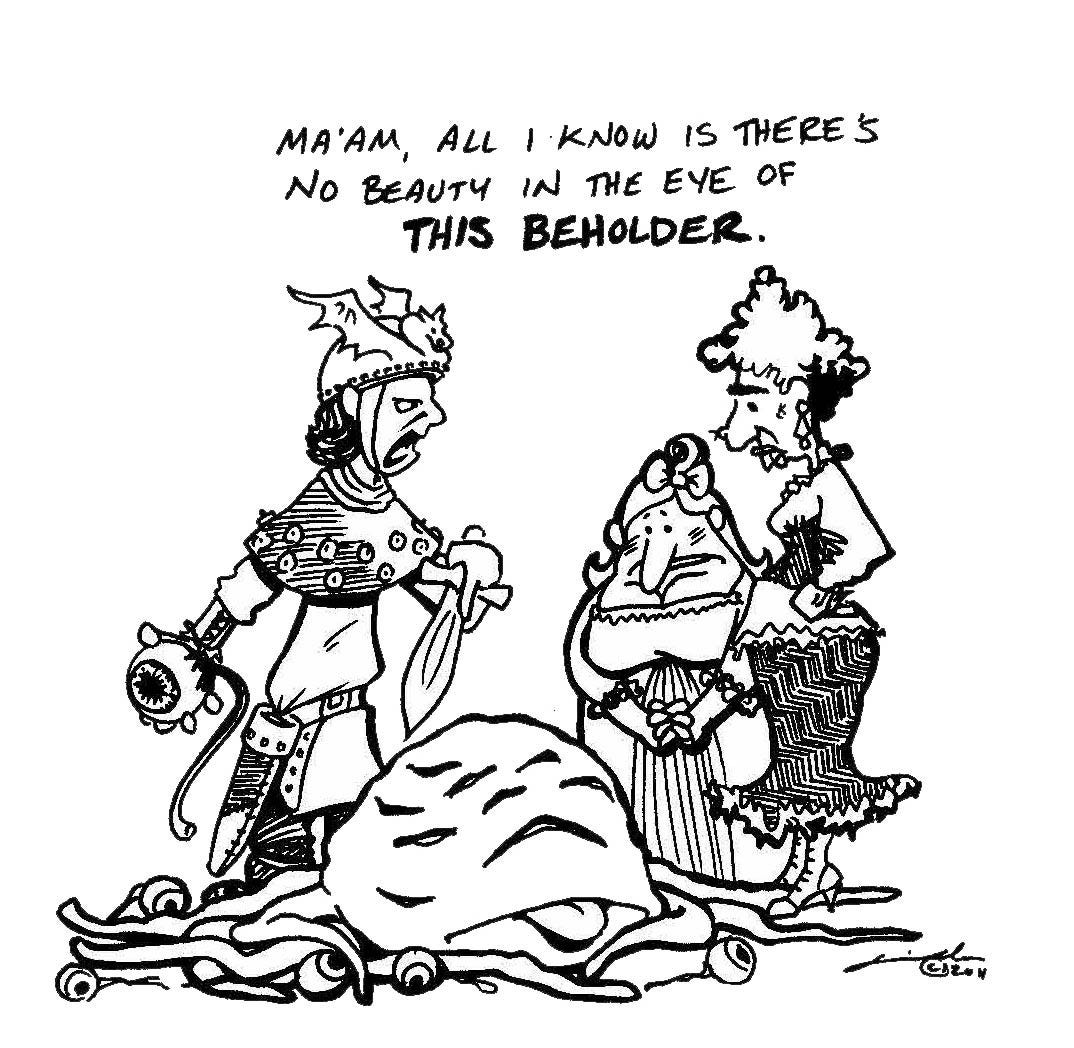
Charisma: The Most Important Attribute in D&D
A couple of years ago, I wrote an article about how my friend Sean McPhail and I used Basic Dungeons & Dragons as the mechanical foundation for our shipboarding actions when we played Broadsides & Boarding Parties. It’s a wonderful boardgame designed by Larry Harris (who also designed Axis & Allies) that was published as part of The Citadel’s Game Series in the U.K. in 1982 and updated with tons of “toy” elements by Milton Bradley in 1984 as a part of their Gamemaster series of wargames. Typical of a Larry Harris design, the game introduces wargaming mechanics in a way that makes sense to a broader audience. His rules tend to be elegant, but sometimes have a weakspot.

In the case of Broadsides and Boarding Parties, that weakspot was the boarding action rules. While the limited information, simultaneous movement system of the “broadsides” is a very simple system, it is elegant and fun. The battles of the boarding parties, however, are a bit dull and amount to little more than a sereis of bland die rolls where each player rolls a d6 (and adds a couple of modifiers…maybe) and the higher roll wins and kills one of the other crew. The fights happen in groups and even though your Captain adds a minor bonus, the action never evokes the feel of an Errol Flynn duel. That’s were our inclusion of the D&D Basic rules comes in. The moment we incorporated the basic combat system, it transformed the game entirely, but that was only the beginning of the wonders than using D&D combat added to the game.
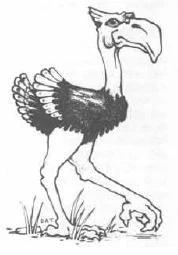
You see, before I began playing Dungeons & Boarding Parties, I had largely ignored Charisma (abbrieviated as CHR in the Days When Tigers Used to Smoke as Rebekah King shared many seasons ago) in my early D&D gaming experiences. My first game session, where my character was ignobly turned into an Axe Beak, made me reticent to play any magic user characters for quite some time. So much so that the first D&D character I ever rolled up (the Axe Beak was a borrowed character) was a fighter named Darg. He had a 17 Strength and I never once took his Charisma into consideration when playing him. I can’t even remember what his Charisma score was.

All I cared about with Darg, and a host of characters after him, was that his physical attributes (Strength, Dexterity, and Constitution) were high. In those early days of Moldvay/Cook play, I barely gave Wisdom and Intelligence a second thought. As for Charisma, I wondered why it was even there. I it didn’t do anything meaningful. Playing Dungeons & Boarding parties taught me how wrong this mindset was.
How?
Well, you see…we started using the Morale rules from the combat section for all non-Captain characters. We rolled up entire pirate crews of 1st level fighters, and eventually other classes as well, of which only the Captain was a player character. Yes, they earned experience and if the Captain died one of them would replace him next game, but they were still merely “Retainers.” We had recently read the section on retainers in the Basic Rulebook and it opened up a whole new world of play for us. No longer did one of us have to kill all of the pirates on the other ship, or even just the Captain, to win the battle. All we needed was for the crew to fail a morale check.
That’s were Charisma came in.
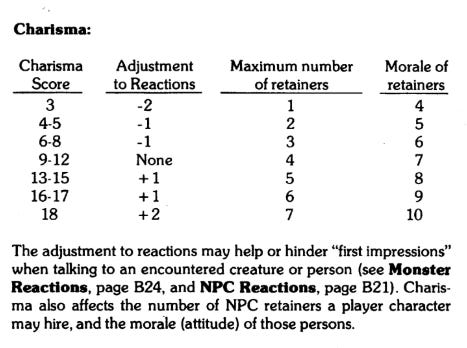
Charisma affected not just how many Retainers you could have, or as we called them “loyal crew,” but it determined their morale as well. The higher your Charisma, the more of your crew were loyal crew members and the higher their Morale. Having a high Charisma in Dungeons & Boarding Parties was suddenly as important as having high physical stats. This is because all crew (loyal and unloyal crew) had to make morale checks with the first casualty, when your side experiences their first death and when half of your side has been incapacitated.

Since the death of the Captain was an automatic loss in Dungeons & Boarding Parties, we didn’t need to check at that time but we did need to check in the other circumstances and it made a HUGE difference. We gave different morale values to the loyal and unloyal crew, with unloyal having a morale score 1 point lower than the loyal crew. This led to huge swings in the battles and sped up combat immensely. And morale was only the first way that Charisma mattered, and boy did it ever matter for that in Dungeons & Boarding Parties. It also mattered that way for Dungeons & Dragons too and it has since the White Box. The primary reason for this is that D&D was based on miniature wargames and morale is a central mechanic in those, but the secondary reason is that low level characters need retainers (more on that in a minute).
If you look at the Men & Magic book for the old White Box Dungeons & Dragons rules, there is something that sticks out to the modern gamer. While you roll up your six attributes the same way as you do in later versions of the game (3d6 all the way down natch!), they don’t have as much impact on combat as they do in later rules. While the Greyhawk Supplement eventually makes Strength, Dexterity, and Constitution matter in combat, they get short shrift in White Box D&D. In fact, the only effect Strength ever has in straight White Box is to make it so a character goes up in level faster due to an expereience point bonus. Charisma on the other hand has it’s own table that allows for more hirelings on the high end and a higher loyalty base than Moldvay Basic. Note that the description says that the players “will, in all probability, seek to hire Fighting-Men, Magic-Users, and/or Clerics to strengthen their roles in the campaign.” This is because low level characters are very weak and hirelings let you field little platoons.
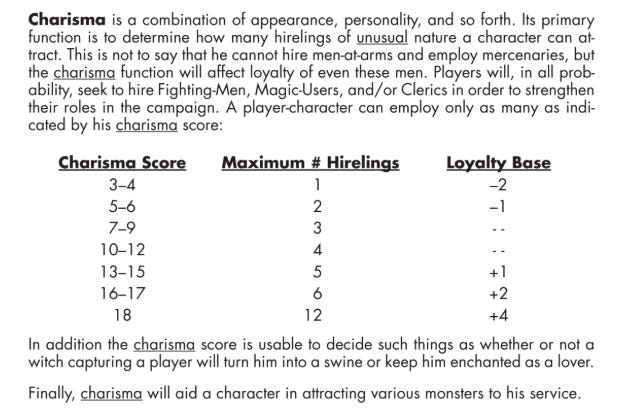
Charisma does more than let you hire poeple though, it also lets you parley with people and monsters and have them react on the reaction table. First, there’s the reaction table for hiring retainers. There is no guarantee people will want to work for you, so you need to roll. The rules are slightly different between D&D (which has “loyalty base” rather than just morale, though it determines morale) and the rolls work differently.

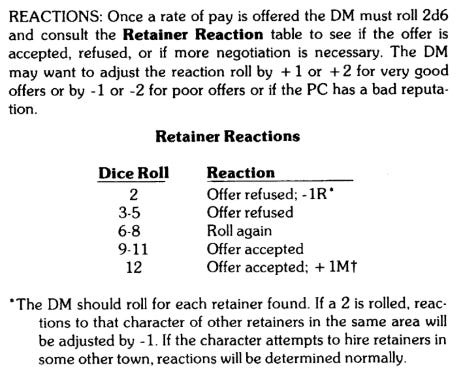
But wait…there’s more. Charisma doesn’t just determine how many people you can hire, whether they will work for you, and how loyal they are. It also determines whether monsters will attack you in the first place if you decide to try talking your way out of a situation first. In White Box, Charisma might not come into play.

However, as the earlier B/X table mentions above, it does help with Monster Reaction rolls in Basic D&D. You see where it says, “see Monster Reactions, page 24?” This is that table.

That’s right, high Charisma characters in B/X can talk their way out of fights with monsters. Charisma is not only NOT a dump stat, it’s a freakin’ superstat. More space is devoted to this one attribute than any other attribute in White Box and Moldvay/Cook D&D. The Holmes version pretty much ignores it, but Molvay, Cook, and Marsh knew what was up and they wrote at length what Charisma could do. It let’s you hire multiple retainers, have them be loyal and unafraid in the face of danger, it makes it easier for you to hire good retainers, AND it let’s you defeat monsters without even fighting.
As I mentioned above, this is all a legacy of D&D coming from miniature wargames where morale is very important and a lot of early D&D adventures were skirmish miniature battle scenarios more than just narrative adventures. While one might be able to argue that B1: In Search of the Unknown and B3: Palace of the Silver Princess are narrative scenarios made for a small band of adventurers akin to that in Hawk the Slayer or the Dungeons & Dragons movies. The same cannot be said of B2: The Keep on the Borderlands. The premise of Keep on the Borderlands is that the player characters are adventurers who arrive at a Keep, deep in the wild frontier, close to the Caves of Chaos. The caves are filled with several small bands of monsters who are raiding the countryside and preventing farmers from moving in and bringing the first elements of civilization with them. This isn’t a fetch quest, this is a semi-military expedition. It’s an adventure that expects you to hire retainers to aid you on your adventures.
Take a moment to look at the encounter sizes in the Caves of Chaos, these are not for a party of 4 to 6 first level characters. They are just going to die and die again and you are going to end up rolling up a lot of characters. If you want to see how many, you can run a quick and tactics free simulation of the encounter on one of my handy dandy combat simulators. This one simulates a combat, but also incorporates the effects of Sleep and Backstab have on combat. The Backstab mechanics are rough. I essentially let it roll move silently to benefit from back stab. The assumption here is that combat is fluid and not on a map, so you just have to be quiet to remain unseen in the mayhem.

I’ve put together a number of B/X widgets that I’m currently beta testing. These aren’t for sale, they are free for use as fan toys, but if you want to play test them I’d greatly appreciate it. These include applications that let you generate a random character of 1st to 3rd level. This character will have no equipment or anything, but will be completely random. I also put together a B/X Character Builder that lets you make a 1st level character and buy equipment. A widget that generates retainers that a character can hire based on their Charisma. A widget that let’s you roll to see if you can hire those retainers and test their loyalty and monster morale later. One that deals only with Monster reactions, retainer loyalty, and monster and NPC morale. There are also two additional combat simulators. One that is for a single character vs. monsters and the other that simulates combat without Sleep or Backstab.
All of these include the effects of morale on monsters and demonstrate how vital morale is as a combat mechanic. I don’t include morale rolls for retainers in the combat simulators, because these are for parties without henchmen, but that makes them better for showing you how tough fights would be without a squad.
When I look at B/X and my own experience, I am now baffled by how I ever considered it a dump stat. It is very powerful and more time is spent in the rulebooks on that single attribute than on any other.
As the kids say today, a good D&D character has Aura.
As someone who played a bard a lot in Dungeons and Dragons 2E, my whole build was based on charisma.
Sleight of Hand, Persuasion, etc.
He lived and died based on reactions from monsters and NPC alike.
Oh the memories this gives me.
Great post. I think when I played 3.5, I thought it was a dump stat. But after playing some other games, I see the importance of Charisma.