


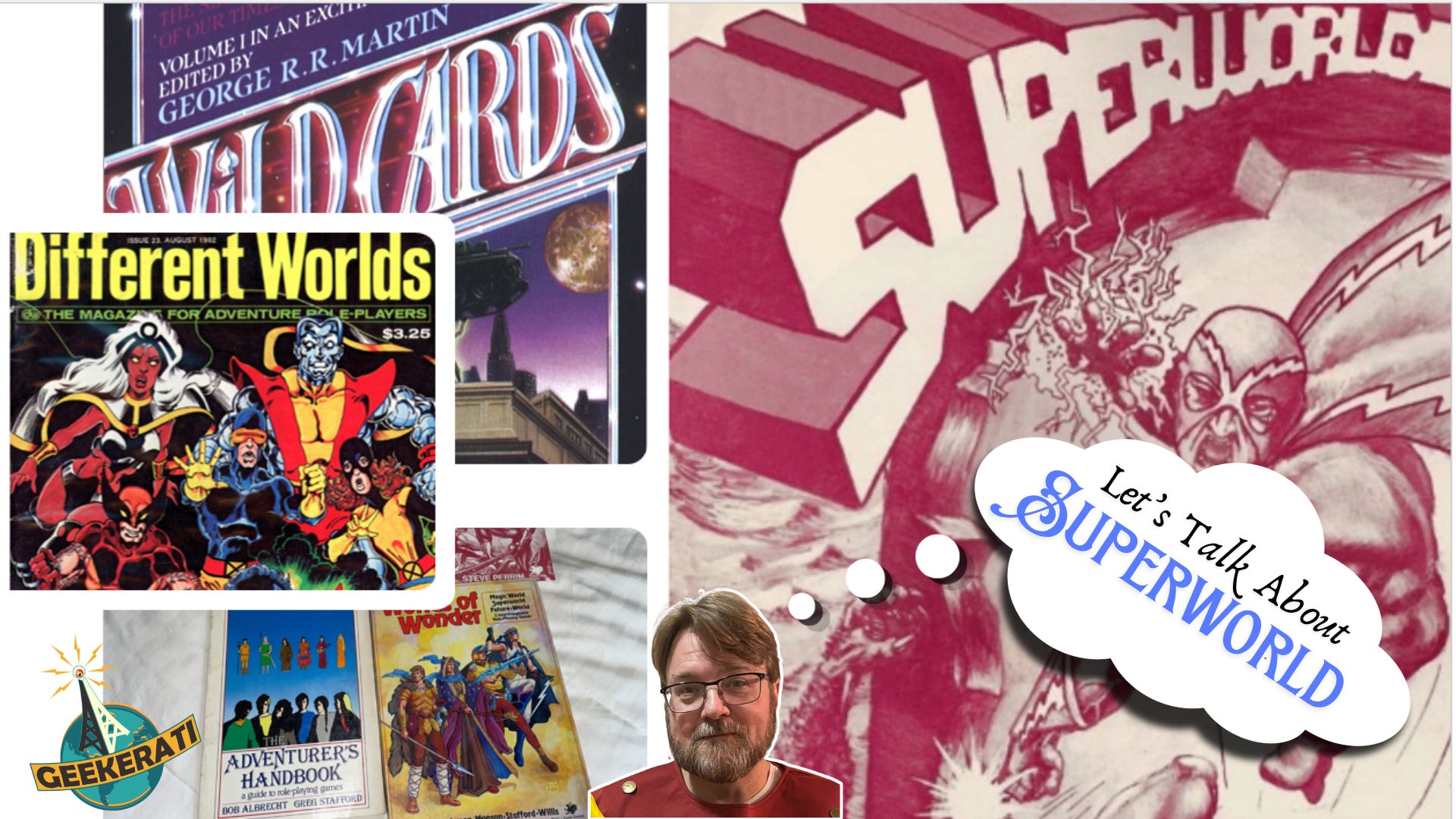
Some Background on Steve Perrin
While I was giving a final editing pass on my recent article on Toxic Fandom, I was reminded of one of my favorite game designers and his final (unfinished) game design project. As regular readers know, I am a HUGE fan of superhero roleplaying games. It’s my favorite genre to play and the superhero games are some of the best mechanically designed projects in the table top gaming space. It’s a genre that constantly pushes the boundaries of game design into interesting paths. From the foundational granularity of Superhero 2044 that was expanded in Champions to the entirely narratively focused design of Marvel Heroic, each game attempts to simulate some aspect of the comic books.

Games like Champions and GURPS try to capture the imaginative slugfests that fill the pages. Games like DC Heroes and Marvel Superhero Adventure Game (Saga) try to capture the full breadth of power levels while allowing every player to “matter.” Marvel Superheroes (FASERIP) and Villains & Vigilantes attempt to capture the freewheeling nature of the source material and Mutants & Masterminds attempts to do all of the above. In my opinion, all of the games I’ve named have been successful. Okay, except for Superhero 2044, but even that succeeds IN PLAY even as it fails to have a character creation system. That failure led to an entire catalog of wonderful games.
One of those games was designed by Steve Perrin, and he’s the designer I was thinking about as I made that final editorial pass. Steve Perrin was introduced to the table top gaming hobby when his roommate Steve Henderson, whom he met through the letters columns in Marvel Comics, introduced him to wargames and then Dungeons & Dragons. Perrin soon became an integral part of the Bay Area gaming (and geek) scene where he helped Clint Bigglestone and Adrienne Martine produce a D&D convention called DunDraCon. By the time I was a kid, this was my go to convention every year and is where I first got a taste of how much gaming really is a close knit community. Perrin had already helped found the SCA, an organization that was sparked by a party at fantasy author Diana Paxson’s house and he jumped into the roleplaying community with gusto.
His first major contribution to “Folk D&D,” a contribution that influenced later published games, was a mimeographed set of house rules that came to be called “The Perrin Conventions.” You can find a copy of those rules in Chaosium’s 1977 D&D supplement All the Worlds’ Monsters Volume 2. “The Perrin Conventions” were well discussed in the early RPG circles (in the pages of Alarums & Excursions) and include rules for initiative, “Dexterity rolls,” and combat. The Dexterity roll mechanic pre-dates the inclusion of a similar mechanic in the Dungeon Masters Guide (sic) and might be the first time an attribute roll resolution was proposed for D&D in a professional publication. For those of you who are Tunnels & Trolls fans, Ken St. Andre provides guidelines for how to convert monsters in the book to T&T.

Eventually Perrin’s involvement in the community brought him into the circle that was playtesting a new roleplaying game that was set in Greg Stafford’s Glorantha setting. An initial attempt was designed by Dave Hargrave, of Arduin fame, but Stafford found the result too close to D&D and passed on Hargrave’s version. The draft that eventually evolved into RuneQuest was the one crafted by Art and Ray Turney and Henrik Pfeifer. It still had some D&D elements like classes and levels but then Stafford brought in Steve Perrin and Clint Bigglestone to look it over on July 4, 1976. Perrin seized on one feature that changed everything, the concept that any character could attempt anything. The version Perrin playtested soon transformed that game into one of the great mainstays of the hobby, RuneQuest, in an edition illustrated by his wife, Luise Perrin (another unsung contributor to the early hobby).
Unlike D&D, RuneQuest had no character classes and was completely skills based. After Lynn Willis and Greg Stafford extracted the core rules of RuneQuest to create the Basic Roleplaying System, Perrin was tasked with creating a product that demonstrated how flexible the mechanics for this game were. That product was called Worlds of Wonder and it contained three different settings that all used the Basic Roleplaying System as the foundation for the mechanics. Those settings were Future*World, Magic World (which would inspire Fred Malmberg to create Drakar och Demoner), and Superworld.

Perrin went on to become one of the giants of the roleplaying game field. Like many of those giants, he left tabletop for the far more lucrative world of computer game design and only returned to the tabletop in his later years. When he did though, he was hired to work on a game I was excited to back on Kickstarter. It was a reboot of the classic Superhero 2044, completely updated with high quality art and rules designed by Steve Perrin and Wayne Shaw. Wayne Shaw’s point-buy power system for Superhero 2044 was published in Lords of Chaos #8 and Shaw is credited in the first edition of Champions as being a significant influence on the game. The game had designer pedigree and the Kickstarter campaign was being run by Checker Book Publishing Group who had done excellent work (in my opinion) in their reprinting of the Flash Gordon comic strips. I backed the project in 2017 and the new version of Superhero 2044 has, sadly, never been published. The initial delays were due to events in the life of publisher Mark Christopher Thompson, who had some personal tragedies that affected his ability to work on the project as much as it needed. Then Donald Saxman, the author of the original Superhero 2044 died on March 24, 2018, which added additional delays to the project as this required the recruitment of someone new to write the introduction.
The biggest challenge was on the game design front though. Steve Perrin’s rules required a good deal of playtesting, far more than the five month timeline the original project proposed from funding to publication. We will set aside that it was only on the second pass that Superhero 2044 achieved sufficient funds to receive funding. The first attempt had been overly ambitious and wanted to include miniatures. That overly ambitious attempt was a sign of things to come though as Thompson continually strived for perfection on the project, even as the years passed by. Like Gareth-Michael Skarka’s Far West Kickstarter, delays due to reasonable causes led to delays due to a desire for perfection. As someone who recently finished his dissertation, I understand this dilemma well. Every deadline missed makes you want to make the product better, but that is a never ending cycle.
Needless to say, the delays led to angry and toxic fans coming out. See…I was able to bring this back to that introductory paragraph. These “fans” got angrier and angrier, though thankfully for Thompson never as angry as they did for Skarka. While I’ve had my own snobbish geek buttons, I’ve never been one to get mad at independent Kickstarter projects being delayed. When I back an independent project, whether it’s Superhero 2044 or Castle Grief’s Arathi Sector project (which arrived the other day and like Kal-Arath looks SWEET!), I view myself as a patron supporting an artist/creator I like. Getting the books from them is a bonus. I am funding art here and not consumerism. My mentality is different when I am backing a project from a large company like CMON or Steve Jackson Games, but even then I am fairly forgiving of delays.
Steve Perrin got a lot of ire directed his way due to the failure to deliver a final draft of the Superhero 2044 rules. This is truly tragic because Steve was working very hard on the rules. I have playtest copies of the game at a couple of phases of development and they are solid, but not quite ready for printing. I think that a lot of supporters were offered the opportunity to playtest, but never did any (due to time etc.) and that this also contributed to the delay. While Perrin might have been a Chaosium luminary, I doubt he had the network that they do for playtesting and I think he wanted to make sure all the kinks were worked out. The game, as it stands now, is very playable and I’d like to see it published. If it never is, I know that there was a strong good faith effort put into the creation and that should be sufficient for fans. Sadly, that’s not typically the case and Perrin died before he could receive the thanks he deserved for the work he put into the book.
I am not in a place to fully review the revised edition of Superhero 2044, and any review would be a tentative one as it is, but I wanted to review a game by Steve Perrin that doesn’t get much attention so I chose to look at his original rules for Superworld from the Worlds of Wonder Boxed set.
Introduction
There is a particular kind of game that fails commercially but continues to be remembered because the story around it connects with the zeitgeist more than the game did. While there are many such games, my favorite example is Superworld. Like many superhero roleplaying games, it sold relatively poorly. As much as I love the genre, fantasy is king in the RPG space and the crossover between comic book fans and roleplayers is small enough that it can only support so many games. Superworld was discontinued after a relatively brief publication run that included a handful of supplements. The failure was likely due, in part, to the fact that at the time of its release the Superhero RPG market was a “Red Ocean” filled with excellent competitors like Champions & Villains & Vigilantes. All three of these games tried to engage in some coopetition to lift everyone’s sales by including conversion rules for the other games, but Superworld couldn’t compete against both Champions and Villains & Vigilantes. It had a point buy system inspired by the first and an indie edge that echoed V&V’s Bill Willingham influences.
Chaosium was in a big financial crunch in the 1980s, so Superworld’s relative failure was a loss for Chaosium at exactly the moment Chaosium could least afford one. And yet it is, almost certainly, one of the most consequential Superhero RPGs ever published. This isn’t because of how many people have played the game at their tables, but because of who was sitting at one particular table in New Mexico, rolling his dice.
There has been a lot of discussion of the literary legacy of Superworld, but I want to take it seriously both as a game and as a literary inspiration. The literary legend gets a lot of coverage, and I will certainly touch upon it in this review, but that legend has a way of unfairly overshadowing the game. I want to correct this because the game deserves better than to be remembered only as “the thing George R.R. Martin played that inspired him to create the Wild Cards series.” Because under the cape, Superworld is doing something none of its rivals were doing in 1982. It applies the gritty, consequence-heavy bones of Basic Role-Playing to four-color comics, and has some very interesting concepts that were only later picked up by other games.
Which Superworld are we even talking about?
First, a clarification on what game I am reviewing in this discussion. Since this is a deep dive geekspace, I want to review the version of Superworld that often gets overlooked. I am going to the out of print well-spring. I’ll review the later version in another post, but I want to do something similar to what I did with Magic World’s connection to Dragonbane. I want to dive into the small 16-page game that showed you could write a solid superhero game in a small space.
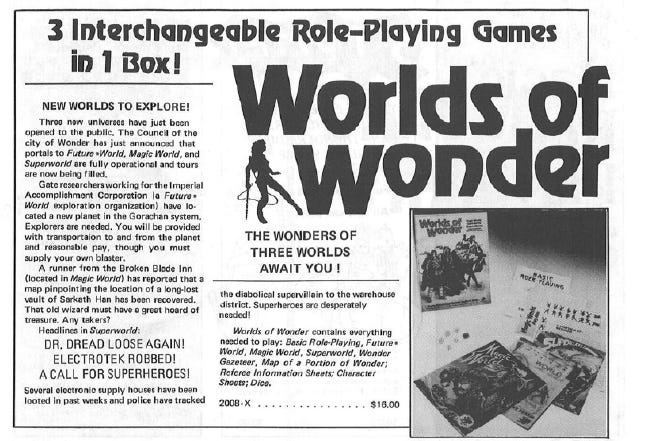
When collectors and retrospectives say Superworld, they almost always mean the 1983 standalone boxed set with its three saddle-stitched booklets that include a Superheroes book, a Superpowers book, and a Gamemasters book. These books combine for more than a hundred pages of mechanics and setting. The box has a really cool smirking robot illustrated by Michael Dooney and indie-inspired interior art by Chris Marrinan and Markus Harrison. If the boxed set were an Amazon streaming show, it would come with warnings that it contains Violence and Smoking. That’s the complete version of the game that received the three published supplements. That’s the version George ran for his New Mexico writing circle friends.
That is not the book in front of me at this moment.
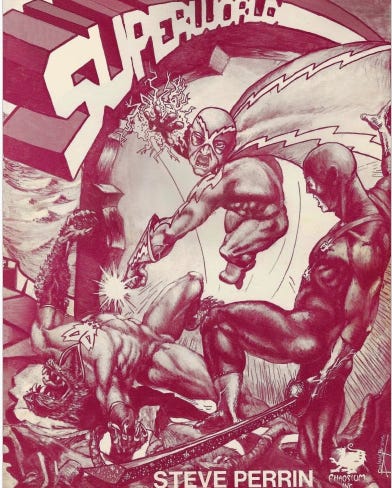
What I am reviewing is the original Superworld. It’s the tightly written 16-page booklet from the 1982 Worlds of Wonder boxed set, written by Steve Perrin and Steve Henderson, with cover and interior art by Roland Brown. I find it to be a wonderful serendipity that two men who became roommates after a friendship they built in the letters pages of Marvel comics would come together and write a superhero roleplaying game. There are so many of these kinds of connections in the Chaosium circle that it makes you wonder whether Greg Stafford’s shaman personality didn’t somehow suggest real sympathetic magical powers. One of the playtesters of the game was Gigi Ward which brings two questions to my mind. The first is whether Gigi Ward was, in some way, an inspiration for Gigi D’Arn the “fictional” gossip columnist that Tadashi Ehara created for Different Worlds Magazine, and the second is whether she was the Gigi who married Steve Henderson. Since my relationship with my wife developed as we played Champions together in college, couples who deepened their relationships while gaming has a special place in my heart.

As with Magic World, Fred Malmberg was one of the playtesters of this version of Superworld but he never published a Superhero companion to Drakar och Demoner. You can hear some of Malmberg’s experience at Chaosium at minute 6:15 in the video embedded below. You can hear his real excitement about gaming in general. It’s something to keep in mind when you remember that this is the man who currently runs Conan Properties, Inc. Whether one agrees with all of his decisions or not in licensing Howard, and I agree more than disagree personally, there is no doubt that he’s a huge gamer geek. He is the Ian Livingstone/Steve Jackson of Sweden.
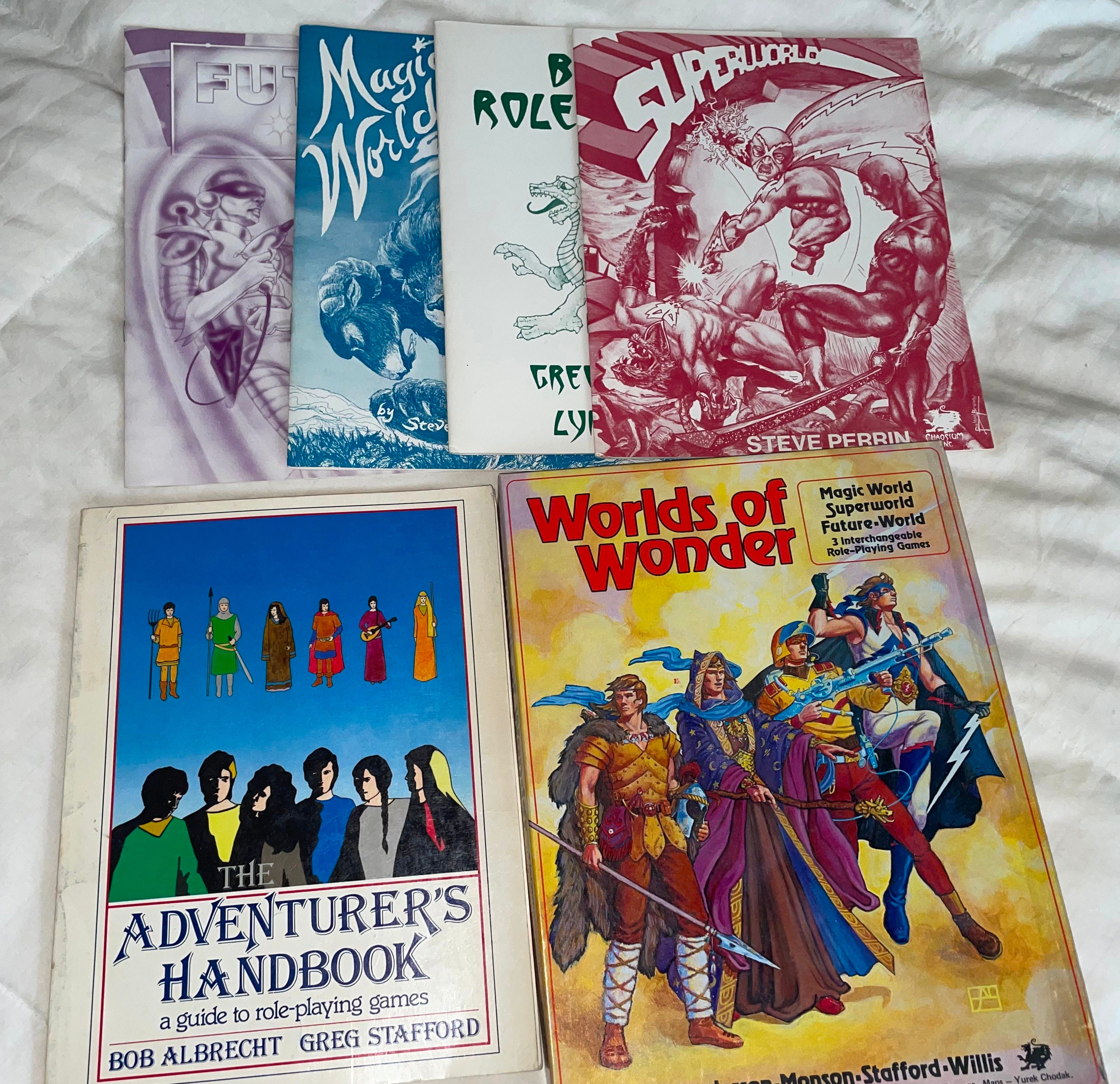
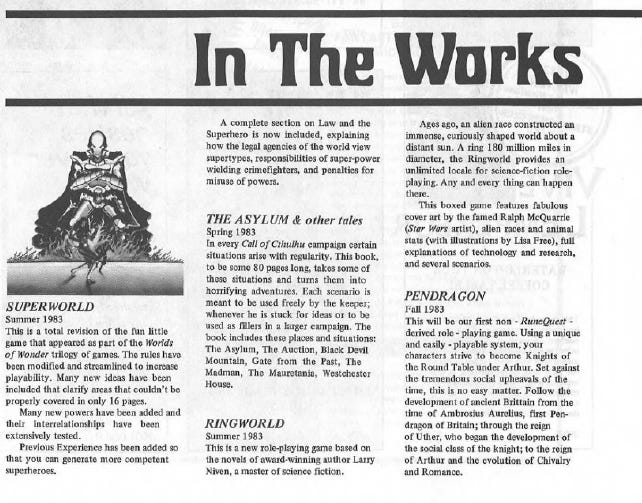
The Superworld book in Worlds of Wonder is the seed of a larger story, but it deserves far more attention than it receives in general. One must keep in mind that the 1983 box is an expansion of this booklet. The advertising of the era highlighted how the Superworld boxed set was a “total revision of the fun little game” included in Worlds of Wonder.
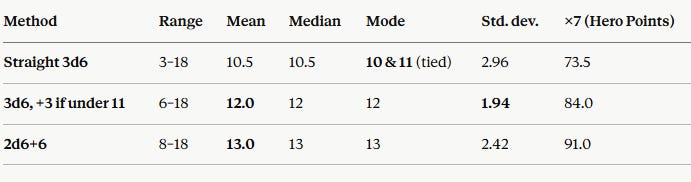
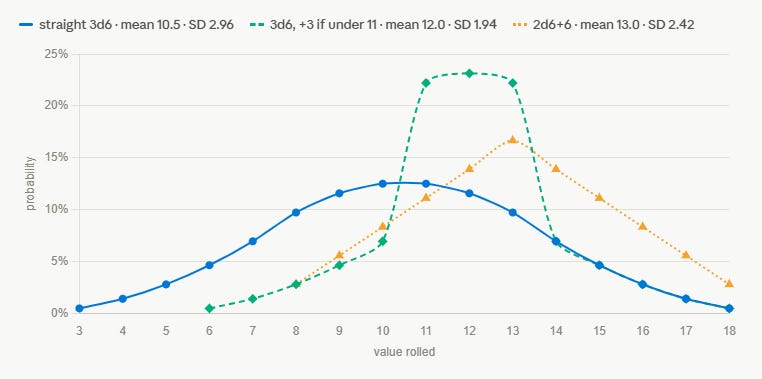
And it was a substantial revision indeed. The character generation got reworked significantly. The original Superworld creates starting characters that are more “average” statistically by having players roll 3d6 per characteristic. Yes, they get to add 3 to anything under 11, which makes the characters slightly more heroic than straight 3d6 (a mean, median, and mode of 12 instead of 10.5 and 10/11). It does strongly increase the number of characters in the middle though where the later boxed set switches to 2d6+6. This increases the mean, median, and mode to 13 but also creates a less curved distribution. These different averages lead to some variation in the number of points characters start with to purchase powers between editions. In both versions of Superworld you add all the attributes together to determine starting statistics, but more characters will have similar hero points to spend in the original version in comparison to the revised version.
The revised version also bolts on purchase restrictions, increases the number of powers available significantly, and patches a lot of rules that were vague or difficult to understand. My favorite little oddity about the original Superworld is that punches were considered a modified version of an “impaling attack” because they wanted punches to be able to go through objects.
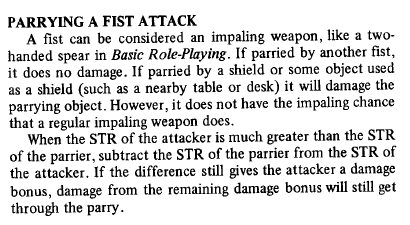
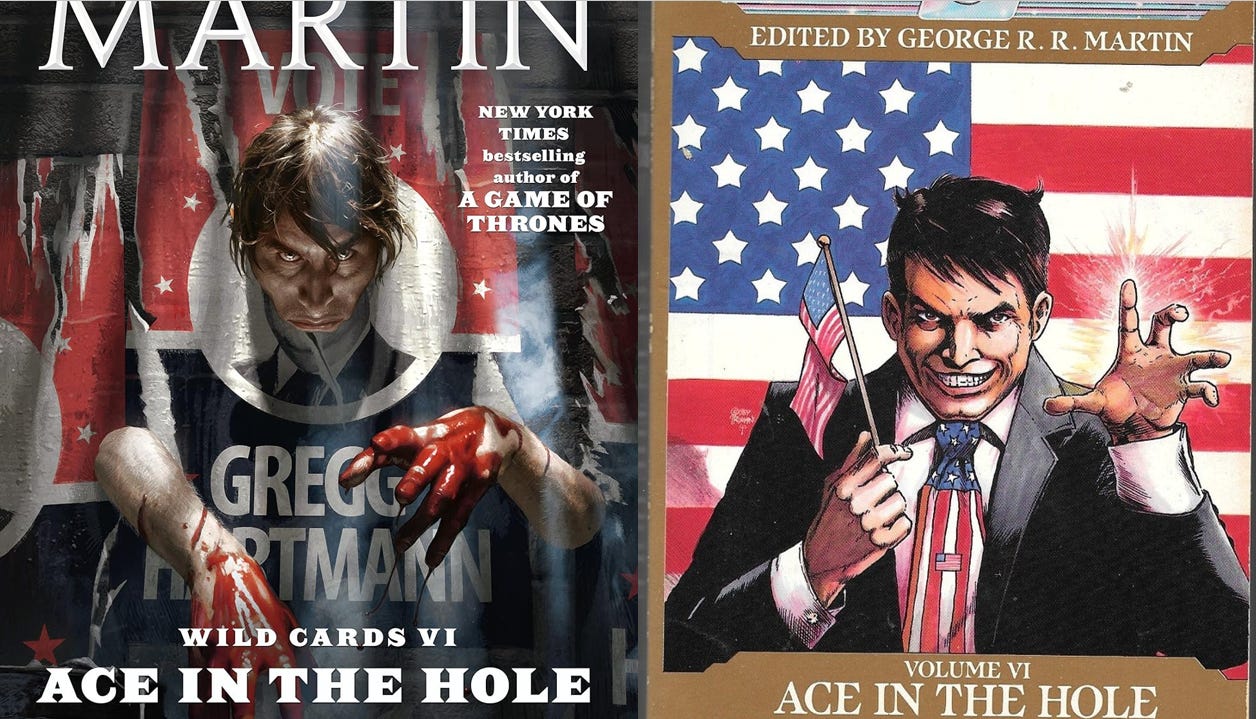
I actually prefer the parrying rule from Worlds of Wonder’s Superworld to that in the boxed set. I know that George R.R. Martin and crew played the boxed set, but the impaling fists fit the battle between Carnifex and Mackie Messer in Book VI: Ace in the Hole better in my mind. Not because of how Messer’s knife hands work, but because of how Carnifex’s punches connect.
As much as the 1983 boxed set adds to the game, everything that makes Superworld Superworld is already there in the 16-pages of the Worlds of Wonder supplement. It’s all you need to play a very good superhero game and that’s even leaving out one of my favorite parts of the booklet. I’ve already said that the Superworld mini-setting is tightly written mechanically, but it also presents a wonderfully logical reason for a superhero setting in three short paragraphs on page 1.
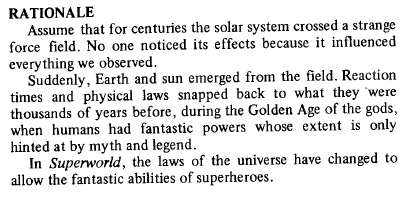
In this Superworld setting the Earth has recently emerged from a forcefield that prevented the miracles of ages past. This has caused the physical laws of the universe to behave as they did in the Age of Legends. Why haven’t there been miracles during the age of emerging science? This forcefield prevented people from acquiring fantastic powers and we have entered a new age of miracles! That’s pretty badass. Your own campaign can determine when we first came out of the forcefield. Was it WWII? The American Revolution? The Steam Era? That’s all for you to decide, though Superworld suggests WWII due to the explosion of superhero comics at the time.
Why Did Chaosium Publish Superworld?
To understand why Superworld exists at all, you have to understand what Chaosium was trying to prove in 1982. Back in 1980, Greg Stafford and Lynn Willis had taken the engine Steve Perrin built for RuneQuest and boiled it down into the Basic Roleplaying System. This is a system that uses percentile dice in a way that makes the probability more intuitive than d20 rolls do. It’s a skill-based, classless system where, famously, any character can attempt anything. They took all the complexity of RuneQuest and boiled it down to the central components. Stafford’s instinct was to strip out the fiddly bits (Strike Ranks, Hit Locations) and print what remained as a sixteen-page booklet called Basic Role-Playing. The pitch was modest, but a wonderful move for the hobby. He wanted to create what I, as someone who uses ggplot in the R programming language would term the grammar of roleplaying. Where Leland Wilkinson created the grammar of graphics (gg in Hadley Wickham’s ggplot), Stafford created a grammar of roleplaying. He told Chaosium customers that this would be the grammar of every game they published, and in doing so created one of the first universal gaming systems.
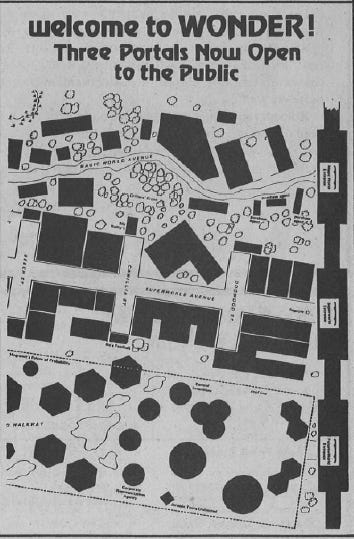
Worlds of Wonder was the proof-of-concept. It provided multiple products in one box. There was the BRP booklet and three thin genre supplements that covered the major rpg genres of the era. There was Magic World for sword-and-sorcery, Future*World for science fiction, and Superworld for caped crusaders. The marketing claim was genuinely radical for 1982. This was the industry’s first multi-genre product running a single rules engine, where a character could, in principle, walk from one genre into another with minimal changes. In fact, the default setting of the boxed set (as opposed to the justification in Superworld) was that player characters could go from setting to setting from a single Westworld-like location.
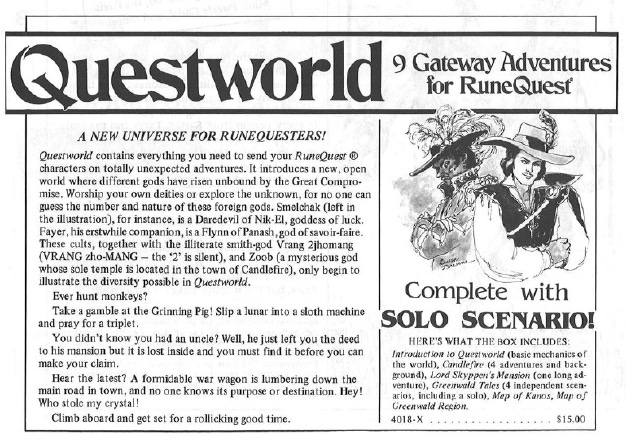
It’s a concept Chaosium was also attempting with Questworld which they hoped would allow RuneQuest to be the rules set for multiple campaign settings that could all interact in a kind of shared universe. Chaosium created an anthology game with Worlds of Wonder and they wanted to create a shared anthology setting with Questworld to allow players to take their characters from one campaign to another (each with their own houserules) in a fluid manner. This multiversal view of home games was a common feature of discussions in zines at the time and Questworld was Chaosium’s attempt at a solution.
Perrin describes Stafford’s fantasy in his own history of the game. Characters would be residents of “Wonder Town,” the little connecting booklet, strolling up Fantasy Street one day, Future Street the next, and pulling on a cape to fly down Super Street the day after. The play-aids sheet that ships with the box provides the foundation for this kind of play. There’s a Weapon & Armor Equivalencies table that tells you when a Future*World blaster hits a Magic World knight, or a Superworld energy projector hits a Future*World battlesuit, whether the armor does anything at all. That table is the intended Rosetta Stone of the game, but it also demonstrates why Champions and the Hero System were more successful at creating a universal system, even as Chaosium created a universal grammar. This table was the attempt to transform the settings from the three separate worlds into one world with three neighborhoods.
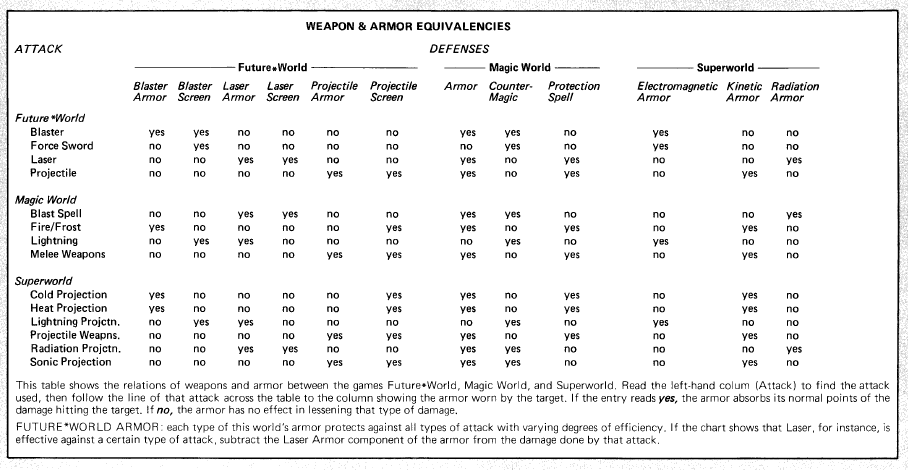
I have a soft spot for this, because I’ve been inside this box before from the other direction. When I was chasing the lineage of Drakar och Demoner and running my own translation of the 1982 Swedish first edition against the originals with the help of Claude, I focused on the Worlds of Wonder BRP booklet and Magic World setting. The thing I wanted to prove to my own satisfaction was that Drakar och Demoner, and therefore its great-grandchild Dragonbane, descended from Magic World specifically and not from RuneQuest proper. It was a lot of work, well a lot of tokens anyway, to discover that the text was identical and this gave me greater appreciation of the evolution of the Basic Roleplaying System. In the US, the system has evolved into a 266 page long open source tome (down from the 400 pages of the prior edition). In Sweden it evolved into Dragonbane, which is a very simple game that could be presented as a simple 16 page grammar of roleplaying booklet if you took out setting specific material.
All of this means the engine humming under Superworld is the literal sibling of the engine that, four decades later, Free League would polish into one of the best-selling fantasy games in the current market. Same box. Same bones. One sibling became Dragonbane. The other is largely forgotten outside the legend.
Finally After All the Pontificating: The Mechanics
So how does Superworld actually work?
Similar to D&D, you roll 3d6 seven times to get your STR, CON, SIZ, INT, POW, DEX, CHA. So far it is exactly the same as you would do if you were creating a farmer’s child wandering into Shirtown. Because this is a supers-setting you can add three to any characteristic that is lower than eleven. This is Superworld‘s gentle admission that superheroes shouldn’t be statistically average, but that not all are iconic specimens of human perfection. Then comes the thing that transforms this into a superhero game. You add all seven characteristics together, and this total is your pool of Hero Points.
Hero Points are the currency of everything in the game, as they would be in Champions. You spend them to “buy” skills in 5% increments and powers in levels of effect. You spend them to push your rolled characteristics higher so that you can have super-strong and super-agile characters. When you’ve spent as many points as you want from your base, you can bank the leftovers to spend later as your character evolves. Powers come out of a list of roughly thirty entries in the original booklet. These powers include Energy Projection, Flight, Armor, Absorption, Telekinesis, Telepathy, Density, Insubstantiality, Martial Arts, and so on. Each of these powers has a Hero Point cost per level and an Energy Point cost to actually use. The example hero the booklet walks you through, Captain Stormcloud, is a photographer struck by lightning atop the Transamerica Building, and you read as his player spends points into Lightning projection, Flight, Absorption, and beefed-up reflexes across several pages. It’s a clean tutorial. The boxed set later renamed him Stormbolt and stretched the same example across thirty pages, which tells you how much the 16 page game’s design leans on “show, don’t enumerate.”
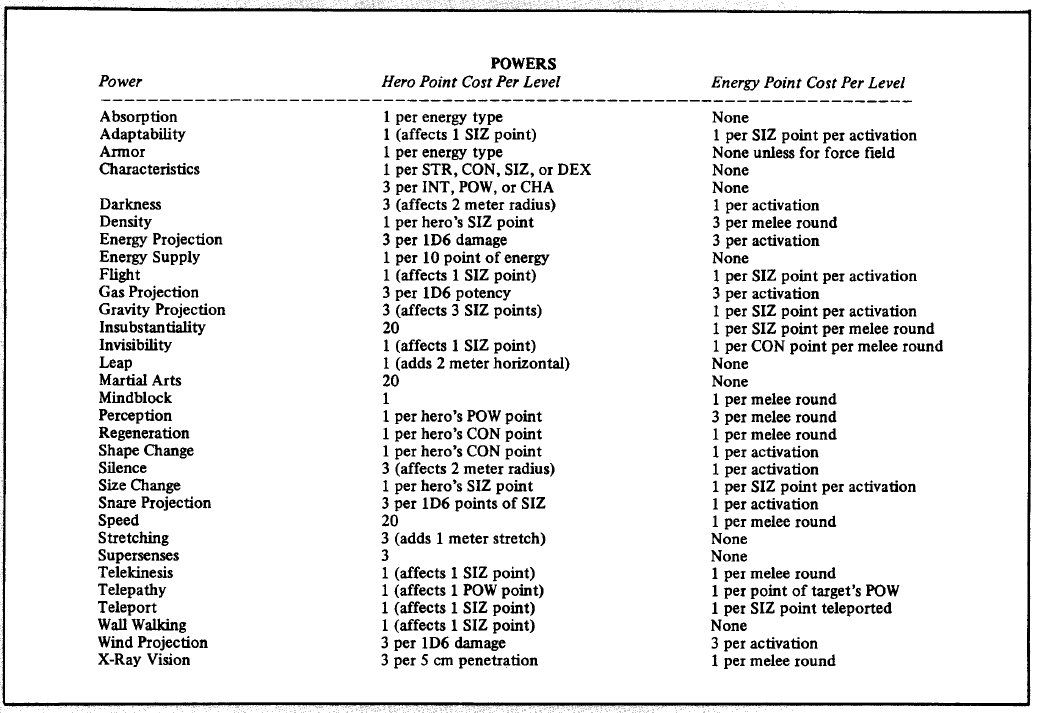
Two things make this engine feel different from every other supers game of its era. The first is the energy-type matrix, which parallels Steve Perrin and Gordon Monson’s Future*World design. Different armors in Future*World are effective against different damage types like impact, laser, and blaster fire. Superworld is even more specific and includes six types of energy that can be absorbed: Physical Impact (blows, falls, bullets), Electromagnetic (lightning, magnetism), Fire/Heat, Cold, Radiation (lasers, light, hard radiation), and Sonic. While the physicists out there might point out that Fire/Heat and radiation are really the same thing, in comics they are thematically different and Perrin runs with that. It’s something I’d change, but the damage types are more granular than the Physical/Energy of early Champions. Defensive powers like Armor and Absorption are bought per type. The consequence is wonderful and slightly cruel: heroes have holes. Your tank might shrug off bullets all day and fold the instant someone hits him with a laser, because he spent his points on Physical Impact armor and never touched Radiation.
Perrin loved this mechanic and stated that adopting multiple energy types based on Gordon’s design “left some characters with interesting holes in their defenses.” It is a more interesting categorization of defenses than the flat Physical/Energy split early Champions used, and it’s the one place where I think Superworld clearly builds on, rather than replicates, its “rival”. I put rival in quotes because the boxed set of Superworld was dedicated to Glenn Thain, who was a key figure in Champions circles and was the creator of Icestar and other core Champions characters. It’s more coopetition than competition, as I’ve already said.
The second is a thing nobody expects from a superhero game, a high level of physical consequences. Because Superworld sits on the BRP chassis, it inherits some of BRP’s lethality and BRP’s nastiest verb… the impale. Roll low enough on an attack with a pointed or projectile weapon and you don’t just hit, you drive the weapon deep and add maximum damage on top of your roll. A firearm in Superworld is a BRP firearm. A magnum impales, and an impaling magnum will end a SIZ-12 hero who economized on Kinetic armor. The melee round is the BRP melee round, which is roughly twelve seconds, Combat is resolved in descending DEX order after players have made their statements of intent up front, but are allowed parries and dodges as active choices. Knockback sends bodies through walls with real SIZ-versus-damage math. This is a superhero game where the referee’s bestiary can include a Magic World bear or a Future*World support gun, and where both can genuinely kill you. It is less lethal than RAW BRP, but it’s still more lethal than most Champions games.
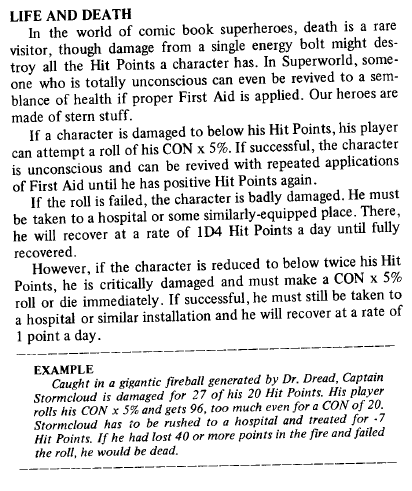
The tension of gaudy four-color powers bolted to a system that treats a bullet like a bullet is Superworld‘s real signature. Champions abstracts violence into a bouncy, recoverable STUN and BODY economy precisely so the comic-book fistfight can rage for pages without anybody dying and as much as I love Champions its combats can take forever. Whether Superworld’s higher baseline potential for lethality is a feature or a bug depends entirely on whether you want your supers game to feel like Justice League or like Watchmen. In 1982, almost nobody was asking for the latter. Today, I’d argue it’s the most modern thing about the book.
The Champions Problem
Here is where I have to be honest on Perrin’s behalf, because he was relentlessly honest about it himself. Superworld lost the sales battle and it was not a narrow loss. It came to market against Villains & Vigilantes (Fantasy Games Unlimited, 1979, 1982), which already had a devoted base that only increased with its more playable second edition, and against Champions (Hero Games, 1981), which had effectively invented the modern point-buy superhero game and become the benchmark every later designer would be measured against. Superworld arrived a year before TSR’s Marvel Super Heroes and into a field that simply did not need a toolbox that fell between other games.
And Perrin knew exactly why his toolbox struggled, because the toolbox was, by his own admission, the wrong shape. In his history he says the Hero Games crew were local friends, that his non-Chaosium gaming buddies were “enamored” of Champions, and that “several design elements of Champions snuck into Superworld.” When Stafford pulled him off a planned Worlds of Wonder II to build the full boxed game, Perrin chose a point-buy toolbox approach that he concedes was “influenced entirely too much by the Champions system.” He still believed point-buy was the right general approach to powers. He also thought, looking back, that he could have routed those points through the BRP base in a way that fit it better, instead of grafting on a parallel economy.
You can feel that graft in the character generation. Superworld tells you, in its own design notes, to build heroes from concept rather than from haphazard point-spending and then hands you a system where you roll 3d6 for your characteristics and your budget for everything else is the sum of those rolls. Good rolls make a more powerful or varied hero and bad rolls make a less powerful or forced focused one. Poor rolling hurts you twice. It is a philosophically muddled handshake between random generation and concept-driven point-buy, and some players find it off-putting. I kind of like it, but I also understand resistance to it. If you are going to go point buy, go point buy and not random plus point buy. The boxed set tried to discipline it with the 2d6+6 reroll and purchase caps, but the seam is right there in the original booklet. This is relatively easy to fix. You can do what the current BRP rulebook recommends and give a fixed number of points that everyone gets. Then again, that might be too close to Champions and it might be better to keep the random as a quirk that separates the game.
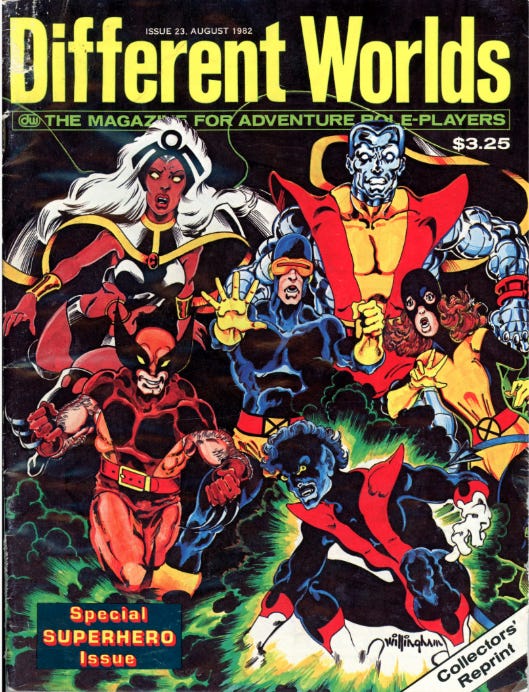
The deeper challenges to players were mechanical, and again, Perrin aired them himself. He wrote them in his designer’s notes and errata that were published in Different Worlds #23 (August 1982), the magazine’s famous “Special Superhero” issue, and possibly the greatest single issue of a gaming magazine ever published. I mean, just look at that beautiful Bill Willingham cover.
Perrin opens the designer’s notes by naming the questions players kept throwing at him: Why is Martial Arts such a useless power? Why would anyone buy Armor when Absorption exists? Why do Smash attacks do no real damage? Why would anyone pay for great Strength when a “kinetic blast” does the same damage at a third the cost? Those aren’t just reviewer’s and consumer’s complaints. These are the designer’s complaints, published with the corrections attached. Martial Arts gets revised to add a full die of damage and a defensive avoidance ability. Smash gets a real damage formula. The power-advantage system (no-energy-use, energy reduction, radius effects) gets bolted on to give the toolbox greater flexibility in emulating powers from the comic books. A lot of this errata would be incorporated into the full boxed set, but a lot wouldn’t be needed due to how much changes between editions.
The candor wasn’t confined to the errata. The same issue of Different Worlds opens with a Perrin-written survey of the entire superhero-RPG field at the time. He discusses Superhero 2044, Villains & Vigilantes, Supergame, Champions, and his own Superworld. These are the five groundbreaking games laid side by side, and then he does something almost nobody does in print. He crowns the competition as king of the genre. Champions, he writes, is the leader of the field, the mark every other game will now have to match. And he introduces his own entry, a few sentences later, as a game that is by his own admission less complete than some of its predecessors, constrained by the page count it had to fit. As a designer he surveyed the battlefield, and plants his rival’s flag on the high ground while pointing at his own game down in the valley. You don’t have to wonder what Perrin thought Superworld‘s place in the pecking order was. He told you himself, on the record, in 1982. I think he’s a bit harsh, in part because combat is far more intuitive and fast in Superworld but Champions is still supreme in that list.
Champions was designed as a superhero game from the first keystroke and built upon the systems in Superhero 2044. Later entries in the Hero System, the universal gaming system Hero published, were based on the mechanics of Champions. Superworld was a fantasy-horror system wearing a cape. The official supplements, like Trouble for HAVOC and the Superworld Companion, shipped with stat conversions to and from Champions, and were marketed as cross-compatible. The message to a buyer was unmistakable, “you can run this with your Champions group.” Which is another way of saying that you probably already have a Champions group. Of course, it is also reflective of the coopetition of the Bay Area gaming scene.
I want to push back on Perrin’s verdict a little more, though. Lawrence Schick’s Heroic Worlds later ranked Superworld fifth among all comic-book superhero systems. He ranked it ahead of Villains & Vigilantes, ahead of Heroes Unlimited. The contemporary reviews were warm as well. White Dwarf gave it 7/10 and called it an intelligent attempt at a genuinely hard genre to simulate. Space Gamer concluded it would never supplant Champions but certainly supplemented it. “Good game, wrong decade” is closer to the truth than “bad game.” It lost a war it was structurally positioned to lose, and it lost it to a friend.
The Campaign that Foreshadowed George R.R. Martin’s Ability to Finish A Song of Ice and Fire
And then, none of that mattered, because of another letter in the Marvel letters pages.
Sometime after Chaosium’s money troubles forced the company to cut back, and to let Perrin himself go, ending any real future for the line, since he and Steve Henderson were the only developers who cared deeply about superheroes at the company, Perrin received an envelope. He tells the story beautifully in his history. It opened, roughly, “do you realize you’ve owed me a letter for seventeen years?”
The correspondent was George R.R. Martin. The two had been teenage pen pals in the comics-fandom scene of the 1960s, and Perrin, who had been busy with college, the founding of the Society for Creative Anachronism, and the small matter of getting married, had simply never written back. Now Martin was writing to report that Vic Milán had given him a copy of Superworld for his birthday and that the campaign it triggered had spent the better part of the last eighteen months devouring all his creative energy. Nothing that paid money was getting written. He wanted to know whether there was a way to turn all that gaming into a product he could actually sell.
There wasn’t, at least not through Chaosium, anyway. The axe had already fallen. So Martin fell back on his own resources, and turned the campaign into a shared-world prose anthology instead.
That campaign, and that anthology, is Wild Cards. It started in Albuquerque in the fall of 1983 with a gaming group that includes a science-fiction Murderers’ Row: Martin, Melinda Snodgrass, Walter Jon Williams, John Jos. Miller, Gail Gerstner-Miller, Parris McBride, Chip Wideman, Victor Milán. When Martin pitched it as a shared-world series, he pulled in Roger Zelazny, Pat Cadigan, Howard Waldrop, Edward Bryant, Lew Shiner and more. Eventually, Steve Perrin himself came aboard as a contributor to the game he’d built by writing characters of his own, including Cyclone and Mistral, into the early volumes. That core group produced the first seven books of a series that is still running today, decades and dozens of volumes later.
Wild Cards is not the campaign as played written up as stories. Martin is emphatic that they deliberately refused to simply transcribe their games. He has stated that doing so would have yielded, in his words, a bad comic book in prose. The alien virus that rationalizes every power, the elegant single cause that replaces the comic-book grab-bag of lightning strikes and radioactive animals and alien artifacts, came from Melinda Snodgrass over morning coffee. The “Jokers,” the deformed and unlucky majority who give the setting its real moral weight, never existed in the game at all. The whole timeline was wrenched back to a 1946 origin only because Howard Waldrop stubbornly insisted his opening Jetboy story climax in that year. What Superworld actually contributed was upstream of all of it. It created a room full of characters, the players who had built them, and a chargen system whose quirks left fingerprints all over the cast. It was the inspiration for the books, but those who wrote weren’t all players.
The flavor of Superworld play comes through in Perrin’s anecdotes too, and it’s gloriously unserious in a way the rulebook’s BRP grimness never hints at. Charlie Krank built Fusion Flea who is an actual flea with fusion powers. Perrin notes it would mostly menace the domestic dog population of the United States. Steve Henderson built a villain team called Spectrum, color-themed down to Purple Passion, a mentalist whose entire combat role was to remove one male hero from the fight, and who apparently did so with great reliability. This is the real texture of the game: a system gritty enough to kill you, played by people having the silliest possible time. That’s not a contradiction. That’s just roleplaying and that lethality IS visible in the novels. Over the years both GURPS and Mutants & Masterminds have created supplements for Wild Cards, but I still think Superworld captures the feel the best.
Steve Perrin died in August 2021. Chaosium’s tribute called him one of the company’s “Great Old Ones.” He was a coauthor on Joker Moon, a Wild Cards volume published that same year. The man whose superhero game lost the commercial war was still writing in the universe it spawned, four decades on, in the year he died. Reading his Superworld history now with its candor, self-deprecation, and obvious affection for a commercial failure plays less like a postmortem and more like a man cheerfully owning every seam in something he loved. He even floats, near the end, that he and Chaosium’s creative director, Jeff Richard, had been discussing a new edition that might wed superheroes to the narrative “heroics” of a HeroQuest. It never came. Neither did his reboot of Superhero 2044. The 1983 box remains the last word.
The Geekerati Verdict
So… should you own Superworld?
Yes. Own it and play it. Step away from the d20 glut. Step into something new and different. Because we are at a point where the old is fresh and the new is stale.
Where this goes next
Here’s the part that’s been nagging at me since I pulled this booklet out of the box.
I am wondering what would it take to do for Superworld what Dragonbane did for Magic World? Keep the things only this game has, the energy-type matrix, the BRP sense of consequence, the cross-genre portability. Fix the things Perrin himself flagged in the Different Worlds errata. Resolve the random-versus-concept muddle at the heart of chargen instead of patching around it. Convert the engine into the same d20 roll-under idiom its fantasy sibling now speaks, so a modern Dragonbane table could pick it up cold. Give it a tonal spine and a presentation worthy of the legend. Now that Chaosium is using the ORC licence, I might be able to use a mechanics crowbar to make it fit.
That’s a project I’d like to do. Not a retro-clone and not a tribute, but a Heartwarmer, in the sense I’ve used before. I want to write a modern game that loves an old one enough to bring it to a new audience with modern mechanics. I’d like to take this strange, gritty, half-finished little game and make it whole. It has been quietly owed this respect for forty years. I think there’s a real game in there. More on that soon.
Oh, and I’ll also be publishing a gaming supplement to this article soon with statistics for some of the Byrne X-Men. I have to do something now that I’m rereading the Death of Phoenix saga.
Wow - you certainly do not leave any stone unturned :)
I loved the Worlds of Wonder set - as the best thing was being able to have all 3 settings cross over into allowing so much fun it was amazing. Thanks for the nostalgia run!
A thoroughly enjoyable and absorbing read, Christian.... Is that original 3-in-1 book still available somewhere, or maybe as a pdf scan.. ?
I love the idea of a revival of it.... So good luck if it happens 👍🤞
All rite best,
Alex