



This post includes a free micro-rpg at the bottom based on Star Frontiers. Let me know what you think.
Why am I Writing an Article on a Long Dead Game?
I spent this past weekend working on my dissertation, a paper on parental tone and emotional political socialization, watching Foyle’s War, creating a list of 13 action films that should be on every geek’s shelf, and pondering how the modern table top role playing game market place differs from earlier eras.
I’m not talking about the small press market. That’s pretty much the same as it ever was, with the benefit of better and cheaper printing being available. The role playing community has always been filled with creative individuals with a DIY attitude who create their own individual products. From Dave Hargrave’s Arduin back in the days of yore, a true work of individual inspiration that you should own, to modern innovations like Nimble by Evan Diaz the small press remains a vital part of the market.
What I’m talking about is how the “big” companies behave when producing games. Of the current crop of big producers, companies like Hasbro/WotC, Steve Jackson Games, Chaosium, and Darrington Press, only one of these companies behaves in a manner close to the companies of yore…and the company will surprise you.
You see back in the days, role playing game companies made games with a variety of game systems. TSR might have been the publisher of Dungeons & Dragons, and that may have been its biggest seller, but they didn’t have a “house” system like 5e is for today’s Hasbro/Wizards of the Coast. Their Marvel Superheroes game, heck their Conan game, had a completely different game system. Chaosium had Runequest, Call of Cthulhu, and other games in their “Basic Role Playing” line, but they also had Pendragon and Prince Valiant that had their own mechanics and innovations.
Even more shocking, the companies would often publish supplements for multiple systems (like Chaosium’s Thieves’ World boxed set) or include conversion guidelines for games published by competitors in their adventure modules. Check out modules for Villains & Vigilantes, Superworld, and Champions from the mid-1980s, and you’ll find notes on how to convert the module to play using the other systems. That would be unthinkable today.
Oh, if you are wondering, the only company with this business foolish (and it is business foolish) and creatively beneficial model of game production is Darrington Press. Their games each use different systems and their major entertainment enterprise highlights a competitor. I admit I cheated in the curation of the list of companies because Free League, one of my favorite companies (I’m reading through their Invincible RPG right now and I’m hoping to run Dragonbane soon), also engages in this older model and to good financial success.
As I was thinking of how TSR used to make a variety of games using a variety of systems, my mind wandered over to Star Frontiers, one of my favorite role playing games. While Star Frontiers isn’t the first science fiction role playing game, and isn’t even the first published by TSR, I think it is one of the best science fiction role playing games ever published. It has a rich and relatively original setting that deserves a lot more credit and love than it has gotten over the years.

Why Star Frontiers is So Great!
When TSR released the Dungeons & Dragons role playing game in the early 1970s, they created a new mode of gaming, the role playing game. I know that some quibble and say that role playing pre-exists D&D with things like Braunsteins, Dave Arneson’s Blackmoor game, and Tony Bath’s Hyboria. That’s true, but D&D was the first commercial role playing game and it is what set the fire of interest in the larger culture. Just as there was certainly “Rock & Roll” before Chuck Berry, he’s still the Father of Rock & Roll. So too is D&D the wellspring from which the role playing game hobby emerged.
What I find particularly interesting about the early days of TSR is that they failed to rapidly follow up the success of their fantasy themed role playing game with a succession of other role playing game releases in other genres. Yes, they published an unlicensed Warriors of Mars game based on Edgar Rice Burroughs’ John Carter of Mars series, a first edition of Boot Hill, and Metamorphosis Alpha, but their main focus was in wargames and expanding D&D as fast as possible. This left room for competitors to find a “blue ocean” in the role playing market. Sure, many of the first role playing games were shallow imitations of D&D...some were even Vacuous to use Gygax’s terminology, it was other companies who capitalized on the broader non-fantasy RPG space in the market.
It wasn’t long after the publication of D&D that Ken St. Andre drafted a set of rules for a science fiction themed role playing game entitled Starfaring, and Marc Miller published Traveller in 1977. Where Starfaring was whimsical, and is a quintessentially 70s artifact that feels a bit like John Carpenter’s Dark Star the rpg, Marc Miller’s Traveller set the standard for science fiction rpgs. In fact, Traveller truly set the standard for any rpg product line that was going to compete in the rpg marketplace. Marc Miller’s creation had a large following among the Space Gamer readership, and the publication of support materials for the game led to the growth of FASA -- one of the classic old RPG companies. Traveller’s success extends to the present, and Marc Miller currently publishes the game through Far Future Enterprises on Drive Thru RPG, Mongoose publishing has a licensed version of the game, and there is a robust Traveller OSR community that uses the Cepheus Engine.
Even though Traveller established science fiction as a viable genre for role playing games, it took TSR five years after the release of Traveller before they released their SF entry into the RPG marketplace, the Star Frontiers game. When Star Frontiers came out, there were those who tried to compare it to Traveller, but I have always felt that the comparisons were slightly off base as they represent different kinds of SF.
Traveller’s rules and back story, as well as the overwhelming influence D&D had on the early RPG market, gave the game a specific feel. Characters created in Traveller are typically former military who are now retired, or as James Maliszewski has pointed out a good many were former Mercenaries. Traveller campaigns had narratives along the lines of the Firefly television show, though it would be more chronologically accurate to say that Firefly has a Traveller feel to it. Traveller‘s own backstory was heavily influenced by Asimov’s Foundation series with it’s dying empire. Traveller campaigns were often gritty SF adventures filled with mercenaries and retired Imperial Officers spanning the Spinward Marches in pursuit of wealth and notoriety. While Traveller did eventually have supplements with alien races in them, the overarching Asimovian feel of the setting remained dominant.

The D&D influence could also be seen in many Traveller campaigns, where players essentially wandered around the galaxy as pirates raiding Imperial space ships for their loot. This isn’t to say that all Traveller campaigns were “spacey dungeon crawls,” the official adventures certainly weren’t, just that some people played it that way or played it as “space pirates.”
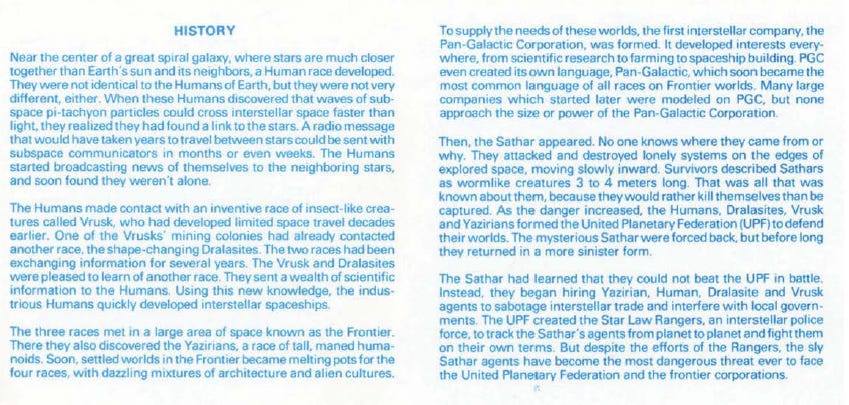
The science fiction background of Star Frontiers was quite different from that of Traveller. Where Traveller took place in a galaxy dominated by an interstellar Empire in a fairly settled area of the galaxy, Star Frontiers took place on the Frontier of civilization where a major corporation “Pan Galactic Corporation,” later multiple corporations, was sponsoring the exploration of the Frontier and attempting to profit. The Pan Galactic Corporation had come into existence to promote exploration and trade among four major alien races: Human, Vrusk, Dralasite, and Yazirian. These races have only just begun to interact with one another, and have banded together on the Frontier of explored space.
While expanding into the Frontier, they soon discover a new enemy, an enemy that threatens to destroy any civilization that chooses to explore the safety of the central galaxy. That enemy is the Sathar, a wormlike race with hypnotic powers on the edge of explored space. The exploring races have only recently completed their First Sathar War, during which they formed the United Planetary Federation, and are now having to deal with terrorist attacks and sabotage by agents of the Sathar...agents from among their own people. In response to the Sathar’s new warfare strategies, espionage and terrorism, the UPF has formed the Star Law Rangers who track Sathar agents and attempt to foil their plots.
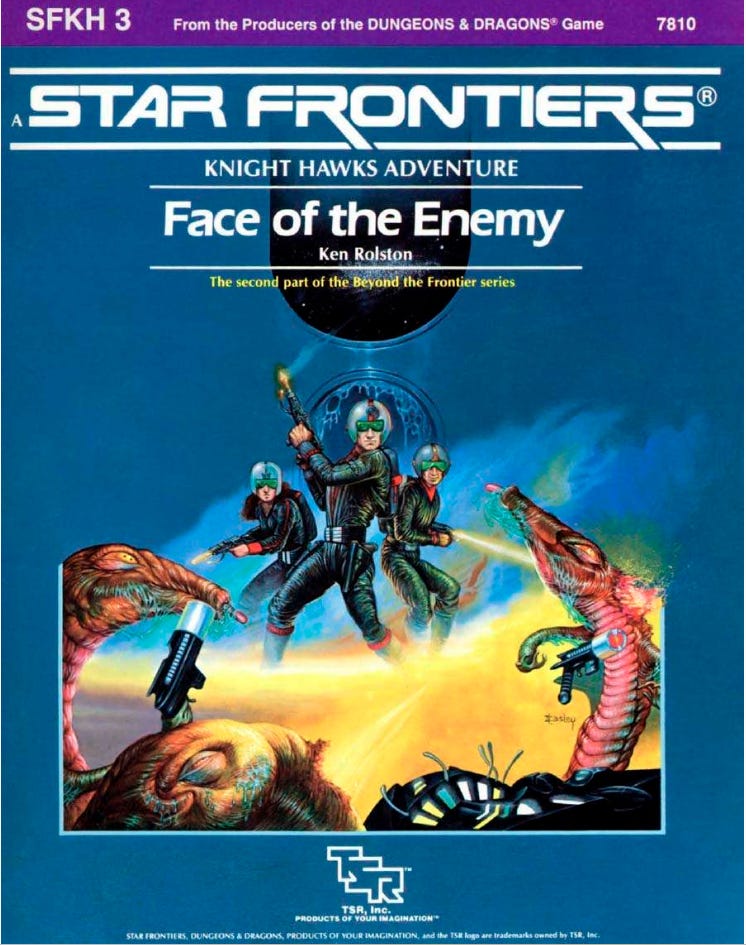
As I’ve been reading through the lore of the Star Frontiers game, it is interesting how much the setting reads like an optimistic version of Warhammer 40,000. In 40k th Imperium is corrupt, but it is surrounded by a host of enemies including Chaos and the dreaded Tyrannids. The Sathar are most similar to the Tyrannids in that they are a mind altering race on the fringe of space that is invading the galaxy and inspires cults etc. They are the horrors from beyond and they require the freedom loving members of every species to band together to defeat them.
Just as Star Frontiers reads as a kind of optimistic space libertarian alternative to 40k’s Imperium, the Star Frontiers setting reads as an alternative Traveller setting as well. Traveller, like 40k, is a game that features an empire in decline, while Star Frontiers is a setting of mercantilism on the rise. This leads to huge differences in the over all tones of the settings. Traveller isn’t as grimdark as 40k, but it’s pretty gritty.
But the setting isn’t the only difference between the games, there are major differences in the game mechanics. Just as Traveller’s mechanics brought an alternative way of modeling conflict to that in D&D, so too did Star Frontiers bring yet another system. In fact, Star Frontiers brought three new game systems to the table. That’s right, three. The main boxed set included a Basic and Expanded version of the rules and the later Zebulon’s Guide to the Frontier Space added a third version of the rules as well as a ton of lore. Each of these products made the rules more and more complex.
Where Traveller characters are retired from former professions and already have a number of skills at which they are proficient, especially if the characters were generated using the Mercenaries or High Guard supplements, Star Frontiers characters are relatively inexperienced.
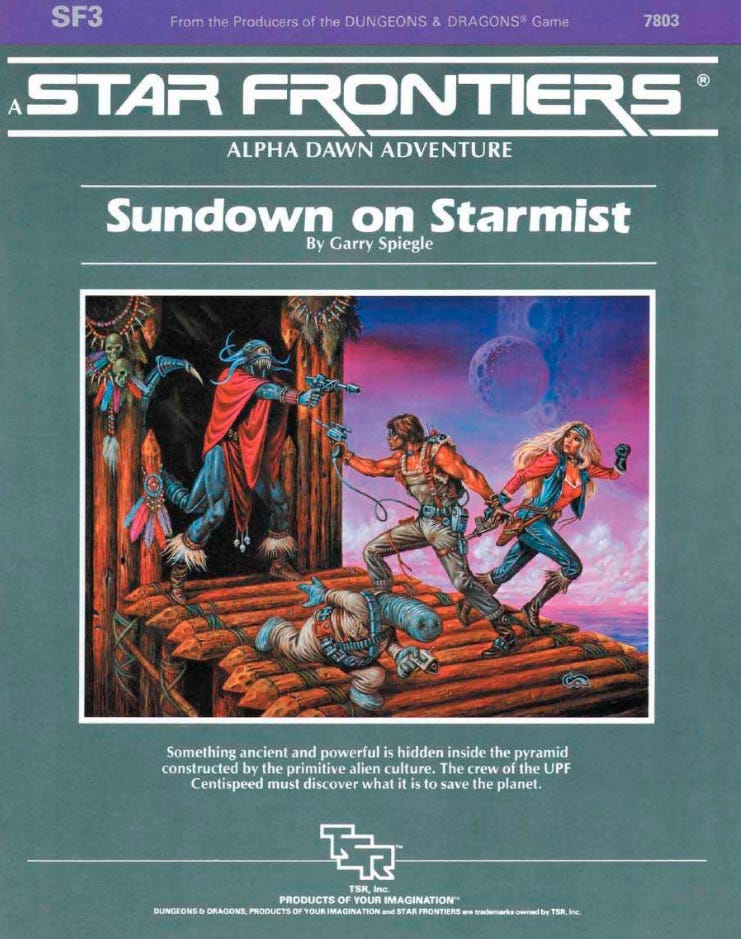
In the Basic version of the Star Frontiers rules, player characters are proficient in using the weapons they are equipped with but lack any other skills and any skill checks that the Game Master might want to make would be percentile checks against attributes. They would have to make that a house rule though, since there are no skill checks in the Basic adventures provided because the Basic version of the game was primarily meant to be an easy point of entry that was essentially pick up and play. The Player Characters work for the Pan Galactic Corporation as security and they get into a fight with a Sathar agent (not an actual Sathar, but a human serving them). It’s an all combat mission that is very scripted. In fact, the Game Master is called “The Reader” at this stage of the game and there is definitely some use of educational pedagogy going on in the presentation.

Even in the Expanded Star Frontiers rules, the characters have training in only two major skills. That’s right. They are only trained in 2 of what they say are 13 skills, but are really closer to 37 when you add all the subskills which need to be learned separately. This means starting characters have very focused training and is at the lowest level with only a moderate chance of success. There are no rules for how to adjudicate things when no one has the necessary skill, and this is a major flaw in the system. It should have given an “unskilled” base chance for skills that can be used untrained and listed those skills that can only be used with training.

The characters start near penniless and are in need of employment. Players can be thankful that the Star Law Rangers are always looking for recruits, that the corporations are always looking for someone willing to risk Sathar attack while exploring planets on the Frontier, and then there’s always the possibility of playing a group of Sathar agents...
Star Frontiers is a game that has a background that is rich in ideas for development, but it is also a game where one has to dig in order to find these ideas. I’ve said that Star Frontiers has deep lore, and it does, but trying to find out the history of the Star Frontiers universe is not an easy task. Prior to the publication of Zebulon’s Guide to Frontier Space there was not a clear timeline of the development of civilization. Players had to induct heavily from the introduction in the Basic Game rule book, read and reread the racial descriptions, and scour every module for minutiae to get a sense of what was going on. Zeb’s Guide did some of the work for you, as it advanced the timeline to a point after the modules and to a point where the Sathar had developed mind controlling organisms that latch on to the victim’s back to take over the nervous system (fans of Puppet Masters and Iron Empires take note). Taking the Frontier beyond an outline and into a fleshed out campaign setting takes time, but it is worth it.
I’ve read the rules many times and played more than a couple of sessions (though never a full campaign). It’s an easy system, though I’ve recently come up with an even simpler version of their Basic Rules with my own Extremely Basic rules. Check them out and tell me what you think. I’m considering expanding these Extremely Basic rules into their own game system that I’ll use with Star Frontiers. Then again, I might just use the setting and play the game with Savage Worlds or another game’s rules set.
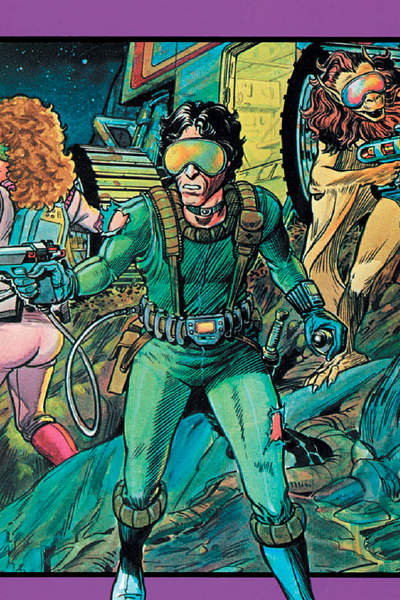
Since I own the entire run, I might use the old (and it feels weird to call them old) d20 Modern rules set, but when a game is 20 years old they are older than my students and so they are “classic” now. Wizards of the Coast published a Star Frontiers setting section for the d20 Future book and had a web expansion with stats for the Sathar that I am including below for your perusal. Be forewarned though, it makes the Sathar look cure. Don’t be tricked by their cuddly appearance in this supplement, they are EVIL.

What do you think? Should I run a Star Frontiers game? If so, what system should I use? Alternity, Savage Worlds, Traveller, other?
I would love to hear how d20 Modern works in practise. I’ve got most of the line and have only played a scenario of Dawning Star.
A great breakdown. My love for the game is largely nostalgic now. At the time, we were all just disappointed that it wasn't Star Wars at a time when that's all we were talking about. That did a disservice to the setting they published, but we were little savages and didn't care. For what it was worth, I went straight from Star Frontiers to Traveller, because I was looking for something that hadn't come out yet. Then, years later, when we DID get Star Wars...I was past it. Capricious youth.