


This Weekly Geekly is LATE. This is in part due to the fact that I spent a lot of November through January holed up in a cave writing on my dissertation, drafting R code and creating visuals in PowerBI to illuminate some data in effective ways. It’s also because, like a lot of you, I spent a lot of time with my family over the winter break. I do have some pretty cool stuff coming down the pipeline though.
A review of the Jurassic Park Role Playing Game…yes, there was one.
Reviews of Megaforce and Staying Alive, as well as the new Robin Hood series on MGM+, articles going episode by episode through the older Robin of Sherwood Series and the Richard Greene series that resulted in the 1960 Hammer Films release Sword of Sherwood Forest.
A review of the Japanese martial arts film Ghost Killer.
Several Sword & Sorcery reviews.
Articles about Conan in role playing games starting with a review of the most recent Conan game from Monolith…oh, and their Batman RPG too.
I’ll be publishing all of that and more in the coming weeks/months, as well as revitalizing the Weekly Geekly Rundown. As much as I like that you all are willing to read my opinions about things, and share your own, I really love sharing the great work that other people are doing across a variety of media.
So…here goes.

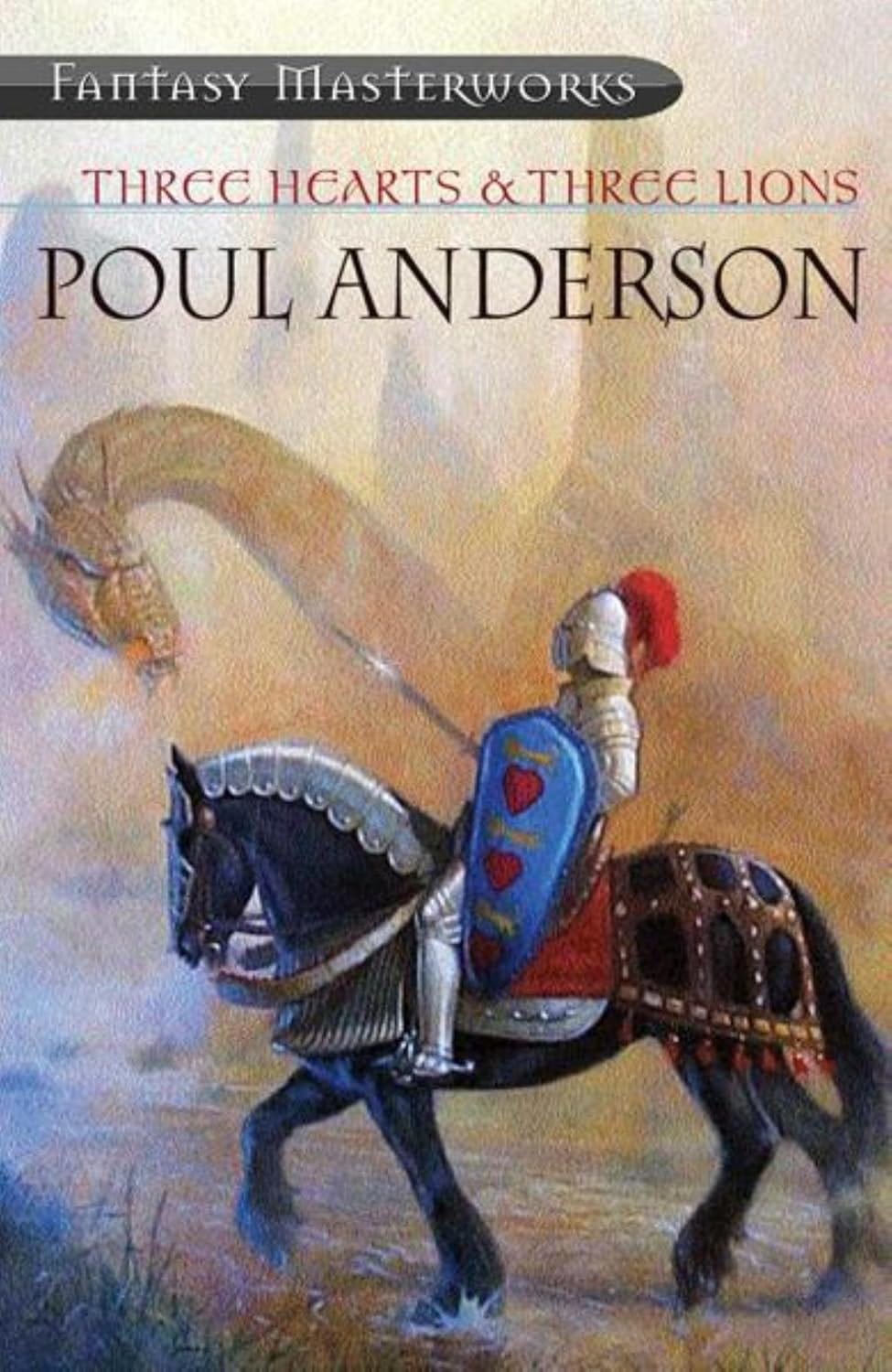
Poul Anderson was born on November 25th, 1926 and I intended to write my weekly oddity as an acknowledgement of his wonderful writing. Some fantasy fans lament that the genre has become too predictable and thematically repetitive and this has always been a risk in the genre. Today, people discuss how a lot is too derivative of Tolkien, romance literature, or another one of the major foundations of the modern market, but there was a time when people lamented the state of Sword & Sorcery fantasy as being too formulaic. One of those people was Poul Anderson.
Way back in 1978, just as the Sword & Sorcery genre was building up steam in what would be a short lived golden era, Poul Anderson wrote a famous essay providing advice for would be authors of heroic fantasy. The essay was entitled “On Thud and Blunder“ and that title became a descriptor for an entire sub-genre of mediocre and derivative heroic fantasy stories.
In written form, “Thud and Blunder” tales would include the John Norman Gor novels (though those have are also critiqued on other grounds), the Lin Carter Thongor tales, and the vast majority of Conan pastiches. In film, almost every heroic fantasy ever made, with an increasing number of modern exceptions, falls into the “Thud and Blunder” camp. Kull, the Conan movies, Krull, The Sword and the Sorcerer and countless other films fall into this category. Don’t get me wrong, I LOVE this category of films. I’m always down to watch Ator the Fighting Eagle or the Deathstalker series (oh…I’ll be reviewing the most recent entry in that series next week), but I understand that these are Thud and Blunder dialed to 11.
The early 2000s saw the release of films like Lord of the Rings and Harry Potter movies (among others) that managed to avoid the syndrome and shifted audience expectations of what a fantasy film could be. As much as I will defend the 2000 Dungeons & Dragons film by comparing it to older fantasy films and fantasy expectations, in a post Lord of the Rings movie world (and post Hellboy II for that matter) it pales in comparison. I still enjoy the low budget fantasy attempts, but I now know that filmic fantasy isn’t limited to them. Heck, with the wonderful independent television pilot Midnight Chronicles that Fantasy Flight Games released in 2009, I saw how good fantasy could be created on a budget. It came out two years before Game of Thrones, so it didn’t yet have the potential audience it deserved but it was a worthy attempt. All that said, the most recent Conan and Red Sonja films demonstrated that filmic Thud and Blunder were alive and well. It seems that too often writers of many Conan stories (no matter the medium) use the old Frazetta covers as inspiration rather than Howard’s work.
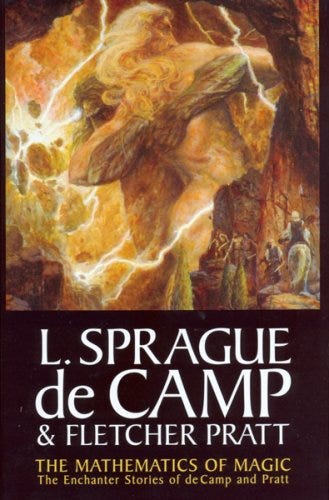
As an aside, Anderson mentions DeCamp as a fantasy author who managed to avoid writing tales of “Thud and Blunder.” Those who are only familiar with DeCamp’s Conan pastiches might find such an assertion baffling, as DeCamp’s tales of Howard’s barbarian are particularly bad, but those readers would be well served to read further into the library of DeCamp’s work. Sprague was quite a wordsmith and when he wasn’t busy unfairly damaging the writing reputations of talented pulp era writers, he was writing wonderfully fun and imaginative fiction. One might attribute the degrading of past authors by a talented author of one generation as a necessary “canonicide” by which one generation of writers asserts its talent and authority, were it not from the genuine pleasure that DeCamp seems to derive from reading the fiction of Howard and Lovecraft.
Adding to bewilderment in this regard is DeCamp’s contemporary Lin Carter. Carter also enjoyed and promoted the virtues of heroic fantasy, and compiled wonderful collections of older fantasy writings. Carter’s own attempts, like the aforementioned Thongor series, are nigh unbearable to read. Yet Carter’s passionate, and articulate, introductions to his collections demonstrate that he could be a capable writer.
Maybe there is something about the heroic fantasy pastiche that brings out the worst writer in all of us, kind of like buddy heist movies can bring out the worst in screenwriters.
Back to “On Thud and Blunder” though...
The key tenant of advice that Anderson, who was a skilled author of heroic fantasy, gives to prospective authors is the need for verisimilitude in the presentation. Certainly fantasy tales will violate many of the laws of nature, but they should seem to take place in living and breathing worlds. Anderson provides several ideas for areas where authors might look to increase the realism of their world and the quality of their fiction. He recommends that authors think about the physical aspects of the environment (what lighting would really be like for example), the real politics, the role of religion, the realistic use of weaponry, and/or the lives of the common classes when they approach a fantasy tale.
When one thinks about it, the best fantasy stories are those that do just that. What draws me to George R.R. Martin’s epic fantasy? His portrayal of political relationships. What draws me to Michael Moorcock’s Elric saga? The living nature of the metaphysics and religion of the tales. Elric’s actions have consequences and the religion of his people is a “living” thing -- quite literally. Tolkien was a wonderful practitioner of mythopoesis. Even when Tolkien’s tales lacked “action,” they contained deep realism.
Anderson’s brief essay should be required reading for any fantasy author, and for most Dungeon Masters as well. Think about how much better your role playing game sessions would be if they took place in a living world. I often think that James Maleziewski’s rejection of the “narrative” module model of rpgs, is that he wants to have room for a deep verisimilitude that is often included in “geographically” based adventures and lacking in “narrative” ones.
My only criticism of the Anderson piece are his uses of Society for Creative Anachronism activities as proxy for any kind of historical representation. These events have themselves become as divergent from the reality they seek to recreate as anything else. When one, as Anderson does, begins discussing chainmail constructed of hanger wire as analogous to real chainmail it is easy to see how the comparisons can begin to fail. Add to that modern metallurgy, which creates lighter and stronger metals, and the errors only begin to compound. SCA comparisons aren’t useless, but they shouldn’t be viewed as “accurate simulations” any more than an episode of “Deadliest Warrior” or a wikipedia article. Members of the SCA aren’t typically Andre Marek who attempt to live their entire life as if they were in the middle ages. Speaking of Andre Marek, the Timeline film is a perfect example of how you can take a book which isn’t “Thud and Blunder” and transform it into a “Thud and Blunder” tale in another medium.
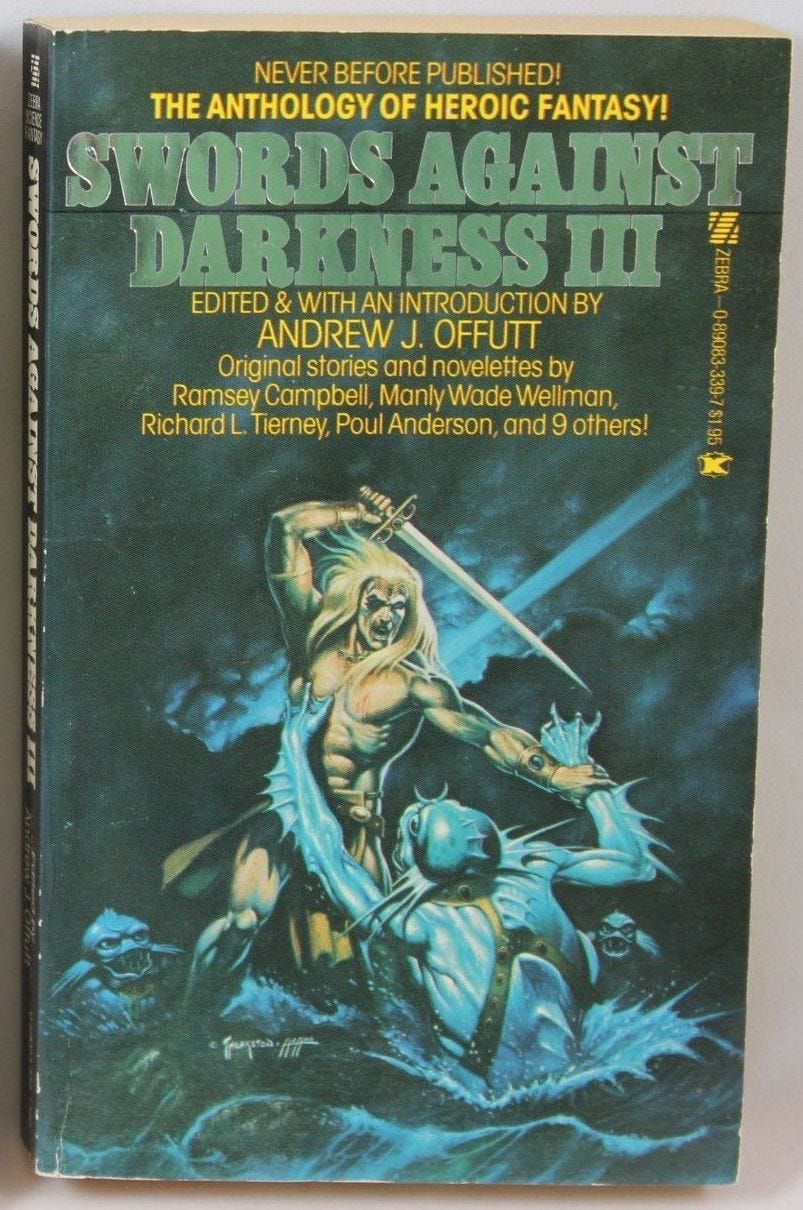
I’d like to re-assert though that if you want to write fantasy, or if you are looking for game master advice, Anderson’s “On Thud and Blunder” is must reading. The link goes to the SFWA where you can read the essay for free and print it out, but the essay is also included in the Andrew Ouffut edited anthology Swords Against Darkness III. Since the anthology includes a Ryre story by Ramsey Campbell (yes, horror author Ramsey Campbell wrote Sword & Sorcery too and you should track down DMR Books’ Far Away & Never), a Simon of Gitta story by Richard L. Tierney (his full stories are avaiable in Sorcery Against Caesar from Pickman Press), as well as stories by Tanith Lee and David Drake, I’d recommend tracking down the anthology if you can.

The Lamentations of Luke Y. Thompson
My friend Luke Y. Thompson recently wrote about a funeral he attended in Los Angeles, and it was a wonderfully moving piece that highlights the important role funerals play in our lives and in our communities. I’ve been to more funerals than I wish I had attended, but I can say that there affect on the grieving experience has been much more positive than the non-funerary experiences I’ve had. My dad gave me half of my mom’s ashes, for which I am deeply grateful, but the lack of a funeral made the grieving period last longer and feel more uncertain than it would have otherwise. There’s no blame to share in this regard, funerals are expensive and she wanted to be cremated, but I do wish we had been able to meet with more friends to share our grief and share stories.

Darran Hight’s Nerdstalgia Notebook
My buddy DaЯRaN HighT has been writing up a storm and sharing nostalgic article after nostalgic article. You should really check out his Nerdstalgia Notebook if you are interested in chatting about Gen-X popular culture from a pure joy perspective. He recently wrote a piece discussing the Marvel CBS-verse made for television Dr. Strange movie which prompted me to pull out my DVD and watch it. Like most of the MCBS-verse, it makes some changes, but there is some real weirdness in the film and it’s very entertaining. I might just have to do a MCBS-verse marathon at some point. The Daredevil/Hulk movie was very cool.

I mentioned that I’ll be reviewing the latest Deathstalker movie soon. My take is a little different than Darran’s, but I recommend checking out his thoughts on the movie. Maybe, if I can talk a couple of readers into it, we can do a Geekchat just discussing this franchise and how this entry measures up to past films.

Jose Zambrano Cassella has three recommendations for real movies that includes two films that aren’t on most “supposed to watch” lists and all three are very much worth your time. The reviews are to the point and get at why the films are must see experiences without falling on the staid plot synopsis that dominates so many reviews and recommendations. No. I’m not telling you what the movies are. I want you to read Jose’s recommendations.

Kate Korsaro has an excellent discussion of the role that death should and could play in role playing games. A lot of modern gaming experience and GM advice seeks to minimize the threat of death and allow player characters to dominate narratives as the stories move from “spotlight” to “spotlight.” Kate argues that the risk of death adds to both play experience and narrative depth and she is correct. She’s also got a new online Zine that she’s putting together and I think it’s absolutely fantastic.

Matt Thompson over at Critical Hit Parader had a recent post where he discussed two of my favorite topics: Michael Moorcock and Blue Öyster Cult. In the post he ranks his favorite BÖC songs as well as discussing his favorite BÖC songwriting pairs. I was glad to see Astronomy and Black Blade in the list of his favorite songs and he gives a shout out to my favorite song, Veteran of the Psychic Wars. It’s a song I’ve always enjoyed, but that I like even more after reading the Corum stories by Michael Moorcock.

Pollster Natalie Jackson has written a piece over Herding Cats & Polls that provides a brief synopsis of the longer article that she wrote for National Journal discussing how we need to update how we talk about partisanship and ideology. She highlights how what pollsters, and political scientists, call “leaners” don’t actually fit in the place we put them on an ideological scale. Let’s say we have a line ranging from 1 to 7, with 1 being Strongly Democratic and 7 being Strongly Republican. We typically place “moderate” at 4 and the “leaners” at 3 and 5. The problem is that leaners aren’t really more moderate than “weak” partisans.


In political science, we’ve been discussing this for some time with McWagner and Much writing about it last year and Magelby and Nelson writing a very detailed discussion of the issue in 2012. In essence, “leaners” (those partisans who claim to be “independent” before being cornered into admitting partisanship) behave more like strong partisans. Add to that the fact that a Democratic Socialist would ideologically be significantly to the left of a Strong Democrat and yet would, on this measure, appear as a moderate. You can see now messy that is and Natalie Jackson’s article is a nice look at this issue.


Given that I talked about how much I loved Step-Die game systems earlier this week, it’s probably no surprise that my recommended role playing game is in that vein. Since Deadlands is also celebrating its 30th anniversary, it’s the perfect time to talk about the game. I’ll do a detailed review next week, but let me say that Deadlands is a wonderful game where the mechanics and the setting tie together almost perfectly. The magic system incorporates poker mechanics and the dice mechanics keep the game gritty, but heroic. So too does the ability of heroes to affect how horrific the environment is by their actions. The setting is now predominantly played using the Savage Worlds system. In fact, 20 of its 30 years have been with that system, but I think more people should give the original rules set a spin. It’s rich and deep and worth your time.


What if there was a metal band made up of what looked like you average collection of Mountain West dads who got together to form a garage band…and decided to wear red gnome hats? What if they actually rocked? Well, that’s exactly how I’d describe the Belgian metal band Gnome. They have a nice sonic complexity with progressive rock elements and some phrasing that suggests influence from banks like Kyuss and Queens of the Stone Age. I have no idea why this band showed up in my YouTube feed, but I am glad they did.
Taking the “what if” idea and spinning it in another direction. What if you took one of the most talented guitarists in the post-punk movement and paired him with a creative and minimalist post-punk rhythm guitarist (Johnny Marr and Bernard Sumner) and had them join a new wave supergroup that crafted songs where you have to listen really carefully to hear any guitar at all? You’d get the band Electronic and you’d find that buried within this very mellow and … yes … electronic sounding song, there is a subtle and interesting guitar solo by Johnny Marr.
If you listen to Bernard Sumner’s guitar playing on Transmission, you can see that he’s able to play off of a driving baseline and fill the empty spaces with a compelling counterpoint that adds depth and complexity to the song. While often thought of as a mere rhythm guitarist by many critcs, you can see how his lyrical phrases are the real magic of the song. Peter Hook’s excellent bass work is what drives the song, and most Joy Division songs, but Sumner’s phrasings fill the spaces wonderfully and show that sometimes minimalist counterpoint can add layers rather than fade into the background.
As for Johnny Marr, his ability to craft wonderful melodies that dance upon the ears is appreciated by critics, but still understated. He’s a damn fine guitarist whose technique features an economy of motion that allows for clean and quick notes. He isn’t shredding, but he’s playing phrases inspired by pure 60’s bubble gum pop, speeding them up, and mixing them with older folk melodies to create something special.
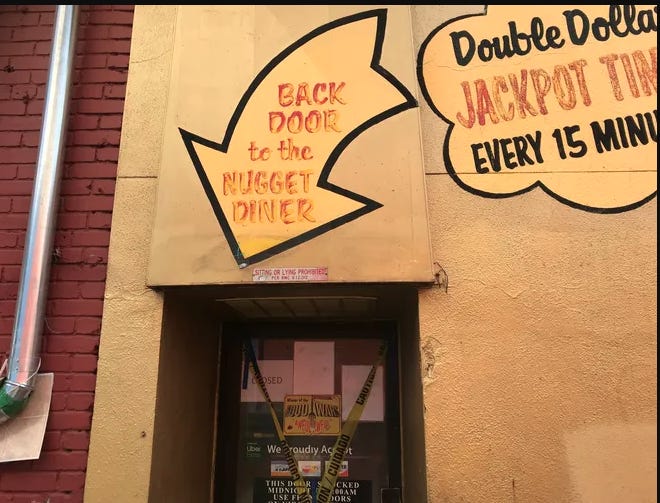
Three weeks ago, Toad the Wet Sprocket released this Acoustic version of their song Jam. It instantly made me feel nostalgic for my hig school and college days, and that was before I saw them walk under the Reno “Biggest Little City” sign. That’s a street sign I walked by and under daily for a couple of years as I worked at Fitzgerald’s Hotel/Casino as a Valet Drive and at Harold’s Club as a 21/Craps Dealer. It brought back memories of going to eat Chinese food at the Flamingo Hilton at the end of Swing Shift, or heading to the little diner behind the “Little” Nugget casino to eat the much too large Awful, Awful hamburger. I’d walk down the alley behind the casinos to the back door of the diner, sit down on the counter and order the burger with its signature “pound” of fries. It seems a lifetime ago and the song magnifies the nostalgic memories and makes me so glad I reconnected with Darran. I’ve never told him this, but he was a great friend during a time when I desperately needed one. That was in high school, not college as the Toad song brings to mind, but I will forever be grateful to him.

While younger generations have turned Boomer into a humorous and shallow insult that just means old, Generation X tends to hate the Baby Boom generation with the passion of a thousand burning suns. If you ever wanted to get a small glimpse of why, there is no better film to watch watch than Ang Lee’s adaptation of Rick Moody’s novel The Ice Storm. If you watch it back to back with Boomerstalgia films like The Big Chill, Lost in America, or the Weather Underground aplogia film Running on Empty, you can see the contrast between how the generation viewed itself (rebellious, counter-cultural, and enlightened) in sharp contrast with how many children saw the generation (narcissistic, self-indulgent, and judgemental).
To be fair, there are films about the generation that apply a critical lens to the era. Films like Saturday Night Fever show the reality of the urban struggling class during the mid-70s, B.W.L. Norton’s More American Graffiti dances around the edges of criticism of the generation with a mix of nostalgia and irony, and Miloš Forman’s Hair does a good job at highlighting complexity even as it leans into the mythology of the era. My life and my parents, were nothing like those depicted in The Ice Storm, for which I am grateful, but I saw glimpses in some my friends’ families...especially after we moved from Reno to the Bay Area for a time.
That you for the shout-out, Christian :)
Anderson also wrote one of the best parodies of S&S. I forget the name of the story, but I do remember a would-be seductress who runs away from the hero because of his bad grooming ("Fleas he's got!").