


Back in May, I discussed how useful it can be to approach D&D magic from an effects-based or special effect design philosophy as both a player and a DM. Using this approach allows for gamers to add a little of narrative magic without the need to have a deep understanding of the mechanical balance underlying the game system required to make new spells from whole cloth. This is an approach used by the Champions role playing game and by Pinnacle Entertainment Group’s Savage Worlds rpg. The Savage Worlds Adventure Edition rule book describes this approach in the following way:
“Trappings allow the core powers presented in this chapter to have many different appearances. They usually have no game effect on their own, but are important for atmosphere and theme.
One character might fire a swarm of bees to attack her foes, for example, while another shoots red lasers from her eyes. Both are examples of the bolt power and share the same mechanics, but they look and are described differently.
Trappings do matter when an obstacle or opponent has a particular strength or weakness. If an ice troll suffers +4 damage from fire- or heat-based attacks, for example, a blast a player describes as a fireball counts as a fire attack and does +4 damage” — Savage Worlds SWADE page 150
For Savage Worlds, and for older editions of Champions, the particular manifestation of a spell is primarily descriptive. It allows characters to be “cool” in the way they want to be while being mechanically balanced with other player characters in the game of similar power levels. The baseline damage is the same, but there is some play around the edges when a creature or villain has a particular vulnerability. This is why SWADE, and Champions, require the special effects to be static once chosen and not be variable, though one could create a system for allowing them to be mutable at a cost in both of these games. In D&D games, I have my Wizards “memorize,” and Sorcerers “know,” particular expressions of spells and have those be fixed. Since Wizards can change their spells when they memorize them the next day, they can memorize different “effects” from day to day but only if they’ve got those expressions in their spell books.
All of this may make it seem like coming at magic from a special effects approach is an intimidating process, and you might have begun to doubt my assertions that it can be done without creating a lot of work for players and DMs, but I’m going to attempt to show you how it does just the opposite. It allows for the creation of a lot of imaginative and narrative effects without the need for creating new mechanics. As a part of this argument, I have decided to write a series of D&D 5e Wizards (I’ll also update to 5.5/6e later) based on Power Themes that reflect the use of effects-based spells.
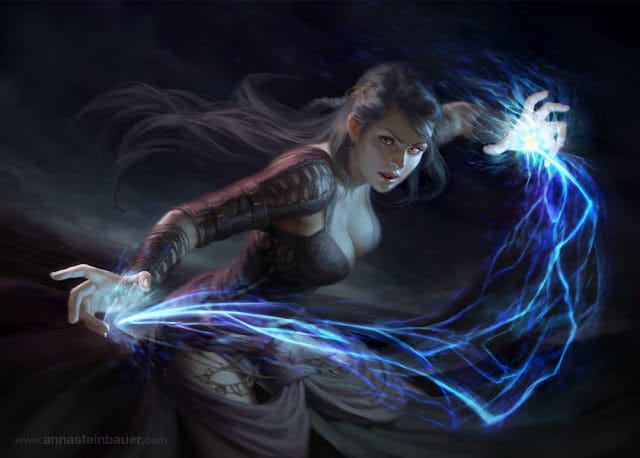
My first character is a Wizard who has dedicated her studies to lightning focused magic. In the Forgotten Realms, she might be a worshipper of Talos or just a character who believes that lightning is really cool…because it is. I haven’t included any magical equipment for this character but have renamed the “reskinned” spells with lightning themed versions. There will be a bit of a discussion of how this interacts with game balance after the stat bloc.
Mystrael Shawk
Human Lightning Wizard (Soldier)
Level 5
Str 8 (-1) Dex 14 (+2) Con 14 (+2)
Int 16 (+3) Wis 10 (+0) Cha 12 (+1)
HP (5d6+10) 32
AC 12 or 15 (Dex; Crackling Aura + Dex)
Init +2 Speed 30 Proficiency Bonus +3
Attacks: Dagger +5 (1d4 piercing), Dagger (ranged) +5 1d4 piercing, Spells +6
Senses: Investigation 16, Perception 10
Saves: Intelligence +6, Wisdom +3
Skills: Arcana +6, Athletics +2, Intimidation +4, Investigation +6, Sleight of Hand +5
Feats: Keen Mind
Human Traits: Bonus Skill (Sleight of Hand), Bonus Feat (War Caster)
Wizard Traits: Spellcasting, Arcane Recovery, Arcane Tradition (Abjuration), Lighting Ward (13 HP)
Spell Casting Ability (Known: 3, 6, 6, 4; Slots: 4, 4, 3, 2; DC 14)
Cantrips: Lightning Ball (Acid Splash), Crackling Illumination (Light), Shocking Grasp
Spells
1 - Arc of Lightning (Burning Hands), Crackling Aura (Mage Armor), Electric Shield (Shield), Synaptic Shock (Sleep), Static Tickle (Tasha’s Hideous Laughter), Plasma Arc (Magic Missile)
2 - Lightning Cloud (Cloud of Daggers), Immobilizing Shock (Hold Person), Electrify Weapon (Magic Weapon), Mystral’s Lightning Arrow (Melf’s Acid Arrow), Clinging Field (Spider Climb), Electrical Flash (Blindness/Darkness)
3 - Electrical Animation (Animate Dead), Sphere of Lightning (Fireball), Ride the Lightning (Fly), Lightning Bolt
As you can see, merely by renaming some of the spells the descriptive effect in play of certain spells is altered without changing their effects. Take Crackling Illumination as an example here. When it comes to game effects, it doesn’t matter whether light is produced by illusory fire, real fire, crackling electricity, or radiant illumination. All that matters is that the spell produces the effect of light. Similarly for Mage Armor, since we aren’t categorizing any kind of damage, the appearance of Mage Armor doesn’t affect game play.
When the character later learns Fire Shield (which will be Lightning Shield natch), there might be some mechanical considerations regarding resistances and immunities. Mystrael’s focus on lightning themed damage spells means that there are mechanical considerations for spells like Lightning Ball (Acid Splash). Any reasonable DM should have their “but that spell already features typed damage, and it might matter” alarm flash a warning. It is very true that there might be some mechanical differences of consequence. Some DMs might merely hand wave such concerns and point out, as Michael Shea at Sly Flourish often does that Dungeons and Dragons isn’t designed to be a balanced game and that imbalance is a part of what we like. As a fan of games like Champions that are heavily playtested to ensure mechanical balance, I won’t do such hand waving here, though it is a perfectly “Folk D&D” thing to do.
Instead, I’m going take a look under the hood of Acid Splash to see what kind of damage it currently does, who is resistant to that, and whether reskinning it as a lightning effect changes anything significantly. No, I’m not going to run a full t-test to determine significance, but I am going to see if there is face validity to the claim that they are pretty much the same.
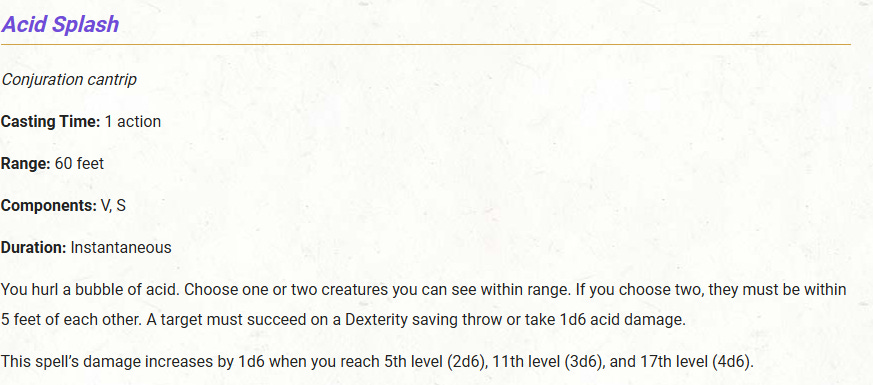
Range: 60 feet
Damage: Save or Take 1d6 Acid Damage
# Creatures affected: 1 or 2 within 5 feet.
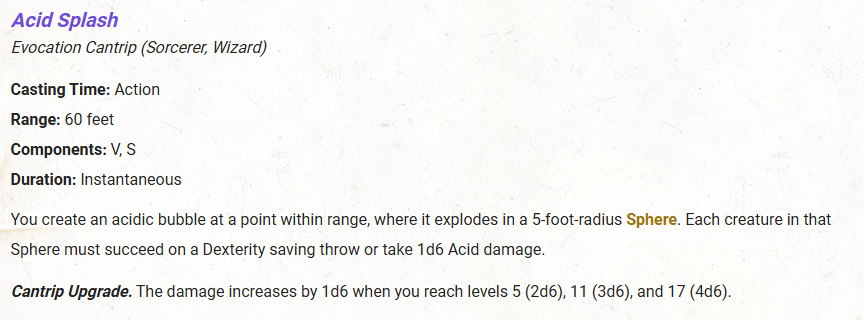

Range: 60 feet
Damage: Save or Take 1d6 Acid Damage
# Creatures affected: All Creatures in a 5 ft. Sphere.
You’ll notice that the 5e version allows for only one or two creatures, while the 6th edition version could affect up to 9 foolish creatures in tight formation. In 5e and 6e, a 5-foot radius is typically treated like a 5-foot cube. If you wanted to treat it more like a true sphere, you could still affect 5. This is a significant increase in power from 2014’s rules set and is one of a thousand minor changes that make 2024 a truly new edition.
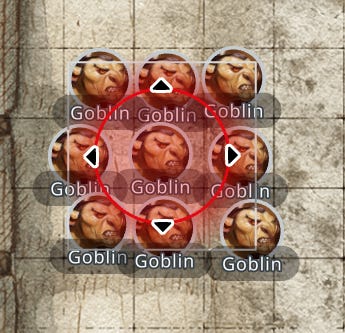
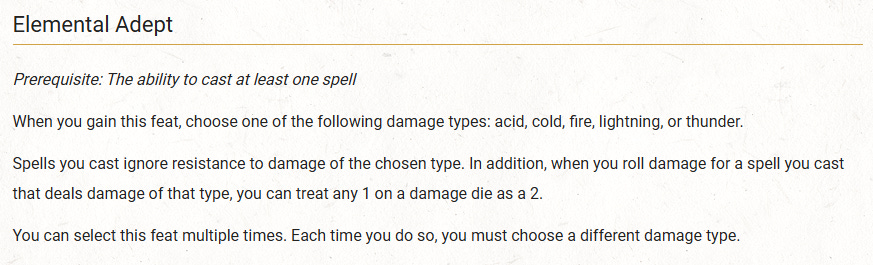
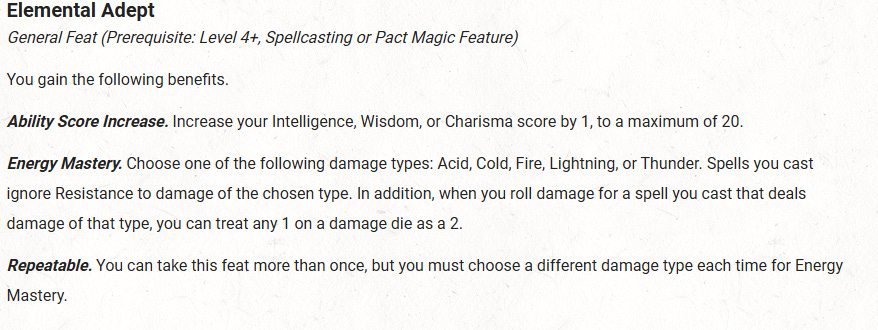
While the newer edition is more powerful, the Acid Splash reskinned as Lightning Ball only changes one aspect of the spell, the damage type. In fact, since the spell already can damage up to 2 creatures (5 to 9 in 6e) in close proximity the spell’s mechanics fit nicely with the reskin. The question here becomes, “Does the spell significantly improve if it becomes lightning based?” There are after all different creatures who are resistant/immune to different damage types and affecting a disproportionate number might affect game balance. This criticism only holds so much weight since the Elemental Adept feat allows casters to ignore type resistance (though not immunity). This feat is yet another example of power creep in the latest edition of D&D because in addition to the old benefit, it now includes a stat bump.
So...what are the differences between Acid and Lightning regarding number of creatures affected? Is a lightning skilled spell significantly better than an acid skinned spell?
Here is the rundown of the number of monsters in the Monster Manual (5e) who are resistant (takes half damage), immune (takes no damage), and vulnerable (takes double damage) to Acid and Lightning damage.
5e Acid Resistance/Vulnerability
Creatures Resistant to Acid in Monster Manual: 17
Creatures Immune to Acid in Monster Manual: 15
Number of Creatures Vulnerable to Acid: 0
5e Lightning Resistance/Vulnerability
Creatures Resistant to Lightning in Monster Manual: 34
Creatures Immune to Lightning in Monster Manual: 19
Number of Creatures Vulnerable to Lightning: 0
Since there are no creatures in the 5e Monster Manual who are Vulnerable to Lightning or Acid damage, there is no real effect there. However, the Lightning damage type, the spell is more limited with regard to the number of creatures it can damage. There are 19 creatures immune to Lightning damage vs. only 15 immune to Acid and there are twice as many “resistant” creatures. What about in 6e?
6e Acid Resistance/Vulnerability
Creatures Resistant to Acid in Monster Manual: 25
Creatures Immune to Acid in Monster Manual: 18
Number of Creatures Vulnerable to Acid: 0
6e Lightning Resistance/Vulnerability
Creatures Resistant to Lightning in Monster Manual: 38
Creatures Immune to Lightning in Monster Manual: 19
Number of Creatures Vulnerable to Lightning: 0
The 6e effect is similar. Choosing Lightning over Acid is a net detriment, though the biggest detriment is choosing the Poison damage type. Poison was a frequent tool in earlier editions of D&D, but over 100 of the monsters in the modern game are straight up immune to poison. Woe unto the poison lord in a land of Skeletons. In the end, these are negligent effects and I believe we can see that this won’t change game balance too much in the player’s favor. Though reskinning poison spells as lightning would be a benefit and so might be discussed.
Regardless of the mechanical considerations when analyzing the impact of damage type, describing Sleep as an effect that results from a quick electrical burst that disrupts the circadian rhythm of a foe or Spider Climb as a static field that surrounds the hands and feet of the caster does nothing other than add a narrative touch to play. The same is true for describing Animate Dead as electrical impulses arching through corpses to control their movements.
There are some damage types that are clearly better or worse than average when it comes to this kind of analysis. Very few creatures are resistant to Radiant damage and approximately 100 monsters (in both editions) are immune to poison, for example, and you would have to decide whether or not to do the “it doesn’t really matter” hand wave or ban those as reskinnable trappings in your games. One thing to consider for spells like Sleep is that you might have the creature’s resistance apply to the hit points rolled against the spell. That significantly reduces the power of that particular spell against certain foes, but it adds the illusion of unpredictability to your magic and makes magic more magical.
If I get good response to this, I might stat up some more themed wizards and maybe do multi-system adaptations.
I enjoyed this very much, and would definitely be interested in seeing more of them.