


I have been thinking about magic systems again.
This happens periodically, usually when I am deep in design work on something ostensibly unrelated, and the underlying questions surface anyway because they are, it turns out, not questions about magic systems specifically. They are questions about what rules are for, about the relationship between mechanical precision and imaginative freedom, and about where a game’s rules should end and where gamemaster design decisions should begin. They are questions about when it’s time for “rulings” and not rules, to use the OSR slogan.
The immediate reason I started thinking about magic systems this time is a superhero roleplaying game I’ve been developing. Superhero games face this problem in an especially acute form. Superhero comics have produced roughly a century’s worth of powers, variants, and combinations, and any rulebook that tries to enumerate them comprehensively will fail. This isn’t not because the designers aren’t talented, or because they lack sufficient understanding of the lore, but because the project is structurally impossible. At some point, every superhero RPG designer has to decide whether they are going to try to list everything or whether they are going to give players the tools to build anything.
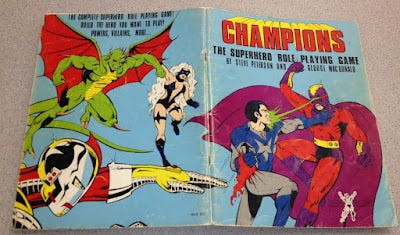
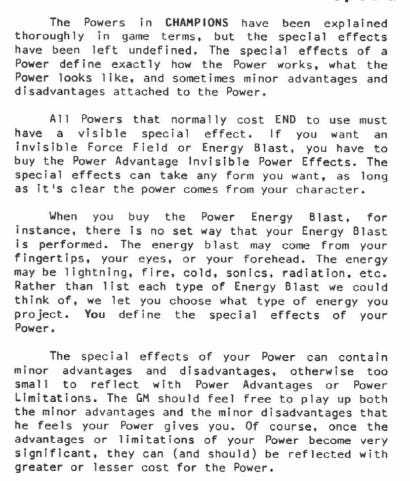
The best superhero games, in my experience, chose the second path. The standard of standards when it comes to tools over lists is a game I keep returning to for design wisdom no matter what genre I am working on: Champions. While I believe that the 4th Edition of Champions is the apotheosis of the game, the 2nd Edition of the game has a fantastic breakdown of what is meant by “special effect” or an effects based approach.
But I’m getting ahead of myself. Let me back up to Dungeons & Dragons, which is where this argument started.
The Very Large Spellbook Problem
There are too many spells in Dungeons & Dragons rulebooks, and this proliferation actively reduces the sense of wonder in the game.
I want to be careful about how I frame this, because I am not making a simple “less is more” argument. Magic in fiction resists quantification almost by definition. Magic in Robert Jordan’s Wheel of Time series works differently than magic in Elizabeth Moon’s Deed of Paksenarrion which is different from Jack Vance’s Dying Earth stories. What makes magic feel magical is frequently its resistance to being fully understood or categorized, and yet roleplaying games require some mechanical grounding for magic to be adjudicated fairly at the table. The question isn’t whether to quantify magic; the question is how much to quantify, and what specifically to quantify.
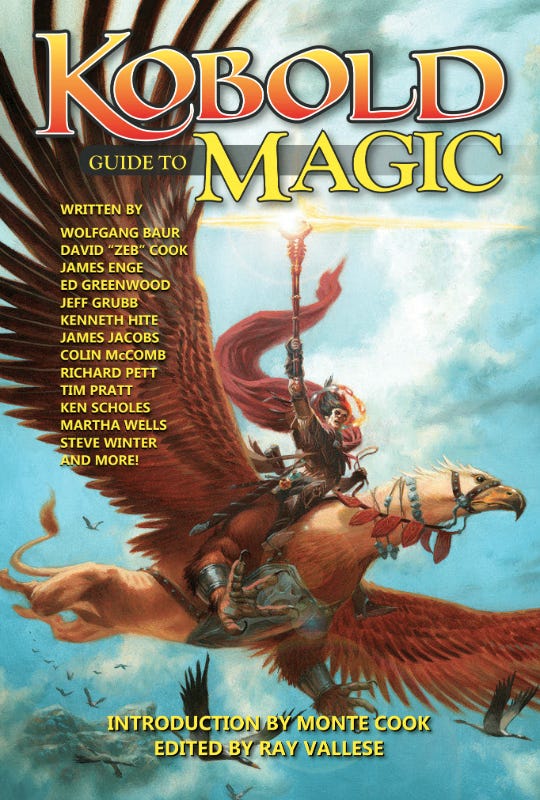
The approach D&D typically takes, what Jeff Grubb called in his “Colors of Magic” article in the Kobold Guide to Magic (available at Amazon or DriveThruRPG) the “Very Large Spellbook,” tries to solve the wonder problem through sheer volume. If you flood the zone with enough spells so that no one knows what everything does, it makes the wonder of discovery possible again. There’s something to this, but the approach has a failure mode Grubb also identifies. As designers lose track, as much as players, you end up with five different spells that all turn a target’s bones into liquid, and once you’ve seen that the mechanical effects are essentially the same across all five, the proliferation stops producing wonder and starts producing clutter. Worse, it produces lookup overhead, to borrow a business term. These are moments at the table where the game stops while someone searches the many “sources” on DnD Beyond or flips through a rulebook trying to establish what a spell actually does. I’ve watched this happen. It is, to put it gently, a momentum killer.
There’s a better approach, and it has been sitting in the hobby for decades. It just happens to have originated in a superhero game rather than a fantasy one.
What Champions Understood

Whether or not you have played it, the Champions roleplaying game by Hero Games is one of the most instructive games ever designed for thinking about what rules are for. My first encounter was the Revised (2nd) Edition, and I spent an embarrassing number of hours building my version of the X-Men for it, only to be informed by more experienced players that I had done more or less everything wrong. This did not diminish my affection for the game and I still stand by my interpretations all these years later. Which reminds me, I have to do a post discussing the X-men stats from Different Worlds #23.
What struck me then, and still strikes me now, is the effects-based approach to power design. The core insight is simple but profound: the rules govern what a power does in the game, not what it looks like in the fiction. Mechanical effects are rigorously defined. Narrative presentation is left entirely to the players.
This idea developed gradually across editions. The first edition, published in 1981, gestures at it in the Energy Blast description and in a brief note about using Multipower to model shapeshifting through special effects. The second edition states it more directly, explaining that “powers in Champions have been explained thoroughly in game terms, but the special effects have been left undefined… The special effects of your Power can contain minor advantages and disadvantages.” By the third edition, the designers had moved the discussion of special effects to the beginning of the Powers chapter, establishing it as a foundational principle rather than an afterthought: “When choosing powers in Champions, always start with the effect and work back to the cause.”
The Champions philosophy is simple. Start with the effect. Work back to the cause.
I want to sit with that for a moment, because it is the most useful piece of design philosophy I have ever encountered in a rulebook, and it applies far beyond superhero games.
What this instruction tells you is that a power defined as “does 6d6 energy damage at range” is mechanically complete. What that energy is, whether it’s electricity, fire, pure kinetic force, psychic pressure, sonic vibration, radiation, the concentrated will of a vengeful god, is a creative decision that belongs to the player and the fiction, not to the rules. The rules tell you what happens mechanically in the game. The players tell you what it looks like. And because the presentation is separable from the mechanics, an effectively infinite number of fictional explanations can map onto a finite set of mechanical effects.
This is what I have come to call the special effects approach, to distinguish it from the increasingly granular effects approach that later editions of Champions developed. Later editions, beginning with the 4th, which is otherwise my favorite, began quantifying more and more presentational elements, which for my tastes moves in the wrong direction. The earlier versions were more freeform, and that freeform quality is precisely what made them generative. In 3rd edition Champions and earlier, if your character had a light based (or fire based) Energy Blast, it was common for the GM to let you use it to create light in order to see things. In 4th edition, you had to purchase "Change Environment.” Your mileage will vary, but the principle I’m extracting here is the earlier one: only quantify what must be quantified, and leave the rest to imagination.
So what happens when you apply this principle to D&D?
The Lost Brigade, Theronna Wolfmancer, and the Rats That Never Came
The best illustration I have encountered in actual play comes from Episode 8, Part 1 of the Saving Throw Show’s series The Lost Brigade (a lost remnant of DungeonTube when games looked and felt like those at our home tables). Around the 41:37 mark, Havana Mahoney’s Druid, Theronna Wolfmancer, attempts to cast Summon Swarm against some creatures the party was fighting. The Dungeon Master, Mason McDaniel, initially handles this beautifully. When Havana asks what the spell looks like, Mason offers several possibilities (do the rats burrow from the earth? Are they vomited from her mouth?) while leaving the final choice to her. It’s exactly the right instinct. It’s generative, it’s evocative, it rewards the player for an inspired fictional choice.
Then the group tries to find the spell in the rules.
Several minutes of lookup ensue. It is eventually established that the spell Havana wanted is a Pathfinder spell, not a D&D 5e spell. She asks whether she can use it anyway. After some discussion, this is declined. Havana sighs and casts Call Lightning instead.
I have never heard a player make a using a lightning based D&D spell sound so resigned. It was the most discouraged “KABLAM” in the history of druidic combat magic. Call Lightning is an epic spell, but here it is cast by a disappointed player.
The fix seems obvious in retrospect. Someone (I’m looking at you Mason) at that table could have asked “what mechanical effect does Havana want?” rather than “does this spell exist in this rulebook?” The answer would have been: an area effect with ongoing damage to creatures that move through or within it, flavored as a rat swarm. In D&D 5e terms, that spell already exists. It’s called Spike Growth and it’s not even high level. It’s a 2nd level spell, just like the Summon Swarm spell that Havana wanted to cast, so power balance is not an issue.
Spike Growth, in the rules, transforms a 20-foot radius area into difficult terrain covered in sharp thorns. Creatures take 2d4 piercing damage for every 5 feet they travel within or into the area, and the transformation is concealed so enemies don’t know it’s there until they’ve taken damage. Mechanically, the spell is:
20-foot radius area, Range 150 feet
Difficult terrain
2d4 piercing damage per 5 feet of movement
Concealed
Concentration, up to 10 minutes
Now strip away the flavor text and ask, “what could generate those effects?” Thorns, yes, but so too could a sudden surge of rats erupting from the earth. There are a host of other effects that could have those mechanics:
A field of ice needles
A pocket of low-lying toxic spores that pierce the lungs with each breath and slow movement to a crawl.
A circle of cursed ground where vengeful spirits claw at anything that passes.
Semisolid shadow with barbed edges.
Magma brought dangerously close to the surface.
Each of those descriptions produces identical mechanical outcomes. Each of them feels completely different in play. And none of them require looking up a new spell.
More Reskins: A Working Vocabulary
The Spike Growth example is a good one, but the principle becomes more useful the more spells you apply it to. Let me work through a few others.
Thunderwave
As written, Thunderwave sends a wave of thunderous force sweeping out from the caster in a 15-foot cube. Each creature in the area takes 2d8 “thunder” damage and is pushed 10 feet away, with a Constitution save to halve the damage and avoid the push. Unsecured objects are automatically pushed. The spell is audible up to 300 feet away.
The mechanics:
15-foot cube, originating from caster
2d8 thunder (force) damage
Pushed 10 feet on failed save
Moves unsecured objects
Loud
These effects are certainly a good representation of a thunderclap, but once again there are other effects that can be represented by those mechanics with a mere change is trappings. It could be any of the following:
A psychic scream from a character who channels emotion as kinetic energy
A religious caster calling down a moment of divine expulsion, the wrath of a god, briefly made physical.
A character with plant-based magic releasing a burst of spores under pressure that simultaneously blinds and repels.
A necromancer releasing a shockwave of necrotic cold, so intense it flash-freezes the air and blasts anything nearby.
The loud component is flavortext that we coudl adapt depending on the special effect. In a reskin “loud” might become “obvious.” It could be a burst of divine light visible at distance, a shockwave of visible psychic distortion, a cloud of spores that hangs in the air for a moment. The mechanics require that the effect be detectable; what it is detectable as is a creative decision.
The pushing mechanic is particularly evocative. An Edritch Knight who gains this spell could describe it as an acrobatic kick that releases a burst of supernatural force; all flash, momentum, and style. An artificer who finds this spell might describe it as the discharge of a pistol loaded with something that isn’t quite powder and isn’t quite lightning.
Entangle
Entangle covers a 20-foot square originating from a point within range with writhing, grasping plants. The area becomes difficult terrain for the duration. Creatures in the area must make a Strength save or become restrained until the spell ends. Restrained creatures must spend their action to attempt a Strength check against your spell save DC to free themselves.
The mechanics:
20-foot square area
Difficult terrain for the duration
Strength save or restrained
Restrained creatures must spend their action on a Strength check to escape
Concentration, 1 minute
The fictional presentation here is wide open. Grasping plants are the default, but the core mechanical event is the ground (or space) grabs you and holds you there, and you must exert force to escape. The action cost for the escape check emphasizes that this isn’t just inconvenient, it is a genuine contest that demands your full attention.
Once again, this does a good job of mechanically representing actual plants, but it could also represent:
Ice that flash-freezes around the feet and lower legs.
Chains of spectral force. A sudden intensification of gravity localized to a 20-foot square.
A wave of spiritual compulsion that plants each creature’s feet with religious certainty. The creatures will not move because they suddenly, viscerally believe they should not. In this case, you could change it from a Strength save to a Wisdom one.
A swarm of rats that cling and weigh and slow and grab rather than biting as they would in the spike growth adaptation.
In a more gonzo game, it could be a momentary dimensional adhesion — the very fabric of space briefly becomes sticky.
The Strength check is somewhat of a mechanical “dial” when reskinning the effects. That particular mechanic implies that the primary method of escape is physical exertion. While you could shift to an Intelligence or Wisdom check, it isn’t necessary. Here, I’m reminded of the battle between Nekron and Darkwolf in Fire and Ice. In that movie, it looks more like physical Strength or Constitution are doing the work to resist Nekron’s mental manipulation. The caster’s magic doesn’t care that the chain is psychic; it still takes muscle to break.
A note for those playing under the 2024 rules: the updated Player’s Handbook makes the caster immune to the restraining effect of Entangle. You no longer have to save against your own spell. The escape check also tightened from a straight Strength check to a Strength (Athletics) check, meaning creatures with Athletics proficiency have a somewhat easier time breaking loose. Both changes quietly make the reskin argument even stronger. Imagine Theronna Wolfmancer casting her rat swarm under the 2024 rules. In this situation, the creatures surge up from the earth and engulf the battlefield, but they part around her instinctively, obediently, as if she were something older and more patient than they are. She walks through the swarm untouched while her enemies flail against it, spending their actions trying to tear free. The strong ones, the ones trained in Athletics, can fight their way clear. Everyone else stays put. The plants were never the point. The restraint was the point. And now the caster gets to look cool while it happens.
Hex
Hex is a 1st-level warlock spell that lets you place a curse on a creature you can see. The target takes an extra 1d6 necrotic damage whenever you hit them with an attack. You also choose one ability score; the target has disadvantage on checks using that ability. The curse lasts up to an hour with concentration, and if the target drops to 0 hit points, you can move the curse to a new creature.
The mechanics:
Mark a target
+1d6 damage on each of your hits against that target
Disadvantage on one ability score’s checks
Transferable on target’s death
Concentration, 1 hour
This is one of the most reskin-friendly spells in the game because the mechanics are almost purely relational. What matters is the link between you and the target, not any particular physical phenomenon.
The standard presentation is a necrotic curse, shadowy and ominous, but imagine the following reskins::
A ranger-adjacent character who “hexes” a target is really just marking them as a target. They are subject to the ranger’s heightened attention, studied vulnerability, the predator’s eye. The extra damage isn’t dark magic, it’s the result of knowing exactly where to strike. The ability disadvantage is knowing exactly where not to let them have room. In this reading, Hex becomes a hunter’s mark that doesn’t require the Hunter’s Mark spell.
A fire-themed warlock might describe Hex as placing a sympathetic link through a burning coal. The target’s necrotic damage is heat-damage, or at least is flavored that way narratively even if the type doesn’t change mechanically. Though remember, a part of reskinning is just changing the energy type. A fey warlock might describe it as stealing the target’s luck. Here the ability disadvantage comes from the creature’s fortune being redirected elsewhere.
A divination-flavored caster could describe Hex as reading the target’s future and finding its weakness. Here the Warlock knows every move the victim will make slightly before they make it, which explains both the accuracy bonus to damage and their hampered abilities.
Class Design as Special Effects: The B/X Connection
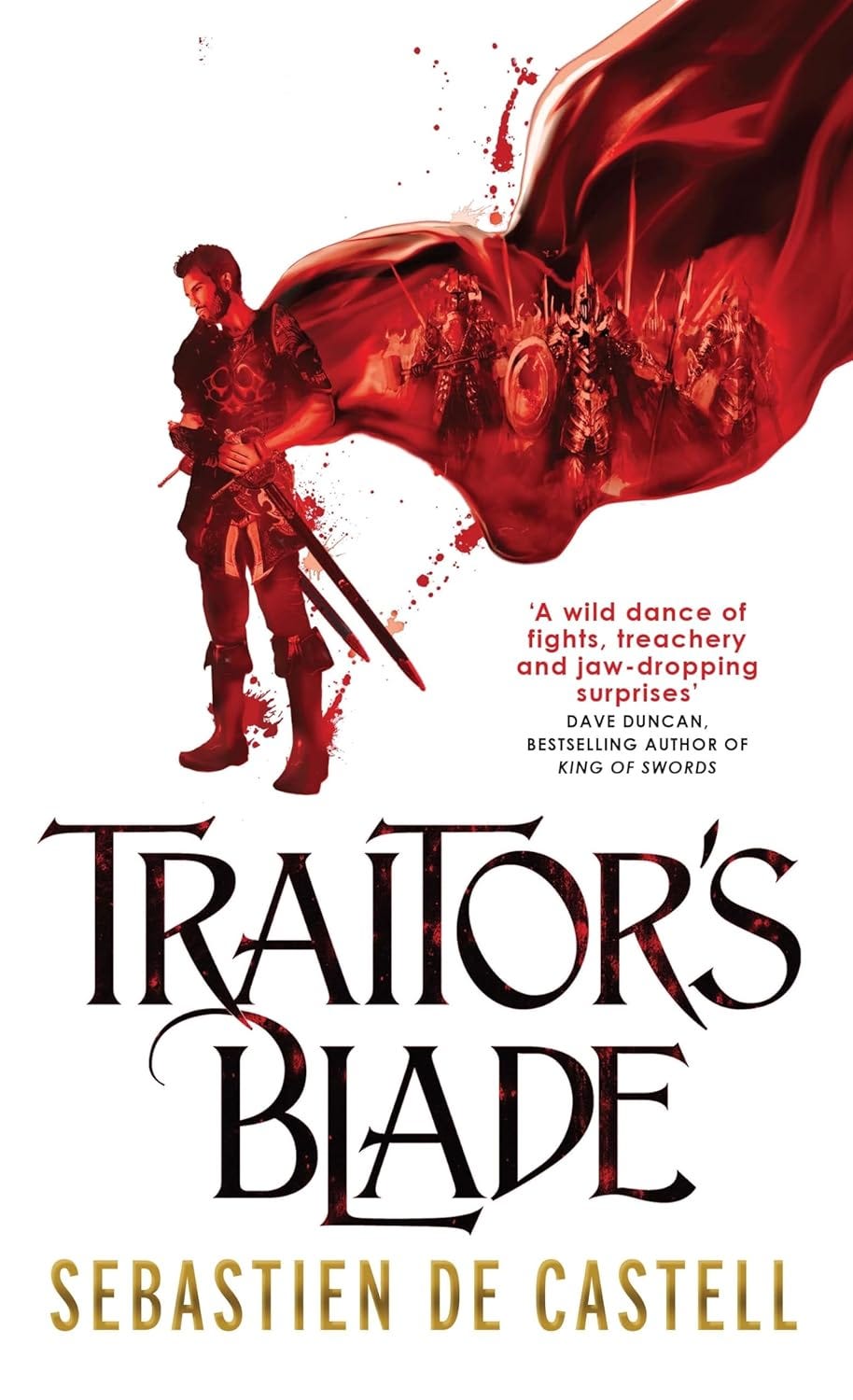
I have been working for some time on class designs for B/X Dungeons & Dragons. I recently published an article featuring the Swashbuckler and am working on one for the Greatcoat of Sebastien De Castell’s swords and powder fantasy series. The more I do this work , the more I realize that the special effects philosophy is as applicable to class design as it is to spell design.
In B/X, classes are mechanical frameworks. The Fighter gets a certain attack progression, certain hit dice, certain saving throws. These mechanics define what the class does in play. They don’t determine the fiction that surrounds that class in your specific campaign, or even at your specific table. A Fighter is defined by the fact that they are good at hitting things and surviving being hit , and that definition turns out to be generative rather than limiting, because an enormous range of fictional archetypes share those mechanical traits.
When I design new B/X classes, I try to apply the same discipline. Start with the effect. Work back to the cause.
The Swashbuckler class, as developed it, is built around a set of mechanical behaviors surrounding the particular relationship between mobility and combat. The class has a reliance on positioning and tempo rather than raw durability and a set of social abilities that reflect the class’s inherent flair. Those mechanics were defined first. The question “what is a swashbuckler, exactly?” Is it Zorro? D’Artagnan? Inigo Montoya? Jack Sparrow? Firefly’s Saffron? This was a question the mechanics answer in part, but don’t fully determine. The class is designed so that all of those characters could be played through it, each with different fictional coloring but identical mechanical structures.

The Greatcoat follows a similar logic. The Greatcoat is, at its mechanical core, a fighter-adjacent class defined by preparation, resource management, and improvisation under pressure. It has certain combat abilities, certain skills, a particular toolkit. It is Swashbuckler adjacent, but not exactly the same thing. What the Greatcoat is in YOUR campaign is determined at the table, not in the rulebook. Where De Castell’s are the fallen servants of the King, yours could be wandering soldiers of fortune, supernatural investigators, or revolutionary pamphleteers who are better at violence than they’d like to admit.
This is not a new idea in class design. It’s implicit in the best OSR work, and in the original B/X classes themselves, which are far more open-ended than their later editions would suggest. A Thief in B/X is a set of mechanical capabilities that could describe a pickpocket, a trained assassin, a spy, an acrobat, or a confidence artist, depending on what the player brings to the table. The rules don’t preclude any of those. The rules enable all of them by defining the mechanical space and leaving the fictional space open.
What the special effects approach gives us, in both spell and class design, is a usable principle for deciding where to stop. You stop quantifying when you have captured the mechanical effect. Everything after that is improvisation, and improvisation, when it is given clear mechanical ground to stand on is where the best moments in this hobby live.
What This Looks Like in Play
I want to close with a practical observation rather than a theoretical one.
The special effects approach is not primarily a design philosophy, though it is that. It is a table habit. It is the Dungeon Master asking “what do you want the spell to do?” before asking “which spell is that?” It is the player who says “I want to summon rats” getting to summon rats because the Dungeon Master knows that Spike Growth, described differently, is rats. It is the new class that gets used at a dozen different tables by players who make it look like completely different characters, all because the mechanics were defined clearly and the fiction was left alone.
When I am working on the superhero RPG that pulled me back to these questions, the same discipline applies. Superhero powers are mechanical effects. The spider-bite, the alien heritage, the experimental accident, the ancient curse, the rigorous training. These are special effects. The rules need to know what the power does. The fiction gets to decide what the power is.
That is, ultimately, the whole argument. The rules should be as precise as they need to be and no more precise than that. The imagination should have room to move.
Theronna Wolfmancer deserved her rats, and in my game she’d have had them.
What spells have you reskinned at your table? I’m particularly interested in cases where the reskin changed how players related to a class or a character — where the fictional presentation made a mechanical difference to how people played. Drop it in the comments.
A note regarding potential paid subscriber benefits: The Swashbuckler and Greatcoat classes referenced here are part of ongoing development for what I hope will become published Geekerati Zine (print and pdf). I am also working more on my own Black Powder Fantasy setting, Dar ul’Ilindith. It’s a world where the doors to Elfland are reopening and with them, magic and faith are returning to the world . More on both coming soon.
All posts on the Geekerati Newsletter are free and will never be behind a paywall. If you’d like to support my work here, please think about becoming a paid subscriber or making a purchase through the Amazon and DriveThruRPG links in my articles.
My favorite magic system is the spheres from Mage: The Ascension. Nine different effects (Location, Magic, Energy, Matter, Time, Spirits, Chance, Life, Mind) with the level determining the power of the effect. So a fireball could be just energy (strict heat); matter and energy (flame/lava/impact); location, matter, and energy (to make it appear somewhere else); and so on. You would work with the GM to determine what spheres at what levels would be needed for an effect that you describe.