Three X-Men, Fresh Out of the Box
I recently reviewed the single short book version of the Superworld setting that was released as a part of Chaosium’s Worlds of Wonder boxed set. Though Chaosium has released a lot of their older roleplaying games, that boxed set lies gathering dust on the shelf. When I mentioned I was working on that review in a post on Twitter (it will always be Twitter to me), Sandy Petersen responded that Chaosium sold the Worlds of Wonder name to the company that eventually released Teddy Ruxpin. I’m sure that Sandy meant trademark, rather than copyright, but the end result is the same. That result is that we’ll likely never see a 1:1 reprint of Worlds of Wonder. It’s too bad, because it’s a great game and due to its concision, it’s the best introduction to the Basic Role*Playing1 engine produced to date.
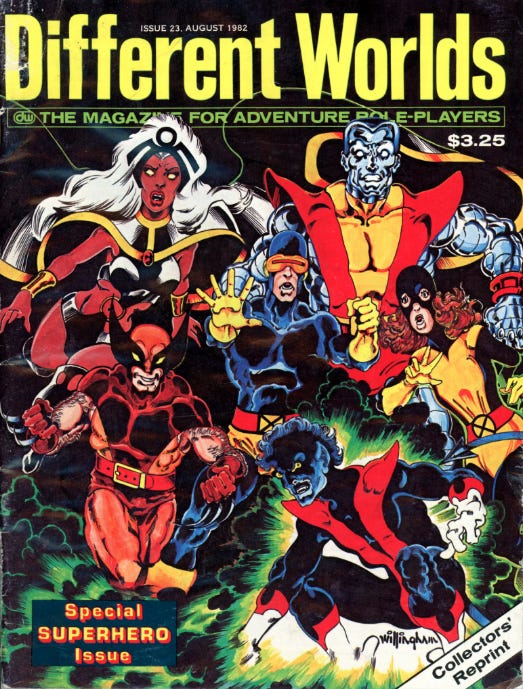
In that review of Superworld, I wrote that I would provide a short gaming supplement for the game in order to highlight how well the system works. Long time readers know that I consider the 23rd issue of Different Worlds (August 1982) magazine to be the single best issue of a gaming magazine ever published. This is in large part because of the rich content it provided for several superhero roleplaying games. It included reviews, errata, and even statistics for some of our favorite comic book characters, including Marvel’s now classic post-Giant Size X-Men lineup. It included stats for those characters for both Champions and the Worlds of Wonder version of Superworld. The Superworld stats were put together by Karl Maurer and have design notes by Steve Perrin, along with some pretty cool illustrations by Steve’s wife Luise Perrene. I’ve never understood the difference in spelling of the last name, but I strongly believe that Luise is one of the underrated artists of early RPG history.
Anyway, the statistics Steve and Karl provided presented the X-Men as experienced characters who had skills that had grown via experience to 80–90% over imagined years of play. The powers were paid for out of the actual combination of starting power points and disabilities, but I think there was a bit of stat fudging there to ensure characters could be emulated. Even though the powers are relatively modest compared to what they could have been, the characters presented in the issue are the veteran versions. This is especially odd for a character like Kitty Pryde who made her first appearance in X-Men #129 in January of 1980. That was a relatively short time before the Different Worlds issue was published and I’d like to present some “Young X-Men” that are closer to what players can expect to start a campaign with, rather than experienced versions. Assuming that skills have increased due to experience, means that more points would have been available for power purchases.
So, the three characters I am creating are the opposite of what Karl and Steve presented. These are merely seedling characters. Each X-Man was generated using only the rules presented in the book. They are RAW newbs where I didn’t estimate attributes beforehand and instead, rolled 3D6 down the line and added 3 to any score under 11 if appropriate. I took the total of the seven starting characteristics as the Hero Point total and spent them. Nothing on these starter character sheets comes from experience, or the assumption of experience. I wanted to create true starting characters. The characters will have the mutant powers of their comic book name sakes, but the characteristics are unremarkable and the skills sit near their Basic Role-Playing base. This does mean that the characters I am providing are not pure adaptations of existing characters, rather they are attempts to emulate characters within the constraints of the rules as written. I’m not worried about having high starting skill values, because skill growth is one of the benefits of actually playing in a campaign.
The results are every interesting. You can recognize the characters, but they are not iconic veteran versions. The rookie Cyclops I put together projects a 7D6 optic blast, which is very impressive, but not as impressive as the “official” 9D6 one. The rookie Wolverine’s claws are sharp, but he hasn’t developed all the durability, speed, or full suite of sensory powers that he gains as writers keep adding to his abilities. My rookie version of Nightcrawler can teleport himself and a little cargo a couple hundred meters, but there is no way he could teleport an entire car across a city block.
Rules Used
As I mentioned earlier, I designed the characters using the rules as written in the short Superworld setting guide. Here’s a quick breakdown of the rules, to give you a strong foundation for evaluating my feeble attempt to work within the constraints.
Characteristics: Attributes were determined by rolling 3D6 each for STR, CON, SIZ, INT, POW, DEX, CHA down the line, no roll then pick. If any score was under 11 I had the option to raise it by +3, but I didn’t have to do so. (The book also lets players scrap a hopeless spread and roll a new character, and I took advantage of that as you’ll see with Nightcrawler’s note.)
Total Hero Points = the sum of the seven characteristics (after the +3 option), plus bonus points from Disabilities. This is one of the rules I’ll change in my retroclone, but it was fun to play around with.
Hit Points = CON.
MOVE = 24 meters per round. I did not buy increased movement for any of the characters, except the teleportation for Nightcrawler. After all, none of these three characters fly.
Buying up a characteristic costs 1 Hero Point per point of STR/CON/SIZ/DEX; 3 Hero Points per point of INT/POW/CHA. The errata in Different Worlds #23 applies a cap that you can’t spend more Hero Points on a stat than its original rolled value at character creation.
Skills cost 1 Hero Point per +5%. I did not spend a lot of points on skills and kept it deliberately light here. These are rookies after all and will gain skill later via normal skill increase rolls. This is one area to minimize with new characters as spending points on powers is a ton of fun.
Damage bonus: I calculated damage bonus using the Magic World rules Perrin actually used rather than the damage bonus described under Size Change in the Superworld rulebook. My interpretation is that the Size Change modifications only apply to characters with that power. This means that a STR or SIZ of 15+ adds +1D6 to melee and natural-weapon damage, 31+ gives +2D6, and 46+ gives +3D6. I always used the higher of STR or SIZ and remembered that unlike later BRP games, they neither stack nor are they averaged. Martial Arts is a power and adds its own benefits separately.
Power and disability costs are taken from the Superworld booklet and the issue #23 errata. I bought touch-range “natural weapon” powers (Wolverine’s claws) using Kinetic Projection with no range, and following Perrin’s own discussion of Maurer’s Wolverine, I took both the STR based damage bonus and Martial Arts.
Each block lists the dice as rolled, then the build, so that you can see that every Hero Point is accounted for.
WOLVERINE (Logan)
Stats Rolled: STR 11, CON 8, SIZ 13, INT 8, POW 11, DEX 7, CHA 8
Stats (Post +3): STR 11, CON 11, SIZ 13, INT 11, POW 11, DEX 10, CHA 11
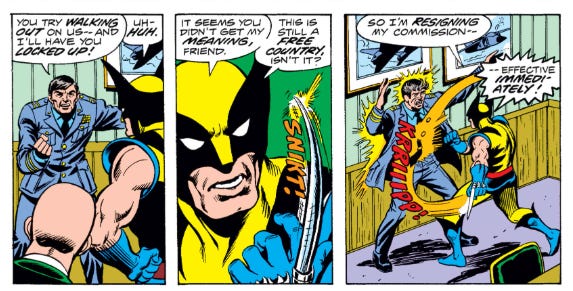
This was a very average spread. I used +3 option to lift CON, INT, DEX, and CHA to reasonable levels. In order to meet what I thought were Logan’s bare minimums, I did use Hero Points to increase some stats. The rookie Logan has the claws, the healing, and the sharp senses, but the conditioning, speed, and full suite of sensory powers that the veteran has are months or years of play away.
STR 15 CON 14 SIZ 13 INT 11 POW 11 DEX 13 CHA 11
Original Hero Points – 78 Total Hero Points – 98 (78 + 20 disability)
MOVE: 24
HIT POINTS: 14
ARMOR: Kinetic 2
ABSORPTION: None
ENERGY POINTS: Personal 60

POWERS:
Claws (Kinetic Projection, No Range, 2D6). Hero Points: 6
Martial Arts 1. Hero Points: 20
Regeneration 1: Hero Points: 13
Supersenses: Smell 1, Hearing 1, Vision 1, Touch 1, Infravision 1. Hero Points: 15 Armor: Kinetic 2. Hero Points: 2
Energy: 60. Hero Points: 6
Characteristics: STR +4, CON +3, DEX +3. Hero Points: 10
SKILLS: Fist 70%, Grapple 45%, Climb 70%, Listen 70%, Spot Hidden 50%, Move Quietly 45%, First Aid 50%, Dodge 65%, Hide 55%
DISABILITIES (bonus points):
Mutant, a hunted minority (5)
Berserker: must make an INT×2 roll or go berserk when a teammate is hurt or he is humiliated (5)
Loner, surly and insubordinate (5)
Claws function only at touch range (5)
SPECIAL: Regeneration restores 1 Hit Point per melee round while energy lasts. This is not the instant healing of the comics. His energy pool runs out at 60 and needs to be spent on a variety of actions. His senses are far keener than human, but he carries only five of the veteran’s seven.
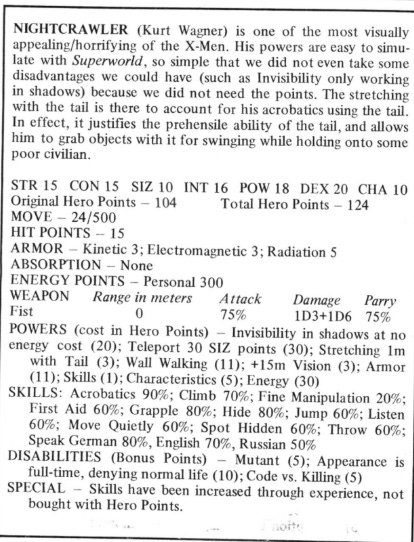
Compared to the Different Worlds #23 Version: In issue #23, Wolverine has CON 28, 4D6+2D6 claws, seven heightened senses, Speed for faster movement, Adaptability, Armor 9, and Recharge to get his Energy back quicker.
CYCLOPS (Scott Summers)
Stats Rolled: STR 11, CON 12, SIZ 6, INT 13, POW 13, DEX 13, CHA 11.
Stats (Post +3): STR 11, CON 12, SIZ 9, INT 13, POW 13, DEX 13, CHA 11.
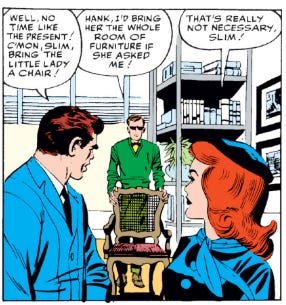
The +3 option lifts the tiny SIZ to 9, which explains why they called Scott “slim” in the early issues of X-Men when Professor X was in love with Jean Grey in highly inappropriate ways.
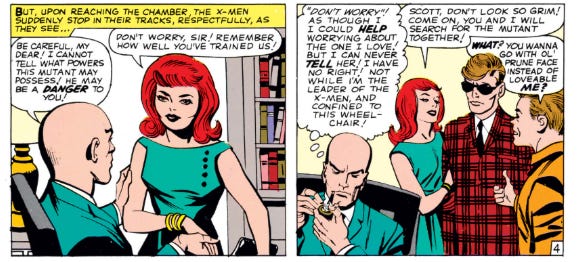
This is a slight and wiry Scott who will become stronger as he works out more in the Danger Room. He has good values for POW and DEX. I made the optic blast the primary focus of the character.
STR 11 CON 15 SIZ 9 INT 13 POW 15 DEX 16 CHA 11
Original Hero Points – 82 Total Hero Points – 102 (82 + 20 disability)
MOVE: 24
HIT POINTS: 15
ARMOR: Kinetic 3, Electromagnetic 3, Radiation 3
ABSORPTION: None
ENERGY POINTS: Personal 180

POWERS:
Optic Blast (Kinetic Projection 7D6, +15m range, to 30m). Hero Points: 21 + 3 Optic Blast Parry (Parry Armor 15). Hero Points: 15
Armor: Kinetic 3, EM 3, Radiation 3. Hero Points: 9
Energy: 180. Hero Points: 18
Characteristics: CON +3, POW +2, DEX +3. Hero Points: 12
SKILLS — Throw 70% (Throw is Used for Optic Blast Attack Base Roll), Acrobatics 30%, Grapple 45%, Climb 65%, Listen 60%, Spot Hidden 40%, First Aid 55%, Dodge 80%
DISABILITIES (bonus points)
Mutant, a hunted minority (5)
The optic blast is always on and uncontrollable without his ruby-quartz visor. This is a full-time condition that denies a normal life and endangers everyone around him (10)
Rigid sense of duty, compelled to lead and to follow the rules (5)
SPECIAL: Remember that the blast never switches off. Scott must wear the visor (or sealed ruby-quartz goggles) at all times. If it is removed or shattered, the beam fires continuously at full force until Scott passes out from lack of energy. The Parry Armor lets him deflect one incoming attack per round with a precise beam, on a successful parry roll. It operates as a parry per the rules, but with a cool special effect.
Compared to the Different Worlds #23 Version: The more veteran Cyclops fires 9D6 and has a 21-point beam-parry. He also has skill in Martial Arts. The rookie version one hits for 7D6, has a weaker but still potent parry, and hasn’t trained in hand-to-hand combat yet. He does already have all of the important signature abilities though.
NIGHTCRAWLER (Kurt Wagner)
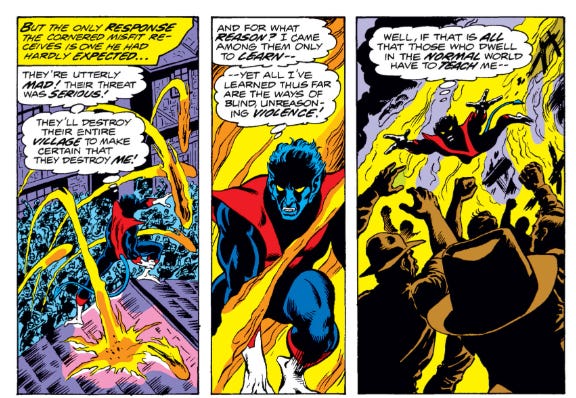
A note on my die rolls for this character. The first two spreads I rolled for this character included a DEX of 4. That’s right, I rolled 4 for DEX twice and while Nightcrawler may have lost out to Spider-Man in Secret Wars, this low DEX was unplayable for an acrobat. So, I allowed myself to scrap the rolls per the book (after all even a 7 DEX is too low) rolled a third fresh character. This time, I got a workable if weird spread.
Stats Rolled: STR 9, CON 17, SIZ 12, INT 13, POW 9, DEX 13, CHA 15
Stats (Post +3): STR 12, CON 17, SIZ 12, INT 13, POW 12, DEX 13, CHA 15
I felt a little guilty using the +3 option because it lifts his STR and POW, even as his other stats are VERY GOOD.
I ended up buying up a lot of DEX, because agility is Kurt’s angle…see what I did there?
STR 15 CON 17 SIZ 12 INT 13 POW 12 DEX 18 CHA 15
Original Hero Points – 94 Total Hero Points – 114 (94 + 20 disability)
MOVE: 24
HIT POINTS: 17
ARMOR: Kinetic 3
ABSORPTION: None
ENERGY POINTS: Personal 200

POWERS:
Teleport 16 (moves his SIZ plus up to 4 SIZ of cargo, up to 200m). Hero Points: 16
Wall Walking 14. Hero Points: 14
Prehensile Tail (Stretching 2l, 2m reach). Hero Points: 6
Invisibility 12 (only in shadow, no energy cost). Hero Points: 12
Leap 5 (+10m horizontal/+5m vertical). Hero Points: 5
Armor: Kinetic 3. Hero Points: 3
Supersenses: Vision +15m. Hero Points: 3
Energy 200. Hero Points: 20
Characteristics: STR +3, DEX +5. Hero Points: 8 (I know he’s not all that strong, but I wanted the extra damage, and he didn’t have enough points for Martial Arts).
SKILLS — Acrobatics 30%, Climb 70%, Hide 75%, Move Quietly 45%, Jump 60%, Fine Manipulation 20%, Grapple 40%, Throw 55%, Dodge 90%
DISABILITIES (bonus points)
Mutant, a hunted minority (5)
Demonic Appearance: blue fur, fangs, tail, glowing eyes; full-time, cannot pass as human, denies a normal life (10)
Code against killing (5)
SPECIAL: At this time, Kurt must see or clearly know his destination to teleport. He cannot attempt blind jumps and arrives in a sulfurous puff of displaced air, which can give away his location. His shadow-blending only works where there are shadows to use because it is due to his fur. While it’s not in his skill set, because this is early BRP and not later iterations of the game, he is a native German speaker.
Compared to the Different Worlds #23 Version: The veteran version of Nightcrawler teleports up to 30 SIZ points, which is very potent indeed. He can vanish completely in shadow at no cost and has Acrobatics 90%. My version moves himself and a little cargo and tumbles is very much a rookie acrobat at 30%.
How They Grow Up
One of the great things about Basic Role*Playing experience system is that every time you successfully use a skill in play you get to roll to improve that skill after the game session. This is supposedly how the issue #23 versions reached their 70–90% skill values. Players can save or earn new Hero Points to buy the rest of the missing abilities over time. After he buys another level of Regeneration, Wolverine will start shrugging off wounds mid-fight. An additional two dice of Optic Blast damage and Cyclops is blasting through walls like no one’s business. Buy a couple dozen more levels of Teleport and Nightcrawler is Bamf-ing the whole team across the city, or even into space.
I think these are a pretty good start. What are your thoughts?
I prefer to use the term Roleplay, but the game was originally released as Basic Role*Playing.