


Pre-Review Ramblings
I’ve long been a fan of D&D media tie-in fiction and a part of me is sad that there is so little new fiction being written for the line. I reviewed Ravenloft: Heir of Strahd earlier this year and I thought that Delilah S. Dawson put forth a good faith effort to produce an entertaining story. She tried to balance body horror, Gothic horror, traditional fantasy, and the modern Critical Role D&D party. Overall, the experience was enjoyable, but it’s certainly not the book for everyone.
![Which Way Ravenloft: Heir of Strahd? Horror or Whimsy? [Book Review]](https://substackcdn.com/image/fetch/$s_!CtST!,w_140,h_140,c_fill,f_webp,q_auto:good,fl_progressive:steep,g_auto/https%3A%2F%2Fsubstack-post-media.s3.amazonaws.com%2Fpublic%2Fimages%2F1170d529-1bbc-48c0-9857-700d9ce3ea52_1500x1500.jpeg)
I am currently reading the first two volumes in The Fallbacks series, which leans pretty heavily in the Critical Role direction. That tone isn’t for everyone and that’s what prompted me to pick up the keyboard and write this piece. That Wizards of the Coast is publishing a couple of series that appeal to only a segment of their fanbase wouldn’t be a big deal if they were producing books like they used to. When you are only publishing a handful of books a year, hitting only one segment of your fanbase isn’t the best planning. Last year saw the publication of Ravenloft: Heir of Strahd, The Fallbacks: Dealing with Dragons, and Drizzt: The Finest Edge of Twilight. This year we’ve seen the publication of a new Dragonlance novel called War Wizard and a romantasy called The Feywild Job.
I’m not throwing any shade at the fact that Wizards is publishing the Critical Role-esque and romantasy books. Those have an audience and that audience wants books, so a publisher should publish them. What I am throwing shade at is the dearth of books being published by Wizards of the Coast. There was a time when TSR published over 240 D&D-related novels. Sure, TSR went bankrupt, but as James Lowder (who was one of the key editors during the golden years of D&D media tie-in fiction) told Ben Riggs for his book Slaying the Dragon, the fiction was a money maker. It was Dragon Dice and Dragon*Strike (as much as I love both) that helped seal TSR’s fate. They overprinted Dragon Dice on the second printing and Dragon*Strike was expensive to produce and did not sell well. In fact, many of the boxed sets TSR was selling back in the day cost more to make than they were selling for.
The explosion of books resumed when Wizards of the Coast released 3rd edition and continued all through 4th edition. I was easily reading two D&D books a month for a couple of decades and so many of them were excellent. There are some fantastic Eberron, Forgotten Realms, Dark Sun, and Greyhawk novels out there. Sure, not every novel is a banger, and not every novel is for me, but there were so many that there was always something I wanted to read. There was something for everyone and I wish they’d go back to that model. Yes, publish the books you are currently publishing, but publish MOAR!
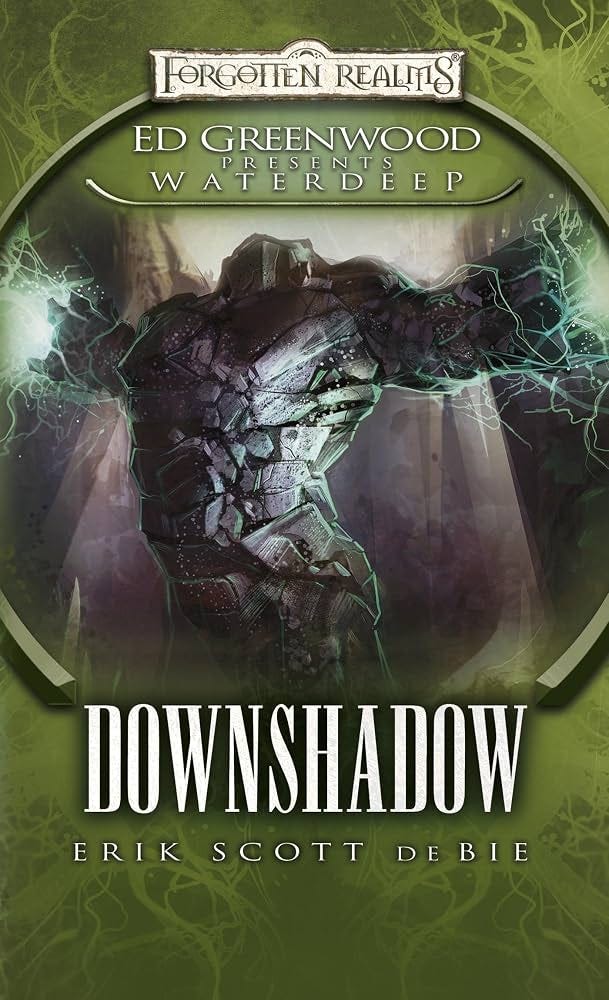
Which brings me to why I am sharing a retro-review. Back at the transition from 3rd edition to 4th edition D&D, there were a number of fun books that were published and many of those got overlooked. Heck, maybe their lower sales (and I don’t know that their sales were low) are why we have fewer and more targeted books today. One of the books I very much enjoyed from that era was Downshadow, a tale that is essentially D&D Paladin Batman, and here’s my retro-review of the book.
The Retro-Review
The Forgotten Realms, where Erik Scott de Bie’s 2009 novel Downshadow takes place, began as the brainchild of game designer and author Ed Greenwood long before there was a game called Dungeons & Dragons. The Forgotten Realms was Ed Greenwood’s fantasy world, a world he wrote stories for and for which he eventually wrote several articles in Dragon magazine. By the late 1980s, the Forgotten Realms became one of the major core settings for D&D and there have been tens of thousands of pages devoted to its characters, its unique rules, its mythology, and its history. One can easily get lost perusing the Forgotten Realms wiki.
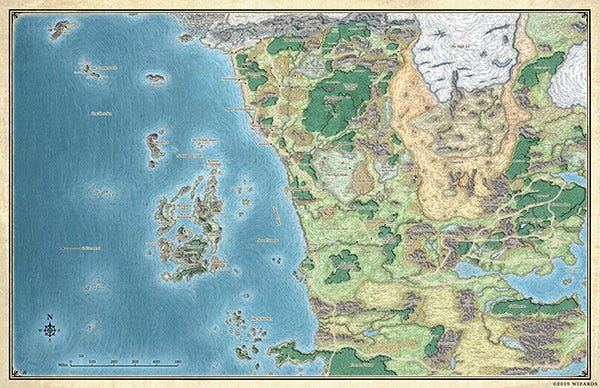
Downshadow takes place in one of the major cities of the Forgotten Realms world, a city called Waterdeep. Since the God of Murder and Strife (Cyric) killed the Goddess of Magic (Mystra) nearly a century ago, the Realms have been a place of chaos and despair. With Mystra’s death, the Weave of Magic that surrounded the world shattered and much of it fell to earth (Toril), infecting the world and its residents like a disease in an event called the Spellplague. This event, and others, changed the world forever. Many of the great heroes who once protected average citizens have died or been driven mad in the ensuing years. Waterdeep, a once great and wondrous city, was badly affected by the Spellplague, both in terms of physical destruction and in becoming a refuge for those who were cursed by the Spellplague. These cursed individuals now live in a part of the city called Downshadow, a city that lives under the city of Waterdeep. Strange and dangerous things lie all around Downshadow in the form of monsters and traps of ancient magic, but strange and dangerous things live in Downshadow as well. Where there is civilization, there is crime, and where the shadows are deep, the criminal element is even more powerful.
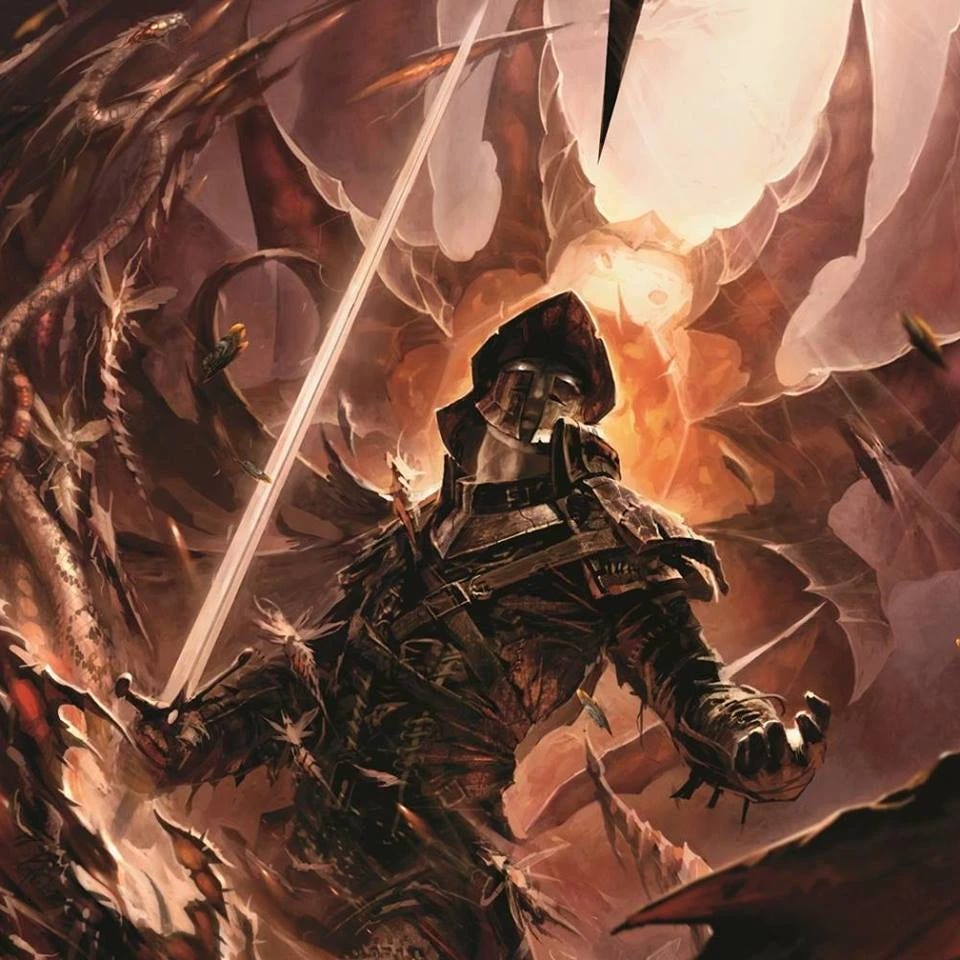
The city watch of Waterdeep has formed a special Guard unit that is given the duty of protecting the citizens of Waterdeep from the dangers of Downshadow and of protecting the citizens of Downshadow, but even they cannot do enough. Aiding the brave members of the watch is a troubled vigilante named Shadowbane — the main character of Downshadow. Shadowbane was once a beggar, thief, and murderer who had been both blessed and cursed by the Spellplague. He heals faster than most people and has near superheroic strength, agility, and stamina. He used these abilities for evil purposes in the city of Luskan until he met a Paladin who gave him faith in a higher purpose and who provided the young man with a legacy. Shadowbane went from a dark stalker on the edge of society to a shadowy vigilante who used his knowledge of how the criminal elements operate to combat them where they hide.
As one can imagine from the description above, Downshadow is a combination fantasy and superhero adventure tale that owes a good deal to many prior stories. Reading the novel one can see the influence of Zorro, the Scarlet Pimpernel, and Batman. Like the tales of these heroes, Shadowbane hides his real identity from many of those he loves and strives to balance his bloodthirsty nature against his need to provide justice for and not vengeance to those he hunts. The Spellplague has given him power, but it is also slowly killing him and removing his ability to feel physical sensations. This phenomenon is symbolic of his own growing emotional distance from those around him. If he wants to atone, Shadowbane must learn to love and protect others and not just hide in shadows and avenge past slights. And it is in the narrative of Downshadow that Shadowbane must make this choice.
The story of Downshadow is fairly simple. There is a criminal mastermind in town who wishes to stir up chaos in the aristocracy of Waterdeep and expand his influence. To do this he uses his provocateur protégé Fayne to create scandalous situations and reveal the secrets of those who wish their secrets kept. He also hires an assassin named Rath to eliminate those he cannot ruin. He seeks to ruin the High Priestess of Sune and to destroy Shadowbane, whose vigilantism interferes too much with his machinations. Shadowbane must do his utmost to oppose the plans of the mastermind while discovering who he really is and what his true purpose will be. Into this struggle enters a mysterious young woman named Myrin. Myrin appears out of nowhere and has no memory of her own past, but it seems that she too has been touched by the Spellplague (or has she?) and given abilities she cannot truly control.
Can Shadowbane stop the plans of the mysterious mastermind? Can he protect those he loves? Can he keep his secret hidden? Can he meet his destiny?
These are the questions that work themselves out in the novel, and the answer to the above questions isn’t always yes.
Erik Scott de Bie meets the challenge of writing a compelling story while working within the constraints of a media tie-in novel. Though the tale is based on a D&D world, one rarely sees game mechanics leak into the storytelling. A major challenge a writer in a D&D novel faces is making the magic and action feel like the D&D setting without making it seem too much like a reader is reading mechanics out of a user’s manual like the Player’s Handbook. De Bie demonstrates a deep knowledge of the Forgotten Realms setting and infuses the narrative with bits of history and mythology where necessary. Reading Downshadow, I very much felt that the story was taking place in a larger world that had a rich history. De Bie was able to convey information about Shadowbane’s heretical Paladin order and the origins of the Spellplague without the information seeming overly expository. The exposition is presented narratively and only when necessary. The story is compelling and the outcome open enough to leave a reader wanting more. Shadowbane himself is a bit of a cipher, but his character does grow as the story progresses. He starts as a generic superhero, but by the end of the book readers are beginning to see the personality behind the mask. I am eager to cover how the character further develops as I reread Shadowbane and Shadowbane: Eye of Justice in the coming months. Many likable characters die in the story and there is a cameo or two from other Forgotten Realms tales that provide nice Easter eggs.
The only flaw with the novel is that the narrative sometimes jumps from one scene to another in a mildly awkward way that caused me to double back and reread past passages to make sure I didn’t miss any information. Given the breakneck pace of the book, this slight speed bump interrupted the flow of the story.
De Bie got his break in 2005 with Ghostwalker because Wizards needed books to publish in their massive pipeline. I’m glad I read Downshadow and I wish Wizards would go back to publishing a couple of books a month instead of a couple of books a year.
Post-Review: Let Me Tell You About My Character
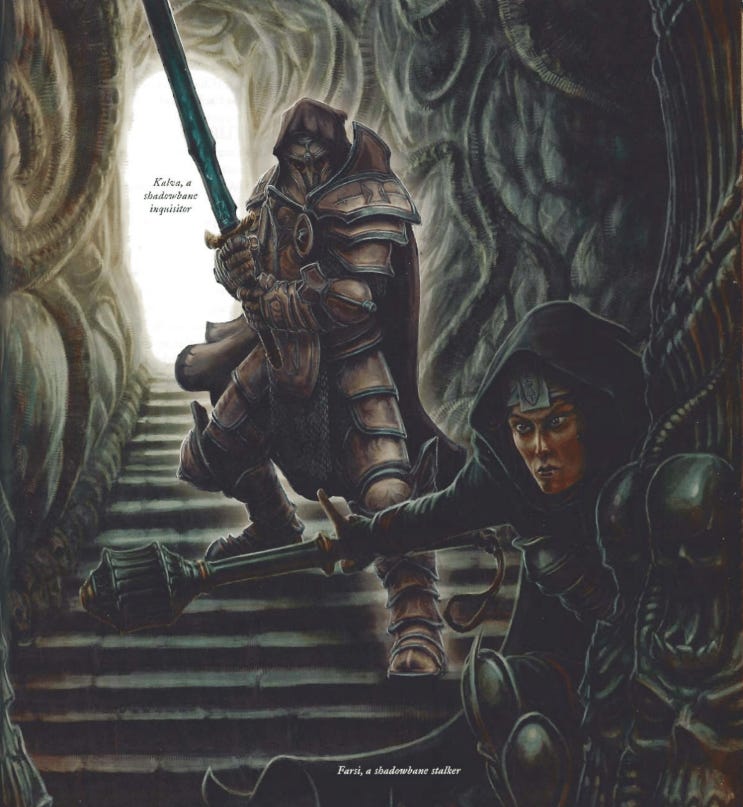
The Shadowbane character is based on either the Shadowbane Inquisitor or Shadowbane Stalker prestige class from the Complete Adventurer book for the 3.5 edition of Dungeons & Dragons, though there are some significant differences. One of those differences is that Shadowbane’s sect is heretical. It believes that the essences of two dead gods are still active in the world, rather than the accepted belief that a single god now has control of the “portfolios” of the dead gods. Gods dying and being replaced has been a part of the Forgotten Realms, for good or ill, since the transition from 1st to 2nd edition when some of the world’s gods were killed to explain why Assassin was no longer an official class in the game (among other things).
I think one of the things I liked about Shadowbane was that he reminded me of a fusion of the only two characters I have ever played in Forgotten Realms campaigns. The first was a 2nd edition AD&D Paladin of Tyr who had the Swashbuckler kit from The Complete Fighter’s Handbook. How could one not want to be able to specialize in four (FOUR!!!) weapons?! Not only was this possible for a Swashbuckler, but it was also required. Awesome. I have always been a fan of Zorro, the Scarlet Pimpernel, and the Three Musketeers, so I really wanted to play a happy-go-lucky swashbuckling Paladin. Since Paladins had been typically portrayed as humorless, this was fun.
The other character was a Fighter/Mage/Thief I played in a Forgotten Realms-based RPGA Living City campaign, also under 2nd edition AD&D. The character had a “secret identity” as a fop who investigated troubles with his brave companions, only to flee suddenly when the going got tough and let his “bodyguard” take care of all the meaningless little things like combat. The bodyguard was always mysteriously lurking in the shadows, waiting for the moment to trade places with his employer. This character required buy-in from my group, who had to separate character knowledge from player knowledge. Some tried to “cheat” to discover my secret or demonstrate that they “knew” my secret, but most of them discovered it made for better roleplaying moments, humorous and dramatic, to play along. Thus, some of those who once “knew” my secret eventually “forgot” as well when they discovered how much fun ignorance could be.
That’s right, I committed the most heinous of gamer sins and “told you about my character.” If you don’t mind, I’d like you to tell me about one of yours.