


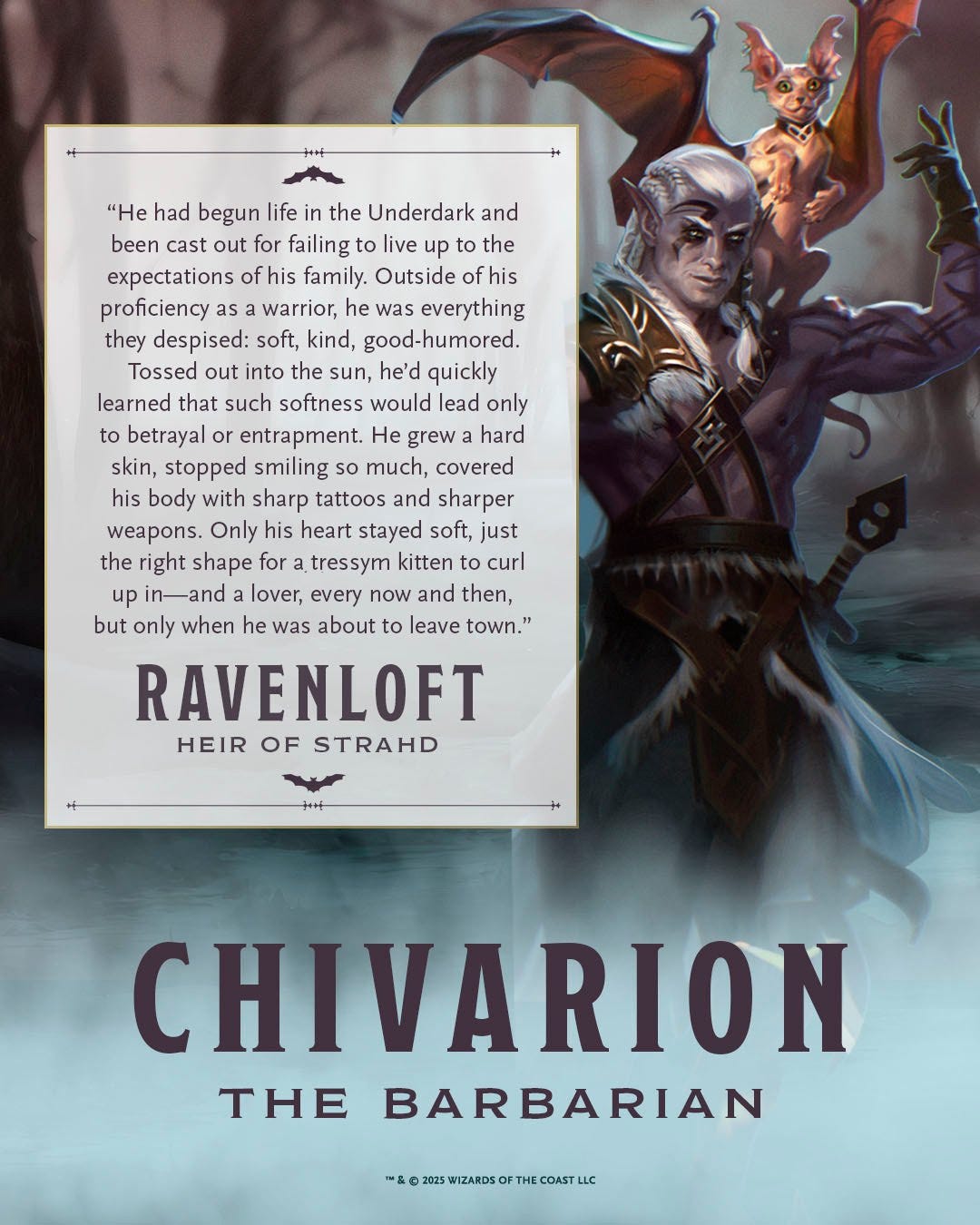
“Faster, Murder! Kill! Kill!”
- Chivarion in Ravenloft: Heir of Strahd

TL;DR of the Review
If you got the reference in the quote from Chivarion above (Murder is the name of Chivarion’s Tressym), and you don’t think it’s cringe, then this is the novel for you.
You can purchase Heir of Strahd at Amazon.com or at The Mysterious Galaxy Bookstore.
This review will be a review of whether or not you should read the book (and that answer is above) and not a synopsis or plot description driven review.
Introduction
Media tie-in fiction is an interesting and challenging environment for an author to ply their trade. When you sign the contract, you are signing on to a number of narrative restrictions because whatever you write has to fit a pre-existing setting. Add to this the fact that fans of the setting will enter any reading of fiction by a new author with skepticism as they wonder if it is written by a real fan or a tourist. After dealing with those tough critics, you have the knowledge that no matter how good the result of your efforts are, you are unlikely to receive any literary praise for your effort.
Screenwriter Zack Stentz’s recently published a Twitter (yes, it’s always going to be Twitter) post asking “What if someone wrote the Great American Novel, but it was like…a Star Wars novlization?” It spawned some interesting conversation and highlighted a couple of excellent media tie-in novels like John M. Ford’s The Final Reflection (if you haven’t read Ford’s The Dragon Waiting, you should and since this is a review of a vampire book it even fits), Timothy Zahn’s Thrawn Trilogy, and Dan Abnett’s (the real creator of the modern Guardians of the Galaxy) Eisenhorn series. As long as the list was, there was only one Dungeons & Dragons related novel recommended, Laurell K. Hamilton’s Death of a Darklord.
I was surprised at the dearth of D&D because a lot of my favorite media tie-in fiction has been published by TSR in support of the Dungeons & Dragons role playing game. One of the smart choices that TSR made back in the day was to create multiple lines of fiction to support their role playing game lines. They didn’t always treat their authors with the respect they deserved, but under the guidance of some excellent editors (Jean Blashfield Black and James Lowder to name only two) they published a number of good to excellent novels. While the first Dragonlance trilogy had weaknesses, especially in the first volume where you can hear the dice roll from time to time, the second trilogy (Dragonlance Legends) demonstrated that Margaret Weis and Tracy Hickman were able to escape Tolkien clone-ville and develop new creative ideas. The Sembia Series, in particular Paul Kemp’s Erevis Cale novels, is quite good Sword & Sorcery fiction. No discussion of D&D media tie-in fiction would be complete without discussing R.A. Salvatore’s Drizzt stories, which are rip roaring fun.
Of all the fanbases out there, Dungeons & Dragons fans can be among the most critical and that is especially true in the modern era when a corporate focus on return on investment over quality product production damaged the brand significantly. Agreeing to write a novel at a time like this, especially when that novel would feature characters that were, in part, offered up by the Wizards of Coast team who wanted to make sure that the book didn’t feature a “heavily human party,” is an act that is almost inviting criticism. Especially when the novel you are agreeing to write is the first Ravenloft themed novel to be published in two decades.
D&D Wasn't "Under Monetized," but Belief that it was Probably Hurt the Brand

The Hollywood Reporter recently reported that Hasbro’s year-end financials presentation to shareholders showed that the company had posted a HUGE loss in the 4th Quarter of 2022. The loss was so bad …
Delilah Dawson embraced that challenge, including sinking her teeth into the idea of including a Kenku (bird person) character in a key role, and the end product is a novel that hopes to be the foundation for a new line of Ravenloft novels for fans new and old. The novel is Ravenloft: Heir of Strahd, and in many ways it was written as a replacement introduction to the setting for 1991’s Vampire of the Mists. Is it successful? In what ways is it successful? Who was it written for? Those are all questions that will be answered in this essay.
Transparency Before the Review
Before I get deep into the review… I know, we are deep in the post and haven’t even started the review yet, but hear me out. Before I get deep into the review, I’d like to add a bit of transparency. I’ve met Delilah Dawson in person. She probably doesn’t remember me, but I remember the meeting and have a very positive opinion of her and her sincerity in geek fandom. The meeting happened at Comic Con when she was working the booth next to my friend Doc Wyatt. I wandered over to chat with Doc and Kevin Burke (his writing partner) about Iron Man: Armored Adventures, Avengers: Earth’s Mightiest Heroes, and Ninjago, all of which they’d worked on, and to chat with Doc about his new comic book/graphic novel. I can’t remember whether Doc was promoting his The Witchfinder General book or Alien Bones, both of which are worth your time, but I do remember that as we were talking Delilah walked over and joined in for what was a great conversation. Four geeks having a great time at a smaller publisher booth at Comic Con.
As a final, for now, aside, let me tell you that smaller publisher booths and the Mysterious Galaxy panels were the best kept secrets of Comic Con. Terry Gilman, Maryelizabeth Yturralde. and Jeff Mariotte helped put together some of the best Fantasy/SF panels of any convention I’ve ever been to and provided fans the opportunity to have Q&As with writers like George R.R. Martin without the horrors of Hall H. Yes, that means that I went to a room with maybe 20 people that had Martin on a panel the same year that there was a huge line to see him from the rafters in Hall H. That’s how cool the Mysterious Galaxy panels were. I haven’t been to Comic Con since 2019 because…well…I moved to Idaho.
The Review Proper
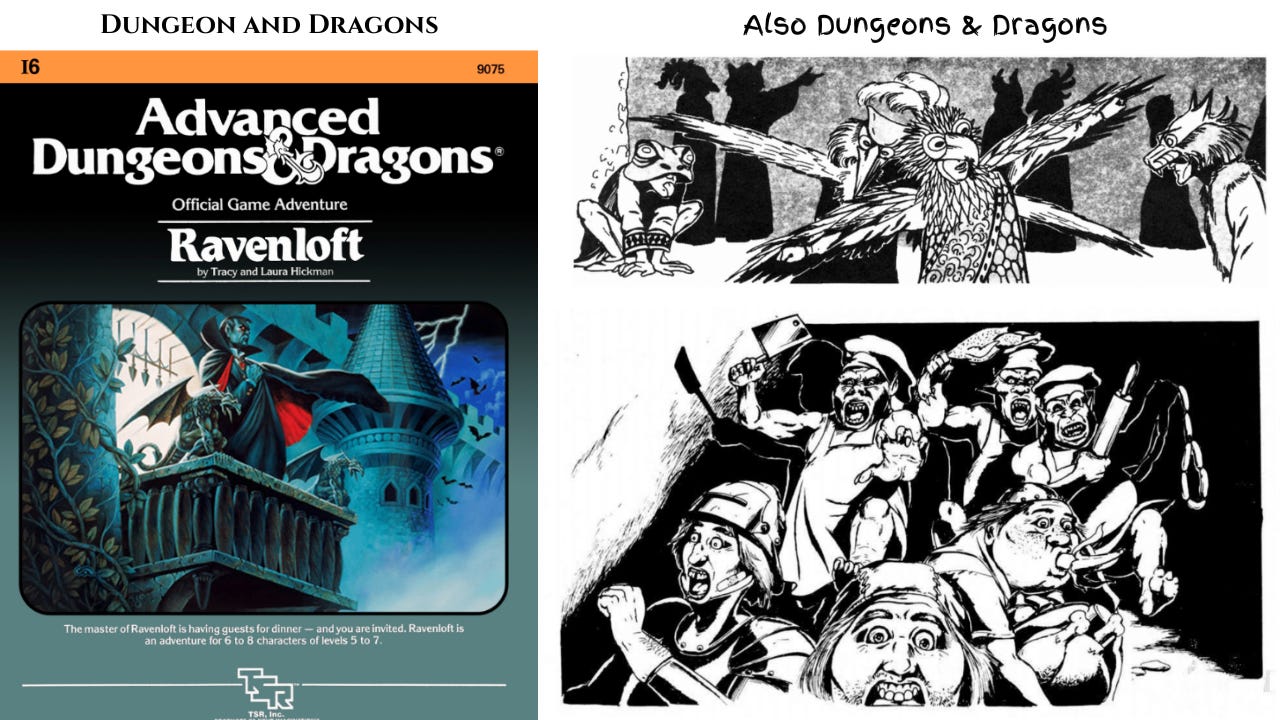
When TSR launched their Ravenloft line of fiction, the company had already been publishing fantasy novels for almost a decade. This included direct media tie-in fiction like Dragonlance, but also included non-game related books like Nick Pollotta and Phil Fogio’s Illegal Aliens. The company was an established publisher with numerous New York Times Bestsellers to its name. The author they selected to write the first Ravenloft novel was an inexperienced novelist named Christie Golden who pretty much knocked it out of the park with her novel Vampire in the Mists. Golden’s novel had a character from the Forgotten Realms setting, at the time the core setting for 2nd edition AD&D, and transported him into the Mists of Ravenloft.
Christie’s book accomplished every goal that had been set for it. It sold well. It provided a wonderful introduction to the Ravenloft setting that was made richer by not assuming readers had played the Ravenloft gaming module that inspired the setting, even as it has deep connections to that adventure. The novel was serious in tone and drew heavily from the Hammer films that inspired Tracy Hickman to write the original module. In doing so, it set the tone for future Ravenloft novels.
The choice to write a serious Gothic inspired horror novel that tied into the Forgotten Realms was the right choice, but it wasn’t the only choice that could have been made. Dungeons & Dragons, the game, has frequently alternated between the very serious and the silly. The common joke is that every D&D campaign starts out thinking it’s going to be Lord of the Rings, only to become Monty Python and the Holy Grail. As serious as the Moonshae Forgotten Realms Series was, Ed Greenwood’s Spellfire books had significant moments of whimsy and (before they were bowdlerized) more than a dash of Benny Hill. There’s a moment in Spellfire when they are fighting a Dracolich and one of the characters uses a spell attached to his shield to allow him to fly. That sounds epic, right? Well, the shield flies and he kind of dangles from reinforced straps. It’s more realistic, a bit humorous, and…okay…still epic. The point is that D&D always has to balance between serious and whimsical.
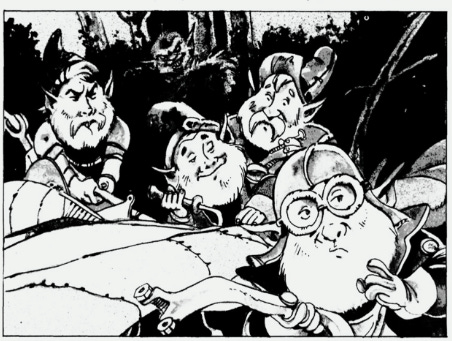
During the 1990s, the majority of fiction and adventures tilted toward serious in both the Forgotten Realms and Ravenloft. In my beloved Mystara? Whimsy all the time. So much so that there’s a supplement about biplane using gnomes fighting dragons called Top Ballista. When 3rd edition came out in 2000. the entire line shifted serious.
The current era of game play has evolved from the very serious 3rd edition era and more closely resembles the 2nd edition era which alternated between serious and whimsical. You are as likely to play in a grimdark campaign as you are to play in one inspired by the silliness of Critical Role. I think a major reason for this is that the media that influences gamers has changed over time. Gygax was influenced by Robert E. Howard, but he was also influenced by L. Sprague deCamp and Fletcher Pratt’s Harold Shea novels. Monte Cook and crew, the 3rd edition team, focused more on Howard and Moorcock than deCamp and Pratt. The 5th edition team is bringing in more media into the mix and you see elements of Sam Raimi (Army of Darkness an Xena) and Joss Whedon (Buffy, Angel), as well as a ton of Anime…and no small dose of Monty Python. Add to this mix the influence of the AD&D and Forgotten Realms comic books published by DC Comics and you’ve left grimdark in the dust.
This is the milieu (gygaxian word 101) in which Delilah Dawson had to choose an approach to use in writing the first in what the publisher hopes is a line of Ravenloft novels. The modern Forgotten Realms are very Critical Role in feel, so what should a book that takes characters from the Forgotten Realms and launches them into the Mists of Ravenloft look like?
Dawson, and the team at Wizards, decided on a somewhat mixed approach. The main party of characters would be evocative of the modern Forgotten Realms and the latest Dungeons & Dragons movie and would feature a Kenku, Half-Orc, Tiefling, Human, and Drow. That’s right, only one human in the mix and that’s the Artificer character. These characters have personalities that are very Whedonesque and reminiscent of the characters in the long running Buffy the Vampire series. Each of them has some dark past elements, but most of them also have an ironic layer retained from their time adventuring in the Forgotten Realms.
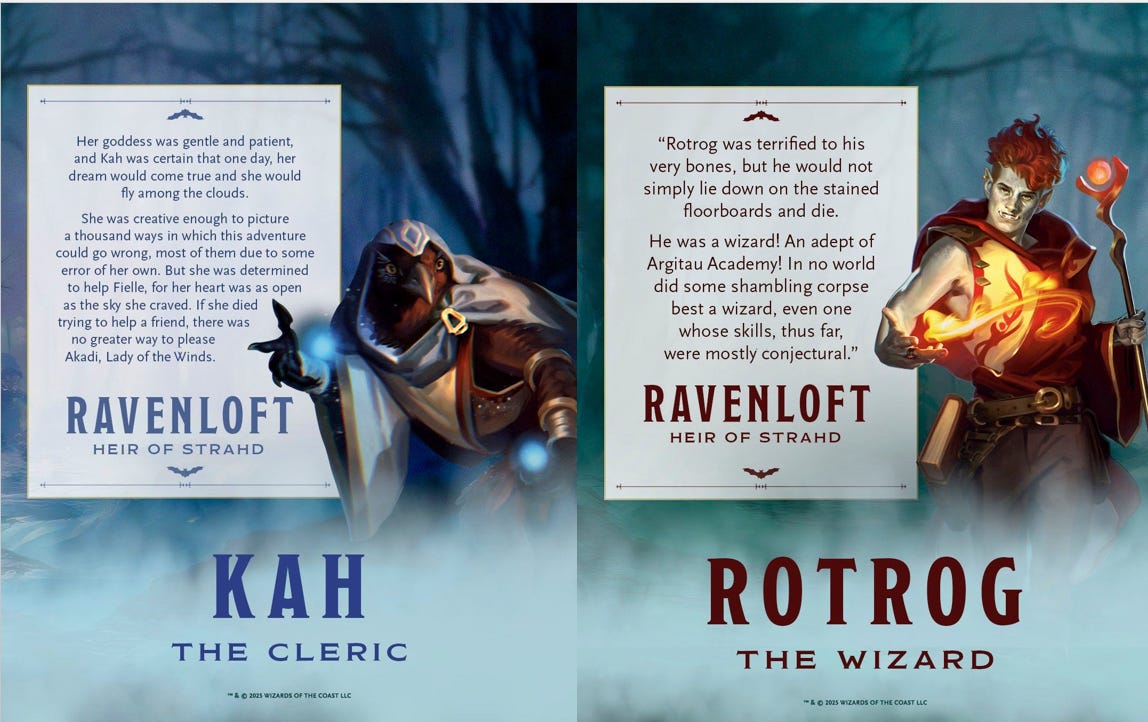
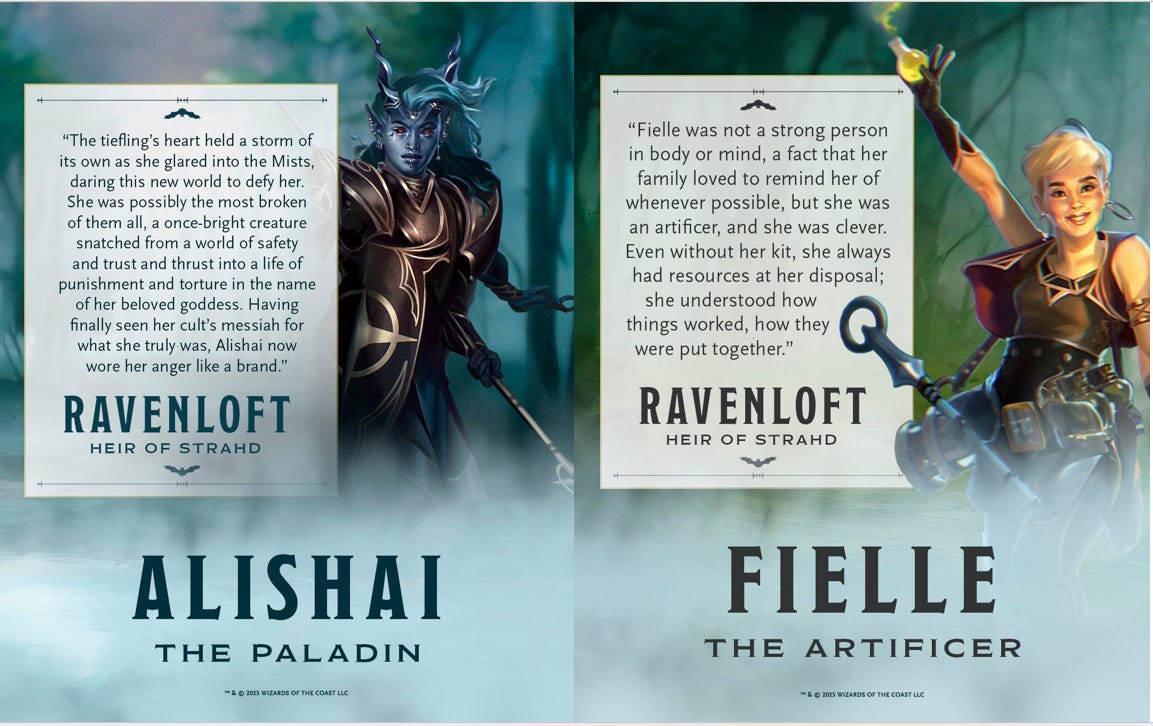
These characters, however, are tossed into a horror story that is a mix of Hammer era and modern horror. Dawson uses the newer module House of Strahd as a basis for the structure of the first half of the novel, and if you are paying attention is even map accurate which was kind of cool, but there are moments of near body horror as well.
When the characters arrive, they have a pretty horrific encounter at a Cabin in the Woods. Inside the Cabin, which was clearly either an Inn or Butcher Shop, there are a number of butchered pig carcasses that were being prepared for eating. Only one small catch, they are now undead zombie pig carcasses that attempt to envelope and smother the protagonists. It’s a pretty creepy moment and it was at that point that I began to understand that Dawson was trying to balance the lighthearted Critical Role and Dungeon Meshi expectations that a modern gamer might have with the darker old school elements that Ravenloft fans might desire.
She was aiming at the unicorn of horror fiction, the PG-13 horror comedy. When I say unicorn, I mean it. I’m a big fan of the genre, which includes Happy Dead Day and Drag Me to Hell, but it’s not the biggest box office draw in general. Audiences love horror and they love comedy, but they don’t always love horror comedy…particularly PG-13 horror comedies. I don’t know what it is about modern audiences, but they seem to want everything to be R…even when it would be better at PG-13.
Dawson has a background writing horror novels in addition to media tie-in fiction and she tries to combine both those skill sets in Heir of Strahd. It’s a very difficult balances, and for the most part Dawson does very well with the balance. When she fails, and there are a couple of eye roll moments in the read, it’s the fault of the Wizards of the Coast team and not her writing. The most cringe moment for me took place in the second part of the novel during a piece of exposition regarding one of the Ravenloft realms, but it was modern canonical and Dawson wasn’t the one who chose that particular bit of lameness to be a part of the setting. Overall, the balance of humor and horror hit the right notes from me and I really appreciated it when Chivarion the Barbarian (who I totally think of as a Ranger) tells his Tressym companion to attack a foe by saying, “Faster, Murder! Kill! Kill!”
You see…as anyone who’s played Baldur’s Gate 3 knows, a Tressym is a catlike creature with wings and so he was really saying “Faster, Pussycat! Kill! Kill!” and…if you have to explain a joke the explanation is never funny, but since it’s one of my favorite cult films, I really liked the reference. It was a moment that won me over as a reader.
In addition to balancing tone, Dawson had to balance the tension between presenting an entertaining narrative with the obvious mission on Wizards’ behalf of introducing the “geography of the Domains of Ravenloft” and I don’t know if Dawson succeeded or not. Since the main villain of the story is Strahd von Zarovich, we spend half the novel in the Domain of Barovia and this part of the narrative is natural and the story and geography are tightly aligned. It is when the protagonists go on their mission to Lamordia (and leave Dracula-land for Frankenstein-land) that narrative begins to take less precedence and a need to provide a dungeon crawl and geography dump take over.
The shift away from Adam (the creation of Dotor Victor Mordenheim) to Viktra Mordenheim as the Domain’s Dreadlord was an odd choice when Wizards first made that choice and it becomes more obvious here. As interesting as the environmental details are, and I loved the Rust Monsters on the beach, the Dreadlord’s backstory was far more of an info dump than an integrated part of the story. Though the fact that the mission (aka dungeon crawl) that the protagonists go on is essentially Scooby Gang raids Stuart Gordon’s Re-Animator lab was pretty cool. The tonal balance here shifted away from horror and more toward desperate action with moments of comedy. The reason for the mission was good, as was the objective, but I could almost here the DM drawing the map here. This section felt more like a D&D session than a novel.
Okay, the Protagonists are Whimsical but What About Strahd?
Dawson approached the classic villain Strahd von Zarovich with reverence for canon, but also without a desire to write a pure pastische. It is clear that she wanted to write a Strahd that was familiar to those who play 5th edition Dungeons & Dragons while drawing on the lore from the 1st and 2nd Edition eras of the game. You can find evidence for this in the interview she gave on the Wizards of the Coast website. In that interview, she discusses her approach to capturing Strahd’s essence as a sympathetic, but horrific, villain:
“After reading all of Curse of Strahd and Vampire in the Mists (1991) and some of I, Strahd (1993) [by P. N. Elrod], I felt like I had a pretty good handle on him and the ways that he uses people and toys with them. Writing sympathetic but still horrible, murderous monsters is pretty much my bailiwick” — Delilah Dawson in a Behind the Scenes Look at Ravenloft
While it is obviously the right choice for Dawson to have read Vampire of the Mists and parts of I, Strahd, what I found most interesting about her referencing those works is that they reminded me how similar she is to those earlier writers. Christie Golden had never written a novel before and Patricia Nead Elrod started her writing career in Dragon and Dungeon Magazines with first an article about familiars (hey Chivarion I’m kinda looking at you) in Dragon Magazine #147 and adventures in Dungeon Magazine’s issues 1, 7, 9. and 13.
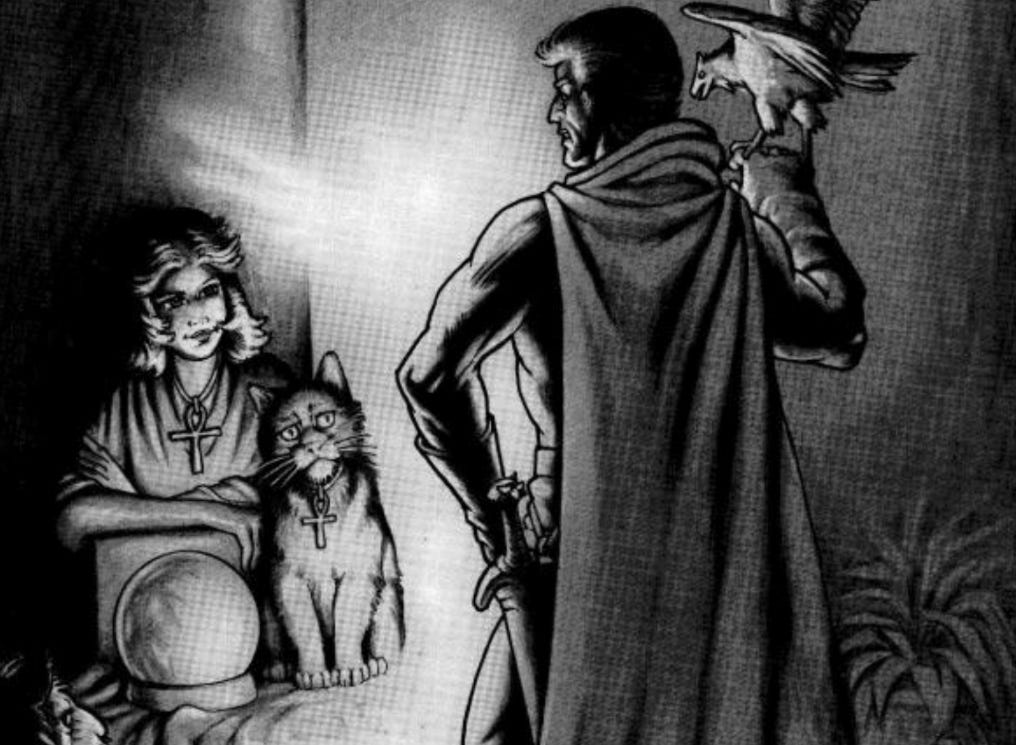
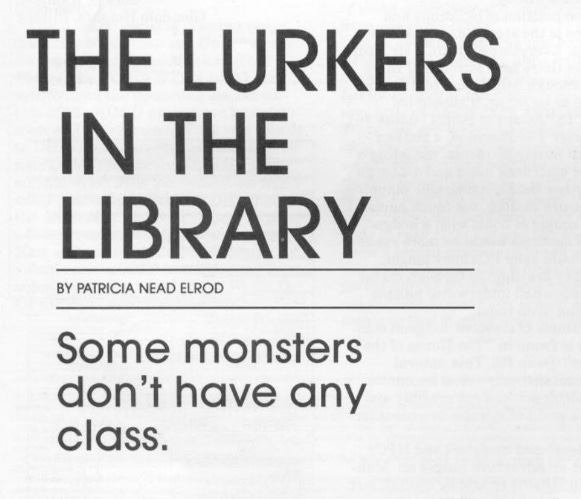
Enrod and Golden cut their teeth writing geek fiction and Delilah Dawson has written quite of bit of geek fiction and when she was younger played the West End Games Star Wars role playing game as one of her first gaming experiences. A look at Dawson’s bibliography reveals that she’s a geek fiction writer similar to Elrod, in that she writes a combination of horror and romance fiction. Though to be fair to Dawson, she’s got significantly less romance in the mix than Elrod did and she’s got a couple of comic books in the mix too…one based on Firefly.
Which brings me back to the Whedon influence. There’s are a lot of Whedonisms in the book, those moments when the characters make snarky asides about each other or their past. One of Whedon’s writing tools was to have the characters constantly antagonize one another in dialogue in order to create the veneer of conflict. Dawson doesn’t wander completely into Whedonland, but if you don’t want to read a book where every character (except for one) talks to the others with more than a dash of sarcasm, then this book might not be for you because there is a lot of that.
Does it Provide a Foundation for a Series?
Yes…no…and yes. Where Christie Golden opted to end Vampire of the Mists with at “del Toro” ending (just watch Blade 2 to get a feel for what I mean here), Dawson opted for what I term the 70s ending with Heir of Strahd. The 70s ending is a bit of a twist ending, think Twilight Zone’s mandatory twist, but without the moral “and unless we all behave this could be you too” 1980s afternoon cartoon speech featuring Rod Serling. That’s right. I just said that the end of every Twilight Zone episode was the equivalent of “and now you know, and knowing is half the battle.”
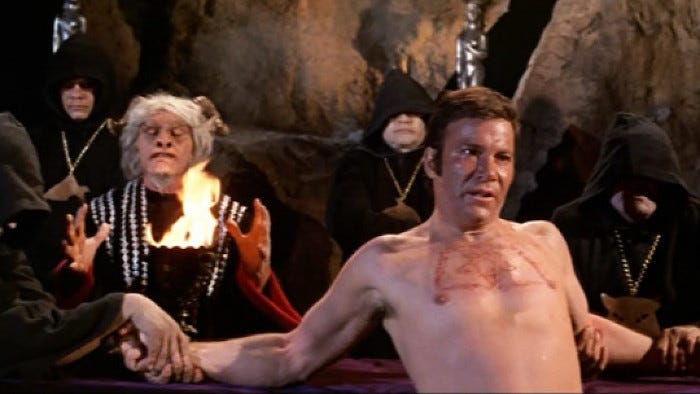
Rod Serling provided those wrapped bows, but the movies of the 1970s pulled no such punches. They gave you the downer without the morals. Think Race with the Devil starring Peter Fonda, Warren Oates, and Loretta Swift (and yes you should watch that) or The Devil’s Rain starring William Shatner (the movie that provided the mask used for The Shape in Halloween). These movies let you think the heroes won, but then turned the tables on you to reveal that something darker has happened. Which reminds me, you should totally read Jack Williamson’s classic novel Darker than You Think if you like werewolf and/or vampire stories.
Now I’m not going to tell you what that darker thing is, or which character is related to that twist, but I will say that it provides one possible foundation for a sequel and it’s a sequel that I would read. It’s also an ending that subverts the lighthearted tone that so many people were afraid that the book would have. The sequel in this case would be about the same characters, but would likely take place in the Forgotten Realms. So yes, it provides a foundation for more Forgotten Realms novels.
As a first Ravenloft novel though, I think it stalls the franchise. The Strahd stuff is cool, as is the introduction of his eternal nemesis Von Richten, but that story feels somewhat resolved. We aren’t left with an understanding of the connection between Dreadlords and the Domains and the endless cycle of horror for the Dreadlords who even death doesn’t provide rest. I don’t know that people who read this book would want a book about Lamoria or any of the other Ravenloft locations, let alone any of the other Ravenloft characters.
Then again, maybe they would. The version of Van Richten presented here, and the network of allies suggested by the author, provide ample room for more adventures in the Domains of Dread. If so, I’d like them to be more native to the Domains themselves and less focused on connecting the Domains with the Forgotten Realms or any other D&D setting. While D&D is focusing so much on the “multi-verse” aspect right now, I think that’s a mistake. Let each setting stand on its own and have its own character. Not every world needs Tieflings running around and not every world needs to be as grim as base Greyhawk. Don’t try to pull a Cat Who Walks Through Walls and Number of the Beast (when Heinlein mistakenly tied all his fiction together). They may all be settings for the same game, but they don’t all need to exist as crossover material either. Tell me the tales of Ravenloft, not of people from Eberron stumbling into Ravenloft.
I’m not saying it was a mistake to have characters stumble in this time, it is an introductory novel after all, but I am saying that doing that too often will feel more like Monster of the Week than a good narrative experience.
As for this book? I enjoyed how it adapted the House of Strahd module into a story and found that I came to like the characters, even as they are very Whedonesque characters and other readers might be a bit tired of those tropes.