


Background
Okay, this one is an odd one. I decided to start going through my DriveThruRPG library (all 9,280 files) and begin reviewing those I’ve given a test run. I’ll also do some gaming “read”-views, but I wanted to start with one I actually played when it came out. It was during the early d20 boom and quite a few publishers, large and individual, decided to try their hand at designing a superhero roleplaying game and this is one of those early attempts.
Vigilance Superhero is a great example of the kind of products that were being released at a time when the pdf marketplace was just beginning to explode. It was a time when desktop publishing was starting to get more professional, but it was also a time when a lot of amateurs were jumping into the water. Some of those amateurs went on to become successful professionals, while others faded into obscurity. It was also a time that saw the death of the “True Fantasy Heartbreaker” and the dawn of the “Fantasy Heartwarmer.”
When Ron Edwards coined the term Fantasy Heartbreaker in March of 2002, he did so in an article where he shared his lament that so many gaming creators in the 1980s and 1990s put their time and fortunes into efforts that were doomed to fail. These games were doomed because they were often nothing more than existing fantasy roleplaying games (usually just D&D) with a couple of added fixes that the burgeoning designers thought improved the game. What prompted Ron’s criticism wasn’t that the games were bad or lazy, though some people use Fantasy Heartbreaker as a pejorative in just that way. Yes, he thought some rules were sloppy, but his heart was broken because they often contained genuine innovations that would go unnoticed by players and that the games would bankrupt their creators.
And considering when most were published, before most printers changed their policies regarding small print runs, print costs must have been enormous, in the $6000-plus category for standard paperbacks. Some of the games contain cardstock inserts, too. Vanity is vanity, sure, but we are not talking about small sums…
…The basic notion is that nearly all of the listed games have one great idea buried in them somewhere. It's perhaps the central point of this essay - that yes, these games are not "only" AD&D; knockoffs and hodgepodges of house rules. They are indeed the products of actual play, love for the medium, and determined creativity. That's why they break my heart, because the nuggets are so buried and bemired within all the painful material I listed above…
…It is not fair to dismiss the games as "sucky" - they deserve better than that, and no one is going to give them fair play and critical attention unless we do it. Sure, I expect tons of groan-moments as some permutation of an imitative system, or some overwhelming and unnecessary assumption, interferes with play. But those nuggets of innovation, on the other hand, might penetrate our minds, via play, in a way that prompts further insight..
Ron later went on to argue that d20 and 3.x games, those based on the OGL, could not in any meaningful way be considered Fantasy Heartbreakers. This was in part due to the fact that the d20 license (and the OGL) created a new environment, but the other reason was that the market had shifted to facilitate these kinds of games in ways that wouldn’t break the bank of the creators. One of those ways was in the rise of pdf sales. It was now possible for designers to create games for a small niche of gamers, and to do so without taking out a home improvement loan. Designers could experiment, or publish their inspired but highly amateurish games. Thus we have the rise of what I call the Fantasy Heartwarmer. These are games with similar features to the old Heartbreakers, except that the cost to make and purchase them are so low that you can focus on the best parts of them. Better yet, some of these games manage to find people to actually play them.
In today’s Retro Review, I am looking at Charles Rice’s 2002 role playing game Vigilance Superhero as just such a Heartwarmer. Since superhero games are my favorite genre of role playing games, I feel an impulse to share and review the more obscure entries into the catalog.
Why Vigilance?
To channel my inner Walter Benjamin for a minute, and to reject him somewhat, there is a kind of artifact that rewards reading twice. First, you read it as the art that the artifact claims to be and then you read it years later as a fossil of the moment that produced it. In “The Work of Art in the Age of Mechanical Reproduction,” Benjamin argued that individual works of art are unique products of time and place and that reproductions, such as photographs etc., were lacking in one or more of the elements that made the work authentic.
This unique existence of the work of art determined the history to which it was subject throughout the time of its existence. This includes the changes which it may have suffered in physical condition over the years as well as the various changes in its ownership. The traces of the first can be revealed only by chemical or physical analyses which it is impossible to perform on a reproduction; changes of ownership are subject to a tradition which must be traced from the situation of the original. — Walter Benjamin 1936, Translated in 1968 by Harry Zohn in Illuminations edited by Hannah Arendt.
His argument is even more compelling in an age of digital reproduction. The peak Napster era, the modern streaming era, and the pushback toward physical products have proven that he was right in many ways. Where I would push back is that I believe that even digital productions, as opposed to digital reproductions, retain the aura of time and place that makes them unique. My statement above about re-reading Vigilance Superhero is an example of exactly that phenomenon. My $5 pdf of Charles Rice’s Vigilance SuperHero is an entirely digital creation where every copy of the file is identical, yet every copy provides the full artistic experience. One might argue that having the original physical draft would have more artistic aura, and that would be true if there had ever been an original physical draft but there isn’t. It has always existed in multiplicity and it still has aura and value, and it has become something more as time has passed just as a physical object does.
When I read it through the lens of my initial encounter back in 2002, I see that as a game it is a competent, generous, frequently clever attempt to make men in capes out of the third edition of Dungeons & Dragons. When I read it as a product of its time and place, I see a near-perfect core sample of the d20 boom. It helped provide a deeper understanding of the licensing arrangement that made it possible, the editorial roughness the boom tolerated, and the structural strain of bolting four-color heroics onto a set of game mechanics built for dungeon crawls. I’ll be discussing it in both ways in this review. In part, because it is as an artifact of the past that Vigilance Superhero has the greatest value.
The name turns out to be apt in a way Rice probably didn’t intend. “Vigilance” was the watchword of the whole open-gaming era. Not just for the heroes inside the book, but for every small publisher squinting at the fine print of a license that could be revoked at a corporation’s discretion. Hasbro may have later argued (probably incorrectly) that the OGL was revocable, but the earlier d20 license was explicitly revocable. It was a license that gave you the benefit of brand, but with relatively strict requirements.

Two licenses, one with a logo
Almost everyone who lived through the early 2000s remembers the Open Game License. Modern gamers may not know that there were two legal instruments that allowed publishers to make games that used D&D mechanics, and that the difference between these licenses explains a lot about why the games of the period looked the way they did.
The OGL was designed to be an open-source instrument. Wizards of the Coast carved out a chunk of third-edition D&D, the classes, monsters, spells, the core resolution mechanics, into a System Reference Document and licensed it under perpetual, royalty-free terms. Anybody could copy, modify, and redistribute that content, even commercially. The strategic logic, as brand manager Ryan Dancey argued it, was a desire to crowdsource a portion of the content creation in order to promote growth. It wanted to leverage the existing gaming network in order to expand the consumer base. According to this logic, D&D’s real asset wasn’t its rules but its installed base, and the way to make D&D the default was to make everyone else build on its structure instead of inventing their own. Get the whole hobby speaking d20 and players would migrate frictionlessly from product to product, learning one system and buying within one ecosystem. The supplements would be somebody else’s overhead; the evergreen core books would stay Wizards’ own. We can see the legacy of this strategy by how few modern gamers explored new systems after D&D hit its recent zenith. We are only now, after Hasbro attacked this very license, seeing younger gamers expand to new rules sets in large numbers.


The d20 System Trademark License was a different animal entirely. It governed the use of the little “d20 System” logo. This was the official badge that signaled compatibility on a store shelf; and it came with strings the OGL did not. The most consequential string, for the purposes of this review, is that a product carrying the d20 logo was forbidden to include rules for character creation or advancement. That was not a quirk, it was the whole point of the d20 license. The SRD itself deliberately omitted chargen and leveling so that anyone using the trademark would have to send the player back to a Wizards’ published Player’s Handbook. Not that this stopped some publishers from creating “Pocket Player’s Handbooks” that had more information than was in the SRD. The logo was a marketing bulletin board that simultaneously gave your product credibility while pushing customers toward Wizards’ core book as well. There’s a reason nearly every fantasy d20 product of the era carries some version of the line “Requires the use of the Dungeons & Dragons Player’s Handbook.”
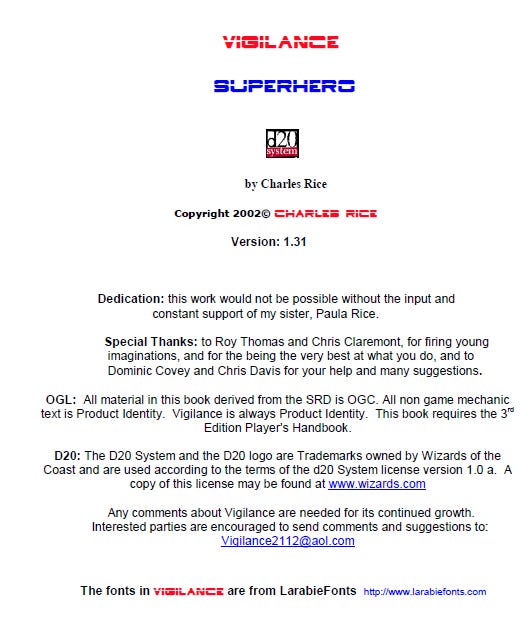
If you take a look at Vigilance‘s imprint page, it does the standard dual-flag dance of the period. There’s an OGL declaration similar to what you’d see in a lot of modern books (”All material in this book derived from the SRD is OGC… Vigilance is always Product Identity”) and, separately, the d20 trademark notice (”the D20 logo are Trademarks owned by Wizards of the Coast and are used according to the terms of the d20 System license version 1.0a”), capped with the mandated tag, “This book requires the 3rd Edition Player’s Handbook.” There are several mistakes in the presentation in Vigilance. The statement requiring the use of the Player’s Handbook is in the OGL section, which doesn’t require it, and the d20 License is listed as version 1.0a when that is the version of the OGL at the time. I’ve included version 3 above for you to examine because it was released around the time Vigilance was published, but you can look at v 0.4 of the d20 License. Hasbro has made it difficult to find the pre-3.5 System Reference Document, but you can read it here.
Here is where the document gets interesting in showing how the system works. Vigilance includes a complete character generation and an advancement system that plays with the D&D system and points you to the PHB and DMG in most of the ways intended. Vigilance’s character classes and origins are unique and if you look at the character class files from the original SRD, you can compare them to the classes listed in the SRD. Vigilance doesn’t use any of these, and it even has its own origins (the equivalent of D&D races) that hand out ability bonuses at creation. It has altered the experience economy to incorporate disadvantages in an interesting way that lets you start at a higher level. You can also spend XP to build gadgets and forge psychic links. It refers you to the main rulebooks enough that you are dependent on them, but changes some things too in ways that would have been better served by a completely integrated rulebook…something the d20 License didn’t allow.
It’s worth remembering how this story ends, because it bears on how we should value the document now. The d20 License was a fragile instrument that implied quality and was unilaterally revocable. Wizards eventually retired the badge and many publishers fled it in order to have more complete games. By 2003 the more legally minded companies had already learned they could publish d20-compatible games under the OGL alone and skip the trademark entirely. This became even more necessary after the surprise 3.5 revision stranded warehouses of 3.0 stock and Wizards declined to update the d20 trademark to match. There were reasons the d20 license wasn’t updated that start with erotic and end with bloat. There was a lot of stuff being published by third parties that Wizards would have found offensive and other stuff they found to be unbalanced and were glutting the market. Many of these products had the d20 trademark, implying that Wizards endorsed them and Wizards did not have the resources to police them all and weren’t yet in their “Send the Pinkertons” era.
The OGL, by contrast, was supposed to be the permanent and irrevocable license. Of course Wizards tried to de-authorize OGL 1.0a anyway in 2023, before the backlash drove the SRD into a Creative Commons release and hurt Wizards/Hasbro in ways from which they still haven’t recovered. One of the licenses that made Vigilance possible nearly died two decades after Vigilance did. The five-dollar PDF outlived the trademark it mostly complied with. There’s a small, sharp irony in that, and it’s the kind of thing the book’s title keeps insisting we pay attention to.
The d20 Bloat
I’ve mentioned bloat a couple of times already and that is because bloat is the other word that looms large over this period, and it’s worth separating the two things people mean by it, because Vigilance is a case study in both.
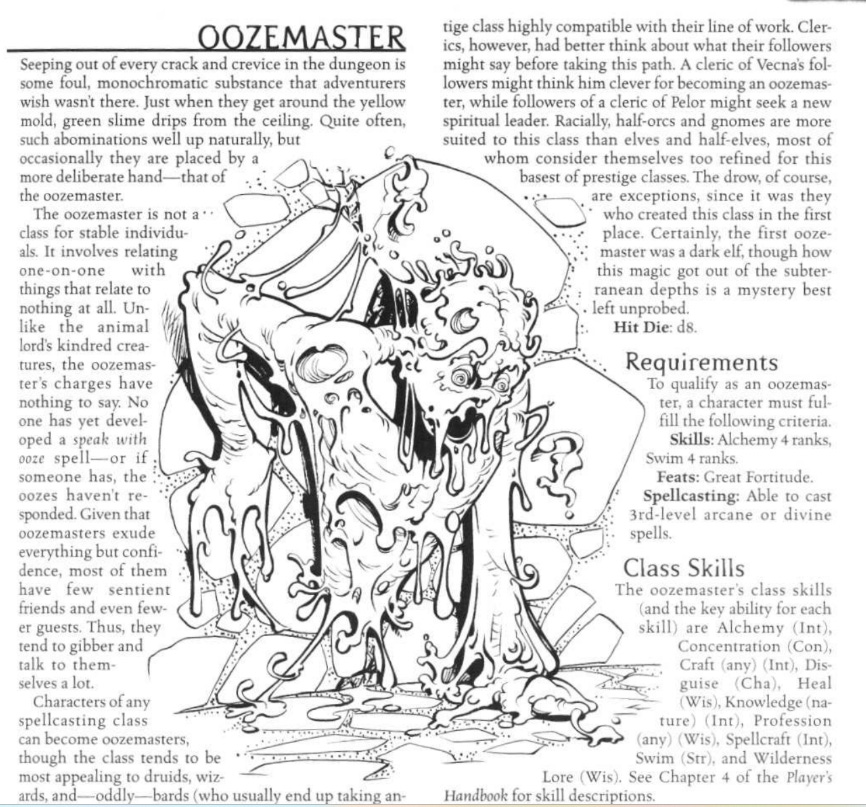
The macro sense is the d20 glut. This is the flood of third-party product that the low barrier to entry produced. Dancey’s plan worked almost too well. There were dozens of new companies, hundreds of adventures, an explosion of creativity and, by Sturgeon’s iron law, a proportional explosion of dreck. Everyone was creating d20 content, just as they are creating 5e content today. Some companies, like Pinnacle Entertainment Group, issued d20 versions of their non-d20 games in order to promote their original material. The thought was that people would play the d20 version first, and then dive into the real thing. Then came the 3.5 revision of D&D at Gen Con in 2003. The game was similar enough to 3rd edition that players transitioned to it easily, but it also had some major changes that made a lot of earlier content (both official and unofficial) obsolete. Did you love the Oozemaster prestige class? Sorry, that’s not a legal class anymore and all of that money you spent on the affordable ($19.95) paperback class-based splat books needs to be spent again on $27 hardcovers.
Third-party publishers were given little warning, and the market choked on obsolete inventory. Many d20 houses folded or fled to OGL-only branding within a year. My local game store told me that Pinnacle Entertainment Group had gone out of business. This statement was based on an odd combination of rumors around the Cybergames fiasco and the collapse of the d20 market.
Vigilance sits at the purest, most democratic end of that flood. It’s a five-dollar PDF, written by one person, sold for pocket change and openly soliciting feedback (the book prints an AOL address and asks for comments). It was a far cry from the endless books that Mongoose was printing at the time, with very little playtesting, that took the 2nd edition “Complete” book concept and put it into overdrive. As bad as Mongoose’s output could be at times, I’m willing to forgive them because they also produced strong non-d20 work like Dragon Warriors and Lone Wolf and hired experienced designers for some of their material. The purer expressions of glut were Fast Forward Entertainment, who were cranking out books at an AI pace in a pre-AI era, and Valar Project, whose Book of Erotic Fantasy is tamer than you might imagine. It’s deeply rooted in a mechanics-based mindset. One would think a book like this would be more narrative and filled with material that appealed to the relatively narrow audience that would have interest in such a book. Instead, it’s very mechanically crunchy in ways that someone who would actually want to buy a book on this topic wouldn’t actually want.
Vigilance wasn’t the creation of someone trying to get a quick influx of revenue following a trend. The author wasn’t trying to get rich, instead this is a creative product from the bottom rung of a commercial ladder. This is the OGL’s promise and its peril in a single object. This is the modern Heartbreaker/Heartwarmer in its ideal state. The promise is that an individual with a word processor and a love of Uncanny X-Men could now publish a full superhero RPG and sell it. They could offer it on a digital storefront beside the professionals, at a price low enough to be an impulse buy. Rice’s dedication makes the fannish DNA explicit, by tipping the hat to Roy Thomas and Chris Claremont “for firing young imaginations.”
But which storefront you stood beside mattered as much as the price. I bought Vigilance from RPGNow, now DriveThruRPG, which was then only a year or two old. The digital market was still forming and the production standards varied widely. In this case, it’s a plain PDF that still opens today without any artifacting, but which looks like it was laid out in Word over a couple of hours. Around the time I bought this from RPGNow, I was buying ESDs, the “Electronic Software Downloads” that SV Games sold after Wizards handed it the keys to the official online store for the out-of-print TSR back catalog. SV Games had all the classic modules and rulebooks, scanned into PDFs of famously uneven quality and delivered inside a wrapper that unpacked to a standard file on your machine. It was a strange arrangement that existed because of the speed of the internet at the time, which was around 400 Kb/s and 1/500th the average internet speed today. I find it interesting that the heyday of Napster happened in an era of such slow data transferral.
SV Games ESDs often required you to download a couple of files, which the wrapper then combined to give you a readable pdf. At the time, SV Games held the prestige relationship in the pdf market. It was, in effect, Wizards’ outsourced digital storefront, and it charged independent publishers a punishing fifty-percent commission, which was double RPGNow’s rate. This commission might be one of the reasons that it went out of business. It shut its download program in April 2005 and any purchaser who hadn’t backed up their copies by that time lost them forever. The classic-D&D business migrated to RPGNow and DriveThruRPG. Wizards killed those PDFs entirely in 2009, only to have them rise from the ashes in the post-GSL crisis. The open, low-margin storefront outlasted the official one with the funky downloading scheme. Given the GSL and OGL scandals over the years, I think it’s fair to say that in the open-gaming economy, the terms outlive the pedigree. Gamers want to “own” things and they want to have access to creating new things related to the things they love.
What actually works: d20, bent toward the cape
As amateurish as Vigilance is in its presentation, it still looks like a word document with minimal formatting but it’s clearly an effort of love. It contains a handful of core conversions that are smart. Smart enough that you can see the designer who would, the very next year, build a much-improved commercial product out of this raw material. Though this game was released as a completed game with a $5 price point, it’s best in some ways to look at it as a beta release.
One of the things that I really like is how it handles Defense. Vigilance replaces Armor Class with a stat equal to 10 + your Fortitude save + your Reflex save. Other games with a similar mechanic tend to rely solely on Dexterity, just as AC normally does, but the use of two physical saving throws (one representing toughness and the other agility) is truly innovative and it presages the various typed defenses we’d see in 4th Edition D&D that replaced traditional categorical saving throws in that edition. The basic conceit is that a superhero avoids harm two ways, by not being where the blow lands, or by shrugging it off when it does, and folding both saves into one defensive number models exactly that. A nimble acrobat and an invulnerable brick arrive at high Defense by different routes, but they can both be hard to affect. Vigilance abandons the d20 Armor model for the RuneQuest and Tunnels & Trolls model where it has no effect on your chance to be hit and instead grants damage resistance by attack type, so a flak vest stops bullets but not psychic assault. One of the first posts I did for Geekerati was a discussion of how armor, even when it only alters the chance to hit, is always a form of damage reduction.

But in superhero games, the kind of damage matters a lot more than in a fantasy game. The Human Torch is much more resistant to Fire damage than Ice damage. So having Armor, both in physical and power form, affect different damage types differently is a genuinely good idea, and it’s the kind of idea that only emerges when a designer is willing to ask what the genre actually needs rather than what the SRD already provides.
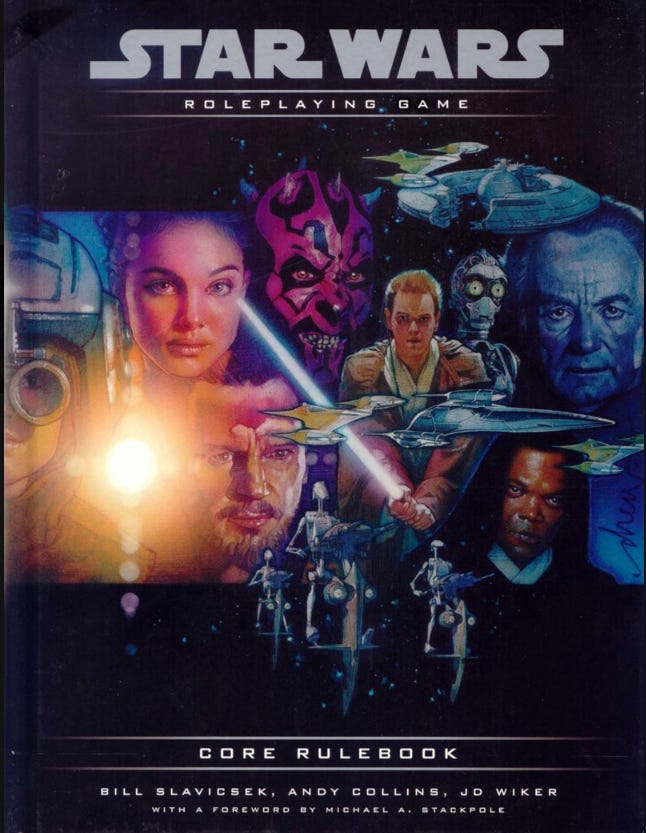
The damage system is a combination of Vitality and Wound points, lifted from the broader d20 family. Wizards’ own Star Wars Roleplaying Game (2000) introduced the split, though one could argue Palladium and Hero got there first, and Spycraft carried it forward. Vitality scales with level and is used for most damage. Wounds are equal to your Constitution and only start taking hits once Vitality is gone. Critical hits skip straight to Wounds. This is closer to the comic-book damage model than normal hit points. In comics the hero trades blows across a two-page spread without consequence, and then the one lucky shot, the critical hit, overcomes resistance. Grafting it onto supers is a good call, though still a little more lethal than I like for my superhero games. I kind of wish Charles Rice had lifted from games like West End’s older Star Wars game or Paranoia that use damage categories.
I very much like how the game adapted traditional race categories into origins and integrated those into the new mechanics. Mutants must take the Prejudice disadvantage, so the rules enforce the X-Men’s central metaphor. Aliens must take an Enemy from their own people, hard-coding the doomed-last-survivor trope and its inevitable “actually there’s another one and he hates you” sequel. Artificial Life must take a Forbidding Demeanor and gets no XP for it, paying for its uncanniness in social currency. This is design with a point of view, and I like that. Not every game needs to be a generic game with infinite choices. I prefer it when the mechanics and the setting are tied together somehow. In my view, it’s more fun when all paladins are Lawful Good or when superheroes are incentivized to be four-color in tone rather than murderous vigilantes who claim the moral high ground. The mechanics aren’t neutral scaffolding in this game. They insist that an origin is a wound as much as a gift, which is the single most reliable truth of the superhero genre. Power should always come with a cost.
Three more conversions deserve credit, all of them imported from the superhero RPG tradition that predates d20. Rice brings in a Disadvantages-for-XP mechanic where you bank your phobias and dependents and secret identities into starting experience. This builds on the Champions/HERO system, but has it affect the starting level of the character rather than primarily providing additional build points. Like Champions, players are rewarded when disadvantages actually complicate an adventure, so the player who loads up on weaknesses that never bite gets no return. Rice’s Heroism and Villainy points are TORG’s drama points by another name. You can spend one to add an open-ended d6-per-five-levels to a roll, or to shrug damage, or if you spend five points you can convert your own death into mere unconsciousness. This mutes the damage system a bit and works well in play. The “Special Effects” rule, which formally decouples a power’s mechanical effect from its fictional look, is HERO-system thinking dropped cleanly into d20. You can create a Fortitude-resisted physical blast that is a stream of poison, a telekinetic fist, or a bolt of ruby force, and the rules don’t care which you do mechanically. That decoupling is exactly how you get an entire genre’s worth of powers out of a small number of mechanical templates. I’ve written how D&D should do this more often than it does currently. I’m a huge fan of effects-based design.

Comic books are built on archetypes, so comic-book teams based on classes work better than many critics might think. Brave New World wasn’t afraid to have archetypes play a big role, and neither should a d20 adaptation be. We all recognize the Brick up front, the Energy Projector as ranged artillery, the Acrobat dodging everything, the Psychic holding the squad’s minds together, the Detective who is very obviously the Batman clone (”a shadow among shadows… the dark shadow of the city”), and the Gadgeteer welding in his lab. These are all classic archetypes of the genre, so much so that even Champions (the most freeform build what you want game ever in the genre) had an entire line of “how to build the archetypes” books. The feats reinforce the archetype theme. Banter and Wit give you a Defense bonus and an enrage effect for running your mouth in a fight, which is Spider-Man or Ambush Bug rendered as a rules subsystem. When Vigilance is working, it’s because Rice clearly knows the genre and is translating specific four-color conventions into d20 grammar with real fluency.
Where the mechanics fight the genre
The game isn’t perfect though. The reason this is a fascinating document rather than a widely played game is that the d20 mechanics keep fighting the source material, and Vigilance can’t win without even more changes. Of all the attempts to lever d20 into superheroics, only Mutants & Masterminds did so with decent commercial success. That was in part because it did a lot of conceptual stretching when adapting the d20 system. It’s close enough that you know what to do, roll d20 and roll high, but different enough that it feels like Champions or DC Heroes.
Vigilance’s deepest problem is scaling. Four-color comics run on power curves d20’s linear math has trouble expressing. Vigilance‘s blast does 1d6 per four power points spent, so a committed projector is soon rolling fistfuls of dice, while Defense climbs off two saves and attack climbs off base attack bonus. These two escalating tracks don’t stay in productive tension. Their advancement isn’t parallel and damage ends up winning out over defense in ways that run counter to the source material. The result drifts toward rocket tag. You have big dice pools, swingy Vitality/Wound thresholds, and combats that resolve in a lucky crit rather than a war of attrition. The exploding Heroism dice and the open-ended damage feats (Chain Reaction rerolling every 10) only widen the variance. d20 is happiest in bounded systems and getting the superhero genre to work within such a system requires creating boundaries similar to what Mutants & Masterminds did. You have to have boundaries that the game lives within and eventually those boundaries shift the game away from familiar d20 territory.
Rice, to his enormous credit, knows this and says so. The book contains one of the more honest disclaimers I’ve read in a game of its era: the abilities here, it warns, are “not intended to be loosed in any regular d20 game,” and are “meant only to be balanced with each other.” That candor is admirable. It’s also a tell. When a designer has to cordon his own system off from the parent game because the power math won’t cohabit with it, the conversion is straining against its source. The disclaimer is Vigilance admitting that fantasy d20 and four-color supers are not, finally, the same shape. Of course, DC Heroes is my favorite superhero game and it suffers the opposite effect. It’s great at emulating superheroes, but requires significant fiddling to emulate Sword & Sorcery.
Another reason the game didn’t succeed as well as it might have otherwise is that 2002 also gave us the d20 superhero game that got everything right in Green Ronin’s Mutants & Masterminds. M&M’s radical move was to keep d20’s roll-d20-add-modifier-versus-DC core and throw out almost everything else — no Vitality, no hit-point attrition, no classes, no Vancian scaffolding. It replaced hit points with a damage save, replaced classes with pure point-buy, and let power level cap the whole build so the math stayed coherent at four-color scale. If you read the DC Adventures RPG that Green Ronin built upon the M&M foundation, you’ll see that M&M has more in common with DC Heroes than it does with D&D. That’s the design Vigilance keeps reaching toward and can’t quite commit to, because Vigilance is too loyal to the parent system to drift as far away. Rice bolts superpowers onto D&D’s skeleton where Green Ronin kept D&D’s handshake and grew a new skeleton. The contrast is the whole argument of this review in miniature. The more of d20’s fantasy machinery you keep, the more the superhero genre fights you. Vigilance keeps a lot of it, and pays for every piece.
The Verdict
So what is Vigilance SuperHero worth, twenty-some years on?
As a game to run tonight, I’d play it but I wouldn’t play it often. Rice would likely agree, given that he superseded it himself with an improved edition a year later. The rough edges are real, the scaling is unstable above the low-to-mid levels the genre most wants to exceed, and there are cleaner d20-adjacent supers engines, Mutants & Masterminds chief among them, that solved its hardest problems by refusing to inherit them. If you want to play a campaign, this isn’t the book for you. If you want to play for an evening or two, I’d give it a shot.
But as a thing to read and learn from, it’s close to ideal, and I mean that as real praise. It is a clean core sample of the d20 boom drilled straight down through every layer. You can see first hand how the open source licensing and the trademark restrictions pulled in opposite directions. It gives you a nice solid amateur effort to compare with the macro flood of cheap enthusiast PDFs and “so-called” professional crud. The enthusiasts were often presenting better, and thus Heartwarming, games while bigger publishers like Fast Forward were filling the market with mass-produced and never played material. This is a work of love that lets you watch, in a single five-dollar document, both what the OGL made possible and why so much of what it made possible needed a second draft.
The license that let one fan put a five-dollar superhero RPG on a storefront was the same license Wizards tried to claw back in 2023, before the hobby’s vigilance, that word again, forced the core rules into Creative Commons for good. Vigilance is an early footnote in that story, but it’s the kind of footnote that tells you what the whole text was about. The open-gaming age was never a guarantee. It was a gift with fine print, revocable in theory, watched in practice, and ultimately defended by exactly the constituency of fans and small publishers that books like this one came from. Charles Rice named his game better than he knew. Constant vigilance was always the price: for the heroes inside the book, and for everyone who ever had to read the OGL.
Vigilance SuperHero, by Charles Rice is out of print, but you can buy Blood and Vigilance: Modern Superhero d20 (RPGObjects, 2003) to get a glimpse of what it would become. Still not perfect, but worth exploring if you love superhero games.
Now I have to pull out my Mutants & Masterminds books again. I might run it with ICRPG, though.