


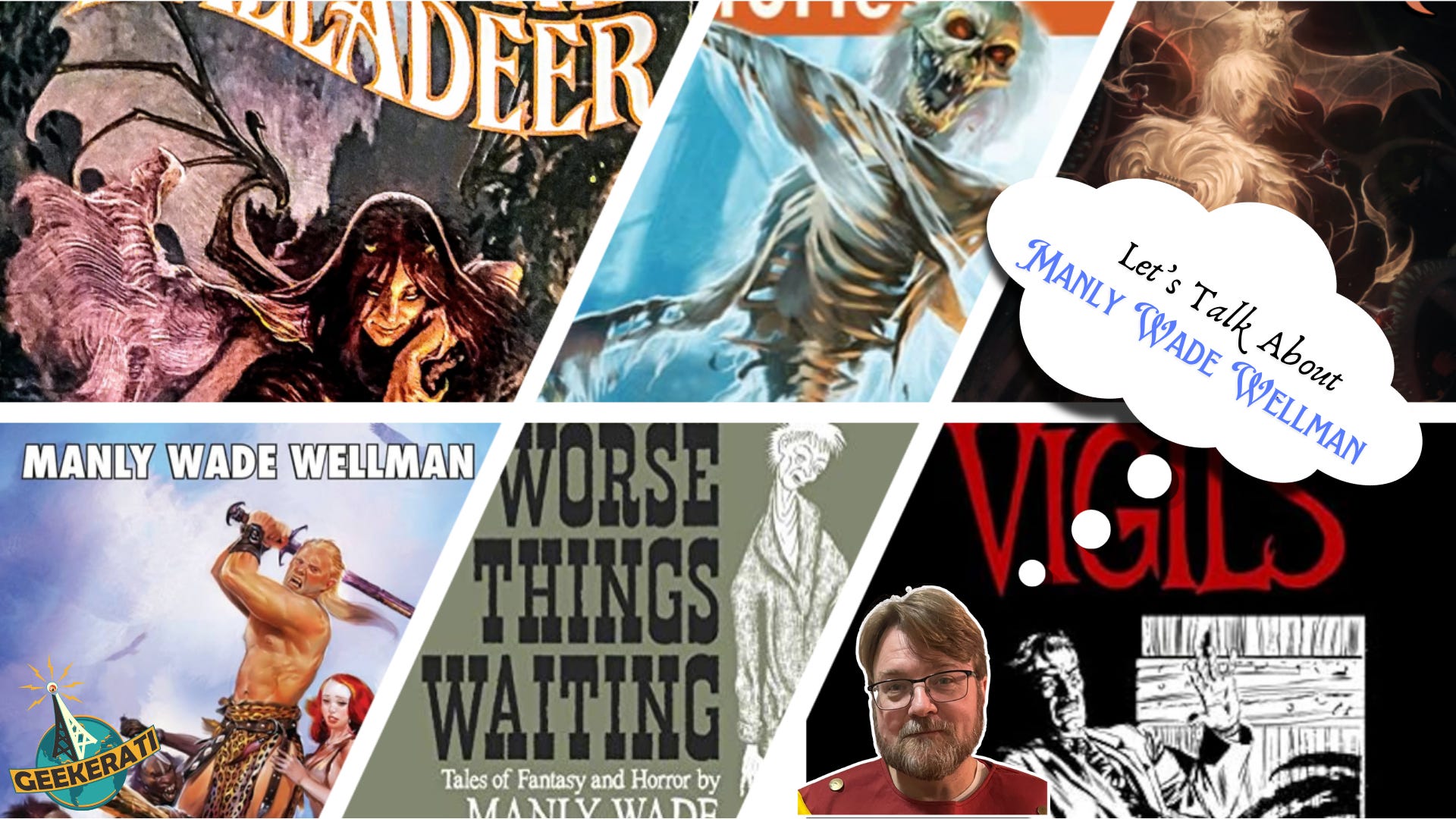
As has become common, there is a gaming appendix for this article. In this case, I present statistics and adventure seeds for Chill 1st Edition and Savage Worlds. Most of the biographical information in this post is from David Drake’s blog posts about his friendship with Wellman.
While Manly Wade Wellman is listed as one of the inspirational reading recommendations in Appendix N of the 1st Edition AD&D Dungeon Masters Guide (sic), I discovered his works while I was an undergraduate in college. My friend J and I were talking about our favorite fantasy authors one day and he mentioned Wellman and his John the Balladeer stories. I had never read these stories or heard of Wellman. Heck, though I owned a copy of the DMG I hadn’t taken more than a glance at Appendix N at that time. I did, however, trust J’s literary taste. J (his real name is John Ford, but his nickname is J…yes, the letter J and not Jay) and I had talked extensively about movies and for a time wrote a review column in the Sparks Tribune called Celluloid Say-So. I had great fun writing those with him as we’d sit by my computer and rotate paragraphs in an attempt to write a simulated conversation about our experience with a movie. I knew what he liked; and I knew I tended to like most of what he enjoyed. I also, eventually, learned that one of my favorite science fiction and fantasy authors was close friends with Wellman.
On March 17, 1970, David Drake, law student, soon-to-be Vietnam draftee, future author of Hammer’s Slammers, walked into a writing office above a drugstore in Chapel Hill, North Carolina, and introduced himself to the man Karl Edward Wagner would later call “the dean of fantasy writers.”
Drake recorded the meeting in his journal that night writing that Wellman was “heavy, iron-grey with a brush mustache, wearing a sport coat, dark blue shirt & tie.” They talked about the John the Balladeer stories, about Charles Fort, about Lord Dunsany (whom Wellman had met), and about Oscar Wilde. Drake would later describe it as “pretty typical of the hundreds of others I had with Manly in later years.” Conversations with Wellman covered wide ground and were digressive, ricocheting across the whole of literary and human experience.
Drake had been putting the meeting off for years. He was embarrassed, he said, “and didn’t want to seem pushy to such a great figure.” He finally picked up the phone two weeks before he was going to be shipped out to Southeast Asia. Drake reasoned with the bleak practicality of a man facing serious odds that “there was a very good chance I was going to die in the next year” and that he would feel like an idiot in his final moments if he hadn’t taken the chance.
He made it back. For the next fifteen years, until Wellman’s slow death from infection in 1986, Drake was a fixture in “the Triangle’s” small world of professional fantasists. The Triangle is the nickname of the part of North Carolina that contains Duke, NC State, and the University of North Carolina at Chapel Hill. At the center of this geographic triangle lies Research Triangle Park, the largest research park in the United States. It’s an academic and intellectual hub, even more today than it was in 1970. It was in this milieu that Drake found himself socializing regularly with Wellman and his wife Frances, and with the young Karl Edward Wagner, who had already sold “That Robert E Howard stuff” and dropped out of medical school to write full time. Three writers at different stages of their careers, different temperaments, different lanes. bit bound together by geography, affection, and a shared conviction that the pulp tradition was worth taking seriously.
That friendship is very interesting and it provides one of the few windows we have into what Manly Wade Wellman was actually like as a person. It also gives us a glimpse into a different triangle. A literary triangle that is an odd mix of literary styles and a T.S. Eliot style transmission of genre ideas that passes from Wellman to Wagner to Drake. It is a real literary lineage that the fantasy field has mostly failed to acknowledge, largely because the writers were so different in their topics. Wellman was a fantasist who is most famous for his folklorist fantasy and though he wrote horror stories, they echo of the Holler and Southern Tradition. Wagner may have written “That Robert E Howard stuff,” but his Kane stories are brutal and not for the light of heart and his horror is often disturbing and fully embraces the Gothic in Southern Gothic. His short story “Sticks” is a must read and it is featured in a number of anthologies, including the one I just linked. Drake’s stories draw tend on classical mythology (Babylonian in addition to Greek and Roman) or his own experience as a Vietnam veteran. His book Redliners, the book he is proudest of, is a harrowing story about the link between veterans and civilians the writing of which served as a kind of therapy for Drake. Both Wellman and Wagner recommended that Drake draw on his experiences in Southeast Asia for his fiction, and you can see shadows of Vietnam throughout his Hammer’s Slammers stories.
Though they were very different people from different generations, Wagner founded Carcosa Press in 1973 specifically to rescue Wellman’s work in hardcover at a moment when Wellman’s collected horror fiction was effectively inaccessible. Wagner later served as literary agent for Wellman’s estate. Drake visited Wellman nearly every day during the last ten months of his life, listening as the old man used him “as a dump for his memories about old girlfriends, books he’d known and loved, and all the other fragments of his long life that were most vivid to him.” When Wellman died, Drake wrote: “So long as I live, so does a little bit of Manly Wade Hampton Wellman.”
That is what literary preservation actually looks like. Not institutions. Not syllabi. Three writers in a college town who loved each other’s work and showed up. Sadly, all three are now dead and it is up to us to keep up the legacy of an oft forgotten author.

The Problem of Wellman
Here is the problem with writing about Manly Wade Wellman in 2026, he doesn’t fit easily into our check box genre lists. Every other major figure in Appendix N fits somewhere recognizable. Robert E. Howard IS sword and sorcery. He is the wellspring and you can shelve him easily. You can explain him in a sentence, you can point to Conan and be done, or at least that is the common understanding. Fans of Howard know that Conan barely scratches the surface and that the rest of Howard’s work suffers a the same problem Wellman does. Lovecraft is cosmic horror. Jack Vance is dying-earth picaresque. Fritz Leiber is the sophisticated, ironic, urban fantasy of the Gray Mouser. Even the more obscure entries have a lane. Margaret St. Clair is paranoid underground SF, A. Merritt is lush pulp adventure, Lord Dunsany is mythopoeic fairy tale. As with Howard, these are all reductive. My favorite Leiber stories, for example, are his urban fantasy tales like Conjure Wife or Our Lady of Darkness, but he is best known for the Twain (Fafhrd and the Grey Mouser).
Wellman has no lane. He has a territory, and it is vast, and it is strange, and it covers roughly 70 years of fiction across at least four distinct registers that have almost nothing in common except their author. Let’s take a moment and consider what we are actually looking at when we look at the Wellman bibliography:
John the Balladeer (aka Silver John) is a wandering folk musician in the contemporary Appalachian mountains who carries a guitar strung with silver strings and encounters the demons, witches, and old things that persist in the hollows and ridges of the Carolina highlands. The John stories are intimate, wry, rooted in authentic Appalachian folklore that Wellman absorbed through his friendship with the scholar Vance Randolph, who took him on field trips through the Arkansas Ozarks to collect folk traditions directly from communities still practicing them. Silver John is not a wizard. He is not a warrior, exactly. He is a man who knows old songs, knows old customs, knows that iron and silver and running water and righteous faith have real purchase in a world where old things have not gone away. The horror in these stories is communal and survivable. The faith that defeats evil is specifically, deliberately Christian. It’s not the Catholic ritual we see in so many modern horror films. It’s not ceremonial magic. Instead, it’s the Baptist and Methodist piety of mountain people who never stopped believing in demons because they never stopped believing in God.
John Thunstone is a New York occult investigator. He’s big, powerful, and carryies a sword-cane with a blade of silver. He operates in a world of secret societies, ancient sorcerers, and creatures from pre-history that have endured into the modern era. The Thunstone stories are more urban, more adventurous, closer to the heroic pulp tradition. They belong on the same shelf as Seabury Quinn’s Jules de Grandin, and they are generally better. In my own headcanon, he and the Balladeer are the same person but the mood of their tales is very different.
Judge Pursuivant is an older occult detective, a retired jurist with white hair and white mustache. He’s the Judge Holden of supernatural inquiry. Except unlike McCarthy’s Judge, Pursuivant is fundamentally decent and specifically faithful. He and Thunstone appear in the same stories occasionally, crossing paths like detectives in a shared fictional universe.
Kardios of Atlantis wanders the ancient world in a series Wellman wrote in the 1970s and ‘80s — a lone hero navigating a world of Greek mythology as it actually was before the myths were tidied up, where the gods are real and ambiguous and the monsters are genuinely monstrous. These stories are lighter in tone, closer to sword and sorcery, written with a scholar’s knowledge of classical sources and a storyteller’s instinct for what makes a good yarn.
Hok the Mighty goes further back than any of this. Hok is a Cro-Magnon hero — a man of bone and spear, the first and most literal of all warriors, fighting in a world before agriculture, before cities, before writing, where the enemies are Neanderthal kin-rivals and the great predators of the Pleistocene and, sometimes, things that have no name. The Hok stories were among Wellman’s earliest, and they are still striking: lean, hard, imagining human beginnings not as paradise but as a condition of constant, creative, violent survival.
One writer. Four registers. Horror, myth, prehistory, the occult. Faith, humor, violence, wonder. And that’s before you get to the historical fiction, the detective stories, the journalism, the non-fiction, the westerns. The guy did write a story where Sherlock Holmes teams up with Professor Challenger to investigate what is happening in H.G. Wells’ War of the Worlds. He cowrote that last story with his son Wade (1937 - 2018).
What Wellman Knew That Lovecraft Didn’t
The comparison to Lovecraft is unavoidable because it clarifies what is actually at stake in the John the Balladeer stories and how Wellman approached the horror tale.
Lovecraft is one of Appendix N’s most influential figure and is likely its most discussed one. That discussion has increasingly focused on what makes Lovecraft’s horror work so well. His cosmic horror presents a universe of alien power that is genuinely indifferent to human suffering because it is so vast that humans are significant. The horror works because the protagonists are alone, because the old knowledge is fragmentary and corrupted, because the traditions that might have helped have been destroyed or forgotten, because there is no community capable of standing against what comes from outside. Lovecraft was responding to Nietzsche’s claim regarding the last man that they are indifferent to the vastness of space. Lovecraft argued that man’s principle fear is of the unknown, and that the big questions Nietzsche’s last man blinks at are the source of terror.
“What is love? What is creation? What is longing? What is a star?” — so asketh the last man and blinketh. — Nietzsche, Thus Spake Zarathustra
The oldest and strongest emotion of mankind is fear, and the oldest and strongest kind of fear is fear of the unknown — Lovecraft, Supernatural Horror in Literature
Wellman’s horror is built on exactly the opposite architecture of both of these authors. Man, in Wellman’s view is neither the nihilist nor the craven. In the Balladeer stories, for example, the old knowledge is intact. The folk traditions are real, and people still practice them. When John encounters a witch or a demon or a thing older than naming, he is not alone. Instead, he is embedded in a community of mountain people who remember things and who will stand with him when the time comes. The songs he sings are not incantations he has to rediscover from corrupted manuscripts. They are folk songs that have been kept alive because folk songs are kept alive by being sung, by being passed down, by being loved. The faith that defeats evil is not occult knowledge reserved for initiates. It is the faith of common people who never abandoned it.
This is not naive. Wellman knew how hard mountain life was. He knew the darkness in the hollows (Hollers) was real darkness, not metaphor. He understood the cruelness of those who lived there as much as Raylan Givens. He earned the ethnographic knowledge that grounds these stories through actual fieldwork with Randolph, not through armchair scholarship. The result is horror that is, paradoxically, more frightening in some ways than Lovecraft, because it takes place in a world where the human community has real resources and still sometimes loses.
But it is also horror that is, fundamentally, hopeful. Not in a saccharine way. In the way that faith is hopeful. The characters in Wellman stories have the conviction that there is something worth defending, that the right song at the right moment matters, that the silver string on the guitar is not just metal but meaning. That’s why I made the Raylan Givens reference. Raylan is a hero in a dark world. Many of the criminals he opposes would be equally at home in Breaking Bad, but Givens isn’t alone when he stands against these forces.
This is the road not taken in American horror fiction, and it is the road not taken in D&D. The game that drew on Appendix N reached for Lovecraft’s cosmic horror and Howard’s heroic violence far more than it reached for Wellman’s communal, faithful, folk-rooted darkness. It is easy to understand why. Cosmic horror scales well to dungeon design, and heroic violence is the grammar of the combat encounter. But something was lost in that choice. The John the Balladeer stories suggest a fantasy gaming tradition where the party is embedded in a real community with real stakes, where the songs and customs and beliefs of ordinary people are the actual tools of supernatural resistance, where faith is not a character class but a lived practice with mechanical teeth. It’s a sentiment also on display in the Paksenarrion novels by Elizabeth Moon where more time is spent discussing what it means to be good and how it is important for champions of goodness to know and experience the suffering of the average community member and it’s one that deserves its own game.

The Man Himself
Drake’s account of Wellman, assembled across multiple essays on his website, is irreplaceable because it captures someone who is genuinely hard to categorize, as hard to categorize as his fiction. The primary essays are “Manly Wade Wellman, Reporter,” “Hammer’s Slammers (1979),” and “Manly Wade Wellman,” but there are many more because Wellman loomed large in Drake’s life.
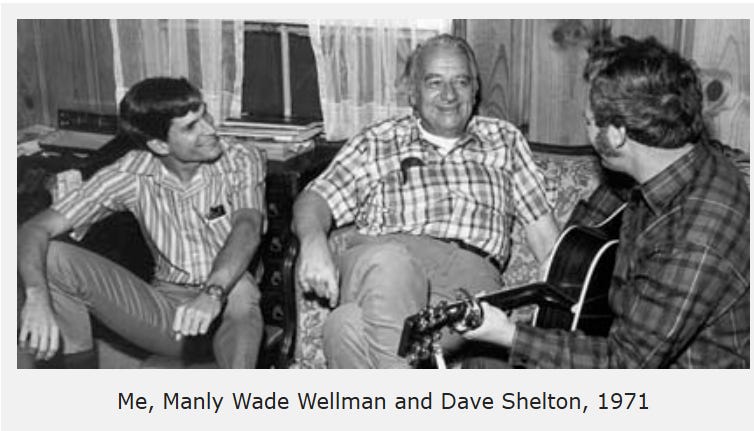
Wellman was born in 1903 in Portuguese West Africa, where his father was a medical officer. He grew up between Angola and the American South. He played football on scholarship at college. He worked as a crime reporter in Wichita in the late 1920s, accompanying police on raids because he was big and athletic and on good terms with the department. He tramped through the Arkansas Ozarks with Vance Randolph in the early 1940s, listening. He wrote for Weird Tales and Unknown and Planet Stories and every other pulp of consequence. He moved to Chapel Hill after the war and stayed for forty years.
There’s one anecdote from Drake’s writing that has always stuck with me and demonstrated the difference between Wellman and his young proteges Wagner and Drake. Wellman got into an argument over whether cocaine was addictive or medically beneficial. Wagner, fresh out of medical school, was “sneeringly certain of the medical opinion that cocaine was non-addictive.” Drake, impressed by the Wagner’s assertion of a scientific consensus, agreed. Wellman, who had experience watching the Wichita drug trade as a working crime reporter in 1930, was adamant that cocaine destroyed people. “Now,” Drake wrote, looking back decades later, “I can only nod to Manly’s memory. Manly was right; I was wrong. And that was generally true when we differed on matters of opinion.”
The lesson Drake draws is interesting and is evidence of his humility. According to Drake, Wellman was smarter than he, in his arrogance, had given him credit for. The old man who wore a sport coat to meetings in his office above a drugstore, who talked about Dunsany and Oscar Wilde and Charles Fort in the same conversation, who wrote stories about a mountain musician with a silver guitar. That was a man who knew things the younger writers hadn’t learned yet, because he had learned them the hard way.
It was this knowledge from experience that Karl Edward Wagner understood when he named Wellman “the dean of fantasy writers.” Not the most famous. Not the most commercially successful. Not the most influential on the game that would define the genre’s commercial future. The Dean. Wellman was the one who had been there from almost the beginning, who had seen the so much, who carried much of what was worth carrying, and who loved to share his knowledge with the next generation.
Wagner spent years making sure that the carrying continued. Carcosa Press where he published the excellent anthologies Worse Things Waiting and Lonely Vigils, which were briefly made available again by Shadowridge Press but which are now out of publication again. He ran the literary estate. He made sure that every hardcover edition began with careful introductions. What Wagner did was not glamorous work. It was the work of someone who understood that the tradition doesn’t survive on its own, that it survives because particular people make particular choices to preserve particular things. Wagner, the rebel who challenged tradition and the status quo worked hard to make sure that a stodgy advocate of that very tradition was lovingly preserved.
Drake understood it too. He showed up. Day after day, in the last ten months, listening to the old man talk about old girlfriends and books and fragments of a long life. Not because it would help his career, but because it was the right thing to do. As I read the newsletters Drake wrote in the final two years of his own life, after he’d suffered a head injury in a motorcycle accident, I could see him attempting to give all of his readers the same gift Wellman had given him. Yes, Drake being there for Manly was a gift, but so too was the insight and wisdom that Wellman gave to him. As Drake struggled to write, something that had always been easy for him, the power of his words hit harder than ever. I miss him and I miss his tales of Wellman.
The Games That Were Built for This, and the Ones That Should Have Been
What game should you use if you want to play in the waters that Wellman mapped out? There are a few good answers and here’s a brief rundown.
Game One: The Chained Coffin and the Shudder Mountains

The most direct gaming response to Wellman already exists and is a wonderful tribute to the author. The Chained Coffin (DCC adventure #83), written by Michael Curtis for Goodman Games, is set in the Shudder Mountains which are an Appalachian-analogue hill country of backwoods superstition, old evil, and folk tradition that Curtis built explicitly from the John the Balladeer stories. Thanks to Goodman Games, Wellman got the same institutional treatment Fritz Leiber has received many times, but too few people have noted it. Joseph Goodman read all of Appendix N when he was doing research as he designed Dungeon Crawl Classics and he’s published products for many of the overlooked authors on that list.

The Shudder Mountains setting does something mechanically interesting in the DCC context. It leans on the patron system and on the game’s relationship to luck and divine favor in a way that rhymes with Wellman’s folk architecture. The magic here doesn’t come from mastery of arcane systems. It comes from knowing the right words, the right songs, the right names. John does not memorize spells in his stories. He carries silver strings and knows what they mean. DCC might seem an odd fit for Wellman’s fiction. After all the DCC funnel, where zero-level characters die in job lots until a few survivors emerge hardened and defined is a defining and brutal feature of the game. However, characters who have levels in DCC are much more capable than zero-level characters and this allows it to fit the Wellman register of community survival better than it might first appear. The people of the Shudder Mountains are not heroes by birth. They are heroes because they endured.
If you are already in the DCC ecosystem, start here. Curtis did the work.
Game 2 — The Hybrid: Shudder Mountains Setting, Savage Worlds Engine, Holler Soul
If you want to run Wellman’s full range, John the Balladeer and Thunstone, folk horror and pulp action, intimate community dread and a big man throwing villains like javelins. I think the best answer is a three-part combination that none of its components fully achieves alone.
The first component is the Shudder Mountains setting material from the DCC boxed set. Use it as a sourcebook regardless of system. The geographic and folkloric detail Curtis assembled is fantastic. The regional monster ecology, the backwoods social texture, the specific way old evil nests in specific places is valuable independent of DCC’s resolution mechanics. Strip the system and keep the world.
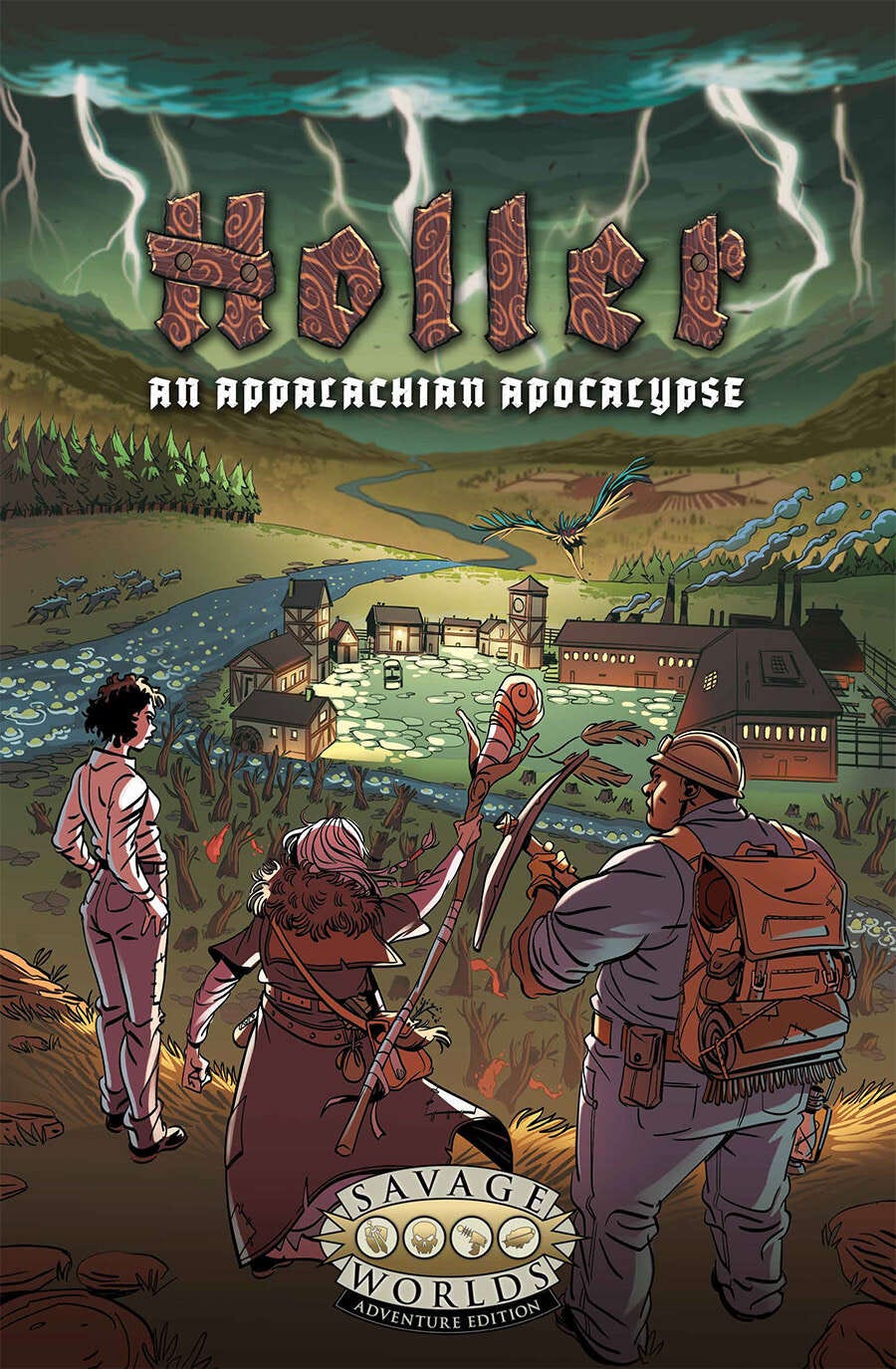
The second component is Holler: An Appalachian Apocalypse, Tim Earley’s folk horror setting for Savage Worlds Adventure Edition is an official Pinnacle product. Shane Hensley, who was raised in Appalachia himself and recognized in it something true. Holler is set in a sealed-off version of the Appalachian mountains threatened by the Blight, a toxic fog, and beset by demons, cryptids, haints, and roguish fey. Its heroes are everyday Appalachian folk like miners, moonshiners, granny women, holy rollers, roustabouts, and bluegrass pickers. That last archetype is John the Balladeer to the bone. The granny women are the keepers of the folk tradition Wellman spent decades documenting. The holy rollers are the Baptist and Methodist faith that John’s world takes seriously as a supernatural tool. Holler builds Wellman’s community architecture directly into the setting premise, The heroes are outmanned and outgunned, and they win through kinship bonds, wits, and the old knowledge and not through power levels.
The third component is the Savage Worlds Adventure Edition engine itself because it allows for the kind of casual heroism I think is necessary for a Wellman-esque role playing game. Savage Worlds has Wild Cards. These are Player characters and named NPCs who roll an extra d6 on every trait roll and keep the better result. Wild Cards are meaningfully, mechanically more capable than ordinary people. They survive things that kill extras, they act with a decisiveness that lesser characters cannot match. This matters because Thunstone, and other Wellman heroes, are Wild Card in the precise sense the game intends. He is described in the same breath as Doc Savage and Tarzan. He beats monsters with his fists. He is wealthy, physically imposing, and possessed of an encyclopedic knowledge of the occult that he uses as a tactical asset rather than a source of dread. Essentially, he’s a Lovecraftian “hero” if Robert E. Howard had created him. Anyone who has read “The Challenge from Beyond” knows what I am talking about. It’s a shared tale where each author writes a section and passes it on to the next author to navigate the section ending challenge. Lovecraft leaves the protagonist a wriggling mass horrified by what he has become, but Robert E. Howard has him take it in stride as a new adventure.
Yet—horribly verifying his disordered and unfamiliar sensations—it was not his own body at all that he saw reflected in the burnished metal. It was, instead, the loathsome, pale-grey bulk of one of the great centipedes. — H.P. Lovecraft, The Challenge from Beyond
He fought down an unreasoning horror. Judged from a cosmic standpoint, why should his metamorphosis horrify him? Life and consciousness were the only realities in the universe. Form was unimportant. His present body was hideous only according to terrestrial standards. Fear and revulsion were drowned in the excitement of titanic adventure. — Robert E. Howard, The Challenge from Beyond
As with Robert E. Howard’s version of George Campbell (the protagonist of Challenge) running Thunstone in Call of Cthulhu, where investigators are structurally fragile and sanity is a declining resource, fights his entire character concept at the mechanical level. Running him in Savage Worlds, where the Wild Card system says this person is exceptional and that exceptionalism is real and has teeth, is correct.
The three together form something none of them are individually. It provides a Wellman table that handles the intimate folk horror of John the Balladeer, the pulp action of Thunstone, and the community-rooted survivability of Hok in the same session, without switching systems, without the GM fighting the mechanics to reach the fiction.
Game 3: Chill, and Why It’s the Philosophical Answer
For groups who want the Thunstone and Pursuivant register specifically ( the occult detective, the investigation, the urban horror), the game you want is Chill, and the reason is not mechanical but architectural. Since it’s out of print, you’ll have to settle for Cryptworld by Daniel Proctor, but it’s a worthy successor.
Chill, originally published by Pacesetter in 1984, puts players in the role of Envoys of SAVE. Player characters are ordinary people dedicated to fighting the Unknown, the animating force behind all supernatural evil. The Envoys have access to the Art which is a collection of folk techniques, spiritual disciplines, and hard-won practices that give them real, reliable purchase against the Unknown. The Art is not spellcasting in the D&D sense. It is closer to what John the Balladeer does when he selects the right song for the right moment, or what Thunstone does when he inscribes the Latin from Judges on his blade and trusts that it means what it says. Sic pereant omnes inimici tui. Thus perish all your enemies. He believes it. The game should too.
More importantly, Chill is structurally hopeful. The Unknown is dangerous and the Envoys are human, but the game is built around the assumption that good people with the right knowledge can face down evil and win. This is the assumption Lovecraft’s fiction explicitly rejects and Wellman’s explicitly requires.
Game 4: The Problem Call of Cthulhu Cannot Solve
Call of Cthulhu is the obvious answer for the Thunstone and Pursuivant register, but it is wrong in an instructive way.
Let’s take a look at the first John Thunstone story. “The Third Cry to Legba” (1943) opens with a hidden cult performing ritual invocations of a powerful supernatural entity. There’s a secret congregation, a gate being opened, something terrible on the other side. If you described this to a CoC player they would recognize it immediately. It maps directly onto the Louisiana bayou cult from Lovecraft’s “The Call of Cthulhu.” It’s a similar structure of hidden worship, the same sense of an older world pressing through into the modern one, the same thrill of uncovering what should have stayed buried.
The difference is where the focus of the story lies and what the source of evil is. Lovecraft’s Louisiana cult calls something genuinely alien and the invesigators who encounter the cult are a part of the background narrative and not the real action of the story. The foe the cult wants to summon is a thing that erodes investigator sanity by proximity alone, because the human mind cannot process what it is. Wellman’s cult invokes Legba who is the Vodou lwa who opens the gate for other spirits. This is a figure with a real name, a real tradition, specific known vulnerabilities, and a counter-tradition that Thunstone has studied because he did his homework before arriving. This is not an imagined new horror, but a supernatural being from our world. The Necronomicon is referenced in the first Thunstone story, but as an aside. The reference is a knowing nod to Lovecraft’s universe that Wellman acknowledges exists and then declines to find particularly alarming. Wellman’s response is that of Howard. Why should I be afraid of this? I can learn from it. Thunstone has read the Necronomicon. He finds his saint-forged silver sword considerably more useful.
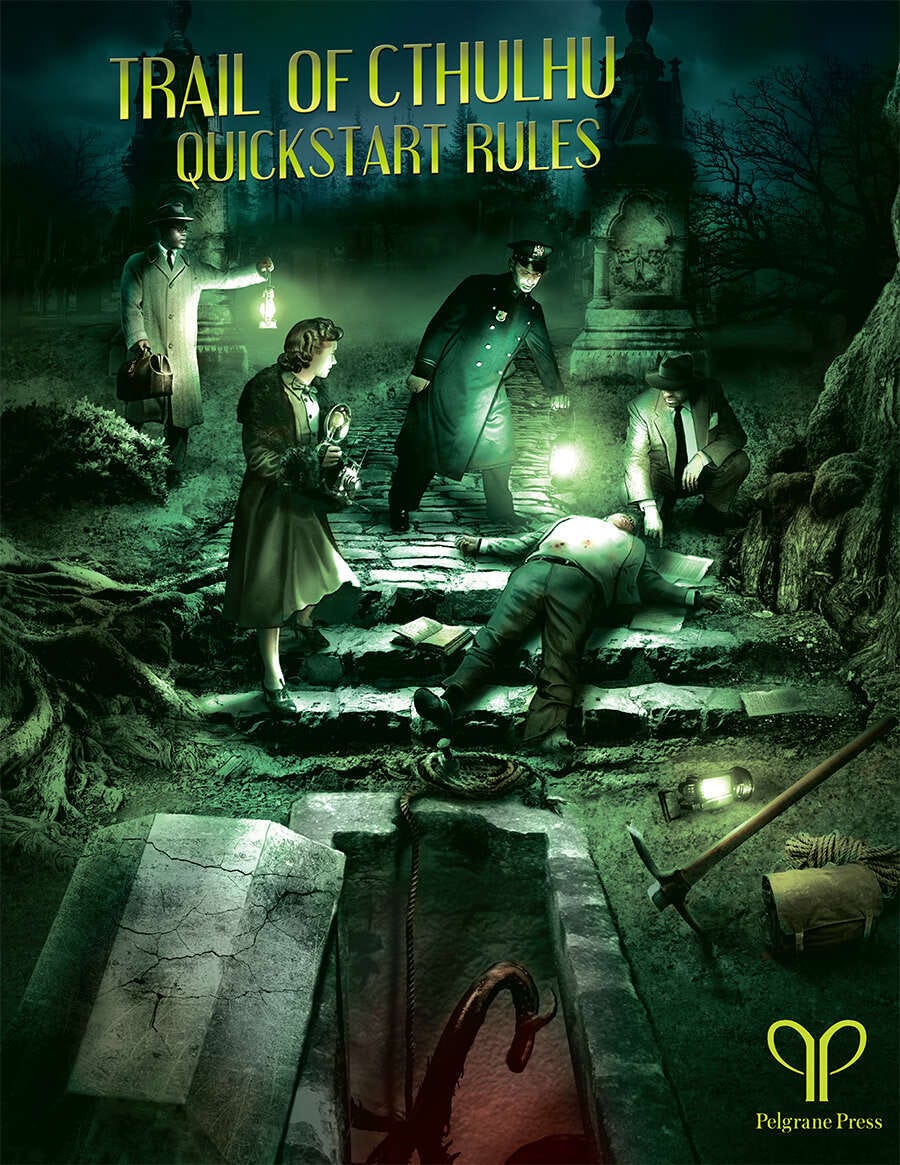
This is the architectural difference. CoC’s sanity system exists because Lovecraft’s worldview requires it, The more you know, the worse it gets, because what you learn is unbearable and true. Thunstone’s worldview is the direct inversion of Lovecraftian dread. The more you know, the better equipped you are, because correct knowledge of the right name and the right counter is exactly how you win. You can run Thunstone in CoC if you fight the system hard, but I think Kenneth Hite’s Trail of Cthulhu, the GUMSHOE variant, handles competent investigators better and rewards knowledge rather than punishing it. but you are still rowing against the current.
The Shonokins are where this distinction becomes sharpest. Wellman’s pre-human race. The cat-eyed, long-fingered, aliens who claim that North America was theirs before the first human set foot on it, feel at a glance like a Mythos race. They have the deep uncanniness that Lovecraft associated with the inhabitants of Innsmouth or the things beneath Dunwich, but they are not cosmic horrors. They are opponents. They have a specific, exploitable weakness. They cannot bear the sight of their own dead. Thunstone knows this and uses it with brutal efficiency. Running them as CoC Mythos creatures is a category error. It imports cosmic despair into a story built on the premise that the right knowledge, applied correctly and sometimes with a silver coated sword stroke, is enough.
While AD&D mentions Manly Wade Wellman, it’s a poor fit for his fiction in many was. To properly play a Wellman inspired game you need Chill, you need Savage Worlds. You need a system that agrees with him that faith is a tool, that folk knowledge is real power, that a big man with a silver sword and something worth defending can walk into the dark and come back out. The game built for Lovecraft’s universe is the wrong game for Wellman’s and knowing why tells us something about different people can approach horror as a genre.
Where Should You Start?
If you have read nothing by Wellman, start with Who Fears the Devil?, the Karl Edward Wagner edited John the Balladeer, or the Complete John the Balladeer. The story that usually opens these anthologies is “O Ugly Bird!”, and it is as good an entry point as exists in American horror fiction. It’s lean, funny, frightening, and quietly devastating. It contains everything Wellman does that nobody else does. It’s also a joy to read aloud because Wellman captures the voice of the Holler so well.
After you’ve finished with the Balladeer, I recommend Worse Things Waiting, the Carcosa Press collection that was also published by Shadowridge Press. This gathers Wellman’s Weird Tales horror across the full range of his work. It features Thunstone, Pursuivant, standalone horror, and other stories ranging the breadth of a career. It is hard to find and worth finding.
The Kardios stories are in print from DMR Books, which has done serious work bringing Wellman’s prehistoric fiction back into circulation. Read them as a companion to Howard’s Kull stories. They demonstrate same fascination with the deep past, with a very different conception of what that past means. Kardios is a classical scholar’s idea of adventure fiction, which is either a recommendation or a warning depending on your tolerance for myth rendered straight.
And if you want to understand what it felt like to be inside the community of writers who took Wellman seriously, read David Drake’s website. The essays are brief and personal and irreplaceable. A man remembering his teachers.
Manly Wade Hampton Wellman was born on May 21, 1903, in Kamundongo, Angola. He died on April 5, 1986, in Chapel Hill, North Carolina. His ashes are scattered in the yard of the house he shared with Frances for fifty years. She said she still saw him around the house after he was gone. She died in 2000. Their ashes are together now.
He was 122 years old yesterday. He deserves more readers than he has. Go remedy that.
Wellman at the Table: A Gaming Companion
Stat Blocks and Adventure Seeds for Savage Worlds Adventure Edition and Chill (Pacesetter 1st Edition, 1984)
SWADE stat blocks use Savage Worlds Adventure Edition (Pinnacle, 2018). Named player-character analogues are presented as Wild Cards. Chill stat blocks use the Pacesetter 1984 first edition. Human characters list flat ability scores (range 26–80); creatures use the dice(score) notation from the Horrors from the Unknown booklet. The Shudder Mountains boxed set (Goodman Games) and Holler: An Appalachian Apocalypse (Pinnacle) are referenced as setting materials throughout. The sourcebooks aren’t required, but both are worth owning.
Chill mechanical reference: Sense Unknown = PCN ÷ 5 (drop fractions). Art qualification requires original PCN 60+ and WPR 50+. Art bases: Communication = (PCN+PER)÷2; Restoration = (PCN+STR)÷2; Protection = (PCN+LUCK)÷2. Each discipline costs 2d10 WPR plus optional additional WPR to raise base chance (Campaign Book p.52). The Evil Way is the province of Unknown creatures only.
The Heroes
Silver John (John the Balladeer)
Korean War veteran. Wandering musician. The silver strings on his guitar are not affectation, they are the same silver that turns werewolves and drives off the old things. He plays them with the same deliberateness that a man chambers a round. He knows the old songs, the old customs, the old names. He has faith the way mountain people have faith. His faith is not a theological position but a working assumption, tested daily against a world that contains real darkness.
SAVAGE WORLDS ADVENTURE EDITION — Wild Card
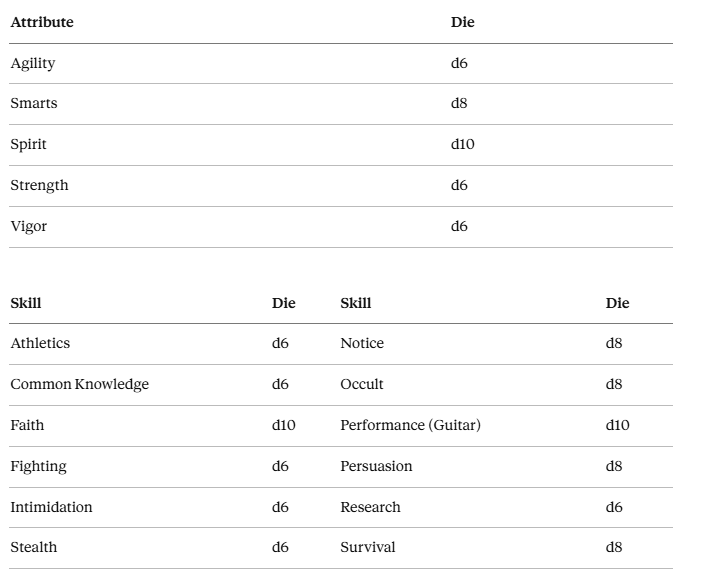
Pace 6 · Parry 5 · Toughness 5
Edges: Arcane Background (Miracles), Connections (Appalachian mountain communities), Strong Willed, Woodsman
Hindrances: Heroic (must aid those in need), Poverty (wandering musician — owns what he carries), Vow (Minor — never use the old knowledge for personal gain)
Arcane Background (Miracles) — Faith d10 · Power Points 15
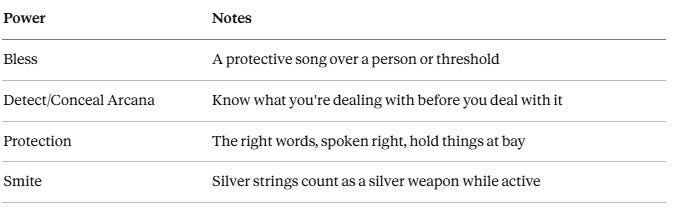
Special Equipment: Silver-strung guitar. Functions as a holy symbol; John receives +2 to all Faith rolls when actively playing against supernatural evil. A creature with a specific musical vulnerability (GM’s discretion) may suffer an additional −2 to its Fear check when John plays.
Designer’s Note: Silver John is not a fighter, and running him as one misses the point. His Spirit and Faith are the load-bearing stats. He wins by knowing the right thing and doing it at the right moment. He should feel like a Chill Envoy wearing SWADE boots.
CHILL 1ST EDITION (Pacesetter, 1984) — Human Character / SAVE Envoy Equivalent
STR  58        PCN  66
DEX  54        STA  60
AGL  56        LUCK 60
WPR  76
PER  70
Sense Unknown: 13 (PCN 66 ÷ 5) Unskilled Melee: 57 ((STR 58 + AGL 56) ÷ 2)
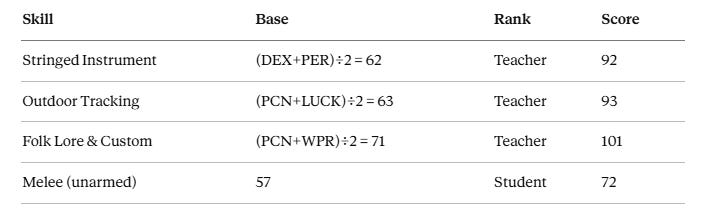
The Art: Qualified (PCN 66, WPR 76). John begins with one free discipline and has earned others through years of practice.

Silver strings: When John plays and sings as the action for a Protection discipline, add +10 to his base chance. This bonus is lost if he is interrupted, struck, or forced to stop playing. The guitar is not enchanted. It is consecrated by use and faith. The Unknown knows the difference.
Notes: John’s WPR of 76 is his defining characteristic. He resists fear, persuasion, and Evil Way Subjection disciplines better than his Stamina and Strength suggest. Folk Lore & Custom at 101 means he nearly always identifies what he is dealing with. In Wellman’s stories, knowing a thing’s name is most of the battle.
John Thunstone
Scholar. Playboy. Enemy of evil. He is large the way a working man is large. He’s the Doc Savage of Occult Detectives. His sword-cane carries a blade of silver inscribed with Latin from Judges: Sic pereant omnes inimici tui. Thus perish all your enemies. He believes it. Rowley Thorne bald, burly, based on Aleister Crowley is Thunstone’s Moriarty. They have met four times and Thorne has lost four times. This was not because Thunstone is luckier. It was because Thunstone came in knowing what he was dealing with. He knows he is living in a horror story and, as Supernatural has shown us, that changes everything.
SAVAGE WORLDS ADVENTURE EDITION — Wild Card
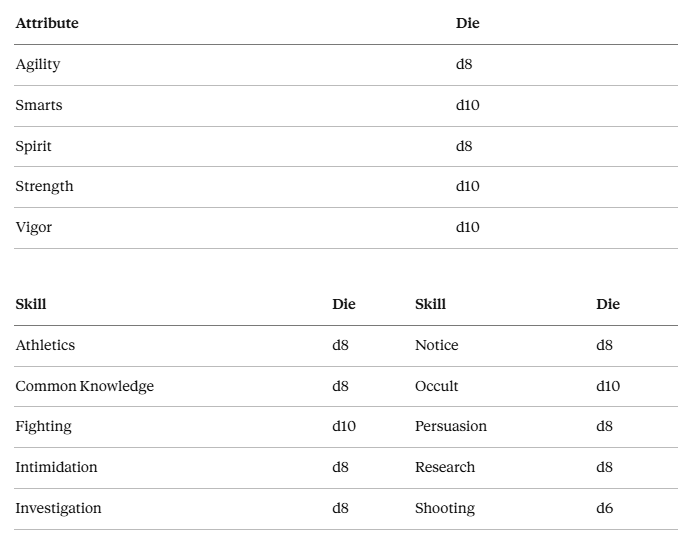
Pace 6 · Parry 7 · Toughness 9
Edges: Brawny, Combat Reflexes, Filthy Rich, Investigator, Scholar (Occult; History of Religions), Strong Willed, Sweep
Hindrances: Code of Honor (will not use knowledge of evil to commit it), Enemy (Major — Rowley Thorne, recurring and durable)
Special Equipment: Silver sword-cane (Saint Dunstan’s blade). Damage Str+d6. +2 damage against supernatural creatures. Counts as a blessed weapon against undead, demons, and entities of the Unknown. While Thunstone holds the blade and speaks the inscription aloud, he gains +2 to Spirit rolls for the remainder of the round. The words have meaning and power in Wellman’s fiction, and the game should reflect that.
Designer’s Note: Thunstone’s physical dominance is a part of the narrative and Strength d10, Vigor d10, Brawny, and Sweep together mean he handles groups of Extras efficiently and without drama. Against Wild Cards and genuine supernatural threats, Smarts and Occult become the decisive factors. He is built to win. Wellman wrote him to win. The GM should not apologize for that.
CHILL 1ST EDITION (Pacesetter, 1984) — Human Character / SAVE Envoy (Veteran)
STR  76        PCN  74
DEX  66        STA  78
AGL  68        LUCK 62
WPR  72
PER  70
Sense Unknown: 14 (PCN 74 ÷ 5) Unskilled Melee: 72 ((STR 76 + AGL 68) ÷ 2)
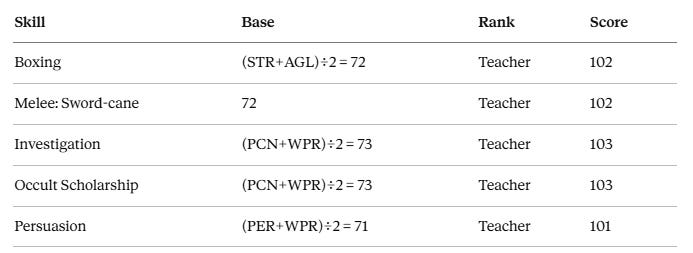
The Art: Qualified (PCN 74, WPR 72)

Silver sword-cane: Str+d6 damage. Against Unknown creatures with silver or holy vulnerabilities, wounds are one category more serious. The inscription Sic pereant omnes inimici tui functions as an active Ward (Protection) when Thunstone holds the blade and speaks the words. When he does this there is no WPR cost, and the ward cannot be disrupted, but it’s only usable once per session.
The Antagonists
Rowley Thorne
He is based on Aleister Crowley the way a scalpel is based on a kitchen knife. Bald, burly, seemingly unkillable — he bargains with outer powers for abilities he turns on anyone who gets in his way, and Thunstone has been in his way four times. This has not improved his disposition. He dresses well, speaks well, and is genuinely learned: a better occultist than most of the people who call themselves occultists, and a worse human being than most of the people who call themselves villains.
SAVAGE WORLDS ADVENTURE EDITION — Wild Card
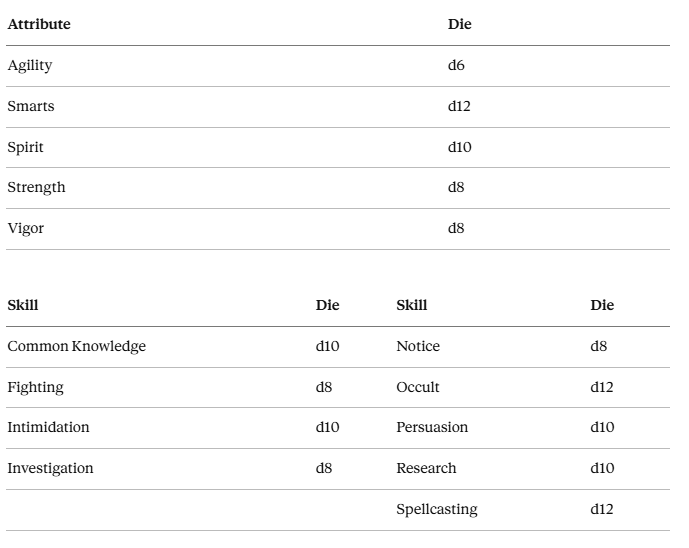
Pace 5 · Parry 6 · Toughness 8
Edges: Arcane Background (Magic), New Powers ×3, Power Points 20, Scholar (Occult; Forbidden Systems), Strong Willed
Hindrances: Arrogant (he has been right about nearly everything — this is not entirely unfounded), Enemy (Major — Thunstone), Overconfident
Arcane Background (Magic) — Spellcasting d12 · Power Points 20
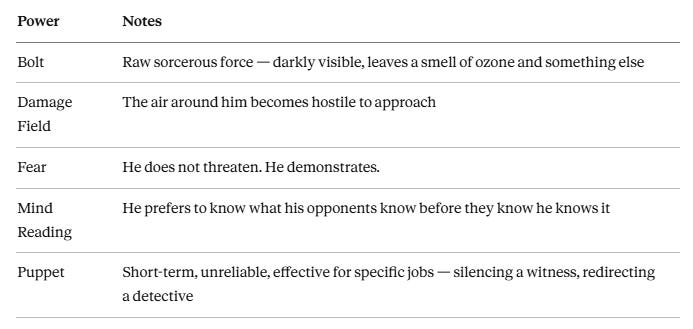
On recurring survival: Thorne should escape the first encounter… and the second. Wellman structured the Thunstone stories around a nemesis who does not stay dead in the conventional sense. The mechanism whether it is a prepared contingency, a pact with something patient, or a vessel waiting elsewhere should never be fully explained until the campaign’s equivalent of The School of Darkness. His Power Points regenerate at the standard rate, but the GM should note: something is always paying attention when Thorne draws on these powers. Something is keeping a ledger.
CHILL 1ST EDITION (Pacesetter, 1984) — Human Villain / Major NPC
Thorne is human, which means the Evil Way is technically not available to him — the Evil Way is the province of the Unknown. Thorne has solved this by making arrangements with things that should not be arranged with. Treat his Evil Way access as illegitimate, expensive, and never quite reliable. Something always knows when he uses it. Something always takes note.
STR  62        PCN  74
DEX  52        STA  66
AGL  46        LUCK 40
WPR  80
PER  70
Sense Unknown: 14 (PCN 74 ÷ 5) Unskilled Melee: 54 ((STR 62 + AGL 46) ÷ 2)
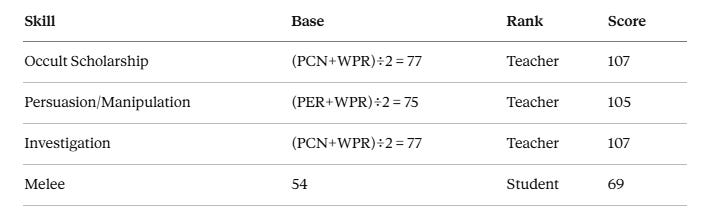
The Art: Qualified (PCN 74, WPR 80) and deeply corrupted

Evil Way access (illegitimate): Thorne uses the following at EWS 85 (the minimum score). The CM should never explain exactly how he acquired this access.
Harm (Distortion, Column 2, Cost: 2 wpr/use, Range: Sight, Area: 1 character) — on a C result, the target loses 1d10 STA immediately
Influence (Subjection SP, Column: Will, Cost: 10 wpr/use, Range: Sight, Area: 1 being) — long-term mental compulsion; Thorne’s preferred weapon for acquiring allies and silencing witnesses
On survival: His LUCK of 40 is deliberately low. Whatever keeps Thorne alive is not luck. The CM decides the mechanism and keeps it vague. He returns, slightly changed, never quite explaining what it cost him.
The Shonokins
They were here before we were. They say so, and they are not lying. Their eyes catch light wrong. Their ring finger is longer than their index. Their nails, their teeth are different. They dress in homespun wide-brimmed hats and walk roads that appear on no map. They have been waiting for the agreement that displaced them to expire. Every Shonokin is a sorcerer. They have one weakness so specific and so strange that it seems almost designed to be found. They cannot bear the sight of their own dead. Thunstone figured this out and he uses it with what the source fiction calls brutal efficiency. So should your players.
SAVAGE WORLDS ADVENTURE EDITION
Shonokin (Extra)
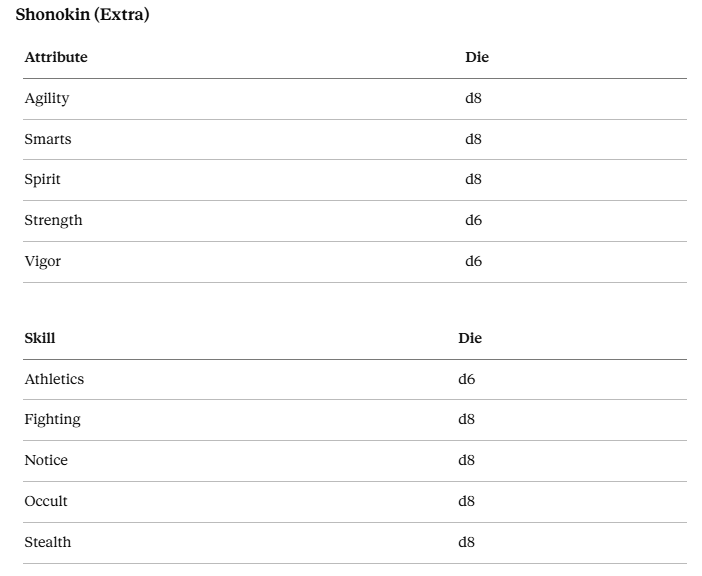
Pace 6 · Parry 6 · Toughness 5
Special Abilities:
Ancient Sorcery: Once per round a Shonokin may use one of the following without a Spellcasting roll against unresisting targets; resisting targets make an opposed Spirit roll:
Bolt: 2d6 damage, range 12/24/48
Blind: target at −2 to all trait rolls for 1 round (vision-based)
Fear: target makes a Fear check at −1
Domain Awareness: +2 to all trait rolls in territory the Shonokins claim as their own. They are always aware when someone enters their domain.
Weakness — Their Own Dead: When a Shonokin can see the corpse of another Shonokin, it must make a Spirit roll (TN 6). Failure: Shaken and must move away from the corpse at full Pace. Critical failure (1 on the Wild Die): Panicked. A panicked Shonokin flees the area entirely and will not return this encounter. A Shonokin cannot use Ancient Sorcery while subject to this Weakness. The Shonokins know this. They collect and remove their dead as a matter of strategic practice.
Shonokin Shaman (Wild Card)
As above but: Spirit d10, Occult d10. Additional powers via Spellcasting d10: Puppet (full SWADE mechanics, resisted by Spirit), Curse (−2 to all of target’s trait rolls for 1 hour, resisted by Spirit). The Shaman is the community’s strategist and negotiator. Treat as a named NPC. Wild Card (d6 Wild Die on all trait rolls).
CHILL 1ST EDITION (Pacesetter, 1984) — Unknown Creatures / Pre-Human Intelligences
The Shonokins sit awkwardly in Chill’s taxonomy — they are not demons, not undead, not spirits. They are something older. Treat them as a distinct category of Unknown with their own relationship to the Evil Way. The CM should resist explaining them further than the source fiction does.
STR  4 (60)      PCN  5 (75)
DEX  4 (60)      STA  4 (60)
AGL  4 (60)      EWS  95
WPR  5 (75)      FEAR 4
PER  3 (45)      ATT  1/60%
Movement: L 90’ A NA W NA Sense Unknown: 15 (PCN 75 ÷ 5) Unskilled Melee: 67 ((60+75)÷2)
Disciplines: Harm (Distortion, Column 2, 2 wpr/use, Sight range, 1 character), Influence (Subjection SP, Column: Will, 10 wpr/use, Sight range, 1 being), Cloak (Distortion — supernatural concealment; −30 to all PCN checks to detect the Shonokin, cost 1 wpr/round)
Collective Influence: A Shonokin community exercising Influence simultaneously adds +5 to the base EWS check for each Shonokin beyond the first. This is how they take territory. They don’t do it by force but with coordinated, invisible pressure.
Manipulation: Yes — through Influence.
IPs: 750
Weakness — Their Own Dead: When a Shonokin sees a dead member of its kind, it must make an immediate WPR check (against WPR 75). Failure: all Evil Way use ceases instantly; the Shonokin flees and will not return while the body remains. On S or L only: shaken but present — at −20 to all checks until the body is out of sight.
The investigation’s central goal in any Shonokin scenario is finding a body before the community retrieves it.
Shonokin Shaman (advanced): EWS 110, WPR 6(90), PCN 6(90). Additional disciplines: Sleep (Subjection, Column: Will, 25 wpr/use, Room range), Steal Memory (Subjection SP, Column: Will, 10 wpr/use, Sight range, 1 being). The shaman is the community’s last resort. Treat as a named NPC with individual history and motivations.
Adventure Characters (The Big Bad)
Everett Caul
Everett is a graduate student in theology. Twenty-six years old. Brilliant, methodical, and genuinely convinced that what he found in the missing professor’s office represents an opportunity rather than a warning. He is not evil in any conventional sense. He is simply the kind of person who reads do not perform this ceremony and asks whether that applies to him specifically.
He has performed two-thirds of the ceremony. He believes he is binding something dangerous and making it safe. He is probably wrong. He is not certainly wrong. The players will have to engage with his argument on its own terms and you can decide the outcome.
Caul is dangerous not because he is a skilled sorcerer but because he is operating machinery he does not fully understand, on a schedule that is nearly complete, in a building that has been quietly wrong for a hundred and thirty years.
SAVAGE WORLDS ADVENTURE EDITION — Wild Card
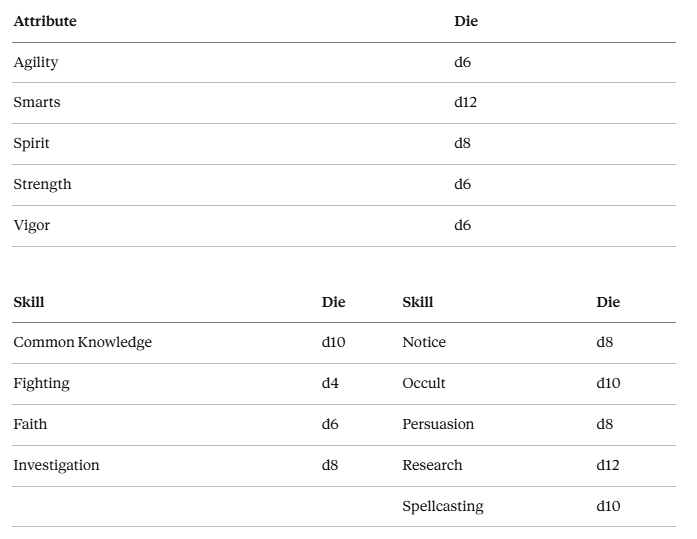
Pace 6 · Parry 4 · Toughness 5
Edges: Arcane Background (Magic), Scholar (Theology; Folklore), Investigator
Hindrances: Curious (Major — he cannot leave a mystery alone; this is the whole problem), Overconfident, Stubborn
Arcane Background (Magic) — Spellcasting d10 · Power Points 10
Caul’s powers are partially improvised from Thorne’s fragmentary notes. They work, mostly, in the sense that a gun assembled from mismatched parts works/ It is functional until the moment it isn’t.
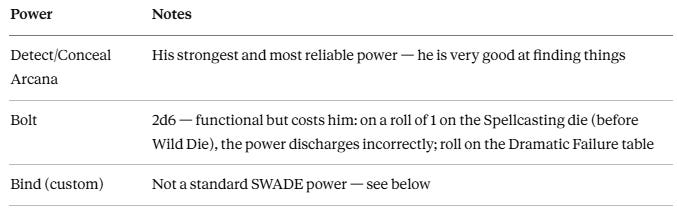
Bind (Custom Power): Caul’s partial ceremony has given him limited access to a binding ritual. When used against the entity in The School of What Remains, this power acts as Puppet (resisted by the entity’s Spirit d12) but requires two consecutive successful Spellcasting rolls in the same round to activate. The first succesful roll first begins the binding, the second completes it. If the second roll fails, the first roll’s PP are spent and the effect does not occur. This is the nature of incomplete ritual work.
On running Caul: He should be an antagonist the players can talk to, argue with, and if they are persuasive enough, turn. A Persuasion roll at −2 against his Smarts d12 opens genuine dialogue. Two successive successful Persuasion rolls against his Spirit d8 creates the possibility of his cooperation. He will not cooperate unless he believes the players’ alternative is better than his own plan. This means they need an actual alternative, not just an objection.
If the players allow him to complete the ceremony, it works. Imperfectly. The entity is bound, not destroyed, in a containment that will last thirty to fifty years by Caul’s estimate. This is probably accurate. What happens in thirty to fifty years is a future campaign arc.
Adventure Seeds
I. “THE THIRD GATE” (Chill 1e — Urban Investigation)
Thunstone / Pursuivant in tone. One session, expandable.
The Setup: A jazz club in lower Manhattan has been open for four months. The music is extraordinary. The bandleader, a man named Constant Mabry, seems to have found something in the music that nobody else has. Audiences leave changed. They quieter, more compliant, and subtly “wrong.” Three patrons have gone missing. A fourth was found dead in the river, his expression peaceful, his hands arranged as if playing an instrument he was not holding.
An Envoy with Investigation (Occult specialization) recognizes the club’s name, the Legba Room, and understands what it means. Legba opens the gate. Mabry has found half of an old Haitian ceremony and has been performing it nightly, calling something through, and the something has been answering.
The Unknown: Mabry is not the threat. He is merely the conduit, and he does not fully understand what he is doing. The threat is what has been coming through. It’s a loa-adjacent entity (EWS 100, FEAR 5) that is using the music to accumulate Influence over a growing number of New Yorkers. It cannot be banished while the ceremony continues. The Envoys must find the counter-ceremony (Occult Scholarship check at −20 without a specialist in Haitian folk tradition), locate someone who can perform it (a scholar in Brooklyn, not an Envoy, not entirely cooperative), and perform it in the club while the entity is present and hostile.
Thunstone as NPC: Thunstone appears midway through, having followed the same thread independently. He knows the counter-ceremony but will not share it immediately. He wants to assess the Envoys first. A Communication roll (or a good reason, which he accepts in lieu of a roll) wins his cooperation. He will handle Mabry if the Envoys handle the entity. Bring him in only if necessary or if you feel it will add to the story. The Envoys should be the heroes if possible.
The Complication: Mabry has begun to understand what he opened. He is terrified. He is also, genuinely, one of the finest musicians alive, and the entity knows this and is keeping him alive specifically. Shutting down the ceremony means shutting down Mabry’s music permanently. This is not a mechanical question. Let the players decide what they think that is worth.
II. “WHAT THE HOLLOW HOLDS” (Savage Worlds — Folk Horror)
John the Balladeer in tone. Two sessions. Uses Shudder Mountains geography and Holler folk horror framework.
The Setup: The Garner family settlement, twelve households, three generations, one of the oldest communities in the Shudder Mountains, has gone quiet. No one comes to market. No letters. A cousin who went to check came back three days later and will not say what she saw, only that the hollow is not right and the people are still there and she does not think they want to leave anymore.
The players are local people the Garners know and trust. One should play music and fill the Balladeer slot, whether or not they are John literally. One might be a granny woman with working knowledge of the old protective traditions. They are from here, which means they know what the hollow has always been, and they know something has changed. If you are using pre-generated characters, use those two character seeds. If not, try to encourage those kinds of characters.
What Actually Happened: The Shonokins have reclaimed the hollow. They have not harmed the Garners. The agreement, as they understand it, permits them to assert presence in unceded territory, and this hollow appears on no map and no deed that counts in their reckoning. The Garners are under a sustained Puppet effect that makes them content, peaceful, unwilling to leave. Seven Shonokins hold the hollow, including one Shaman Wild Card. None of them will initiate visible conflict. They will present their case that they were here first, the agreement permits this, and the Garners are not being hurt as a defense for why they should be allowed to stay and corrupt the hollow. The thing is, they are not exactly wrong and this should be the unsettling part. The players need to know what the cost of letting Shonokins control the area really means.
The Key: There is a dead Shonokin in the root cellar of the oldest Garner house. The eldest Shonokin died two weeks ago of causes unrelated to the settlement. The community brought the body here because the hollow felt right. They have not retrieved it because they cannot enter that house. They say it is the humans’ space, which is technically correct, and they also cannot enter without risking the thing in the cellar.
The Garners do not know the body is there. Neither will the players, until they ask the right questions and make the right Notice rolls.
The Climax: Once the players find the body, the Shonokins know. The shaman attempts to negotiate immediately. He tells the PCs that they will release the Puppet effect and withdraw if the body is returned. Whether the players accept, what conditions they extract, and whether they trust the Shonokins to hold to the agreement is a moral question the scenario does not answer for them. There is no clean offensive resolution. There is no clean trusting resolution. This is Wellman’s territory. The encounter is survivable, communal, but not without cost.
The Music: At some point during the investigation the Balladeer equivalent player should get a moment to use Performance. When the right song is played in the right place at the right time, the Shaman’s Spirit roll to maintain the Puppet effect suffers a −2 penalty. This is not decisive. It is meaningful. In Wellman, those are the same thing.
III. “THE SCHOOL OF WHAT REMAINS” (Savage Worlds or Chill 1e — Hybrid)
Thunstone / Pursuivant in tone. Three sessions. Either system with minimal adjustment.
The Setup: Dunstan College is a theology and liberal arts school in the North Carolina mountains that was founded 1887 and has an enrollment of 340 students. Three students have recently withdrawn without explanation. The folklore professor has not been seen in two weeks. The college president, Dr. Eleanor Hayne, has sent a letter to the players’ organization because she does not know what she is dealing with and knows she does not know.
The college was built on the site of something older andt he folklore professor found records of that oldest layer. She should not have started translating them, but she did and the costs have been high.
The Antagonist: Everett Caul (see stats above). He found Rowley Thorne’s notes in the professor’s office and has performed two-thirds of a binding ceremony that might protect the college. The professor interrupted him at the critical moment and she is now in a state that Caul describes, when pressed, as a necessary pause.
The Wellman Element: The professor is alive, in the college’s oldest building. She’s in a room that does not appear on the current floor plan and she’s in a condition that Thorne’s notes describe how to reverse. Finding the records, translating the relevant section, and applying the counter while Caul attempts to complete his ceremony is the three-session arc. Can the player’s get Caul to give them access to the notes and stop the binding? Should they stop the binding? Is there a better solution?
The Moral Question: Caul is not summoning anything. He is attempting to bind something that came through in 1887 when the college’s founders built on this site without knowing what they were building on. He believes binding it will make it safe. He is probably wrong. He is not certainly wrong. The players must engage with this argument before they can answer it.
Cross-System Notes:
In Chill 1e: The entity has EWS 115 and is partially manifested. Its disciplines function but it cannot yet take physical form. The counter-ceremony requires an Occult Scholarship check at Teacher rank and two uninterrupted turns. The entity will attempt Influence on any character attempting the counter. Dr. Hayne has a Sense Unknown of 12. She has been aware something was wrong for months and is a better asset than she appears.
In SWADE: Use Caul’s full stat block above. The entity manifests physically in the final session with Spirit d12, Toughness 12, Fear −2, and immunity to non-silver, non-blessed weapons. The professor’s counter-ceremony, when performed correctly, reduces Toughness to 8 and removes immunity for the scene. This is the players’ window. If Caul completes his ceremony instead, see the note under his stat block.
The Ending Wellman Would Write: The entity is bound, not destroyed. Caul is shaken, humbled, and possibly salvageable. The professor recovers but carries something with her, a knowledge she cannot unlearn. Dr. Hayne thanks the players and asks no further questions, because she has decided to know exactly as much as she needs to know and no more. The oldest building on campus remains the oldest. The hollow under the foundation is still there.
But the immediate crisis is over, and the people who needed protecting are protected. In Wellman, that is what a win looks like.
I owe Mike Mignola thanks for introducing me to Wellman; he mentioned the Silver John stories in the introduction to a collection that had Hellboy's The Crooked Man in it. I loved the Crooked Man so much, I spent waaaaay too much money on Night Shade Press's 5-book Wellman Collection.
Thank you for this article and the links within, I've learned some things about one of my favorite authors.
I had a conversation with David Drake at a con a few years before he died. He held the rights to MWW's stuff at that point and was open to licensing it. I don't know who would hold them now.
I liked the Shanokins and updated them as Shadowkin in some Kolchak fan fiction.
https://randallhayes.substack.com/p/the-rake