


“Smith’s errand in Lakkdarol, like most of his errands, is better not spoken of. Man lives as he must, and Smith’s living was a perilous affair outside the law and ruled by the ray-gun only.” — C.L. Moore, Shambleau, 1933
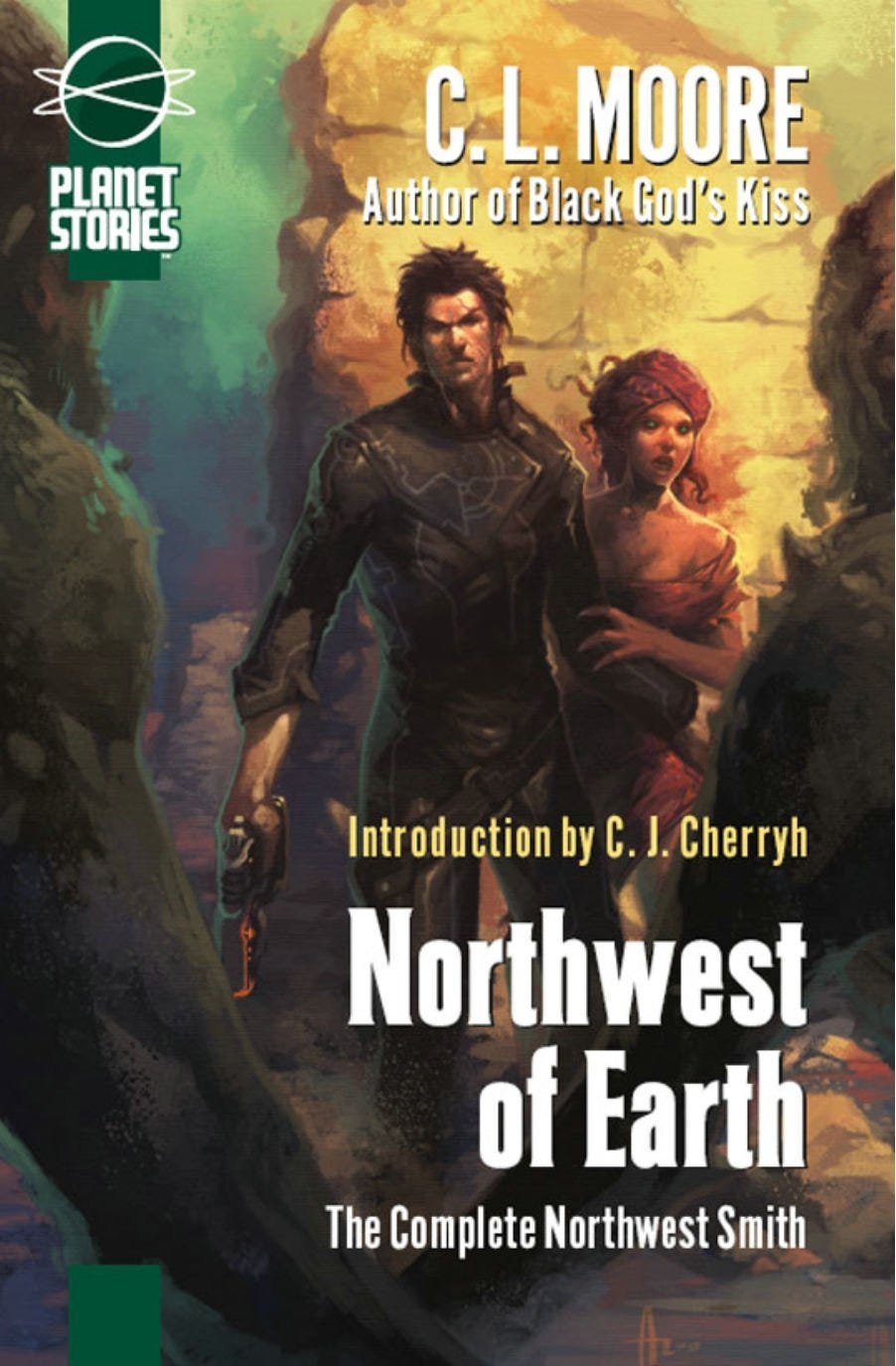
Why am I Adding Game Material at the End of this Article?
I really like reading and writing about fantasy and science fiction stories and so do a lot of my readers. A lot of my readers also love playing role playing games and discussing the fiction that surrounds them. I’ve been thinking about the book and story reviews I’ve written over the years and I realized that I was violating one of the old Google+ OSR rules: “If you are going to write a long article, you should include game content at the end.” Today, that changes. From now one, when I write a review of material from Appendix N it will have accompanying role playing game material at the end of the article. That way, those readers who are just interested in the book material won’t be distracted by game material; and those who want game material related to the fiction will have it available. I think it captures the “Old White Dwarf/Dragon” feel I’m aiming for pretty well, which brings me to a series of articles I’ve been writing discussing the stories of Northwest Smith by C.L. Moore.
Why You Should Read the Northwest Smith Stories and Why I’m Writing a Series of Articles
The easiest way to introduce C.L. Moore's Northwest Smith stories to a new reader is to compare him to Han Solo. If you do a quick Google search, you’ll see that the comparison has been floating around geek culture for decades. It’s about as accurate as The Hidden Fortress connection with Star Wars that David Ehrenstein wrote about in his discussion of The Hidden Fortress for Criterion in 1987, a connection that is reinforced in a 2001 interview that Lucas did with Criterion. Interestingly, it was John Milius (of Conan the Barbarian and Red Dawn fame). Anyone who has actually watched The Hidden Fortress sees the connection, but also sees that a lot of the commentary around the connection is hyperbolic. There’s as much Flash Gordon and Kurosawa in Star Wars, but cineastes are going to cineaste. That’s all beside the poing because, in the case of Northwest Smith the comparison does the basic job. Both are space outlaws with a quick gun, a checkered past, and a loyalty problem that turns out to be loyalty after all. If that framing gets someone to pick up Shambleau or a Northwest Smith collection then it has earned its keep.
But the comparison undersells what Moore was actually doing, and I've noticed that readers who come in through the Solo door sometimes bounce off the stories precisely because they're expecting something different. Northwest Smith is not a swashbuckler. He is not triumphant. He moves through the solar system the way a man moves through a landscape that is trying to consume him. Since Moore’s tales include more than a few elements of cosmic horror, Smith comes close, more than once, to letting it consume him.
What Moore built between 1933 and 1940 is a peculiar and unreplicable thing. She wrote stories that had a Weird Fiction engine running on Planetary Romance fuel. The solar system she imagined draws on the fiction of Edgar Rice Burroughs. Shas an ancient Mars, lush and dangerous Venus, but instead of it being populated with the Edwardian ideal of heroism, she populates it with something closer to genuine dread. Her Mars is exhausted and full of things that predate human civilization by geological ages. Her Venus is beautiful in the way that things are beautiful to attract the unwary to become dinner.
There is a heavily Western influenced element that is real and worth highlighting. Smith moves through this setting like a gunfighter, which is to say like a man who has substituted speed and nerve for the kind of moral order that other people depend on. There's a reason the stories feel like they take place in frontier country even when the frontier is the Martian desert. But where the Western gunfighter usually maintains a certain heroic (or ironic) distance from the darkness around him because he sees the world clearly because he's seen it all, Smith does not. Where John Wayne’s Quirt Evans from Angel and the Badman would suss out danger at a moment’s notice and take quick action to prevent getting trapped, Smith gets drawn in. If Quirt believes someone is pure of heart, they are. If Smith does, he’s got a good chance to be wrong and if it’s a fatal temptress seeking to destroy him he’ll nearly succumb. The stories are, repeatedly, about what happens to a man who thought his toughness was a wall and discovers it has gaps in it.
That is what makes them worth reading. That is what I have been writing about.
The Series So Far
The Encountering Northwest Smith series launched in October 2023 and has now covered six of Moore's original stories. Here is where we've been.
"Encountering Northwest Smith: 'Shambleau'" (October 30, 2023) starts with the tale that set the pattern. "Shambleau" is the story that introduced Moore to Weird Tales readers in November 1933, and it remains the essential text. It is the story that establishes the template and includes one of the most terrifying monsters in the series. Smith rescues a creature being hunted through the streets of a Martian town, brings her back to his quarters, and ends up endangering himself in the process. The piece examines what kind of story Moore was telling. She isn’t giving us a horror story in the Lovecraftian mode, where the terror is the vast indifference of the cosmos. Instead she provides us something more intimate and more disturbing. She writes a horror story about innocence and temptation and about the parts of a person's inner life that toughness can't protect.

"Encountering Northwest Smith: 'Black Thirst'" (December 12, 2023) moves the action to Venus and to one of the stranger villains in Moore's solar system. The Alendar is a being of immense age who has spent centuries distilling and consuming the essence of beauty itself. He’s a vampire who feeds not on blood, but on beauty. "Black Thirst" is Moore at her most operatic. In the piece I look at how Moore constructs the Alendar as a figure of genuine horror rather than mere menace. I also look at the logic of what he is, and why that logic, once grasped, is so unsettling. My piece explores how Moore uses Venus as a setting. Venus isn’t an inhospitable alien world but a place of dangerous abundance, where the lushness of everything is part of what makes it lethal.
“Encountering Northwest Smith: ‘Scarlet Dream’” (June 5, 2024) is the outlier of the series in the best possible way. The story concerns a cloth, a shawl, that transports its wearer to a dimension that is not quite a place and not quite a dream. “Scarlet Dream” is where Moore’s prose texture becomes the argument. The piece examines how she creates a sense of wrongness not through explicit description but through accumulated atmosphere, and why the story’s resolution is more disturbing than most horror endings that are trying harder. Where other stories merge the Western and Cosmic Horror, “Scarlet Dream” mashes up tales of Faerie with Lovecraftian dread. It’s fantastic.

“Blogging Northwest Smith: ‘Dust of the Gods’” (July 25, 2024) brings Yarol, Smith’s Venusian partner and an interesting secondary character in the series, to the center of the story. “Dust of the Gods” is driven by a drug that induces visions of things that predate the human solar system, and it is one of the clearest expressions of what I think Moore was doing with the cosmic horror element. Her universe is not Lovecraft’s universe of malign emptiness, but something older and stranger and not entirely malign. Like Lovecraft, she evokes the cosmology of Lucretius’ de Rerum Natura, but the shift away from malign emptyness adds a horror that is in some ways is worse than nihilistic indifference. The piece examines Yarol as a character in his own right and what his perspective adds to the series that Smith’s perspective alone cannot provide.

“Encountering Northwest Smith: ‘Julhi’” (August 26, 2024) is the series at its most formally experimental. Moore is pushing at the edges of what the Weird Fiction story can do with point of view and the nature of the entity Smith encounters. The piece examines how Moore constructs Julhi as a genuinely alien presence rather than a monster in the conventional sense, and why that distinction matters for the horror the story generates.

“Encountering Northwest Smith: ‘Nymph of Darkness’” (September 4, 2024) covers the story Moore co-wrote with Forrest J. Ackerman. It’s a collaboration that raises questions about authorship and the degree to which the Northwest Smith voice is Moore’s specifically. I explore the co-authorship question as an entry point into what makes Moore’s solo prose distinctive, and what the Nymph herself represents in the context of the series’ ongoing interest in entities that interact with human consciousness in ways that bypass the will. I also touch upon Ackerman’s complex legacy and how that intersects with modern fandom. I don’t go too much into detail there, because Forry’s positive contributions are vast, but I do acknowledge them.

Where the Series Is Headed
Six stories down, and the series is not finished. Moore wrote eleven Northwest Smith tales in total before the character was effectively retired, and there are several that deserve the same close attention. I am very much looking forward to reading “Yvala,” “Lost Paradise,” “Werewoman,” and I'm especially excited to read and discuss the late collaboration with her husband Henry Kuttner, “Quest of the Starstone,” which introduces Jirel of Joiry to the Northwest Smith universe and is one of the more remarkable cross-pollinations in the pulp tradition.
The plan is to continue through the full corpus, maintaining the same approach. I will continue reading Moore’s stories as serious genre work, paying attention to what she was doing with the conventions she inherited, and arguing for her importance as a writer who has not yet received the canonical attention she deserves.
And Now for the Game Content!

Moore’s work is Appendix N material at its best. Gary Gygax’s famous reading list in the Advanced Dungeons & Dragons Dungeon Masters Guide mentions her alongside the authors who shaped what Dungeons & Dragons was imagining. The Northwest Smith stories share a lot of DNA with the game. There are frontier settings, encounters with entities whose nature is uncertain, the tension between a character’s individual toughness and the vastness of what they’re up against. It’s often under-appreciated how much early D&D was a mashup of all kinds of fantasy. Today’s game focuses a bit too much on the mashup of Tolkien’s Heroic and Leiber’s Picaresque, with a dash of Romantasy on the side, but it leaves out so much of the weird. Early D&D was weird and that’s what makes the game so great!
For Old School Moldvay/Cook Basic readers who run games, or who want to, here are some B/X compatible stat blocks for the three main figures in the first story. These are intended less as direct conversion tools and more as thinking aids. I tried to translate Moore’s characters and monsters into the mechanical vocabulary that lets you put them at the table. I also designed a character class for Yarol the Venusian called The Venusian Scout.
Oh, and Moldvay Basic is now available as a Print on Demand book. Times are great indeed.
Northwest Smith
Human Fighter, Level 6
STR 13 | DEX 15 | CON 14 | INT 12 | WIS 9 | CHR 13
Armor Class: 7 (leather jacket, quick reflexes) Hit Points: 32 Movement: 120’ (40’) Save As: Fighter 6 Morale: 10 Alignment: Neutral
Attacks:
Heat gun: 1d6 damage, range 60’/120’/180’ (treat as heavy crossbow for rate of fire)
Knife: 1d4+1 damage
Special: Smith saves at +2 against charm, fascination, and mind-affecting effects. Smith’s seen enough to be harder to beguile than most. This bonus does not apply against the Shambleau’s Psychic Embrace (see below) or any creature he believes is “innocent” at the onset. Have the player make a Wisdom Check (per page B60 of Moldvay Basic) if they assert they are wary when you think they should think the creature is innocent.
Notes for the Referee: Smith is not a hero in the conventional sense. He operates in moral grey zones, has a warrant or two outstanding in more than one jurisdiction, and his loyalty to Yarol is one of the few things about him that is entirely uncomplicated. He can function as an ally, a contact, or a rival depending on the campaign. If you put him in as an NPC, he should feel like a man who has survived things that should have killed him — which means he should act like someone who takes nothing for granted.
The Shambleau
Ancient Predator / Life-Force Vampire
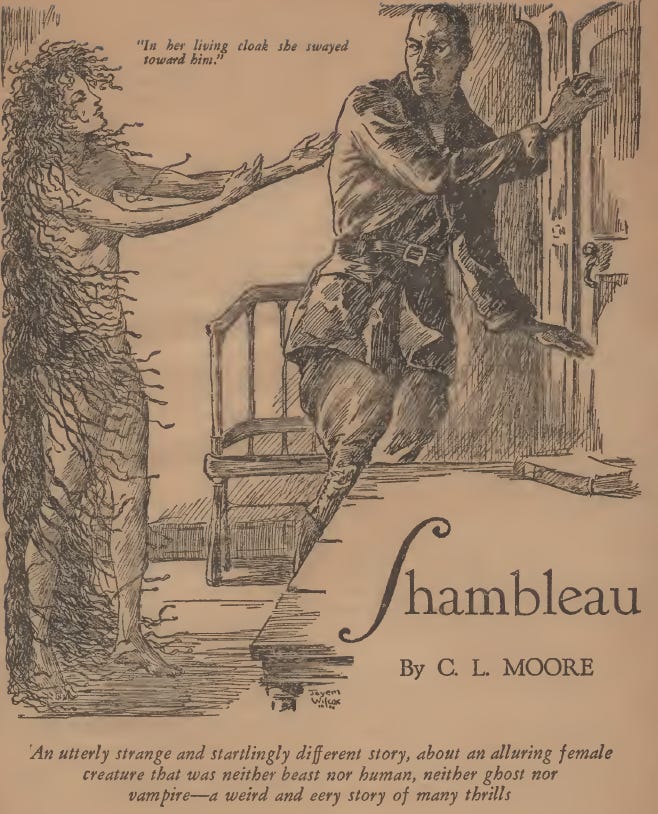
Armor Class: 7 Hit Dice: 4 (18 HP) Movement: 90’ (30’) Attacks: See Lure Form and True Form below Save As: Fighter 4 Morale: 6 No. Appearing: 1 (solitary; encountered in pairs or groups only in the rarest legends) Treasure: None Alignment: Chaotic XP: 450
Description: The Shambleau is one of the oldest races. It is older than recorded history, older perhaps than humanity itself. Yarol the Venusian, who knew of them through ancestral memory, suggests they may be the origin of the Gorgon legend: “The Gorgon, Medusa, a beautiful woman with snakes for hair, and a gaze that turned men to stone.” What the ancient Greeks encountered was likely a Shambleau; what killed them was not petrification but the combination of paralysis and the Psychic Drain.
The Shambleau does not hunt, it lures. Maybe a PC gets separated from the party and finds one in distress, being pursued by people who know what it is. The creature feeds on life-force, not blood, by wrapping its victims in the living mass of its tentacle-hair and drawing out what Yarol calls the “life-forces of men.” The experience is intensely pleasurable for the victim. This is not incidental; it is the mechanism.
Lure Form: The Shambleau’s assumed form is a humanoid female with smooth brown skin, green slit-pupil cat-eyes, three-fingered clawed hands, four-toed clawed feet, and typically some form of head covering around her head to conceal the tentacles. You can also have them use some form of illusion spell to hide their appearance, though Venusians should see through it. She moves silently, makes no unnecessary sound, and has a half-sweet, half-sickening odor that those with relevant experience (Venusians, certain spacers) may recognize. In this form she is no more physically dangerous than an unarmed human.
True Form: Beneath the turban is the Shambleau’s feeding apparatus, a mass of wet, warm, scarlet tentacle-hair, each strand thick and round as a worm, all writhing with independent life. When fully released this mass can reach to her feet. She does not reveal it until she is ready to feed.
Special Abilities:
Hypnotic Gaze. The Shambleau uses eye contact to initiate feeding. Any creature that meets the Shambleau’s eyes in her true form must save vs. spells or fall into a trance. Even on a successful save, the creature suffers -2 to all rolls for 1d4 rounds from the partial psychic contact. Creatures who deliberately avert their eyes (closing them, turning away, using a mirror or reflection to observe indirectly) are not required to save, but fighting or maneuvering while averting the eyes imposes a -4 penalty to attack rolls.
Tentacle Embrace. Once a creature is tranced, the Shambleau’s living hair wraps around it completely. The tranced creature’s body becomes rigid and immobile, “stony as marble” in Moore’s words, though the victim remains conscious and aware. A creature in the Embrace cannot take any action, cannot call for help, and does not perceive the contact as harmful. It experiences intense pleasure. The Embrace can reach and ensnare more than one creature per round at the referee’s discretion, though it concentrates on one primary victim.
A non-tranced creature in physical contact with the tentacle-hair must save vs. spells each round or become tranced; even on a success, it feels a “shock of repulsive pleasure” and must save again the following round if still in contact. Kicking or stamping hard on the tendrils forces them to recoil for one round (Yarol’s method), buying time to move without triggering a save.
Psychic Drain. Each full turn (10 minutes) a creature spends in the Embrace, it loses 2 points of Wisdom. A creature drained to Wisdom 3 or below appears to outside observers as dead-alive: gray-faced, ecstatic, completely unresponsive. Northwest Smith was in this state for three days before Yarol found him. Wisdom lost to Psychic Drain recovers at 1 point per full day of rest away from the Shambleau’s presence.
Addiction. Any creature that has lost Wisdom to the Drain must save vs. spells each day or spend that day seeking out the Shambleau and submitting to the Embrace willingly. Some men, Yarol notes, “take to it like a drug” and never recover their will. This compulsion persists until full Wisdom is restored, and even then some characters may require additional saves at the referee’s discretion.
Ancient Presence. Venusians and others with ancestral race-memory of the Shambleau save against the Hypnotic Gaze at +4 and automatically recognize the Shambleau in her lure form on a successful WIS check. This is not a learned skill. Instead it is some deeper ancestral or genetic memory, which is why Yarol described it as a prayer to a god he had forgotten.
A New B/X Character Class: The Venusian Scout
When I wrote the B/X Ranger a while back, I argued that using the Halfling as the structural foundation made sense because of the combination of abilities reflected in the B/X Halfling class. I wanted to follow that example and reskin an existing class for The Venusian Scout. I wasn’t quite able to do that because I thought Yarol, and other Scouts, should have a slightly different set of abilities than the B/X Ranger I put together.

This time I went another direction when finding the right combination that this Fighter/Thief hybrid needs. Yarol is slim, preternaturally quiet, charming past the point of decency, trained with a needle gun, a capable fighter in his own right, and carrying ancestral racial memory of the kind of supernatural entities that populate Moore’s solar system. He is not the Thief. He is not the Fighter. He is something in between, with a particular flavor that neither pure class captures.
Looking for a Foundation: The Creature Crucible Answer
My first instinct was to search the Creature Crucible series, PC1 through PC4, to find a Fighter/Thief hybrid I could use as a foundation the same way the Ranger used the Halfling. I couldn’t find one there.
The PC series (Tall Tales of the Wee Folk, Top Ballista, The Sea People, Night Howlers) takes non-human races and builds their classes around a Fighter chassis with magical or nature-based abilities grafted on. Centaurs, Faenare, Tritons, Lycanthropes are all variations on the Fighter with supernatural add-ons. My quick look didn’t find the Thief’s skill set a hybrid component anywhere in PC1–PC4. If you want stealthy agility in the Creature Crucibles, you get nature magic, not thief skills.
The closest existing class I could find in the BECMI expanded line is actually the Rake from Dawn of the Emperors: Thyatis and Alphatia. The Rake is described as “the non-thief thief.” It’s a culturally based swashbuckling variant for Pearl Islands characters who admire the Thief’s agility but not their profession. The Arena of Thyatis version adds a Charisma bonus and a dodge ability (equal to the character’s Hide in Shadows percentage) in place of Backstab. It’s a genuinely interesting concept, but it’s far from perfect.
The problem is the execution. The Rake is built on the Thief’s chassis, same HD (1d4), same THAC0 progression, same XP cost. It’s a better Thief in a narrow context but it was never a Fighter. It’s a worse Thief than a Thief and a much worse Fighter than a Fighter. For a class that needs to function as a genuine combat partner for Northwest Smith, that isn’t going to work.
So I looked at another key hybrid class in the B/X core rulebook, the Elf, for inspiration and took a leap from there.
The Elf as Template
The Elf class in B/X is a Fighter/Magic-User hybrid. It uses both classes’ abilities simultaneously. The Elf fights as a Fighter and casts spells as a Magic-User, but progresses more slowly than either pure class and is capped at level 10. The XP cost is correspondingly higher and the hit points are the mid-point between the two.
That structure is exactly what a Fighter/Thief hybrid needs. The Venusian Scout fights as a Fighter and operates as a (partial) Thief simultaneously, progresses more slowly than either pure class, is capped at a lower maximum level, and has armor restrictions that reflect the need for mobility over protection.
The Halfling remains a useful secondary reference as a hybrid class. Its static hide-in-wilderness ability, missile weapon bonus, and fighting progression showed that you could make a hybrid class with some unique abilities rather than just the best of both worlds that the Elf is. I’ve kept the same maximum level cap (8) that I used for the Ranger, for the same reasons I kept it there. In B/X (which is capped at level 14), the most interesting play happens between levels 3 and 7, the game doesn’t require characters to become superheroes to feel significant, and the cap creates a natural ceiling that encourages players to retire or transition characters rather than grinding indefinitely. If I was to adapt it to BECMI, I’d likely follow what Frank Mentzer did for the demi-human classes there and increase abilities but not hit points.
Yarol as the Model
From the text of Shambleau, Yarol has the following demonstrable capabilities:
Fights effectively at range (needle gun with a sleep agent) and in close quarters (knife)
Moves with preternatural silence, “even the lightness of his footsteps was loud” against Yarol’s
Has a face of “cherubic innocence” that is “wholly deceptive,” with a +4 to reaction rolls across species lines
Carries ancestral Venusian racial memory of supernatural entities including the Shambleau
Has been in enough tight spots to have the “most hated and most respected” name in the Patrol’s records, next to Smith’s
Improvises under pressure (using the cracked mirror to aim his gun without direct eye contact)
The class needs to capture all of this without becoming overloaded. In adapting a B/X class, the key isn’t just what you add but in what you leave out. The Venusian Scout has no Find/Remove Traps, no Open Locks, no Backstab. Those abilities belong to the specialist Thief and keep that class useful. What the Scout has is the combat backbone of the Fighter, the mobility and stealth toolkit of the Thief, and a set of special abilities that are specific to the Venusian pulp-fiction setting rather than generic dungeon-crawl utility.
The Venusian Scout
Requirements: DEX 9, CHA 9 Prime Requisite: DEX and CHA Hit Dice: 1d6 Maximum Level: 8 Armor: Leather armor only; no shields Weapons: All weapons Languages: Common plus two additional (Venusian and one language of the player’s choice reflecting the Scout’s spacer background)
Prime Requisite XP Bonus

Experience and Level Adjustment
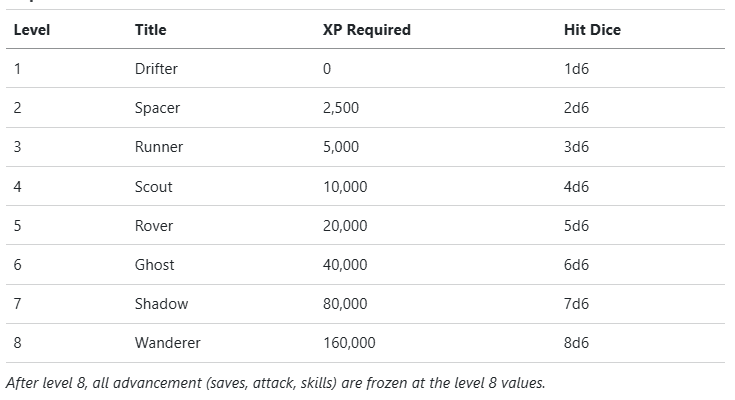
Attack Bonus / THAC0
The Venusian Scout attacks as a Fighter of the same level through level 8.

Saving Throws
Venusian Scouts use the Thief saving throw table. Additionally, they receive a +2 bonus to saves vs. charm, fascination, hold, and other mind-affecting supernatural effects (see Charm Resistance below).

Thief Skills
Venusian Scouts train in a subset of the Thief’s skills — those appropriate to a mobile, socially adept spacer-scout rather than a specialist burglar. They have no access to Open Locks, Find/Remove Traps, or Backstab. Their available skills advance at the standard Thief rate.
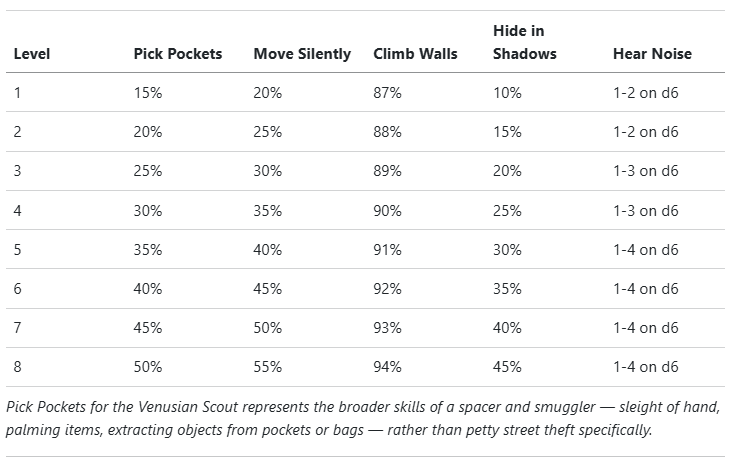
Special Abilities
Supernatural Awareness. When the Venusian Scout first encounters a being with supernatural charm, lure, or psychic feeding abilities, undead with mental powers, sirens, entities like the Shambleau, demons with fascination effects, roll 1d6 before the creature has a chance to act. On a 1–2, the Scout recognizes the danger from ancestral racial memory and is not required to make an initial saving throw against the creature’s passive or triggered abilities during that first round. This improves to 1–3 at level 5. If the creature has already acted (surprise round, or the Scout was not the first to encounter it), this ability does not apply.
Design note: This is not a general immunity. It’s a single-round warning system that gives the Scout and their companions time to respond. It is deliberately narrow. Yarol was almost taken by the Shambleau even with ancestral knowledge. The ability represents recognition, not protection.
Charm Resistance. +2 to all saving throws vs. charm, fascination, hold, and mind-affecting supernatural effects. This represents generations of Venusian racial exposure to such entities. It does not stack with Supernatural Awareness. The Awareness either prevents the initial save or it doesn’t, and if the Scout is forced to save normally, the +2 applies.
Needle Weapon Mastery. Venusian Scouts are trained with needle weapons. These are thin-barreled delivery devices that fire dart-sized projectiles carrying a contact agent. A needle gun uses the following statistics:
Damage: 1d3
Range: 30’ / 60’ / 90’
Rate of Fire: 1/round
Special: On a hit, the target must save vs. Poison or fall asleep for 1d6 turns (unconscious, cannot be woken by normal means for the duration)
The Scout can prepare a number of loaded darts equal to their level per day without special facilities; with access to a Venusian apothecary or equivalent, double this number. Unused prepared darts lose potency after 24 hours.
At level 5, the Scout may also prepare paralytic darts: on a hit, the target saves vs. Poison or is paralyzed for 2d4 rounds instead of sleeping. They remain conscious but cannot move or act.
In fantasy settings without firearms, the needle gun can be reflavored as a needle crossbow (a small, compact crossbow firing dart-like bolts) or a blowgun with a wider effective range reflecting the Scout’s expertise.
Light-Footed. Even when not actively attempting Move Silently, the Venusian Scout moves with unusual quiet. Venusian Scouts surprise their opponents on a roll of 1-3 rather than 1-2.
Social Ease. +1 to all reaction rolls with intelligent beings. At level 5, this increases to +2. This reflects both the natural Venusian charm, Yarol has “the face of a fallen angel, without Lucifer’s majesty to redeem it,” and the Scout’s experience moving through diverse planetary cultures and ports of call.
At Level 8: The Safe House
A Venusian Scout who reaches level 8 and chooses to establish a base. This might be a discrete apartment in a space port city, a contact point in a smugglers’ network, or a safe house on the fringes of settled space. This Safe House attracts 1d6 followers of levels 1–3. These followers are a mix of fellow scouts, informants, couriers, and spacers looking for someone with a reputation. They are loyal but not soldiers; they will carry messages and share information but will not take serious physical risks unless treated as genuine partners.
Design Notes
Though I gave some explanation of my design choices above, here is a quick Q&A explaining my logic.
Why max level 8? The same reason I capped the Ranger at level 8: the class is powerful enough within that range. A level 8 Venusian Scout has Fighter-level combat, five Thief skills at solid percentages, a sleep-dart weapon that neutralizes many threats outright, charm resistance, and a passive early-warning system for the kind of supernatural entities that kill fighters dead. They don’t need to be a superhero. Neither did Yarol, and he was one of the most dangerous people in Moore’s solar system.
Why Thief saves instead of Fighter saves? Thief saves in B/X are better against Death/Poison and Paralysis but worse against Dragon Breath and Spells. This is the right tradeoff for a spacer-scout. Yarol has clearly survived enough poison and close calls that he skews toward those resistances, and the additional +2 vs. charm on top of that reflects Venusian heritage specifically. A Fighter’s saves lean toward the big existential threats (breath weapons, powerful magic) which are appropriate for someone who regularly fights things that size; less appropriate for someone who moves like Yarol does.
Why no Backstab? Because Backstab is the Thief’s defining combat ability and giving it to the Venusian Scout would push the class into overlap territory with a pure Thief and given how weak the Thief is in B/X I tend to be very permissive with that ability for balance purposes. The Needle Weapon Mastery is a different thing entirely. It’s incapacitation rather than damage multiplication, it has meaningful resource management (prepared doses per day), and it reflects what Yarol actually uses in the story. A sleep dart is not the same as a knife in the back, and that difference matters mechanically and fictionally. It’s pretty powerful, it’s like a sleep spell per level but with a save, but it does have limitations in that you have to hit with it etc.
On the Rake. The Rake from Dawn of the Emperors is the obvious comparison point, and I want to acknowledge it directly and why I didn’t use it. The concept is exactly right. The class is presented as a combat-capable social operator who isn’t really a Thief, but the execution is thin. Building on a Thief chassis with a Dodge ability grafted on gives you a worse Thief with one interesting defensive option. Building on the same Thief chassis with Fighter combat, selected Thief skills, and class-specific special abilities gave me something that actually plays differently from both parent classes. That’s the goal.
Yarol the Venusian
He was slim, as all Venusians are, as fair and sleek as any of them, and as with most of his countrymen the look of cherubic innocence on his face was wholly deceptive. He had the face of a fallen angel, without Lucifer’s majesty to redeem it; for a black devil grinned in his eyes and there were faint lines of ruthlessness and dissipation about his mouth to tell of the long years behind him that had run the gamut of experiences and made his name, next to Smith’s, the most hatedand the most respected in the records of the Patrol. — C.L. Moore, Shambleau, 1933

7th-level Venusian Scout (Shadow)
STR 10 | DEX 17 | CON 12 | INT 14 | WIS 13 | CHA 16
HP: 28 | AC: 6 (leather, DEX bonus) | THAC0: 15 Save: Death 11 / Wand 12 / Paralysis 11 / Breath 14 / Spell 13 (+2 vs. charm) XP Required (this level): 80,000
Thief Skills: Pick Pockets 45% | Move Silently 50% | Climb Walls 93% | Hide in Shadows 40% | Hear Noise 1–4 on d6
Attacks: Needle gun (1d3 + save vs. Poison/sleep 1d6 turns, range 30/60/90); knife (1d4); up to 7 prepared darts per day (sleep or paralytic at level 5+)
Special:
Supernatural Awareness: recognizes charm/lure entities on 1–3 before they act (level 5+)
Charm Resistance: +2 vs. charm/mind-affecting saves
Light-Footed: Surprises opponents on a roll of 1-3.
Social Ease: +2 to reaction rolls (level 5+)
Languages: Common, Venusian, Martian Low
Notes: Yarol has the face of a fallen angel and the record of someone who deserved the fall. His name appears in the Patrol records immediately after Northwest Smith’s, usually in the same incident report. He is currently flying the Maid and awaiting Smith’s return from whatever trouble Smith has gotten into. The needle gun holds four loaded sleep darts; he has three paralytic darts in reserve in a belt pouch.
I chose the above Rick Hershey image to represent Yarol because I liked it and because the way Jirel of Joiry reacts to Yarol’s appreance in “Quest of the Starstone” suggests that Yarol appears inhuman to a medieval European. I wanted to show that. My version isn’t canonical, but I think it is cool.