


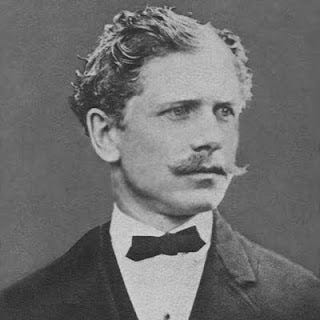
“And, God help me! the Damned Thing is of such a color!”
Editor’s Note — Spoilers abound in this discussion, but they come after the link to the file containing the Bierce story. Give it a read and then continue on if you haven’t read it before.
Editor’s Note #2 — Some of this has been published by me before, but I am adding movie recommendations related to Bierce’s and Lovecraft’s tales at the end of the article.
I’ve been trying to catch up on the reading and researching I need to do for a series of reviews from the golden age of Sword & Sorcery, and adjacent, pulp fiction. In gamer terms, it’s an Appendix N adjacent series of reviews, but not a formal Appendix N series because I want to be able to wander down paths as the whim takes me. I’ve started the series a couple of times, but dissertation (now finished) and work often get in the way.

During this recent return I was re-reading the notes for the article I wrote in 2024 discussing the collaboration between C L Moore and Forrest Ackerman on her story “Nymph of Darkness.” I was particularly taken with Moore’s reference to Ambrose Bierce’s “The Damned Thing” as an inspiration for the way Nyusa’s invisibility worked in that story. I have been known from time to time to make a connection between Lovecraft’s “The Colour Out of Space”, which also featured a creature made of a color no one had ever seen before, and the creature in Bierce’s story. The creatures are different, but there are a number of similarities in the tale that stick out.

I first read “The Damned Thing” a few years ago and I still find it to be an enjoyable short tale that leaves you thinking about the underlying horror for much longer than it takes to read the story. It also wasn’t at all what I expected it to be based on my earlier assumptions. Having read Moore’s correspondence with Ackerman, and the description in my copy of Lovecraft’s Supernatural Horror in Literature, I expected something Gothic and atmospheric. I expected a tale filled with madness and despair. The description of “The Damned Thing” in Supernatural Horror in Literature points to it as an exception in Bierce’s narrative style, a style which the book describes as “a jaunty and commonplacedly artificial style derived from journalistic models.” Gothic and atmospheric are not words that I would use to describe “The Damned Thing.” It certainly has its disturbing elements, and it is a wonderful commentary on willful disbelief, but it is a shockingly straight-forward tale. In fact, I might describe it as commonplacedly derived from journalistic models.
“The Damned Thing” is a perfect example of the modern procedural tale. The story opens with men, Mountain Men to be specific, gathered around a table upon which lies the body of Hugh Morgan. The use of Mountain Men is likely very intentional with regard to what Bierce is aiming at with the story. Frederick Jackson Turner’s presentation on “The Significance of the Frontier in American History” had been made earlier in the year that “The Damned Thing” was published, and the stages of Turner’s hypothesis are witnessed in the tale.
First, we have the Mountain Men those rugged adventurers who explore the vast unknown wilderness. Then we have the “coroner,” a figure who is one of the Mountain Men in dress and composure, but who has a job associated with greater civilization. In fact, the reason the men are gathered around the table is to perform a kind of coroner’s inquest and decide upon the cause of Hugh Morgan’s death. Finally, we have William Harker, the young journalist and fiction writer who had come to the Frontier to write a story about Hugh Morgan because he believed Morgan’s isolated life was worth sharing with his civilized readership. William completely represents the final stage of development in Jackson’s work. We have explorer’s, law bringers, and the civilized, and they are all gathered around a table to guide us through the narrative.
The narrative is broken into four clear acts that are given chapter markers.
There is the establishing act where we find out that the men have gathered as a jury and that William Harker will testify regarding how Hugh Morgan died. We also learn that there is an additional piece of evidence, a book, that will play a role in the story even after it fails to play a role in the jury.
The next act consists of Harker’s testimony about his hunting trip with Morgan and the beast that they encountered, a beast responsible for Hugh’s death. A couple of things stand out here. We are finally given hints as to the location of the story. Bierce consistently uses the term chaparral when describing the environment, a flora commonly associated with the West. The use of chaparral lends further evidence to the Turner-esque nature of the story. When the beast is introduced, it is described as “the wind” moving vegetation. It is only after Morgan shoots at the beast, and it charges Morgan, that Harker realizes that they have encountered some creature...an invisible creature. The description of the invisibility is intriguing and somewhat puzzling.
“At a distance of less than thirty yards was my friend, down upon one knee, his head thrown back at a frightful angle, hatless, his long hair in disorder and his whole body in violent movement from side to side, backward and forward. His right arm was lifted and seemed to lack the hand -- at least, I could see none. The other arm was invisible.” — Bierce, The Damned Thing.
We know from Harker’s description that the creature is invisible, and transparent. We can see through it as it moves through the bushes in the earlier description. We also learn that things within its grasp are similarly obscured from our vision in the places where the creature holds its victim. There is obviously some cause, other than mere transparency, for the beast’s invisibility. The image that keeps coming to my mind is the representation of the predator in John McTiernan’s Predator (1987).
In the third act, the Jury deliberates and determines that the death was caused by a mountain lion. The coroner assures the jurors that there is no other evidence available to help them in their determination of cause of death. The jury rejects a purely supernatural cause for the death, but acknowledges that Harker bears no fault. We also learn that the coroner was lying when he said that there was no other useful evidence. The book the coroner had been reading at the beginning of the tale happens to be Hugh Morgan’s diary.
The final act is where all is made clear, in non-supernatural terms. Morgan’s diary reveals to the audience that Morgan had indeed been encountering an invisible creature for some time, but Morgan had a scientific explanation. This was no mythic beast, rather the creature only reflects light that the human eye cannot see. Somehow light bends around the creature. This is where the description of the invisibility of the creature is at its strongest and weakest. The reason for the invisibility is ingenious, the execution is lacking. Bierce refers to Morgan noticing the creature because its form blocked his ability to see a couple of stars, yet he can “see through” the creature to the world behind it. In essence, the creature may not actually be invisible in the sense we tend to think of invisibility. Rather we may just be unable to see the thing, no black absence of light and no true transparency. A little awkward, but still cool.
What is even more interesting is what Bierce is doing here. One can readily understand why authors might write tales about the inability of those who follow a material metaphysic to acknowledge or engage with the supernatural. The Exorcist is a wonderful horror tale of this sort. The science being applied to the victim of possession is as horrifying as, if not more than, the effects of the actual possession. What happens in Bierce’s tale is a material metaphysician, or rational realist if you will, in the form of the coroner unable to cope with a plausible scientific description of an unimaginable thing. Some scientists might want to explore the chaparral to find the beast, but the coroner essentially asserts that it is “better not to know.” One wonders if Bierce was critiquing particular rigid dogmatists in the scientific community with this tale.
One can see why Lovecraft and Moore were inspired by the piece. Lovecraft liberally borrows names from “The Damned Thing” in his story “The Colour Out of Space.” The only person who will share the tale of the invisible beast stalking the lands around Arkham is named Ammi Pierce -- clearly Ambrose Bierce -- and the name Nahum Gardner is close enough to Hugh Morgan for government work. The reluctance of the townsfolk to talk with our narrator in “Colour” fits with the jury’s reluctance to deal with the unknown.
Simple tales like “The Damned Thing” and “The Colour Out of Space,” are often the targets of criticism by iconoclasts who seek to establish newer voices in a genre. One such case was an older article on the Tor website Which brings me to Seamus Cooper’s 2009 article in the Tor 12 Days of Lovecraft series. Tor is a major publisher of science fiction and fantasy, arguably THE major publisher especially if you judge major by my personal buying habits. They are also a publisher that alternates between phases of mythical canonization and iconoclasm.
In the article Cooper asserts that “The Colour Out of Space” is quite bad. A strong opinion regarding a story that Lovecraft thought his best, and about a tale that is largely praised among Lovecraft fandom. Cooper believes that “Colour” is “ill-conceived and poorly executed.” This belief seems to largely stem from the fact that Cooper believes that the stakes of the tale have already taken place and that there is nothing left to chill the spines of the reader. This kind of analysis reminds me of when I saw The Blair Witch Project in the theater. After months of watching the marketing materials, I left the theater disillusioned and I asked my friend J, “is that it?” He nodded and we both agreed it wasn’t scary at all. Then, about five hours later, when I was going to sleep, it hit me. I was genuinely scared of the shadows in the corner of my room. I felt the dread. I’m not even superstitious, but I was in that moment. I thought there was no fear there, and there wasn’t at the moment, but there was later when I was alone in the dark. It changed my views about the film entirely. My friend J had similar thoughts.
Cooper is wrong on both counts. Kenneth Hite discusses some of the merits of the tale in his Tour de Lovecraft, so I won’t repeat them here. Instead, I’ll make a couple of my own observations.
With regard to the tale being poorly executed, one finds this a particularly baffling claim. The story begins with what may be the best written first sentence and introductory paragraphs in all of Lovecraftian fiction:
“West of Arkham the hills rise wild, and there are valleys with deep woods that no axe has ever cut.” — H.P. Lovecraft, The Colour Out of Space
The words are poetry without purple prose. Lovecraft sets the tone of the wild and unexplored marvelously, and he sets the tone for the foulness of the place itself in exquisite fashion. This story is rife with beautifully constructed wordsmithing, something I wouldn’t often credit Lovecraft’s fiction.
It would be fair to say that Lovecraft was inspired by Washington Irving’s classic The Legend of Sleepy Hollow which opens as follows:
“In the bosom of one of those spacious coves which indent the eastern shore of the Hudson, at that broad expansion of the river denominated by the ancient Dutch navigators the Tappan Zee, and where they always prudently shortened sail and implored the protection of St. Nicholas when they crossed, there lies a small market town or rural port, which by some is called Greensburgh, but which is more generally and properly known by the name of Tarry Town.” — The Legend of Sleepy Hollow
That might suggest that Lovecraft’s introduction wasn’t original, but it argues against it being poorly executed. I think Lovecraft’s prose is tighter and achieves the same effect with fewer words.
It is also remarkable how Lovecraft has transformed a hunting encounter with an unknown beast into a horrifying encounter with an alien presence. An encounter, I might add, that extends the interaction between the alien and the scientific beyond the mere coroner. In the end the beast does vanish, leaving a small piece behind trapped in a well, putting a seeming end to the stakes. But given the fact that there is soon to be a reservoir on top of the location of the small (trapped) piece, and the nature altering and mind altering affect this piece has on the land and the people surrounding it, one wonders what will happen when the reservoir comes and possibly frees the beast.
The end of this tale is as creepy as the end of the first Friday the 13th, when we discover that it might be possible for Jason to rise from the bottom of the lake, or John Carpenter’s The Thing. The creature is destroyed at the end of Carpenter’s movie...or is it? The same is true here. Just how has the beast altered those around it? What effect will it have?
The stakes are subtle, rather than grotesque. They are social, rather than personal. But the stakes are horrifying none the less.
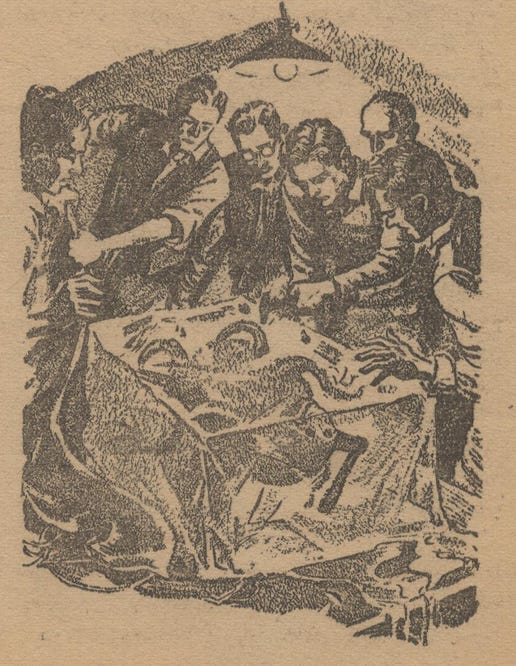
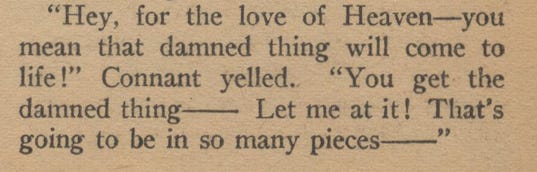
This beast represents something more than a colorless thing. Bierce’s tale inspired “Who Goes There?,” the source story for The Thing, but as well as influenced the narrative of The Blob. To give just a glimpse of how “The Damned Thing” influenced “Who Goes There?” check out the “coroner’s inquest” image from the original Campbell tale in the August 1938 issue of Astounding Science Fiction, as well as a brief excerpt name dropping the older tale.
Damned Thing and Colour Out of Space Movie Recommendations
The Thing (1982)
In many ways, John W. Campbell’s tale “Who Goes There?” is an updated version of Bierce’s classic horror tale. It changes key things, like having the action take place narratively rather than through testimony, but the essence remains the same. There is a creature that exists that is difficult to detect and it’s coming for you and sowing distrust. The Thing is John Carpenter’s classic adaptation of Campbell’s story, and it remains one of the best horror films, and one of the best “containment” science fiction films ever made.
Predator (1987)
Bierce’s tale features “Mountain Men” who are attacked by an invisible creature that is hunting them as much as they are hunting it. I don’t know if the screenwriters, or John McTiernan, had Bierce in mind when they penned the tale of an invisible alien stalking soldiers in the jungle depths, but it’s very much a parallel story. Like Campbell’s tale, this is one that happens narratively rather than in retrospect. I’m sure you’ve seen it before, but watch it after reading Bierce.
The Blob (1958)
While H.P. Lovecraft’s tale was about an intangible creature that emerged from a meteor and emitted a light (or radiation) that warped the perceptions, minds, and reality of those affected by it, The Blob is about a slimy creature that emerges from a meteor and consumes everything it comes into contact with. It absorbs the body and essence of the things it consumes but doesn’t absorb their personality or ability to adopt their appearance like The Thing. Instead, it consumes everything. It makes those it destroys a part of a “Species Being.” There’s been a lot of writing about how films like Invasion of the Body Snatchers embodied Cold War fears, but The Blob is as much an anti-communist film as the rest of them. It just happens to have been released in the aftermath of the McCarthy era, so it highlights how the paranoia and blame of the “young” is misguided. The threat of the loss of individuality to a “foreign” threat is still there, but paranoia about your neighbors is removed. The threat is obvious and it’s growing. I don’t even think it’s an accident that “cold” kills the beast.
Annihilation (2018)
While Jeff VanderMeer has denied that “The Colour Out of Space” has any influence on Annihilation and his Southern Reach saga, I think he is protesting far too much. That doesn’t mean I think he based Annihilation on the Lovecraft tale, only that it was one of the stories that provided that materials that allowed him to tell his story. Vandermeer, along with his wife Ann, is one of the great editors in the history of Science Fiction and Fantasy fiction. Unlike many of the other great editors (I’m looking at, and loving you, Lin Carter…Thongor’s a favorite, but it is far from literature even as what you championed was), VanderMeer is a talented and inspired writer. He also edited an anthology called The Weird that is excellent, but sadly includes neither of these tales. He incorporated the materials more organically and created something new, but it’s still a tale of cosmic horror that echoes the themes and storyline of “The Colour Out of Space.” It’s also damned good.
“Can’t git away...draws ye...ye know summ’at’s comin’, but ‘tain’t no use...” — Ambrose Bierce, The Damned Thing
I really loved the movie version of Color out of Space.,. then it dawned on me what the optics were of Lovecraft specifically writing about a new "color" coming to town and assimilating all the good people. Still a good movie but that thought made me a little queasy.