


The Background
In 1977, Steve Jackson revolutionized the gaming industry when he published his classic wargame OGRE through Metagaming Concepts. What made OGRE revolutionary wasn’t that it was a balanced science fiction roleplaying game that built upon the premises in the Bolo and Hammers Slammers books. Instead, it was the bang for the buck. Wargames, even chit and map wargames, have always been a bit pricey and OGRE was cheap and it created a MicroGame revolution. That revolution included games like Melee and Wizard (The Fantasy Trip) and eventually created the foundation for Steve Jackson Games when he left Metagaming.
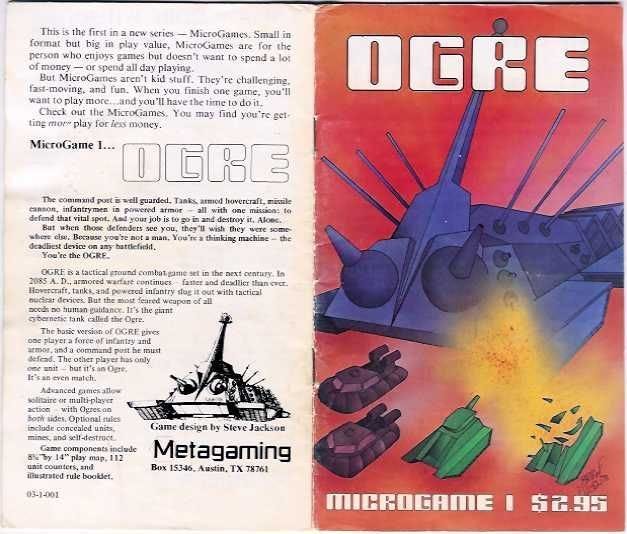
While we think of Steve Jackson games as the company that Munchkin built, this isn’t the case at all. Yes, they are as big as they are today due to Munchkin, but before they were the company that Munchkin built, they were the company that GURPS built. Before that, they were the company that Car Wars built. In reality, they are the company that OGRE and The Space Gamer built. When Steve Jackson left Metagaming, he wasn’t able to take The Fantasy Trip with him, but he was able to take OGRE, GEV, and The Space Gamer and those formed a solid basis for a company that exploded in popularity with Car Wars.
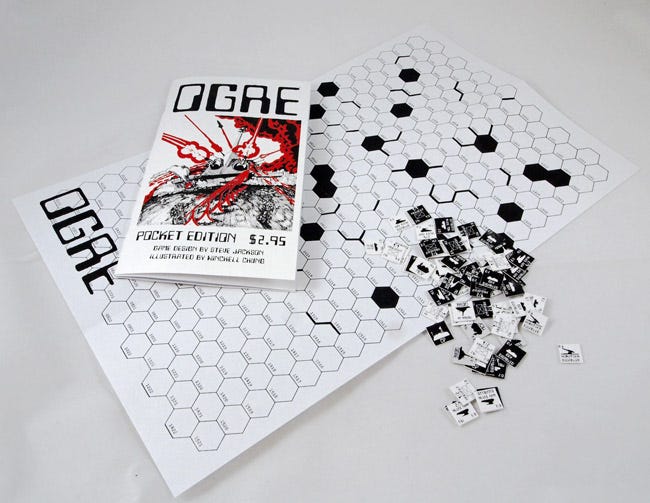
OGRE has a simple premise. At some point in a post-apocalyptic future an artificially intelligent tank battles human forces on a blasted and irradiated battlefield. One player takes the role of the unstoppable and heartless killing machine and the other takes the role of the relatively helpless human opposition who try desperately to stop the OGRE from destroying their Command Center. It’s a castle defense game with asymmetrical forces and it is brilliant. The game is currently on its 6th edition, which is a lot prettier than the original version, but the tense gameplay remains the same. It is a must own game for even the casual wargamer. While the 6th edition is a bit pricey at $49.95, it is worth it because the game is extremely replayable and has tremendous tactical depth. If you want to get the game cheaper, you can always search the internet for used copies and older editions. I’m a particular fan of the OGRE/GEV set that was packaged in a VCR box.
The Lost Opportunity
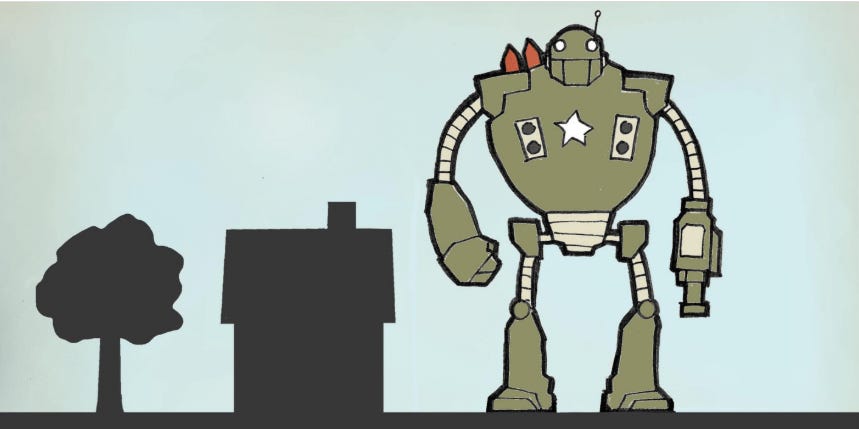
While the game is currently available from Steve Jackson Games, in part because it looks like their 80/20 Munchkin to everything else ratio is sliding into 70/30 territory requiring them to have strong titles in the 30 percent of non-Munchkin sales, there was a time when OGRE was completely out of print and that’s when a neophyte game illustrator named Kwanchai Moriya decided to make a print and play version of the game reskinned to a Science Fictional World War II with Giant Robots. Kwanchai is a big name in board game illustration today, but that wasn’t the case back in 2009 when he produced his amateur print and play edition and released it on Board Game Geek.
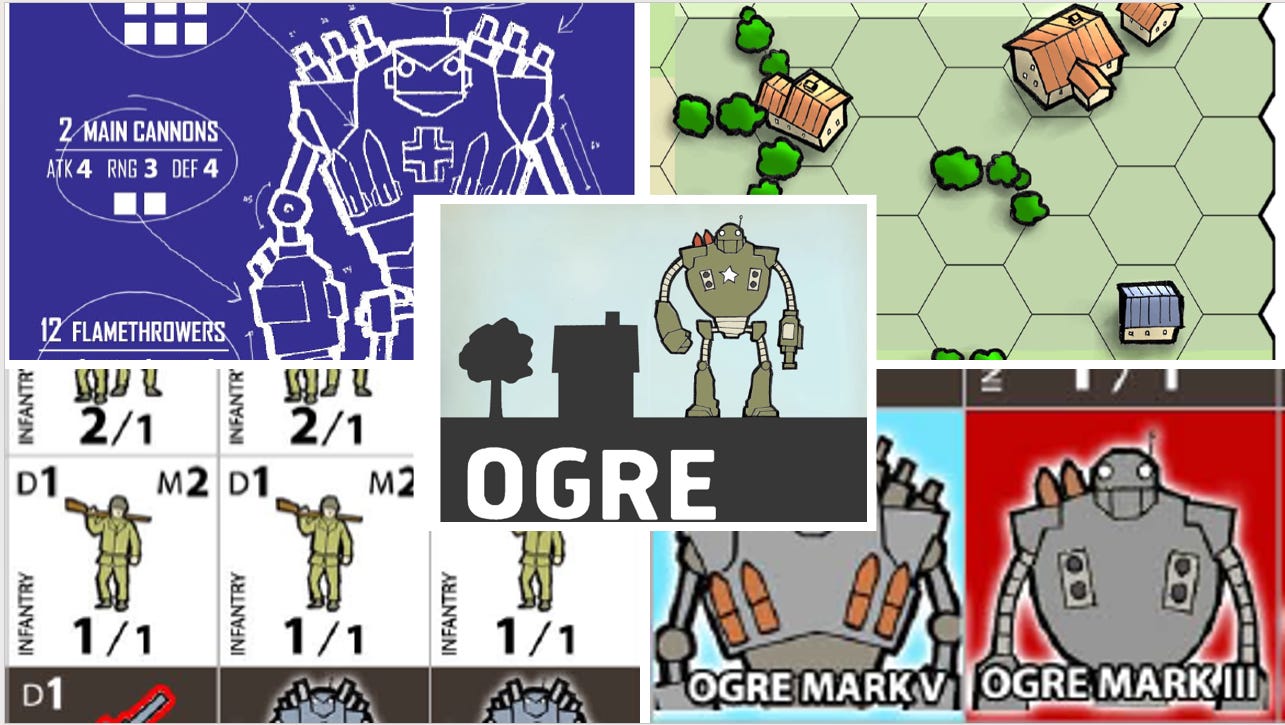
His amateur version quickly went viral due to its unique look and theme. That theme included a cover inspired by Avalon Hill’s classic Cross of Iron expansion for Squad Leader. That Cross of Iron cover is one of the best examples of the excellent work that Rodger B. MacGowan produced in the wargaming hobby. Rodger was a frequent illustrator for Avalon Hill and eventually became Art Director for GMT Games LLC and was the Founder and Art Director for C3i Magazine, which contained support materials for many GMT games and frequently included full games in the issues with high end components. MacGowan was inducted into the Adventure Gaming Hall of Fame in 2006 and passed away tragically due to pneumonia in February of 2025, an event that hit the fan community hard because his home and studio (where much of his work was stored) were burned down in the Palisades fire in January of that year. While many of the originals were lost, GMT published a hardcover collection of his art just as these tragic events unfurled.
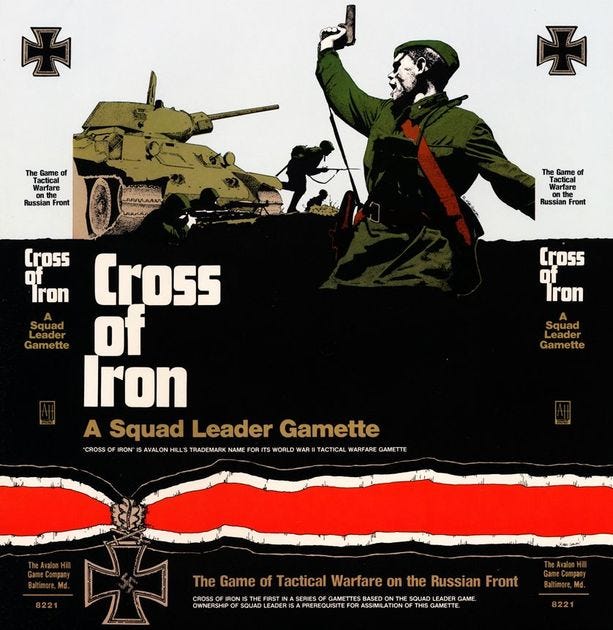
Kwanchai’s work was years before MacGowan’s death, but it paid homage to one of the great illustrators of the hobby. The game itself was a great tribute to one of the classic games of the hobby, but it also had one major problem. He did more than create new counters and a new map, he reprinted the entire rulebook and did several other things that violated copyright and trademarks owned by Steve Jackson Games. As Kwanchai himself describes it:
**Hi, if you are coming late to this party, just to let you know, Steve Jackson Games has removed all files and images related to my redesign. If you didn’t get a chance to see it, well, it was pretty cool.
If you don’t know what happened, I’ll give you a miniature rundown: 1) I created and posted a redesign of Ogre with completely original artwork, but I included the use of the SJG trademarked name “Ogre” and a complete set of rules which were basically word for word. 2) It got downloaded a lot and jumped to #2 “hottest” download on BGG. 3) Steve Jackson Games had the files for the redesign removed from BGG, then a little while later, had images of the redesign removed from the Ogre BGG page, then a little while after that, had images of the redesign removed from my BGG personal gallery, then awhile after that, had blog posts featuring the redesign removed from my personal art blog. **
He hadn’t licensed the homebrew and went far beyond what is standard practice for fan versions under fair use and Steve Jackson Games brought the hammer down. When they did it wasn’t in a mean or insincere way. Sure, they used the full legal authority they had, but they (as we would soon find out) were about to release a new and even more beautiful Designer’s Edition of OGRE. They had every right to come down on Kwanchai and remove the files from Board Game Geek. They weren’t acting in bad faith, and I am a very strong advocate of intellectual property, so I agree with what they did morally.
But, and it’s a BIG BUT (sorry, not sorry), I don’t think they should have merely required BGG and Kwanchai to remove the files from the internet. I think that stopping there was a bad business decision. Unlike Wizards of the Coast’s OGL fiasco, Steve Jackson Games didn’t get a lot of hate from fans for their action because they were within their rights. They got some from the copyleft to be sure, but most people understood. What Steve Jackson Games did wrong was in failing to BUY the files from Kwanchai and enter into a contract with him to publish them. There was clear demand for this product, and they could have offered it as a pdf stretch goal for their Kickstarter. They never did and that was a HUGE missed opportunity. Had they done so, even the critics on the copyleft would have had little to complain about.
The story isn’t an unhappy one for Kwanchai, but it was a slightly unhappy one for fans. Kwanchai went on to become a highly desired artist in the board game industry. We fans got the beautiful 6th edition of OGRE, but imagine if Steve Jackson Games had worked with Kwanchai to design an alternative edition of OGRE (both physical and pdf). Just imagine what a fully refined version of the game, with feedback from Andrew Hackard and Steve Jackson…and maybe Rodger MacGowan, could have been. It’s a real missed opportunity and I wish fans had been able to see that game.