


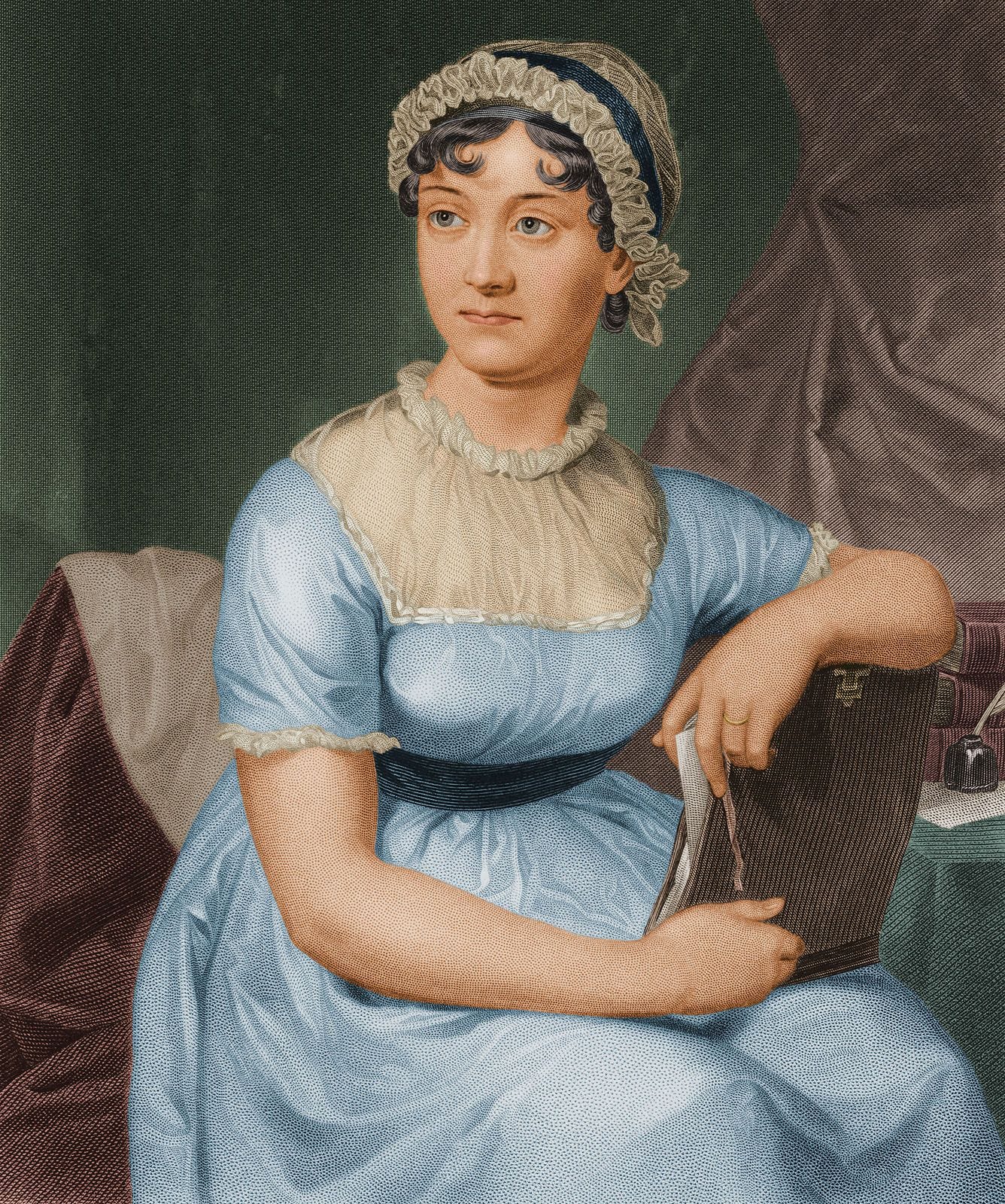
Jane Austen and War Gaming
This week’s rundown is a little weirder than most. Because Jane Austen is my favorite novelist of all-time, and because July 18th is the anniversary of her death, this week’s Weekly Geekly will be almost entirely Jane Austen themed. The only exceptions will be when I share reviews from Luke Y Thompson and Courtney Howard and the links I share from around the Substackverse.
As I just stated I consider Jane Austen to be the greatest novelist in the English Language. I’ll let others celebrate various obscure and challenging adaptations of Homer in a new setting or angst ridden tales with undertones of wanting to retain/maintain the innocence of youth. I can appreciate these tales when they are done well, to be sure, but some reading is more like work than I desire in leisure reading and to this day paeans to protecting the innocence of youth remind me too much of the Satanic Panic of my youth.
As might be apparent from the “leisure reading” comment above, I am somewhat resistant to the modern “literary” novel. The modern literary novel is a genre, and yes I think it is its own genre, that often spends more time trying to BE novel than trying to be A novel.
While that might imply a certain kind of pretense on my part, and it probably does, I am a reader who can enjoy Twain and Fenimore Cooper. I know you’re supposed to pick sides between those two, but I don’t care. I also love the works of Poe, Dickens, Collins (we share a birthday after all), and a long list of other literary authors. I did have a dual major in English Literature for a reason and that reason is that I love to read. It is, one might say, my jam.
As much as I love to read literature, ranging from the hacky pastiches of Lin Carter to the skilled craft of Faulkner, there is no author who engages me in the way Jane Austen does. Her writing combines almost everything I love about storytelling. She is able to convey compelling drama in what others might overlook as mundane situations. I also think that if she were alive today, she’d have her own actual play live stream and it would be bigger than Critical Role. Ever since I first read Northanger Abbey as an undergraduate, I’ve been convinced that she should be included in the inspirations for what we consider the role playing game hobby.
There is a scene in Northanger Abbey where Henry Tilney (the worthy romantic interest) and Catherine Morland are riding a carriage towards the eponymous Abbey. Catherine is a young woman obsessed with Gothic fiction. Since nothing is more Gothic than a mysterious Abbey, Henry takes it upon himself to begin a role playing session with Catherine to pass the time. He will establish the scenario and she is to react. In my opinion, it is one of the most romantic scenes in all of Austen’s work. The scene begins with Henry affirming that Catherine’s obsession with the writings of Ann Radcliffe are not the waste of time that others have dismissively stated and continues with the role playing session. He begins the session in a manner that fledging game masters should absolutely follow:
“And are you prepared to encounter all the horrors that a building such as ‘what one reads about’ may produce? Have you a stout heart? Nerves fit for sliding panels and tapestry?” — Henry Tilney, Northanger Abbey
It is with this magical statement that Henry not only begins a story, but elevates it from the mere telling of a tale to a role playing session. The series of questions has a two fold purpose. First, to set the tone of the shared narrative. It is a dark and Gothic tone to be sure. Secondly, it is designed to give Catherine agency. She will be shaping the story. His statement also reminds me of the opening of the video tutorial for the 1990s TSR board game Dragon*Strike which was designed to introduce new gamers to the hobby. In that introduction, the Dragon Master states:
“Feeling brave tonight? How Brave? Brave enough to do battle with hideous monsters? Hmm? Brave enough to sneak around dead castles in the dark with chances being the next victim?” — Dragon Master, TSR Hobbies Dragon*Strike
Note the similarities? I find them striking. I wonder if Flint Dille, the author of the script for Dragon*Strike, had Northanger Abbey lurking somewhere in the recesses of his mind when he wrote those words. One difference between the two, is the establishment of agency that I asserted Henry offers Catherine. The Dragon Master is setting only the narrative tone, but Henry is adding the element of choice.
Jane Austen also has another connection to the wargaming and role playing game hobbies. Though this connection is one that I’m making quite a bit of a stretch to create. Where I think the quote in Northanger Abbey is mildly causal to the creation of role playing as a larger hobby, this connection is merely correlational but it’s an interesting correlation. You see W. Britains, now known as just Britains, published a line of miniatures in a format just slightly larger than their “standard” size based on her novel Pride and Prejudice.

It makes sense that W. Britains would have produced a Pride and Prejudice set for a couple of reasons. It is Austen’s most adapted work and I can imagine a host of people who construct miniature scenes or collect figurines buying them. My wife and I love to build Lego Villages as a part of our Christmas decoration, there are train enthusiasts, and still others like to build miniature scenes for the sake of creating moments in miniature. What better source material than Pride and Prejudice?
Beyond the collectible and still-life markets though, having Britains release a Pride and Prejudice set makes sense from a wargaming perspective too. You see that figure of Mr. Wickham? Pride and Prejudice was published in 1813 during the Napoleonic Wars, but Austen started writing the novel when England was currently losing a war against Revolutionary France in 1796. Mr. Wickham has a Lieutenant’s commission with the militia that George III had “embodied” in 1792 with the intent of going to war in 1793. The militia were not the regular army, but there was a quartering system in place for them that ended in 1795. This likely suggests that the novel takes place in the late 18th Century, rather than during the Napoleonic era.
All that aside, at the end of the novel Mr. Wickham is no longer a part of the militia. Thanks to Mr. Darcy, he holds an Ensign’s commission with the Regular Army. An interesting note, and a sign that Mr. Darcy is punishing Wickham at the same time as he is saving the Bennet’s from disgrace, Wickham’s Ensign commission is of lower rank than his Lieutenant rank in the Militia. Wickham’s shift goes from one of moderate rank, the right of quartering, and leisure, to one where he is stationed and will likely be sent to war.
This scenario makes these figures perfect for wargaming in the Regency and Napoleonic periods and creates in my mind numerous scenarios for role playing situations in the milieu. I’d likely base such a scenario on the television episode/movie Sharpe’s Justice where Sharpe and Mr. Wickham meet. That episode is not based on a Cornwell novel, and it’s outside Sharpe canon, but it is loosely based on the Peterloo Massacre which would make for a great setting for a role playing game adventure.
All of that, of course, is a long way of saying that Jane Austen has a connection with wargaming because one of the principal miniatures manufacturers of early wargaming manufactured figures based on her writings that would be appropriate for wargaming. W. Britains were among the figures used by Donald Featherstone, Tony Bath, and others in the British wargaming scene and as we know that scene was influential to both Gygax’s and Arneson’s gaming groups.
And while the Brontë’s may have hated Jane Austen (in particular Charlotte), no doubt in part due to elements of class and a desire to be seen on their own strengths which are substantive, they too engaged in the kind of role playing that young Catherine Morland enjoyed. That and likely a dose of actual wargaming of a sort, for the hobby as recreation is older than any rules set. In fact, what is most interesting in reading about Charlotte Brontë’s rejection of Austen is how much her critiques fit within comments one might expect of Catherine Morland. Which is to say that while the Brontë’s might not have liked or sympathized with Austen, she would have probably liked and sympathized with them.
One way to describe the differences between Austen and the Brontës might be that they lived what she only imagined. Austen’s life was more protected than that of the Brontës and where she written about imagined role playing, it is likely that they role played imagined situations they later wrote down.
None of this is to say that Jane Austen or the Brontës invented role playing games or role playing as a pastime, rather I argue that role playing games developed from the storytelling games people have played whenever they have leisure. One thing that marked an evolution in role playing games was the introduction of non-arbitrary was of determining outcomes. The creation of quantitative, balanced, and fair rules was a real innovation, but it’s one that often comes into conflict with the desire of individuals to tell a story.
Weekly Luke Y Thompson and Courtney Howard Film Article Cavalcade
The Lamentations of Luke Y. Thompson
Stepping away from Austenpolooza for a moment, Luke Y Thompson has a wonderfully titled review of the new 4k release of the original Invasion of the Body Snatchers. As is typical of an LYT review, he shows his deep knowledge of the subject and his penchant for researching that which he is reviewing. He argues, rightly so, “it may be a bit of a Rorschach test. Whatever unified, internally conformist movement you fear most is what the pod people are.”
There were a lot of conformist movements in the 1950s that ranged from Communism to pure “Return to Normal” Social Conformity. For all that the root of Communism is the transformation of man from individual man to political man, which is the species-being (to paraphrase Marx), so too was the aim of much of post-war America to create a Man in the Grey Flannel Suit. I think a large part of the reason the Beats and later Counter-Culture took root in America had less to do with any ideology, than in a desire to assert individuality against encroaching conformity on all fronts. Frederick Jackson Turner got a lot wrong about American history, but what he did get right is that Americans have a deep rooted sense of individualism and Body Snatchers is a scream lamenting the loss of this ideal.
Courtney Howard’s View from the Center Seat
When it comes to Netflix romantic comedies, they range in quality from the sub-Hallmark formulaic, artificial, and pointless to the pleasant and heartwarming. Since my wife and I were sick this weekend, and unable to watch Twisters to celebrate our whirlwind decades long love affair, we watched Glen Powell and Zoey Deutsch in Claire Scanlon’s Set it Up. While Scanlon’s direction is workmanlike, it is Powell and Deutsch’s performances and the very accurate regarding “assistant life” screenplay by Katie Silberman that elevated the film to one that rang true.
Given our love of Harry Connick Jr. in romantic films, Hope Floats always makes me and Jody cry, we had hopes that Find Me Falling would be on the more heartfelt side of the spectrum. If Courtney Howard’s review is any suggestion though, it falls flat as more written by algorithm and committee than with the heart. It looks like Find Me Falling is a film where the direction and cinematography stand out, but the acting and especially the screen play lack real depth. We’ll watch it anyway, but with our guard up.
Geekerati Roleplaying Game Recommendation
There aren’t a ton of Regency era or Jane Austen themed role playing games, but there is a relatively recent one that has received very good reviews.

Good Society: A Jane Austen RPG is a relatively recent role playing game that has a lot of interesting elements. It’s a combination of party game and role playing game mechanically, in that it focuses very strictly on the ROLE playing and not at all on the ROLL playing aspect if the hobby. Picture if you will the “Murder” episode of The Office or a How to Host a Murder, but far more open ended and with player agency mechanics and you’ve got Good Society.
Given the breadth of options, I personally think the game is better described as a Regency Era role playing game, but that’s just a quibble. The game has some interesting mechanics that are similar to mechanics in FATE and Cypher based games that allow players to influence/prompt other player’s actions. It’s a mechanic I’m not particularly fond of because of how it has the potential to spiral out of control and create a negative experience unless players create a good set of norms at the onset. This is one of those cases where Huizinga’s description of play space as a magic circle that requires and enforces norms that can bleed over to the real world is very apt. None of which is to say the game isn’t a very good game, rather than you need to make sure to establish the right norms and that those norms might be different from your typical game session.
I highly recommend giving Professor Dungeon Master’s channel a watch as it provides a fantastic review.
Geekerati Blog/Newsletter Recommendation
Mark Finn recognizes the great talent that was Bob Newhart in his post this week. It’s much deserved. Do yourself a favor and listen to some old Newhart comedy records.

Ethan Sabatella asks us to look at One Piece as a model for how to structure an RPG campaign. Given that I often argue that the best campaigns are never ending, and that One Piece has been going on forever, this is a very good recommendation for how to keep things interesting while keeping the same core of characters.

Some may argue that we have only just now hit the point where consumerism has “gone too far” and that we are now in “late stage capitalism.” I’ve always thought such critiques of capitalism, which have been going on since Werner Sombart invented the term in 1902, completely lacked imagination. If we’ve been in “late capitalism” for approximately 1/3 the existence of the economic system, maybe…just maybe…we aren’t actually in late capitalism yet. We are, however, in an expanding era of consumerism, or at least that’s what they keep telling us.
I mentioned Ron Goulart’s book The Assault on Childhood in a prior post where he argues that the 60s were creating a generation of “super consumers” rather than kids. I’m not saying he was wrong, except in that he thought his was new. Similarly, for those who think we are just now hitting a point where consumerism is overcoming actual fandom, as was argued on The Power of Us today, J.Q. Graziano reminds us that they once marketed Sword and the Sorcerer Coloring Books at children.

I don’t mean to be too critical of Yvonne Phan’s critique of the “fan” who can’t name three songs, but merch has always been more about signaling than fandom. That’s why “Firms” didn’t wear “kit” in the era of peak Football Factory mentality. It’s why there are jokes about not “being that guy” who wears the band’s shirt to the concert. When I went to see The Dickies or Dwarves in chinos and a polo, I was making as much a fashion statement as the fans in Levi’s jackets with patches. The Sex Pistols weren’t a great punk band, they were selected specifically to sell fashion. Punk fashion as meaningful statement was dead before punk was and films like The Fabulous Stains starring Diane Lane knew it at the time. Merch has always only been cloth deep, but I’m fine with that. If merch helps people I like pay the bills, more power to it. I’ve never believed that “being a sell out” was an insult. The Goo Goo Dolls were better musicians when they left the punk scene. I may like listening to Messed Up as much as the next fan, or even their pseudo-pop punk Stop the World, but Iris reminds me of my mom and makes me cry.

Geekerati Music Recommendation
While the only played piece of music specifically named by Jane Austen in her novels is the Irish Folk Song “Robin Adair” which Jane Fairfax plays in Emma, the pianoforte is an instrument that looms large in her fiction as a symbol of status and advancement. The pianoforte is a stringed percussion instrument that can play both piano (soft) and forte (loud), one often broken by Beethoven due to its wooden design, that is the forerunner to the modern piano and an instrument that is capable of producing wondrous beauty. In his excellent series of lectures on How to Listen to and Understand Great Music, Robert Greenberg discusses how one of the innovations of the Classical Era (approximately the mid-1700s to 1820) of music was that much of it was written to be played at home and playing at home happens often in Austen’s work as the young women of her works demonstrate their skill at the pianoforte. So it is natural to include a recommendation from that period as this week’s musical piece, one that could be played on a pianoforte and was intended for that instrument. That means I cannot recommend Bach’s Goldberg Variations, as those were written for the harpsicord.
One of my favorite Classical pieces, and one that a very skilled pianist might have played in Austen’s period, is Beethoven’s Moonlight Sonata. I really enjoy how Valentina Lisitsa performs the piece (and if you haven’t seen her Liszt’s Hungarian Rhapsody #2 you are missing out) and you might too. I’m also including her performance of Für Elise as that is probably more likely to have been played in the social settings Austen writes about, though without the orchestra gathered around the piano.
Classic Film Recommendation
There are so many great adaptations of Austen’s work from the 1995 version of Pride & Prejudice starring Colin Firth as Mr. Darcy and Jennifer Ehle as Elizabeth Bennet to the Gwyneth Paltrow’s delightful portrayal of Emma where she played opposite Jeremy Northam as an equally delightful Mr. Knightley.
There have also been some less than stellar adaptations that tend to fail as they wander away from the source material as was the case with Robert Z. Leonard’s Pride & Prejudice starring Lawrence Olivier as Mr. Darcy (avoid it, especially if you hated the kiss at the end of the Keira Knightley version) or the bizarre nose bleed scene in Autumn de Wilde’s well acted and stunningly shot Emma that was too metacognitive for its own good. It wasn’t as bad as the Olivier vehicle’s betrayal of the author, but it had enough moments to make it fall shorter than it should given the skill demonstrated in other areas. Let Austen be Austen or tell your own Regency Era tale. There is nothing wrong with that and it’s a booming genre.
My own recommendation is the 1995 BBC adaptation of Persuasion starring Ciarán Hinds as Captain Wentworth and Amanda Root as Anne Elliot. It may leave a couple of moments behind, but it is a very good version of my favorite Jane Austen novel. This particular adaptation coincides with the BBC increasing their production values to match the quality of stories they were producing.
As a final recommendation, and this isn’t a film recommendation by any means, I’d like to recommend a couple of audio versions of Jane Austen’s work as well. Yes, you should read all of Austen’s work every year, but having books read to you is another wonderful way to experience literature and Rosamund Pike’s readings of Pride & Prejudice and Sense & Sensibility available on Audible are delightful.
Thanks for linking my piece!
Combining Austen with roleplaying games does seem odd at first, but I think she would very much have enjoyed the ROLE-playing aspect of the hobby and the emergent storytelling.