



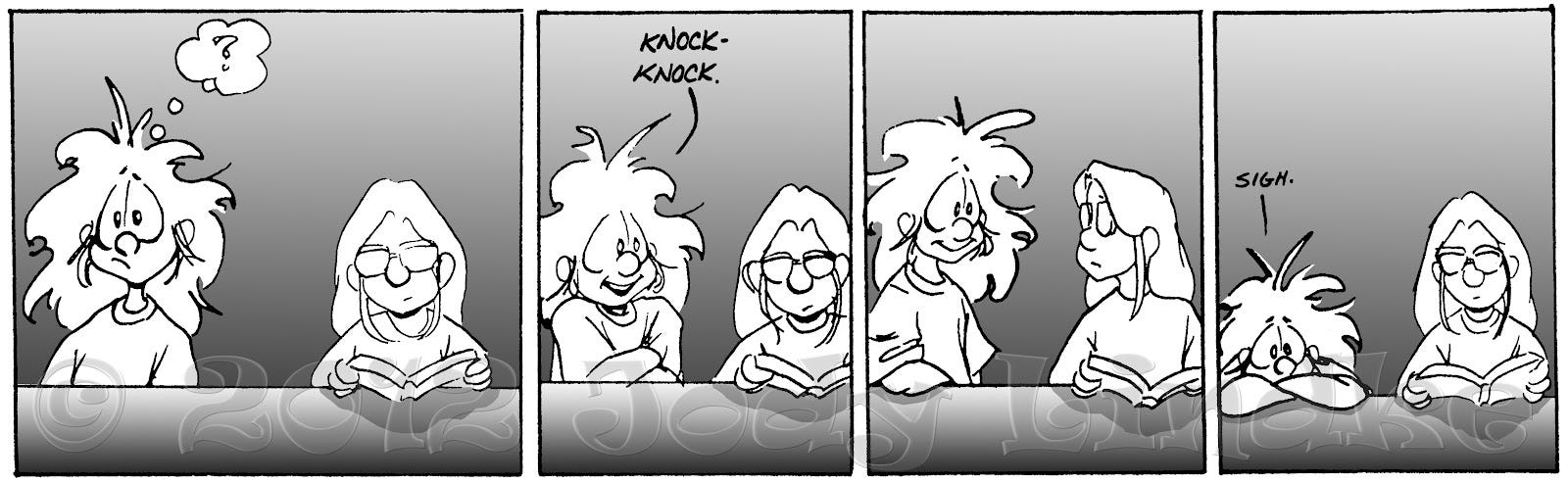
I wasn’t able to track down an really interesting geek related topic for this week’s oddity, so I thought I’d share one of my wife’s Nicnup cartoons. It captures her sense of humor perfectly.
As an aside, it looks like I will be doing giveaways here of Sword & Sorcery novels and video games I have the codes for. Look for one next Friday!

The Lamentations of Luke Y. Thompson
Waterworld is a film that has grown on me over time. I initially rejected the film as a self-indulgent Mad Max clone, but I’ve since grown to appreciate it as a fun film. An EXPENSIVE, but fun film. I think a part of my softening on the film is that Kevin Costner is a very likable actor who has made a number of films I enjoy, and the second is that I’ve come to be very critical of film critics who focus on the finances of a film when rejecting it. As I read the old negative reviews of Heaven’s Gate or John Carter, I am struck by how much the critics are parroting the “studio line.” It’s almost as if they are trying to give the studio cover for a massive write off. Both of those films have aesthetic merit, even as both cost far too much to make. Waterworld isn’t the masterpiece that Heaven’s Gate is (and I think it is one of the best Westerns ever made), nor is it as entertaining as John Carter (once it finally arrives on Mars), but it is as fun as the stunt show it inspired and that has had legs. In one of his latest articles, Luke Y. Thompson reviews a film in the Waterworld tradition called Storm Rider. I’m thankful he did, because otherwise I wouldn’t even know it existed and I’m game for this kind of film, even if it’s terrible.

Molly O’blivion’s Musings
Molly O'Blivion is collaborating with Hellish Views - Harry Evans on a series of articles on Horror in Star Trek: The Original Series. In this first entry, they discuss the episodes “The Man Trap” and “Miri.” I’m a big fan of “The Man Trap,” but it’s one of those episodes that puts the lie to the frequent (possibly spurious) Roddenberry quote that Star Trek was supposed to be Wagon Train in the Stars. Most of the time, Star Trek is Horatio Hornblower in the Stars, but in “The Man Trap” it’s pretty much “let’s borrow A.E. van Vogt’s story Black Destroyer and add a sexual dynamic to it.” That sexual dynamic changes a lot, but when I read Voyage of the Space Beagle (years after I’d seen “The Man Trap”) the intersection of the particular kinds of encounters they faced and the highly logical Science Officer with mental powers (weak psionics for Spock and the “Nexialism” of Elliot Grosvenor in the Space Beagle, I wondered why van Vogt wasn’t receiving royalties. He did eventually receive a $50,000 settlement from the Alien production, which also borrowed ideas from Black Destroyer. Of course, there are enough differences in “The Man Trap” to make it interesting, but the connection is pretty obvious once you see it.


One of my first geek chats was with Richard Iorio of Rogue Games, where we discussed his most recent edition of the Colonial Gothic Role Playing Game and how he is planning to release a set of rules specifically aimed at D&D 5e players. His d20 Rulebook won’t replace his core game, but will allow those who want to play in a Gothic Horror version of the American Founding era who prefer to use familiar mechanics to do so. He’s working on a lot of projects right now and has been kind enough to update us on some of his projects in his latest newsletter. It’s brief, but it includes one big announcement. He’s writing up a complete meta-plot for his Colonial Gothic game, which means that there is a kind of “adventure path” that can be used for campaign play. Great news indeed.

I cite Jon Haidt more than a couple of times in my dissertation when I discuss political polarization and how different moral frameworks inform our decision making processes. The model is still evolving, but it’s built on robust research and Dr. Haidt is an important scholar in the field of psychology. Lately, he’s focused a lot of attention to our over use of digital media and how it affects human interactions. There is some very important discussion regarding the topic, and some troubling findings, but I have been surprised of late at how much catastrophizing there is in some of the articles he’s sharing on social media.
Take this piece by Ted Gioia as an example. As a parent of teenage twins who grew up in the digital era, and who sees real time the affect social media and other digital distractions have on my daughters and their friends, I found the use of a catastrophic frame in this piece alarming. I’m not as skeptical of the findings as Christopher J Ferguson, Ph.D. is in his writings and research, though I too have memories of musical and ludic Satanic Panics, but I do worry about how using a catastrophic frame will engage the emotions of parents and children. Catastrophic frames are designed to activate fear and that fear might lead to either avoidance behaviors or anger based attack behaviors, neither of which seem to me to be a productive deliberative response. Given that one of the reasons that Haidt is very worried about young people to day is that we tend to teach young people to catastrophize, it seems odd to me that he would use such a frame to encourage serious engagement with an important issue.

I often discuss how Michael Moorcock was my introduction to Fantasy fiction as a literary genre, but I don’t mention often enough how seeing the covers Michael Whelan did for his Elric novels led me to read the John Carter novels of Edgar Rice Burroughs. As I mentioned in my most recent live chat, Michael Whelan is a giant in SF and Fantasy illustration and his beautiful paintings inspired me to read a wide array of stories. In his most recent post, he discusses whether Barsoom (Edgar Rice Burroughs’ Mars) is a Fantasy or Science Fiction setting. I loved reading his thoughts on the topic and agree with the statement he makes early “that all ‘SF’ is fantasy, really.” To me it’s a subgenre, but Whelan has other thoughts as well.

That reminds me, I wrote some of my thoughts about Planetary Romance (the particular sub-genre that John Carter’s stories fall into) in the past. Check out that article and let me know what you think.
Is Planetary Romance a Different Genre from Sword & Sorcery

Before diving deep into the waters of geek genre minutiae, I’d like to take a moment to thank of of my subscribers new and old. We just passed 400 subscribers and 2024 has been a year of semi-explosi…
I am of about 23 different minds when it comes to the upcoming Rebellion edition of Tunnels & Trolls and I am very thankful that Dave Thaumavore took the time to interview Filip Hartelius of Rebellion Unplugged about what they are aiming for with the game. The interview did little to assuage my concerns with the game. I’ve played the quickstart rules and “for me” they don’t feel like T&T at all. That doesn’t mean it’s a bad game, I don’t think it is, but it does lack the gonzo whimsy of Ken St. Andre’s creation. The new version is whimsical, to be sure, but it lacks the underground/UK comic edge of St. Andre’s game, which is surprising given that Rebellion publishes 2000 A.D.
You will be able to back Tunnels and Trolls: A New Age on Kickstarter soon and you can download the quickstart rules right now. My sense is that the design team is trying to recruit people who play games like Daggerheart and 5e, but St. Andre’s original strategy wasn’t to peel players away from existing games. He wanted to provide something for those who didn’t understand, or didn’t want to play D&D. He was engaging in a “Blue Ocean” strategy, while Rebellion seems to be following trends and entering a shark infested “Red Ocean.”

Speaking of whimsy, Matt Thompson has some thoughts on William Shatner’s upcoming Heavy Metal album. I’ve long been a Shatner fan and this will be a must buy for me.


We are currently living in a golden age or storytelling roleplaying games. These are games where the mechanics focus more on narrative “yes, and” or “no, but” resolution systems and less on tactical combat or granular skill resolution. The modern exemplars of this genre are Apocalypse World, Burning Wheel, Daggerheart, and Blades in the Dark. There are many other great games in the genre": Supercrew which is one of my personal favorites, and games like Lacuna, 3:16, and Sorcerer that were part of Ron Edwards’ “The Forge” indie game movement in the early 2000s. Many of the modern games (especially Apocalypse World) owe a lot to the Ron Edwards’ movement, with Apocalypse World owing a particular debt to Inspectres. While Edwards was only one of the designers in that circle, he was a key interlocutor who pushed the other participants to broaden how they think about role playing games as games and as art.
While The Forge storygames movement isn’t as well known today as it should be, even lesser known is the storygaming movement of the early 1990s. When White Wolf Publishing released their first Vampire: The Masquerade rulebook, they brought in an entirely new cohort of players into gaming fandom. Their mechanics, especially their “automatically successful” thresholds and their “storyteller” advice changed the hobby forever, but they were not alone. While they were pushing certain boundaries and making roleplaying a little “cooler” than it had been before, there was a design team in Southern California creating their own story focused system…one that is far too underappreciated. I’m referring to the folks at Better Games, who were vital in the development of modern storytelling rpgs. They don’t often get as much credit as they deserve, but their games remain innovative and vital today decades after they were created. They were truly decades ahead of their time. Characters in Better Games Free-Style Role-Play games have no numerical statistics, instead they have a number of narrative descriptors that describe how their characters function.
It’s an innovation that works in a number of settings ranging from Fantasy to Horror, but my favorite example of it was in Better Games two comic book inspired games Good Guys Finish Last and Villains Finish First that were published by Space Gamer/Fantasy Gamer magazine when Better Games owned the rights to that title.
Good Guys Finish Last has been rereleased by postworld games with a much improved layout updated by jim pinto (sic) and I highly recommend checking it out. While I could go on and on about how important Better Games was to the storytelling game scene, I will share jim pinto’s introduction instead. Given that jim has gone on to design a number of excellent games in the storytelling game space, his praise speaks volumes about the direct influence Better Games had on the genre.

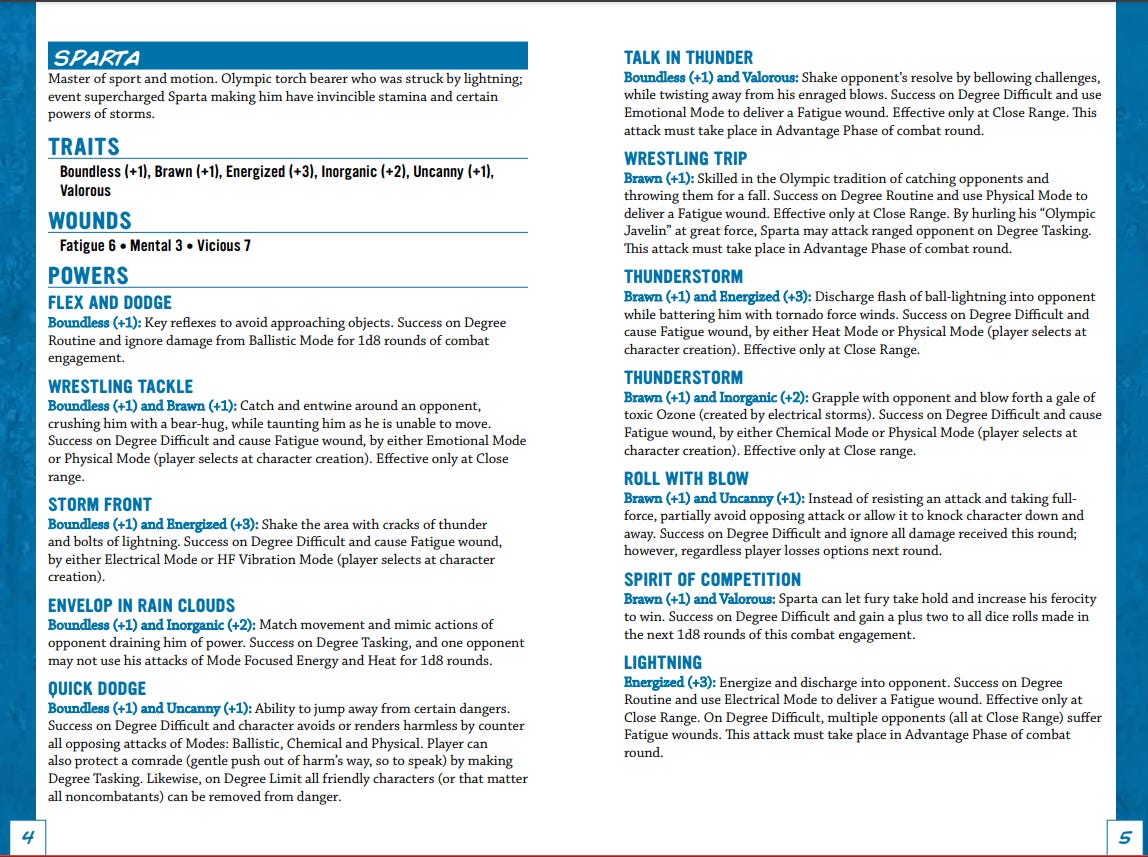
To give you another example of what characters in Free-Style systems look like, though you are free to look at the link to my blog post above, here is a glimpse at a character sheet in Good Guys Finish Last. You’ll notice that all of the abilities are named and the only number listed is the modifier. I wish jim had opted for the actual wound chart for each character, rather than listing numbers, as that shows which keywords add to which damage type and help give the game even greater narrative focus.

A Trick of the Tail was the first album featuring Phil Collins as the lead singer of the band. Peter Gabriel decided to leave the band during The Lamb Lies Down on Broadway Tour and the band was unable to find a replacement who could match Gabriel’s unique voice. Collins had frequently sung backup for the band, but the shift to lead singer was something he did only reluctantly. It was his studio performance of “Squonk” on A Trick of the Tail that convinced his bandmates that he could slide into the role.
A Trick of the Tail is still very much Genesis in full Progressive Rock mode, but you can hear the beginnings of elements that would form the foundation of their later pop transformation in Squonk. Once Steve Hackett left the band in 1978, the remaining trio began to incorporate more mainstream songs like “Follow You, Follow Me” though they retained their progressive foundation (listen to the sophisticated percussion on this “pure pop” tune). The real transition for the band came after Duke, which was a mix of progressive and pop that is my favorite Genesis album. Since I’ve shared that one numerous times though, I’ll share the lovely “Follow You, Follow Me” that presages the kinds of songs Collins would play in his solo career.
Prince is undeniably one of the greatest musicians in Rock history. His musical compositions incorporate progressive, pop, jazz, blues, and so many other musical inspirations. His compositional vocabulary was as vast as his talent. He was a prolific creator who wrote hit after hit, and many that were made hits by other artists. He was, unlike many pop stars, a true singer-songwriter and he was a helluva guitarist as well. I’ve always loved Raspberry Berey because it combines transforms his sexually charged music into a beautiful love song.
When people finally achieve success in an entertainment related field, people often describe them as being an “overnight success.” This description is more often than not completely unfounded. For most artists, there are years of sweat and toil…the miserable paying of dues…that precede that “sudden success.” When I think of the struggles of the musical artist, I often think of this performance by the band Graduate on the kids game show Runaround. While it’s a paying gig, that’s giving the band much needed exposure, Roland Orzabel sings “Ever Met a Day” with a kind of rage I’ve rarely seen and the kids in the audience have clearly never heard teh song before and the shots of the crowd show them to be baffled and clueless to what they are hearing. Meanwhile, their Roland’s bandmate fully commits to his flute solo. I imagine if any interviewer ever asked Roland during a Tears for Fears interview, “Have you ever paid your dues?” I think his response would be, “Have I paid my dues? Have I paid my dues?! Have you ever met a day where you had to perform infront of 8 year olds who wondered who the hell you were?!”
Camille Saint-Saëns dedicated his Symphony no. 3 to Liszt and you can hear the inspiration throughout the composition. Saint-Saëns isn’t discussed as much as many other Romantic composers and I think a part of that is due to his longevity. He was born in 1835 and died in 1921. He lived long enough to become the focus of artistic paricide of the emerging generation of impressionist and expressionist musicians. The irony of this is that he was as much a modernist in his own time as those younger musicians who called him reactionary were in theirs.

There are very few films I consider to be perfect films, but About Time (2013) is one of those films. Not only is it one of the best romantic films, but it is THE best Time Travel film ever made. I called it a romantic film, and not a romantic comedy, because it is more than a romance. Yes, the romance between the characters played by Domhnall Gleeson and Rachel McAdams is compelling, charming, and funny, but that romance is only one of the kinds of love that this film is about. You see, this film is about love…in all its forms. It is also about how to embrace life fully, that most romantic of causes.
There are so many great scenes in the film, but if you want to experience the boulloin cube version of it, there is no better scene than the Best Man Speeches Scene where the main character experiences speeches by all of the people he asked to be his Best Man through the use of time travel, an ability he inherited from his father.
"I initially rejected the film as a self-indulgent Mad Max clone, but I’ve since grown to appreciate it as a fun film."
It's both. It was 100% calculatedly conceived as an expensive Mad Max clone, and it's fun.
Thanks so much for the shout-out! I'm happy you enjoyed it and I got a lot out of learning about the comparisons you've listed here