


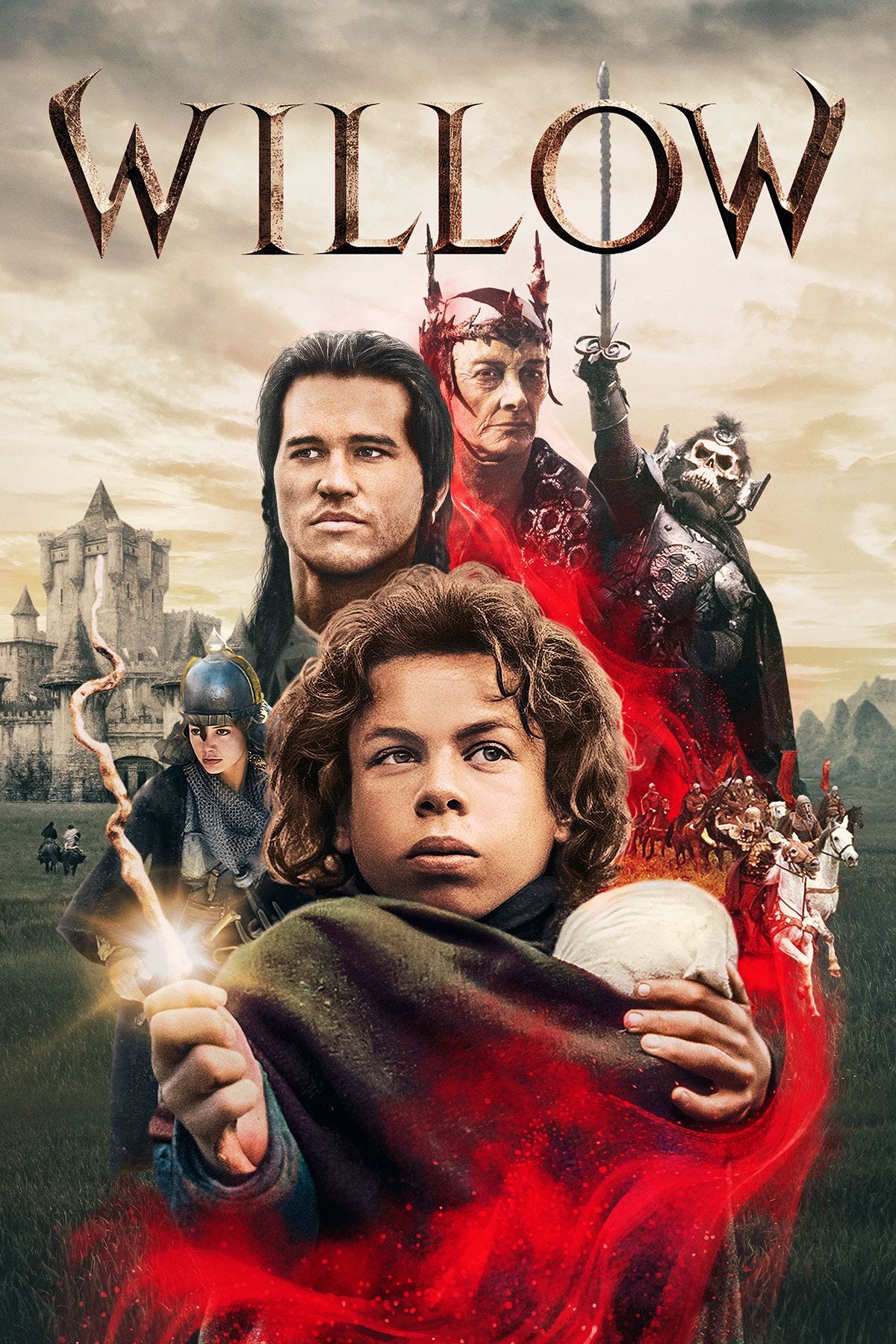
This review of Willow (1988) has two gaming appendices.
An Era that Alternated Between Low Budget and Brilliant and Sometimes Managed Both
There are those who look at the 1980s fantasy film landscape and find it easy to romanticize that era and honestly I’m one of those people. It was a decade that gave us leather-clad barbarians, sorcerers with impractical headgear, and enough magic swords to stock a small armory. It’s an era that gave us The Beastmaster (1982), in which Marc Singer’s Dar communes with ferrets and a pair of mischievous raccoons while Rip Torn chews every available piece of scenery. It’s a film that played so often on HBO in the 1990s that it became a running joke that HBO stood for “Hey, Beastmaster’s On” and it seems like I watched every broadcast. The 1980s also gave us Hawk the Slayer (1980), which had no business being as entertaining as it is, armed as it was with a miniguns-as-rapid-fire-crossbow budget and a synth score that sounds like a Casio keyboard achieving sentience. These are films that know their lane and occupy it with cheerful disregard for critical opinion.
I still find myself quoting Crow the elf from time to time. Heck, I’ve even wrote up stats for Crow in the old Blogger days for both the Savage Worlds and Shadow of the Demon Lord role playing games.
As much as I have a fondness for the era, I have to admit that genuine film making craft was rare for films in the genre. For every Hawk the Slayer, (trust me it’s a high point) there were ten films that didn’t have its sincerity or energy. There were hundreds of low budget, low effort, films capitalizing on the Sword & Sorcery boom after the film Conan the Barbarian was released. They were dollar budget films that rarely accomplished more than being an excuse for John Normanesque nudity. Every now and then though, there was a film that aimed at true greatness. Dragonslayer (1981) is the best of these and it is among the best fantasy films ever made. Dragonslayer remains astonishing and fresh. It is a genuinely dark, morally complex fairy tale that gave us Vermithrax Pejorative, arguably the finest practical-effects dragon in cinema history and certainly one of the best dragon names ever, and a story that dared to show us a high fantasy film where magic was dying. It trusted its audience and yet it bombed in the box-office. It cost $18 million to make and only made $14 in sales. Add to that that Conan, in 1982, provided a model that lower budget studios could copy and itt’s no wonder studios opted for Blood & Loincloth. The return on investment was higher.
It took almost a decade before someone other than Ray Harryhausen picked up the gauntlet and attempted to make a sincere attempt at a classic and ambitious fantasy film. Willow (1988), released thirty-eight years ago today and it was that film.
The World George Lucas Imagined and Ron Howard Brought to Life
Credit where it’s due is complicated here, because Willow emerged from a specific and sometimes uneasy collaboration. George Lucas conceived the story, rooted in the archetypal Hero’s Journey that had defined his career since Star Wars, and his fingerprints are unmistakable. You can see it in the chosen one (the baby) who must be protected, the reluctant and underestimated hero with hidden reserves of courage, and the mercenary with a heart that eventually turns. These are Lucas signatures. In 1988, with the exception of Howard the Duck, he still had the Midas touch in popular adventure cinema so his name was at the forfront of marketing.
But it’s Ron Howard’s direction that elevates the material from blueprint to lived-in world. Howard had spent the preceding years establishing himself as a filmmaker of unexpected range, from Grand Theft Auto to Splash to Cocoon to Gung Ho, and he brought to Willow something that Lucas-produced fantasy sometimes lacked. Howard’s direction gave us genuine emotional attentiveness to the characters in the foreground. Watch any Ron Howard film and you’ll see that his directoral skill set is much broader than “faster, more intense.”
The grand sweep is also there, courtesy of John Toll’s cinematography and the spectacular landscapes of Wales, New Zealand, and the UK, but Howard’s camera keeps finding its way back to faces and giving us gentle character driven moments.
This matters because Willow is, at its core, a film about a small person in a big world. Willow Ufgood is played by Warwick Davis who brings brilliance and depth to the role. Though Davis was only twenty-one years old when the film was shot and he carries the film with a warmth and comic precision that never tips into mugging. His depictions of fatherly emotions are spot on, as is the way he grapples with failure and insecurity. His Willow is genuinely brave not in a chest-puffed fantasy-hero way, but in the way of someone who is frightened and does the thing anyway. He does things because they are the right thing to do, even when no one else is willing to do them. He’s willing to do the right thing, even if it costs him his farm. He is one of the great heroes in filmic fantasy and he is far from “the chosen one.”
The Genre’s Conventions on Proud Display
The fantasy films and novels of this era had a shared vocabulary, and Willow speaks it fluently. There is a prophecy. There is a chosen one. In this case, the chosen is an infant named Elora Danan who is “destined” to bring down the dark queen Bavmorda. There is a wise old sorcerer and an aspiring warm-hearted one whose only magic is the kind you see Penn & Teller perform. There is a mercenary who doesn’t believe in prophecies. There is a warrior woman. There are creatures both practical and proto-digital. The film does not pretend these conventions don’t exist, it simply executes them with more care than most. Even when it inverts the tropes, as it does in the case of Elora Danan, it does so with sincerity rather than cynicism.
Like the best films of the era Willow is sincere, but it is better than most because it has a more fully developed narrative. Let’s take a moment to compare it to The Beastmaster. Don Coscarelli’s film is a genuine pleasure, in large part because Singer is so charismatic. Add to Singer’s charm, animal companions who are a delightful gimmick (with some surprising emotional depth), and Tanya Roberts and John Amos providing solid performances, and you’ve got a recipe for many a rewatch. But The Beastmaster is ultimately a collection of sequences in search of narrative momentum. The threat recedes and advances without much internal logic and the film survives on charm. Hawk the Slayer is even more episodic, essentially a proto-RPG adventure module translated to film. Don’t get me wrong, that’s a part of why I love Hawk the Slayer and it is a significant part of its appeal, but it does mean that Hawk the Slayer lacks a real emotional core.
Willow has actual dramatic architecture. The beginning establishes stakes that are personal before they are epic. Is Willow going to be able to keep his farm? Will he be recognized as the town’s seer? These are personal questions that persist even as the stakes escalate. The middle of the film is a genuine road movie with escalating complications. The emdomg delivers on all of the film’s promises. I have always found the antagonist, Queen Bavmorda as played by Jean Marsh, to be genuinely menacing. She’s not campy-menacing in the way of, say, Tim Curry in Legend or Jeremy Irons in Dungeons & Dragons (magnificent as they are). Instead, Bavmorda is coldly, administratively evil in a way that feels almost bureaucratic. She doesn’t rant. She simply decides that things will be a certain way and sets about making them so. Even when she chews the scenery, it feels more like genuine anger than scene chewing.
Val Kilmer, Having the Time of His Life
Speaking of crewing the scenery, there is Madmartigan.
Val Kilmer in 1988 was coming off Top Gun. He’d paid his dues with Top Secret! and Real Genius, both underreated in my opinion, and was becoming a big star. Of course, he was also heading toward Batman Forever and the difficult reputation that would eventually overshadow his talent. In Willow, he is simply incandescent. He brought the charismatic joy he exhibited in Top Secret! and added the depth he demonstrated in Top Gun and gave audiences a roguish swordsman of zero fixed principles, enormous self-regard, and, it turns out, genuine heroic capacity buried under layers of expedient cowardice. Ron Howard was wise enough to let him be funny. The sequence in which he, under the influence of a love powder, declares his passion for the enemy general’s wife is the kind of set piece that shouldn’t work. It’s stale and is more fitting in an old Jerry Lewis film and yet Kilmer makes it work, because Kilmer commits to it completely and unironically.
The chemistry between Kilmer and Joanne Whalley (as the warrior Sorsha, Bavmorda’s daughter) is also worth noting. It’s also worth noting how Sorsha is presented in the film. She’s beautiful, but her armor is functional and her character is much more than mere decoration. Sorsha is written and performed as a character with an actual arc. Her turn from antagonist to ally is motivated by something more than the protagonist’s handsomeness. This kind of sincerity was common in the best fantasy films of the era. Whether it was Sandal Bergman as Valeria, Cailtin Clarke as Valerian, or Chloe Salaman as Princess Elspeth (an truly honorable and tragic heroine in Dragonslayer), the best fantasy films of the 1980s featured some fantastic women who exhibited agency and heroism.
The Special Effects and Their Moment
Willow sits at a fascinating threshold in cinematic technology. ILM produced effects work that was state-of-the-art in 1988 and remains largely impressive today. The most impressive special effects are the practical creature work and a morphing sequence involving a sorceress named Fin Raziel. Where some of the digital work in the film frays on the edges, the shapechanging duel represents one of the earliest uses of the digital morphing technology that would explode into ubiquity with The Abyss and Terminator 2. The two-headed dragon, Eborsisk (a Lucas joke at the expense of film critics Roger Ebert and Gene Siskel), is a magnificent practical puppet. The magic itself is rendered with real imagination and spells feel costly in a way that much fantasy-film magic doesn’t.
Where the effects show their age, the film absorbs the damage, because the majority of the storytelling doesn’t depend on spectacle to compensate for emotional vacancy. The film is a useful reminder that effects are a tool, not a foundation.
Getting It Right and the Failure of Sequels
It’s worth dwelling on how unusual Willow‘s quality actually was, not as a backhanded compliment but as genuine context. The late 1970s and 1980s produced an enormous volume of fantasy cinema. Post-Conan the Barbarian (1982), every studio wanted a piece of the sword-and-sorcery market. The results ranged from inspired (Labyrinth, 1986) to enjoyable-if-modest (Krull, 1983 which regular readers know I love) to sincerely inexplicable. Dragonslayer stood apart because it was genuinely dark and intelligent about its darkness. Willow stood apart for a different reason. It was genuinely warm and intelligent about its warmth and owned that it was cheerful and inspirational fairy tale. There is not an ironic bone in the film’s “body.”
The focus on hope, and the lack of irony, are what made the original better than later attempts to expand the series. The Chronicles of the Shadow War trilogy is entertaining in its own right. Chris Claremont is a talented writer who wrote some of the best X-men stories ever published. All of that being true, from the first few pages of Shadow Moon, I never felt like I was reading a tale in the Willow-verse. In an interview on Big Shiny Robot!, when asked if the Shadow War books should be used as the basis for a movie sequel, Chris Claremont laughed and then revealed he hadn’t recorded the collaboration with Lucas and instead wrote his own story because he wasn’t allowed to use most of the characters. The book series is almost Grim Dark and gives us an Elora who isn’t, initially, worth rooting for.
The recent (2023) television series suffers from a similar problem. It abandons the fairy tale quality of the film where a regular person does what is right because it must be done. It replaces resigned heroism with youthful rebellion. In the series, Sorsha and Madmartigan have twin children named Airk and Kit. Madmartigan has disappeared and his children are dealing with some psychological trauma as a result. Even so the children have regular sibling rivalry, with Kit seeming to be tempermentally more like her father and is clearly written to be the focus of the show. So far, so good. It is only after Airk is kidnapped by the Big Bad where we get to see Kit’s true character. She has to be forced by her mother Sorsha to go off and rescue her brother.
Okay, let’s pause here for a minute so I can really impress upon you how stupid this is. We are in a fantasy story where one of the heirs of a kingdom has been kidnapped so the sovereign, Sorsha, immediately decides to send the only other heir to the throne off on a risky and potentially fatal quest to find the sibling. This is stupid. It is stupid beyond credulity. There is no way that a parent says, “oh, one of my children is missing. I know what I’ll do. I’ll send my only other child out to find them.” That’s not going to happen. Add to this, Kit doesn’t want to go. Not because of a lack of responsibility, but because she just doesn’t like Kit that much and she “doesn’t want royal duties.”
Once again. This is stupid. I’m not normally this mean, but her only royal duty would be to stay alive and that’s what she is doing by not wanting to go. The show is aiming for a duty vs. rebellion arc, but the set up inverts the whole thing. Sorsha should be telling Kit that she has a DUTY TO STAY and Kit should be fighting tooth and nail to sneak out. Jonathan Kasdan’s set up screenplay launches the quest on the weakest of premises and the actors struggled with mixed character motivations. While most of the online outrage about the show has focused on the actors, I always thought they were doing the best they could with pretty weak material. Ruby Cruz (Kit) has charisma and charm when given the opportunity, but it is really Amar Chadha-Patel (Boorman) and Tony Revolori (Graydon Hastur) who kept me watching the show. Though their characters also suffered from inconsistent motivation, they were both able to maximize their best moments in ways that mattered.
To be honest though, I don’t think any of the actors did a bad job. The show’s failure was its lack of faith in the classic and sincere fairy tale formula. It wanted to add a little edge to the whimsy of Willow, forgetting that for all it’s whimsy Willow the film had heart. When Airk asks Madmartigan to win this war for him, it is a moving moment because it is sincere. I kept waiting for the TV show to give me some sincerity and it never did. That’s all on the writers, who included the screenwriter of Far and Away and the original Willow. I cannot understand how the screenwriter of two of the most sincere “heart on the sleeve” movies of all-time could have written television screenplays this morally gray, but here we are.
The film works because it believes in its hero’s decency. It believes that courage is meaningful even when the outcome is uncertain. It believes that the bonds formed on a hard road are real. These are not complicated ideas, but they are ideas that have to be earned through craft, and Willow earns them.
Thirty-eight years later, that’s still worth something. If only those who hold the legacy could understand that worth.
Willow (1988) was directed by Ron Howard from a screenplay by Bob Dolman, based on a story by George Lucas. It stars Warwick Davis, Val Kilmer, Joanne Whalley, Jean Marsh, Patricia Hayes, and Billy Barty. John Barry’s score deserves a separate essay entirely. Hopefullly by someone who is better about writing about how music moves us emotionally than I am.
Gaming Appendix 1: The Willow Sourcebook, B/X D&D, and Getting It Right
Note: This appendix is occasioned by a happy bit of recent news. The Moldvay Basic rulebook , the “B” of B/X, is now available in print-on-demand from DriveThruRPG, joining the Cook/Marsh Expert set (available in POD since 2023). For the first time since the 1981 boxed sets went out of print, both halves of what is arguably the most elegant version of D&D ever published are available to purchase as official reprints. If you’ve been running Old School Essentials and want the originals on your shelf beside it, now is the moment. I’ll be writing a full review of B/X later as I see it as the well-spring of modern “folk” D&D.
The world of Willow has been codified for tabletop gaming once before. The Willow Sourcebook (Tor Books, 1988), written by Allen Varney with additional material from Greg Costikyan, is a system-neutral character compendium covering every significant person, creature, and location in the film. Its gaming notes use a generic stat block built on the familiar 3–18 attribute range and the classic six. The architecture is TSR to its bones. The conversions below use the Moldvay Basic / Cook Expert rules (1981), with ascending AC equivalents in brackets for Old School Essentials and similar retroclones.
But we should be honest about the sourcebook’s numbers before we work with them. In 2013, Varney himself commented on a review of the book that “The publisher, packager, and I all regarded the gaming stats as a thin but necessary wrapper to comply with the letter of our gaming license.” This is refreshingly candid, and it shows. Several of the sourcebook’s attribute assignments read like first-draft estimates made without serious examination of what the numbers actually mean in play. Varney is one of my favorite game designers and he put real work into the portraits, but didn’t do as much hard work on the stats themselves.
The stats below take Varney’s character portraits, which are as I said genuinely excellent, as the design brief and build outward from there, referencing the original numbers where they work and departing from them where they don’t. The original figures are noted for comparison throughout.
HEROES
WILLOW UFGOOD Magic-User, 4th Level
AC 8 [11], HD 4d4, hp 13, MV 120’ (40’), #AT 1 (dagger or by spell) Dmg 1d4, Save MU4, ML 9, AL Lawful, XP 75
STR 9, DEX 13, CON 12, WIS 14, INT 17, CHR 13
Spells (2/2): Sleep, Magic Missile / Phantasmal Force, ESP
On the numbers: The sourcebook gives Willow DEX 16, CHR 8, WIS 12. The CHR 8 is the the one I take most issue with. Though Willow isn’t yet a full leader at the beginning, he inspires loyalty. Willow is warm, persuasive, and genuinely likeable. After all, he talks Madmartigan into taking Elora, earns the loyalty of the brownies, and maintains the trust of everyone in his party despite having almost nothing to offer them materially. That is not an 8 Charisma. I’ve set it at 13, which is above average but not exceptional. He’s not a court diplomat, he’s a farmer who turns out to be good with people who will make a good leader for them someday.
DEX 16 similarly overstates what the film shows. Willow is quick-handed. His stagecraft is real, and he moves quietly through the world, but his DEX in the sourcebook is high enough to make him a genuinely agile combatant and he’s far from one of those. DEX 13 reflects a careful, stealthy Nelwyn who has excellent fine motor control without implying the combat reflexes of a trained thief. WIS 14 reflects his consistently good judgment under pressure. His INT 17 stays because he defeats his opponent through intelligence alone in the end.
For spells, Sleep is a reach but vital for starting magic users in B/X, Magic Missile represents his growing offensive capability, Phantasmal Force covers the pig-vanishing trick that defeats Bavmorda’s Ritual in a “real magic” way instead of the way it was depicted in the film, and ESP reflects his surprising perceptiveness about people and situations. This is a natural extension of a character whose Wisdom is his real gift. You could design Willow as a Thief or Halfling, but I’ve opted for having him use real magic. Let’s imagine this is him at the end of the movie.
Morale note: Willow’s ML 9 means he occasionally hesitates and needs a moment to recover. That is specifically the point of him as a character. He is frightened almost continuously and does the thing anyway.
MADMARTIGAN Fighter, 14th Level
AC 2 [17], HD 9d8+10, hp 68, MV 60’ (20’) in armor, #AT 1 (longsword +2 to hit) Dmg 1d8+4, Save F14, ML 9, AL Neutral, XP 1,350
STR 16, DEX 18, CON 16, WIS 9, INT 13, CHR 17
On the numbers: The sourcebook lists Madmartigan as a 20th-level fighter, explicitly the finest swordsman the players will meet, with a note to set him three levels above the best fighter in the campaign. B/X caps at 14th level, which is where Name Level fighters have become something beyond ordinary heroic, and it suits him if you accept that he’s rejecting a part of what is granted at that level. He is not an abstraction. He is a specific, irreplaceable human being who happens to be nearly impossible to kill with a sword. He has also refused to take on his responsibilities as a “leader.” It isn’t until the death of Airk that we can see him setting up a stronghold and having followers. People want to follow him, so level 14 is right mechanically, but he hasn’t set things up yet.
The sourcebook’s STR 14 is the one number here I’ve changed . In Moldvay, STR 13-15 gives +1 to hit, damage, and opening doors. So the sourcebook’s Madmartigan is not without a Strength modifier in a B/X game, but STR 13 undersells someone described as a 20th-level physical specimen who lifts armored soldiers and powers through ranks of opponents. I’ve set STR 16, which gives +2 to hit, damage, and opening doors. He’s still not Conan or Kael, but this is a meaningful step up, making his longsword hit for 1d8+2 (STR) plus the +2 to hit from exceptional skill (I’ve taken the Sourcebook’s “+4 to hit” and converted down to B/X’s tighter modifier scale). The result: 1d8+4 damage per hit from a character who connects with nearly anything he swings at by 14th level.
His DEX 18 shows off his combat dominance, dropping him to AC 2 in chain without a shield. His WIS 9 let’s us know why he has all of those personal disasters. These stay exactly as written. His CHR 17 is correct and important narratively. He’s the most immediately magnetic human in the film, and players should feel that.
Equipment: Chain mail (default), longsword, occasionally a shield (AC 1 [18] with DEX). At Nockmaar Castle he acquires plate; adjust AC to 1 [18], or 0 [19] with shield.
VILLAINS
QUEEN BAVMORDA Magic-User, 14th Level (see note)
AC 5 [14], HD 9d4+5, hp 55, MV 120’ (40’), #AT 1 or by spell Dmg 1d4+1 (staff) or by spell, Save MU14*, ML 12, AL Chaotic, XP 3,000+
STR 10, DEX 14, CON 18, WIS 12, INT 18, CHR 14
*Bavmorda may reroll any failed saving throw once, keeping the second result. She has spent decades hardening herself against magical interference.
On the numbers: The Willow Sourcebook presents Bavmorda as a 36th-level magic-user. That works in BECMI, but B/X has no mechanism for this, so her level functions as a narrative declaration that she is beyond the standard advancement table. I used 14th level as the mechanical floor and understand that her actual capability exceeds what those numbers represent.
The sourcebook’s attribute spread is CON 18, INT 18, WIS 17, CHR 18. She is, as kids will say for the next six or seven days, attributemaxxing. She has four near-maximum scores, with only STR (10) and DEX (16) falling below the ceiling. As David Pretty joked in the review I referenced earlier, Varney might be “the sort of DM who lets you roll 4d6 and drop the lowest.” I think it was just a matter of assigning high numbers rather than considering what WIS 17 and CHR 18 actually mean in terms of what happened in the movie.
I really disagree with the WIS 17 score because Bavmorda underestimates Willow Ufgood repeatedly throughout the film. She dismisses him as beneath her attention, fails to anticipate the pig-vanishing trick, and never adjusts her threat assessment despite mounting evidence. That is not the behavior of a character with Wisdom in the upper percentile of human capability. Wisdom in B/X governs judgment, perception, and willpower. Bavmorda’s strategic blindspot, her inability to take seriously the possibility that someone insignificant could outthink her, is precisely a failure of Wisdom. I’ve set it at 12, which is average. I don’t think she has below normal wisdom, but she is susceptible to the arrogance that comes with being the most powerful person in the room for thirty years.
I also think the CHR 18 is similarly difficult to defend. Bavmorda commands through fear and magical compulsion, not personal magnetism. She doesn’t need Charisma to generate obedience when she is the most powerful wizard in the world. She inspires obedience because the alternatives are monstrous, not because people genuinely want to follow her. CHR 14 is still above average, she has genuine authority and presence, but it separates “people comply” from “people want to please her.” She gained her position of power because she was powerful, not because people were inspired or compelled by her leadership abilities.
If B/X had Lichs in the rule book, I’d probably make her a Lich and have that explain a lot of her resilience. Since it doesn’t, I’ll keep the CON 18. Decades of high-level spellcasting require extraordinary physical endurance. The INT 18 also stays because she is unambiguously the most formidable magical intellect in the world. She’s smart but, as we’ve seen, she isn’t wise.
HP 55 is a reasonable B/X calculation for a 14th-level MU with CON 18 (which grants +3 per Hit Die through level 9, giving 9d4+27 plus five flat HP for levels 10–14 at average rolls). The sourcebook’s 75 is overly generous for a lower hit point game like B/X. The reduced HP makes her no less dangerous, she will likely never be defeated in direct magical combat, but it means the climactic physical confrontation with Fin Raziel carries real stakes.
When it comes to Bavmorda’s actual spell casting abilities, I’m going to break the rules a bit. Bavmorda carries no spellbook in any conventional sense. She has no spell slots. Treat her as having access to any Magic-User spell of levels 1–6 at will, with the narrative caveat that her most powerful spells require elaborate ritual preparation. She cannot mass-transform an army in a moment of improvisation, but use your discretion when thinking about what spells she can cast in a “combat time.”
The Ritual of Obliteration
The Ritual is not a spell in the B/X rulebook. In fact “rituals” don’t exist at all in B/X. They were one of the additions in 4th edition that I thought was a genuine benefit to D&D mechanics. The ritual belongs to a category of magic that Varney himself handled well in the sourcebook, and that the module Curse of Xanathon handles similarly, where the effect is real and mechanically grounded, but the source lies outside the standard spell list. The Ritual is a ritual. It has requirements, a process, and a specific vulnerability.
Requirements: A prepared ceremonial space (minimum one week to consecrate), twelve druid/wizard celebrants acting in concert, and an uninterrupted casting period of approximately one hour. The target must be physically present in the space. The Ritual cannot be rushed, and disrupting any of the twelve celebrants during the final phase will abort it.
Effect: On completion, the target’s soul is permanently obliterated. The victim is not merely killed, but annihilated. No resurrection, no afterlife, no recovery. This effect is absolute.
The Vulnerability: If the target is removed from the ritual space at the exact moment the final lightning bolt would strike, not before, not after, but in the instant of obliteration, the bolt has no target to consume and rebounds back upon its source. In the movie Bavmorda had to make a Saving Throw vs. Death Ray at this moment and she failed. If you play this out in your game, have it be that she automatically fails.
This last clause is not a rules hack. It is the literal logic of the film. Willow’s pig-vanishing trick works because the Ritual’s magic cannot distinguish between “target has been transported” and “target does not exist.” The bolt returns because Bavmorda’s own spell has nowhere to go. It is, in the sourcebook’s own elegant phrase, a case of the prophecy being “surprisingly fulfilled.”
GM note: Bavmorda should not feel like a combat encounter. She should feel like a weather system with a specific structural weakness that only becomes apparent at the moment of maximum crisis.
GENERAL KAEL Fighter, 14th Level
AC 2 [17], HD 9d8+10, hp 72, MV 60’ (20’), #AT 1 (longsword +2 to hit) Dmg 1d8+5, Save F14, ML 12, AL Chaotic, XP 1,350
STR 18, DEX 15, CON 18, WIS 14, INT 16, CHR 14
Special — The Death Mask: At the start of the first round of any combat encounter in which Kael is visible, all opposing combatants who have not previously faced him must make a Saving Throw vs. Spells. Failure means the character suffers –2 to attack rolls during that first round only, as the skull-faced helmet and Kael’s sheer physical presence triggers a momentary freezing of nerve. Characters who have faced Kael before are immune. The DM may waive this check for player characters who have been explicitly established as exceptional in courage or military experience.
Special — Nockmaar Command: All Nockmaar soldiers within 60’ of Kael gain +1 to all Morale checks.
On the numbers: If Madmartigan is the film’s argument for what a fighter looks like at his most brilliantly alive, Kael is the argument for what a fighter looks like at his most perfectly formed. The sourcebook’s numbers for him are the most defensible in the book. The reviewer noted that reversing his INT and WIS would approximate a typical first player-character fighter, which is funny and accurate. I do think one attribute needs adjustment.
The sourcebook gives Kael DEX 17, almost identical to Madmartigan’s 18. This flattens the distinction between them. Madmartigan’s whole fighting style is reactive, acrobatic, improvisational. The battle between them is a conflict between speed and flow and the ability to redirect force and a mechanism that is precise, overwhelming, and inevitable. A DEX of 17 makes Kael feel like a slightly slower Madmartigan. DEX 15 makes him feel like a different kind of fighter entirely. He still receives an AC benefit, but it also reflects why he buys the heaviest armor money can command (+1 DEX to AC 3 plate = AC 2 [17]).
In compensation for downgrading his DEX, I decided to upgrade is WIS. The sourcebook gives Kael WIS 12, average, which undersells one of his most important traits. Kael is a strategically brilliant commander who understands power, loyalty, and the geometry of large-scale conflict. He never overreaches, never makes the obvious ambitious mistake, and has the unique military discipline to serve Bavmorda faithfully precisely because he understands that her power exceeds what he could acquire by betrayal. WIS 14 reflects a character who is genuinely wise about the world, where Madmartigan’s WIS 9 reflects someone who is genuinely not.
This creates a mechanical mirror that matches the film nicely. Madmartigan has the higher DEX and CHR; Kael has the higher STR, CON, and WIS. Madmartigan is faster, more charismatic, more unpredictable. Kael hits harder, absorbs more punishment, and makes better decisions under strategic pressure. The only way Madmartigan beats Kael is to be smarter in the moment, which is exactly what the film’s climax demands.
Kael’s HP 72 tracks the B/X math cleanly: 9d8 with CON 18 (+3 per die through level 9) averages 67.5, plus 5×2 for levels 10–14 = 77.5 average at maximum, 72 at a reasonable median.
Equipment: Full plate, the Death Mask (bound-spirit skull helmet), longsword, warhorse. His sword skill applies to any one-handed weapon — the +2 to hit functions the same as Madmartigan’s.
The Willow Sourcebook (1988) by Allen Varney with additional material by Greg Costikyan is a great book. It’s sadly out of print, but it is very much worth reading. The combination of Allen Varney, Greg Costikyan, and Eric Goldberg as authors makes this a gaming hall of fame publication. Maybe it will be reprinted some day. The Moldvay Basic Set Rulebook (1981) and Cook/Marsh Expert Set Rulebook (1981) are both currently available in print-on-demand from DriveThruRPG.
A Second Gaming Appendix: Shadow of the Weird Wizard
Shadow of the Weird Wizard (Schwalb Entertainment, 2024), Robert J. Schwalb’s “kid friendly” successor to Shadow of the Demon Lord, uses a set of mechanics that has evolved many editions away from B/X. It’s one that illuminates these characters in different ways. Where B/X rewards careful attribute assignment on a 3–18 scale, SWW builds around four attributes (Strength, Agility, Intellect, Will) with explicit modifiers, a Difficulty rating for encounter budgeting, and attacks expressed as dice pools with boons and banes. The system is explicitly cinematic, and Willow is an explicitly cinematic film which makes it a very good fit. Given that Schwalb’s “Shadow” games are inspired by 4th edition D&D, they are familiar enough to D&D players in general but different enough that they deserve some discussion.
The most useful difference in adapting Willow from screen to TTRPG is that in SWW, Will governs both magical power and mental fortitude, while Intellect governs knowledge and problem-solving. Since this is not the same attribute as D&D’s Wisdom, Bavmorda can be assigned a very high Will. Her magical force is absolute, and we can stat her up appropriately without that assignment implying good judgment. The arrogance that blinds her to Willow is a trait, not a low score. This is a more honest representation of the character than any single-number stat.
Stat blocks use the Secrets of the Weird Wizard bestiary format. Ascending Defense (higher = harder to hit), variable Health pools, and encounter Difficulty ratings replace B/X’s descending AC and hit dice. I’ll provide stats for Willow and Madmartigan in a final section as player characters. That’s right! This post gets 3 appendices.
HEROES
WILLOW UFGOOD HUMAN (NELWYN) · DIFFICULTY 3
Defense: 11, Health: 22 Strength: 9 (−1), Agility: 12 (+2) Intellect: 14 (+4), Will: 13 (+3) Size: 1/2, Speed: 4 Languages: Common (Nelwyn dialect)
Nelwyn Stealth: Willow makes Agility rolls to hide and move silently with 1 boon.
Quick Study (Magical): Once per round, when Willow observes a magical effect, he makes an Intellect roll. On a success, he understands its general nature.
ACTIONS
Melee Attack—Dagger · Thrown 5: Agility (+2) (1d6)
Sleep Hex (Magical): Willow hurls an enchanted acorn at a target within 10 yards, making a Will (+3) roll against the target’s Agility. On a success, one creature of Size 3 or less falls asleep until it takes damage or another creature uses an action to rouse it. Willow loses access to this talent for 1 minute after using it.
Phantasmal Deception (Magical): Willow creates a convincing illusion within 5 yards. Until a creature interacts with it or the round ends, the illusion appears real. A creature that interacts with the illusion makes an Intellect roll; on a failure, it believes the illusion is real until the end of the next round.
REACTIONS
Improvised Solution: When Willow or an ally within 5 yards would be hit by an attack, Willow can describe a quick improvised response. The Sage decides if the action is plausible; if so, the attacker rolls with 1 bane.
On the design: SWW’s Size 1/2 is exactly right for a Nelwyn. It reflects Willow’s physical smallness without making him mechanically helpless. His Agility 12 (+2) drives both his stealth (a racial trait) and his dagger attacks. His Intellect 14 (+2) represents his magic learning, while Will 13 (+1) represents his determination and growing magical force. The gap between Intellect and Will is meaningful. He’s clever before he’s powerful, which is precisely the arc of the film.
Willow’s Difficulty 3 makes him a workable novice-tier challenge on his own, useful if the Sage wants a scene where separating the party becomes dangerous, but his real value is as an allied NPC. His Phantasmal Deception and Sleep Hex reward creative play and narrative solutions over direct combat, which is exactly how Willow wins.
MADMARTIGAN HUMAN · DIFFICULTY 6
Defense: 16 (chain), Health: 50 Strength: 14 (+4), Agility: 16 (+6) Intellect: 11 (+1), Will: 9 (−1) Size: 1, Speed: 5 Languages: Common
Peerless Swordsman: Madmartigan’s Sword attacks roll with 2 boons rather than 1.
Stalwart: When Madmartigan becomes confused or frightened, he makes a luck roll. On a success, the effect ends immediately.
Reckless Courage: Madmartigan makes Will rolls to resist temptation, seduction, or provocations to personal conflict with 2 banes.
ACTIONS
Melee Attack—Sword · Slashing: Agility (+6) with 2 boons (3d6) Critical Success: The target takes an extra 1d6 damage, and Madmartigan makes a free attack against the same or an adjacent target.
Two Attacks: Madmartigan makes two Sword attacks.
FURY
Make a Sword attack. Move up to his Speed.
On the design: Madmartigan’s Agility 16 (+6) is reflective of his combat style and in SWW terms Agility drives both attack and Defense for a mobile fighter, so his entire combat profile flows from a single attribute. This is more elegant than B/X’s separate to-hit and AC calculations. His Will 9 (−1) is the mechanical expression of every bad personal decision he makes, and Reckless Courage makes it concrete: he is specifically susceptible to provocations and temptations in ways that cost him. Stalwart keeps him from breaking in genuine crisis. He can be goaded, but he doesn’t break.
The Fury entry is deliberately restrained. Madmartigan’s power comes from exceptional precision, not supernatural speed; giving him a Fury that mirrors the Knight’s “Two Attacks” as a bonus action would overpower him at Difficulty 6. Instead his Fury gives him a free sword strike or repositioning, which rewards players who set up flanking or create tactical openings for him.
VILLAINS
QUEEN BAVMORDA HUMAN · DIFFICULTY 10
Defense: 12, Health: 70 Strength: 10 (+0), Agility: 11 (+1) Intellect: 16 (+6), Will: 17 (+7) Size: 1, Speed: 5 Languages: Arcane, Common, Kingdom
Supreme Sorceress: Bavmorda adds 1 boon to all magical attack rolls.
Undeniable Will: Bavmorda is immune to the confused, frightened, charmed, and compelled afflictions.
Contemptuous of Inferiors: Bavmorda makes Intellect rolls to detect threats originating from creatures of Difficulty 4 or less with 1 bane. She simply does not take small things seriously.
ACTIONS
Melee Attack—Staff · Bludgeoning: Strength (+0) with 1 boon (1d6)
Lightning Wrath (Magical): Bavmorda hurls a bolt of lightning at a target within 20 yards. Make a Will (+7) roll with 1 boon against the target’s Agility. On a success, the target takes 5d6 damage. Once Bavmorda uses this talent, she loses access to it until the end of her next turn.
Mass Transformation (Magical): Bavmorda transforms up to six creatures she can see within 15 yards into harmless animals. Each target makes a Will roll against Difficulty 15. On a failure, the target becomes the animal until it makes a successful Will roll at the end of each of its rounds. Once Bavmorda uses this talent, she loses access to it for 1 minute.
FURY
Cast Lightning Wrath (if available). Move up to her Speed.
END OF THE ROUND
Magical Surge: Bavmorda regains access to Lightning Wrath if she has lost it.
The Ritual of Obliteration
The Ritual functions identically to the version described in the B/X appendix above, with the following SWW-specific notes. The Ritual requires twelve celebrant druids (each Difficulty 2 Ordained Priests, effectively) and an uninterrupted preparation period of one hour of game time. The target must remain within the ritual space.
The Vulnerability: When the Ritual’s final effect resolves, if the target has been physically removed from the ritual space in that same round, by any means, the bolt has no target and rebounds. Bavmorda must immediately make a Will roll against Difficulty 20. She automatically fails. She takes the Ritual’s full effect herself, which incapacitates her instantly and permanently.
Sage Note: The Ritual should never feel like a combat encounter. It is a ticking clock. The characters’ objective is to extract the target before the final round of casting, not to fight Bavmorda directly. Bavmorda’s Contemptuous of Inferiors trait is the key. She fails to adequately watch Willow because she does not believe he is capable of disrupting the Ritual.
On the design: Bavmorda’s Will 17 (+7) is the highest Will score in this appendix, and it should feel like it. Her Lightning Wrath is a Difficulty 15 Agility check for targets and most novice-tier characters fail that roll routinely. Her Magical Surge end-of-round effect means she fires at full power every turn, which makes the characters’ impulse to engage her directly a losing proposition.
Contemptuous of Inferiors is the heart of the design. It does not reduce her power. She is still the most dangerous creature in any scene she enters, but it creates a specific, exploitable vulnerability at the narrative level. She fails to perceive the threat that defeats her because it comes from someone she does not consider worth watching. The trait makes the film’s resolution feel inevitable rather than lucky.
GENERAL KAEL HUMAN · DIFFICULTY 8
Defense: 20 (plate, shield), Health: 60 Strength: 15 (+5), Agility: 13 (+3) Intellect: 13 (+3), Will: 13 (+3) Size: 1, Speed: 4 Languages: Common, Kingdom
Weapon Master: Kael’s melee attacks deal an extra 1d6 damage.
Terror of the Death Mask: When combat begins, each enemy that can see Kael makes a Will roll against Difficulty 13. On a failure, the creature becomes frightened until the end of its next turn. A frightened creature makes attack rolls with 1 bane.
Iron Commander: Each Nockmaar soldier within 10 yards makes Will rolls (including morale) with 1 boon.
ACTIONS
Melee Attack—Sword · Slashing: Strength (+5) with 2 boons (3d6 + 1d6 from Weapon Master)
Melee Attack—Mace · Bludgeoning: Strength (+5) with 2 boons (3d6 + 1d6 from Weapon Master)
Two Attacks: Kael makes two Sword attacks.
FURY
Make a Sword attack. Move up to his Speed.
REACTIONS
Iron Parry: When Kael is hit by a melee attack, he can make a Strength (+5) roll against the attacker’s attack result. On a success, Kael takes half damage.
On the design: He was designed to be in direct contrast with Madmartigan. Madmartigan’s combat profile is built almost entirely on Agility 16 (+3). He’s fast, precise, and acrobatic. Kael’s is built on Strength 15 (+3) plus Weapon Master, which adds 1d6 to every hit. Where Madmartigan wins through skill and speed, Kael wins through mass and inevitability. Their total damage output is comparable, but the texture is completely different.
Kael’s Defense of 20 (plate and shield) is the highest in this appendix. At Difficulty 8 he’s the hardest straight combat encounter. The highest possible defense in SWW is 25 and this gets him close to that. Bavmorda is the most dangerous presence in any room she enters, but Kael is the hardest person to physically kill. The finale of the film requires both problems to be addressed simultaneously, which is exactly the kind of layered encounter SWW is built for.
Iron Commander is deliberately limited to the tactical radius. Kael’s army is unbeatable with him leading it. Separated from his troops, he’s still dangerous but not impossible. The film’s resolution requires getting to him past the army, which means the army has to be dealt with first.
A Third Appendix! What is Christian Thinking?! Building Willow and Madmartigan as Player Characters
The opposition stat blocks represent these characters as the Sage needs them. They are calibrated threat levels with mechanical precision, but what if you want to play as Willow? Shadow of the Weird Wizard is a player-facing game, and both characters have arcs that map cleanly onto the novice to expert to master path chain. The builds below represent full level-10 progressions. A Sage running a Willow-adjacent campaign could hand either sheet to a player on day one and say “start here.”
One note on ancestry before diving in: the core book’s novice paths assume human-scale Size 1. Willow is a Nelwyn who are roughly halfling-sized. The Weird Ancestries supplement covers small folk ancestries with Size 1/2, the Slippery trait, and natural stealth. Apply whichever small-folk ancestry fits your table’s needs. The path builds below are ancestry-agnostic and don’t assume owing the Weird Ancestries rulebook.
MADMARTIGAN
Fighter to Swashbuckler to Battle Master
The three-path chain almost writes itself. The Swashbuckler description reads: “In combat, you’re the one who swings on the chandelier. You yank the curtain down to entangle your foes, or scale the cliff with a dagger clenched in your teeth to rescue your one true love from the blackguard’s clutches.” That is Madmartigan, sentence for sentence.
Novice: Fighter
Starting attribute set (Roll 6): STR 12, AGI 12, INT 9, WIL 10.
Attributes at level 10: STR 14, AGI 16, INT 9, WIL 11.
Combat Training (level 1) gives him attack rolls with 1 boon from the start and the ability to roll damage twice on a critical success, so his precision is already above the baseline. Combat Recovery is his resilience; he takes serious damage and keeps fighting. At level 2 he picks his Fighting Style:
Armiger is the only real choice. Choose three weapons (longsword, short sword, dagger) and roll with 1 boon on all three. At level 5, once per combat he can treat any success on an Armiger weapon attack as a critical success (luck ends). Combined with Combat Training’s double-damage-on-crit, this means Madmartigan can choose his moment to deal devastating damage. All of which is precisely how his big fights play out on film.
Expert: Swashbuckler (level 3)
Apply both attribute increases to Agility (14). Health +12. Bonus Damage +1d6.
The Bravado pool is the mechanical heart of the build. At the start of combat, roll a number of d6s equal to level, six dice at level 6, nine at level 9. Note each result and spend them to activate:
Bold Defense: Subtract a Bravado result from an enemy’s attack roll. Madmartigan is hard to hit because he’s actively spoiling the attempt.
Derring-Do: Add a Bravado result to any attribute roll. This is his improvised stunts: leaping gaps, catching falling objects, talking his way through a checkpoint.
Evasive Maneuvers (level 4): Spending any Bravado result makes him Slippery until end of next turn. He’s a ghost in the middle of a melee.
Cutting Quip (level 4): When an enemy fails an attribute roll, spending a Bravado 3+ weakens them until end of his next turn. The trash talk is mechanically load-bearing.
Courageous Strike (level 6): On a successful attack, spend a Bravado result to add twice its number as extra damage. A Bravado 6 becomes 12 bonus damage.
Dashing Recovery (level 9): When he expends his last Bravado, make a luck roll. On a success, gain one extra action next turn. He burns everything and keeps going.
Master: Battle Master (level 7)
Apply three attribute increases: AGI to 16 (modifier +6), STR to 14 (+4), WIL to 11 (+1). Health +18. Bonus Damage +1d6 (now 3d6 total pool).
Certain Strike: When the d20 shows 5 or less, add level to the result. At level 10 that’s a floor of 15 before modifier. Almost nothing resists him.
Glancing Blow: On a failed attack, deal 1d6 damage anyway. He always draws blood.
Storm of Strikes (level 8): Use an action to attack every creature within 5 yards. Each takes 1d6 per two Bonus Damage dice. Against massed infantry this is cinematic.
Battle Mastery (level 10): Impose 1 bane on all attacks against him. Make Agility rolls to avoid or mitigate harm. The finest swordsman in the world is simply difficult to damage.
The complete picture at level 10: AGI 16 (+6), Bravado pool of 10d6 at combat start, Armiger 1 boon on sword attacks, Combat Training 1 boon on all attacks (net 2 boons), critical success on demand once per combat, Courageous Strike for explosive burst damage, Storm of Strikes for crowd control, Battle Mastery imposing 1 bane on all incoming attacks. He is the most dangerous human combatant at a table of novice-tier adventurers, and he should feel like it from level 1 onward.
WILLOW UFGOOD
Mage to Wizard to Abjurer
Willow’s arc is not “discovers he’s powerful.” It’s “discovers he’s capable of protecting others.” The path chain needs to end somewhere and Abjurer seems perfect for him. After all the Ritual climax a moment defines what Willow will become when he finally achieves his destiny. Though he won’t fulfill that destiny until years after the events of the film.
Novice: Mage
Starting attribute set (Roll 3): STR 9, AGI 10, INT 13, WIL 11.
Attributes at level 10: STR 10, AGI 10, INT 17, WIL 13.
Languages: Arcane and Common (Nelwyn dialect).
Traditions (two at level 1, one more at level 2): Illusion and Enchantment at level 1; Protection at level 2. Illusion covers his phantasmal deceptions throughout the film; Enchantment covers the sleep hex; Protection is what he’s actually building toward.
Starting spells (four novice): Draw from Illusion (a basic phantasmal figment), Enchantment (a sleep-adjacent confusion effect), Protection (a minor ward), and a utility divination. His grimoire grows.
Mage Implement: His enchanted acorns are the implement. Not a wand, acorns. The implement produces charges equal to level; spending one gives 1 boon on a spell roll (Augment Magic), reveals nearby magic (Mage Sense), or lets him resist a magical effect with 1 boon while taking half damage (Mage Shield). The acorn-as-implement is mechanically identical to a wand but thematic in a way I think is appropriate. Yes, he has enchanted acorns in the movie and I’m rolling with that gimmick.
The Source of Magic table (d6): Roll 3 reads “You apprenticed under a famous wizard or attended a magical university. Then again, you might have found a magical trout who whispered terrible truths about the world, thus opening a door to great magical power.” The magical-trout option is not metaphorical, it could be Fin or some other mystical power.
At level 2: Spell Recovery lets him heal half his damage total and regain all expended novice castings. This keeps him in the fight without requiring the party to spend resources on him.
At level 5: Spell Expertise — when he casts a spell requiring an attribute roll, he rolls with 1 boon. When a spell enables a creature to resist, it rolls with 1 bane. His magic becomes harder to shake off.
Expert: Wizard (level 3)
Apply both attribute increases to Intellect (15). Health +4. Two expert spells added.
The Wizard Grimoire is the build’s structural center. It holds four extra novice spells from any tradition he knows, expanding his toolkit considerably. It grows at levels 4 and 6 (one expert spell each) and level 9 (one master spell). He can swap spells after an hour of study. This represents him after years of learning from experience.
Carrying the grimoire gives 1 boon on Intellect rolls and imposes 1 bane on attacks targeting his Intellect. He’s focused, difficult to rattle intellectually, immune to the Intellect impaired affliction. The Book of Magic is doing real mechanical work.
Wizard Sight (level 4): An action or reaction to see magical auras, perceive invisible magical creatures, and prevent hidden magic from concealing itself.
Burn the Page (level 6): Cast any spell from the grimoire as if it were an inscription, but it disappears from the book afterward. Emergency casting at a resource cost, spending knowledge for a one-time effect. Feels exactly right for Willow’s improvised solutions under pressure.
Magic Savant (level 9): After each rest, choose one novice, one expert, and one master spell from his known repertoire. Increase their castings by the spell’s normal amount. He has studied long enough that certain effects flow easily.
Master: Abjurer (level 7)
Apply three attribute increases: Intellect to 17 (+7), Will to 13 (+3), STR to 10 (0). Health +6. Protection tradition deepens; one master spell added.
The Abjurer’s opening description: “You confronted manifold dangers in your career, witnessed terrible things that had the worst intentions toward you and yours. Whether you faced hostile magic or ravenous monsters, you triumphed over these challenges by making the protection of your allies and yourself your highest priority.”
That is Willow’s entire arc.
Defensive Sigil (level 7, Magical): Place a protective sigil on a creature in reach. For 1 hour, attacks against the target roll with 1 bane. When it takes damage, it can end the effect to halve that damage. Five uses per rest. Willow marks Elora. He marks the party. He marks whoever needs protecting this round.
Turn Magic (level 8, Magical, Reaction): When a creature within 5 yards would be targeted by a magical effect, make an Intellect roll. On a success, the magic has no effect. At level 10, a critical success lets him redirect that effect to any target within 10 yards. This what he learned from his experience combatting the Ritual.
Disjoin Magic (level 10, Magical): For 1 minute, become immune to all magical effects. Cannot cast spells or use magical talents in return. The ultimate defensive tool where he can step entirely outside the magical conversation. Used sparingly, because while active he cannot protect anyone else either.
The complete picture at level 10: INT 17 (+7), Grimoire with 4 extra novice spells plus expert and master additions, Spell Expertise (1 boon on all spell attack rolls, targets roll with 1 bane), Defensive Sigil protecting five allies simultaneously, Turn Magic as a reaction to negate or redirect hostile magic, Disjoin Magic for absolute magical immunity. His Health is modest (12 base + 4+4+6 from expert + 6 from master = 32), his Defense is low (8 natural, no armor), and he hits nothing in melee. He wins by making everything around him harder to harm, and by being in the right place at the right moment with the right spell.
Of course, this represents a Willow many years removed from the film, but the development shows the choices along the way allowing you to give players a Willow at any level.
Shadow of the Weird Wizard and Secrets of the Weird Wizard are © 2024 Schwalb Entertainment, LLC. Both are available at DriveThruRPG.
Willow is still one of the better fantasy Sword & Sorcery films made. Great cast, excellent story, decent effects for the day all made for a highly memorable and entertaining family film.
Interesting you don't mention the Brownies at all -- a fascination with really stupid humor in French accents, hinting at a Jerry Lewis inspiration, foreshadows Jar Jar Binks heavily.
I could have forgiven the Willow TV show anything if not for the truly unforgivable use of modern pop songs. Lucas/Howard got that fantasy needed epic score. A Knight's Tale made the gimmick work, but "Money for Nothing" talking about microwaves and color TVs, in Willow? Big ol' nope.