


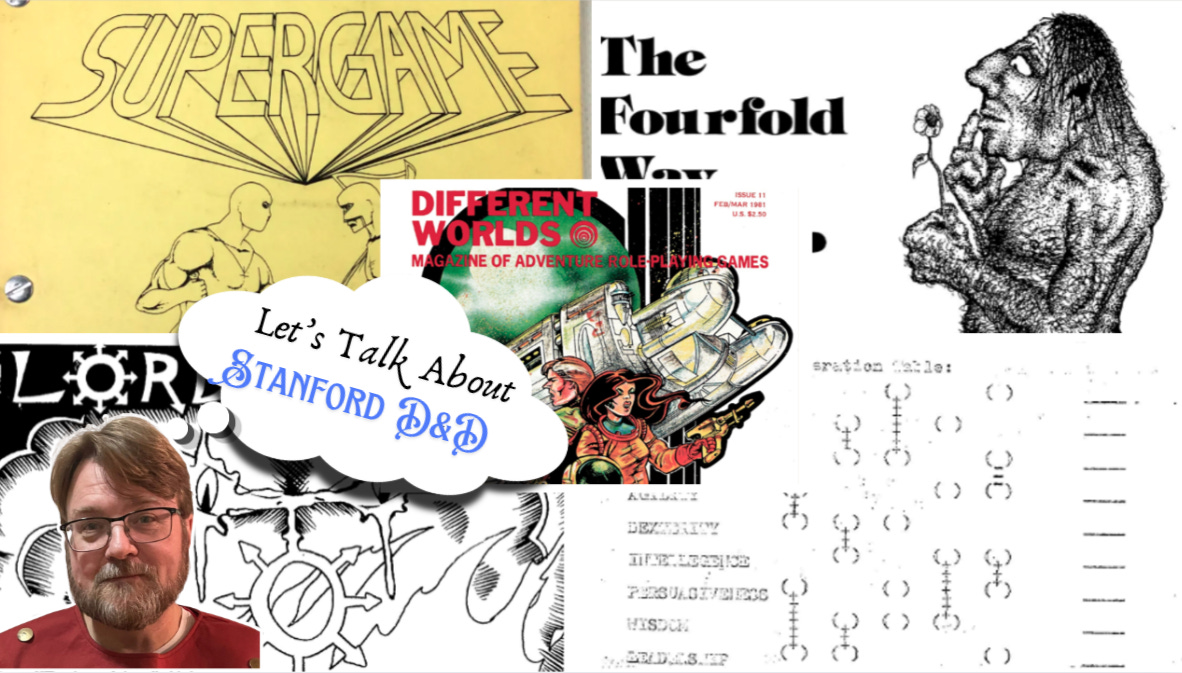
There’s a moment in the history of any hobby where the people who are going to change it haven’t quite changed it yet. They’re playing games in basements and dormitories, arguing about rules that don’t quite work, and writing things down for one another in typewritten fanzines that almost nobody outside their immediate circle will ever read. The California RPG Scene in the mid-1970s was full of those moments. Some of those moments, Cal-Tech’s Warlock, the creation of the Thief Class for D&D, Supergame by DAG Design, and The Arduin Grimoire, are relatively well-known in gaming historiography circles. There are probably far more that have been lost.
There is one that I think is for the most part lost and forgotten and I’d like to rekindle interest in it so that we can hopefully get the full picture. If I hadn’t been stopped in my tracks by an aside in an article in Different Worlds #11, and pursued a relatively long Google dive, I wouldn’t have known about this D&D variant at all and it’s possible you didn’t either.
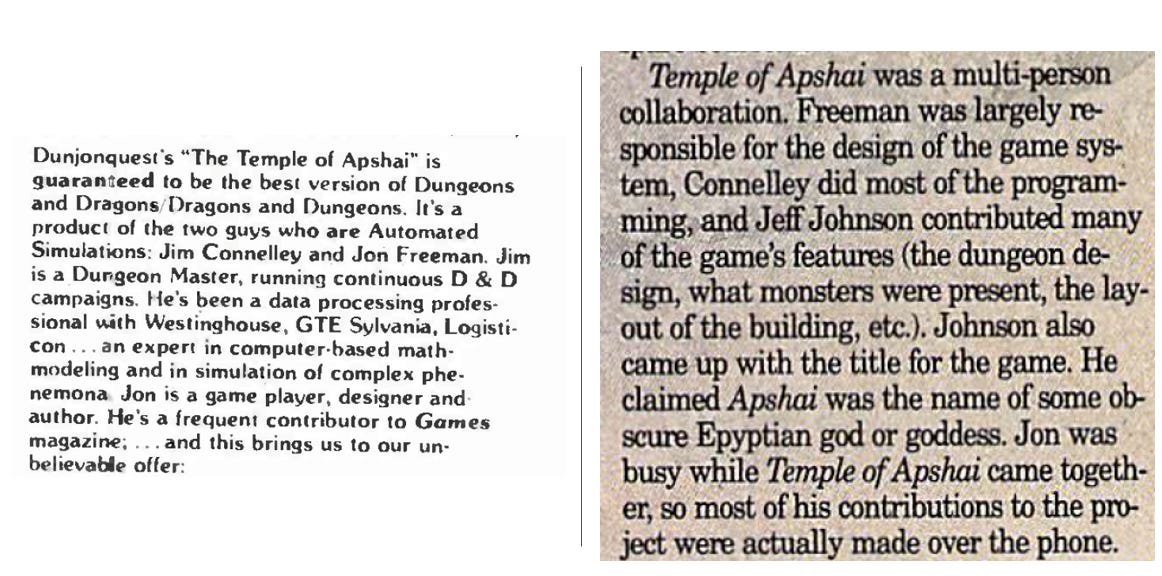
How much do you know about “The Stanford System” for Dungeons & Dragons? They were the house rules that a particular community of Stanford gamers used in the late 1970s and early 1980s. They are rules that may, or may not, have influenced Epyx games’ Dunjonquest: The Temple of Apshai, because Jeffrey A Johnson (the author of the article in in Different World #11 that mentions the Stanford System) was one of the designers of Temple of Apshai. Prior to re-reading the Four-Fold Way article last December, I hadn’t known about The Stanford System at all.
Given how many times I’ve read Different Worlds #11, there really is no excuse for this oversight, but it remains true. I missed it and I thought you might have too. Different Worlds is, as I’ve mentioned many times, one of the most important gaming magazines ever to be published. While it was a Chaosium house organ, it covered the wider world of role playing games and, like Alarums and Excursions and Lords of Chaos, was at the center of the California Roleplaying Scene.
Old RPG Magazines #1: Different Worlds #23

To say that Different Worlds Issue #23 is an excellent Superhero Themed Gaming Magazine issue would be an understatement. It is closer to the truth to say that this particular issue of Different Worl…
Jeffrey A. Johnson’s article “The Fourfold Way of FRP” in Different Worlds #11 was a response to Glenn Blacow’s article on Role-Playing Game Styles in issue #10 of the magazine. Both of these articles are cornerstones of roleplaying game design theory that you’ll see discussed widely, often by people who’ve heard of the articles but never actually read them. The articles are insightful and speak to many of the conflicts in the modern hobby as much as they spoke about the cleavages in the 1970s and 1980s. When it comes to gaming styles, it seems there is nothing new under the sun. Early in the article Jeffrey A. Johnson writes the following:
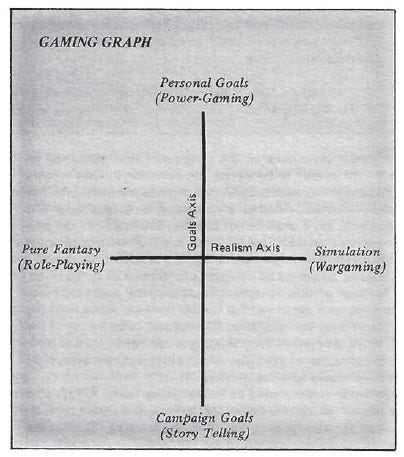
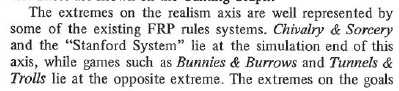
He writes that the “Stanford System” is heavily on the simulation/wargaming end of the pure fantasy/wargaming axis. The context in which he makes this statement implies that he expects his readers to know exactly what he is talking about, but after asking around my gaming circles I couldn’t find anyone who had any idea what this system was. To be fair, the article was written 46 years ago. I’ve reached out to Tadashi Ehara, the editor of Different Worlds, and George MacDonald of Hero Games and SSI who worked with Jeffrey A. Johnson, but I haven’t heard back from them on that.
After getting as much as I could out of my social network contacts, I decided to see if my Google-Fu could uncover anything. That’s when I stumbled across Tom Van Winkle’s 2020 blogpost on the topic. It’s a pretty rich discussion of The Stanford System and led me to another source of information, a personal zine called Phantasmagoria #1 written by Barry Eynon (whom I think I identified, but who didn’t respond to my LinkedIn attempt to connect). Another Google search later and I discovered that I could get a copy of Phantasmagoria #1 to examine on my own.
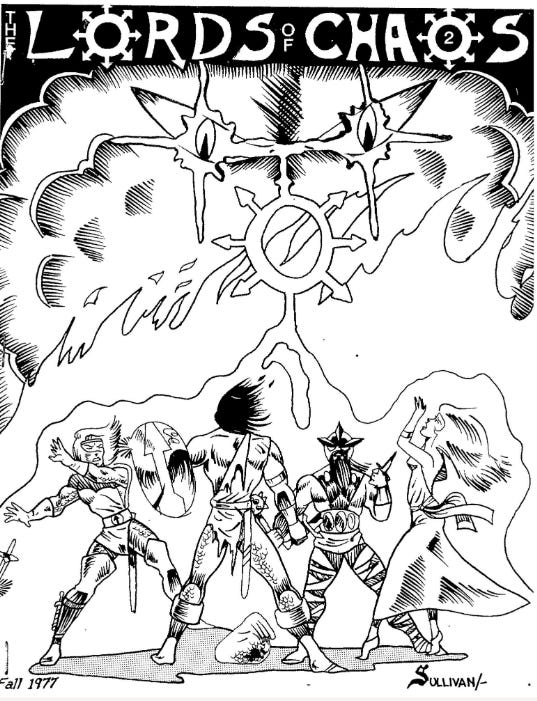
Phantasmagoria #1 was published in the Fall of 1977 as part of The Lords of Chaos #2, three full years before Johnson’s article in Different Worlds. This demonstrates a kind of staying power that should have made The Stanford System something that gets talked about more frequently The Lords of Chaos was an Amateur Press Association1 edited by Nicolai Shapero out of Belmont, California. Shapero, who also appears in gaming history under the names “Niall Shapero” and “Niall Shapiro,” was a contributor to Lee Gold’s Alarums & Excursions and would go on to create the science fiction RPG Other Suns for Fantasy Games Unlimited in 1983. When I lived in Southern California, I chatted with Shapero at a couple of science fiction club meetings down there. I’ve sent him a message to see if he knows more too.
At its peak The Lords of Chaos had around 200 subscribers, published every two months then quarterly, then running to 13 issues through 1981. It’s a wonderful trove of information and counted Steve Marsh, Steve Perrin, and Lee Gold among its contributors. Dragon #50 called its writers “some of the best writers from other APAs.” It was, in short, not a mere vanity project. It was a legitimate node in the California gaming network, even if it was too short lived. I say too short lived because it’s also where the Wayne Shaw developed his alternate rules for Superhero 2044. Those rules would go on to inspire the creation of Supergame and Champions.
The piece Shapero coaxed out of Eynon was addressed, in Eynon’s words, to “the rarefied tastes of those who indulge in the game of Dungeons & Dragons.” It is a brief document that is only four typewritten pages, but it contains a description of what Eynon and his fellow Stanford players called the “Stanford System.” This was a seat of D&D house rules, possibly near-complete rewrite like Cal-Tech’s Warlock, that addressed what they saw as D&D’s fundamental design problems.
As you know, I’ve been documenting the California RPG Scene here on Geekerati for some time. I think that games Supergame, Wayne Shaw’s house rules for Superhero 2044, and the Arduin Grimoire, are important documents in gaming history. I love to discuss the remarkable density of innovation that came out of the Bay Area and Southern California in those early years. The Stanford System belongs in that conversation. If anything, it belongs near the top of it, even as it remains in the shadows of the past.
Barry Eynon? Who Is That?
When I first moved to Los Angeles, I used to frequent Aero Hobbies as my go-to gaming store. Gary, the owner, was very generous with his time and connected me with a lot of other gamers in the community. Pretty soon, I was playing in 3rd Edition D&D groups and having a great time. Every time I visited the store, Gary would try to sell me on Runequest and he eventually won me over. I had a lot of chats with him, but it wasn’t until after he died that I found out that it was his call to Gary Gygax that facilitated the creation of the Thief Class in D&D. Now Gary didn’t create the Thief, it was the creation of one of the gamers at his store named Darrold Daniel Wagner, but it was Gary’s call that set the official publication ball in motion. Ever since then, I’ve had a desire to learn about the people behind the early ideas of the hobby.
In that spirit I’d like to spend a moment on the man who detailed what we have about the Stanford System, because he’s a person who has slipped almost entirely through the cracks of RPG history. Of course, so too have Jon Freeman and Jeffrey A. Johnson, who were both likely a part of the “Stanford Scene” and who created Temple of Apshai and other games only to be rarely discussed in modern gaming circles. It’s no wonder I keep reading new discoveries of long known facts in online discussions. We gamers do not share our history with each other near enough.
Have you ever noticed how often gamers assert their bona fides before they discuss their ideas? You probably have. You’ve read enough of my stuff and half of my entries are justifications for what I am writing. Well, Eynon makes sure to let the readers of Lords of Chaos know he is one of us/them. He points out that he is “a wargamer from way back.” Given the connection between wargames and roleplaying games, this was the default credentials for anyone designing games in 1977. He says he came to D&D about two years earlier through the Ryth Campaign, the Detroit-area campaign run by John Van De Graaf and Len Scensny that has its own minor legendary status among early D&D historians. He arrived in California for graduate study at Stanford in 1976, and by the time he wrote Phantasmagoria, he claims to have played under every major rules variant in circulation, from the Perrin System to Warlock, while collecting DMs for the Stanford unified campaign project.
I don’t know what he’s written since. I found a post on rec.games.board from the 1990s, but the Stanford System itself was never published. Unlike a lot of other Bay Area gamers, like Mike Pondsmith, Sandy Petersen, and George MacDonald, he doesn’t seem to have migrated over to video game design as a career. A huge number of computer role playing game designers came from the Bay Area scene. I guess it helps to be an early adopter of a hobby right in the heart of the computer revolution.
Why the Stanford System Exists
Thanks to the library holdings at UC Riverside, I have a copy of Phantasmagoria #1. I’ve created a recreated copy at the end of the post for research purposes. I’ll take it down if Barry asks. It’s a remarkable read and a great glimpse into house rule creation past and present. The opening invocation sets the tone immediately:
Fleeing from the hounds of Hell, pursued by the Lords of Chaos themselves, came I at last, as in a dream, upon the Word...
That’s the epigraph. The man knew how to open a fanzine. What follows is a clear-eyed, analytically rigorous critique of D&D’s underlying design logic, written by someone who had played enough variants to know what was structural and what was superficial.
Eynon’s core argument is deceptively simple. He argues that Gygax and Arneson wrote down rules for a game they were already playing, and the resulting system has some deep incoherences baked into it. We know now this this is only partly true, but what we know about the historical development of D&D only amplifies his comment regarding system incoherences from a certain perspective.
Unlike many critics, he’s careful not to be dismissive. Eynon acknowledges that D&D is fun and playable if you use common sense and aren’t afraid to call Lake Geneva for clarifications, but he thinks you can do better by starting over with slightly different assumptions. Remember, this is a 1977 zine and so pre-dates Advanced Dungeons & Dragons. I love the old White Box rules, but they are easier to understand if you already know how to play D&D in some form.
He lists the problems he and his fellow Stanford DMs kept running into when they tried to unify their campaign:
No one ever gets tired. The game has no fatigue or endurance system.
Carrying treasure out of dungeons teaches you to throw spells and wield a broadsword. Gold-for-XP is modeling the wrong thing.
Getting better means you can survive being stabbed more times. Escalating hit points as an abstraction for skill doesn’t match intuition.
A fighter who has never touched a bow can suddenly shoot like William Tell at high level. Class-based uniform skill blocks ignore what you’ve actually done.
A mage goes up a level and a tome containing all his new spells is magically presented to him. Automatic spell acquisition without study or effort.
What I find striking about this list, and I’ve been looking at it for a while now, is that it’s essentially the same list of complaints that would drive independent game design for the next decade and continues to drive a lot of design discussion. Spend a day on X or Bluesky chatting about RPGs and you are likely to read one of these critiques even today. The endurance problem is something that Runequest and other games solve. The gold-for-XP problem is what the entire OSR has been arguing about since 2008 and is something no other role playing game has adopted. The hit point escalation problem is what the Arduin Grimoire addresses with its brutal damage tables. The uniform skill block problem is what the skill-based systems like Runequest, Champions, GURPS, eventually D&D 3rd edition’s skill system take a swing at. There’s a reason I say that D&D became GURPS with 3rd edition. The automatic spell acquisition problem is addressed by, among others, the magic guild system in Runequest and the Stanford System sounds a bit like Dragonbane’s.
I Liked D&D More Before it Became GURPS

“Almost all old school dungeon delving is an off the cuff Player VS DM negotiation made in the moment.” — Jim Zub
Eynon and his Stanford colleagues were essentially identifying the exact fault lines along which D&D would fracture and reform over the next thirty years. In 1977. In a four-page fanzine.
The Stanford System: What It Actually Did
The group’s solution, informally called the “Stanford System,” had been in use in their campaign for more than six months by the time Eynon wrote Phantasmagoria. He notes it was maintained in a computer file for easy modification and expected to be available in print “toward the end of the summer.” It never was, as far as I have been able to determine. The document may be lost, but if it was actually kept in computer form it might still be around. Though the article was written in 1977, so Heaven only knows if it’s on an easily retrievable medium. If you have a copy, please contact me immediately.
Eynon gives us a sketch of the system’s salient features, and even the sketch is impressive:
1. An endurance system. Walking, fighting, and throwing spells all cost endurance points. Some can be recovered during an expedition by resting. This is the first published description of an endurance-based resource management system in a role-playing game, as far as anyone can tell. This was the claim that Tom Van Winkle made in his 2020 blog post on the Stanford System. I’d have to do some additional research but I find the claim credible. As always, I’d welcome pushback from anyone who knows otherwise. Crucially, hit points don’t escalate much. The damage you can take before dying stays fairly constant with level. Advancement instead increases how many endurance points you have in a given day. Endurance then, critically, determines how good you are at blocking blows in the first place. Better fighters don’t just absorb more punishment. They are better at avoiding it.
2. A split experience system. Fighters gain experience in specific weapon types from actually using them in combat. Mages progress individually in five categories of magic: Bewilder, Control Energy, Protection, Move & Reshape, and Detect & Enhance. There is also an overall category that determines magic resistance and total endurance. This is, functionally, a skill system, one of the earliest in role-playing games, predating the better-known BRP/Runequest approach by about a year, but coming after Traveller. It should be noted that character advancement in Traveller is very slow though and that skills don’t change much after your character survives character creation. If it survives.

3. Treasure doesn’t teach you to throw spells. The only way treasure affects ability is if it’s spent on training or better equipment. Mages have to study and pay for new spells from the Guild. The California scene was full of people rejecting XP-for-gold independently of one another; what’s notable here is the Guild requirement for spell acquisition, which is a specific and elegant solution to problem #5 above. It’s similar to the approach Tunnels & Trolls took and might have been influenced by Ken St. Andre’s design.
4. Damage stays roughly constant. As noted above, what scales with level is your endurance pool and your ability to avoid or block blows. This is the same intuition that drives Runequest’s hit location and armor system. The key idea here is that heroic characters survive because they’re skilled, not because they’re effectively made of more meat.
Correlated Characteristics: The Part That Makes Game Designers Sit Up
The most immediately distinctive feature of Phantasmagoria #1, and the part I think deserves the most attention, is a character creation section at the end called “Correlated Characteristics.”
The Stanford System used nine ability scores instead of D&D’s six. They took Dexterity and split it into Dexterity and Agility, a distinction that would reappear in many later games. They took Charisma and split it into Persuasiveness and Leadership. They added Size as a distinct characteristic, something that Runequest would also do.
The addition of Size is particularly interesting. Tom Van Winkle’s research suggests that Size as an explicit game mechanic may have originated at Stanford or at CalTech (the Warlock rules from 1975 also use Size, and the priority is genuinely unclear). What is clear is that Size appears in Runequest, where it directly modifies hit points, and in Chaosium’s Basic Role Playing system. Steve Perrin, co-designer of Runequest, was deeply embedded in the Bay Area gaming community during this period. He was a co-founder of the SCA, his Perrin Conventions were circulating as D&D house rules, and he almost certainly knew what people were doing at Stanford. The pipeline from the Stanford System to Runequest may not be direct, but it’s not imaginary either because the people were likely hanging out at the various Bay Area gaming conventions. As I’ll discuss in a later post on Superhero games, the use of a Size characteristic makes a lot of stuff very easy to DM.
One thing that really caught my eye was the concept of correlated characteristics. Eynon and company weren’t just using nine characteristics. They were also generating them in a way that created statistical correlation between related attributes. The idea is intuitive. You’d expect someone with an 18 Strength to be more likely to have a high Constitution than someone with a 3 Strength. Generating each characteristic independently doesn’t reflect that.
Their solution is elegant. They created a table, which I’ve recreated below in a form that I hope makes it a bit easier to read than the original typewritten version, that groups characteristics into dice-rolling pools. For each pair of boxes connected by a + symbol, you only roll one die and place the result in both boxes. This creates positive correlation between linked attributes. For the one pair connected by an = symbol (Size and Agility, which are negatively correlated because the game assumes larger characters tend to be less agile), you roll one D6 and place the result in the top box, then 7 minus the result in the bottom box. This gives you an inverse roll of the prior result, making Size and Agility directly negatively correlated.
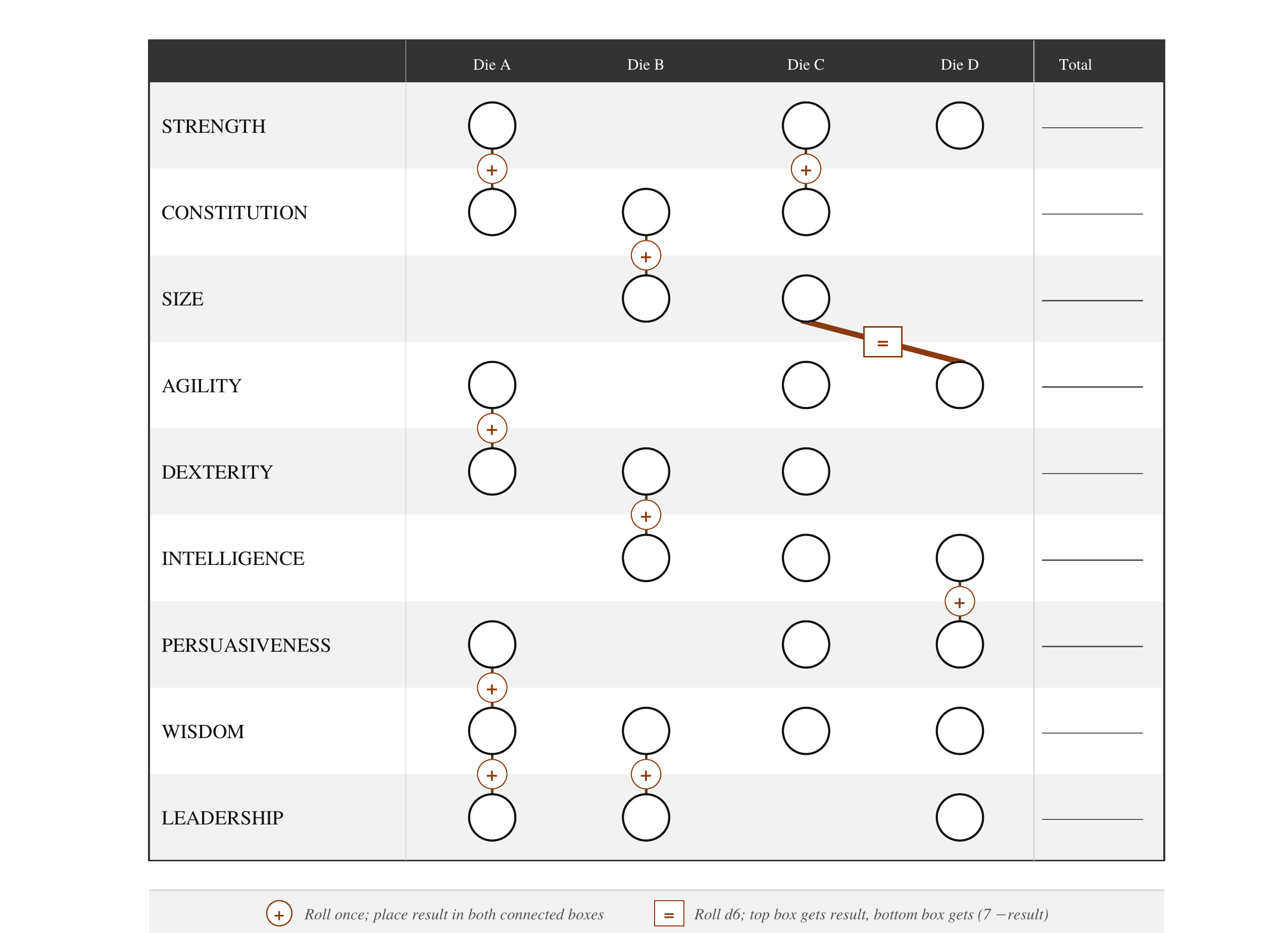
The result is a set of nine characteristics that feel like they belong to the same person rather than a random collision of numbers. It takes a little longer to generate, but it produces what Eynon calls “nicer (less incongruous) sets of characteristics.”
I am +3 against anyone who reads that and doesn’t immediately want to use it.
The Stanford System Enters the Wider Conversation
Here’s the thing that I think seals the case for taking the Stanford System seriously as a historical artifact and not merely an interesting curiosity. It didn’t stay inside the APA fanzine network.
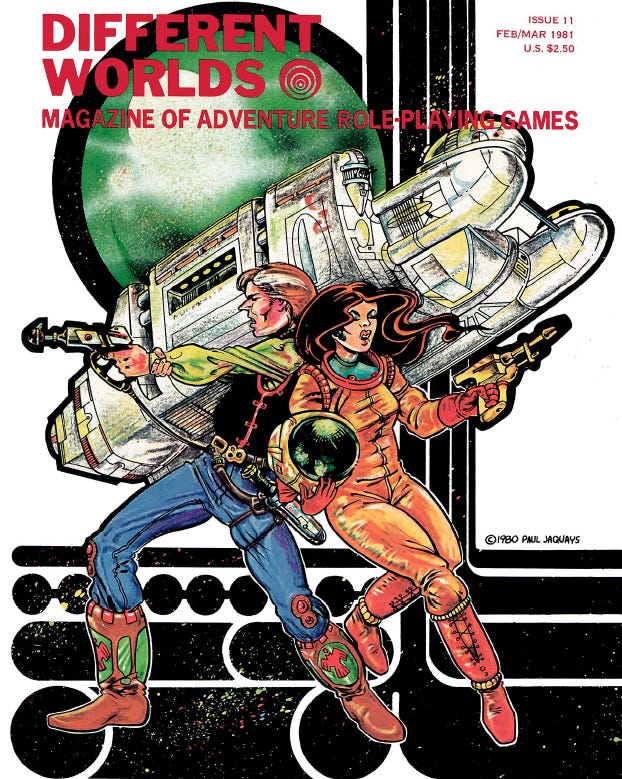
As I mentioned earlier when I discussed my inspiration for this article, Jeffrey A. Johnson mentioned the Stanford System in February/March of 1981 in the pages of Different Worlds #11. Different Worlds wasn’t a small fanzine. It was a Chaosium publication, meaning it had the institutional backing of the company that had just published Runequest and was the center of the Bay Area game design world. These two articles have became one of the most influential theories of game design published in the early hobby. Most people only mention Blacow, even though the framework is called “the Fourfold Way” which is the name of Johnson’s article, and it’s still cited today as a precursor to GNS theory and modern discussions of player types. So the Stanford System is discussed in an article that is a cornerstone of the indierpg storygame movement of the early 2000s, even though no one knows it by name.
That’s remarkable to me.
For a document that was never formally published, that never became a commercial product, that exists today as four typewritten pages in the back of an APA fanzine, that is a remarkable lifespan.
I am not completely certain who Jeffrey A. Johnson was. There’s a reason I say the Stanford System “may” have been connected to Temple of Apshai. Sure, Jon Freeman and Jeffrey A. Johnson are both D&D players from the Bay Area who played games with people at Stanford, but Johnson’s a common enough name (it is after all my pre-married name and I get a ton of emails for various Christian Johnson). I can’t be sure that the Jeffrey A. Johnson who wrote to Different Worlds is the same one who worked at Epyx and SSI. It would be cool to think that the Stanford System influenced not only Temple of Apshai, but Pool of Radiance and all the Gold Box D&D Games too. That would mean it influenced the first Baldur’s Gate and thus the most recent game, Baldur’s Gate 3. That’s a lot of influence for a fogotten and rarely discussed manuscript. I’ve not been able to identify him to my satisfaction, but whoever he was, he wrote for a Chaosium publication and assumed his readers would recognize “the Stanford System” without explanation. That assumption is itself the evidence. The Stanford System wasn’t a secret known only to the people who built it. It was part of the shared vocabulary of the California gaming scene.
I want to be careful not to overclaim. Phantasmagoria #1 is a four-page sketch of a system that was never fully published, written by someone who has never been a major figure in the history of the hobby. The Stanford System may have influenced Runequest or Runequest may have independently arrived at similar conclusions. Game design is full of parallel invention, and the California scene in the late 1970s was a remarkably fertile environment where a lot of smart people were working on a lot of the same problems at the same time.
What I can say with confidence is this. In the Fall of 1977, Barry Eynon and a handful of Stanford Dungeonmasters had identified many game design elements that people continue to discuss as problems with D&D’s design. They proposed workable solutions to all of them, and implemented those solutions in an active campaign. The solutions they proposed (endurance-based resource management, skill-based experience, treasure spent on training, non-escalating hit points, correlated ability score generation) were genuinely novel, and several of them would be independently reinvented by major commercial game designers over the following decade.
The California scene keeps delivering these moments: the Warlock rules at CalTech which were published by a game store in Long Beach, the Perrin Conventions, the invention of the Thief class by gamers at Aero Hobbies in Santa Monica, the Arduin Grimoire, Supergame, Wayne Shaw’s house rules for Superhero 2044. All of these are significant parts of the history of roleplaying games and the California scene does not get talked about enough.
I want to take a moment to say how grateful I am that UC Riverside, where I’m completing my doctorate, has copies of many of these fanzines, because without institutions treating this material as worth preserving, it would be entirely gone.
Phantasmagoria #1 is a document that deserved better than near-oblivion. It still does.
I’ve put together a cleaned-up version of Phantasmagoria #1 as a PDF, which you can download at the link below. The text has been OCR-transcribed from the original scan and lightly corrected. The scan quality makes a few words genuinely ambiguous, but I have tried to stay as close to Eynon’s original language as possible. The Correlated Characteristics table has been recreated as a visualization rather than reproduced from the scan, both because the original is difficult to read and because I think a clean version makes the elegance of the system more legible.
Barry Eynon’s address and phone number, which appeared in the original colophon, have been redacted.

Thanks to Tom Van Winkle, whose 2020 blog post “The Stanford System of Role-Playing Games (1976-77)“ is the most substantial prior research on this subject, and who deserves considerable credit for bringing it to attention. Thanks also to Glenn F. Blacow, whose “Aspects of Adventure Gaming” (Different Worlds #10, Oct/Nov 1980) set the stage for Jeffrey A. Johnson’s “The Fourfold Way of FRP” (Different Worlds #11, Feb/Mar 1981) . Johnson’s piece contains, as far as I can tell, the only contemporary mention of the Stanford System in a nationally distributed publication. If you have any information about Barry Eynon, the complete Stanford System document, or other materials from the Stanford gaming community in the late 1970s, I would very much like to hear from you.
APAs are fanzines assembled from contributions by multiple writers and distributed to subscribers
If only I'd known about correlated characteristics back then, I'd have used them in every RPG I designed in the last fifty years.
I absolutely do want to use something like that... I've thought about having correlated attributes before, and seeing that chart inspired me to get off my butt and actually do an easy / sensible one that can be used as a drop-in replacement without changing the attribute collection usually used in D&D.
Going to nine stats may be sensible, but it's a real barrier, whereas getting something sorted for the "standard six" is an easier patch. So, here goes nothing:
https://ibb.co/n8gG50YR