


Before the Review a Prelude to Why I Often Write About Older Films
When Luke Y. Thompson nominated me for the Sunshine Blogger (Substacker) Award, one of the things he mentioned that he enjoyed about my newsletter was that it inspired him to go back and approach films from bygone eras of Hollywood that he had missed. I took this to be a very high complement because Luke has a deep well of film knowledge. It also got me thinking about the way that I approach pop culture criticism in general.
I don’t spend a lot of time writing about the things I don’t like. This is partially due to the fact that I don’t have to do so. I am not on any deadline except the ones that I set for myself and so I am free to watch only the things that interest me and to only write about the things I want to advocate. That doesn’t mean that my criticism will be shallow, but it does mean that I am not pressured by the need for clicks, outrage, or fleeting interest and can just go where the muse takes me.
As an example of this, the new Supergirl trailer came out yesterday and social media is filled with all kinds of takes, but those takes are also highly predictable. Conservative critics are incensed at the tagline of “Truth, Justice, Whatever” and Krypto peeing on a newspaper photograph of Superman. Liberal critics are all-in and eagerly waiting a deconstructed version of the “goody two shoes” character portrayed by, the underrated in general, Helen Slater and are eager for a character more akin to Samara Weaving’s Grace from Ready or Not. It’s all edge and rejection of the self sacrificing hero that they are hoping to see. The fact that one of the reasons Helen Slater is underappreciated as an actress is the fact that her Supergirl performance was pretty shallow doesn’t matter to them.
What many people in both of these groups share is that neither have likely read the Tom King series Supergirl: Woman of Tomorrow that inspired the film. If they had read that series, or spent more than a kneejerk’s amount of time in reflection on the film, they would have noticed these two frames in the trailer and placed them within the full context of Kara Zor-El’s story.

You see, Kara and Kal are the last two Kryptonians. No I’m not ignoring Krypto the way the film and Tom King ignored Streaky because they are the last humanoid Kryptonians. Think about that for a second. They are the last of an entire planet’s population. It’s a realization that made reading early issues, before various retcons and updates to the timeline, of Superboy and the Legion of Super Heroes very sad. In the initial issues, Superboy is the inspiration for the Legion, but there are no Kryptonians. This eventually changes, for a variety of reasons, but it adds an interesting melancholy to Supe's legacy.
Back to the issue at hand though. Kal-El left Krypton as a baby. His only memories of the planet and people are those given to him by the computer that accompanied him, a computer that is both Braniac and the Annihilator in the WB cartoon from the 90s and might just be both of those in the modern DCCU as well. Kara Zor-El, on the other hand, lived on Krypton and knew the people there. It is only due to circumstances related to time and/or the state of Kandor as a city, circumstances that change in different versions of her character, that she arrives on Earth at a younger age than her cousin. What remains constant though is that she knows what she lost. Kal-El has lost a people he only knows second-hand. Kara has lost everything.
This comes with pain and Tom King explores that issue in his comic run. It’s a run that I’m not as high on as many others, but it is one that I understand and one that grapples with a topic worthy of engaging with. Regardless of the moody/edgy/nihilistic “Whatever” attitude she has at the beginning of the miniseries, by the end she becomes the kind of Kara Zor-El I love the most. She becomes as heroic and dedicated as the one that died in Crisis of the Infinite Earths. That Supergirl gave up everything to save everyone she could, but especially Kal. That’s the Supergirl that I want to see, and the one I expect to see at the end of the film.
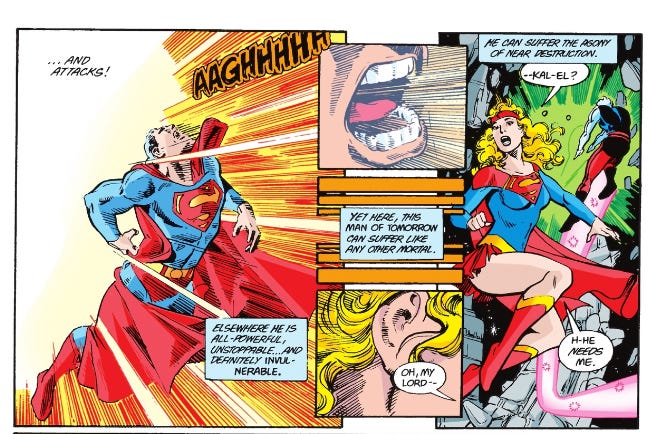
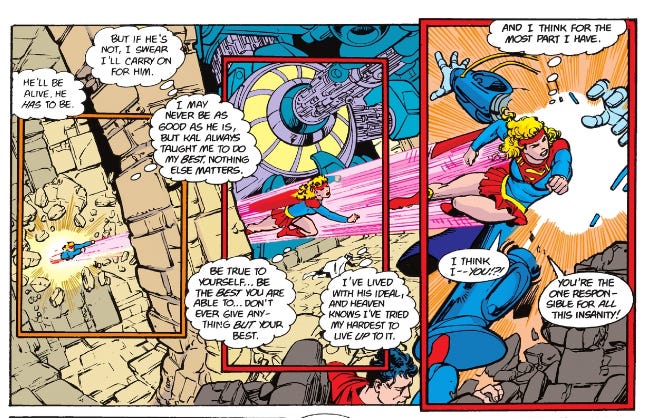
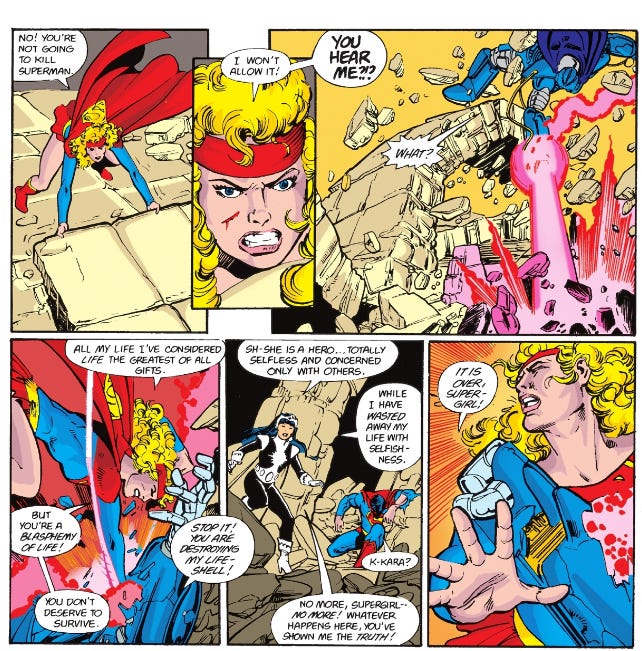
I didn’t mean to go on that long about the issue at hand, because I don’t know how it will turn out in the end, and because I really don’t want to jump into the online bruhaha, but after going back and looking at those George Perez illustrated panels, I couldn’t help it.
That is, of course, why I tend to write about older movies. Too much of modern criticism is caught up in the culture wars, or if we are lucky merely trapped in the “canon wars.” These are things that divide us as people rather than unite us and pop culture exists to be something that unites us, and so I tend to write disproportionatly about older films that had their own culture wars back in the day but are largely separate from our own.
Now onto my Review of It Happened Tomorrow
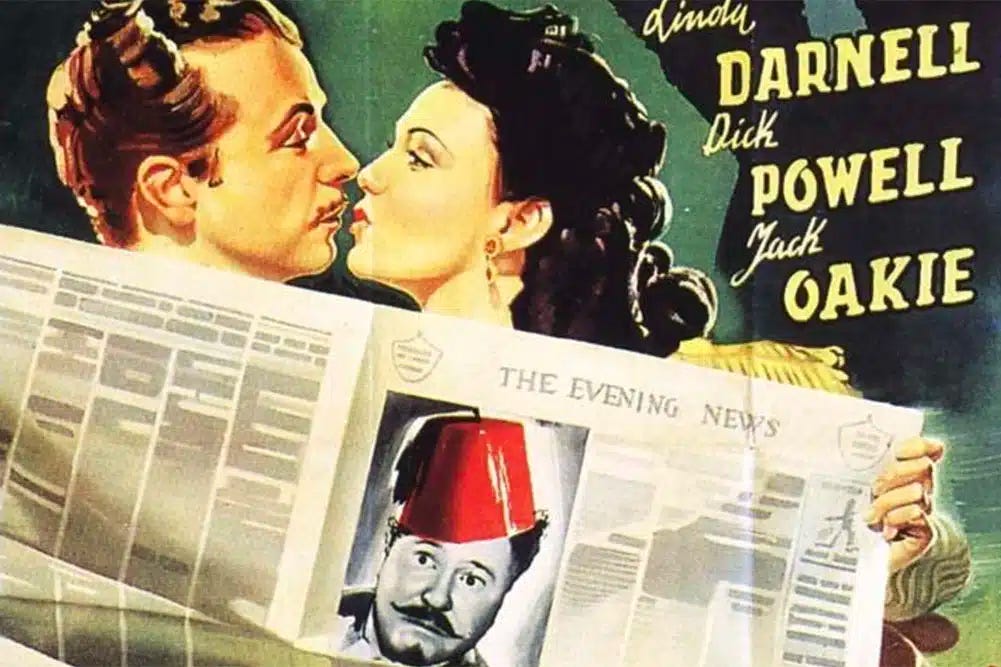
When Walter Lippmann wrote his book Public Opinion in 1921, he almost single handedly created both the formal study of public opinion and inspired the creation of formal schools of journalism. It is one of the most important books ever written on the subject of how people come to hold the opinions they have and how reliant they are on media to fill holes in their knowledge. At the time he wrote the book, the primary means that people received their news was the newspaper. The first radio news broadcast had occurred on August 31, 1920 from satation 8MK in Detroit, Michigan. That station was owned by The Detroit News and was a part of the E.W. Scripps news empire (as an aside, my wife won the Scripps Howard Charles M. Schulz Award and was the first woman to win it for her undergraduate cartoon Nicnup (we weren’t married at the time, I took her name after we were married).
Anyway…Lippmann took a great deal of inspiration from Plato’s analogy of the Cave and created a concept called the “pseudo-environment” to describe the perceived world that each of us lives in. He opens his book with the following example:
There is an island in the ocean where in 1914 a few Englishmen, Frenchmen, and Germans lived. No cable reaches that island, and the British mail steamer comes but once in sixty days. In September it had not yet come, and the islanders were still talking about the latest newspaper which told about the approaching trial of Madame Caillaux for the shooting of Gaston Calmette. It was, therefore, with more than usual eagerness that the whole colony assembled at the quay on a day in mid-September to hear from the captain what the verdict had been. They learned that for over six weeks now those of them who were English and those of them who were French had been fighting in behalf of the sanctity of treaties against those of them who were Germans. For six strange weeks they had acted as if they were friends, when in fact they were enemies. — Walter Lippmann, Public Opinion 1921
Due to the speed of information, and people’s limited ability to perceive the world outside of their immediate circumstances, we exist in a state of constant ambiguity. We know a great deal about the things that directly surround us, but the further you get from the immediate the blurrier and less reliable our perceived environment is. While this is easy to see in Lippmann’s early 1900s example, the concept applies just as much today with the added challenges of information overload and disinformation.
I don’t know if French René Clair had read Public Opinion when he was working on the screenplay for It Happened Tomorrow (1944) with screenwriter Dudley Nichols (Stagecoach, Bringing Up Baby, And Then There Were None), but the theme of how the newspaper creates our environment is the foundational conceit of this timeless romantic comedy. Clair, or Nichols, was familiar with Lord Dunsany’s one-act play The Jest of Hahalaba, which involves a tale of a man who gets access to tomorrow’s news today and pays the price for that knowledge. My wondering if either of them was familiar with Lippmann is in large part due to how the tale resolves. In either case, the story is one which argues that having too much information can be a very dangerous thing.
The film opens with a large family getting ready to celebrate the 50th wedding anniversary of the patron and matron of the family. This celebration is briefly interrupted when the husband and wife have a minor disagreement about whether to reveal the truth about how they met and fell in love. The husband is eager to spill the beans and the wife is hesitant because not even she believes the more magical elements of that tale.
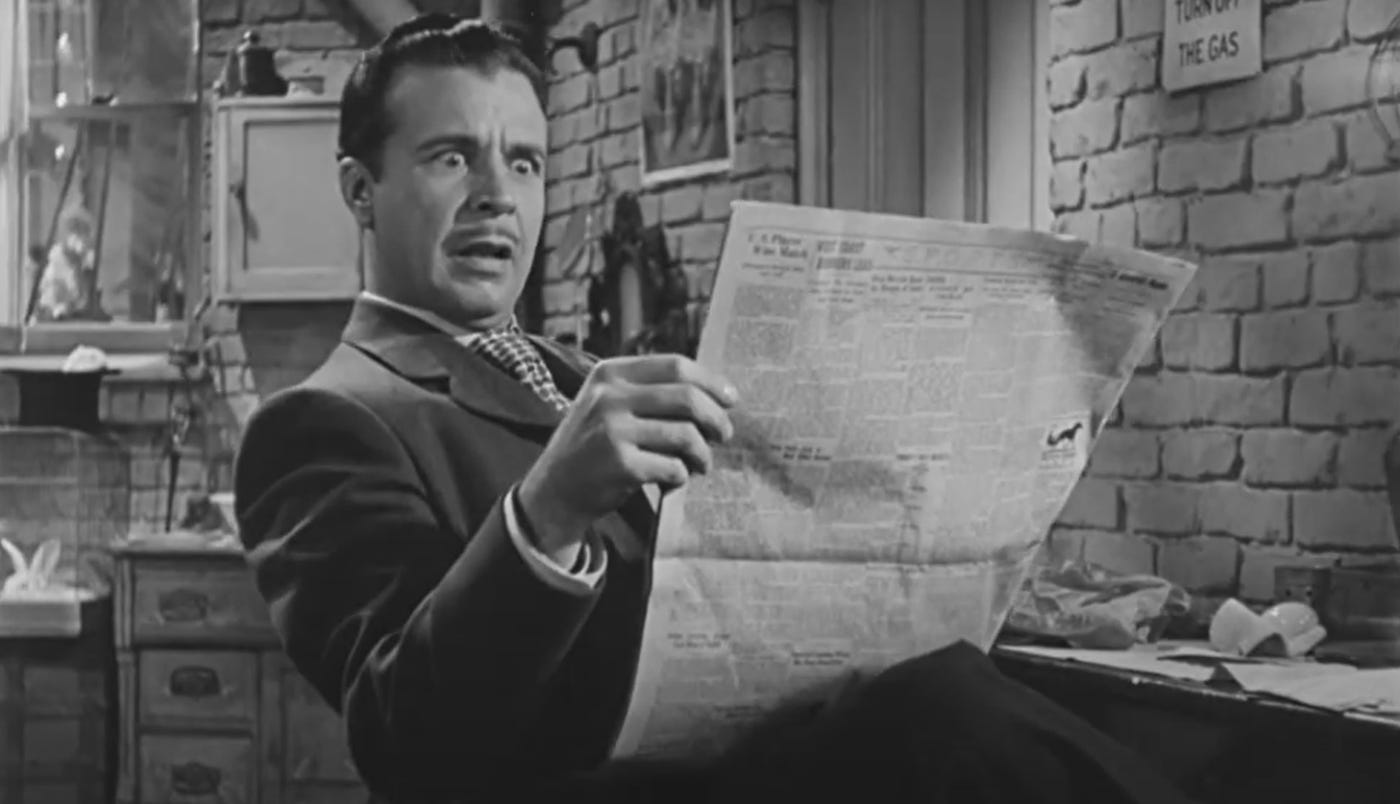
As they have this discussion, we are transported back in time where Larry Stevens (Dick Powell) has just arrived at the his day job at the newspaper announcing that today is the last day that he will be a writer of obituaries and that from now on, he plans on being an ace reporter. He and his fellow journalists are at the end of the day and enjoying one another’s company when they are briefly interrupted by the newspaper’s archivist Pop Benson (John Philliber). The archivist pontificates on how wonderful it is to work in the news because the papers that they write are a form of time travel. That you can look backwards in time and if, by some miraculous ability, you could access future issues you would be able to see the world yet to be. Each newspaper is not merely an artifact of its time, reading one is to engage in actual time travel.
This combination of ideas, newspapers as time travel or prophecy, has been played with in a number of films and television shows such as the beautiful and tragic Somewhere in Time (starring Superman’s own Christopher Reeve) and the underappreciated four season television show Early Edition (starring upcoming Green Lantern Kyle Chandler).
Larry Stevens and his compatriots scoff at the idea, though they all clearly love Pop, and head off to see a magic show that has come to town. They arrive at the magic show just in time for the fortune telling act where Larry Stevens falls in love at first sight with Sylvia (Linda Darnell). He falls so much in love that he tricks the seer into saying that she will meet him for lunch the next day. You’ll have to watch that particular exchange because it’s too cute to give the spoiling particulars.
After dropping Sylvia off at her apartment for the evening, Stevens ends up walking close to the newspaper office and runs into Pop who hands him a newspaper, but it’s the newspaper for that evening rather than the morning newspaper. Stevens has been given the gift of prophecy, but he doesn’t know it yet. This knowledge is revealed to him at breakfast and after that confirmation, he uses that information to become a valued and prized reporter.
From this point on, the film is in pure Screwball Comedy mode as Stevens uses the future newspaper, and subsequent future papers, in an attempt to give himself career success, financial stability, and romantic success. With each achievement the stakes increase again and again and as in The Jest of Hahalaba, he eventually reads a story that tempts the fates and this is where the romantic and comedic genius of René Clair really shines. He manages to keep the moral of the Dunsany tale without violating genre conventions or the introduction to the film.
The film is a gem that features strong performances and is woefully overlooked by modern audiences. It doesn’t help that the film was released in 1944, which was one hell of a year for films as it saw the release of Meet Me in St. Louis, Double Indemnity, Laura, Going My Way, Arsenic and Old Lace, Gaslight, Lifeboat, To Have and Have Not (where Bogart and Bacall met and have tremendous romantic chemistry), The Lodger, National Velvet, The Thin Man Goes Home, and so many other excellent movies. It’s not 1939 good as a year, but it is easy to see how a film could get lost in that shuffle. Even with that competition the film received two Oscar nominations (Best Sound and Best Music) and is fondly enough remembered to receive a Retro Hugo Science Fiction Nomination in 2020 where it lost to The Curse of the Cat People (directed by the amazing Robert Wise).
As the award nominations suggest, both the sound design and music are excellent in the film, but so too is the acting. Linda Darnell was historically praised more for her beauty than her acting, but she is very good in this film and her performance in My Darling Clementine (one of the early Wyatt Earp films) is worthy of note. My own childhood memories of her come from watching Tyrone Power’s The Mark of Zorro on video with my Opa, where I was entranced by her performance. Linda Darnell died tragically in a fire believed to have been caused by “reckless smoking.” Dick Powell was a solid leading man, but eventually migrated over to television and took a turn behind the film camera as well as a director. Like Darnell, he died relatively young, at the age of 58, in his case due to lung cancer. That cancer might have been related to his directing and filming of The Conqueror (yes, the one where John Wayne as Genghis Khan) downwind from America’s above ground atomic tests. Interestingly, his ranch house was used as the exterior of the house in the television show Hart to Hart.
It Happened Tomorrow is a pleasure to watch, especially if you ge the newer 4k transfer, and is a perfect example of how René Clair was able to merge French farce with Hollywood storytelling. I’ve already praised his work on I Married a Witch, and his version of And Then There Were None is a classic. All of them, even the Christie adaptation, have a wonderful manic energy that is infectious to watch. As the film might have been overlooked due to coming out in 1944, so too has René Clair’s filmic contribution been overlooked due to the focus of critics on the French New Wave. Truffaut was critical of him in issue 37 of Cahiers du Cinéma, but Truffaut is the ultimate keeper of a “supposed to like” list and an exemplar of a creator of films you are “supposed to like” and I will be the first in line to critique him for Jules et Jim or his bizarre take on Fahrenheit 451. I’d much rather watch a René Clair comedy and I understand that much of Truffaut’s critique was rooted in the need for one generation of film makers to establish themselves by first critiquing the prior generation.
For my money, I’d rather spend time in the magical fantasies of René Clair than in the depressed and amoral world of Jules et Jim.
If audiences want yet another comic book movie with yet another redemptive arc (writers: other stories are available!) then good luck to them. I was a huge Marvel nut as a kid but I've got fatigue even for the MCU by now. Never having been a Superman/girl fan, I've got nothing to say about this new one except that I hope it's what those fans have been waiting for.
Kara's ongoing sadness and the way her grief gets in the way of her relationships is a major theme in the CW show, which gives both Helen Slater and Dean Cain roles as her parents. It's not a great show, but at least we never have to see that headband.
Right now I'm enjoying Walt Hickey's YOU ARE WHAT YOU WATCH, which uses data to update Lippmann.