


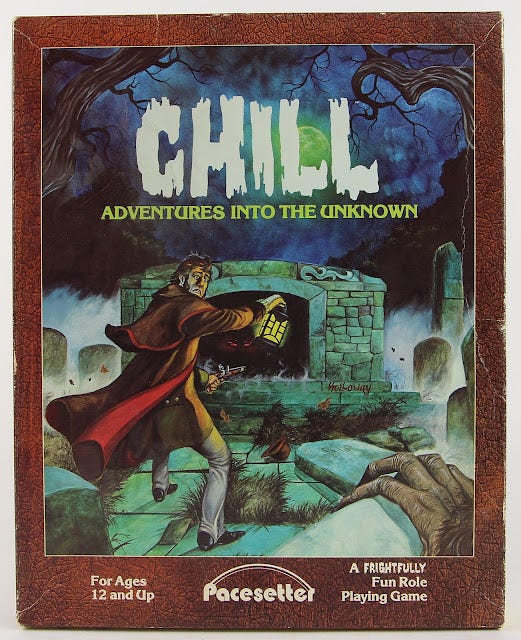
You are about to enter the world of CHILL, where unknown things sneak, and crawl, and creep, and slither in the darkness of a moonless night. This is the world of horror, the world of the vampire, ghost, and ghoul, the world of things not know, and best not dreamt of. CHILL is a role-playing game of adventure into the Unknown and your first adventure is about to begin.
-- CHILL Introductory Folder
This review has been a long time coming because I did a ton of background research (as is typical) to add context to the hobby and to the game. Chill is one of the great games of its era and it doesn’t get the respect it deserves.
Why I Am Revisiting Chill.
I know I have recommended Chill, and its modern updates Cryptworld and Frightshow Classics, in past Weekly Geekly Rundowns, but it is a game I deeply love. It is also a game that was not well reviewed when it first came out and often gets short shrift when people talk about it today. I want to change the “accepted” opinion of Chill as a roleplaying game by actually explaining what the game does, how it does it, and why it does it. In doing so, I hope you’ll see that Chill deserves a permanent place in any serious collection of horror roleplaying games.
The Founding Story
Modern gamers are often under the impression, partially fueled by nostalgia, that the late 70s and early 80s were a time of growth and happiness at TSR, but that is not the case. While it is true that the publication of the AD&D Dungeon Masters Guide (sic) and Players Handbook (sic) was followed by an explosion of sales where the books were selling 100s of thousands of copies a year, it is also true that trouble was brewing in the company. While Gary Gygax was in Los Angeles attempting to expand the reach of Dungeons & Dragons by shopping screenplays and getting animated cartoons produced, the Blume brothers had plans of their own. They used this growth as an opportunity to bring in family members who provided very little creative or logistic value to the company and the pressures from this would eventually lead to layoffs in 1983 and the eventual sale of the company to Lorraine Williams in 1985. Ben Riggs has a wonderful discussion of this era, and the era that followed, in his book Slaying the Dragon.

This turmoil also resulted in the creation of a short-lived, but wonderful, roleplaying game company called Pacesetter Ltd. The company was founded in 1984 by a group of former TSR employees that included Mark Acres, Troy Denning, and Stephen D. Sullivan. This company quickly release a series of game products that had very high production value and better game design than they were given credit for. These games included the Chill, Star Ace, and Time Master roleplaying games as well as a number of boardgames. Of the roleplaying games, only one of them is currently in print. Goblinoid Games owns the rights to Timemaster and has made the game available on DriveThruRPG. Martin Caron owns the rights to Chill 2nd (originally published by Mayfair Games) and 3rd editions, but I don’t know what the status of the original edition is. You can, however, purchase Cryptworld Goblinoid Games and it’s a darn good proxy for the original. Former Steve Jackson Games CEO Philip Reed owns the rights to Star Ace, but the game is currently unavailable. He did offer pdfs of the game for sale through his company Ronin Arts for a while on the Paizo website, but these are no longer available, and he never published the d20 version he was working on. Pacesetter made some great games, but their legacy is scattered to the four corners of the hobby.
The full founding story of Pacesetter is worth understanding in some detail, and I am going to cover a little of that story here. The founders names carry weight in the history of the hobby and the design choices they made for Chill are reflective of broader trends in game design in 1984, especially for what people thought would be the best way to bring new gamers into the hobby by making game terminology more accessible.
Mark Acres is one of the key designers at Pacesetter and he joined TSR in 1980 where he worked on a range of products before the Blume layoffs that struck the company in late 1983. While at TSR he had been involved in design discussions that would eventually result in the Marvel Super Heroes roleplaying game which was one of that year’s most significant releases. While Jeff Grubb and Steve Winter are the primary designers of that game, Acres design work at Pacesetter shows that he was among the TSR voices shaping the direction of towards the accessible and table-driven resolution systems TSR leaned on after AD&D. When he helped to found Pacesetter in January 1984, he brought that design sensibility with him.
Troy Denning is a huge name in the field. He joined TSR in 1981 and would go on to a distinguished career after Pacesetter, including a stint back at TSR where he designed the Dark Sun campaign setting and the D&D black box introductory set (my favorite boxed introductory set period) for a new generation of players. It’s a set that demonstrates that his commitment to new gamers remained with him, even after long years in the hobby. When things went downhill for Pacesetter he moved over to Mayfair games when they purchased the rights to Chill and he designed the second edition of the game while he was there.
Stephen D. Sullivan did a lot of editorial, art direction, and map illustrations for TSR and that served him well when he became the art director across the entire Pacesetter line. His fingerprints are all over Chill, Time Master, Star Ace, Wabbit Wampage, and Black Morn Manor. Some of his early graphics work can be seen in maps throughout TSR produces as well as in the Marvel Super Heroes game and I.C.E.’s Middle Earth roleplaying line where he did maps for modules like Angmar.
Together these three designers are a central part of the second wave of roleplaying game designers who built mainstream gaming in the 1980s and beyond.
Chill was not the first horror roleplaying game. That honor might actually belong to Glen and Philip Rahman’s Lovecraft Variant for Tunnels & Trolls in Issue 7 of Sorcerer’s Apprentice Magazine, though the milestone is typically given to Sandy Petersen’s Call of Cthulhu. That game was published by Chaosium in 1981, and by 1984 it was already well established as the premier game for Lovecraftian style horror. Call of Cthulhu perfectly captures the dark, nihilistic, cosmically indifferent horror of H. P. Lovecraft’s fiction, but that’s not the only genre of horror and there is room in the market for different approaches.
Chill aimed at a different tradition entirely. Instead of going for cosmic horror and unrelenting dread, Chill was inspired by the Hammer Studios and American International Pictures horror films that had defined much of the horror genre on the big and small screen through the 1950s, 1960s, and 1970s. Chill’s monsters are the vampires, werewolves, ghosts, and ghouls you see time and time again in that tradition. The tone of this kind of horror is adventurous rather than despairing and while the protagonists don’t always win against the forces of evil there always seems to be a chance that they will. The protagonists of this genre are not academics who are slowly losing their sanity, though they may still be academics. If they are, then they are more like Peter Cushing’s Van Helsing, competent investigators who push back against the darkness and are sometimes victorious. It is horror where the agency of heroes can make a difference. The psychic investigators of Jules de Grandin or Manly Wade Wellman are a better fit for Chill than for Call of Cthulhu. Wellman’s John Thunstone has read the Necronomicon, but it did not leave him horrified. Instead it provided him with tools to defeat those who serve the Dark.
Expectations and Critical Reception
A Horror Game for the Easily Frightened… — Rick Swan
Gamers are often a very pretentious lot and when the reviewers got their hands on Chill, they were far from kind. As the early reviewers had with Marvel Super Heroes, they focused on what the game wasn’t rather than what the game was. They wanted adventures that resulted in janitors gibbering in the corners as their bodies were devoured by terrors from beyond and what they got was a grown-up Scooby Squad like we’d eventually see in series like Supernatural and Buffy the Vampire Slayer.

Because its focus was less nihilistic than Call of Cthulhu, and because its creators were former TSR employees, Rick Swan reviewed the game quite negatively in Dragon magazine and in his Complete Guide to Role-Playing Games. Swan described the game as “A horror game for the easily frightened... While most of Chill’s vampires, werewolves, and other B-movie refugees wouldn’t scare a ten-year-old, they’re appropriate to the modest ambitions of the game... Chill is too shallow for extended campaigns, and lacks the depth to please anyone but the most undemanding players. For beginners only.”
Swan was correct that the game was designed to be accessible to beginners. He was not wrong that the monsters lack the existential menace of Lovecraftian horror. What he missed was that this was a deliberate aesthetic choice rather than a failure of imagination, and that aesthetic choice was ahead of its time. He was not alone in misinterpreting what Chill was attempting. Lawrence Schick, who in addition to doing excellent translations of the Three Musketeers under the name of Lawrence Ellsworth is one of the most important early roleplaying game historians, asserted that Chill was a humorous game. While it’s true that the game had humorous supplements like Creature Feature and Elvira’s Evenings of Terror, those were extensions of the Saturday Evening Horror Hosted Horror vibe the game was aiming at, a vibe that ranged from Ironic to Gothic.
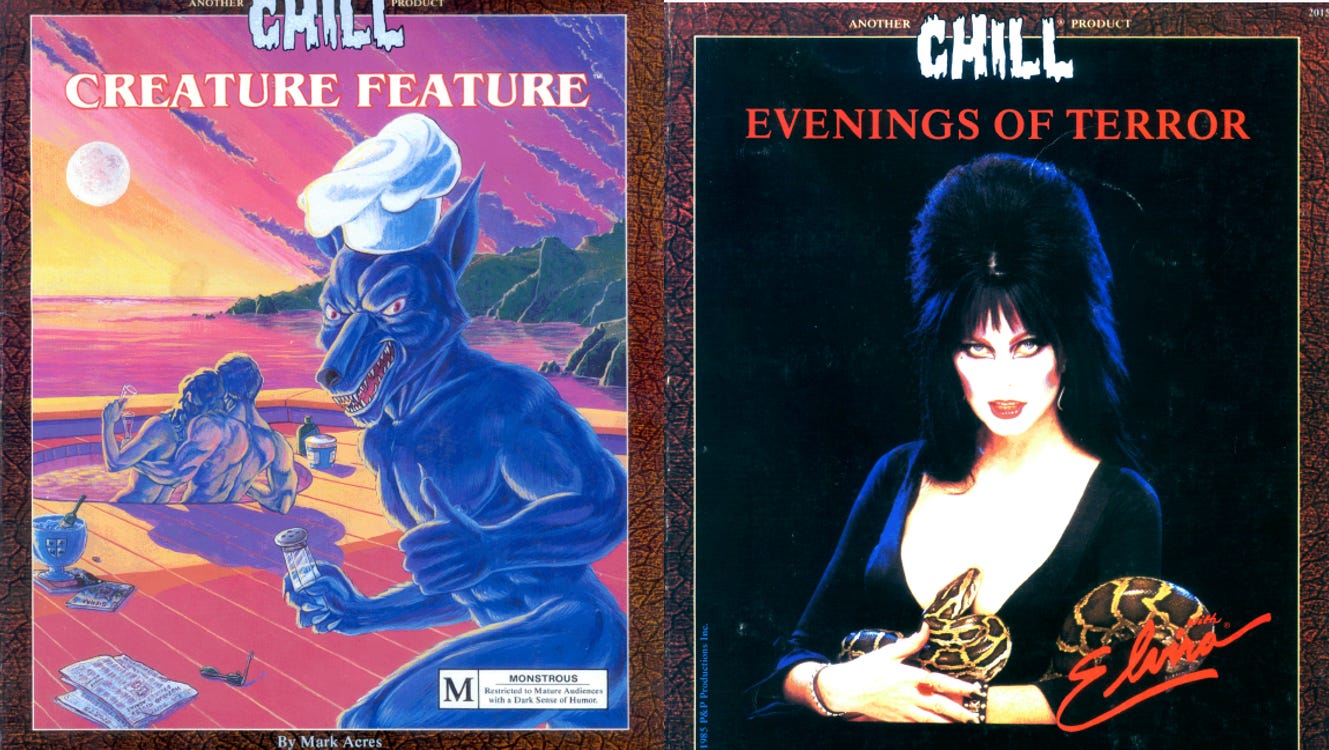
As I mentioned above, Chill does not want to be Call of Cthulhu. Chill wants to be Horror of Dracula, or The Wicker Man, or one of the dozen AIP pictures in which teenagers stumble into supernatural danger and have to fight their way-out using wit, courage, and whatever silver bullets they can find. Criticizing Chill for not being cosmically terrifying is like criticizing Errol Flynn’s Adventures of Robin Hood for not being Hamlet or Macbeth. The comparison, and negative judgement, reveals more about the critic’s taste than about the game’s quality. Both Robin Hood and Hamlet are masterpieces and to dismiss one is to dismiss an entire genre, rather than to dismiss bad craftsmanship.
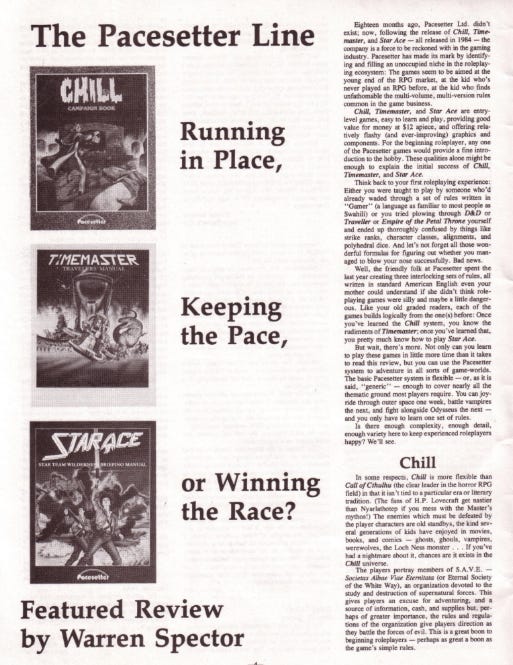
The most comprehensive contemporary review of Chill was Warren Spector’s piece in Space Gamer No. 75, where he reviewed the entire Pacesetter line. Spector was a balanced reviewer, so not all of his assessment was positive, but his description of the game is more on target than Swan’s.
“You won’t find better, more consistently entertaining writing in any set of game rules... Chill is the first to include an introductory folder advising players to begin playing that adventure before they’ve read the rules of the game! To begin, players have only to read a four-page READ-ME-FIRST! introduction to the rules, pick up the 16-page adventure booklet and begin playing! And, sure enough, the cockamamie scheme works!” — Warren Spector
Spector’s final verdict was that the game “falls somewhat short of the mark,” but his analysis makes clear that he understood he was looking at something new. The introductory folder that he praised was not merely a gimmick. The folder represented a genuine design achievement and provided a fun way that games could welcome new players. A lot of modern games could learn from Chill’s introductory booklet and first adventure. Sure, they are scripted, but they are also wonderful pedagogical tools.
From Opening the Box to Playing in 15 Minutes
Not only was the introductory booklet a pedagogical tool, it was one that allowed you to get the game up and running in seconds. That’s quite an achievement. The Chill box shipped with a four-page introductory folder that was designed to be read in sequence by a group sitting down at the table for the first time. The folder explained who could play (anyone), what was in the box, what the Chillmaster (the game’s term for the gamemaster) did, how to run the pre-generated characters included in the box, how to use the dice, how to make a General Check, how to use the Chill Action Table for Specific Checks, and what the Art (the game’s name for psychic abilities the players might possess) was. Those four pages contained all the basics of the game and provided them in way that allowed players to open the box and play within minutes.
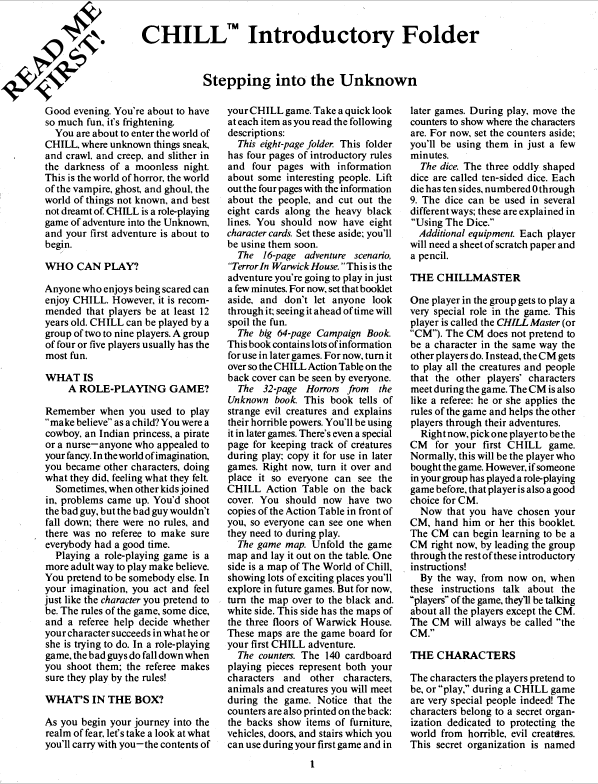
This game, made in 1984, is easy enough to learn that a group can open the box and begin playing within fifteen minutes. It doesn’t matter if you are grognards or newbs, you’ll be able to pick up and play the game from scratch. It requires no prior roleplaying experience. Given how complex roleplaying games often appear to non-gamers, this is a remarkable achievement in game design. It is easy to underestimate how important this achievement is because we have grown accustomed to games that are much more approachable than many early rpgs, but in 1984 it was not standard. The standard roleplaying games at the time read more like arcane tomes that user friendly introductions to game play. In fact, I’d argue that it’s still not standard approach. There are few games you can just pick up and play like Pacesetter’s Chill.
How the Rules Work
The mechanics of Chill are simple and flexible. The system breaks character actions into two kinds of “checks” where you roll percentile dice to determine success or failure: the General Check and the Specific Check. Both checks use percentile dice to determine success or failure and so you roll two ten-sided dice in order to generate a number ranging from 01 to 100. You count the result as 100 when you roll two zeroes (00) on the dice. Percentile dice were one of the innovations of Basic Role Playing, Runequest, and Call of Cthulhu. Where rolling a d20 can be converted into percentile chances, with a small amount of math, percentile dice produce easily interpreted probabilistic rolls. If your Strength score is 55, you have a 55 percent chance of succeeding at a feat of strength. Most players understand this immediately, because they don’t to do any conversion to interpret the difficulty.
General Checks are the easiest of the two to resolve and are typically used when you are merely asking whether or not a character succeeds at an action and not how well they succeed. Maybe a character is attempting to pick a lock under ideal conditions or needs to remember a relevant fact. If you aren’t measuring how efficiently they picked the lock or how quickly they are able to remember the tidbit, then you have the player make a General Check against an ability score or relevant skill. A roll that is equal to or under the attribute or skill rating succeeds. If you roll higher than the attribute or skill rating, then the attempt fails. There are no critical successes or failures in a General Check. You either succeed or not.
Where general checks are a pretty direct conversion of the percentile systems of Basic Role Playing, Specific Checks introduce the core mechanic of the game, the Chill Action Table. It’s this table that makes me think that Troy Denning and the other Chill designers were a part of the discussions behind the Marvel Super Heroes roleplaying game at TSR. The Chill Action Table is the primary way that the game adds complexity and subtlety to action success. It determines everything from how much information a character “knows” in a knowledge check to how much damage and attack does and how serious that damage is. It’s a design that deserves further examination because it highlights a trend in roleplaying games in the mid-1980s where systems wanted to include degrees of success in ways that were approachable to new gamers.
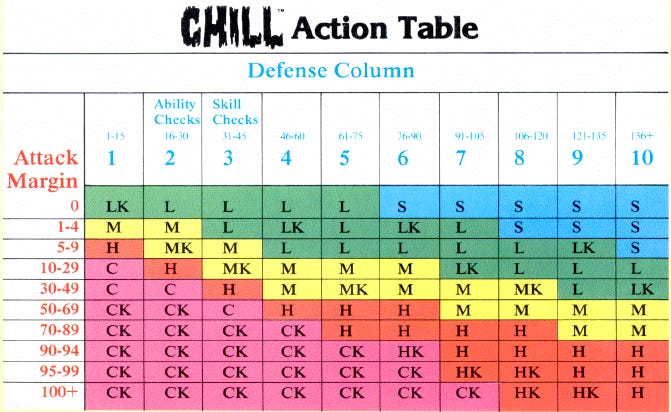
So how does this relatively arcane looking chart work?
When a character attempts something where you need to know how well a character succeeds and not just whether or not they do, you make a Specific Check and use this chart. Some of the most common events that require this are when you attack an enemy, use a supernatural discipline, or try to persuade a resistant NPC. When these, or similar, circumstances occur, the player rolls percentile dice and subtracts the result from the relevant score. To give a simple example and ignore possible modifiers for a moment, if the character’s Boxing skill is 55 and the player rolls 23, the Attack Margin is 32. If the roll is higher than the score, the check fails.
Once you get the Attack Margin you cross-reference it on the Chill Action Table using the appropriate defense column. The table’s left-most column lists the possible Attack Margin ranges. If you look across the top row, you’ll see a series of numbers as well as column headers for Ability and Skill Checks (at columns 2 and 3 respectively). You read across the row where your Attack Margin (or success margin for non-combat rolls) lines up with the proper column, where you will see a combination of letters that describe how successful you are: S, L, M, H, C, or K.
What those letters mean depends on the context of the action. In armed combat an S result is a Scratch (1–2 points of Stamina damage), an L is a Light Wound (2–20 points, with the wound box checked), an M is a Medium Wound (4–40 points), an H is a Heavy Wound (6–60 points, with additional Stamina loss each round), a C is a Critical wound or Called Shot (treated as Heavy plus the attacker’s declared shot), and a K is Knockdown (the defender is knocked to the ground and must pass a Dexterity check to hold onto any hand-held items). In non-combat situations these have different meanings, but one thing that should become readily apparent is that the lower the number on the “Defense” column, the more difficult it is to get a critical success. Attribute Checks are more difficult than Skill Checks, for example.
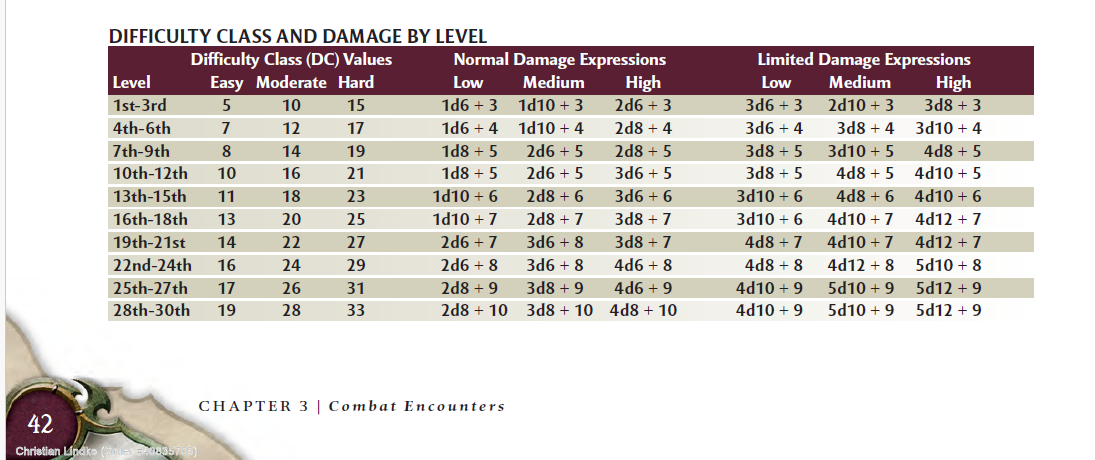
The genius of the system is that one simple table covers every type of action in the game. You can run a combat session or a role playing heavy session and the codes on the chart will give you just the right level of granularity. The chart is small enough that the Chillmaster can merely print out the Action Table on a 3x5 card and run the game on the fly without leafing through the rulebook. It’s a Dungeon Master’s Guide on a 3x5 card. One of the things I loved about 4th edition Dungeons & Dragons is that I could run entire campaigns using just a print out of page 42 (yes, that was an intentional Douglas Adams reference in the design) of the Dungeon Master’s Guide and Paul Hughes’ Monster Manual 3 on a Business Card from the Blog of Holding Website. The system seemed complex on its face, but it was simple enough to run with two sheets of paper. This is not an accident and is a part of the “get players playing immediately” philosophy of the game.
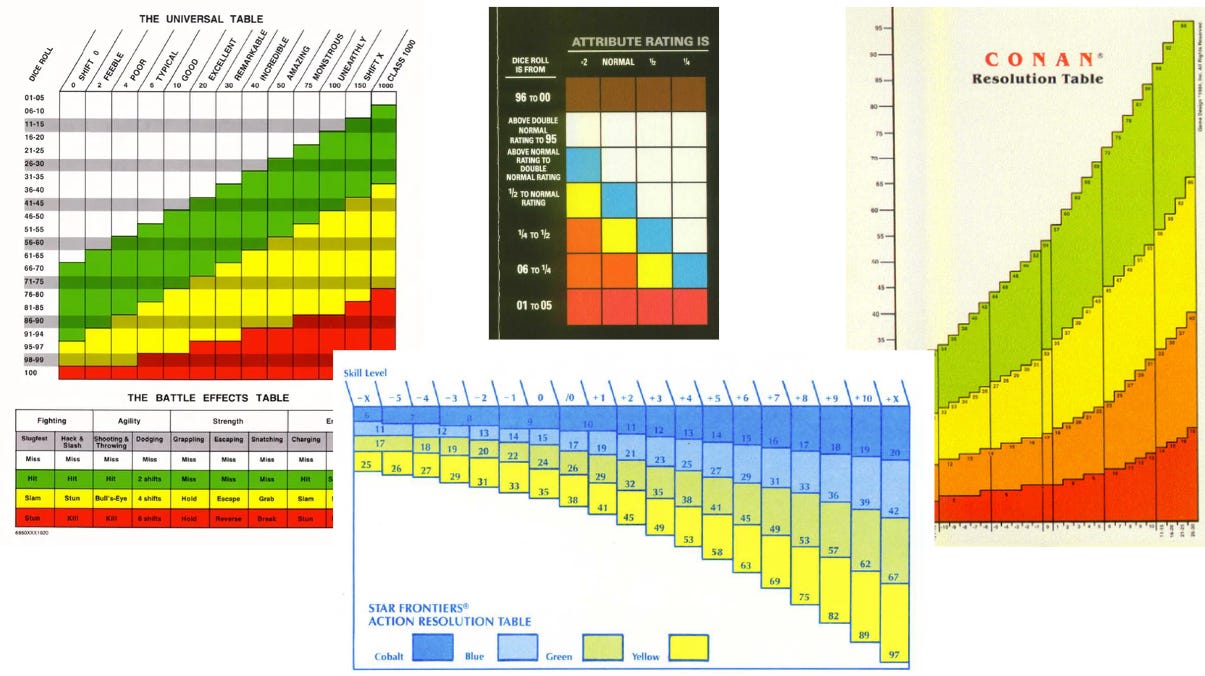
Roleplaying games often separate the roll to succeed from the mechanism that determines how successful that success is. For example, in Dungeons & Dragons the to hit roll and the damage roll are separate. In Dragon Warriors, the to hit roll and the armor penetration roll are separate. It’s a pattern throughout many role playing games, but Chill was a part of a wave that combined success and degree of success in a single roll. All you have to do is cross-index your Attack Margin against the action type. A character with a Boxing score of 70 is able to produce a much broader of results than a less skilled one and is more likely to get better damage results. The system accomplishes multiple results with a single roll and doesn't require separate hit and damage rolls that can slow down play. TSR released several games around the time that incorporated similar charts (Marvel Super Heroes, Indiana Jones, Conan, and the Zebulon’s Guide optional rules for Star Frontiers). If you take a look at these games, you can see that only Marvel really rivals Chill for ease of interpretation.
Characters and Their Abilities
Chill characters are defined by a number of Basic Abilities and Skills. The Abilities include things like Strength, Dexterity, Agility, Willpower, Perception, Personality, Luck, and Stamina. As a relatively OSR game, these are determined randomly by rolling 3d10, multiplying by 2, and adding 20 to the result. This produces scores that range from 26 to 80, with an average of about 53. Given that this is a percentile system, that means that the average person is assumed to succeed at a risky general task about 50% of the time.
A character’s base chance to succeed at a skill is a combination of a number derived from their starting attributes (usually the average of two attributes). Each skill is made up of two components, natural talent and training that combine to provide a final skill level. Natural ability is calculated as the average of two or three relevant abilities, and this is modified by the amount of training a character has experienced. The Boxing skill, for instance, is the average of Strength and Agility while the Investigation skill is the average of Perception, Willpower, and Luck. If you have high physical attributes, you are more naturally talented at those skills and can achieve higher percentile success chances (and thus get a wider range of results), but the choice to optimize around natural talent or to go against type is up to the player.
One of my favorite things about Chill is its skill training mechanic. In many percentile games, you have a pool of points and you add those directly to the skill value and that gives you the new success chance. Chill’s system is more narrative. Characters are either Students, Teachers, or Masters in a skill and each adds a different amount to the base chance of success. The first two (Student and Teacher) add 15 points each and Master adds 25 points beyond that. A Master of a skill adds 55% to the base chance and so even a person with the lowest related attributes (26) has an 81% base chance to succeed. A character with low attributes can become very skilled in an area, but they have a ceiling still tied to their inherent abilities. One other interesting element of the training ranks is that different skills unlock different talents at higher ranks of skill. For example, a Martial Artist gets multiple attacks and eventually gets the ability to throw Shuriken like a Ninja (very 80s) as one of those attacks.
Stamina plays a number of roles in the game. In addition to being used to resist poisons etc., it also represents how much damage a character can take, both lethal (wound) damage and non-lethal (non-wound) damage. When Chill was published, most roleplaying games had some form of hit point system. Some of them like D&D and Runequest had them as a separate statistic, but others like Traveller had attacks reduce your base attributes. Traveller’s was slightly less abstracted than D&D and Runequest, but it still wasn’t overtly narrative. Chill also had a hit point mechanic in that attacks reduced stamina, but it also had different “levels” of damage like Light, Medium, Heavy, and Critical that added a narrative element. In fact, a character who took several trivial Light, but lethal, attacks would soon find themselves in Critical condition even if their Stamina was still high. This means that several minor lethal attacks can incapacitate the character, even if their Stamina is never reduced to zero. That’s a far cry from a humorous kid’s game mechanically.
Willpower is a resource that depletes under supernatural pressure and is where Chill brings in a fear mechanic. When characters encounter creatures using the Evil Way, the supernatural force that animates the evil creatures in Chill, they must make Willpower checks to resist fear and maintain their ability to act. Characters who have their Willpower drop below 20 get “cold feet” and will not engage in combat. If a character’s Willpower reaches zero, they become so mentally fogged that they can only follow simple commands. Sleep restores Willpower at a rate of ten points per hour of uninterrupted rest, but it will ebb and flow with play. While “The Evil Way” and “The Art” were elements that critics at the time found silly, I think they perfectly match the stories of John Thunstone, John Silence, or John the Balladeer. Jeez Louise, those John’s like fighting evil.
The Art: Chill’s Heroic Magic System
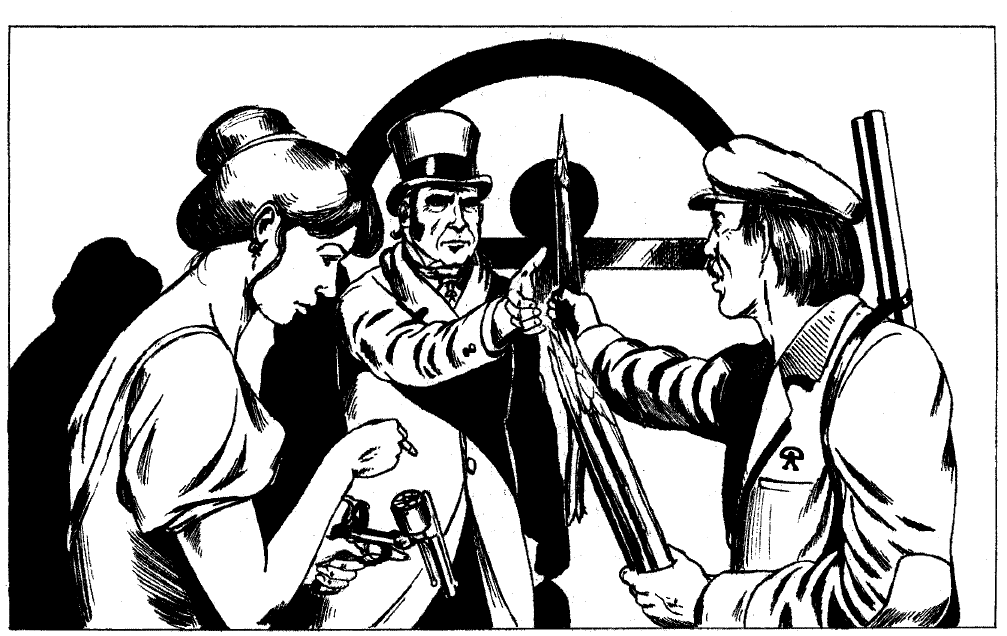
Where many horror games confine player characters strictly to the mundane, Chill gives its investigators access to supernatural abilities through a system called the Art. The Art represents the ability to perceive and harness energies from the Unknown. This is not magic in the epic fantasy sense, nor is it the mind scrambling system of Call of Cthulhu. The Art is closer to the psychic and spiritual sensitivity that protagonists in supernatural fiction sometimes possess. This is where Harry Dresden and Nicholas, the Duc de Richleau find the resources to combat the servants of Evil.
Not everyone has access to the Art, and a character must have Perception of at least 60 and base Willpower of at least 50 to use any of the powers in the book. These are low enough requirements to be attainable but are not guaranteed at character creation. This means that not every character will have access to the Art. Those who do may choose one of three disciplines: Communication, Restoration, and Protection. The Evil Way is a fourth art but is only available to those who serve Evil and cannot be learned by player characters.
Communication disciplines allow characters to send and receive messages in ways by use of their mind alone. Telepathic Sending lets a character transmit a message of seven words or fewer to any living mind within range, Telepathic Empathy reads the emotions of another being from any distance, and Clairvoyant/Prescient Dream allows a character to seek information through controlled dreaming.
Restoration disciplines primarily provide healing, but one of them provides one of my favorite powers. Restore Stamina returns 1d10 points of Stamina to another character, Restore Willpower does the same for Willpower, while (my favorite) Feat of Strength temporarily grants superhuman physical capability. I’m pretty sure Feat of Strength annoyed Rick Swan, but I loved it because it simulates the adrenaline rush so many heroes demonstrate in fiction and film.
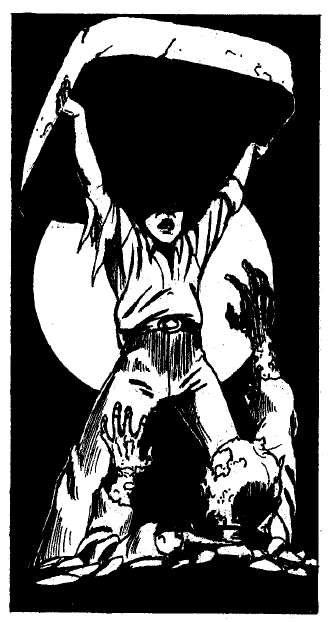
Protection disciplines provide mystical defense against the Unknown. Raise Perception temporarily enhances the perceptive abilities of all nearby characters, Mental Shield blocks Subjection disciplines from the Evil Way for a minute at a time, and Sphere of Protection creates a fifteen-foot bubble within which no creature from the Unknown can enter. These are the more purely mystical powers of characters like Christopher Lee’s Nicholas, the Duc de Richleau.
1984 and Changes in the Hobby
Chill was published in 1984, which was a year that marked a lot of changes in the roleplaying game industry. Many of the early publishers had achieved all the growth they could with the existing hobby gaming population and they needed to expand to new markets. The industry was seeking to grow beyond early adopters and provide products for the next generation. The gaming market hit the wargamer ceiling, where rules complexity was not an obstacle to market growth, and the industry had to find out how to make these games accessible to people who have never played one before. The emergence of D&D and other roleplaying games led to a decline in traditional wargame sales, but that market was limited, and the publishers knew it.
The Marvel Super Heroes roleplaying game, designed by Jeff Grubb and Steve Winter at TSR was released the same year as Chill, and it remains the best example of how to overcome this challenge. Like Chill it was dismissed as simplistic and “childish” by the grognards, but it is a much-beloved game of those who played it as youths in the 1980s. Grubb and Winter addressed this problem with the Universal Results Table, which was a percentile roll cross-indexed against a color-coded column (white, green, yellow, red) that used attributes defined by adjectives. Heroes could have Monstrous Strength or Amazing Agility and though those had numeric meaning, it sounds a lot cooler to say “I have Monstrous Strength” than “My Strength is 75.”
TSR continued this pattern when it had Zeb Cook design new two games for TSR that used similar table-driven approaches. The Indiana Jones RPG had players roll percentile roll against attributes, modified by a check table that produced degrees of success in the same vein as the Action Table. The Conan RPG went further, and Cook directly adapted the Marvel Super Heroes color-coded result system for a heroic fantasy context, aiming explicitly at players ages ten and up. Zeb also took a design look at Star Frontiers created an entirely new system that was simultaneously more approachable and more complex in Zebulon’s Guide to Frontier Space.
In a single year, the roleplaying industry’s major designers Grubb, Winter, and Cook at TSR, as well as Acres, Denning, and Sullivan at Pacesetter, all converged on the same answer to the accessibility problem. They presented players with mechanics that relied on a simple percentile roll, cross-indexed on a table, that produced granular results with letter or color codes.
Chill’s approach to the problem was to combine an Action Table with a pick up and play introductory folder. The Action Table gave experienced players the granular result system they needed for meaningful tactical decisions, while the introductory folder gave new players a ramp that led them into the game without passing through the rulebooks first. It is no mere coincidence that one of the designers of Chill would go on to design the pedagogically sophisticated Black Box edition of Dungeons & Dragons.
Tone, Atmosphere, and the Chill Aesthetic
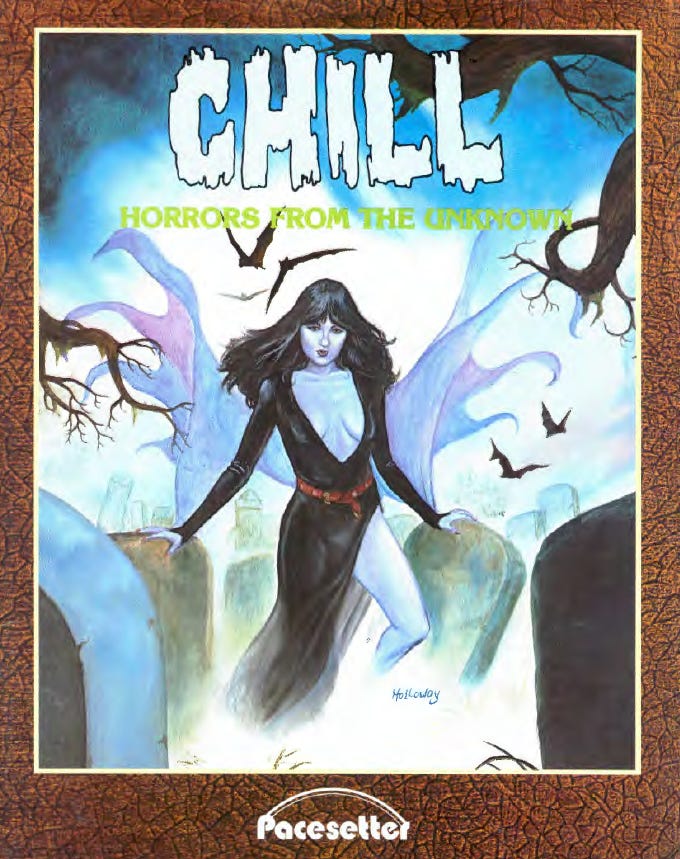
There are many games from the 1980s that feel mechanically dated by modern gaming standards. You won’t find a lot of people playing Bureau 13 and other Tri-Tac Games and as much as I love Champions, modern gamers don’t love its complexity. Pacesetter’s first edition of Chill is not one of these dated games. It has a kind of classic quality, like all the Hammer and AIP films it was inspired by. Those films, at least the ones that didn’t try to be “keep up with the times” by becoming ironic, have transcended their moment to become canonical texts of a particular horror tradition. That Hammer is releasing a new 4K transfer of their first Dracula film is testimony to their enduring success. While I personally think the second Fright Night is superior to the original, for some tonal reasons, the Peter Cushing inspired Peter Vincent of that film will be recognizable to audiences long after the Criss Angel inspired one of the most recent film fades from relevance (and I like Criss Angel, but he’s no Peter Cushing).
The tone of game’s writing one of the things that creates that timeless feel. The Campaign Book is narrated by a talking raven, reminiscent of Edgar Allan Poe’s tales, who addresses the Chillmaster directly in a tone that is simultaneously ominous and gently self-deprecating. I always hear it in the voice of Vincent Price in my mind’s ear.
Every character in Chill is assumed to be a member of S.A.V.E., the Societas Albae Viae Eternatia, the “Society of the White Way Eternal.” The organization provides every member with a kit that contains a wooden stake, a silver crucifix, a vial of holy water, a copy of the Book of Damnations, a flask of garlic oil, and a standard-issue firearm. While Rick Swan and others found this silly, this kind of conceit was a big part of the success of shows like Buffy, Angel, and Supernatural. The Watchers, Slayers, and Winchesters all know they live in a horror movie, and they have organizational allies. Far from being silly, this provides a perfect conceit for campaign play.
Chill’s Legacy
Chill is not a perfect game, but it is a wonderful one. It is a game that understood its purpose with unusual clarity and executed that intent perfectly. The designers produced a game that remains an enjoyable playing experience forty years after its publication.
My interest in reviewing and promoting Chill isn’t because I wanted to do an historical exploration of the hobby. My interest is in promoting the game and getting new players to play it in the hopes that the original game will be republished, hopefully by the crew at Cryptworld and Frightshow Classics. The fact is that Chill does something that no other horror roleplaying game quite replicates. It allows players to feel like Peter Cushing’s Van Helsing or one of the Winchester Brothers. It is also written in a way that lets you open the box and start playing within 15 minutes.
Find a copy and do exactly that.
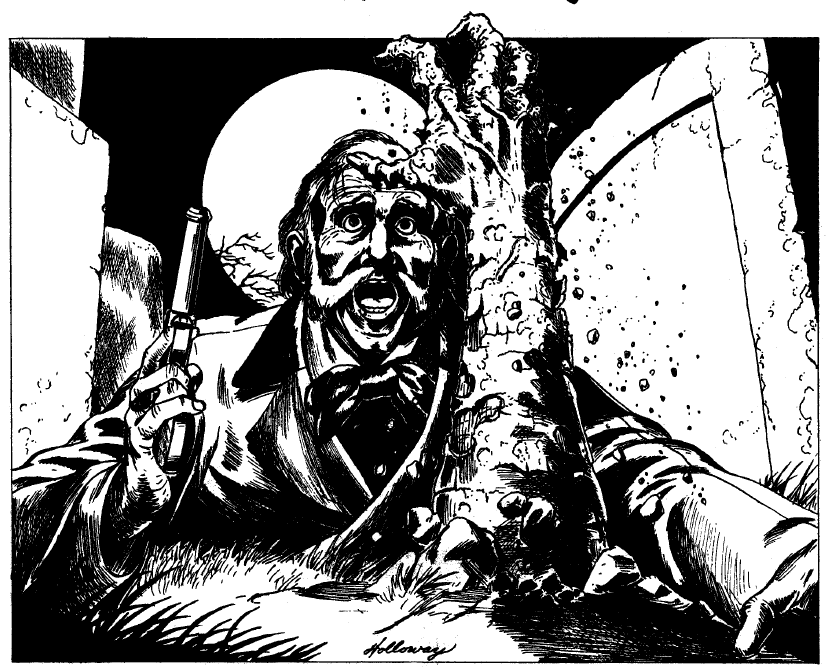
A hand touched his face, but he felt no warmth of human reassurance in that other hand, no sense of comradeship against the dark foes of the night. Boulton shrank from the touch. Then scrambled back. Then shouted. For now, he could see the hand, rising like a pale, icy plant, from the churning soil of a grave.
— Chill Campaign Book