


A Quick Self-Depricating Preface
I know what you are saying. “Yay! Christian is finally doing a movie review after a couple of weeks of mostly gaming material! Oh, wait?! It’s an old, relatively obscure Western? Yep, that’s totally on brand for Christian. Let’s check it out.” For the record, there will be game related material for this review, but I wrote so much of it that it will get its own post and we’ll just let this one stay as a pure movie review for my fellow cineastes.
Why So Many Westerns in the Retro-Reviews?
I have long been a fan of Westerns. I remember watching episodes of The Lone Ranger in syndication with my father on many a weekend and watching John Wayne Westerns with my Opa. They are one of America’s many mythologies. Just as Europeans have their three major literary cycles (The Matter of Britain, The Matter of France, and The Matter of Rome), so too does America have its own literary cycles that include Southern and New England Gothic stories, Tall-Tales, and Westerns. Both Europe and the United States have other rich literary cycles, but these six are wonderful starting places if you want to begin to understand the culture underpinning each of these societies.
The Tall-Tale and the Western are narrative expressions of William Jackson Turner’s taxonomy of exploration and rough and tumble rugged individualism. No character better exemplifies the American spirit than John Henry, a tale both about the inevitability of progress and the beauty of the human spirit. Those who think such ideas are dated, or that they don’t resonate with modern audiences, would do well to watch Gattica or Project Hail Mary. While the endings of each are different, the soul of both is that of John Henry or the Western hero.
One thing that separates the Western from most mythologies is that it has always been a deconstructive mythology. When John Wayne starred in Stagecoach (1939), a film so iconic that it is now cliché, he was already starring in a film that subverted heroic narratives. John Wayne’s Ringo kid is no hero in the traditional sense, he’s a man seeking revenge. His final shootout is cold-blooded he acts like a calculated killer. The camera cuts away to add tension, and there is some great editing to add to that uncertainty, but we know now how it turns out. At the time, given Wayne’s status as a minor actor, the result was in question and you can feel the real tension. It’s a wonderful scene and one that is echoed in the pistol vs. rifle conversation and showdown in A Fistful of Dollars (1964).
Even if you are rolling your eyes at my assertion that Stagecoach was already deconstructing the genre, you’ll have to accept that Destry Rides Again, also released in 1939, is a deconstruction of the genre. When Mel Brooks used Destry Rides Again as the foundation for so many gags in Blazing Saddles (1974), he was deconstructing a deconstruction. There is a joke in Blazing Saddles, where Mel Brooks’ Governor William J. Le Petomane, faced with a crisis requiring moral courage, turns to his advisors and asks: “Why don’t we do what they did in the old days?” The answer, delivered with complete sincerity is, “You’d do it for Randolph Scott.”
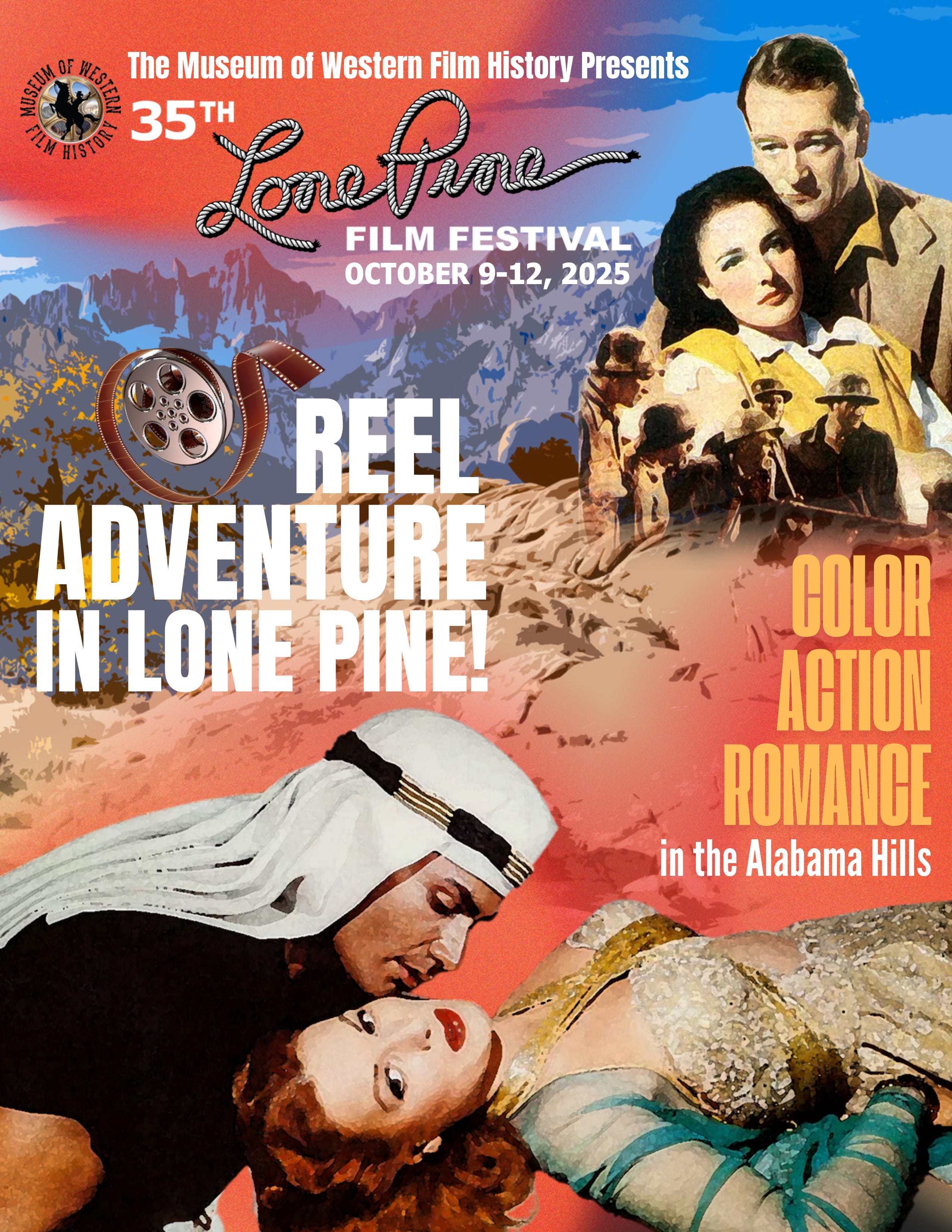
I laughed the first time I heard it, but I was only laughing at the excellent delivery. The joke works better if you understand the premise. When I first watched Blazing Saddles, I didn’t really know who Randolph Scott was. Outside of the more recent Westerns of my youth (Silverado for example), my mental corral of Westerns was largely limited to episodes of The Lone Ranger as well as the Westerns of John Wayne and Clint Eastwood. My first experience with the Westerns of Randolph Scott came when one of my mentoring undergraduate Political Science professors asked if I’d ever attended the Lone Pine Film Festival. He knew I loved movies and was regularly driving to the Bay Area (from Reno) on the weekends to catch Hong Kong action films at theaters in San Francisco. I told him I hadn’t and he mentioned that the Alabama Hills outside of Lone Pine had been the filming location for some of the best Westerns ever made, including those by Randolph Scott.
Wanting to maintain my film fan cred, I did not immediately say “Who?” But I thought it. A quick Google search later and I had a list of movies to start my education. The first film on the list was Sam Peckinpah’s Ride the High Country and after watching it, I was an instant fan of Scott’s. My thoughts were along the lines of that saying kids said about ten years ago, “Randolph Scott? I was not aware of your game.” Scott is charming, charismatic, and funny. His characters are also very interesting.
Even when they are on the wrong side of the law, a character played by Randolph Scott stands for something. You could rely on these characters the way you relied on a good rivet or a solid fence post. They were the men you wanted when things got serious. Whether it’s the gunslinger in Ride the High Country or the man in pursuit of vengeance in 7 Men from Now, a Randolph Scott character gets things done and people trust him to do it. Mel Brooks understood this, which is why that throwaway gag in a film about the absurdity of Western mythology is also, quietly, a tribute to one of the genre’s genuine pillars. Scott has a large filmography, but it can be difficult to find good copies of some of his “smaller” non-Boetticher Westerns. The Boetticher ones, rightfully, get a lot of respect and even have Criterion editions. The Man Behind the Gun was directed by Felix Feist, who also directed Donovan’s Brain and The Man Who Cheated Himself. Feist was a competent director, but not an auteur. Taking all of that in, you can imagine the delight I felt when I was browsing HBO for something to watch over the weekend.
The Man Behind the Gun (1953)
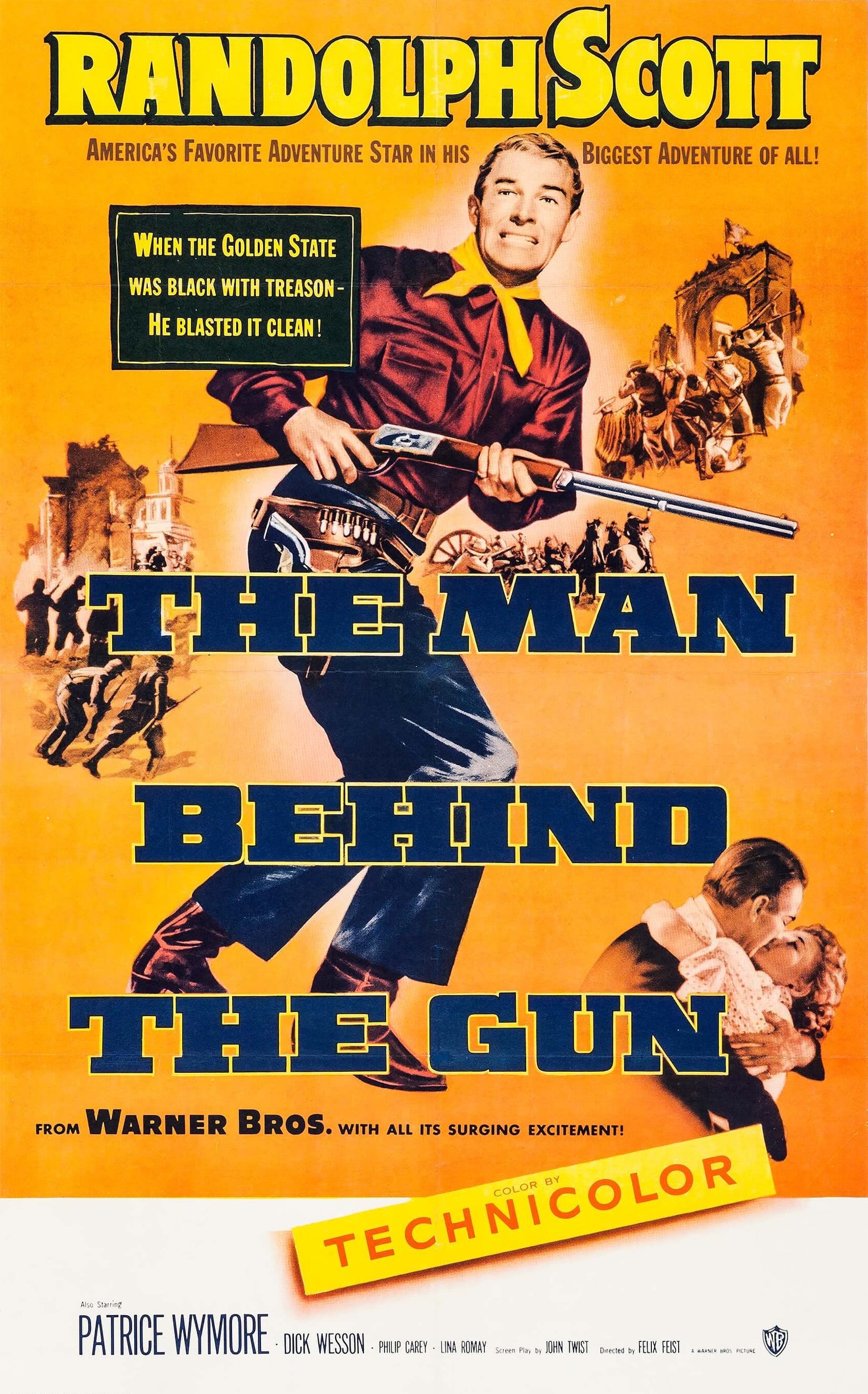
The Man Behind the Gun (1953) is not a film that you will find on anyone’s list of essential Westerns, which is a bit of a shame. It is a Warner Bros. programmer that was merely meant to churn people through the theater 82 minutes at a time. Of course, The Tall T (1957), is a 78 minute Columbia Pictures programmer starring Scott and it’s in the National Film Registry. When The Man Behind the Gun steps out of the studio and into the wild, you get some beautifully shot Technicolor images of the Simi Valley. The rock formations of Simi Valley are as recognizable as those of the Alabama Hills near Lone Pine, but the mountains are older and smoother. One doesn’t see the jagged granite spike of Mt. Whitney blocking the sun with its summit of near 15,000 feet. The rocks of Simi were deposited by a different flood and the mountains are more windworn and smooth.
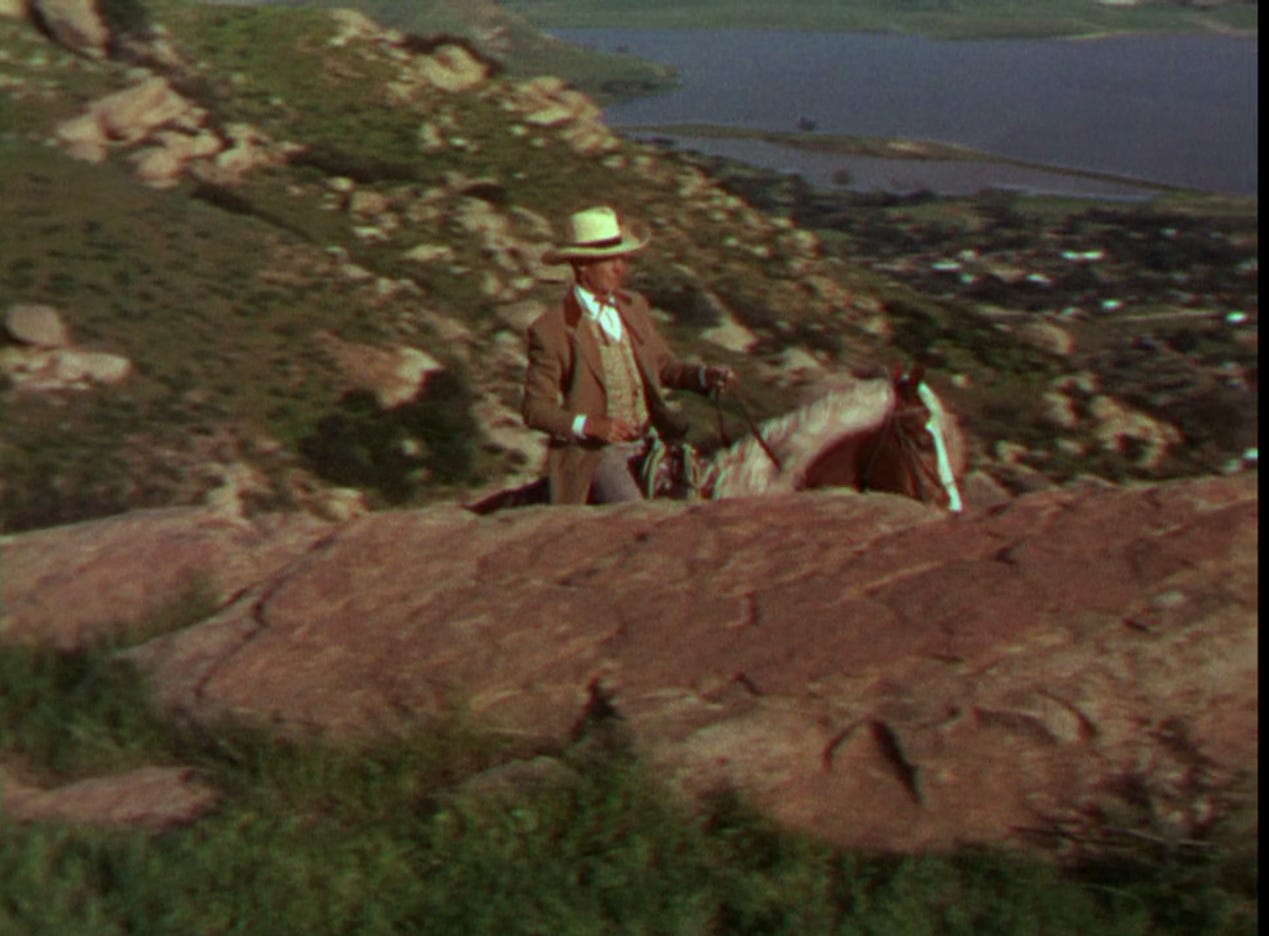
The majority of filming was done at Bell Ranch and you can see the lake that is part of the near by day K’uik’ui Ranch in the shot above. Bell Moving Picture Ranch was a great location, but all of the sets were removed in the 1990s. The film features a script by John Twist that earns its surname. The plot is a bit wild to the point of being improbable in places, and the shift from the red herring villain to the real villain is done in a way that saps the tension from a premise that should crackle. The twist is a great one, but the execution doesn’t quite hit the mark. Like Frontier Marshal before it, the film is saved to the point of actually being elevated into something special, by the sheer force of Randolph Scott’s presence. It’s also saved by the fact that the plot stumbles, almost by accident, into one of the truest stories the American West ever told.
The Setup Is Strange, and That’s Part of the Appeal
Major Ransome Callicut (Scott) is an undercover Army officer dispatched to 1850s Southern California, disguised as a traveling schoolteacher, to investigate a secessionist conspiracy. There were a number of films in the 1950s that had storylines about the intersection of the Civil War and the West. Gary Cooper’s excellent Springfield Rifle comes to mind as does the Durango Kid entry Frontier Outpost (1950). In The Man Behind the Gun, the potential villains are a group of well-heeled insurrectionists who are led by the corrupt Senator Mark Sheldon (Roy Roberts) and his enforcer menacing Bram Creegan (Morris Ankrum) who, we are told, want to detach Southern California from the Union and establish it as a pro-slavery state on the eve of the Civil War.
This is not pure fantasy. The Bear Flag Republic was barely a decade old in 1853. The question of California’s political identity, slave or free, unified or fractured, was genuinely unsettled in the years following the Compromise of 1850. Southern California, then a sparsely populated rancho territory with economic and cultural ties to the old Mexican land grant aristocracy, had a different character than the gold rush north. The idea that ambitious men might try to carve out a separate fiefdom is not historically absurd. Screenwriter John Twist reaches for this history and then mostly ignores it in favor of stagecoach chases and saloon brawls, but the premise has real bones.
What the film does with that premise, though, is what makes it interesting. The heart of Sheldon’s criminal operation is not, at bottom, about political ideology. It is about water.
Water Is Always the Story
The climactic action sequence, a spectacular raid on what we find out is the “water pirates’ camp,” reveals what the so-called secessionists are actually protecting. They weren’t interested in any potential Civil War. Instead, they wanted to control the water in 1850s Southern California and he who controls the water controls everything. The cattle ranches, the farmland, the emerging settlements. Everything runs on water access in a landscape that gets perhaps fifteen inches of rain a year if it’s feeling generous. The political conspiracy is a ruse for what is in the end a resource war. Like Quantum of Solace, the villain is interested in man’s first most precious resource and not in the politics of the day.
Audiences in 1953 may not have fully registered this, but anyone who grew up in the West, as I did (Reno, Nevada), understands in their bones what water means in that landscape. William Mulholland didn’t invent the idea, he merely executed it at scale. The Owens Valley was drained to slake Los Angeles not because anyone was malicious in some cartoonish way, but because the logic of water in a semi-arid basin is ruthless and absolute. You control the water or you lose the West. Take that people who think Dune is about Oil. What are the Fremen up to in those cisterns? An author who saw the beginnings of the terraforming of dunes in Oregon knows all about water.
One of the best examples of the water wars genre is John Sayles’ film The Milagro Beanfield War (1988), where a single man’s decision to illegally irrigate his beanfield ignites a war between a rural New Mexico community and developers who have quietly monopolized the local water supply. The beanfield is not really about beans. It is about who gets to exist in a landscape that cannot support everyone who wants to live in it. The water is the whole argument.
Water is central to one of the quintessential Westerns. George Stevens’ film Shane was released the same year Man Behind the Gun was released (1953) and while Ryker’s cattle operation and the Starrett homesteaders are fighting a war that looks like a personality conflict, it is really a water and grazing rights argument with guns attached. Ryker is not simply a villain. He is a man who arrived first, built his operation around access to open range and water, and now watches fences go up around the resource base his livelihood depends on. The homesteaders are not simply victims. They are a competing claim on the same scarce commons. Shane doesn’t resolve that argument. Shane just ends it, which is a different thing entirely. Stevens is too honest a filmmaker to pretend the valley is big enough for both and the book makes the point even clearer.
The Man Behind the Gun is not as sophisticated as either of those films, but it is, in its blundering B-picture way, telling the same story. The insurrectionists need secession because secession means no federal oversight, and no federal oversight means the water is theirs. Callicut isn’t just stopping a political plot. He’s stopping the privatization of a commons that Southern California’s future depends on.
It is a remarkable thing to find in a film that also features Alan Hale Jr. as a strong man and Dick Wesson as “Monk” a sidekick who swings a bullwhip.
The Landscape Knows What the Script Doesn’t
Part of what makes this message so strong is where the film was shot. Bell Ranch in the Simi Valley overlookes the nearby Ball Ranch Loop (K’uik’ui Ranch) which is now largely preserved as part of the Santa Monica Mountains National Recreation Area. This is a stunning landscape of rolling oak-studded hills, golden grassland, and that particular Southern California light that turns everything amber in the late afternoon. It is beautiful in a way that is entirely different from the jagged volcanic drama of Lone Pine and the Alabama Hills, where Scott spent so much of his career. You can see the preserved watershed behind Scott as he rides up the hill as he journeys to the schoolhouse where he will “teach.”
In Frontier Marshal, the Eastern Sierra Nevada locations do moral work. The stacked granite boulders, the looming crags of Mount Whitney, the hardness of that terrain. All of that matches the film’s relatively dark material and Scott’s occasionally alarming interpretation of Wyatt Earp as a genuinely decent man in a landscape that seems designed to punish decency. Lone Pine is a landscape of confrontation.
The Simi Valley is a landscape of promise and serenity. Those green and gold hills look like the California of the land grant dreamers. They are soft, fertile, and generously lit. It is, in other words, exactly the landscape worth fighting over. When the water pirates establish themselves in the film’s final act, they are parasites on precisely this: the seemingly abundant but actually fragile resource base of Southern California’s pre-aqueduct promise. Cinematographer Bert Glennon, a veteran who shot Stagecoach for Ford, knows what he has, and he uses it.
Randolph Scott and the Women of the Film
Randolph Scott in 1953 is a man in transition. The Boetticher Westerns are still a few years away. The Ranown productions that will cement his legacy, Seven Men from Now, Ride Lonesome, Comanche Station, are on the horizon but not yet visible. What we have here is Scott at a curious midpoint. He’s too big a star for the programmer Western having featured prominently in films like My Favorite Wife, but he is not yet in the films that will fully use all of his talents.
His Callicut has the characteristic Scott contradiction. He’s warm, disarming, almost implausibly likeable, and capable of sudden precise violence that makes you believe he has always been exactly this dangerous. This is not an easy combination to sell. Scott sells it every time. It is his hallmark. He’s deceptively dangerous in the same way he manages to be deceptively sexy. After all, a 1940 audience had to believe he was a genuine sexual threat to Cary Grant in My Favorite Wife, which is no small ask, and the diving scene in speedos is the film making that argument as directly as the Production Code would allow.
What surprised me in The Man Behind the Gun is what the film attempts, imperfectly, to do with its women. The conventional reading of early-50s Westerns is that they overused the damsel in distress trope where women exist to be rescued, to provide romantic motivation, and to represent Civilization’s stake in the outcome. I think this is largely overblown. Westerns like The Naked Spur highlight that the critics making this claim seem to have watched 1950s Westerns in the same way that Karl Popper read Plato. Which is to say that they probably didn’t, otherwise they wouldn’t be saying things that gets disproven so easily by repeated examples. The women in Westerns are harder than they are given credit for, but they do “play” with the damsel in distress notion. The Man Behind the Gun is a good example of how this trope is subverted.
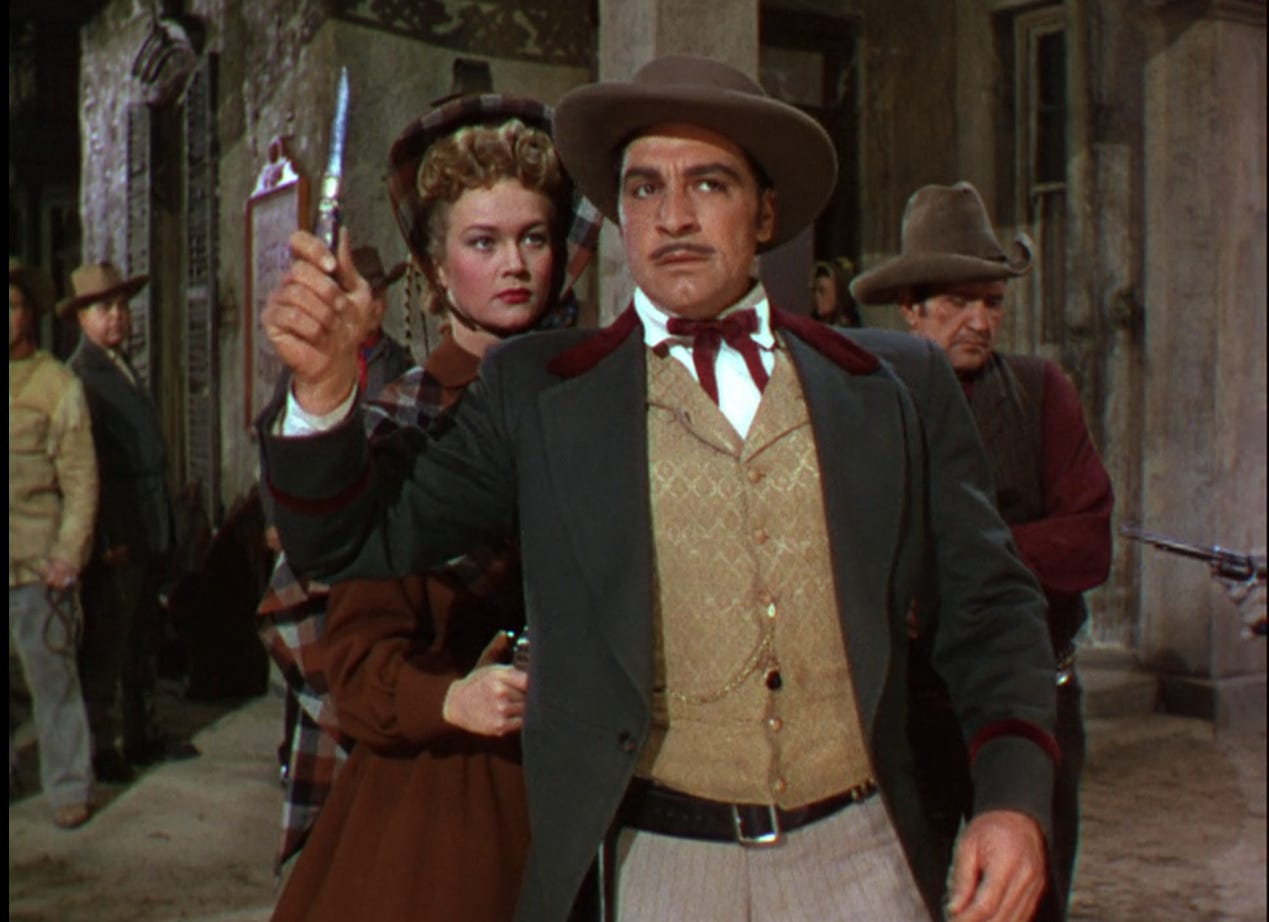
There is what appears to be a damsel in distress C-storyline threading through the love square that drives much of the film’s romantic geometry, but it is undermined before it happens when Lora Roberts (Patrice Wymore) produces the gun that Callicut gave her earlier and uses it at exactly the right moment to save his hide. It is not a grand feminist statement. It is a small, practical beat. She was given a tool, she learned to use it, she used it. It is enough to signal that the film sees Lora as a person with agency rather than a passive prize. Viewers have this scene in the back of their mind when the villains take Lora hostage. They know she’ll find a way to escape on her own and she does, even as the cavalry comes to rescue her.
Lina Romay as Chona Degnon is often praised as the film’s real revelation. Romay plays the saloon singer/villain’s consort with a knowing energy that most of the film’s heroes can’t match. She is operating in full awareness of her situation. She understands the men around her, the power she has, the limits of that power and she is an interesting character played by a charismatic actress. The consensus is that she walks away with the film, but that’s misguided. She lacks the power of Marie Windsor in The Narrow Margin, or the seductive quality of Barbara Stanwyck in…well everything. She’s great, but highlighting her is the staid and easy choice. Wymore’s Lora is the truly strong woman in the movie, but like Grace Kelly’s Quaker in High Noon she seems weak on the surface. Chona appears strong on the surface, but is actually weak because she measures her worth in how a man sees her. She needs the saloon to survive, she needs “the City.” Lora doesn’t. She’s the kind of woman who survived on the prairie.
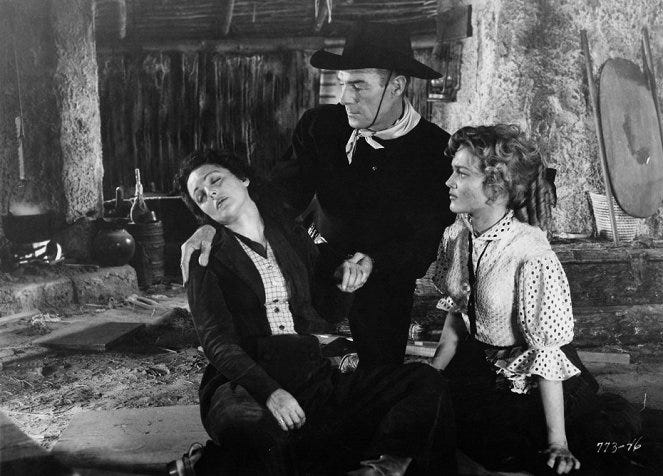
The love square itself, Lora and Chona both entangled with Captain Giles (Philip Carey) and Callicut, is messier than the film intends. As flawed as it is, it generates genuine dramatic heat in a way that the secessionist conspiracy, which needed a stronger villain, does not. Morris Ankrum is a reliable heavy who is given almost nothing to do. The film’s antagonist problem is real.
Felix Feist and the Grammar of the Journeyman
Director Felix Feist is not a name that comes up in the auteurist conversation about Westerns, and The Man Behind the Gun does not change that. He is efficient, occasionally stylish, and fundamentally in service of the material rather than in dialogue with it. He would migrate to television soon after this, The Man Behind the Gun has the pacing and visual grammar of a prestige TV movie twenty years before that was a category.
What he does well is action. The opening gun fight and the raid on the water pirates’ camp have real momentum. The final shootout earns its release. Feist also has the sense to let the cast do their work without interference, which is the most important directorial skill in a film like this. Randolph Scott charms and Alan Hale Jr. clowns and it works. Let them work their wheelhouse.
The Verdict
The Man Behind the Gun is messier than Frontier Marshal. It has more moving parts than it can fully control, a villain scaffolding that collapses under weight, and a romantic geometry that is interesting in theory and chaotic in execution. It is not the Randolph Scott film you show someone to explain why Randolph Scott matters.

It is, however, a film that rewards attention. The locations are beautiful and historically resonant in ways the script doesn’t fully earn but the landscape provides anyway. Lina Romay and Patrice Wymore have good tension. As for Scott, he’s doing what Scott always does, which is making you believe in a man who is both completely trustworthy and genuinely dangerous, a combination that turns out to be exactly what Southern California needed in 1853.
The water pirates had to lose. The question of who controlled the water in Southern California would be answered differently, and more durably, a few decades later. But that’s a story about William Mulholland and the Owens Valley, and that’s a darker Western than Warner Bros. was making in 1953.
Whenever I see a new Western available on a streaming service, I always look to see if it stars Randolph Scott. Because when it comes to choosing whether to watch it or not…
I’ll do it for Randolph Scott.
The Man Behind the Gun (1953) is directed by Felix E. Feist, stars Randolph Scott, Patrice Wymore, Lina Romay, and Philip Carey, and is streaming on HBO Max.
“You’d do it for Randolph Scott.”
Townspeople: "Randolph Scott?"
(Heavenly choir) "RAN-DOLPH-SCOOOTTT!"
When I saw this film for the first time and this gag came up, I thought: "He must be somebody important in Hollywood, or, was, at least." And he was definitely one of Hollywood's best Western actors- hence the shoutout...