


About a month ago, I saw a Note on Substack by Kristen SaBerre asking for volunteers to participate in a massive film review project centered on adaptations of Jane Austen’s novels. Since I consider Jane Austen to be one of the greatest authors in the English language (she, Dashiell Hammett, Mark Twain, and Tolkien have special places in my heart), I asked if I could be a participant and was welcomed into the fold and became a full-fledged member of The Jane Austen Screen Adaptations Club.
When it came to adaptations, I had my heart set on one of two adaptations. I either wanted to write about my favorite adaptation (Persuasion) or about one that my beloved friend Shawna Benson worked on (The Lizzie Bennet Diaries). Someone had already taken the Diaries, and so I was left with a beloved filmic companion. As always, something I am sure annoyed Luke Y. Thompson, it took me longer to write than I’d hoped, but that’s because I wanted to have something novel to say. I’m very proud of my contribution and was happy to see an edited version of it included in today’s entry over at SCREEN SOMM.

Kristen, the editor, did a good job cutting my longish piece down to a similar size to the other reviews and recommended that I publish my full review here. I appreciate that she is letting me do this (as a participant in her project I would not have done so without her permission) because while I believe her edits retained much of the main thrust of my review, it lacks the meandering and intellectual sidetracks I am prone to and I want to share those with you.
Before I do though, I’d like to take another moment to thank Kristen for putting this project together. This is the kind of project we need more of in the world, displays of the things we love and why we love them. I don’t agree with some of the reviewers regarding their assessment of some adaptations, but I do appreciate their enthusiasm and sincere joy.
Persuasion (1995) — The Full Review
Persuasion is Jane Austen’s last complete novel. It was published posthumously in a set that included Northanger Abbey. These two novels represent Austen at the height of her powers as an author and observer of human behavior. It is fitting that these novels were published together because even though they have very different narratives, they both give audiences a glimpse into Austen’s thoughts about the literature of her time. Northanger Abbey directs its gaze at the Gothic tales of authors like Ann Radcliffe and argues for the importance of such narratives, even as it critiques them. Persuasion, too, includes commentary on Gothic themes and adds analysis of Byronic ones as well, but Austen directs her critical eye at a new target. With Persuasion, Austen aims her analysis at her own earlier works, and in particular at Emma.
In the earlier novel, we are presented with the irresistible character of Emma. She is as charming and delightful as she is naïve and meddlesome. For all her faults, we fall in love with her as deeply as Mr. Knightley even as she gives Miss Smith dreadful advice regarding Robert Martin. We come to understand, through Mr. Knightley, that Robert Martin represents a new and emerging world where merit triumphs over paper titles and that his love for Miss Smith is a privilege and not something to be shunned. Knightley teaches Emma about virtue, and Robert Martin demonstrates the constancy one expects of a worthy partner. As with all Austen novels, we are privy to the thoughts of the characters, but most of what we learn is in brilliant conversations. It’s an easy story to adapt because feelings are expressed, rather than suggested.
Like Emma, Persuasion has at its core bad advice transmitted from a respected mentor to a young woman in love. Unlike Emma, Lady Russell is not naïve or meddlesome. Instead, she is overprotective as she fails to recognize the potential inherent in the object of young Anne Elliot’s affections. As Emma did with Miss Smith, Lady Russell advises Anne Elliot that her suitor is beneath her station and that she deserves someone more fitting to her virtues. As with Emma, Lady Russell is wrong because she doesn’t recognize fully the superiority of individual virtue over the false pretenses provided by virtue of birth. Given that Sir Walter provides such a glorious example of the failures of paper virtue, it pains us that she held onto her older notions. We, like Anne, forgive her because we know her love of Anne was sincere and her motivations pure. We know that Captain Wentworth will forgive her too. In sharp contrast to the narrative of Emma, though, we learn much of what we know about the characters in Persuasion through their thoughts and actions and not their statements. It is fitting that Captain Wentworth’s ship was called the Laconia, for the characters are often silent about their real feelings in public. This presents a particular challenge to those adapting the tale to film. How does one show the inner longing and love of Anne Elliot and Captain Wentworth without relying on a ham-fisted technique like voiceover?
This is the obstacle director Roger Michell and screenwriter Nick Dear deftly overcome in the 1995 production of Persuasion, and in overcoming this challenge they create one of the best adaptations of a Jane Austen tale ever put to film. In some ways, we shouldn’t be surprised that an Austen adaptation released in the mid-1990s is compelling and shows great fidelity to the source material. This was the era of Emma, Sense and Sensibility, and Pride and Prejudice, all of which were beautiful and showed great deference to the source material. Even Clueless, which brought Emma into what was then modern-day Beverly Hills, retained so much of the heart of Austen that it has become a beloved classic in its own right. What makes Persuasion shine above these films, in many ways, is that it is deeply moving even though so much of the action is internal to the characters.
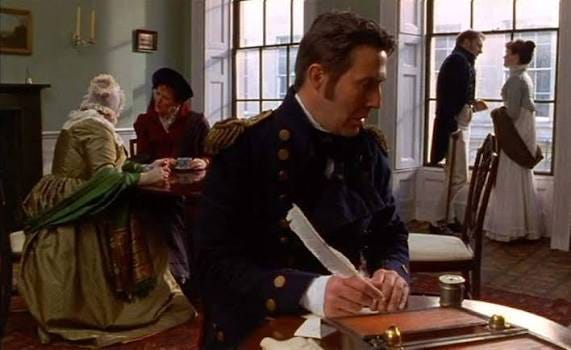
To have audiences feel the full force of the internal longing of Captain Wentworth and Anne Elliot requires both great directing and great acting, and Amanda Root (Anne Elliot) and Ciarán Hinds (Captain Wentworth) provide a masterclass in subtlety. When Captain Wentworth is writing his letter, we can see his longing, and the tension builds as we hope he can finish the letter in time to get it to Anne. The scene pulls my romantic heartstrings every time. Those not familiar with the tale beforehand get to see the well-paced revelation of Wentworth’s love for Anne and feel the full impact of many subtle movements and actions earlier in the film come to fruition. Those of us who have read the book, or are rewatching the film for the tenth time (for it deserves at least that many viewings), see each glimpse from Anne or gesture from Wentworth for what it is, a sincere and powerful, yet quiet and small, expression of a deep love that has endured years of separation. There are small areas where the film fails to capture the novel. For example, Elizabeth’s and Sir Walter’s villainy and fate are not explored in the film as much as they are in the book. Additionally, the exploration of the reasons for and fallout of Lady Russell’s advice is done more cursorily in the film than in the book. We don’t see as clearly how the novel returns to some of the themes of Emma. Such is the challenge of adaptations, though. One must choose what to include and what to leave out, and Nick Dear and Roger Michell focus, rightly, on the most important relationship. We spend our time with Anne and thus are able to feel the full force of longing when she is in the presence of Captain Wentworth.
Do yourself a favor and watch this wonderful production and follow it up by reading one of the great novelists in the English language. Jane Austen is a treasure, and this film does justice to her legacy.