



Kill or Be Killed Meets Logan’s Run?
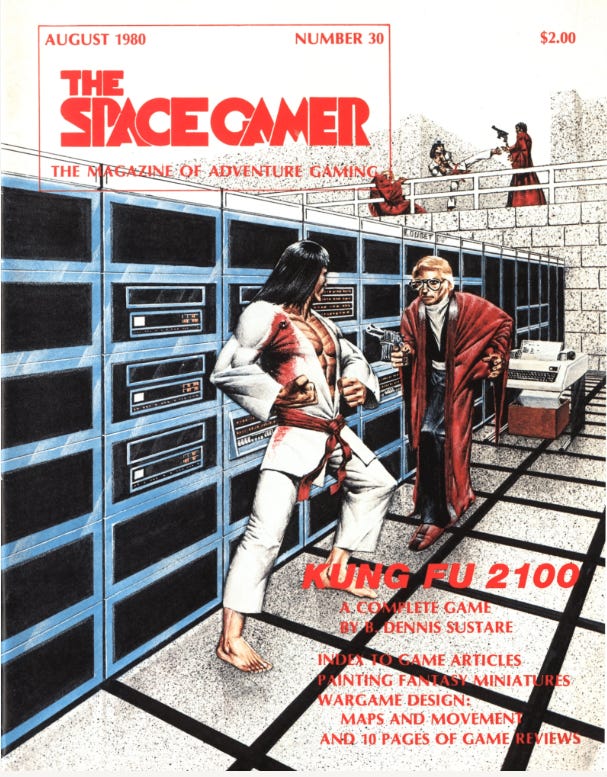
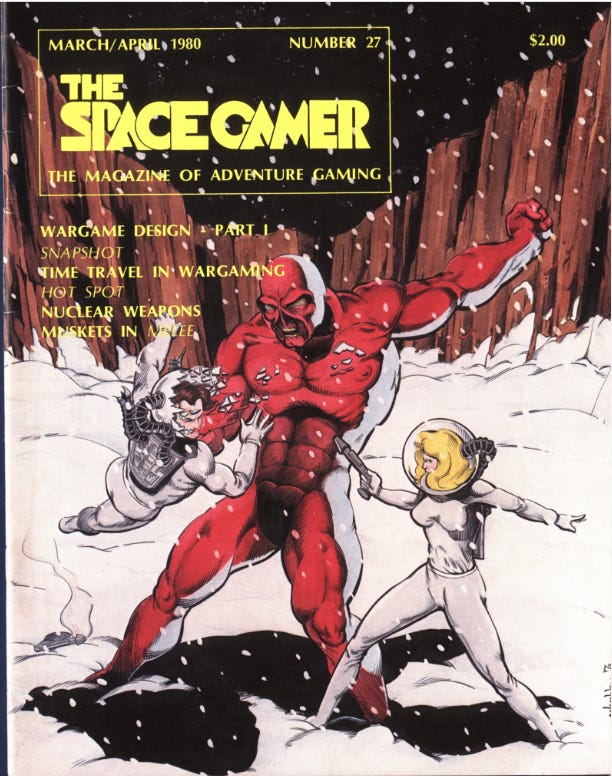
For its first twenty-six issues, the storied Space Gamer magazine was a house organ owned and published by Metagaming Concepts. Metagaming used the magazine to promote their upcoming products, and included some, but not much, coverage of products by other companies. The focus of the magazine changed radically after it changed publishers. Starting with Issue 27, The Space Gamer was published by the upstart Steve Jackson Games and continued to be published by them for another five years.
The Steve Jackson Games run of The Space Gamer is one of the best runs of any gaming magazine in the history of the hobby. James Maliszewski waxed nostalgic about the title back in 2011 and I mentioned The Space Gamer in the first entry in my “Old Gaming Magazine” Series. I’ll be doing an issue by issue rundown of the magazine, which is currently available for a very reasonable price from Steve Jackson Games in PDF, but I wanted to highlight one of the games published in the magazine because it is a big favorite of mine.
In addition to publishing news and articles reviewing/supporting existing games on the market, the Steve Jackson era of the magazine included a number of classic minigames. Some were humorous, like Allen Varney’s Globbo. and other games were extensions of other Steve Jackson products. In the case of Battlesuit, the game expanded Steve Jackson’s OGRE Universe to include man to man combat in powered armor inspired by Starship Troopers.

Most of the games published in The Space Gamer were quite good, but one struck a particular chord with me when I first encountered it as a wee tyke. I was at a friend’s house, likely Christian Hunt (we Christians have to stick together), and it was in a pile of old magazines he had been given by older gamers in his gaming group. That game was Dennis Sustare’s Kung Fu 2100. The game had everything that I was semi-obsessed with at the time: martial artists, secret laboratories run by evil scientists, and transhuman clones.
Dennis Sustare is not a well known game designer today, but he designed some very good micro-games in the 80s. His Star Smuggler game is an entertaining solo game where the player takes on the role of a Han Solo-esque freetrader, and his Intruder is a playful combination of A.E. Van Vogt’s Black Destroyer and Ridley Scott’s Alien that plays like Star Trek meets John Carpenter’s: The Thing. This is likely because both Alien and Star Trek were inspired by the adventures of Van Vogt’s Space Beagle, and Sustare’s game captures the anxiety of a crew of scientists dealing with an otherworldly threat. Sustare was also the creator of the Druid class for Dungeons & Dragons and the Bunnies and Burrows role playing game of Watership Down-esque adventure.


Dennis Sustare’s design of Kung Fu 2100 was inspired by an illustration in the issue 27 of The Space Gamer: (the first Steve Jackson Games issue). This illustration also included the rules to a contest that promised to publish the winner’s work in the pages of the magazine. Seems like a great way to get new content and the tagline for the contest was “Bruce Lee Meets IGDRIP?”
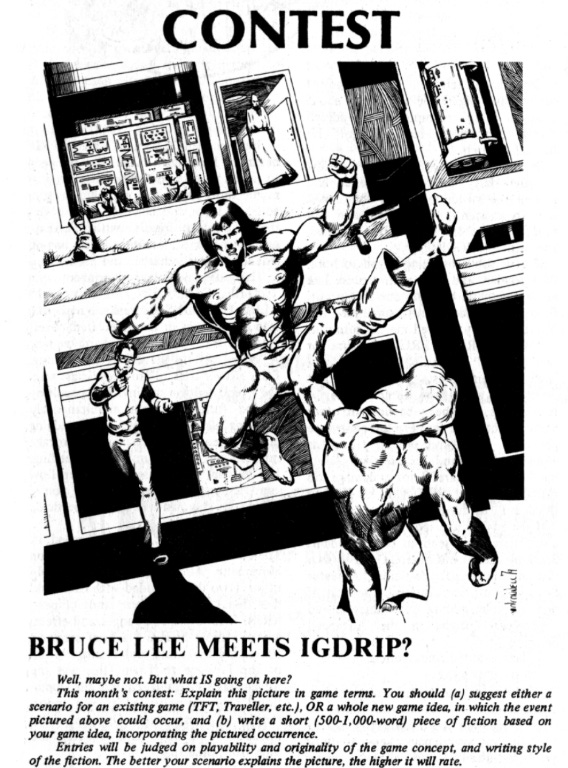
If you are confused by what the heck IGDRIP is, I was too until I went back and reread issue 27 where the contest was published. It’s a reference to a short story in the magazine about an AI computer that can design and “intensify” any game that has been imagined by a person anywhere in the world. Essentially, the machine can read everyone’s minds and knows the games we are imagining creating and it can spit out a rules set for them. In this case, IGDRIP means Istantaneous Game Design and Rules Intensification Program. The story was written by Allen Varney, the designer of Globbo!, and is a combination humorous science fiction story and critical takedown of the way most war game rules were written at the time.
The contest asked readers to describe what was going on in the image in any fashion they desired. It could be a game idea or write a short piece of fiction. Sustare did both and his winning submission became the complete game insert for issue 30.
Kung Fu 2100 was eventually published in three different formats. The first was as the insert game in issue 30 of The Space Gamer for which you will need issue 31 to get the errata to the game because there are a couple of errors. This was followed up with a minigame enclosed in a ziplock bag, and the final version was included the same printed material as the second except that it was now packaged in SJG’s signature minigame box as a part of their Pocket Box line of games. In the end, the game got nice packaging and provided hours of fun at an inexpensive price. A few years back, these Pocket Box games were republished as a part of a Kickstarter and I was able to get my hands on a lot of interesting games when I got that collection.
Kung Fu 2100 combines the mythology of Logan’s Run and James Ryan’s Kill or Be Killed. To quote the copy on the game:
IRON FISTS...
For years the CloneMasters have ruled the world. Their only foes are the Terminators -- trained from birth in the martial arts. Now you are a Terminator. Your mission: smash your way into the CloneMaster’s fortress...chop through his defenses...and destroy him forever.
But his guards are many and loyal. Like you, they can kill with a single blow. And time is against you...
The game features an interesting combat system where kung fu maneuvers are selected in secret and later revealed as combat occurs simultaneously. There is also an interesting alternating movement system in order to maintain game balance and narrative tension. The Terminators (who fight against the immortality offered by the cloning process) are tougher than their opponents, but they are badly outnumbered and only the right combination of stealth and skill selection will help them defeat the dreaded CloneMaster and his minions.
The components of the game have never been nothing special, you have to hand cut out the counters, but I have always wanted to make a project of making a “home play edition” of the game similar to the alternate maps and tokens that Kwanchai Morita did for OGRE and Melee. Steve Jackson Games demanded that Kwanchai take these redesigns down (because he’d included the full rules of the games and not just tokens), but they are really cool.
In my home edition, which I’d have to have someone else draw, I’d replace the small counters used to represent maneuvers and replace them with small eurogame sized cards. The Terminators, Jellies, and CloneMaster would be represented by stand up paper minis similar to the Cardboard Heroes line by SJG. I’d also make a more modern looking map. I’ll get around to it some day, but that day will have to wait. I’d also like to design a simple role playing game that expands on the base game and adds elements of American Ninja II into the mix.
As it is now, you can get a cheap copy of the game by buying issue 30 of The Space Gamer, printing out the proper pages, and getting down to having a good time. You should also buy that copy of issue 31 for the errata, but that issue is worth the purchase for the reviews alone.
Before I forget, one of the most interesting things about the game is that the Terminators are a part of the Cult of Thanatos. The reason they despise the CloneMasters so much isn’t entirely due to the tyranny of CloneMaster rule. The Terminators are far more upset that the CloneMasters seek immortality. The Terminators are part of a cult that glorifies death, and seeks to bring destruction to those who are avoiding the inevitability of death.
Back in the day, our gaming group did a GURPS scenario based on Kung Fu 2100. It was a blast!