


This is a greatly expanded version of an article that was originally posted at cinerati.blogspot.com.
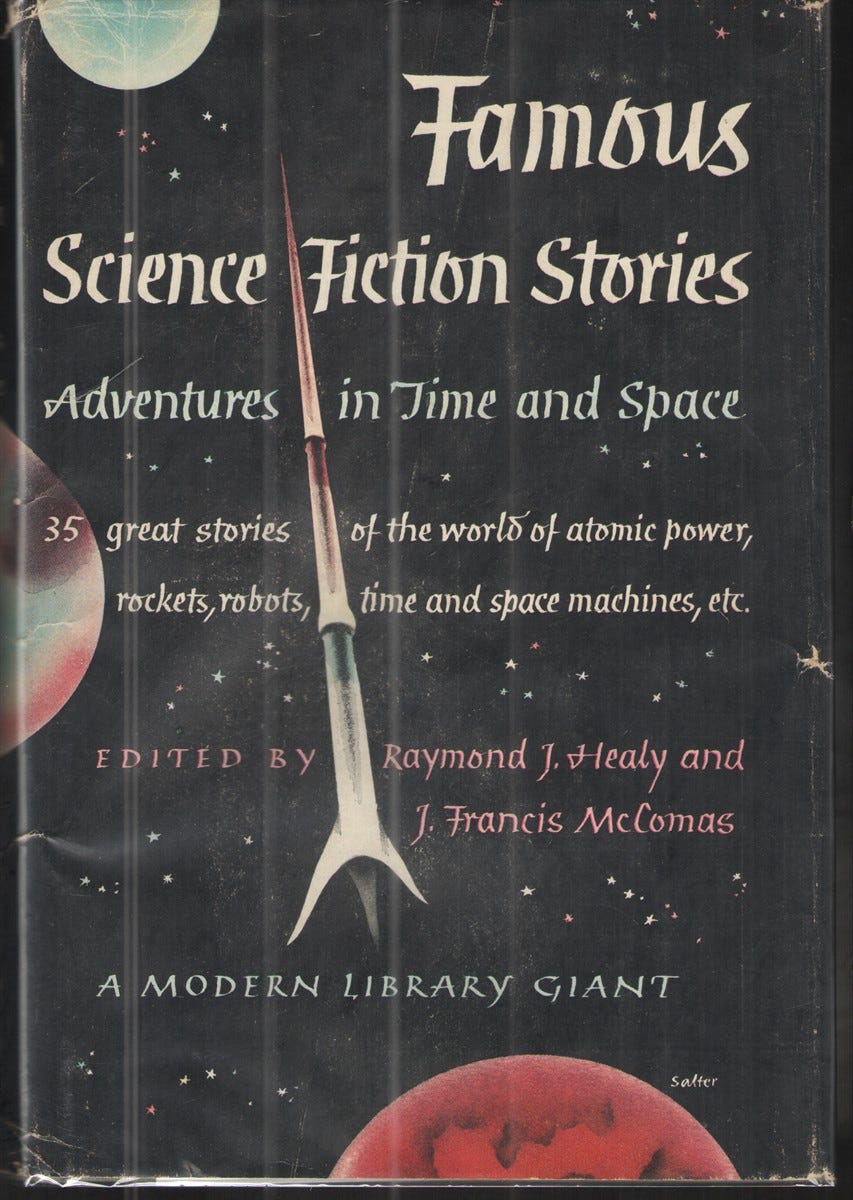
There is a particular kind of book that does double duty. It entertains you on the surface and underneath, it makes an argument. Adventures in Time and Space, the 1946 anthology edited by Raymond J. Healy and J. Francis McComas, is that kind of book. It includes thirty-five stories of rockets and aliens and temporal paradoxes and creatures that shouldn’t exist in a single 900+ page volume. All of the stories came from the pre-war pulps, in particular Astounding Science Fiction, and presented for the neophyte and casual fan easy access to stories that might be otherwise difficult to track down. Okay, it technically contains 33 stories and 2 essays, but who’s counting? Adventures in Time and Space is not merely a collection of good science fiction stories. It is possibly, as Don Sakers argued in Analog magazine, the most important Science Fiction anthology ever published. It is Healy and McComas’ “35 Theses.” Along with Crown Publishers’ 1948 A Treasury of Science Fiction, it is among the only science fiction hardcovers to be distributed by a large mainstream publisher. As such, it is a treatise arguing that science fiction is Literature, with a capital L, and that people who dismiss the genre on principle are wrong.
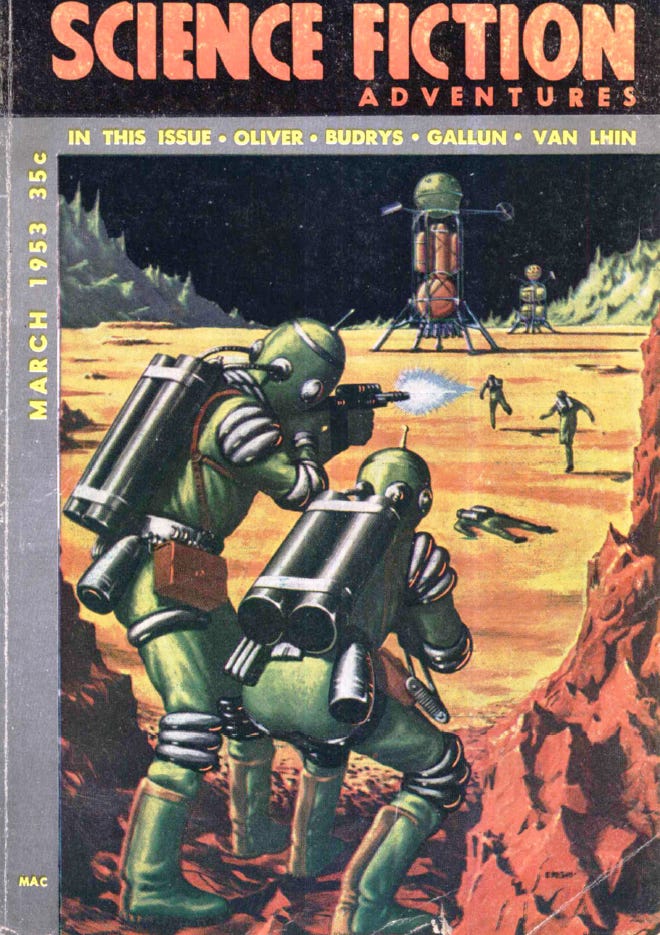
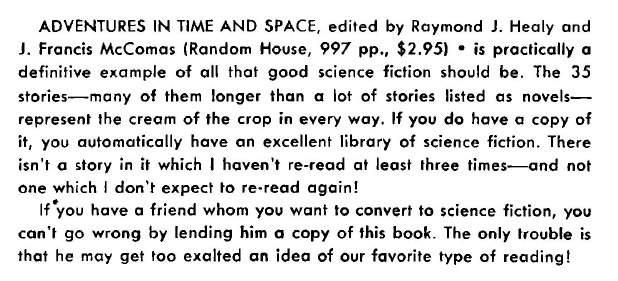
It is a book of which Lester del Rey wrote, in his 1953 review of the book, “If you have a friend whom you want to convert to science fiction, you can’t go wrong lending him a copy of this book.” While Lester del Rey has been the victim of much recent, and wrong minded, literary parricide1 regarding the role he and his wife played in the growth (or death as the critics assert) of Fantasy as a genre, he was one of the great Science Fiction critics. I find that today’s YouTube literary critics, of both the “curmudgeon” and “newest wave rulez” sides of literary culture wars, spend far too much time attacking the authors of the mid-20th Century Science Fiction and Fantasy scenes, and too little time actually reading them.
I love many of the authors of that era. They pushed Science Fiction and Fantasy in new directions, even before Harlan Ellison and Michael Moorcock pushed their New Wave writers. I adore this book as a cornerstone of my Science Fiction library and own the 1957 Modern Library edition. It is the sort of book that looks out at me from the shelf with quiet authority. I return to it regularly. I return not just to revisit a comfort read, but as a primary source document that informs me of what the state of Science Fiction was in its Golden Age. It is the Aristotle’s Rhetoric of pre-war Science Fiction. Like Artistotle’s Rhetoric, it is making an argument.
Arguments in Time and Space
Healy and McComas were not modest men, the my volume opens with the editors agreeing that critics have called the anthology “definitive,” and then agreeing with the critics because the praise really belongs to the editor who first published most of the stories, John W. Campbell, Jr. They write that “perhaps no one man ever had a greater influence over a literary form,” and then they make the case.
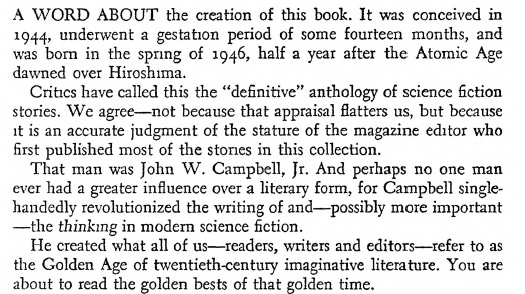
Healy and McComas argue that prior to Campbell’s arrival as editor of Astounding Stories in 1937, science fiction had badly deteriorated from the standards established by Wells and Verne. Sure, there were some editors who wanted genuine scientific speculation, but they often let those stories appear dressed in atrocious prose. My sense is that these scientifically accurate stories read like procedural or technical manuals. In Healy and McComas’ telling, most magazines offered neither genuine scientific speculation or good writing. To use their phrase, they stated that “magazines nominally presenting science fiction offered science was claptrap and the fiction was graceless and dull.” Campbell, they argue, changed all of that. He demanded that science fiction think rigorously, write seriously, and imagine daringly.
Twenty years before the New Wave would engage in an attempt to redefine the genre, in part by attacking the old as staid and disconnected from realityz, Healy and McComas were saying that Campbell did much of the same thing for his generation of readers. I read those words today and I don’t think Healy and McComas are overstating the case, nor do I think Ellison was overstating his. Both are right that the genre had stagnated. Of course, both were hyperbolic in their assertions as the eras that preceeded them still had much to offer.
Campbell’s shadow still looms over science fiction the way Lin Carter’s looms over fantasy and August Derleth’s looms over the Weird Tale. This is is to say that you cannot understand how the genre developed without understanding what these editors valued, what they demanded of their contributors, and what they refused to publish. The editor who shapes a genre’s output shapes the genre itself, sometimes more than any single writer does.
Campbell’s editorial philosophy was genuinely distinctive, and it’s worth articulating what it actually was. He wanted stories in which science was not a backdrop or a stage prop, but a character. The scientific element had to matter and be meaningful for the audience. It should be reflected in the mode of thinking that the protagonist applied to problems, and that the reader should be able to follow thos solutions step by step. Campbell wanted engineers and scientists who thought like engineers and scientists, not like square-jawed adventurers who happened to carry ray guns. And perhaps most distinctively, he wanted optimism. Not naive optimism, not the refusal to acknowledge danger, but the underlying conviction that human intelligence, applied rigorously and creatively, could solve the problems that human intelligence had created.
You can see his influence in Issac Asimov’s Foundation and Robot stories, which under Campbell’s hand read like a justification for scientific management (Foundation) or an entertaining logic puzzle transformed into narrative (the Robot stories). After Campbell no longer influence these Asimov stories, they went from feeling as if they were in distinct and different futures into one where the Robots were the ones performing the incredible scientific management and in doing so, they lost there humanity. Hari Seldon being a robot undermines the optimism of human achievment.
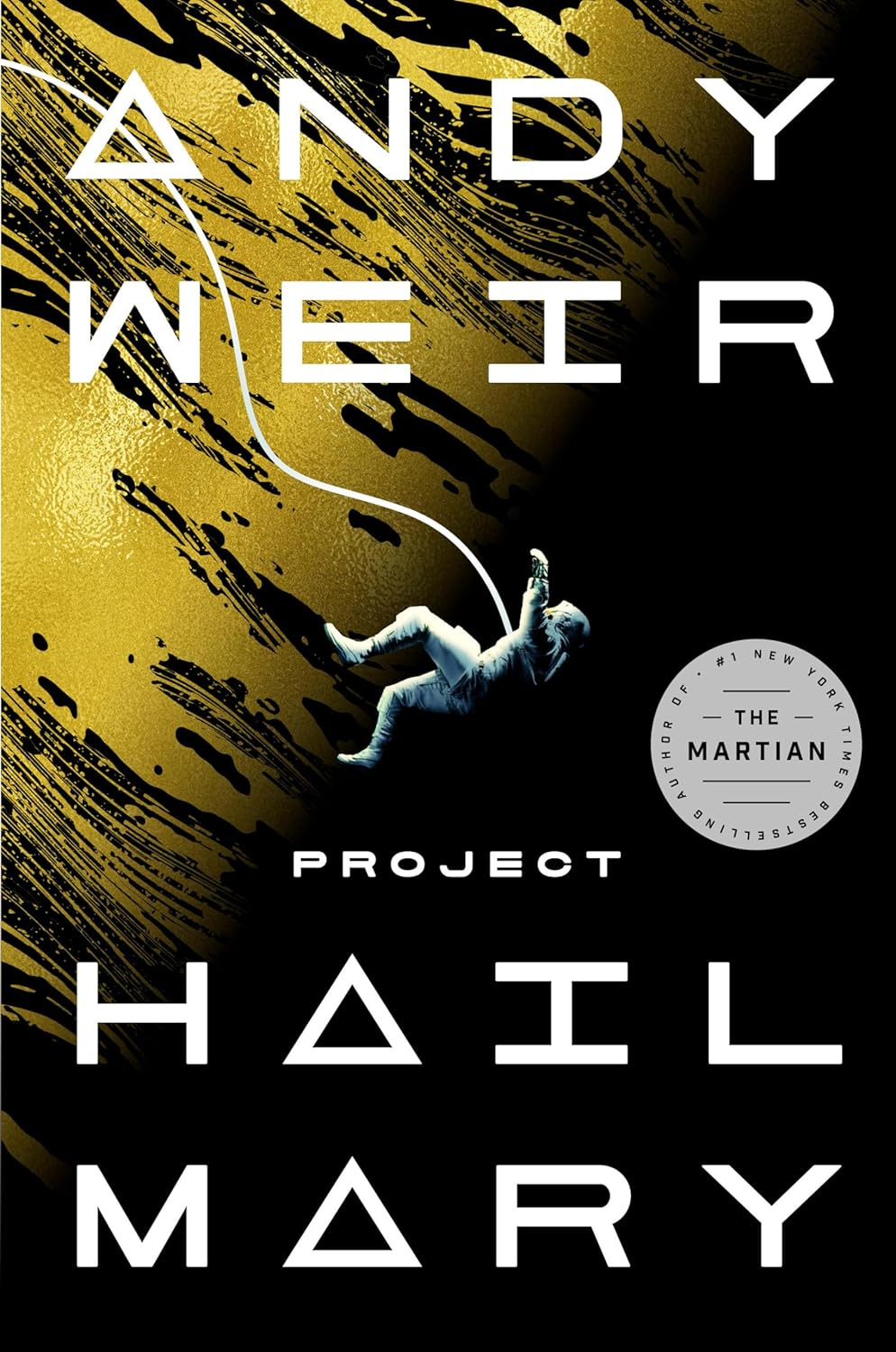
This optimism about human intelligence is the animating faith of Campbellian science fiction, and it explains more about the era’s themes than any single editorial directive could. That two of the most successful Science Fiction films (and books) of recent years (The Martian and Project Hail Mary) harken to that formula is a sign that readers want that kind of hope and that while the psychedelic cynicism of the New Wave has value, people also want to believe in something.
The Intellectual DNA: Nexialism and Psychohistory
I have to warn you about something I notice every time I dive into the Campbellian canon. For author after author, the themes rhyme. Heinlein, Asimov, van Vogt might all have different “voices” as authors, but the arguments they are making in their stories are not their own. They are Campbellian to the core.
Read Isaac Asimov’s Foundation stories and A.E. van Vogt’s The Voyage of Space Beagle and Slan in a single sustained run, and something begins to emerge from the background noise. Asimov’s “psychohistory,” the fictional science of predicting the behavior of populations over vast spans of time through the application of rigorous mathematical modeling, sounds remarkably similar to van Vogt’s “nexialism,” the discipline of integrating knowledge across scientific fields to solve problems that specialists, siloed in their individual domains, cannot address. Both are collection-of-disciplines philosophies. Both posit a kind of master science. Both advance a way of thinking that transcends the limitations of narrow expertise by synthesizing it into something greater. Don’t get me started on Mentats in Dune World (Analog Magazine December 1963 - February 1964, edited by…John W. Campbell) and the rejection of “thinking machines” in favor of people who enter an altered state to compute faster. This is just like nexialism.
This is not coincidence. This is the Campbellian worldview expressing itself through multiple writers working under the same editorial influence. Campbell believed in the synthesizing intelligence, the rigorous generalist who could see connections others missed. He believed in the social sciences as genuine sciences, not merely as arts dressed up in the clothing of precision. And he was optimistic, in the deepest possible sense, about what disciplined human intelligence could achieve.
What I find remarkable is how far that theme extends. Some people argue that Frank Herbert’s Dune is a critique of the Campbellian hero. and in some ways it is, but even moreso it is a critique of religious attacks against reason and the failure of a Campbellian hero to stop religious fanaticism. What are Mentats but practitioners of nexialism at human cognitive limits? What are the Bene Gesserit but psychohistorians who have replaced equations with genetics and training and generations of careful breeding? Herbert understood Campbell’s vision well enough to write a tragedy about it, which is perhaps the most genuine form of engagement with an idea.
Adventures in Time and Space doesn’t include Dune, the publication of which was still two decades away, but the DNA is present throughout and you can see Campbell’s hand.
Some of My Favorite Stories
Since reading a single entry that reviews all thirty-five stories would be a considerable slog, and since I am also in the process of cutting out major chunks of an overly long dissertation chapter, let me tell you about some of the stories I return to most frequently.
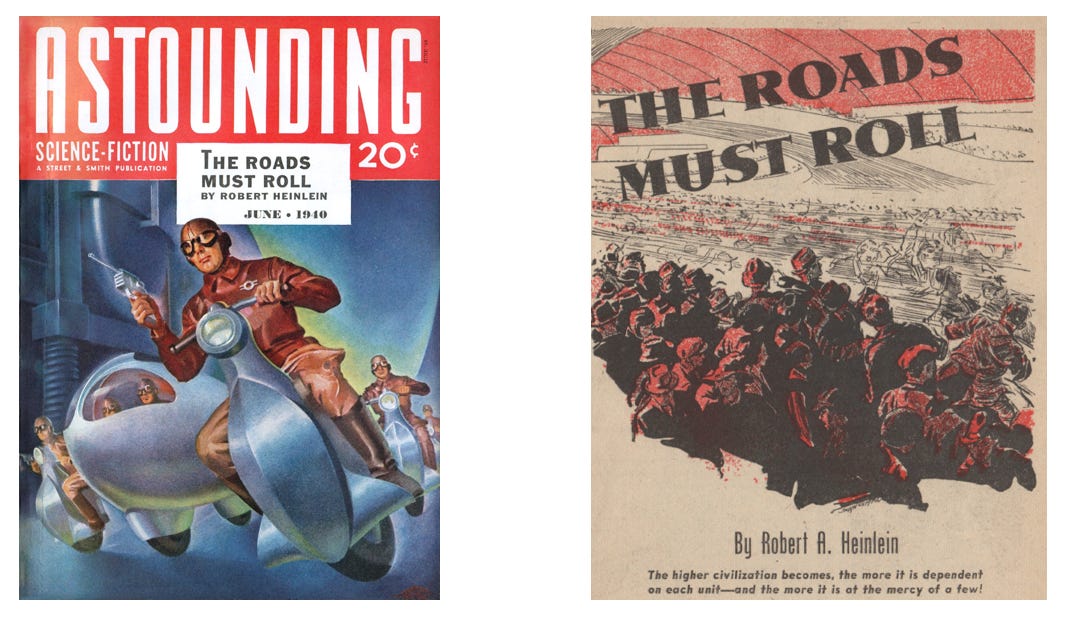
Robert Heinlein’s “Requiem” and “The Roads Must Roll” represent two sides of the Heinlein that Campbell helped develop. “Requiem” is the emotional one. The story is about D.D. Harriman, the man who funded the first trip to the Moon in Heinlein’s “The Man Who Sold the Moon.” Harriman never got to go on the journey himself, and finally arranges to make the trip even though it will almost certainly kill him. It is, at its core, a story about the difference between building a dream and living it, and it earns its ending in a way that a lesser writer would fumble. It’s a melancholy and powerful tale.
“The Roads Must Roll” is the engineer’s Heinlein and is the first Heinlein story I ever read. It takes a hard look at what it would take to maintain a future infrastructure that society had become dependent upon, and what happens when the people doing the maintaining decide to stop. The roads themselves are a bizarrely designed infrastructural feat and their stopping results in tremendous harm to life and economy. In the end, it is psychology that saves the day.
Both stories reward re-reading. Neither is quite what you expect from a reputation that often gets reduced to the politics.
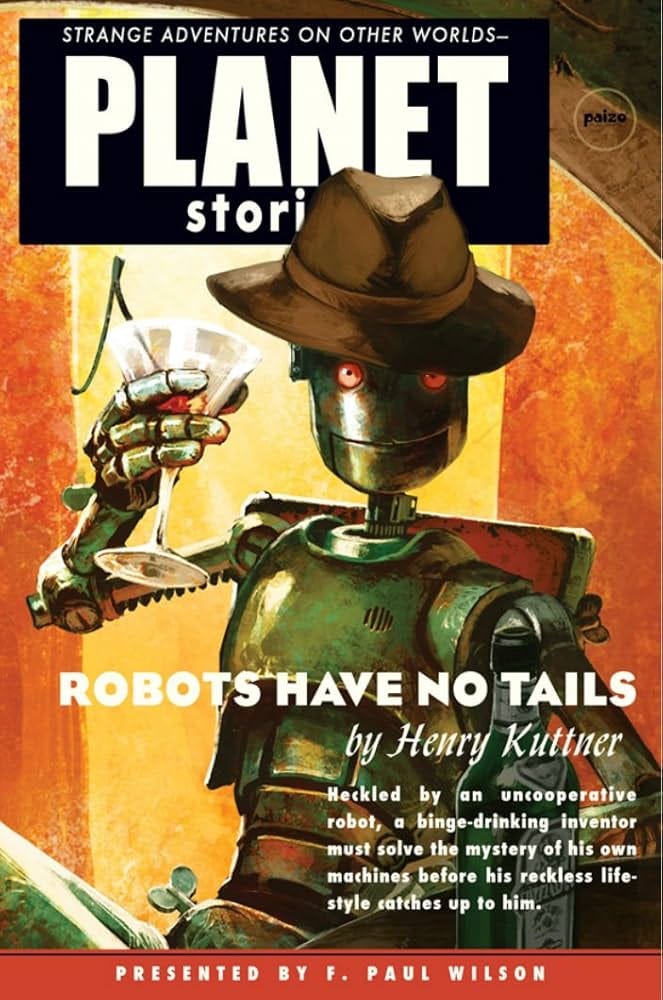
Henry Kuttner, Henry Kuttner, and Henry Kuttner and C.L. Moore, There are three stories by Lewis Padgett in Adventures in Time and Space: “The Proud Robot,” “Time Locker” and “The Twonky.” Lewis Padgett is a pseudonym that Henry Kuttner and C.L. Moore often used when they co-wrote stories and so a reader of Adventures in Time and Space might think that they co-wrote all three of these tales. It’s a likely enough assumption, as they collaborated so often that people often think even fully credited Kuttner works like The Dark World were a collaboration (I am one of those people by the way). However, in this case only one of those stories (“The Twonky”) was co-written. The two “Gallagher” tales, all of which are included in Robots Have No Tales, were solely the work of Kuttner..at least that’s what C.L. Moore wrote in her introduction to that anthology and the Internet Speculatative Fiction Database also credits only him.
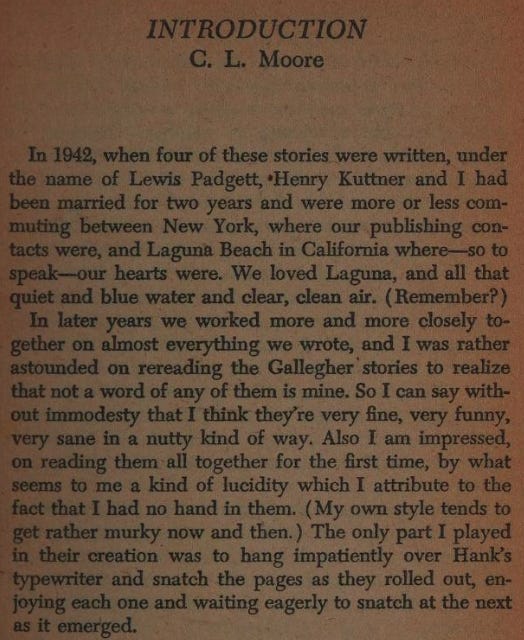
I discussed earlier how each literary era attempts to kill the past in order to justify itself. Sometimes that tendency pushes aside things that should not be forgotten. In this case, I am talking about the fiction of C.L. Moore and Kuttner who are among the most underread writers in the modern science fiction reader’s diet. This is a genuine loss. Moore in particular, whose solo work includes the Northwest Smith stories and the Jirel of Joiry fantasy series, has a prose sensibility that is truly delightful to read. It is descriptive without being ornate, emotionally precise without being sentimental, capable of evoking a specific quality of dread or wonder depending on her narrative goals. “The Twonky” is a domestic horror story about a piece of furniture that turns out to be a machine from the future, designed to manage and regulate human behavior. It is, depending on your tolerance for paranoia, either hilarious or genuinely unsettling. I find it both.
Happy Belated Birthday to C.L. Moore: Collaborator and Visionary Extraordinaire

He lay there unquietly for a long while, turning the unanswered questions over and ov…
John W. Campbell, Jr.’s “Who Goes There?” — John W. Campbell didn’t always publish his own stories, but when he did they could be straight up bangers. In this case, Campbell published “Who Goes There?” in Asounding under his Don A. Stuart pseudonym. While you may not know the story by name, it is probably the most famous story in the anthology, and with reason. It is the basis for both the 1951 film The Thing from Another World and John Carpenter’s 1982 The Thing, and while both films are worth your time, neither quite captures what Campbell was doing on the page (though Carpenter’s comes close). The story is a study in paranoia and epistemology. How do you determine who is still human when the creature you’re dealing with can perfectly replicate any organism it consumes? The horror is not in the monster, it’s in the discovery that certainty itself has become impossible. In some ways, this is a Campbellian attack against relativism and in favor of objectivism.
Isaac Asimov’s “Nightfall” is one of those stories that appears on nearly every “best science fiction short stories” list ever compiled, and it certainly deserves the placement. The premise is elegant, and once again very Campbellian. Imagine a world with six suns, where night comes once every two thousand years. What happens to a civilization when darkness falls? Asimov was twenty-one when he wrote it, working with Campbell’s editorial guidance, and it shows what that collaboration could produce. The ending is still gut-punch effective after eighty-some years. It is an argument against lazy science that mixes with a dash of Lovecraftian Cosmic Horror, and yes this is very much a Cosmic Horror tale, for a powerful ending.
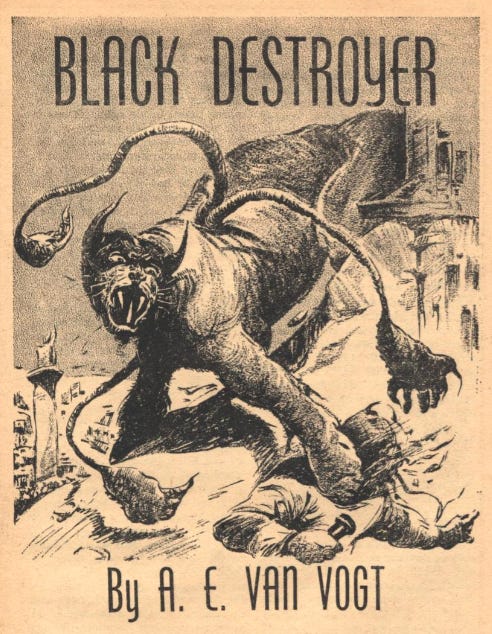
A.E. van Vogt’s “Black Destroyer” is possibly my single favorite story in the collection, and I will tell you why it matters beyond its intrinsic quality. “Black Destroyer” was the opening salvo of what would eventually become The Voyage of the Space Beagle. The creature at the center of this story, the Coerl, is a hypnotically intelligent predator that stows away on a starship and begins hunting the crew one by one. The story is the direct ancestor of at least two major science fiction franchises. Ridley Scott’s Alien takes parts of “Black Destroyer” adds a huge budget and a more rigorous commitment to dread to wonderful effect. The acid blood is in the story, but Scott subverts the scientific expert by his use of the replicant as traitor to the crew to wonderful effect. Alien is a New Wave, or even proto-Cyberpunk, response to “Black Destroyer.”
The Enterprise and her mission in Star Trek rhyme structurally with the Space Beagle and hers, up to and including invisible energy shields and encounters with god like aliens in other stories. The influence was direct enough that van Vogt pursued legal action and reached a settlement after the airing of the episode The Man Trap, something I mentioned in an earlier Geeklinks. Beyond the salt monster, which in van Vogt’s consumes potassium, Spock’s science officer almost screams to be compared to van Vogt’s Elliot Grosvenor whose Nexialism is akin to Spock’s Vulcan Logic.
This is not to say that Scott’s film, or Star Trek, are mere imitation. There are each masterpieces on their own terms, that go beyond van Vogt’s storytelling. I do think it is worth knowing where the template was cast.
For the tabletop gaming reader, I have to point out that the Coerl is also the direct influence behind the Displacer Beast in Dungeons & Dragons. The monster that appears in your fifth edition Monster Manual traces a lineage back through Gary Gygax’s Monster Manual (1977) to van Vogt’s story in 1939. This is one of those chains of influence that reminds you how much of gaming’s DNA was grown in soil that the pulps prepared.
The Atomic Era: Hope and Despair
Adventures in Time and Space arrived in 1946, the editors point out that this is one year after Hiroshima and Nagasaki, one year after the end of the Second World War, one year into the Atomic Age. The Science Fiction that Campbell had been publishing in Astounding was hopeful, but it also discussed the Atomic Age and Atomics. Campbell’s future posited nothing but optimism in the Atomic future, but the reality was much darker.
The anthology arrives at exactly the moment when that bright future had begun to become dread and fear, so it was brave to put it forth and demand that it receive literary recognition. That recognition was slow to come, the academy is as resistant to updating its reading lists as Kuhn’s depictions of scientists in The Structure of Scientific Revolutions. The old liteary guard always fights hard to keep from being displaced, but fight as they may they will always be incorporated. The key for us as readers is to make sure that we revisit the past enough to ensure that worthwhile things that had been pushed aside can be remembered.
A Note on the Modern Library Edition
I mentioned that I own the 1957 Modern Library edition, and I want to say something in its defense as a physical object. Modern Library editions of this era have a specific gravity to them, not just in the literal sense (they are substantial books, properly sewn and bound) but in the sense of cultural weight. The Modern Library imprint, by the mid-1950s, was the American literary canon in portable form. Having Adventures in Time and Space in that series was an argument made by the publisher’s catalog as much as by the editors’ introduction. It’s like owning a Library of America copy of the book and I think this volume deserves one. Certainly, they’ve published enough Science Fiction authors…and many that are in this volume.
If you can find a copy, and used book stores in cities with good science fiction communities sometimes surface them, it is worth having. Erik Mona and the Paizo Planet Stories line made a valiant effort to bring pulp-era science fiction and fantasy back to print in handsome editions before that line went on hiatus, and I remain melancholy about the books that didn’t get made in time. A Planet Stories edition of this anthology, with artwork from their stable, would have been magnificent. The Coerl alone deserves a proper illustration.
The Tradition That Came After
The Campbellian era ended, as all editorial eras do, but it didn’t disappear. It became the water that later science fiction swam in, sometimes consciously, sometimes without knowing it. When we talk about “hard SF,” we are talking about the tradition Campbell cultivated. When we celebrate science fiction for its capacity to think seriously about ideas, we are celebrating something he helped make possible. It has recently seen revival in authors like Andy Weir, but these authors are more celebratory of all kinds of people and not just the feisty engineer. The heroes of modern Campbellianesque fiction are far more humble than those of the Golden Age.
The stories in Adventures in Time and Space are not equally strong. Thirty-five stories is a large sample and some have aged better than others. The best of them, Heinlein’s, Moore and Kuttner’s, Campbell’s own “Who Goes There?”, Asimov’s “Nightfall,” van Vogt’s “Black Destroyer,” are as good as science fiction gets. They reward reading and re-reading. They reward thinking about.
Much like Carter’s Adult Fantasy series brought fantasy’s foundational texts into print for a new generation, Adventures in Time and Space deserves a place on your bookshelf as a working document. It is not just a historical artifact, but a live argument about what the genre is and what it can be.
The argument holds up. So too does Carter’s, but that’s a discussion for another time.
Yes, I know I like that word blame my friend Dennis for introducing it to me many years ago.
I think my favorites from this anthology are “The Proud Robot” and Campbell’s own “Forgetfulness.” Thanks for writing this. Very thorough and well-argued.