


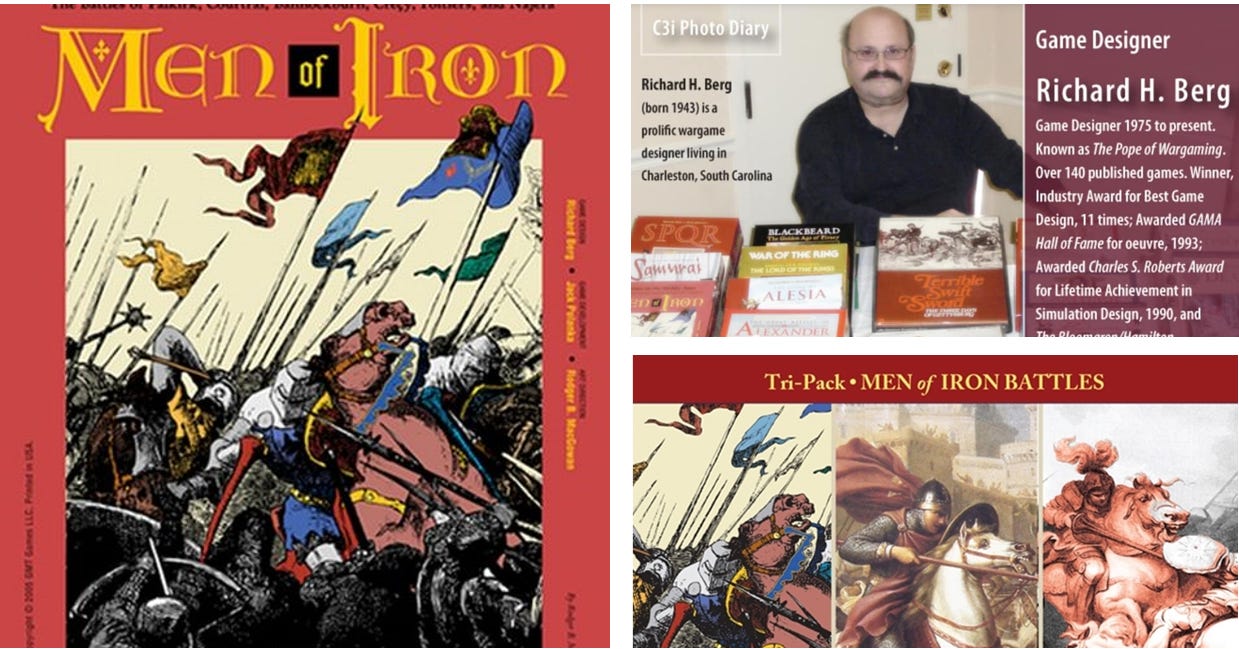
A Sad Reminder Prompts a Review
I often say that birthdays are the best time to be on Facebook. If you are feeling a bit down, the influx of hundreds of people wishing you a happy birthday can be a wonderful tonic for the duldrums. The same is often true of other people’s birthdays. Sending wishes to someone you care about and seeing others share their own positive messages gives a wonderful sense of community. There is one situation that muddies this process though and that’s when someone you are friends with on Facebook has passed away. Then the birthday notice you get from Facebook is a reminder of a a friend that is no longer with you. That can be heartbreaking and I feel a little heartbroken today.
I’ve been playing table top games of all kinds for over three decades and during that time I’ve befriended many game designers, some in person and some online. On of my favorite game designers was Richard Berg. He designed many excellent wargames during the heyday of SPI and was a knowledgeable critic whose reviews could skew on the “mean” side. He had strong opinions and he did not hesitate to share them. I got to see these two factors on display frequently after I befriended him on Facebook. Every time I would post about a superhero game I liked, he would remind me that I was being childish in my enjoyment of “fascists in pajamas.” He never missed a chance to use that phrase and if he was still with us, I’m sure he would have written that as a comment to yesterday’s post about modeling Shape Change in super hero role playing games. I was shocked, and a bit hurt, the first time he wrote it, but as time passed I realized he wasn’t judging me for my love of the genre, he was just sharing his very strong opinion in very stark terms. Once I got used to his rhetorical style, I began looking forward to these posts.
I was reminded of his crankiness earlier this morning when Facebook did its thing. You see today would have been Richard Berg's 83rd birthday. He was born March 10, 1943, and died July 26, 2019, and the wargaming hobby has not yet fully reckoned with the size of the hole he left. The Facebook reminder proded me into looking at my drafts to see if I had any Berg articles on backburner and I had a couple, so this seems like the perfect occasion to finally share a review of one of my favorite Berg designs, Men of Iron. It’s been languishing in my drafts for too long and it’s time for it to see the light. As is usual for my articles, this will be more than a capsule review. This will be a full analytical review because Berg deserves more than a quick review. After all, if he can spend the time to design The Campaign for North Africa, a game that can take more than 100 days to play, I can write a decent review of one of his more accessible games.
My Wargame Review Philosophy
As you might guess, coming from someone who has an entire series of reviews on “Strange Licenced Role Playing Games,” the way I think about wargames might be a little different than some other reviewers. I come at wargames appreciating that they all have to take what Richard Berg called the “Candide Approach” to design (Moves Magazine #26 page 27, 1976). Essentially, every wargame has to:
Allow the ‘player-gamer’ to have a few hours of relaxing fun.
Provide the historian with insight into the particular subject.
Allow the ‘assassin,’ the killer-gamer, to vent his spleen on his opponent by revealing The Master Plan which will not only destroy his opposite number, but History as well.
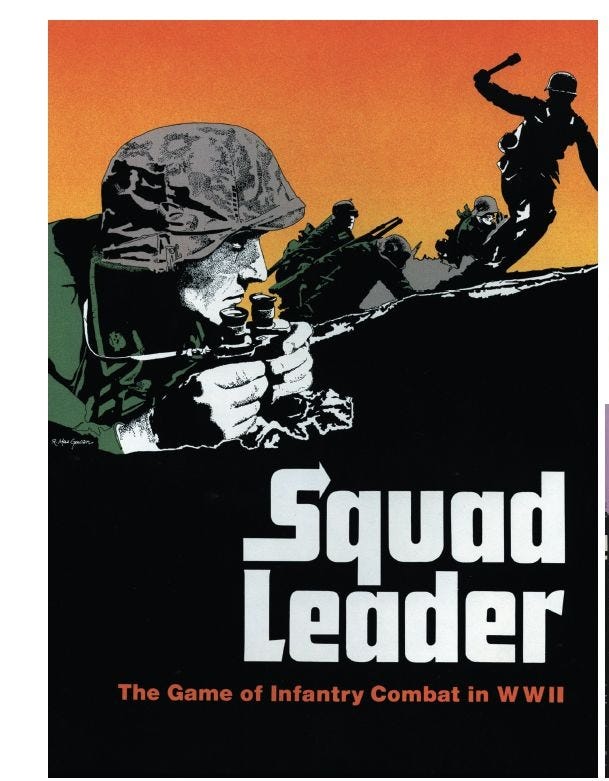
I understand this tension, and that few if any games actually discover the Goldilocks balance, so I ask one question of every wargame I pick up. I don’t ask “is it historically accurate?” or even “is it fun?” Those things matter, but they’re part of a more fundamental question "How does it meet Berg’s Candide Principle?” While I’d known about Berg’s principle for many years, I only came to fully appreciate it after I read John Hill’s design notes for Squad Leader. In those notes, Hill provides one of the most honest pieces of the challenges of game design I’ve ever seen committed to print. Hill wrote that throughout the design of Squad Leader, high emphasis was placed on playability, and that to capture the fluidity and unpredictable nature of infantry combat while retaining that playability, he centered the design around “abstraction.” This is a technique where the designer is not as interested in what actually happened as in the effect of that event. Once you center your thinking on effect, Hill argued, the possible outcomes on the infantry battlefield turn out to be quite limited, no matter how chaotic the inputs. If you focus on the effect of the event, you can appease the gamer, the historian, and the killer gamer.
So that’s the lens I bring to every wargame I sit down with: not “did this recreate the event?” but “did this recreate the effects that made the event historically significant?” Does playing a game, even one with a model that is incomplete, abstracted, and by necessity wrong in many ways, give me a better understanding of why things happened the way they did?
Men of Iron and the Why Question?
In his opening paragraph to the Men of Iron rule book Berg telsl us that he designed this game, the first in a series of games, to provide an answer to why the 14th Century “saw a revival in the supremacy of foot troops, using defensive tactics and missile weapons, against the massive power of charging, heavily armored cavalry.” He wanted to make this historical argument in a way that was accessible, fast playing, and fun. He was aiming for a Candide moment and he succeeded wonderfully.
Richard Berg’s Men of Iron, was originally published as a stand alone game that he hoped would be the first in a series of games from GMT Games. His hopes were rewarded and the game is now available in a Tri-Pack second printing that includes two of the game’s sequels: Infidel and Blood & Roses. Today’s review focuses on the base game and its Battle Book which covers Falkirk (July 22, 1298) through Najera (April 3, 1367) as well as the battle of Agincourt (October 25, 1415, “St. Crispin’s Day”) that was published as an expansion in C3i magazine. This is because each of the games makes an argument for why certain troops were more effective in different eras and each era of warfare deserves its own article. I’ll get to Infidel and Blood & Roses, as well as Arquebus which I think you can guess what that’s arguing, another time.
As I mentioned above, the subject is the re-emergence of infantry in medieval European warfare, because prior to Falkirk heavy mounted knights were effectively the weapon system that ended arguments on the battlefield. William Wallace’s use of pikes at Stirling Bridge and the Flemish invention and use of the Goedendag at Courtrai in 1302, when Flemish foot soldiers sent the elite French chivalry home in pieces, demonstrated that the long conversation of destruction that was military strategy was taking a new turn. Men of Iron puts that transition at center stage, and the design choices Berg makes reflect that historical argument at every level.
What the System Gets Right
Berg’s great achievement in Men of Iron is that he took Hill’s abstraction principle seriously and applied it to a different dilemma, that of medieval command and control. This was an era where unit to unit communication was difficult which increased the Clausewitzian friction within battles. Hill’s Squad Leader modeled the unpredictable nerve and skill of individual squads at a very microscopic level. The leaders Hill examines are in command of only a few troops. In Men of Iron, Berg modeled much larger combat affairs and needed mechanics that demonstrated the near-impossibility of getting a medieval “battle” (what units are called in Men of Iron) to do what you wanted it to do, when you wanted it to do it, in the right order. While you always have to worry about morale in combat, in the medieval period you have to wonder if the other units can even receive your orders at all. Knights can not easily hear your orders across the battlefield. Schiltrons did not move quickly and no one had a radio.
The activation system is the heart of Berg’s design. There are no turns in the conventional sense in Men of Iron. The player who gets to act first is determined by the scenario and the game begins with a Free Activation where the player can command one Battle to take actions. Because this is a free action the Battle can move and fight without any activation roll being required. After that Free Action, you pick a new Battle and must roll against that Battle’s leader’s Activation Rating in order to keep the momentum going. Some leaders are better than others and there is a cumulative penalty that climbs with each successive successful Continuation roll. Even if you are on a hot streak, your momentum eventually burns itself out. At any point during your Continuations (but not during your Free Activation), your opponent may attempt to “Seize the Initiative” by making a roll with their own units and the acting player is not able to reseize the initiative until the other player has acted. This mechanic is changed in the second edition where each player posesses a number Seizure Counters determined by the scenario that limits the number of times they can sieze the initiative. Given how chaotic things could be in the first edition, this was an excellent rules change that decreased time required to play a scenario. In Men of Iron, the tension isn’t just tactical it’s built into the procedures.
This is a perfect application of Hill’s abstraction principle. Berg is not modeling what happened in the command tent at Bannockburn. He is modeling the effect of medieval command limitations, the stutter-step rhythm of a battle where momentum could shift not because of tactics but because the wrong lord got his feelings hurt and refused to advance on schedule or the French Nobility drank too much wine before Agincourt. The mechanism is artificial. The effect is historically honest.
The Battle Book as Design Argument
What makes Men of Iron worth studying rather than just playing is the Battle Book, where Berg’s design philosophy becomes explicit. Each battle (as opposed to Battle) is provided as supporting evidence for the main thesis of Men of Iron that changes in weapons and tactics made heavily armored cavalry less effective in this era.
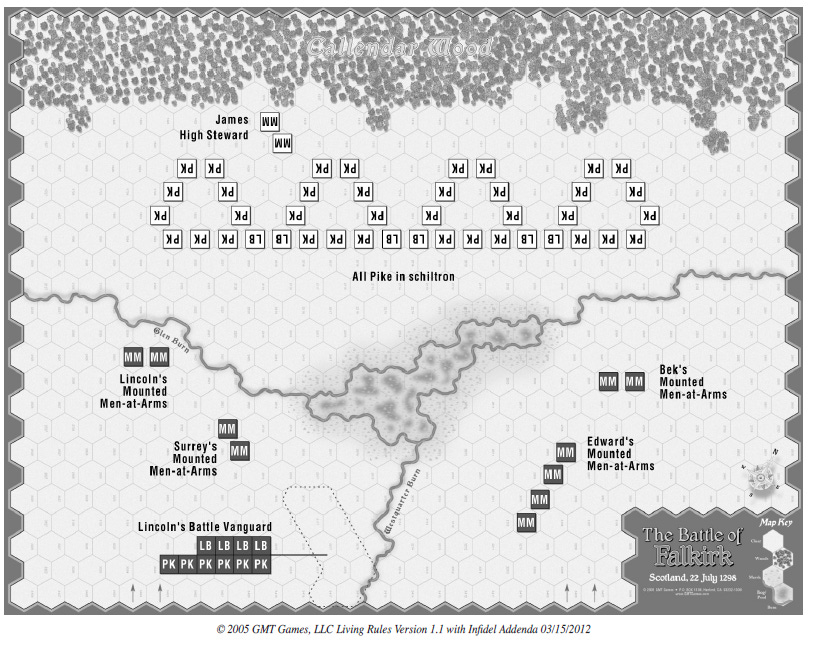
Falkirk is a wonderful example of this principle. Berg’s design note states flatly that the Scots pike formation “was basically immobile (until it broke and ran)” and that in the historical version, “it is almost impossible for the English to lose.” Edward I had analyzed why Surrey lost at Stirling Bridge and he shifted to a more flexible army of footman to combat Wallace’s pikemen. The immobility of the pikes makes this a great solo scenarion and Berge offers the non-historical variant where the Scots can actually maneuver for those who want a competitive two-player game. That’s a designer making a choice Hill would recognize immediately. In Falkirk, the effect being modeled is Edward I adapting to the new realities of the battlefield, and the scenario is structured to generate that effect rather than to pretend the battle was closer than it was. The historical Falkirk is practically a proof-of-concept demonstration. Wallace’s schiltrons are formidable against cavalry, but they were also immovable and this ultimately doomed them because they were not fighting mounted troops. The game doesn’t soften that.
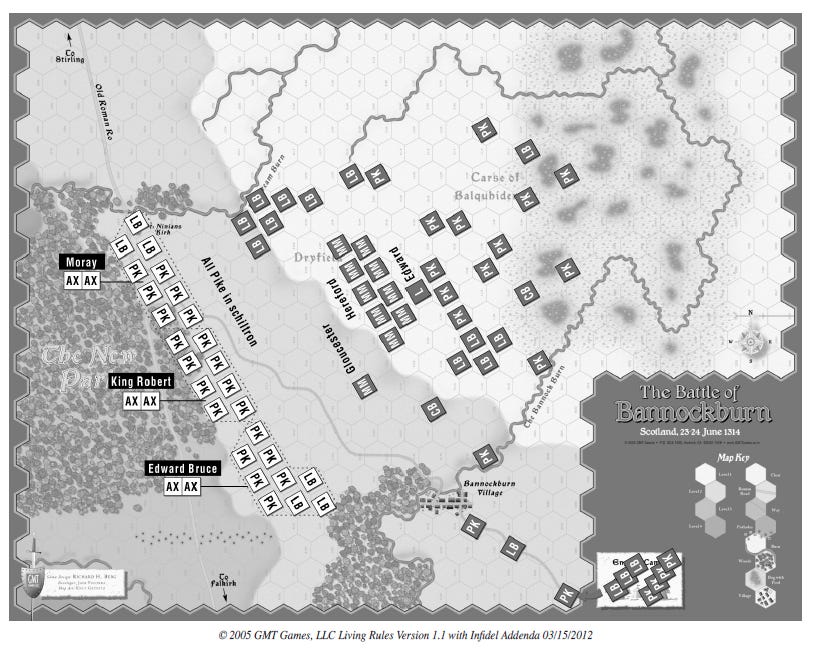
Bannockburn shows the same principle working in reverse. Berg’s historical note for the English army is a small masterpiece of design thinking in miniature. The English foot spent the night in a marshy bog and arrived straggling and disordered, so the rule is that all English pike start the game Disordered. Because he’s making an argument about a real event, he doesn’t have you “roll to see if your pike is disordered.” He doesn’t provide a card that represents exhaustion. Instead, all of the English foot begin Disordered (which is essentially wounded in the system). Starting with that vulnerability provides Edward II with a major challenge. The effect of a brutal Scottish summer night on an army that had been marching hard is folded entirely into counter state. You never model the night. You feel its consequences in the morning, and this time against an army lead by Robert that has learned that in foot battles it’s good to have some Axemen to do the dirty work.
Other scenarios model different effects and innovations with Cortrai having sepcial rules for Goedendags.
Starting Points
If you’re new to the system, start with Falkirk. It’s a very straight forward scenario that is designed for ease of play as a solo experience. The best way to learn a game is to play it and Falkirk lets you play it before you try to talk one of your friends into coming over to play Bannockburn. Besides, if you play Falkirk solo as the Scots you’ll build up enough resentment at having been crushed by the English that you’ll play with all your cunning and skill when your friend plays the English at Bannockburn. On second thought, if you want your friend to play again, you might want to play the English instead and let your friend win.
Bannockburn is the scenario I keep coming back to, because the English need to solve a problem that historically proved insoluble, and watching the game generate reasons why is very interesting. The combination of disordered pike, an activation system that punishes overreach, and terrain that neutralizes the cavalry produces emergent narrative that no amount of scripted rules could replicate.
Berg’s Legacy
Richard Berg died July 26, 2019, and the wargaming hobby is genuinely poorer for it. He was, by any measure, one of the most prolific and historically serious designers the medium produced, and Men of Iron is among his most accessible work. He has a couple of games that are more accessible, but this one has a very good balance. I know that it can be intimidating to those not familiar with “map and chit” wargaming, but it is relatively accessible given the complexity of many games in this hobby. Compared to Great Battles of History or SPQR, this is practically a gateway game on a par with Candyland.
Hill wrote that the results of a mistake in infantry combat were immediate, a group of bodies lying motionless in the street. The medieval battlefield was not so different. Berg understood that the designer’s job was not to put those bodies on the table one by one, but to build a system where the conditions that produced them could emerge through play.
The system’s core argument is that medieval warfare was fundamentally about the interaction between troop types, and that the emergence of disciplined infantry changed the calculus of that interaction in ways that reshaped European military and eventually political culture. Berg was able to masterfully use the design to communicate this argument through the mechanisms it used to emulate battle rather than in spite of them. You don’t just read about why Agincourt mattered. Instead, you can watch a French army attempt to move towards English longbows only to pay the price and you understand their effect in this battle.
That’s abstraction working the way Hill said it should and a game that achieves the rare Goldilocks effect.
Happy birthday, Richard Berg and Rest in Peace knowing that you have a wonderful legacy.
The Men of Iron Tri-Pack is available from GMT Games. If medieval warfare is even adjacent to your interests, it belongs on your shelf and more importantly on your table.
Christian Lindke writes about games, film, and whatever else demands attention at Geekerati Media.
Never got to meet Mr Berg but grateful for this run through of some great games et al