


Movies “About” Gaming: A New Article Series on Geekerati.
Hello everyone. Sorry that it’s been a little while since I have written a post here on Substack, but I am “this close” (read very close) to having my dissertation finished and my defense scheduled. I still have a couple of hoops to jump through before I’m ready, but I’m now very much in deadline mode. I’m pretty happy with how my research chapters turned out and am (eagerly?) awaiting editorial critiques from my dissertation chair that I will incorporate as fast as possible. Soon, I will be Doctor Lord Christian Lindke, or at least I will be after my wife purchase that small plot of land in Scotland as a graduation gift. A gift that fits both with my (slight at 5%) Scottish ancestry and the fact that UC Riverside are the Highlanders by God (and yes, I have an official UC Riverside Kilt which is a registered tartan).

Even though I haven’t been writing as much as I’d like, I have been thinking about new post ideas that fit with my regular (and growing) readership. One topic that hits the intersection of a lot of your interests is how gaming has been represented in film and television. It connects with discussions of the Satanic Panic (and moral panics in general), movies, television, and role playing games and that intersection makes it an ideal choice for a series of articles. It will let me write about films like Mazes & Monsters, ET, and the five official Dungeons & Dragons movies as well as television shows like Stranger Things and the old ITV spy series Callan (which is a must see for fans of Slow Horses).
Don’t worry. In addition to this series, I’ll be continuing all the other article series I write (and bringing back the Weekly Geekly) and writing about gaming in general. This is an addition, rather than a replacement. Oh, and in case you are wondering, I am in the process of working on my film reviews of the 1980s action film Megaforce, a film that was intented to start a franchise, and the highly misunderstood and underappreciated Sylvester Stallone directed film Staying Alive. Megaforce will come first, but there’s the pretentiously anti-pretentious part of me that really wants to get that Staying Alive review out soon. It’s the Rocky III of movies about broadway dance productions and it will be defended!
Why Begin this Series with Dragon*Strike?
As you all have figured out by now, I am one of those crazy types who spends weekends in muggy rooms “adventuring” in worlds beyond imagination. That’s right...I play role playing games. Worse than that, I am not only a fan of the well known Dungeons & Dragons, but am a long time “Forever-GM” who has run numerous game systems for a lot of different gaming groups. I am as comfortable running game sessions of Tails of Equestria, the My Little Pony The Storytelling Game (not to be confused with the more recent My Little Pony Role Playing Game) as I am running sessions of Shadow of the Demon Lord (on the horror/body horror end) or GURPS (on the mechanical complexity end). For the record, I think Tails of Equestria is a better introductory role playing game for young people and it’s better for introducing game mechancis beyond the d20. Having given that caveat, I will say the new Renegade game is very good. I’ve run short one shot campaigns and I’ve run a campaign that lasted over a decade before it ended in an “Oerth shattering finale.”
In fact, I still get mildly annoyed when people call the adventure paths sold by Wizards of the Coast or Paizo “campaigns” instead of adventures. In my mind, a campaign is an ongoing experience that potentially covers many lifetimes of player characters where the players see their characters live and die (sometimes of old age) and where there is always another story to tell, even after the last one ended. The only time I “end” a campaign is when my groups decide that they want to move on to a new game system, though I only put the game “on hold” if there is any suggestion that they will ever want to come back to that older system at some point in the future. You can always hit pause on a world. Of course, the distinction between adventure and campaign is a discussion for another post. This is a post about TSR’s attempt to use a “movie” to teach people how to play a role playing game.
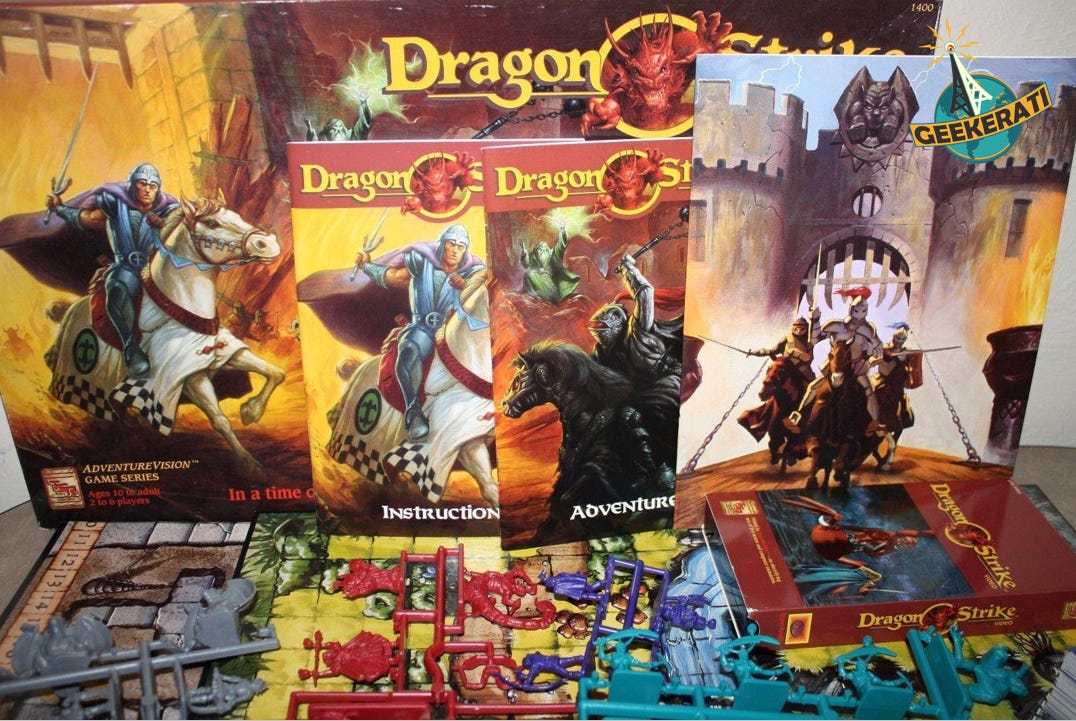
It has long been a ritual in my gaming groups to have new players watch the how to play RPGs film Dragon*Strike which accompanied a D&D adjacent board game of the same name. Dragon*Strike was directed by Flint Dille and stars Deron McBee (aka Kid Fury, aka Malibu on American Gladiators) as the Warrior. It’s an interesting combination of narrative film and intro-documentary in role playing game concepts.
The film was produced during a time when TSR was attempting to expand their brand beyond role playing games and into other aspects of popular culture including comic books and audio adventures. It was during this era when TSR pushed forward with their “comic modules,” which was there attempt to produce comic books without violating their licensing agreement with DC Comics who were producing several Dungeons & Dragons based comic books at the time (Advanced Dungeons & Dragons, Forgotten Realms, and Dragonlance). As Benn Riggs documents in his book Slaying the Dragon: A Secret History of Dungeons & Dragons, that attempt failed and the publication of these comic modules resulted in DC Comics ending their partnership with TSR. That would have been fine, and “a part of the plan,” had the comic modules succeeded, but they did not connect with audiences and ended up costing TSR a lot of revenue in the end.
The comic module project was headed up by Flint Dille who wanted to wanted to leverage his own experience working in the film and television industry in expanding the reach of TSR’s (and his family’s …but more on that in a minute) creative assets. Before I discuss Dille’s family connection to TSR and muddy the discussion, it deserves mentioning that prior to any connection with TSR Dille had done significant work on the Mister T, GI Joe and The Transformers animated series. Flint tells his own side of the story in his autobiography The Gamesmaster and it’s very much worth a read and add context to a lot of the criticism Riggs throws his way. From my point of view, Dille made some bad business decisions, but he was genuinely passionate about his geek projects.
Flint Dille is the brother of Lorraine Williams, who went on to become the head of TSR after what Jon Peterson calls “The Ambush at Sheridan Springs.” Gary Gygax worked with Flint Dille in the early 1980s to promote Dungeons & Dragons in Hollywood (they co wrote a treatment for a D&D movie) and when his control of the company came under attack by the Blumes, Dille connected him with his sister Lorraine and Gygax hoped to use her investment to save the company and help him retain control. That ended up backfiring on Gygax as Williams used the opportunity to take majority control of the company, a situtation that resulted in Gary Gygax leaving the company. Where Gygax had hoped to undo some of the damage the Blumes had done to the company, damage that had resulted in several employees leaving to form Pacesetter games in 1984, he instead ended up completely transforming the company and the role playing game hobby for generations to come.
The Williams era is one filled with controversy for a lot of fans, but it is also a golden age of creative production. That golden age includes Planescape and an excellent Buck Rogers role playing game by Mike Pondsmith…yes, that Mike Pondsmith. Ben Riggs book does a good job of balancing the poor business decisions of the era with the absolutely peak creative content being published. I, and I’m rare in this, think Williams gets a bit of a bum rap, but the comic modules and Dragon*Strike projects are perfect examples fo where her personal goals and the financial needs of the company did not align. The Dille family controls the Buck Rogers intellectual property and Williams was looking for new ways to get people excited about the property that made her family rich. This included the publication of comic books and DC was very luke warm on the prospect of publishing a Buck Rogers comic and so Flint Dille and Willims decided to produce their own comic. They wanted to do so in a way that didn’t anger DC, but they failed big time. They also wanted to get people excited about D&D as a “movie” property and the production of the Dragon*Strike video was more than just a “how to role play” video, it was a “this is how easy it is to make a fantasy film” video, but that project failed too and the expense of these two endeavors (as well as the Dragon Dice game) were major contributors to the collapse of TSR as a company.
Lorraine Williams and Flint Dille had their own ideas about how to expand the Buck Rogers and D&D audiences, but they were wrong about the how on both accounts. Due to their personal connection with the Buck Rogers property, this has created a lot of resentment by some fans. The treatment of the book publishing staff and writers by Williams alienated others. The publishing end of TSR was doing everything Williams wanted the company to accomplish. They were expanding the brand and selling books hand over fist and yet she refused to give royalties and negotiate fair contracts with the very talented team. Her dismissal of creative talent is counterbalanced by her kindness toward William Connors (whose wife faced serious health issues) whom she continued to pay even as he could barely work for the company. A good interview with Ben Riggs and Kenneth Hite discusses the Williams legacy in pretty good detail. Kenneth makes a nice pro-Brontë connection to role playing in the discussion.
Long story short, neither Williams nor Dille were properly business minded to keep the company in business, but Dille was sufficiently creative minded (in both the comic modules and Dragon*Strike) that he made some really cool stuff…which brings me back to Dragon*Strike.
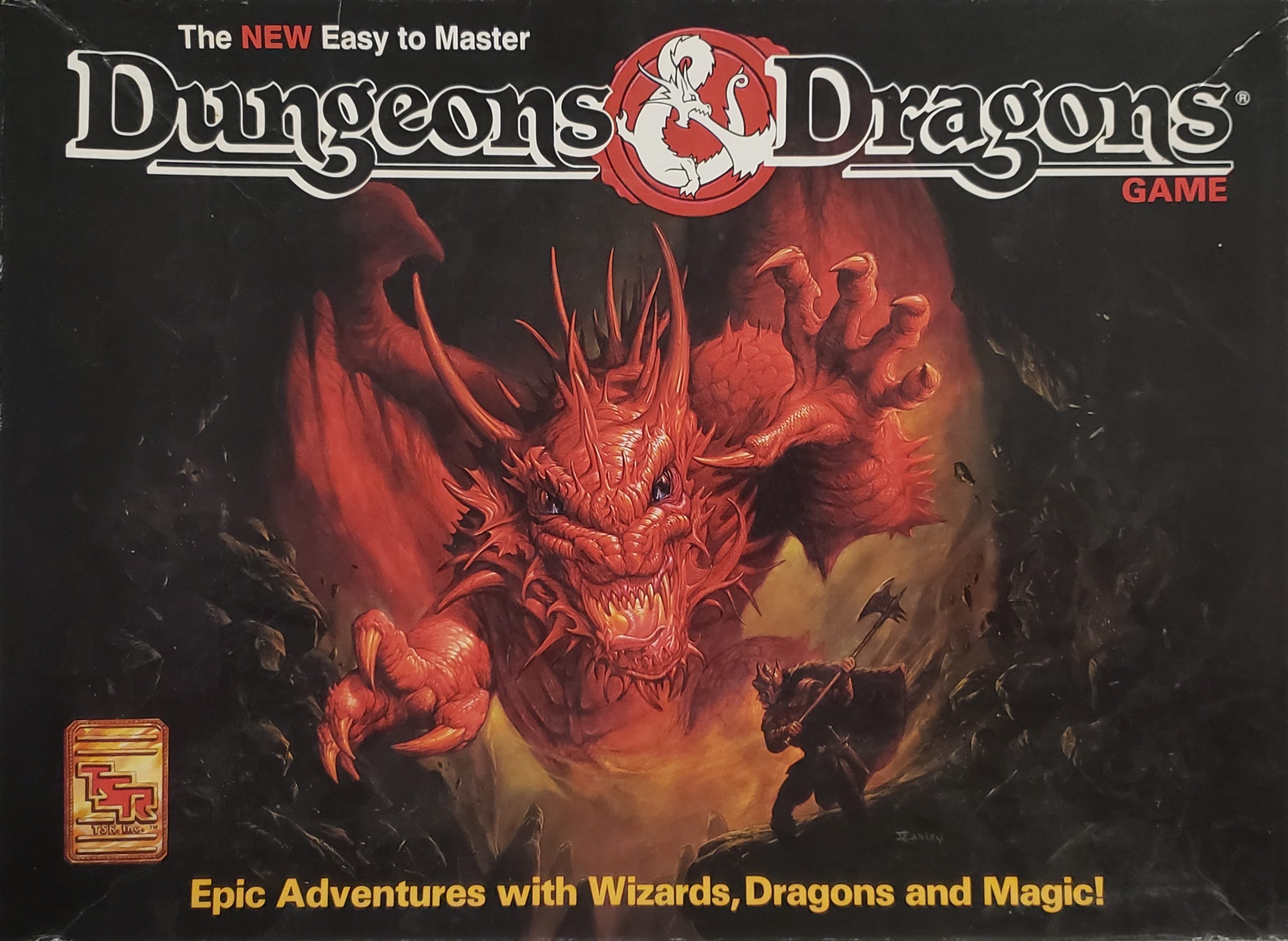
This movie is an interesting artifact of gaming in the early 1990s. Traditional Fantasy based role playing had plateaued and was being challenged by heavily technical games like GURPS, the emerging Goth Gamer crowd (thanks Vampire: The Masquerade), and Magic the Gathering. TSR was looking for a way to recruit gamers into traditional Fantasy gaming and one of the places they looked was academic pedagogical literature and the two products most influenced by this examination are the Dungeons & Dragons Black Box Basic Set and Dragon*Strike. The Black Box incorporated “learning cards” that were similar in approach to educational materials teachers use in Pre-K to 3 education, and in 12th grade grammar courses.
Dragon*Strike incorporates a different pedagogical approach and under the guise of being a “how to play” the game video ends up being a fantastic “what is a role playing game?” video. In many ways its an amateurish film with scenery chewing acting, poor special effects, and poor sound design, but it is also a film that accurately presents what role playing games are and can be. This is a movie that shows you what gaming looks like and does a good job of introducing the hobby as it was in the early 1990s.
Over the years, and much to the annoyance of my players, I have made watching this movie a requirement of playing in one of my home based campaigns. I don’t think my players would be annoyed if they had to watch it once, but having to watch it again and again as new people come into the group is a bit much. I, for one, am a big fan and watch it at least twice a year just to recharge my “I want to play D&D” batteries. Oh, and the game is fun too, but that’s a topic for a game review post.
If this was mandatory watching for a game I was about to join, I would be pretty excited.