


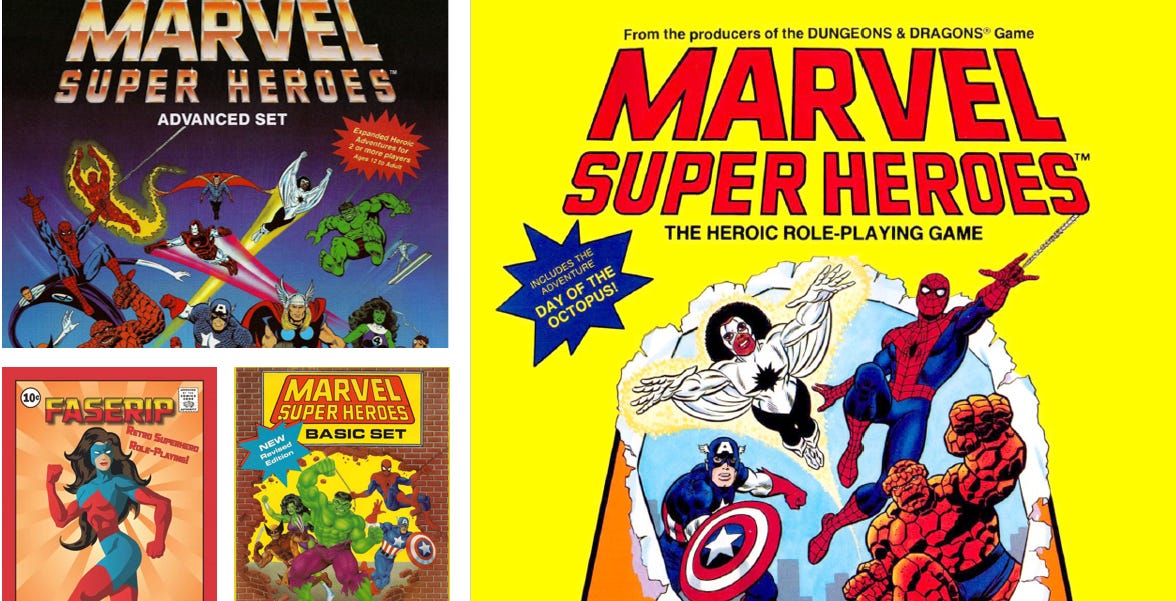
Longtime readers of Geekerati Media know that I have long been a fan of Superhero role playing games. It is my absolute favorite roleplaying game genre and I have yet to find a superhero game that hasn’t inspired me in some way as a game master, designer, and player. While there was a time when I could claim to “own every Superhero RPG in print,” those days have long passed into memory. Now, there are so many independent games that it is nigh impossible to keep up with them all. I’m sure there is someone who has managed to “collect them all,” but it’s not me.
Nevertheless, I still own a very large selection of Superhero RPGs that ranges from Superhero 2044 to DC Heroes to the new Invincible RPG (review coming soon), but there are so many Superhero games out there that it is hard to keep up. I’ve read all of the games I own and have played most of them, but there are a few that stand out as able to withstand the test of time. Among those games that I return to again and again is the Classic Marvel Superheroes Roleplaying Game which uses the FASERIP system. The system has a lot of fans, and I’m one of them, but the FASERIP system isn’t perfect and can break down a bit when trying to run an Avengers style lineup facing Avengers style foes. It really struggles with Champions or Defenders style play. Unless you add the Advanced rules, street level heroes have to stay to the sidelines. With those rules, street level (and slightly tougher) characters matter a bit more but are still pushed to the sidelines. There is a reason that Mike Selinker took the approach he did when designing TSR’s next Marvel game (Marvel SAGA). He wanted Cap to matter, and he never really seems to matter as much as I think he should in FASERIP Marvel.
This very small flaw is easily addressable with House Rules, and the overall system is very flexible. In fact, it has quite a few “genius moments,” and is great for getting people gaming quickly. There is almost no learning curve to begin playing the game and it has enough depth that players continue to learn how to bend the system in ways they never imagined possible. This is particularly true with the Advanced version of the rules, but it’s also true of the core set. One key mechanic is the Karma experience system in the game. You get experience (Karma) for behaving heroically, as well as for actually paying attention to your secret identity and your character’s personal life. This experience can be spent to perform better in combat, and one of the ways that Street Level heroes actually excel is that they tend to have more Karma because they tend to have more responsibilities in their private lives. They are the characters who worry about paying rent, and making a work deadline can net you as much Karma as punching Doctor Doom in the face…in THE FACE!
I’ve been trying to convince my daughters and their gaming group to give the game a run for a while and I think that after their recent fantastic experience with B/X (I will be writing about that) they are more amenable. FASERIP is a system that I want to use at the table, but I want to use in a modified form that is even more accessible to the modern gamer. Even though tables and charts like the one FASERIP uses were created to make gaming easier and more accessible “Back when Tigers Used to Smoke” (thanks Rebekah King for a phrase I now frequently use), they don’t vibe with modern gamers. Modern players are used to target number systems and a chart/table, even an easy to interpret one like FASERIP, is out of their normal wheelhouse.
To that end, I’ve been contemplating using a d20 based mechanic that is partially inspired by The Black Hack (which was the Shadowdark of 10 years ago). I want my d20 based mechanic to replace the Universal Table while being intuitive to modern gamers. The Universal Table tells players what they need to roll to get a basic success (green), a substantial success (yellow), and a critical success (red). The division of success into different categories is one of the “genius” moments of the game, but needing to look at the chart to see if you’ve hit the next color (for those who haven’t memorized the chart) can distract from game play.
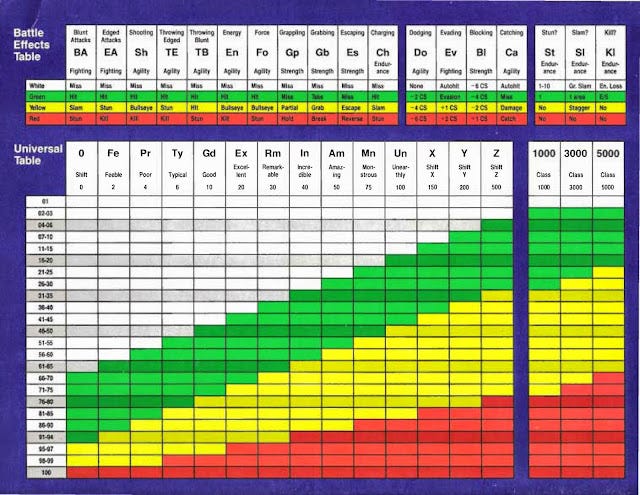
What I am thinking about doing is taking the character ratings on the chart (which are the names and numerical values of characters’ attributes and powers) and assigning them a Target Number in a range of 1 to 20. As with The Black Hack, players want to roll equal to or less than that number to succeed. Now here is the twist, in the House Rule I’m thinking of adopting, players will roll 3 Twenty-Sided Dice against that target number. If one die is equal to or less than the number, it’s a Green result, if two are then it’s Yellow, and three means a Red result. The idea isn’t completely original to me and was originally proposed a decade ago by Zak Smith for his blog. One of the problems of the basic system is that it makes superheroes less superheroic.
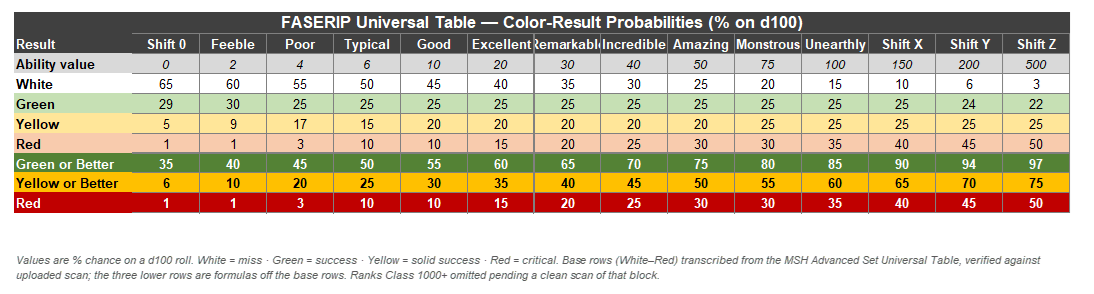

If you take a look at the basic Universal Table, you can see that a person with a “Shift 0” ability in something still has a 35% chance of achieving a Green result or better. When testing success on mundane actions, this means that even low caliber characters can push themselves from time to time when it comes to lifting weights. This allows even Street Level characters to push themselves and works particularly well when you include the “Intensities” rules from Advanced and Revised Marvel rulebooks. In a fight, this means that a person with Fighting of Shift 0 still has a 35% chance of hitting his/her opponent. This somewhat high level of success seems to match with the heroic nature of Supers gaming. The same person has only a 6% chance of some level of improved success (a Yellow or Red result). Low capability characters can push themselves, but extreme successes are rare…though not impossible.

When you look at the table above that shows the probabilities resulting from the 3d20 system, there are some interesting results. The first is that Shift 0 really sucks. It used to be bad, but now it’s pretty punishing. The second is that at the higher end, the probability of getting a Red result drift away from those of the traditional FASERIP system.
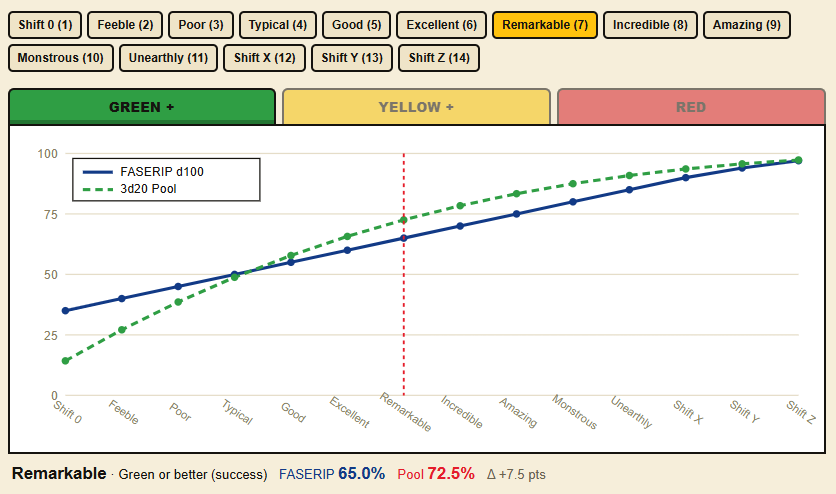
First, let’s look at the chance to succeed at all (you can look at the image below or check out the widget on the Marvel page on my personal website). There are some notable differences at the low and mid-ranges, particularly with regard to Green results. In traditional FASERIP, a character with a Remarkable Fighting score has a 65% chance of a Green result or better and has a 72.5% chance in the 3d20 system. When scores are lower than Good, characters are less frequently successful under the 3d20 system and above Good they are more frequently successful until you get to Shift Z (which is an NPC value anyway). I’m fine with that. It makes the “Street Level” heroes more impressive than they are under the regular system (when facing thugs) and the distinction between tiers continues.
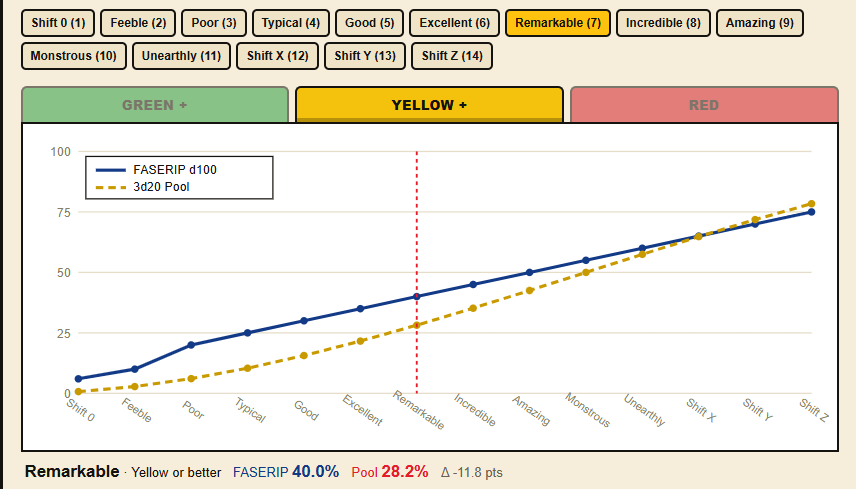
The chance of a basic success is higher, but Yellow and Red results are much more rare in the standard 3d20 system. A person with a Remarkable ability has a 40% chance of a Yellow or better in standard FASERIP, but only a 28.2% chance in the 3d20 system. That’s a reduction of 11.8% and means that the system is pushing heroism down, at least for Street Level characters. They have a higher chance to succeed at the baseline, but a lower chance of “being cool.” That’s not the feel I want for the system. In fact, the disparity gets worse when we look at Red results.
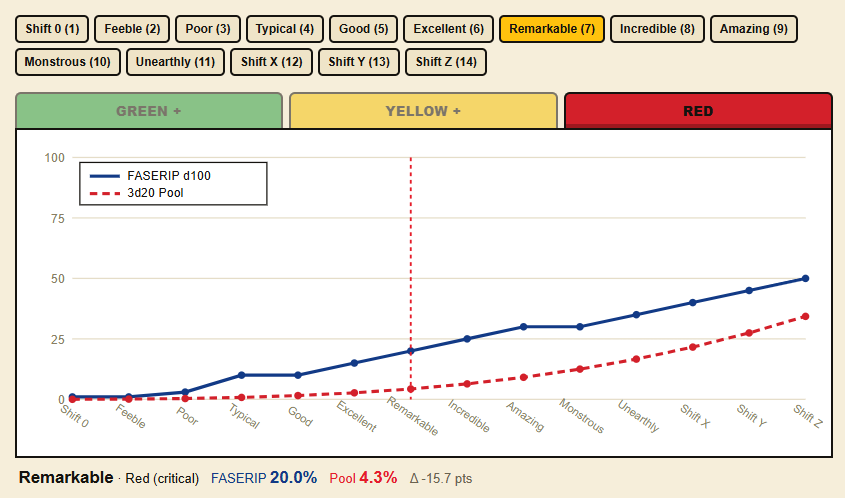
A person with a Remarkable ability in FASERIP typically has a 20% chance of a Red result. That’s a reasonable level and represents how “remarkable” a Remarkable ability score is and lets Street Level characters dominate Typical foes. That’s a good thing and that’s what FASERIP was designed to do. That is not what happens with the 3d20 system. In this simple system, the Remarkable character only has a 4.3% chance of a Red result and this gap persists as the characters become more powerful. There are far fewer critical results in the 3d20 system. If you are playing a more realistic game, that’s probably a good thing. However, I don’t think it’s a good fit for a heroic game.
So what is a game master to do? Well, I played around with a couple of alternatives. One was a 3d6 plus bonus mechanic that I kind of like and might use elsewhere, but I am fond of the elegance of rolling 3d20. So I took a page from the Year Zero Engine. In the baseline version of that system, any roll of 6 or higher is a success. The average character has d6 rank in their attributes (though they may roll more than one), but better characters can roll higher die values like a d10 or d12. In these cases, if a player rolls 10 or more then they score 2 successes.
That’s an interesting mechanic and can be tweaked to fit the 3d20 system. In this case, I decided to see what would happen if a die that rolled one half or less of the Target Number at a given level (the target levels are in the pictures and excel files above), then it would count as two successes and not one. This system aligns closely at the green level with those who are of Shift 0 to Poor rank doing slightly worse than in standard FASERIP, but with the middle and upper tiers doing slightly better. Under this system, the Remarkable character is still 7.5% more likely to have a Green or better result because the major changes of the “one-half equals two successes” modification has the greatest effect on Yellow and Red results.
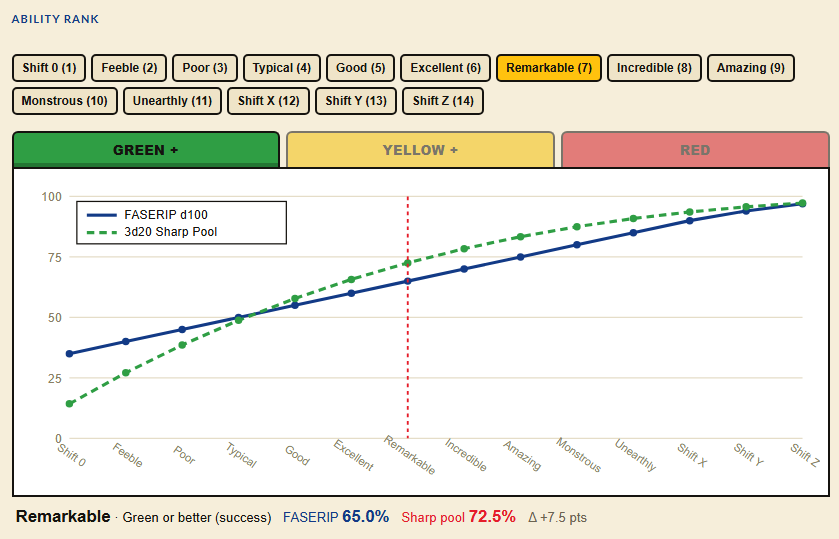
This heroic trend continues with both the Yellow or better (with a 7.2% bonus) and Red result (0.4% better at remarkable and increasing from there). If Marvel didn’t have a “stutter” on the Universal Table at Monstrous they would be much closer, but the modified 3d20 roll at the Monstrous level ends up getting a Red “critical” result 10.6% more often than the standard system. This modified system makes most superheroes more likely of getting a Yellow and high end heroes more likely to get a Red. The effect is opposite of the straight 3d20 roll where everyone is less likely to get a critical roll, so the GM would have to choose whether they wanted a more realistic or a “more heroic/wilder” game. I think this demonstrates the flexibility of shifting from the percentage with a table to some form of 3d20 roll. I am still playing around with it, but I am wondering what the difference would be if you added 5 to one die (a “Marvel Die”) in a straight 3d20 roll if the character had the right talent or the GM thought the circumstances were good.
I think the system is intuitive, flexible, and works to a certain degree and I’m likely to use a modified version of it as I try to persuade my daughters to play. I might also use it for a straight adaptation of The Black Hack to the Superhero genre. There are a couple of previous attempts at Black Hack Supers (The Super Hack, The Super Hack Deluxe, and there used to be one called The Powers Hack), but none of those rules sets are as complete as I would like for a rules set intended for campaign use. The first two were written by Simon Burley, who was a co-author (along with Peter Haines) of the very fun Games Workshop Superhero game Golden Heroes, (which I should probably review in both its self-published and final Games Workshop form). Simon’s designed quite a few Superhero RPGs over the past couple of decades and I always love seeing what he comes up with next.
What I want to do is take the “roll under” system from The Black Hack as the base, as I’ve done for my simulations above, in order to have higher stats mean better results and have stats and results be the same number. As with FASERIP, I’ll likely have the damage equal to the set number but that will take some playtesting as having a “Remarkable” power do 7 points damage is very different than having it do 30 points of damage. Some of that is balanced by the fact that a Remarkable Endurance would only add 7 points to Health, but the whole damage curve is flattened at the higher end because the jumps in effect size from Remarkable (30) to Monstrous (75) is a 45 point increase in the older system and would only be 3 points more in my current system. So that would have to have real play experience to fully evaluate and that means it will have to wait until the next time my daughters and their crew are available to play. That is, unless I can find a new gaming group and now that the dissertation is finished I can begin that process.
Since I’m not one to end on a normal “summation” concluding paragraph, I might as well mention that I’m also contemplating adding the “roll x or y and add an interesting effect” rule from the Cypher System to whatever the 3d20 superhero game ends up being. The “x” or “y” in this case would be Yellow or Red results and they will allow the automatic use of some reality bending Power Stunt. I might even do a straight up mix of Cypher’s 1 - 10 difficulty range and “pool expenditure” system, since I think that would mix with FASERIP’s Karma system nicely.
Over the next few weeks, I’ll be fleshing out a full system but I will be using the 3d20 system as the base of whatever system I end up with.
Looking forward to see how it goes!