



Three years ago Professor Dungeon Master announced that July was going to be Independent Tabletop RPG Month on his YouTube channel. I’m not 100% sure that he invented the concept, but when I did a quick Google to read about it to help with guidelines for recommendations his was the first really informative link that showed up on my Daily Me (see Cass Sunstein’s excellent #Republic for what I’m on about there).
The creation of Independent Tabletop RPG Month was partially in response to all of the shenanigans and mishaps at Hasbro and because of these Professor Dungeon Master asked participants to avoid discussing the World’s Largest Role Playing Game and to focus on smaller games and creators. That’s a partially worthy goal that leaves out some very important games. This is because, as much as I really like a lot of the current batch of independent game designers, Professor Dungeon Master overlooked an equally important category of games, old and out of print games.
In my chat last year with Alan Bahr about his game Swords of Meropis, an entirely independent RPG, I talked about how when I was a kid it seemed that gamers were more ecumenical in their tastes. We were always looking for new games to play. Not just new genre, milieu, or settings, but entirely new mechanics. Even the publisher of the World’s Largest Role Playing Game at that time published numerous rules sets. There was no unified assumption of mechanical basis and I think that was a good thing. Most gamers today are satisfied with either a single game or in some venturous cases different games with similar systems.
I’m not just referring to fans of dungeons and/or dragons in this statement. Many Powered by the Apocalypse fans are more than happy to limit themselves to Apocalypse games. So too with FATE, Blades in the Dark, and it looks like it might become the case with Critical Role fans. All to rare is the modern multi-system gamer who plays DIY and Sell-Out games. I am not opposed to loving any of the games I just mentioned. In fact, I am advocating buying all of them right now and some of them will be featured in my weekly recommendations this month.
I want to make it clear that I am not not trying to shame people who feel more comfortable with their favored rule set. Time is precious and we only have so much of it. There is nothing morally wrong with limiting yourself to one core game foundation, nor is there anything morally superior about being an ecumenical gamer. Nevertheless, I do think those who focus on a single game are missing out on a lot of great experiences. When it comes to my love of a wide array of role playing games, I think it’s important to keep in mind how I am near obsessive in the breadth of the things I geek out about. After all, I discuss film and fiction genres, music, sports, comic books, video games, and pretty much anything else it is possible to geek out about on this site and in my private life.
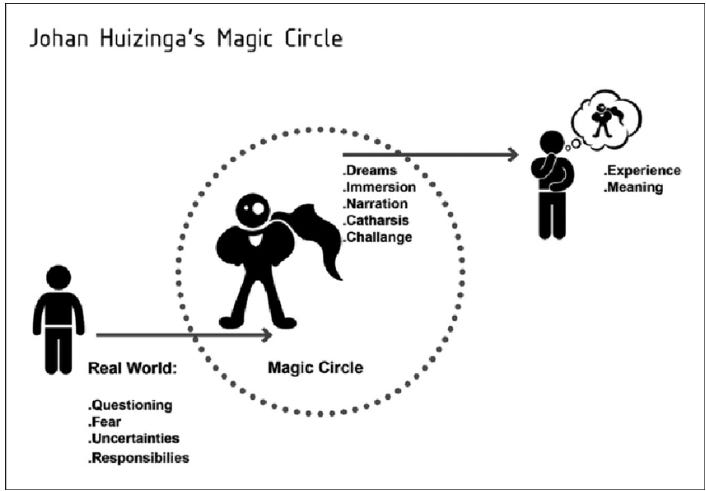
Another thing to keep in mind is that you can buy and read games outside your core game solely for the purpose of making your core game play better. A lot of wonderful ideas that improve the hobby come from smaller games that a lot of people read, but that few people still play. For example, I’ll be posting a review of Daggerheart soon, having run more than a few sessions of it now, and the way it handles initiative is steeped in both improvisation culture and in mechanics like Shadow of the Demon Lord and Warhammer Fantasy Role Play Third Edition (the one with the fiddly bits that is sadly unavailable via pdf or any other means, and fiddly bits are another feature Daggerheart shares with Warhammer 3). While Shadow of the Demon Lord has a core group of fans, I’m pretty sure that I am the world’s only fan of Warhammer Fantasy Role Play Third Edition, even as the Genesys system it spawned has plenty of fans. That just goes to show you that what works with Star Wars and Twilight Imperium doesn’t necessarily appeal to Warhammer players. Mechanics matter. They shape play and how people view what is possible within play. They are a part of Huizinga’s Magic Circle, which was articulated in his book Homo Ludens. The concept is well known, though only loosely applied, in the video game industry. The ramifications of how a space for play has its own social rules is central to so many of the debates in modern gaming, and is also central to a lot of fandom in general but that is another discussion entirely.

As with all forms of entertainment, there is more in the world worth experiencing than one can experience in a lifetime. We live in a rich world and I understand that even limiting oneself to one smaller slice of a geek topic can provide a rich lifetime of worthy pursuits with vast variety. That’s just not my vibe. I understand the value of a deep dive into a narrow area. I can talk political polarization (the focus of my career for 15 years in the non-profit sector and the focus of my Ph.D. studies) until the end of time. I also want more from the rich tapestry of life and I adore dabbling in the various corners of entertainment.
TL:DR: “It can be fun to step outside of the familiar from time to time.”
I wrote this long preamble because I wanted to highlight the fact that my lists of independent games will go beyond Professor DM’s request to promote “independent creators.” Instead, I will be focusing on games that I think are overlooked or, in the case of the out of print, forgotten. I love independent creators and support many, but if I am going to be serious in promoting things different from the familiar paths of “d20+ability+proficiency bonus vs target number” I am going to go into other systems entirely. I will still promote those creators during the month, as I’ll be talking about all kinds of games, but I will also be talking about the World’s Largest Game too at some point during the month.
What do I mean by independent games? Given that almost every RPG company is in reality a small business, with a couple of exceptions, my only defining characteristic on this is “Games that aren’t D&D or D&D adjacent mechanically.” This means that I won’t be recommending Pathfinder 2nd Edition (though I do recommend another game system that uses the setting), Shadowdark, or Old School Essentials. I really like all three of those games mechanically, but they are D&D based Fantasy Heartwarmers (that’s the inverse of a Fantasy Heartbreaker). Additionally, for me to recommend the game it must be available for purchase either physically or on pdf.
And with those caveats, let’s jump into Week 1.
1. Colonial Gothic

Welcome to the dark and mysterious world of Colonial Gothic, where the American colonial period is infused with supernatural elements that will keep you on the edge of your seat. In this game, you play a character who slowly uncovers the hidden truths and malevolent enemies lurking in the shadows, influencing events, and conspiring against the world as we know it. You can be a pastor or a witch hunter battling evil, the choice is yours.
But beware: in this world, magic is real. Creatures of the occult and supernatural exist, and they will stop at nothing to achieve their goals. As a player, you experience the thrill of the unknown, the terror of the unseen, and the satisfaction of defeating the forces of darkness. As a Gamemaster (GM), feel the excitement of crafting your many ideas and resources. So, join us in the world of Colonial Gothic, and let the darkness consume you. — Richard Iorio, Primer to Colonial Gothic 2025
I’ve been a fan of Colonial Gothic for a long time. Not only does it utilize the most underused die of all (the d12) in what it calls the 12° system, but it is meticulously researched game that is a great introduction to US history as well as a great horror role playing game. An inside joke in my family, based on our experiences watching The Patriot, Brotherhood of the Wolf, and Last of the Mohicans, is that you should never make a veteran of the French and Indian War angry.
How the 12° System Works
Colonial Gothic is a target number task resolution system that resolves every action from swinging a tomahawk and sneaking past a sentry to haggling with a merchant with one universal roll: 2d12 + Governing Attribute + Skill Rank ± Bonus/Penalty. These systems have been relatively common since the publication of Traveller in 1977. While one might argue that D&D’s game system is a target number system, that’s only partially true of editions printed prior to 3rd edition because those had “floating” target numbers that could be looked up on tables. What Traveller did was to have a core target number for all combat actions of 8+, the numbers varied on other actions in inconsistent ways in early Traveller but that core 8+ number becomes central in later editions of Traveller. What this innovation does is anchor the game mechanics to an underlying assumption of average competence. The average person in Traveller (0 stat bonus and 0 skill bonus while not being “unskilled”) has to roll an 8+ on 2d6, which gives a baseline probability of 5/12 (15 ways to roll an 8 or higher out of 36 total possible outcomes). That’s approximately (≈) 41.7%. By having the basic probability for success before skills, attributes, or modifiers, are added anchored to 41.7%, Traveller signaled that it was not a game filled with galaxy spanning heroes, and was rather one of more grit. It wasn’t one of helpless characters, but it wasn’t one of guaranteed success either.

The universal TN in Colonial Gothic’s 12° system is 12, which signals that the baseline for this horror game is relatively heroic. The mean of 2d12 is 13, so an utterly unmodified character (attribute +0, no skill) already clears a standard TN 12 about 61.8% of the time before any bonuses.The game does shift the TN for tasks that are unusually easy (TN 6) or genuinely hard (TN 24) and allows the Gamemaster to add conditional modifiers, but under normal conditions the characters are fairly heroic. As a Target Number system any total that meets or beats the TN succeeds. This “meet or beat” detail is one of the first dials that Target Number systems play with. Some systems require you to roll higher than the TN instead of equal to or greater. I’ve always thought that was odd because that’s really no different than a meet or beat on a TN value one number lower.
So in most systems, it doesn’t matter whether you use equal or greater than, or just greater than when analyzing base assumptions of the game. That’s not true of Colonial Gothic because, Richard Iorio has added a nice addition to a mere binary success/fail result. In Colonial Gothic’s 12° system the amount you clear the TN by is your Degrees of Success (result − TN). Similarly if you fail there is a corresponding Degrees of Failure (TN − result) that can be applied. Degrees of Success and Failure tend to matter most in opposed tests and combats, but they are one of the meaningful innovations of the system and give DMs a bit of guidance for how to judge levels of success. They’re what the GM scales rewards against and, in combat, what drives damage. Rolling exactly the TN still succeeds, just with zero degrees (a bare success). Skills and attribute ranks are capped at +10, and situational Bonuses/Penalties run from Instinctive (+6) down to Heroic (−6).
The last wrinkle is the effect of training. A character with at least Base Rank +0 in a skill is Skilled and rolls normally. If a character attempts something they aren’t trained with, they must make an Unskilled roll that imposes a flat −2 penalty to the test. Because 2d12 produces a fairly wide, gently peaked triangular curve (rather than the steep bell of 3d6), each single point of modifier is worth a real, visible slice of probability. This is something you can see in the tool I designed for the game, which I’ve provide a picture of below and a link to here.

This is a game that lets you find out how these conflicts got to be so fear inducing. Colonial Gothic is a rich game that incorporates American supernatural mythology in a way that would make Manly Wade Wellman proud and his Shonokins might just be lurking in the Wilderness. A few years ago, Andrews McMeel Publishing did an adaptation of Colonial Gothic that used the Zweihander rules set called Flames of Freedom, but that game was it seemed a little too heroic and modern in many ways and it lacked some of the narrative charm of Richard Iorio’s 12° system. This isn’t to say that the 12° system is grim dark with player characters dropping off like militia facing a British infantry company, because it isn’t. I just believe that the 12°system is more flexible than the Zweihander version and accommodates many styles of play in a manner that is more narrative focused rather than mechanics focused.

I talked with Richard Iorio of Rogue Games about the base system for Colonial Gothic last year and he mentioned that he would be releasing a 20° System version of the game in 2026 to celebrate the 250th Anniversary of the Birth of the United States. That Kickstarter launched on Independence Day and is very much worth a look. He calls this version the Revolution Edition and the game uses the more familiar Twenty-Sided die to resolve tasks. This version is fully compatible with the 12° System and is meant to be a gateway to the original game rather than a replacement. I’ll be backing the game soon and I think you should too. Richard Iorio is not a creator who publishes but never backs, he’s a backer who also publishes and those are the creators I think need the most support. While his 83 supported projects are reflective of a much more discriminating gamer than my own (1,163 projects) backed projects, that is not an insignificant number.
2. Good Guys Finish Last

As I’ve mentioned many times in the past, the folks at Better Games were vital in the development of modern storytelling role playing games. Yet this group of designers is rarely mentioned by that scene and they don’t get the credit as they deeply deserve. Their games were extremely innovative and remain vital today decades after they were created. Their base mechanical system is at the cutting edge of modern storytelling games and compare well with games that are Powered by the Apocalypse.

Characters in Better Games Free-Style Role-Play games have no numerical physical attributes in the traditional sense, instead they have a number of narrative descriptors that describe how their characters function that sometimes includes a die roll modifier. It’s an innovation that works in a number of settings ranging from Fantasy to Horror, but my favorite example of it was in Better Games two comic book inspired games Good Guys Finish Last and Villains Finish First that were published by Space Gamer/Fantasy Gamer magazine when Better Games owned the rights to that title.
Good Guys Finish Last was rereleased by postworld games a couple of years ago with a much improved layout updated by jim pinto (sic) and I highly recommend checking it out. While I could go on and on about how important Better Games was to the storytelling game scene, I will share jim pinto’s introduction instead. Given that jim has gone on to design a number of excellent games in the storytelling game space, his praise speaks volumes about the direct influence Better Games had on the genre.

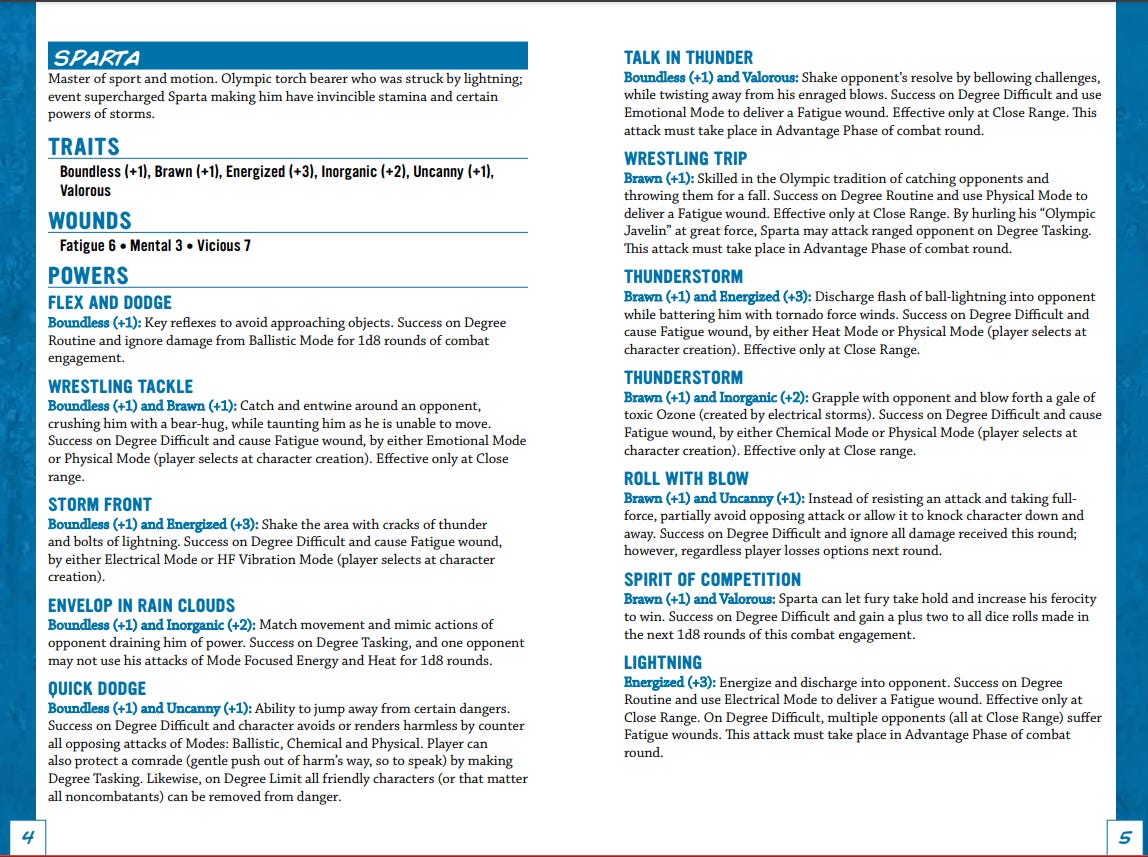
To give you another example of what characters in Free-Style systems look like, here is a glimpse at a character sheet in Good Guys Finish Last. You’ll notice that all of the abilities are named and the only number listed is the modifier. I wish jim had opted for the actual wound chart from the old games for each character, rather than listing numbers, as that shows which keywords add to which damage type and help give the game even greater narrative focus.

3. Champions: The Super Hero Role Playing Game

Yes, I know that this is two super hero role playing games on the same list, but I love super hero role playing games enough that I could do a list of just 31 super hero role playing games worth your time and have that be the list of independent rpgs. Since this is independent rpg month and not super hero rpg month. For me, every month is super hero rpg month, but that’s a post for another time.
As the above paragraph implies, there are a ton of super hero role playing games out there and most of them are worth checking out for one reason or another, but Champions stands above them all. I write those words even as DC Heroes is my favorite super hero game.
Champions wasn’t the first super hero role playing game, that was Superhero ‘44 which was quickly republished as Superhero 2044. I don’t consider Champions the best super hero role playing game either, that’s the aforementioned DC Heroes. It is, however, the most important superhero role playing game ever published. If you read old copies of Space Gamer magazine, available for purchase from Steve Jackson Games at an affordable price, you will be able to see some of the far reaching impact the game had. From its extremely balanced point based system, a point base system based on house rules for Superhero 2044 that were playtested and honed until they were rigorously mathematically balanced, to its robust combat system designed to emulate the panel by panel storytelling of the comic books, Champions is a masterpiece in every edition.

It’s available in multiple editions, but I recommend the Second, Third, and Fourth editions of the game and consider the Fourth edition to be the absolute peak of the game at release. Once you start adding some of the Fourth edition splat books, it begins to get overbearing but the core book is all you need for mechanics. Just it, Strike Force (maybe the best super hero supplement ever written it’s for Third edition Champions not Fourth but it is compatible), and Classic Enemies is enough material to run decades of super hero games.
4. Dragon Warriors

Are you looking for a game that is easy to understand, has tactical complexity, has room for significant free form storytelling, and has a robust Medieval European (England really) setting with heavy doses of influence from Michael Moorcock’s Elric Saga? Then Dragon Warriors is your game.
Dragon Warriors can be played in a manner that emulates light hearted or grim and gritty Fantasy fiction, but given the lethality of its combat system it does lean more towards the grim and gritty. The game has a number of innovations, the weapon damage system is something you really should check out. Weapons do a fixed amount of damage and after you roll to hit an opponent you roll penetration dice versus an armor’s protection value to see if you damage them at all. Only then do you apply weapon damage. It’s an interesting alteration on the armor as damage reduction paradigm and while it does make combat more tactical and sometimes slower, given the relatively low hit points that characters have in the game that never becomes an issue.
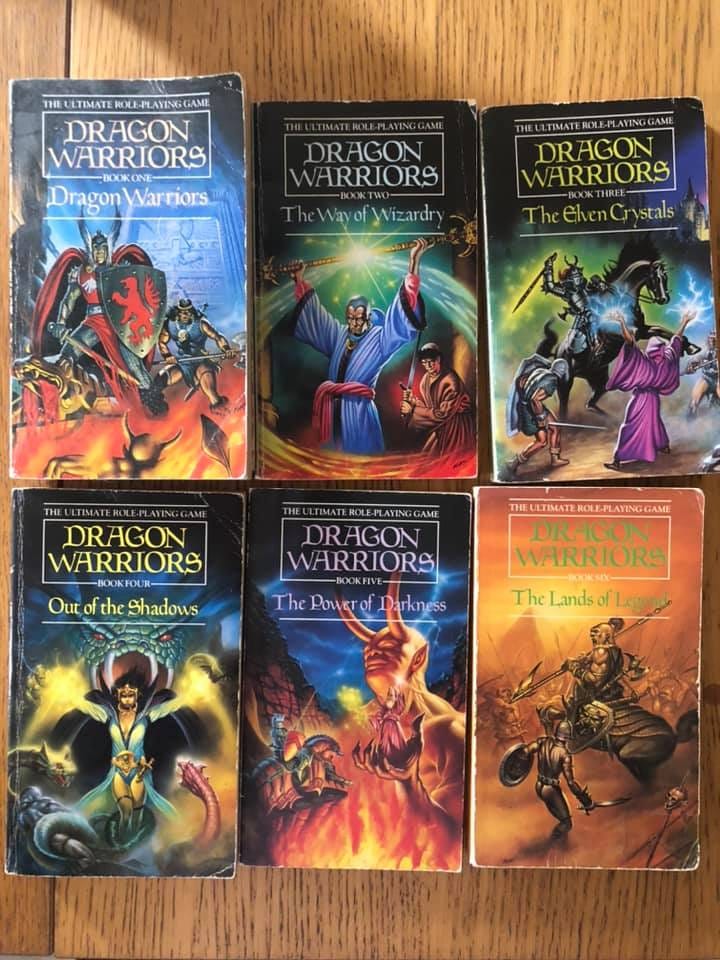
The game was initially released as a series of six paperback “pocket” sized rule books. The first book provides sufficient rules for an entire campaign, but if you wanted to add magic, greater character variety, and a rich setting, then the additional books were a must. I don’t know if it was the first game to be issued that way, but it is a pretty cool way to buy your books.
The game’s mechanics are deeply rooted in the world design, so this is not a generic Fantasy rpg in the traditional sense. The rules and setting have a particular feel to them and it is an interesting feel.
5. Troika!

Troika! is a game that thematically returns to an earlier era of role playing games when many of the designers didn’t feel constrained to emulating a single genre. Like Expedition to the Barrier Peaks or Metamorphosis Alpha, Troika! is a science fantasy role playing game that mashes together ideas from multiple genre to create an intriguing experience.
Mechanically the game is based on the classic Advanced Fighting Fantasy game that expanded upon the mechanics in the Fighting Fantasy Gamebooks. As such, it is an extraordinarily simple game to play and is very much designed with free-form, rather than tactical, play in mind. Since the Fighting Fantasy Gamebooks were designed to be played solo by young people reading a paperback novel, the rules had to be simple and more theatre of the mind focused. Troika! expands on that foundation with an interesting character creation system that includes some really interesting character options. Even if you don’t end up playing Troika!, there are ideas for you to use in any role playing game session.
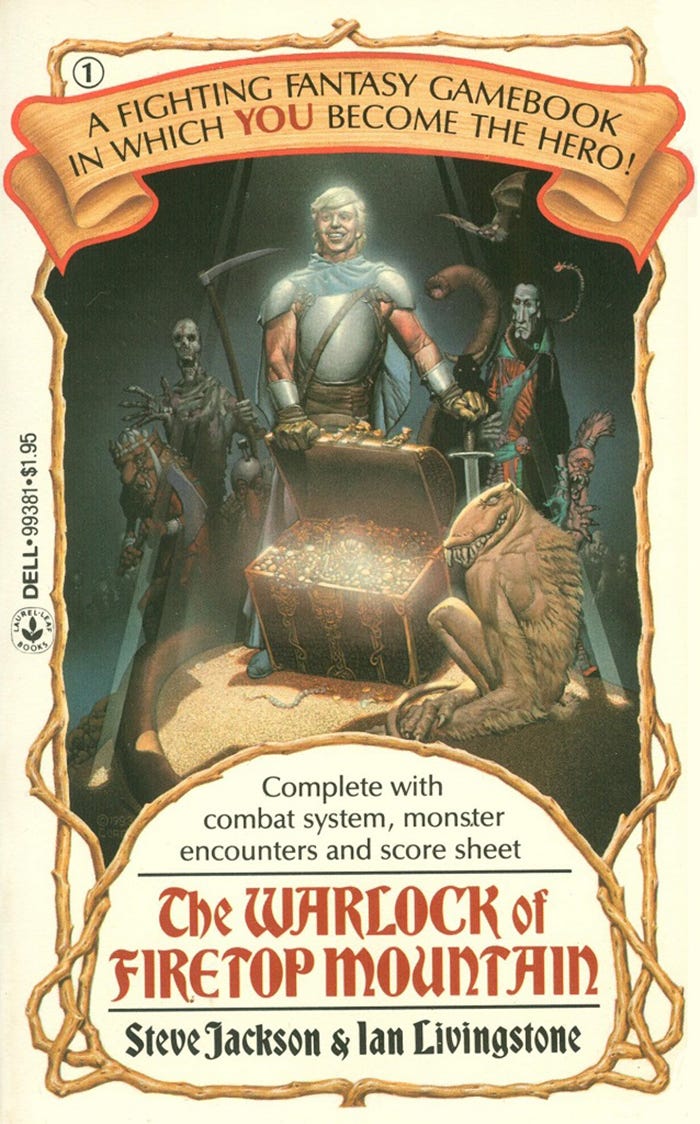
Oh, and since the Fighting Fantasy Gamebooks are still around you might want to check them out too. They are really fun.
6. Savage Worlds

The Savage Worlds role playing system has been around for 20 years and it is without a doubt one of the most flexible role playing game engines on the market today. It has a great community and a large catalog of interesting products. I could go on for days about this game, and will write a formal review of it later with mechanical analysis etc., but this is getting long. The most recent edition of the game is the Adventure edition, but unlike many other role playing games on the market the changes from edition to edition in Savage Worlds are minor balance tweaks rather than complete revisions.
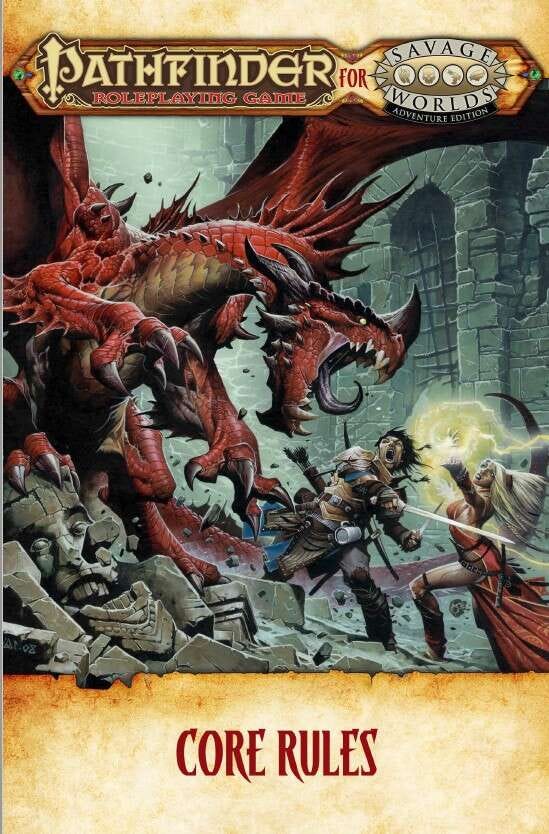
The game’s motto is Fast! Furious! and Fun! and the mechanics keep getting faster and furiouser, it’s up to you to make them funner. Thankfully, they have great products like Deadlands, Pathfinder (yep, that Pathfinder setting in a new rules set), the Super Powers (okay, that makes three super hero games) and Fantasy Companions, Flash Gordon, and so much more.
7. Castle Falkenstein

Castle Falkenstein is, like most games designed and produced by Mike Pondsmith, way ahead of its time. Yes, in the post-success of the Cyberpunk video game world, R. Talsorian and Mike Pondsmith might seem a far cry from the scrappy independent designers you might be expecting here. But the truth is that Mike Pondsmith’s story is one of being an overnight success that took almost 40 years. His original Cyberpunk game was a masterful game inspired by both Champions and Traveller that synthesized those games into a lethal experience that had MOOD. Man could Mike Pondsmith evoke mood.

Castle Falkenstein is a Steampunk role playing game, designed before Steampunk took off, in which the setting and mechanics are deeply intertwined. Given how tactically oriented Cyberpunk was, and is, one might expect some of that to leak into this game, but it doesn’t. Pondsmith is one of the most talented, and for a long time underrated, designers in the role playing game market and this storytelling oriented game is a perfect example of how to mesh milieu and mechanics and the mechanics don’t even appear until page 181 of the rulebook. Pondsmith wants you deeply saturated in the setting before he brings in the mechanics. Those mechanics are card based, because cultured people don’t play with dice as those are for riff-raff and ruffians, and are easy to learn and execute. All of the supplements are excellent, but as a fan of the Wild, Wild, West television show, I highly recommend Six Guns and Sorcery.
I can honestly say I was thoroughly enjoying the piece even before I saw you'd included DW :-)