


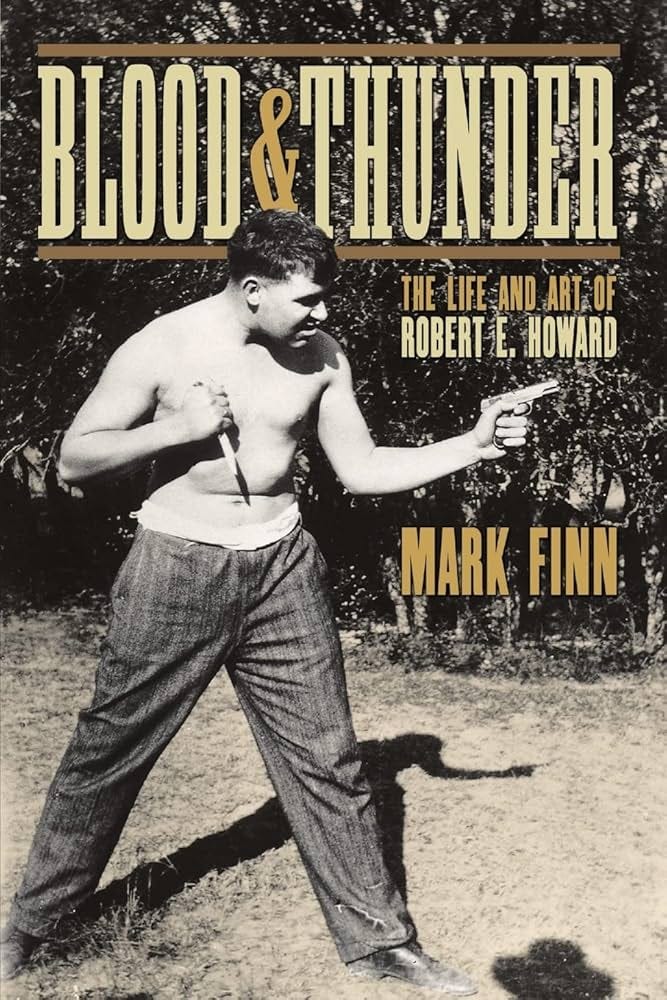
Happy 120th Birthday to Ar-I-E’ch!
When I saw the first Conan movie as a kid, I had never heard of Robert E Howard. Even after that movie inspired me to purchase a couple of Conan paperbacks at the local paperback exchange, my experience of Robert E. Howard’s writing was filtered through the lenses of Sprague L. DeCamp and Lin Carter pastiches. I was too young to discern which parts of the Conan novels were from the wellspring and which were diluted by other storytelling preferences. In many ways, I considered them and other pastische authors like Poul Anderson, Karl Edward Wagner, Bjorn Nyberg, and … yes… Roy Thomas to be equal inheritors of the character. I was a comic book fan and I was used to people of later generations picking up a creation and running with it.
When I finally bought myself a copy of the AD&D Dungeon Master's Guide and read Gary Gygax's famous "Appendix N" I remember looking at the list and seeing Robert E Howard as the only name associated with Conan and while Sprague L. DeCamp was on the list, it was for his Compleat Enchanter stories. I hadn’t read those at the time, but I thought it was interesting that he wasn’t listed with Conan. As I got older, I began looking for more information on Conan and it’s original author and I found a rich literature discussing his writing and the controversies surrounding the pastische tales.
This compelled me to track down copies of Conan stories that were written by Howard and thankfully there was an excellent line of Howard’s stories being published by DelRey (that’s right the “evil” DelRey that killed fantasy). These collections contained only the stories written by Howard, as well as fragments. This let me look back through my older Conan books and I saw that many of the Conan stories I read as a kid, thinking they were Howard stories, were in fact written by DeCamp or Carter. I also discovered that this information was in this wonderful part of books that pre-teens and teens pass over called the “Introduction” or “Foreward” wherein many mysteries are revealed. I hadn’t read those introductions as a kid, but I did as an adult.
In reading the pure Howard and going back to read the editions with "co-written" stories, I could now see a marked difference between the dark prose of Howard and the more juvenile writing of most of the imitators. There was something more to the Howard stories (as I have written before). They weren't the immature wish fulfillment tales of a lusty and violent young man in a loincloth of some of the imitators. Contrary to the Schwarzenegger portrayal, Howard's Conan was cunning, quick witted, joyful and somber.
While I’m not as hard on the pastiche authors as many Howard purists, I am strongly of the opinion that Robert E Howard was a much better author than most of them (Karl Edward Wagner and Poul Anderson are excellent authors in their own right). As much as I enjoy DeCamp and Fletcher Pratt’s Harold Shea stories, and they are really good, the mind that came up with those whimsical tales was never going to fully understand what made Conan work as a character. Add to that love of whimsy a layer of mid-20th Century Freudianism that was applied to understanding Howard and you’re bound to miss the point on many levels. I am even willing to forgive DeCamp his Freudian interpretation of Howard, because it was a product of the times but even more so because he applied that same lens to himself in his own autobiography. But I’m not willing to forgive myself for not pursuing more information about Robert E Howard’s whole literary catalog much sooner.
Conan the Patron of the Arts?

As a fan of pulp fiction, I am continually impressed with how Conan remains a resonant character for modern audiences. The character live in the psyche of the popular culture consciousness in a way t…
For quite some time now, I have been hunting down everything I can find written by Howard. I’ve joined the Robert E Howard Foundation and have purchased many of their volumes of his writings. Like Edgar Rice Burroughs, Howard had a rich imagination that alternated between fantasy, sword & planet, and historical fiction. Howard though, was a much better wordsmith. Like his friends H.P. Lovecraft and Clark Ashton Smith, Howard could turn a phrase and that is what makes so many of the pastiches unbearable. It’s hard to read people attempt, and fail, to capture the rich depth of the Nemedian Chronicles excerpt at the beginning of Howard’s tale The Phoenix on the Sword. He evokes an entire world in a paragraph and the short voice over in the new Red Sonja movie is painful to listen to knowing how brilliant Howard’s description of the Hyborian Age was.
My favorite Howard character combines fantasy, horror, and historical fiction in a way that thematically mixes H. Rider Haggard and H.P. Lovecraft in wonderful ways. That character is Howard’s wrathful Puritan Solomon Kane. He’s an austere and demanding character who fights against many foes, and who like Conan has yet to have a truly great film adaptation. In many ways, it would be harder to adapt Kane for modern audiences. The Haggard-esque stories would not mesh well with modern audiences if adapted literally, just as a modern version of She Who Must Be Obeyed would rub many the wrong way. The stories are a product of their time, but so too is Kane and any presentation of him would have to present him as he and his world are in order to explore the richness within.
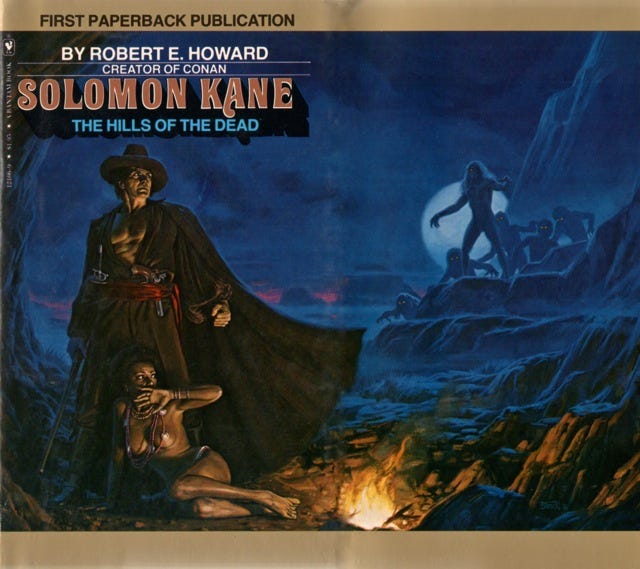
This past weekend, I’ve been paging through Del Rey’s The Horror Stories of Robert E. Howard and came across a story that is wonderfully Poe-esque. In honor of Howard’s 120th birthday, here is a sample of “The Touch of Death.”
Old Adam Farrel lay dead in the house wherein he had lived alone for the last twenty years. A silent, churlish recluse, in his life he had known no friends, and only two men had watched his passing.
Dr. Stein rose and glanced out the window into the gathering dusk.
“You think you can spend the night here, then?” he asked his companion.
This man, Falred by name, assented.
“Yes, certainly. I guess it’s up to me.”
“Rather a useless and primitive custom, sitting up with the dead,” commented the doctor, preparing to depart, “but I suppose in common decency we will have to bow to precedence. Maybe I can find some one who’ll come over here and help you with your vigil.”
Falred shrugged his shoulders. “I doubt it. Farrel wasn’t liked -- wasn’t known by many people. I scarcely knew him myself, but I don’t mind sitting up with a corpse.”
Dr. Stein was removing his rubber gloves and Falred watched the process with an interest that almost amounted to fascination. A slight, involuntary shudder shook him at the memory of touching these gloves -- slick, cold, clammy things, like the touch of death.
The story proceeds from this opening to a perfectly rewarding Twilight Zone style resolution. The tone has been set.
I often wonder at what tales Howard would have written had he lived beyond the age of 30. Sadly, we can only speculate.