


Not the First Superhero Role Playing Game, but the First Great One

I recently posted that July 4th was the 50th Anniversary of the RuneQuest roleplaying game. It’s a game that revolutionized the hobby in many ways. One of the most significant ways it did this, something that is rightly lamented by game designers/critics like Jeffro Johnson, was to move the hobby away from its wargaming roots (both chit and map and miniature wargaming with the shift away from miniature campaign play having the largest impact). It replaced that tradition with influences from mythic storytelling and combat rules influenced by the designer’s participation in the Society for Creative Anachronism. I’ll be writing about that shift in my eventual review of the Playtest Manuscript. In some ways, it’s ironic that RuneQuest led the way in this direction since it was inspired by two chit and map wargames (White Bear and Red Moon as well as Nomad Gods).
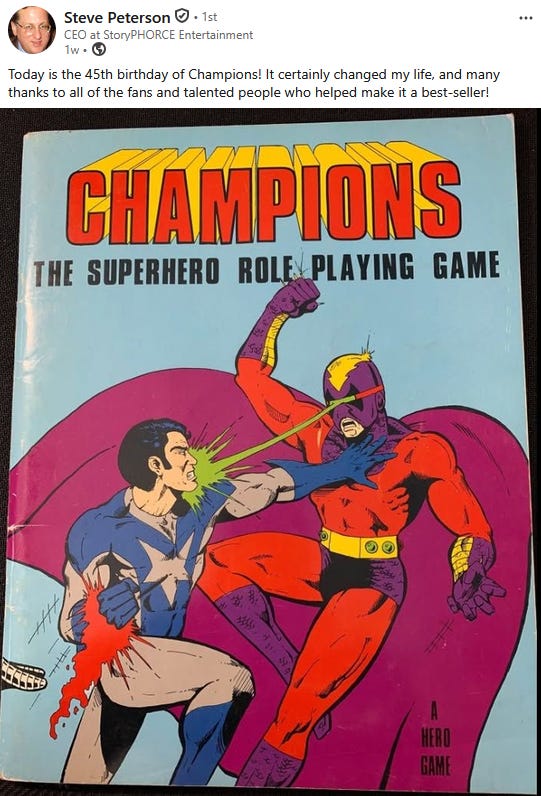
RuneQuest isn’t the only roleplaying game with a July birthday though and I’d like to write about the Champions roleplaying game, which is a game that manages to squeeze itself somewhere between the Gygaxian/Arnesonian wargaming design philosophy and the Staffordian “rpgs as art” philosophy. It’s a very mechanics heavy game, and extremely balanced mathematically, but it has only minimal advise for running campaigns where the players run different opposing factions even as one could readily see how having players run villain and hero groups (as well as individual characters) could make for a robust campaign with richer and more player involved stories than those created by a dictator Gamemaster. I was reminded to write about Champions when I saw Steve Peterson’s post that July 3rd marked the 45th Birthday of the game on LinkedIn.
Champions Release Happened at a Really Cool Location
The Origins Game Fair is one of the oldest role playing game conventions in the the world, having started in 1975. It currently takes place annually in Columbus, Ohio and has done so since 1995, but before it found its permanent home it was held at different locations around the United States each year.
While the logistics of having a large scale gaming convention in a different city every year are very challenging, there were a couple of advantages to doing exactly that. First, it help to support the hobby as a whole by creating excitement that was geographically diverse. It allowed for gamers have access to games and game companies that their local stores might not carry. Additionally, they served as important places to learn about new games in the hobby. Without the modern internet, it could be difficult to learn what games were coming out. Sure, magazines like Different Worlds, White Dwarf, and Space Gamer wrote up short articles on new releases, but they often got that news by attending these conventions.
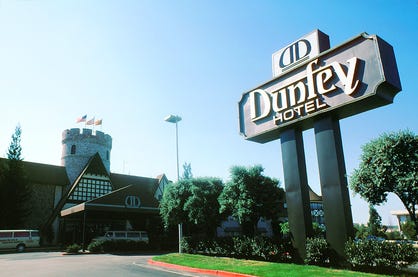
On the weekend of July 3rd through 5th in 1981, the Origins Game Fair took place in San Mateo, California at the Dunfey Hotel. Those familiar with the Bay Area Gaming scene in the 80s through 90 are very familiar with the Dunfey and miss its pseudo-medieval stylings that just screamed, “This is a Place Where Role Playing Games are Played!” Just look at that crenellation and Fachwerk! How could you not what to game there?

San Mateo also happened to the home base of a small gaming company called Hero Games who had just published the first edition of a superhero role playing game called Champions. They released the game on July 3rd of 1981, making this the 45th anniversary of its release. Happy Birthday Champions!
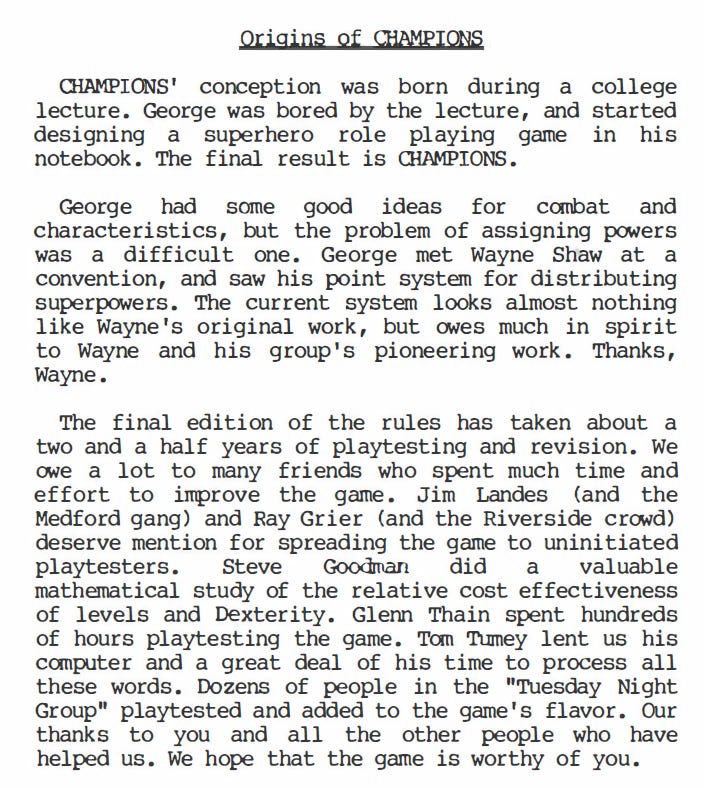
The Champions Superhero Role Playing Game is one of the best superhero role playing games ever designed, so much so that it is THE game to which all superhero rpgs are compared. Champions wasn’t the first role playing game in the superhero genre, that honor goes to the game Superhero 2044 which I discussed in an earlier post. Champions even builds upon some of the ideas in Superhero 2044. Champions character creation has a foundation in the vague point based system in Superhero 2044. These vague rules were eventually improved by the creation of house rules by Wayne Shaw that were published in issue 8 of the Runequest (another Bay Area connection) themed fanzine Lords of Chaos Fanzine. George McDonald and Steve Peterson saw how Wayne Shaw had made the almost non-existent system of Superhero 2044 into something almost workable and was inspired to create a new detailed and easy to understand point based system that was mathematically balanced. I would argue that Champions’ combat system was influenced by the melee combat system presented in Superhero 2044. Both systems compare combat capabilities to determine the the target numbers on a 3d6 bell curve for “to-hit” rolls in combat.

While Champions wasn’t the first superhero rpg, it was the first that presented a coherent system that allowed a player to design the superheroes they read about in comic books. The first edition of Villains & Vigilantes, which predates Champions, did a good job of emulating many aspects of comic book action but the ability to model a character in character design wasn’t one of them. Because Champions was released at the Origins convention, one of the largest gaming conventions at the time, Aaron Allston of Steve Jackson Games was in attendance and it immediately captured his attention. Allston gave Champions a positive, but constructively critical, review in issue #43 of the Space Gamer magazine. That experience led to Aaron Allston running a Champions campaign back at home which led him to write several Champions articles for Space Gamer. He eventually became one of the most important contributors to the Champions line. Those contributions included the Strike Force Sourcebook, which is one of the most important role playing game books ever written…for any game system. You MUST own it.

Reading through the first edition of the game, can have that kind of effect upon a person. The writing is clear, if uneven in places, and the rules mechanics inspire a desire to play around in the sandbox provided by the rules. George MacDonald and Steve Peterson did more than create a great role playing game when they created Champions, they created a great character generation game as well. Hours can be taken up just playing around with character concepts and seeing how they look in the Champions system.
There are websites galore about Champions and many reviews about how great the game is, so the remainder of the post won’t be either of these. Rather, I would like to point out some interesting tidbits about the first edition of the game. Most of these will be critical in nature, but not all. Before going further I will say that though Champions is now in its 6th edition and is a very different game today in some ways, the 1st edition of the game is highly playable and well worth exploring.
One of the first things that struck me reading the book was how obviously extensively playtested the character design system was. This is best illustrated in the section under basic characteristics. In Champions there are primary and secondary characteristics. The primary characteristics include things like Strength and Dexterity. The secondary statistics are all based on fractions of the primary statistics and represent things like the ability to resist damage. Where the playtesting shows here is in how players may buy down all of their primary statistics, but only one of their secondary statistics. A quick analysis of the secondary statistics demonstrates that if this were not the case a “buy strength then buy down all the secondary stats related to strength” infinite loop would occur.
It’s striking how few skills there are in 1st edition Champions. There are 14 in total, and some of them are things like Luck and Lack of Weakness. There are no “profession” skills in 1st edition. To be honest, I kind of like the lack of profession skills. Professions in superhero adventures seem more flavor than something one should have to pay points for, but this is something that will change in future editions. This is one way that the game initially rejected the heavily skill-based philosophy advocated by RuneQuest as Champions limited skills to things that weren’t easily done through actual role play. One of the weaknesses of granular skill systems is that they can devolve into roll-playing instead of role playing. Do the players find the clue? In a skill based system, they can merely roll to find out. In a less skill based system, the players describe how they are searching. You can do that in a skill based system, but players will often feel cheated (and rightly so) if their plan to search was good and a mere roll ruined it for them. So eventually, these games can become more like statistical simulations that role playing exercises.
There are a lot of powers in Champions, but the examples are filled with phrases like “a character” or “a villain” instead of an evocative hero/villain name. It would have been more engaging for the folks at Hero Games to create some Iconic characters that are used throughout the book as examples of each power. The game does include 3 examples of character generation (Crusader, Ogre, and Starburst), but these characters aren’t mentioned in the Powers section. An example using Starburst in the Energy Blast power would have been nice. The second edition does name heroes and villains, but it also names characters we never get full statistics for and I spent many a day trying to figure out full character sheets for those partial listings. Since character design in Champions is a game in its own right, I didn’t mind too much, but I would have liked to see more stats for those evocatively named characters.
The art inside the book pulls readers in different thematic diretions. From time to time I’ve heard people criticize Mark “the hack” Williams for his illustrations, but his work is the best of what is offered in the 1st edition book and it is actually some of my favorite rpg illustration work ever. It’s no surprise that Mark Williams would go on to work on in the special effects industry on films like The Abyss and Terminator 2. Sadly, he died in May or June of 1998 of complications related to cancer. Mark’s work is more classically 4-color than that of his co-artists in the first edition, Victor Dal Chele and Diana Navarro. His strong 4-color vibe is probably why they decided to use Mark’s work extensively in the 2nd edition of the game. Williams’ art is evocative and fun while the work Vic Dal Chele and Diana Navarro was less “comic bookish.”

To be fair, Victor Dal Chele was a relatively young artist at the time and his craft improved significantly as he got older. At the time of Champions he was already a Storyboard Artist on The Kid Superpower Hour with Shazam! and he went on to work on GI Joe, Transformers, He-Man and the Masters of the Universe, and a ton of other cartoons. I have not been able to find more information on Diana Navarro, but as “non-comic bookish” as her art was there is definite talent there and I’d be interested to know where her career went.
The game provides three examples of character generation, but the designs given are less than point efficient and one outclasses the others. The three sample characters are built on 200 points. Crusader can barely hurt Ogre if he decides to punch him (his punch is only 6 dice), and his Dex is bought at one point below where he would receive a rounding benefit. Ogre has a Physical Defense of 23. This is the amount of damage he subtracts from each physical attack that hits and it is very high. Assuming an average of 3.5 points of damage per die, Ogre can resist an average of 6.5 dice of damage per attack. Yes, that’s an average but the most damage 6 dice could do to him would be 13. That would be fine, except Crusader has that 6d6 punch, and Starburst...oh, Starburst. All of Starburst’s major powers are in a multipower which means that as he uses one power he can use less of the other powers in the multipower. The most damage he can do is 8d6, but only if he isn’t flying and doesn’t have his forcefield up. Not efficient at all. One might hope that character examples demonstrate the appropriate ranges of damage and defense, these don’t quite achieve that goal.
The combat example is good, if implausible. Crusader and Starburst defeating Ogre? Sure. The mathematics don’t really support that outcome, but I’ll save that analysis for another post.
The supervillain stats at the end of the book -- there are stats for 8 villains and 2 agents -- lack any accompanying art. The only exception is Shrinker.
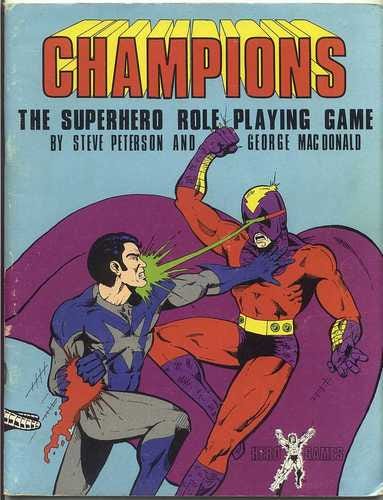
Speaking of artwork and iconics. Take a look at that cover.

Who are these people?! I want to know. The only one who is mentioned in the book is Gargoyle. It’s pretty clear which character he is, but I only know his name because of a copyright notice. Who are the other characters? Is that “Flare”? The villain is named Holocaust, but that cannot be discerned from reading this rule book. If you know who the Iron Man clone is, please let me know. I’d love to see the stats for that guy punching “Holocaust” with his energy fist. It might be Icestar, but he’s punching with energy and not cold so I have no idea.
Champions is a great game, and the first edition is a joy. If you can, try to hunt down a copy and play some old school super hero rpg.
Loved this idea back then.
Sadly, never did find a game to join or anyone interested in joining mine.
Still a great idea though!