


Most roleplaying gamers of a certain age are deeply familiar with Gary Gygax’s Appendix N. It is a famous list of recommended “inspirational and educational reading” that was included deep toward the back of the 1979 Dungeon Masters Guide (sic). The introductory paragraph of that essay begins with the words “Inspiration for all of the fantasy work I have done stems directly from the love my father showed me as a lad, for he spent many hours telling me stories he made up as he went along, tales of cloaked old men who could grant wishes, of magic rings and enchanted swords, or wicked sorcerers and dauntless swordsmen.” Just as Gygax’s father told him inspirational stories, so too did Gygax tell inspirational stories to his children (real and “gaming”). He very much took on the role of the father of a hobby and created a formal written road map for several kinds of play, some of which are only now being formally expanded upon by Jeffro Johnson and what is sometimes called the BROSR movement.
Wargaming and, by extension, roleplaying games have long been dominated by a knowledge base similar to that of Child Folklore. People who had played the games passed them on to the next generation via stories. Robert Louis Stevenson’s wargame with his stepson in the early 1880s was described in an article published in Scribner’s Magazine in 1898, but there is only enough information to intrigue and inspire. There are no fully realized instructions on how to play. There are some very good descriptions, but some significant holes as well.
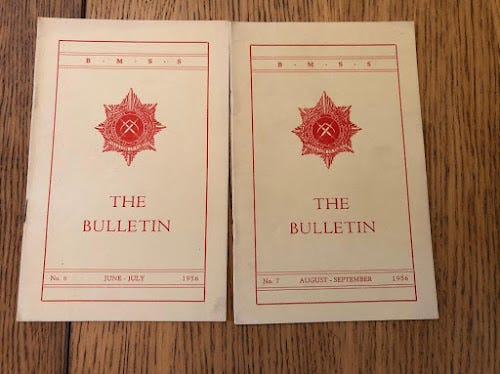
Readers, or collectors like me, of the British Model Soldier Society back issues will have a damnable time finding the wargame rules mentioned throughout the various issues. Some are available and playable (but very loose), while others are largely lost to time. John Curry at the History of Wargaming Project has done a tremendous amount of work to locate many of these games, and yet there are still many holes to be filled. I highly recommend his collections Tony Bath’s Ancient Wargaming: Including Setting up a Wargames Campaign and the Hyborian Campaign and More Wargaming Pioneers Ancient and World War II Battle and Skirmish Rules by Tony Bath, Lionel Tarr, and Michael Korns.


When I say that wargaming is a Child Folklore activity, I mean that the real rules of play are passed on via story and direct instruction without an authoritative text. Donald Featherstone, the Father of Modern Wargaming, changed this somewhat with his multiple books on wargaming and by inspiring others to write their own books. Yet as good as Donald Featherstone’s War Games: Battles and Manoeuvres with Model Soldiers is, it inspires as many questions as it answers. The same was true of roleplaying games and, in particular, Dungeons & Dragons when Gary Gygax began working on Advanced Dungeons & Dragons. When Gygax wrote the Original Dungeons & Dragons game, he started with Dave Arneson’s “18 Pages of Notes” on how to play and run a fantasy adventure game.
Gygax had played in Arneson’s fantasy game, fought four Balrogs in that first experience, and wanted to create a complete game based on that experience. The notes Arneson sent him were not a complete rules set, but they were a good foundation and from that foundation Gygax wrote Dungeons & Dragons and began playing the game with all kinds of people. Thus began our hobby and the immediate explosion of Folk D&D, where play of the game diverged immensely from the rules from day one. One example is how Lee Gold misunderstood how Saving Throws worked. She believed that saving throws were rolled on 2d10 (check the link above for the excerpt from Alarums & Excursions), which changes the mathematics of the game significantly. If that could get lost between Lake Geneva and Los Angeles, nothing in the rules was safe. Another example is the spread of the Perrin Conventions that were designed to fill perceived holes in the D&D combat system. Even as Gygax codified the rules as much as he could at the time in the original little brown books, Child Folklore prevailed and the game transformed into Folk D&D.

Gygax initially embraced Folk D&D, but his experience with campaign play and convention play inspired him to write a formalized version of D&D that could be played with great consistency across all the Folk groups. He wanted to codify an official rules set that captured the best of his experience. Jeffro Johnson has done the lion’s share of work in making this argument, and I think he’s right. I think that looking at AD&D through this lens explains the shift in how Gygax wrote about what was and wasn’t D&D in play. He wasn’t merely protecting a brand, he was rejecting Folk D&D and seeking to create a formal version that stood apart. He was trying to do for roleplaying what the various governing bodies had done for sport, to take the Folk and make it formal. Just as there is “Association Football” aka Soccer, there is Advanced Dungeons & Dragons. While there are many ways to play “Football” that range from Rugby to American Football, there is only one way to play Association Football, and Gygax was attempting something similar. Given the era he wrote in, I doubt that a foreign sport was his underlying inspiration but it’s World Cup season and the metaphor works.
To that end, Gygax provided detailed rules for how to adjudicate almost everything imaginable as a Dungeon Master in his Dungeon Masters Guide. That initial volume is still one of the most coherent and cohesive books on how to play a roleplaying game, and too few actually read what it says in its entirety. Most read the book piecemeal to fill the gaps in their Folk D&D understanding, because try as hard as Gygax might, Folk D&D came to dominate and in particular a form of “heroic narrative” Folk D&D that set aside the wargaming roots of the game and the campaigns it was designed for. Ask someone of a particular age what a campaign is and they will talk about a never-ending game that spans generations of characters. Ask a modern gamer what a campaign is and the answer will sound more like a “season” or story arc.
I’ll admit that I am a Folk D&D player and that this has been my preferred way of playing the game, but I am inspired by the movement to bring the wargaming campaign elements back into the game. I’ve seen how wargame campaigns create inspirational play and story, and bring tremendous player agency at scale, and that has value in a fantasy roleplaying game. However, I have always been a fan of simpler rule sets (B/X) and of superhero games and for me narrative roleplay fits the bill. I do, however, recognize the value of playing games with the Rules as Written and AD&D played by Rules as Written is not Folk D&D. There is a right way to play AD&D and I’m not playing that way.
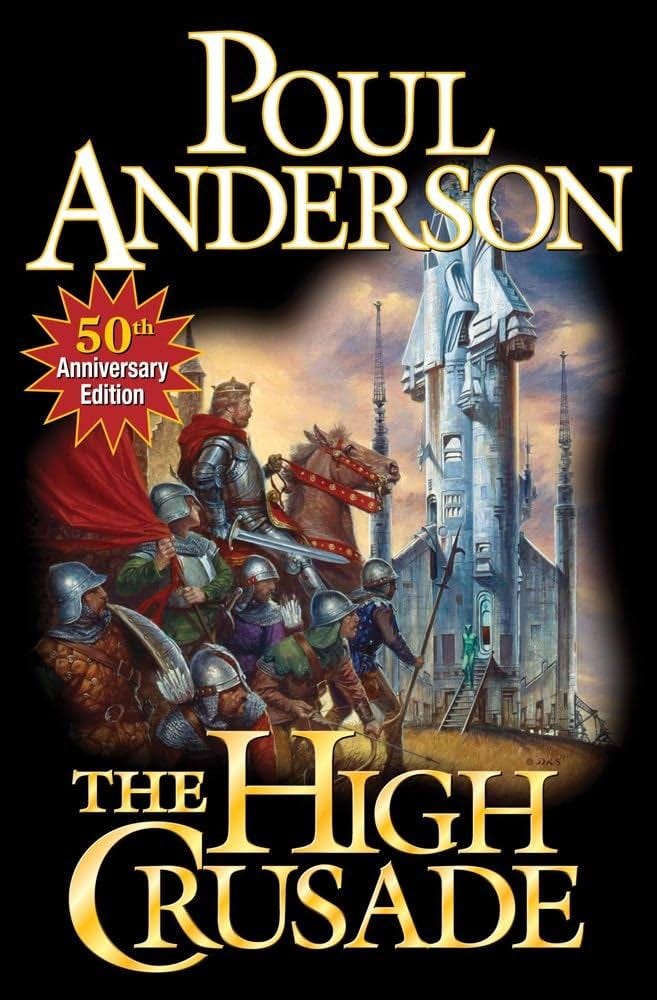
Just because there is a right way to play AD&D doesn’t mean that all games must feel or be thematically the same, and that brings me back to Appendix N where Gary Gygax placed three very different Poul Anderson titles right next to one another: Three Hearts and Three Lions, The Broken Sword, and The High Crusade. The first two get talked about endlessly, and rightly so. Between them they hand modern fantasy the alignment axis, the troll that regenerates, and the paladin as a playable idea. They are inspirational works for Folk D&D that is character focused and is adjacent to familiar fantasy stories.
The High Crusade tends to get read as the odd one out, the science-fiction lark that wandered into a fantasy reading list. I want to argue the opposite. I think it is the most instructive book of the three for anyone who builds worlds or runs games, and I think its neglected 1983 sequel, “Quest,” is the piece that finally shows you what Anderson was actually up to. This turns out to be something larger, and a shade darker, than a comic adventure about knights in space. The High Crusade is a book that shows you the kind of never-ending multi-faction campaign that AD&D was designed for. Gygax included it in Appendix N as one of the central examples of his intended style of play.
And with that extremely long introduction, I will now move on to the formal review.
A Connecticut Yankee, Run Backward
The novel takes place in the year of grace 1345, in the fictional Lincolnshire village of Ansby. A minor English baron named Sir Roger de Tourneville is mustering men to join Edward III’s war in France. The Hundred Years’ War has only recently begun and the longbow has recently done terrible things at the battle of Sluys and will shortly do worse at Crécy. Sir Roger, like every ambitious knight of his generation, is thinking about glory, ransom, and because he is a devout man of his age he is also thinking about the possibility that a successful French campaign might roll onward into a proper crusade to liberate the Holy Land.
That is when the most unexpected event happens. A spaceship lands in his village. That’s right. A spaceship lands in his village.
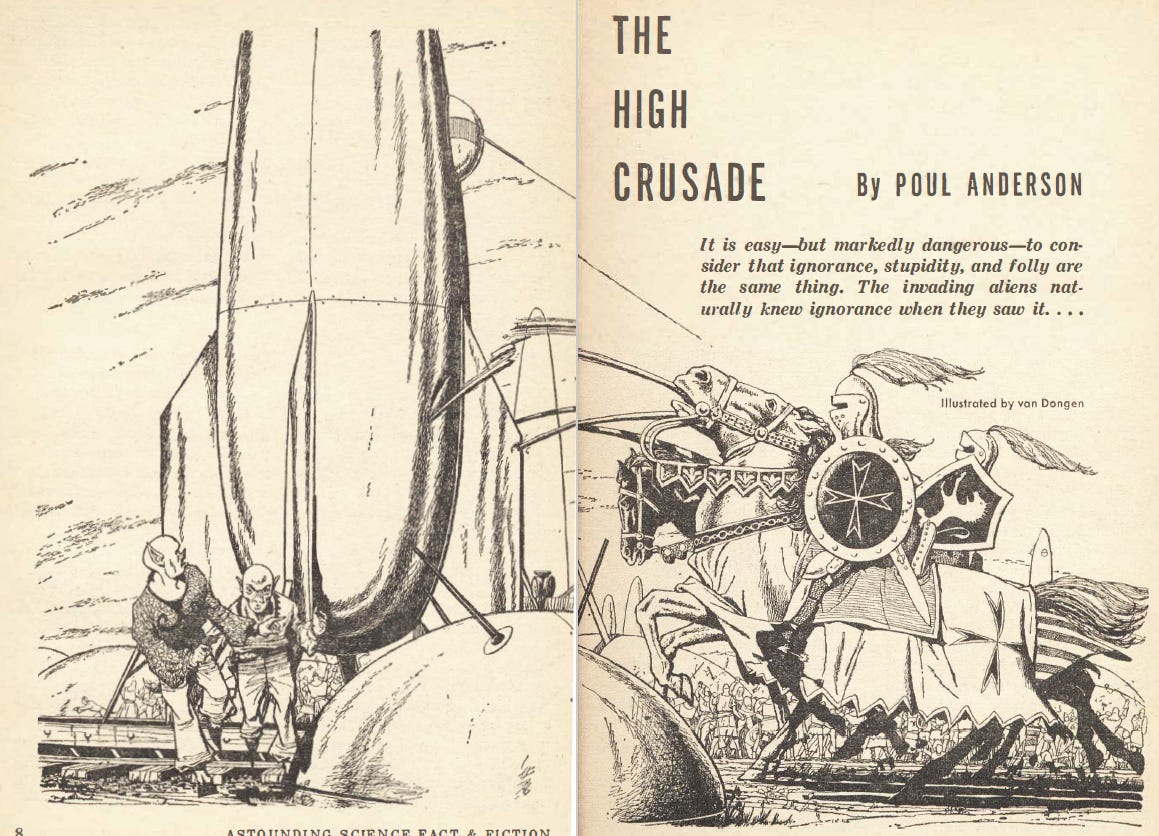
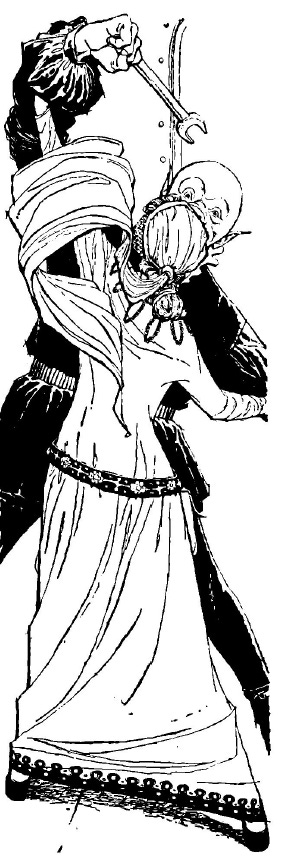
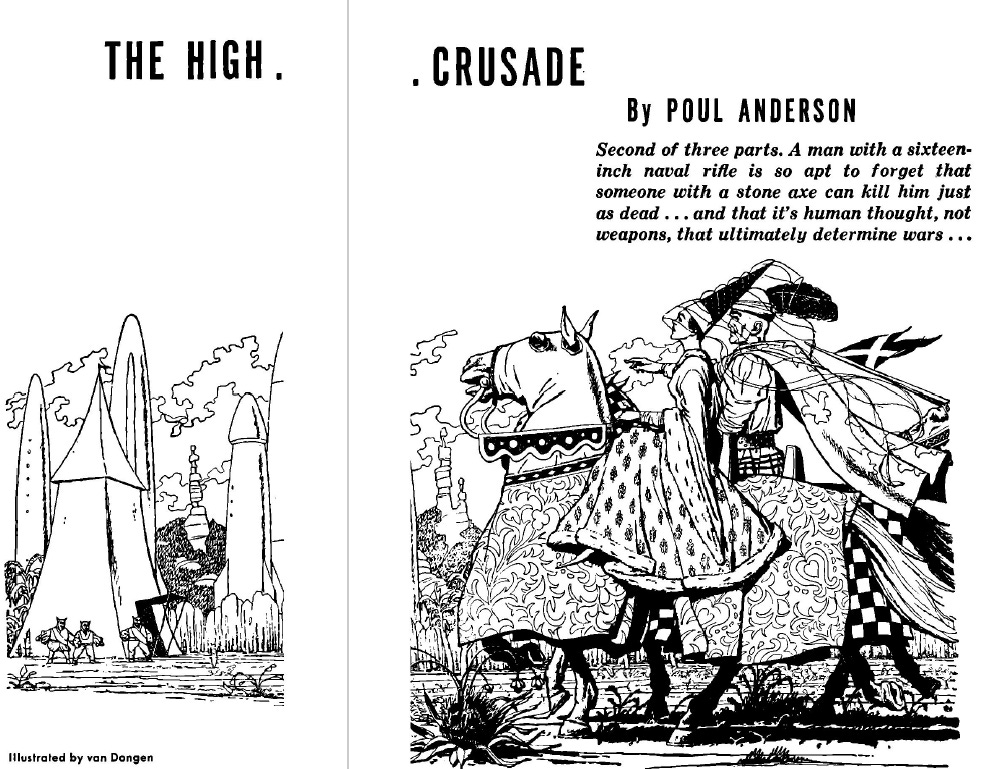
The ship belongs to what our chronicler calls the Wersgorix Empire. The Empire is a spacefaring dominion of blue-skinned and bureaucratically minded conquerors who have swallowed dozens of worlds and expect to swallow Earth next. Their method is standard and, until now, foolproof. They land a scout craft, terrify the primitives, catalogue the resources, and return with a colonization fleet to easily defeat the helpless primitive population. What the Wersgorix have never encountered, and this is the central conceit on which the entire book turns, is a population that responds to a landing craft not by fleeing but by storming it. Sir Roger’s men, assuming the silver vessel is some fresh deviltry and possibly a demonic invasion, put ladders to it, break in, and kill every alien aboard except one, a pilot named Branithar.
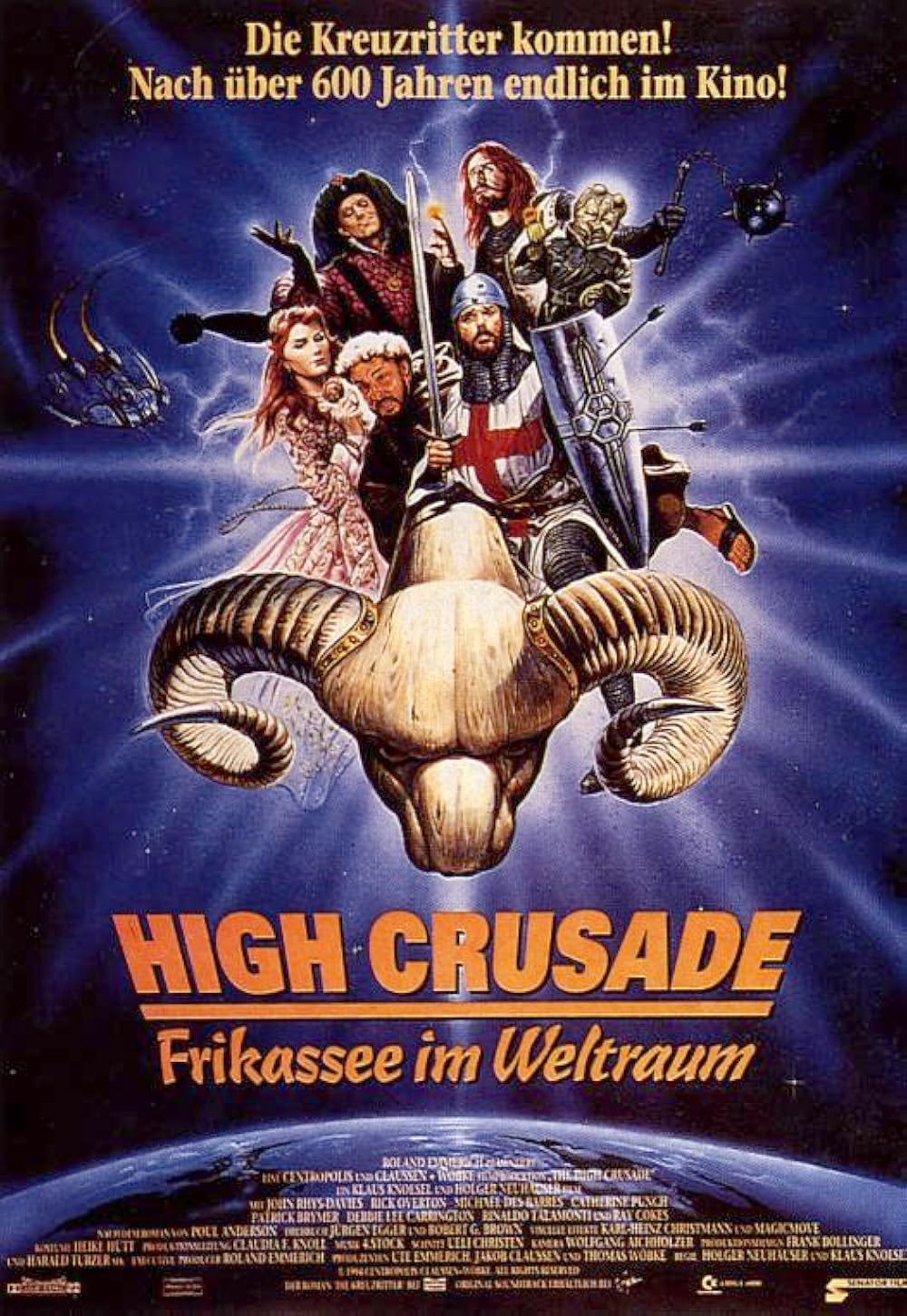
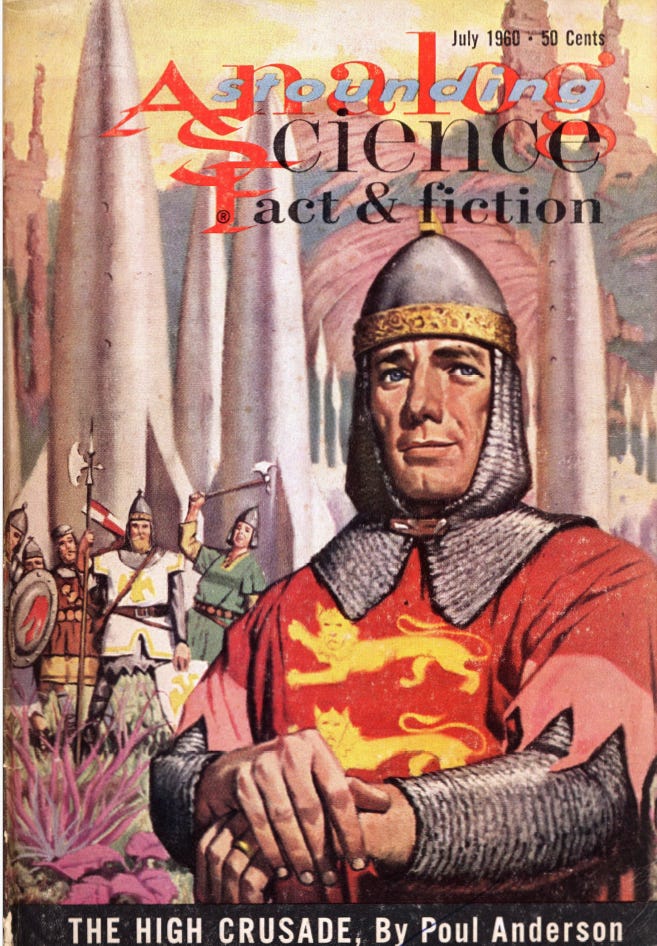
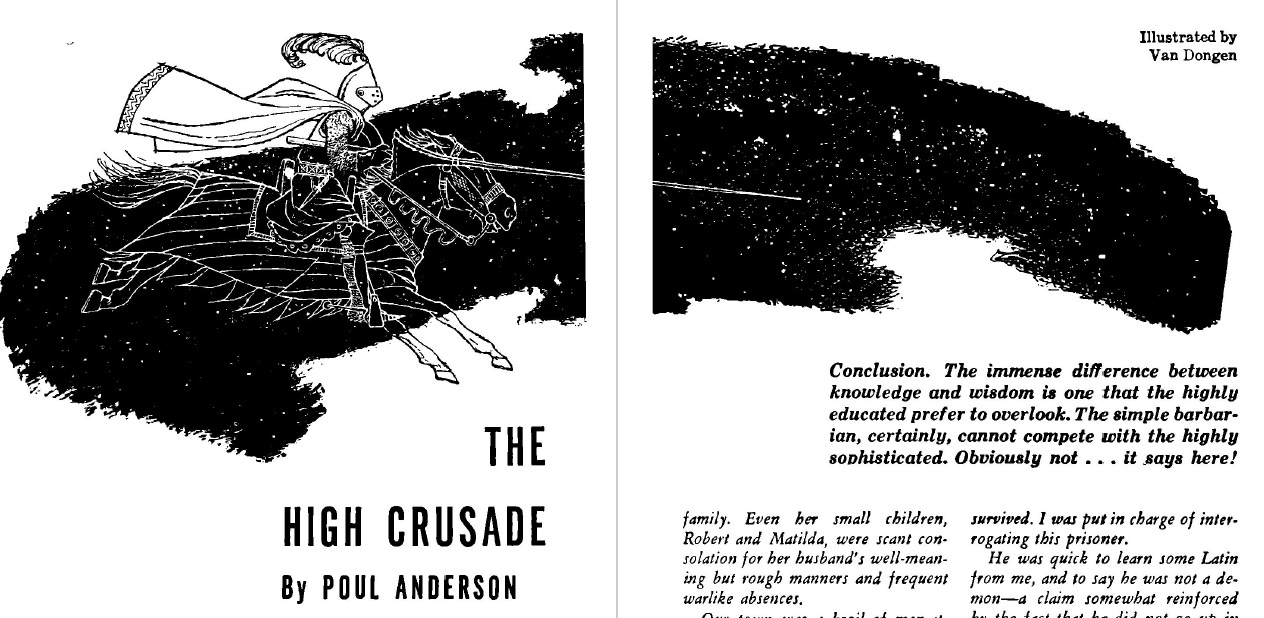
The novel was serialized in the July, August, and September 1960 issues of Astounding, and published in hardcover by Doubleday later that same year. It was eventually nominated for the Hugo in 1961 where it lost to Walter M. Miller’s excellent novel A Canticle for Leibowitz. Anderson himself later called it one of the most popular things he ever wrote, and it has stayed more or less continuously in print for six decades with some of the best editions released by Baen Books. There was a 1994 film adaptation that Anderson pointedly refused to watch, having been told on good authority that it was botchwork. I have yet to see the film, but I recommend reading the book before watching a low-budget, early ‘90s adaptation. The film may be enjoyable on some level as it stars John Rhys-Davies, but it aimed for Monty Python-style comedy when the book is doing so much more.
The obvious literary ancestor to the novel is Mark Twain, but there are some key differences. A Connecticut Yankee in King Arthur’s Court drops a nineteenth-century technician into the sixth century and lets him lord his modern know-how over the credulous medievals. The High Crusade inverts the trope from top to bottom. Here the technological future shows up in the medieval world, where it is shown the value of courage and the folly of decadence. The story is narrated not by a smug modern mind but by a medieval mind with its own view of how the world works. Anderson’s character Brother Parvus is a humble clerk of the Franciscan order who sets the events down years later at his baron’s instruction. He is mindful not to be overly elaborate in his descriptions, even when it would serve him well to do so. The book is far from silly in tone. In the older tale, Twain’s Yankee wins because he knows more, but Anderson’s Englishmen win despite knowing almost nothing. This leaves the reader with two interesting questions.
How do these technologically inferior Englishmen conquer an advanced civilization? And why?
Competence is Cultural, not Technological
I believe that the novel is advancing a very serious thesis. It’s a thesis that has led the book to outlive so many other books from the era. Anderson’s Wersgorix are not stupid, and they are not weak. They command energy weapons, star drives, and instantaneous communication. What they have lost, because their technology made it unnecessary generations ago, is an entire suite of human competences that the feudal English still practice every single day as a condition of survival. They have lost what the Greeks called spiritedness, Thumos (θυμός), and have become decadent.
Consider the specific faculties Anderson gives his knights, and notice that not one of them is technological.
The knights know personal violence at a level that the enemy cannot comprehend. A Wersgor soldier points a device and a thing dies at a distance. He has never in his life closed to arm’s length with an enemy who wants to open his belly. Yes, he has bayonets attached to long-arms, but has never needed to use them nor drilled seriously in their practice. Sir Roger’s men have done little else but train and kill since boyhood. When the fighting collapses to sword-range, and Anderson keeps arranging for it to do so, the aliens are not merely outmatched, they are in a category of experience they don’t possess.
The knights are also deeply familiar with the defensive art of fortification. The medieval mind understands walls, sieges, sally ports, mining, and the patient logic of reducing a strongpoint, because the medieval world is a landscape of strongpoints. When the English take the Wersgor world of Tharixan, they read its fortresses like Ganturath and Stularax (as well as the great base at Darova) the way a mason reads a cathedral. The defenders, who have never had to think of their own installations as besiegeable, have no answer. They have no stockpile of food that will allow them to endure a protracted campaign. Their weapons are designed for quick and decisive battles and not for the kind that require patience and a kind of cruel spirit that allows your enemy to slowly starve or die of disease.
Sir Roger and his cohort also know loyalty as an organizing technology. This is the one modern readers underrate most and where many misread Anderson’s message as comedic. Anderson is arguing that feudalism is not backwardness. Rather, it is a working system for binding armed men to a purpose through oath, land, and personal honor, and over the course of the novel we find that it scales to create a space-spanning empire. Sir Roger extends feudal rights to conquered alien species. He offers the subject peoples a place in a hierarchy of mutual obligation, instead of the mere subjugation the Wersgorix offer, and in doing so creates allies where the Wersgorix have only ever had subjects. The empire Sir Roger’s English build is stitched together with vassalage, and it holds together to create a large empire by the end of the novel.
The medieval mind is also deeply familiar with duplicity in diplomacy and Sir Roger knows how to lie about his competence with a straight face. My favorite running gag in the book is diplomatic. Sir Roger, negotiating with the Wersgor commander Huruga, invents an English interstellar dominion out of whole cloth. He uses the names of Earth cities and conflicts to fabricate a tale of conquest that includes the capture of Constantinople as if it were a star system rather than a city. When he tells tales of English empire to Huruga, a creature of a literal-minded bureaucratic culture, the creature cannot tell that he is being played. The Wersgorix have technology but no guile, no folk memory of a thousand petty barons bluffing one another across contested marches. While Sir Roger has never read Sun Tzu, he is a master of The Art of War.
There is an underlying philosophy for what Anderson is doing in his book. He is applying a Burkean (or possibly Lockean) argument inside a pulp SF wrapper. The Wersgorix are the abstract, rationalized, technocratic empire. The Wersgorix are efficient and brutal, but they are also fragile. Their every capacity was engineered long ago by architects unseen and thus their own technology could be lost if it became too automated. The English carry a thick inheritance of embedded, practical, un-theorized wisdom. They have inherited institutions and habits refined by centuries of hard use, whose value nobody can quite articulate until the moment it saves their lives. The book’s joke is that the “primitives” are actually carrying more usable civilization per capita than the empire that came to civilize them. The aliens live in an authoritarian empire where they submit to law without question and have traditions that subjugate the individual to the state, where the English have traditions that encourage individual liberty and the actions of “little platoons” to create society. You do not have to share Anderson’s politics to see that this is a serious idea wearing a comic mask.
Thumós, and the Cultures that Misplace It
Push the competence argument one step further and it stops being merely a Whig Enlightenment argument and becomes one of Classical virtues. The particular faculty the Wersgorix have lost has a name older than feudalism. The Greeks called it thumós (θυμός). This was the spirited part of the soul that was the seat of courage, honor, and righteous anger. It is the moral element that makes a person stand and fight rather than price the risk and withdraw. In The Iliad, it is Achilles who is the pinnacle of this virtue and it is the source of his rage. Achilles has no particular quarrel with the Trojans; he was recruited to fight in the war as a boy (that’s right, Achilles was younger than Patroclus and the Judgment of Paris happens at the time of the marriage of Achilles’ parents Peleus and Thetis). For more on Achilles and Patroclus, I recommend reading Plato’s Symposium. Speaking of Plato, he set thumós as a buffer between reason and appetite and it was the chief virtue of the guardians of the City in Speech. If you strip it out of society, you are left with exactly the Wersgor psychology. You get cool calculation on top, comfort-seeking underneath, and nothing in the middle willing to close the distance and put its own body in the way. The Wersgorix are not cowards in any melodramatic sense. They are a civilization that has engineered thumós out of itself, because for a thousand years its technology meant no one ever had to be brave in person. Sir Roger’s villagers are almost nothing but thumós, barely governed by anything else, and that turns out to be the decisive asset.
When you look at the book through the lens of thumós and Classical virtues, the book’s largest argument comes into focus. Cultures can decline, and the oldest diagnosis of how is the loss of thumós. This loss is an ancient anxiety with several historical lessons. Rome grew soft long before the vigorous barbarians opened her gates. The late empire of appetite and excess could not summon the virtue of the early one, and it was destined to fail. Anderson, writing in 1960 at the frozen height of the Cold War, appears to be arguing that the West might be sliding down the same slope.
The Wersgorix are a mirror held up to the modern technocratic state and to the industrialized centralized authority state. Anderson is simultaneously critiquing both the central planning of the Soviet Union and the loss of spiritedness of the West. While the United States has not yet become a fully centralized government, Anderson’s vision of America is that we have become casualty-averse and overly centralized. We rule by standoff firepower and administration and are so materially secure that we have forgotten the personal qualities upon which security finally rests. The historian Russell Weigley would later name that style of war, annihilation by overwhelming materiel rather than maneuver or nerve, the “American way,” and Anderson’s novel can be read as a critique that we will soon be staging our own defeat at the hands of the very virtues we let wither. Tocqueville had already named the civil version of the same softening and called it the “soft despotism” of comfortable, well-managed subjects who trade their spiritedness for security and never feel the loss.
I want to be clear that even as Anderson is trying to warn against the West sliding into decadence, it is not the West that is being defeated in the book. The decadent, over-centralized, bureaucratic empire reads just as naturally as a Cold War Soviet figure as a Western one. Indeed I would argue that the Wersgorix work best as an example of the Soviet model, but that Anderson chose medieval Englishmen as their conquerors because he viewed the West as having lost too much spirit in the aftermath of Korea. Anderson is working within a standard “vigorous young culture overruns the decadent empire” plotline that was an ingrained part of the house style of Campbell-era Astounding. For all that Campbell loved technology, he despised centralization even more. Campbell’s editorial hand tilts the theme toward a Spenglerian fable of vitality rather than a coded op-ed about any one government.
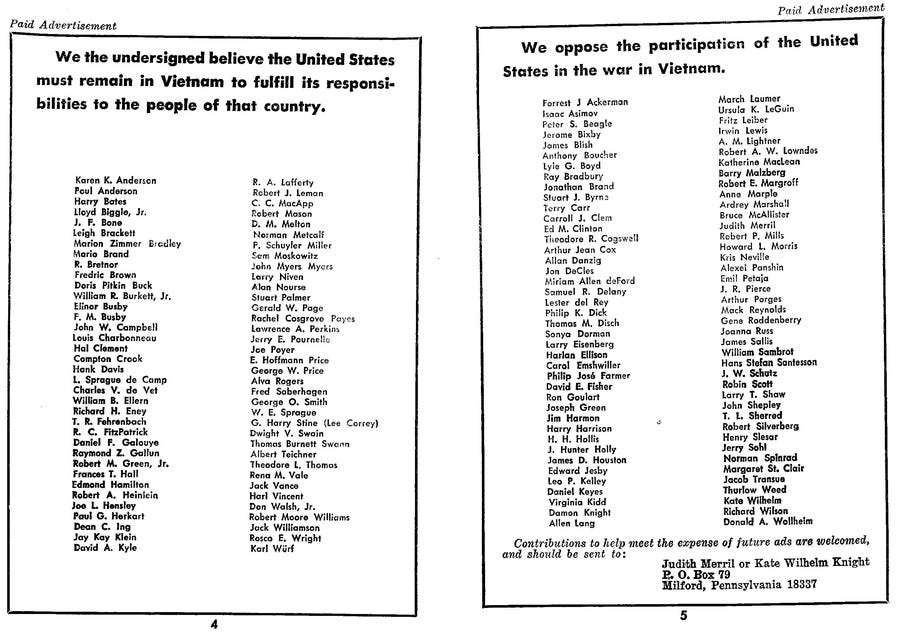
I’m not just pulling this from the text itself in the manner of the New Critics, and I’m not applying Critical Theory to see where Anderson’s novel is a critique of colonialism (though it certainly is that in some ways). I am also pulling from Anderson’s personal philosophy. That philosophy shows that he, like Robert Heinlein, was at minimum sympathetic to a Decline of the West argument. Like many in the Campbell circle, he was a libertarian by conviction and a hawk by temperament. I know that libertarian and hawk are rarely combined in modern libertarianism, but they were far from rare in the mid-century libertarian mindset. After all, it was Anderson who a few years after the publication of The High Crusade would help organize the pro-Vietnam War statement that science-fiction writers ran in Galaxy.
Anderson built The Star Fox around the conviction that a free people must be willing to fight, a sentiment also advanced in Heinlein’s book Starship Troopers. If you read The High Crusade while keeping in mind Anderson’s lifelong political views, you can see a sentimental connection with the thumós argument. Making such an argument does not require me to put words in his mouth, and I won’t. The fact that I don’t have to only strengthens the argument.
The Chronicler and the Machine
The novel would not work without the narrative voice of Brother Parvus. He is our St. Bede, our Saxo Grammaticus. Brother Parvus is where Anderson’s craft shows most plainly. The decision to narrate a star-conquest in the voice of a pious, self-deprecating fourteenth-century friar is the conceit that makes the impossible premise plausible. It is what gets us to suspend our disbelief. Every marvel reaches us pre-translated by Parvus into the medieval mindset. The scout ship is a work of demons or of angels, depending on the day. The Wersgorix are blue devils, until it is seen that they bleed and then they are viewed as men like any other. The star drive is a wonder to be crossed with prayer, which comes to be understood as space becomes navigable by Astrologers. Because Parvus never once steps outside his worldview to wink at us, the reader is never given permission to find the whole thing silly. As readers, we are locked inside a mind for which conquering Heaven’s outer provinces is a perfectly coherent ambition. It is all for the glory of God and Parvus is sincere in his faith. Anderson never mocks Parvus and makes efforts to portray him as a fallible but, in the end, reliable narrator.
Anderson is doing here, on purpose and beautifully, the exact discipline that good worldbuilding demands and that bad worldbuilding fakes. He is not decorating a modern narrator with medieval vocabulary. He has reconstructed a medieval epistemology. He presents us with a whole set of assumptions about causation, hierarchy, salvation, and the proper order of things, and then runs his outrageous plot through it without cheating. This is the same skill that a Dungeon Master uses when a setting has to hold together under improvisational pressure. The focus of game play should not be on “what props are on the table,” or on creating a long list of people or places. Instead, a Dungeon Master should ask what the beliefs in the world are and what consequences follow from them. Anderson’s handling of Parvus is a master class in it. I’d put the book on a designer’s shelf for that alone. The ongoing space crusade is an argument for Jeffrogaxian play as different factions seek to control fiefdoms in planetary systems.
Underneath what some view as comedy there is also a real novel with a real spine, and the spine is Arthurian. Sir Roger loves his wife, the Lady Catherine, imperfectly and proudly. Catherine is drawn toward the charming, cultured, and faithless Sir Owain Montbelle. Everyone but Roger sees Owain’s faults, but Roger merely sees his martial prowess. In the end, Montbelle’s betrayal and his willingness to sell the whole enterprise for a chance to go home and take the hand of Catherine is the Lancelot wound at the center of the story. In this case, the Lancelot is far from virtuous and sows the seeds of discord for his own ends. Anderson is deliberately building the Matter of Britain in miniature into the tale. He gives us the war-leader who founds a realm, a queen, a favored knight who breaks faith, and the founding of a kingdom that will outlast all of them, but he gives us the end we all wanted as a child. A thousand years after the action of the tale, an Earth starship stumbles across the Holy Galactic Empire that Sir Roger’s people built among the stars, and finds a functioning, thriving, faintly absurd feudal-Catholic civilization that has entirely forgotten it began as one afternoon’s misunderstanding in Lincolnshire. It is Camelot, refounded on the far side of the galaxy by people too stubborn and too devout to know it couldn’t be done.
Why this is a Gaming Book
I promised an argument about why The High Crusade belongs on Appendix N as more than an oddity, so here it is in plain terms.
First, it is one of the purest presentations of high concept genre-mashup energy that tabletop roleplaying runs on. Gygax knew this and it’s why the DMG cheerfully offered rules for dragging your AD&D characters into Boot Hill and Gamma World. It’s also why Expedition to the Barrier Peaks put a crashed starship full of ray guns in front of dungeoneers who could only understand it as a magic-haunted ruin. The High Crusade is presented as a solid foundation for multi-faction campaign style play that synthesizes fantasy and science fiction. The High Crusade is, structurally, a roleplaying campaign in which the party wandered into the wrong genre and refused to be intimidated by it. What makes the book work is that it treats that refusal not as a joke but as the source of heroic competence. Every referee who has watched players solve a problem with a tool the module never anticipated will recognize Sir Roger de Tourneville immediately.
Second, it models the thing I keep begging designers to internalize. A setting’s power comes from its logic and not from an itemized list of names and places. Anderson establishes exactly how the medieval mind works and then lets that foundation generate every subsequent surprise. The plot is not a sequence of authorial rescues in the Burroughsian tradition. Instead, it is the disciplined examination of what these specific people, with these specific assumptions, would actually do if they encountered the unknown. That is what a living campaign feels like when it’s working, and The High Crusade is a 250-page demonstration of what a long-term campaign can look like, one that covers over 1,000 years of conflict. Long after Sir Roger and Lady Catherine are dead, adventurers are still questing in the campaign.
And third, Anderson took the games seriously enough to have written a story that accompanies a game based on his novel. In 1983, TSR published a wargame adaptation of The High Crusade. It ran in Ares, the science-fiction gaming magazine that SPI had launched and that TSR was then producing. This is the same magazine ecosystem that gave us DragonQuest and a shelf of tightly designed SF titles. In that issue, Anderson published a brand-new sequel set in the same universe as a companion piece to the game. The story was called “Quest” and it gives us a glimpse into the world after the conquest had begun. The fiction and the game arrived together, in a gaming magazine, as a single artifact. For a publication like this one, that meta connection of game and fiction is perfect fodder for an article, and I don’t think you can review the novel honestly without reviewing its sequel.
“Quest”: The High Crusade’s Version of the Grail Romance
If The High Crusade is Anderson focusing on King Arthur and his conquest of England with the founding of Camelot, the queen, the traitor, and all of that familiar narrative, then “Quest” is the Grail romance that is the natural extension. The first half of John Boorman’s 1981 film Excalibur focuses on the founding and fall of Camelot, but the second half covers the Grail Quest and the connection between the spiritual and the martial. Once you have built Camelot among the stars, there is only one story left to tell, and it is Galahad’s.
The setup is exactly as gloriously literal-minded as you’d hope. A generation or so after the events of the novel, the Holy Galactic Empire that Sir Roger founded is now a going concern with its own capital on a conquered world. This kingdom now turns its attention from worldly conquest to the spiritual as there are more knights than there are battles that need fighting. The short story shows us what would happen if Englishmen carried the Faith to the stars and runs straight to the proper conclusion. These knights would make sure that the most precious relic of that Faith should be found, and if it is no longer on Earth, then it must be somewhere out here, and a good knight is obliged to go looking. Anderson lets his medievals apply their airtight logic to the Grail the same way the novel let them apply it to a starship, and the result is a short and oddly moving story about a culture that has never once doubted that Heaven has a coordinate somewhere in the stars.
Anderson also switches narrators, and the switch is deliberate. Parvus’s humble monkish register belongs to the novel, but the short story is voiced from a different pen. This shift lets Anderson show us the same civilization from inside a different temperament, more knightly, less clerical, and a full generation removed from the original wonder. Our new author is, unlike Parvus, willing to add authorial flair to conversations. The novel was about founding a kingdom. “Quest” is about what a kingdom does once it has nothing left to conquer or found: it goes looking for the sacred.
Is it a minor work by Anderson? Yes, but it is also a very solid one. The piece is brief, its ending is abrupt, and it never pretends to have the same scope as the novel it spins off of. But it is minor in the way a good encore is minor. “Quest” exists to complete something larger and to send you back to the main work with fresh eyes. It also has one wonderfully clever theological trick at its heart. Anderson’s medieval characters construct a perfectly reasoned, internally airtight explanation for why the Grail might no longer be on Earth at all, an explanation that seems silly from our perspective, but is unassailable from a medieval frame of reference. My favorite part of “Quest” is when the characters are interrogating the guardians of the Grail and the priest, who is an alien and not an Earthborn Englishman, brings up numerous heresies during the conversation. I don’t want to spoil anything because this is a delightful and tight tale.
The Verdict
Sixty-some years on, The High Crusade has outlasted an enormous amount of science fiction that others might argue is more “respectable,” and I don’t think the reason is nostalgia. It has survived because its central argument is true, and truer now than when Anderson made it. We are, all of us, citizens of the Wersgor Empire. We are surrounded by capacities we did not build and could not rebuild, our competence increasingly outsourced to systems we no longer understand, mislaying the older human arts of nerve, loyalty, improvisation, and the well-told lie. We have students who use AI to translate A Clockwork Orange from “Old English” to “Modern English” because they never even took the time to read the introduction (which describes the language used in the text) or the lexicon at the back (which provides you the definitions of those words). We are a society that is in many ways losing our thumós, if you want the old word for it. We aren’t necessarily losing it in the bellicose way that a more conservative critique would argue. Rather, we are losing it at an individual level as we pass on our own actions and obligations to machines. Anderson’s free Englishmen are a standing rebuke to the comfortable assumption that the future belongs automatically to whoever has the better technology. Skills atrophy if people rely too much on others or on tools to do the work for them. Culture is the accumulated skill of everyone who came before us, and the fight to keep the best parts of that accumulated skill is what holds us together.
For the gamer and the designer, the lesson is the same but practical instead of philosophical. A world is not its props. It is its logic, and a logic that holds under pressure will generate more genuine surprise than any amount of clever hardware. I love my miniatures and maps, physical and virtual, as much as the next Dungeon Master, but it is the narrative logic that I and the players bring to the table that creates the best game moments. It is the actions and resolutions, and not the props. Anderson built a medieval mind, wound it up, and pointed it at the stars, and every marvelous thing that follows is simply that mind being consistent. Dungeon Masters should run their settings that way and their players will do to their “carefully planned campaigns” exactly what Sir Roger did to the Wersgorix Empire. They will take it in their own directions and you will be delighted, as Anderson clearly was, to be so thoroughly conquered.
Epilogue
Later this week, I’ll be providing a Savage Worlds based supplement for The High Crusade as well as a discussion of how to use Castle Grief’s game Arathi Sector to run your own version of The High Crusade. Both of these systems are perfect for adapting to the setting because Savage Worlds has a large-scale battle system for the non-wargamer and Arathi has unit-scale morale and encounter procedures. Advanced Dungeons & Dragons works perfectly, as it should, for those who want to run the giant 10:1 combats, which probably does include me, but for those who want an abstract resolution of the grand campaign, Savage Worlds and Arathi Sector are perfect.
"Quest" was published in Ares magazine issue 16 along with a lot of other High Crusade goodies.
An Internet search should easily find it on the ol' Archive...
Anderson was extremely prolific, but he was also extremely competent. Those don't always add up...