


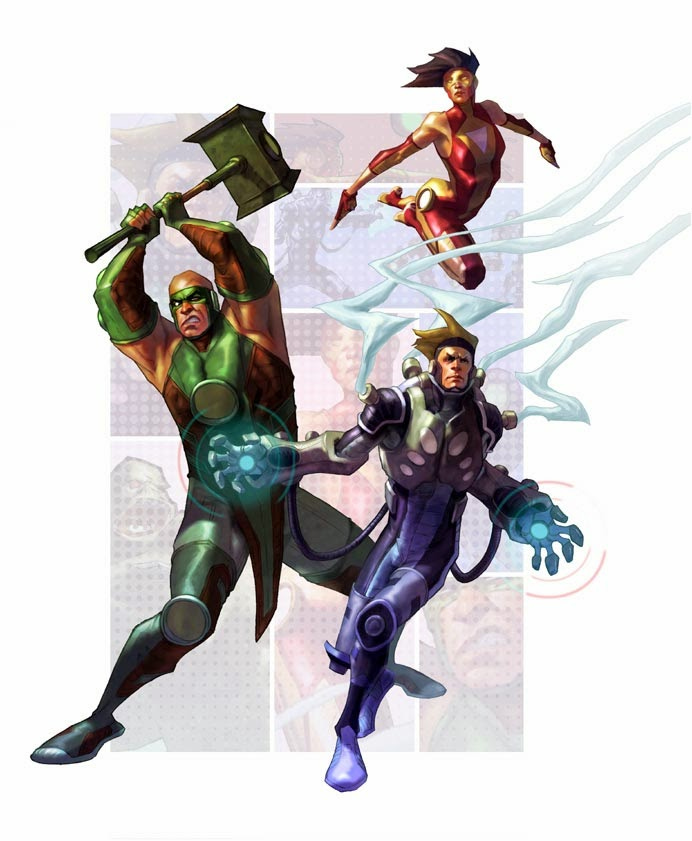
My bi-annual, and updated, lament over games lost.
Over the years, I’ve purchased and run a lot of roleplaying games, but I have a particular affection for superhero roleplaying games. As readers of my past two articles know, my superhero roleplaying game collection ranges from Superhero 2044 to games currently being play tested. I once had a desire to eventually own every superhero roleplaying game ever published, but I’ve abandoned that quest due to the outpouring of games that digital publishing enabled. That doesn’t mean I’m not still on the lookout for new and interesting games in the genre. I very much am, but between itch.io, DriveThruRPG, Lulu, Substack, and random websites with links to cool stuff it can be hard to even find the games that are very much worth my time. What I mean by this, is that there are a ton of games worth experiencing, but that finding them can be a challenge because of how fractured the market has become.
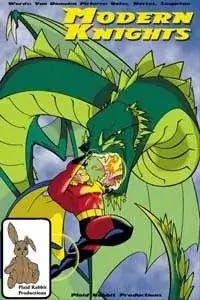
A perfect example of how difficult this can be is Plaid Rabbit’s Modern Knights superhero roleplaying game, which has wandered in and out of publication on that site and isn’t even published by Plaid Rabbit anymore. Wait? You are saying that you’ve never heard of Plaid Rabbit or Modern Knights? They were a part of the growing digital publishing industry in the late 90s and early 00s. Like today, there was a ton of interesting digital content being published and like today a lot of it was quickly forgotten.
Much like Steve Jackson Games’ digital Pyramid, there was a time when finding copies of Plaid Rabbit games was nigh impossible, especially if you are like me and seek to only acquire your games through legal means. A person doesn’t acquire a DriveThruRPG library of 9,380 copies unless that person prefers avoiding digital piracy.

Digital is great, but when material disappears it really disappears and can be impossible to find by any traditional means. Sometimes the only reason older games exist is because of piracy. It really is unforgivable, in my opinion, for digital games to disappear because it’s a format that should allow for truly deep catalog retention due to ease of “shelf space” etc. Publishers have little commercial excuse to pull stuff from the shelves. Certainly, they can pull stuff if they don’t want to offer it anymore because they are embarrassed by it or have come to hate it (like Vincent Baker with Dogs in the Vineyard), but it makes little financial sense to have a past product completely unavailable.
Thankfully both the Steve Jackson Games Pyramid Archive (at Warehouse 23) and Plaid Rabbit’s Modern Knights (via Electric Mulch on DriveThruRPG) have resurfaced in the digital marketplace. There are still other games completely lost to the ether.
As a collector, it’s one thing to worry about digital games that become vaporware. It’s quite another thing to lament over the game that was advertised but never saw the light of day. These are the games that really frustrate me. That’s because these were games that were far enough along in the development cycle that the publishers spend advertising dollars to promote them, or at minimum to offer them for solicitation, and yet no publicly available version exists. Like the second and third boxed sets to Pacesetter’s excellent Sandman roleplaying game, these games are either completely lost or exist as a digital file or random pile of papers in their creators’ homes. If this post on Facebook is correct, those of us who have been wondering who the Sandman is in that wonderfully bizarre game finally have our answer.
Over the years I’ve begun creating a list of these unpublished games, a list of games I’d love to see released digitally or print on demand. Games that are lost to time but need not be.
Today’s post is about three superhero roleplaying games and a “mech” game that I would have loved to see in print. I also hope that the publishers, one that is still in business and two that alternate between existing and not, see fit to at minimum offer these games digitally and regardless of where they are in development. These are games that I don’t need to be released in playable form, but they are games I’d at minimum like to explore for their ideas.
d20 Modern Spectaculars
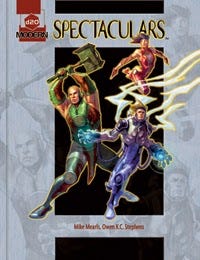
Yes, you read the title of the first game correctly. Wizards of the Coast at one time planned to publish a superhero roleplaying game for there d20 Modern rules set. Wizards had already released a number of high quality products in the line and has made them available online for legacy play. The quality of these games was high enough that any skepticism I might have regarding the ability of the d20 System to smoothly handle super heroic action were dismissed by my enthusiasm. Here’s the advertising blurb for d20 Modern Spectaculars:
New for July in WoTC 2005 calendar:
d20 Spectaculars: New rules for running a d20 Modern campaign in a super-heroic setting.
This new supplement for d20 Modern provides a campaign setting where player characters become the first super heroes. Characters begin with only a few tricks, but as they increase in level they gain fantastic powers. d20 Spectaculars provides everything players and Gamemasters need to participate in super-heroic adventures, including rules for super powers, power trees, new classes, and equipment. A full campaign setting with material and adventure seeds suitable for all levels of play is included.
by Mike Mearls, Bill Slavicsek, Owen K.C. Stephens; 160 pages, $29.95
Let me repeat those designer names again. Mike Mearls (who’s work on D&D was excellent), Bill Slavicsek (Paranoia, Star Wars, D&D, Pokemon Jr.), and Owen K.C. Stephens (a designer who can make the d20/3.x/Pathfinder systems do essentially anything) were the designers on the project. Stephens has been as open as an NDA allows on the subject, but he has made it clear that the designers were paid and treated well even though this product was cancelled. I desperately wish that Hasbro would devote like 60 hours of development to finish the manuscript and put it up on their d20 Modern page. That’s all I ask...that or a super-secret copy of the unpublished manuscript which I will put into a steel vault and never mention to anyone.
If not Hasbro, then maybe Evil Genius will release an Everyday Heroes version of the game. Then again, their focus on licensed games seems to have had the effect that always has on smaller publishers.
Supra-Sentinels
On the opposite end of the “graphic design” and “modern mechanics” spectrum is Judges Guild’s never released Supra-Sentinels roleplaying game. The game would have likely been published in 1983 if Judges Guild hadn’t gone out of business. Based on the publisher, the art, and the advertisements, this game would have been an interesting glimpse into what a late stage old school superhero roleplaying game would have looked like mechanically.
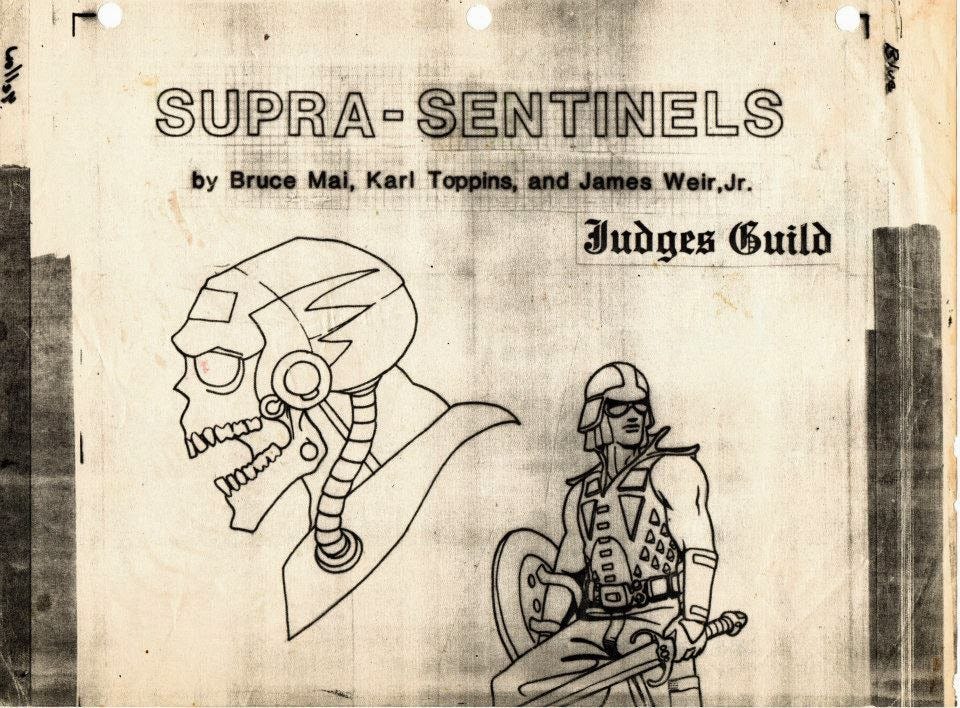
There was some talk by the designers of the game back in 2014 on rpg collector message boards that there was some interest in seeing this game published. Given Judges Guild’s stuttering rebirth in the early 00s, followed by their recent Kickstarter and cooperation with Goodman Games, followed by their later decline it seems like any possibility of it seeing the light of day is gone. Given that Goodman Games had publishing old Judges Guild Journals and modules hardback format without “updating,” I would have loved to see them give Supra-Sentinels a similar treatment. Sadly, Goodman Games and Judge’s Guild have parted company acrimoniously so that looks unlikely.
Proton Fire

Another game lost to collectors was 1985’s “most exciting roleplaying game that never came to be,” TSR’s Proton Fire. The game was far enough in development in order to be solicited to retailers and advertised in TSR’s annual catalog, but it never got published. Like d20 Spectaculars it is one of those games that may have been pretty far down the development pipeline and a skeleton of the game might exist in a box somewhere.
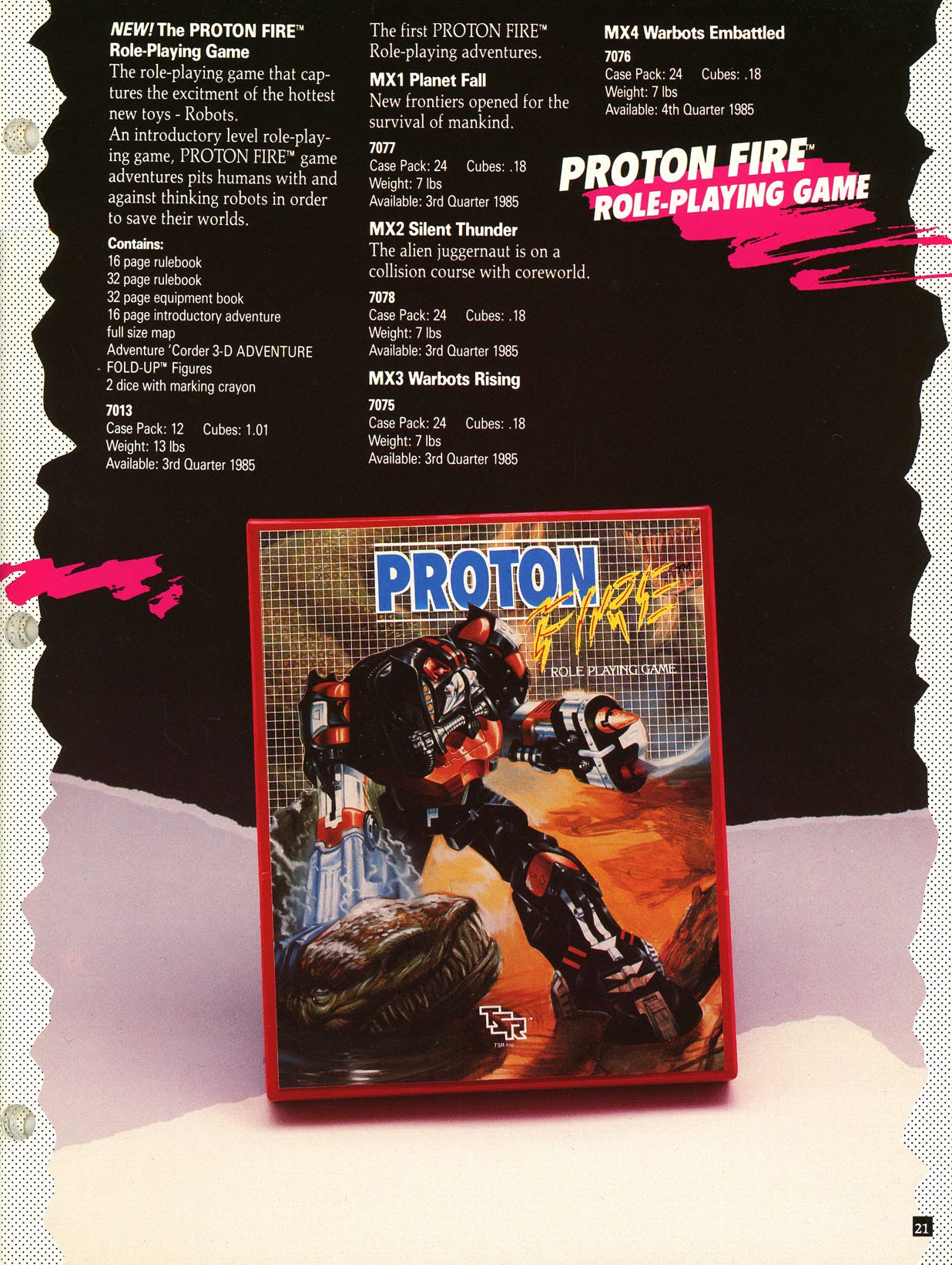
Though the game was never released, it was playtested and heavily promoted. In issue 99 of Dragon Magazine, the Ares section of the magazine included a feature article by Michael Breault discussing the background of the game on pages 76 and 78. You can find copies of those pages around the internet, and they don’t include any mechanics, so I won’t include them here. I will say though that if TSR had managed to release this game, they would have provided some pretty serious competition for FASA’s Battledroids (now Battletech) game.
Battledroids came out in 1984 and was still gaining a fan base. Looking at the proposed materials for Proton Fire, it looks like it would have been more of an RPG than early Battletech and that would have made for an interesting market dynamic. Which would perform better, a tactical miniatures game or a roleplaying game? We’ll never know, but I would love to see the Proton Fire rules if they ever surface.
Superhero 2044 (Second Edition)
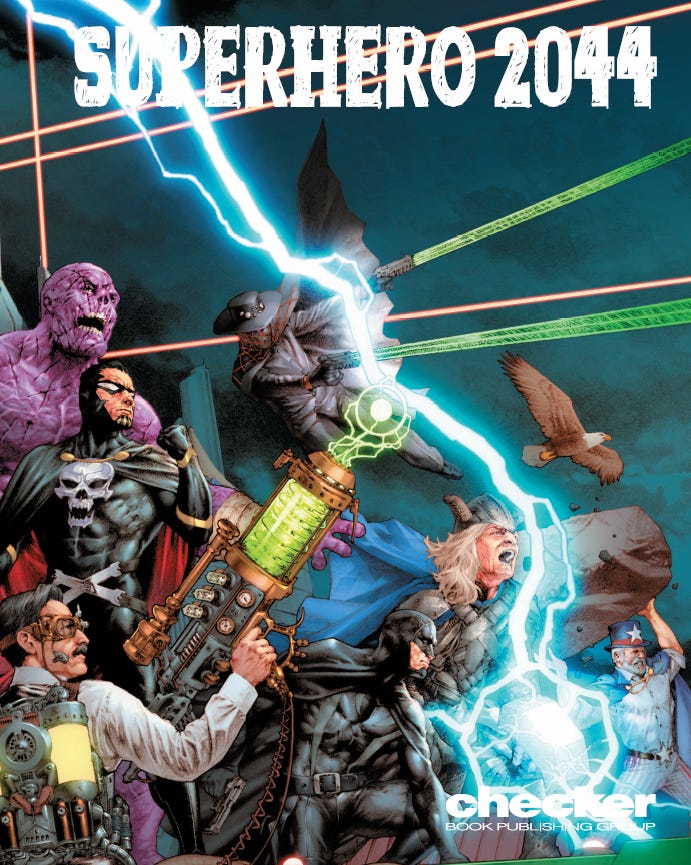
In August of 2017, Mark Christopher Thompson launched an initial Kickstarter that was supposed to fund a “Third Edition” of Superhero 2044 and a corresponding line of miniature figures. The pedant in me can’t stop thinking that it’s a Third Edition of Superhero ‘44 and only the Second Edition of Superhero 2044, but pedants will be pedants. Thompson owned the Checker Book Publishing who had published several volumes of the early Flash Gordon comic strips in hardback omnibus editions. While some have critiqued the quality of those books, I really liked the format and still read my copies from time to time. While the initial goal of $100,000 seemed simultaneously overly ambitious and insufficient to meet the intended goals of the project, I backed the project immediately. It failed spectacularly and was cancelled with only 50 backers. That cancellation was in large part due to the overambitious nature of the project. Good minis require a good distribution partner and Thompson was dreaming bigger than his logistics.
He quickly rebounded and offered a product within his capabilities and strengths. This time he was merely asking backers to support the creation of the game, a game written by Steve Perrin no less. The goal was set at $100 (he already had all the art he wanted to use because a lot of it featured Public Domain Superheroes a subject very dear to the author of the Public Domain Super Heroes Newsletter!) and just needed money to pay Steve and the printer. Thompson promised to publish the book at a loss. Steve Perrin worked hard on the game, and I have three different playtest drafts that I cannot discuss in detail because I signed an NDA on one draft and want to be respectful on the other drafts. I will say that it is very much a Steve Perrin design and it moves away mechanically from the original game.
I would desperately like to see this game in print. It is so close to being publishable. In fact, I think it is publishable with some layout changes and copyediting. Sadly, Thompson is caught in the cycle that so many people who miss deadlines find themselves falling into. He wants the game to be perfect, when all we want now is for the game to exist. It’s worthy of existence. It deserves to be played. It’s Steve Perrin’s last game, so I’d go with one of the 2017 rules sets and not the 2022 one, and I’d love to see the master designer’s final game see the light of day. It’s not perfect, and fandom would be mean, but I would be overjoyed.
Conclusion
I honestly don’t know what the market outside of “me” looks like for these products or games like them, but I would purchase them in a heartbeat. I’d even try to get my players to play them for a spell and would pay another $50 for the Superhero 2044 edition.
While Thompson likely owns the rights to publish Superhero 2044 in perpetuity now (Donald Saxman’s Estate could override that, but Saxman is dead), so I don’t think anyone will be designing a Third Edition to follow Thompson’s Second but I’d love to see that happen. I’m still interested in doing a retroclone of the original Superhero 2044 (called something else naturally). Rules aren’t copyrightable, though the particular expression is, and mine would include the rules additions by Wayne Shaw who has given me permission to use them. Even though Thompson hasn’t delivered the Second Edition, I’m pretty forgiving because I have seen the work done on the project and it was done in good faith. Given that Gareth Skarka’s Far West was finally released (another long delayed Kickstarter I backed), I have hopes that the 2nd Edition of Superhero 2044 will eventually see the light of day. I
The edition I’d like to produce would include excerpts from the interview I did with Wayne Shaw and discuss the influence that Superhero 2044 had on the superhero game genre. It would include notes on how the combat system influenced future games and would be as much an academic cultural artifact as a game. Speaking of which, here’s the initial draft (unfinished) of the combat tutorial I put together for Superhero 2044 back when tigers used to smoke. I think it could serve as a good foundation for the retroclone.

What do you think? Should I give the retroclone a go? Does anyone want to join me on that endeavor?