As is often the case here, I am a little late on finishing off a series of posts, but I am still within my regular “one article a week” schedule. I’ll be aiming for two a week starting in September, but I am adjusting to a new job and my daughters are starting college so there are a bunch of life changes going around.
As I mentioned before, I have picked up on Professor Dungeon Master’s concept of July as Independent Gaming Month and curated a list of games that appeal to the whole spectrum of gamer types that Robin Laws presents in Robin’s Laws of Good Game Mastering. Dividing gamers into this kind of taxonomy originated with early game theorists and roleplaying enthusiasts in the California Scene. Steven Horst and Glen Blacow discussed the concept in Different Worlds #10, where Horst described gaming styles using the term “Theory of Play,” while Glen Blacow called them “Aspects of Adventure Gaming.” In issue #11 of Different Worlds, Jeffrey A. Johnson (who would later go on to design the Temple of Apshai series of games) used Blacow’s “Aspects” as dimensions for a kind of “ideological gaming space” where players weren’t seen as absolutist in their aspects, rather as falling somewhere in an ideological map. Essentially, the roleplaying game equivalent of the famous DW-Nominate Scores we use in political science. Tools like this let you see if politicians have multi-dimensional beliefs or if their beliefs (measured by voting patterns) change over time.
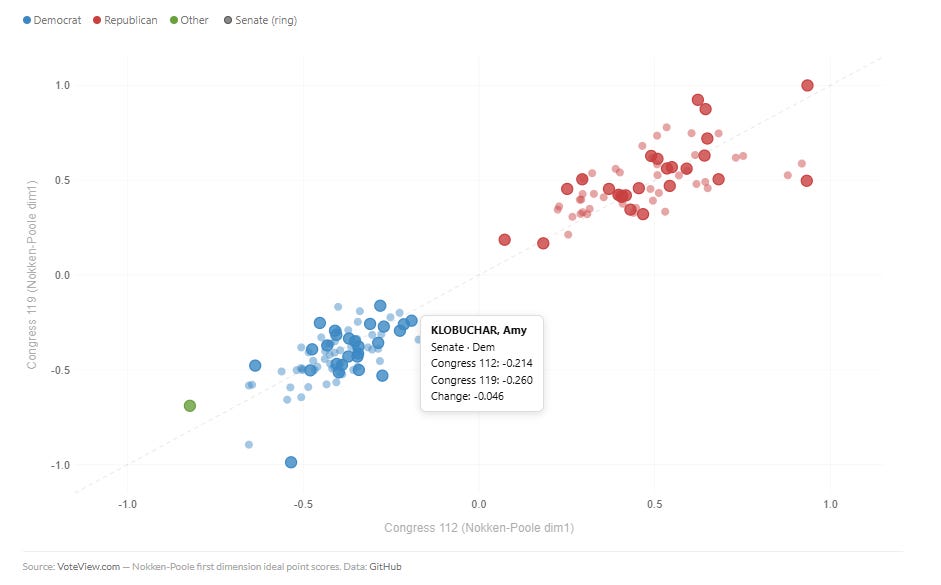
While I really like the Cartesian model that Jeffrey A. Johnson designed, I think that broad classifications are much easier to imagine and design for than specific places on a grid. I might have my students take the Political Compass survey every year, but it is much easier for them to understand Pew’s categories than placement on the Compass. Feel free to take these quizzes and report your results, you’ll get no judgement from me.
Looking at the various articles, you can see a nice expansion of the concept over time, and I tried to provide games for all these groups.
Steven Horst's "Theory of Play"

     1. Personality Projection
     2. Role-Assuming
     3. Directed Development
     4. Undirected Development

Glenn F. Blacow's "Aspects of Adventure Gaming."

     1. Power Gaming
     2. Role-Playing
     3. Wargaming
     4. Story Telling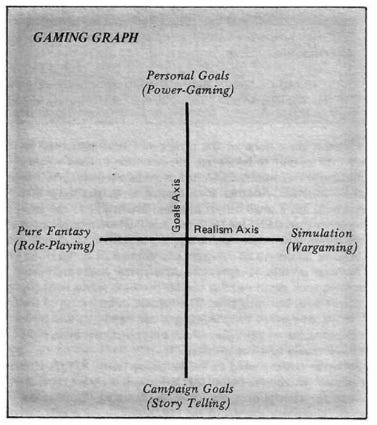
Robin Laws’ Player Types:

     1. The Power Gamer
     2. The Butt Kicker
     3. The Tactician
     4. The Specialist
     5. The Method Actor
     6. The Casual Gamer
Discussion of what each of these types means within each taxonomy will be the topic for a future post, where I will also likely add a couple additional types to Robin’s list in order to incorporate more recent developments in roleplaying like what the BROSR are doing with perpetual Braunsteins and adversarial play. This style of play is unique enough to warrant its own term, even as it would fall somewhere within a Cartesian ideological space.
It’s the Final (Indie) Countdown!!!
July 1 — Colonial Gothic (It’s the 250th Anniversary of the United States after all. His Kickstarter didn’t succeed, but it’s a great game and you should 100% check it out.)
July 2 — Good Guys Finish Last
July 3 — Champions
July 4 — Dragon Warriors (I’m a big fan of Dave Morris and Oliver Johnson’s work and will be reviewing their Blood Sword gamebooks and the RPG I backed on Kickstarter back in the day soon. I’ll also be reviewing Mortal Combat and Dagon Warriors.)
July 5 — Troika
July 6 — Savage Worlds
July 7 — Castle Falkenstein
July 8 — Fantasy AGE role playing
July 9 — Inspectres
July 10 — Warhammer Fantasy Roleplay (Which will have a new edition soon)
July 11 — Traveller
July 12 — Hero Kids (Gaming isn’t just for Grownups)
July 13 — Beach Patrol (Combine this and Tiny Spies and you’ve got Miami Vice)
July 14 — Runequest (from the creator of the Perrin Conventions)
July 15 — Dragonbane
July 17 — Villains & Vigilantes Monkey House Games Edition 2.1 (I’ll be reviewing all three editions soon)
July 18 — Age of Sigmar: Soulbound (I honestly don’t know why Brandon Sanderson didn’t just license this system for his Cosmere RPG)
July 19 — Masks: A New Generation (Second edition coming soon)
July 20 — Mazes
July 21 — Symbaroum (Traditional “Faerie” Fantasy done right)
July 22 — Leagues of Adventure (Paul “Wiggy” Wade Williams is one of my all-time favorite designers)
July 23 —My Life with Master
July 24 — Shiver
July 25 — Mothership
July 26 — Never Going Home
July 27 — Tunnels & Trolls may technically break the “in
July 28 — Vaesen

July 29 — Lasers and Feelings
With the recent release, and disappearance of Critical Role’s Candela Obscura roleplaying game, there has been a bit of chatter about John Harper as a game designer. I know people who play a variety of games, but I don’t know anyone who plays Candela Obscura. Even Beadle & Grimm’s support, a pdf expansion, has been lukewarm. All that said, I think it is an interesting game, but it’s hard to compete with Call of Cthulhu and Vaesen in the horror space.
Harper was discussed because he designed Blades in the Dark, a game that stands on the shoulders of many indie rpg giants like Apocalypse World and Inspectres (see the earlier entry above). Blades in the Dark incorporates a number of player agency and troupe play mechanics in a way that deeply merges mechanics and genre. If you haven’t checked that game out, do so. It was one of the major mechanical and style influences for Candela Obscura and is worth your time, so much so that many accused Critical Role of ripping it off. This accusation tied to the fact that early release pdfs of the game did not include reference to Harper’s creation, but as noted in the section on Inspectres Harper himself neglected to mention all of his influences. Controversy aside Candela Obscura is worth checking out, but I don’t know if it will catch on.
As for John Harper, when he isn’t designing independent games that result in very successful Kickstarter campaigns, he’s out there providing robust roleplaying game material for free. One of the best examples of his design philosophy, and of a subset of story gaming in general, is his game Lasers and Feelings. This game is a one-page role playing game that allows you to play adventures that explore strange new worlds and go where no one has gone before in minutes.
The base conceit for design in Lasers and Feelings is that most of the conflicts in everyone’s favorite weekly version of Wagon Train among the stars are resolved either with Lasers or with Feelings. Our rogue captains, be they Kirk, Burnham, or Pickard, are either blasting the crap out of foes, engaging in romantic interludes, or persuading the aliens to be peaceful with heartfelt appeals. It really is an elegant, if reductive, examination of the genre.
Because of this assumption, the game only needs one statistic, LaserFeelings. This is a number that ranges from 2 to 5. Any roll above that number succeeds at actions that require lasers (fighting etc.), which any roll below that number succeeds on actions that require feelings (romance/persuasion). If you roll the number exactly, you experience “Laser Feelings” and not only succeed but get some additional insight into the conflict/story you are engaging in at the moment. It’s a very simple, but very powerful system. There is a little more to the system, but the key innovation and genius is in this part of the mechanic. One could have designed it it by having two complementary stats (Lasers and Feelings) that must total 7, mirroring Pendragon’s Pagan vs. Christian virtues, but having it be a single number is quite elegant.
There are a HUGE number of Lasers and Feelings derivative games, including the superhero game Zam! Pow! Spork! and tons of games on itch.io. This is a game designed with the Method Actor in mind.

To boldly go where no wolf has gone before.
At fara djarfliga þangat, es engi úlfr hefir áðr farit.
July 30 — When the Wolf Comes
I love me some Ragnarok themed roleplaying games and When the Wolf Comes by Ian Stuart Sharpe takes that them and combines it with Robert Schwalb’s excellent Shadow of the Demon Lord role playing game. After Rob Schwalb left Wizards of the Coast, post-4th edition D&D, he did two things. First, he wrote a great article that convinced me that one of the major reasons people “hated” 4th edition so much was the layout. The other major reason I believe people hated 4e was that it had marketing that told D&D fans that they sucked. The more things change, the more they stay the same (I’m looking at you OGL debacle). The second thing Rob did was design a game that proved his point.
Shadow of the Demon Lord is one of three excellent games based around mechanical innovations in the 4th edition D&D game, the other two are 13th Age and the 4e based Gamma World. Interestingly enough, Schwalb’s game may be based on, and inspired by, the mechanical innovations of 4e, but the game plays vastly differently. Yes, both use d20s and players gain levels which give them powers, and that’s a lot of similarity, but it is very much a different game. One of the key differences is in the initiative system. In traditional D&D, you roll for initiative. That is not the case in Shadow powered games like When the Wolf Comes. In Shadow games players select whether they want to act “Fast” or “Slow.” If they chose to act fast, their characters go first but must choose between moving and taking an action for their turn. If they choose to go slow, they can both move and take an action, but they go after GM characters. It’s a simple system that adds player agency while also making players take tradeoffs into account.
Thematically, When the Wolf Comes really shines. Imagine if you will that Odin wanted to stop/delay Ragnarok and so he gifted his worshipers the gift of gunpowder in the 9th Century, at the peak of Viking exploration. The “Dane” raiders subsequently wipe out Christianity and explore the stars. It’s a great premise and the combination of back story and art give the game a very Cosmic Kirby feel. Imagine if Kirby’s version of Asgard had started on Midgard and you’ve got a slight sense of what the game looks and feels like. I admit that I have a soft spot for “Odin stalls Ragnarok” stories. I played in a GURPS Supers game where we played the Asgardian Gods fighting Ragnarok in modern America, only to discover that we were clones fighting a false Ragnarok and in doing so we delayed the real one. It was a campaign that echoed the Eternals crossover storyline in the Thor comics in Thor Annual #7 and The Mighty Thor #283. My own personal take is that the Völuspá is all a ploy by Odin to fool the giants into thinking they will win Ragnarok no matter what so that Odin can buy time to build the armies of Valhalla large enough to win. He is a trickster after all, like his blood brother who may just be in on the ruse.
All that aside, I love the setting for this game and have enjoyed reading the pdf. I cannot wait until the physical version is available.
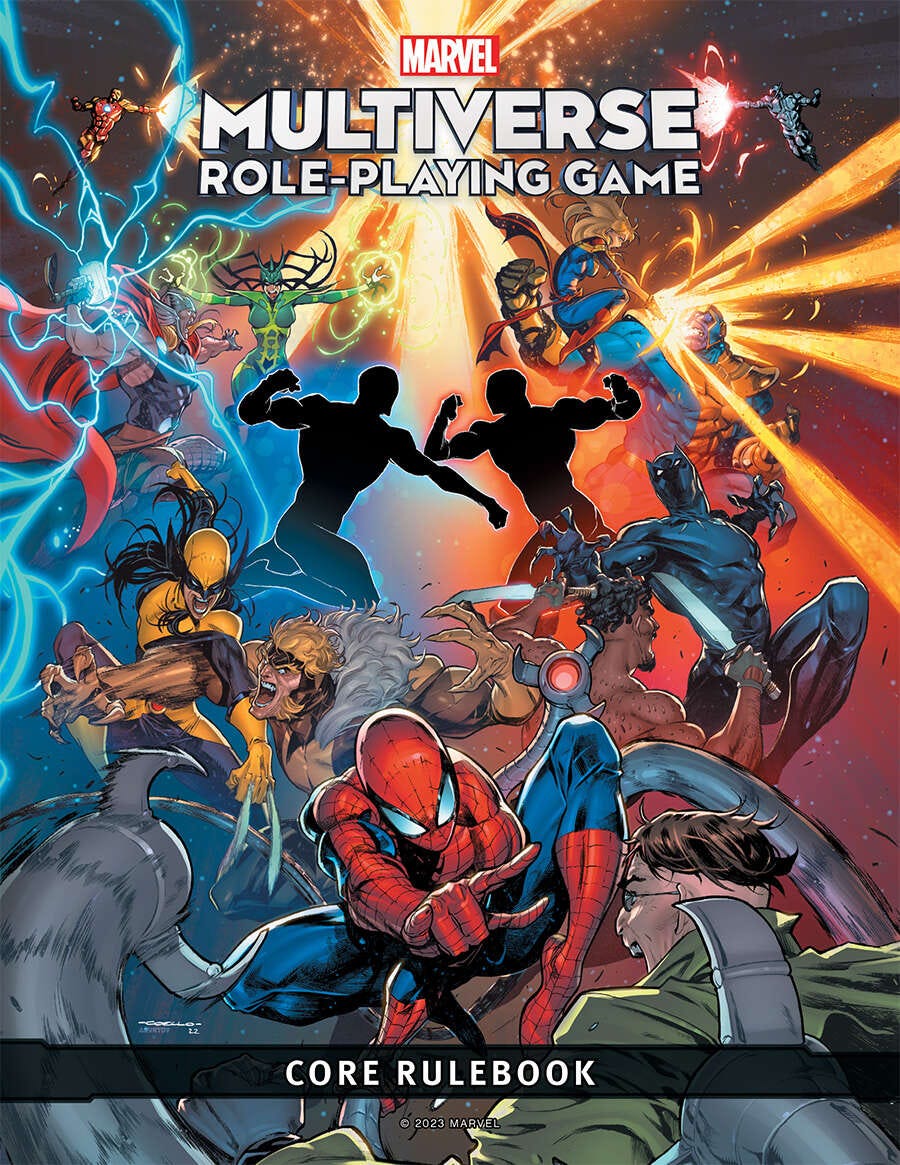
July 31 — Marvel Multiverse Role-Playing Game
I’ll be posting a review of Free League’s Invincible Roleplaying Game soon, but it is entering the market in an era of strong superhero inspired competition. Matt Forbeck’s Marvel Multiverse Role-Playing Game is the latest entry in a long string of high-quality games based on the property. The game was written and designed by my friend Matt Forbeck, so take my recommendation with a dose of “friend flavored salt.” Matt has worked on a ton of roleplaying games that include the TSR Marvel FASERIP system, Champions/Hero System, Brave New World, and the more recent Marvel Heroic Role Playing Game from Margaret Weis Productions.
The new Marvel Multiverse Role-Playing Game is a fantastic combination of the concepts and mechanics of all of those games in a way that allows for both tactical and theatre of the mind play. I promise that I will have a long, very long, formal review of the game soon where I will touch upon many of its influences and address why I think some of the people critical of the game are wrong. When the majority of complaints are disagreements regarding stat blocks, and not how the game plays, you know one of two things. Either the game plays just fine and is encouraging discussion, or that too many people only read roleplaying games and don’t actually play them anymore.
What’s Coming Soon on Geekerati
In the coming weeks, I’ll be reviewing two movies (Private Detective 62 starring William Powell and The Lady in the Lake starring and directed by Robert Montgomery). The first is a depression era detective story that includes a dash of prewar espionage, romance, and a twist on a classic con artist plan. William Powell is, as always, delightful, but you’ll have to wait for the rest of my commentary.
Robert Montgomery’s film is an adaptation of the Raymond Chandler novel of the same name, and it features Chandler’s iconic detective Philip Marlowe. The basic plot of the film is solid, but what sets this film apart for good or ill is the fact that it is filmed entirely in the first person. That’s right, before there was Hardcore Henry, there was The Lady in the Lake. The film has received a lot of flak for the gimmick, but like most such criticism the critics are making too much of the gimmick while ignoring the craft behind it. And there is craft behind it. Is it enough the save the film? You’ll have to wait for the review.
Last, but not least is my upcoming review of the Invincible Roleplaying Game. While the game is based on the comic book and Amazon series, the game is designed to be flexible enough to play any comic book setting. I’ll have comments on the quality of the game, how it plays, and some character write ups from Marvel and DC. The Kickstarter raised enough money that the company promised to release an Open License for the Superhero adaptation they did to the Year Zero Engine, but that has yet to be included in the current System Reference Document. When it is, I might just use it for my own game, though I am currently working on a Fighting Fantasy Gamebook inspired system.