


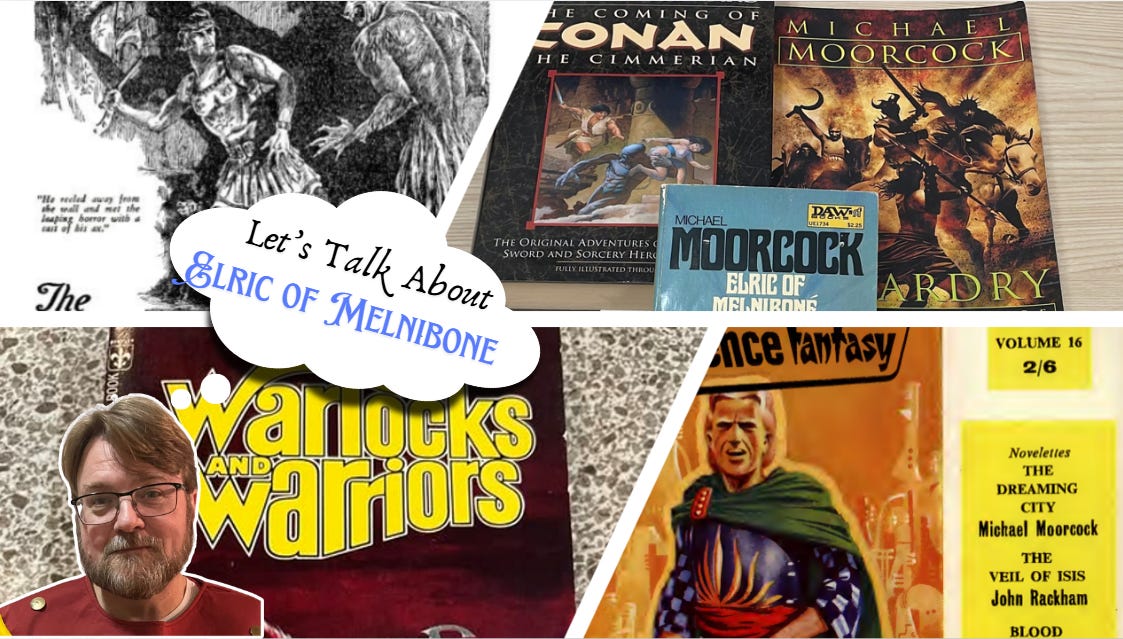
Before I begin my essay on Michael Moorcock’s first Elric novel, and how it has influenced how I view fantasy and the world, I’d like to announce Geekerati Media’s first giveaway. I am offering to any subscriber who lives in the United States (paid or unpaid) a copy of L. Sprague de Camp’s Warlocks and Warriors anthology. It was his fourth Sword & Sorcery anthology and it contains a number of fantastic stories like:
“Turutal” (Ray Capella)
“The Gods of Niom Parma” (Lin Carter)
“The Hills of the Dead“ (A Solomon Kane story featuring Vampires by Robert E. Howard)
“Thunder in the Dawn“ (Henry Kuttner)
“Thieves’ House“ (Fafhrd and the Grey Mouser by Fritz Leiber)
“Black God’s Kiss“ (Jirel of Joiry by C. L. Moore)
“Chu-Bu and Sheemish“ (Lord Dunsany)
“The Master of the Crabs“ (Clark Ashton Smith)
“The Valley of the Spiders” (H. G. Wells)
“The Bells of Shoredan“ (Roger Zelazny)
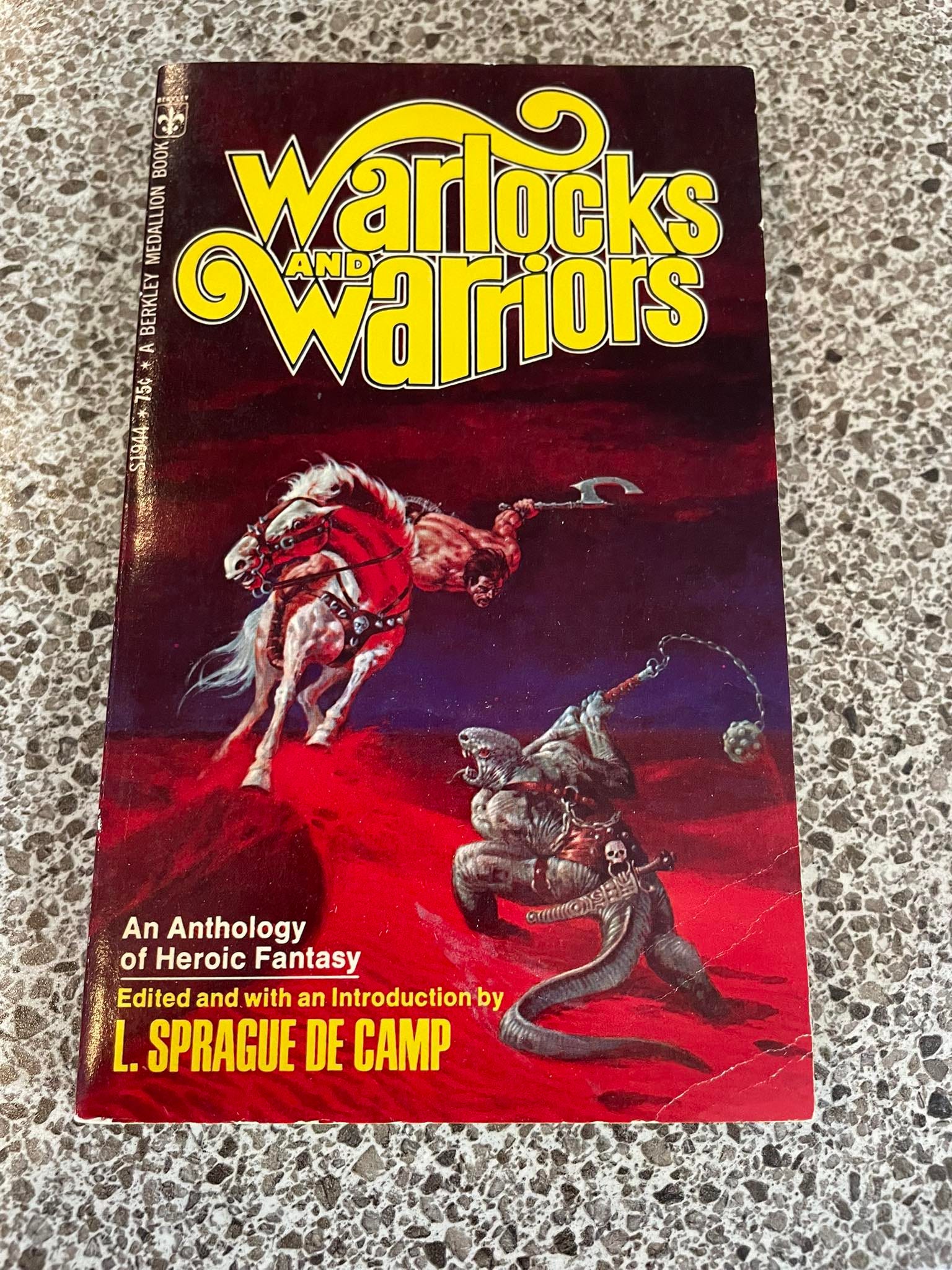
All you need to do to have a chance to win the volume is fill out this brief survey (link now closed). While the survey is open to all subscribers, you might consider becoming a paid subscriber so I can do more of these with even bigger prizes. I’ve said that it’s limited to subscribers in the United States, but if you are willing to pay shipping I’m willing to ship anywhere. I will close the survey on April 15th, 2026 and announce the winner shortly after that.
Now…on with the Newsletter.
How I Discovered Michael Moorcock and Sword & Sorcery Fanatasy
I still remember the exact moment I first encountered Elric of Melniboné. It was the fall semester of 7th grade and I was in a bit of a competition with my friend Mark over who could find the most interesting books and games. It began when I brought a copy of the Dungeon Masters Guide (sic) to school, which he thought was amazing, and continued when he brought in a copy of Tunnels & Trolls and expanded my knowledge of role playing games exponentially in one day.
The exchanges continued to escalate to the point that they initiated what I now call the “Sweet Pickles War” of 7th Grade. That was a war that cost me a friend and I never should have initiated it, but for the six months or so that we were close friends I learned so much from Mark that I am ever grateful for. I do think we would have mended our friendship had I not moved from Reno to the Bay Area, but maybe some day I will find him on the Book of Faces or on some geek site and reconnect. I really wish I could because he was a great guy and I fondly remember our time as friends.
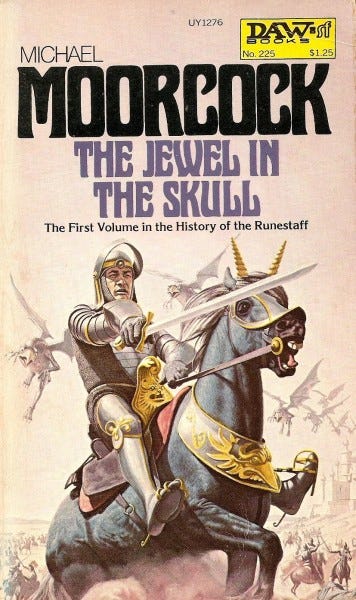
At one point during our pre-Sweet Pickles War conversations, Mark made a point of telling me that what he was reading was “way more badass” than anything I’d encountered and he showed me a copy of Jewel in the Skull by Michael Moorcock. The cover was painted by Richard Clifton-Dey (who eventually painted covers for Blue Öyster Cult) and the weird winged creatures in the background of the painting, as well as the title, hinted at things I wanted to know more about. At that age, I felt like a genuine gauntlet thrown down and II rushed out to my local used paperback store to find every book I could that was written by Michael Moorcock so that I could keep up.
I was able to find most of the Elric saga (with the amazing Michael Whelan covers) and a couple of Corum novels in my first haul. At the time I didn’t know what an antihero was, or what it meant to “deconstruct” a genre. I didn’t fully understand what the Greeks meant by Tragedy either. Sure, I’d read Edith Hamilton’s Mythology, which my true introduction to the wonders of the imagination, but I was clueless about literary tropes. By the time I finished collecting and reading the full Elric Saga, I understood both.
What I didn’t know then, and what took me years to fully appreciate, was that Moorcock was my entry point into the genre of literary fantasy. Sure, I’d read Edith Hamilton and Roger Lancelyn Green’s adaptations of mythologies. I was familiar with some tropes that fantasy built upon as echoes from the distant past, but I wasn’t familiar with the genre. Yes, I owned the Dungeon Masters Guide, but I hadn’t read anything in Appendix N. My gateway into fantasy was the fantasy of deconstruction and despair.
I came to Tolkien, Lewis, and the hopeful tradition only afterward, which means I experienced the tropes of fantasy in reverse order from most readers. And here’s the thing about that: when you’ve grown up on tragic, deconstructive fantasy, traditional high fantasy doesn’t feel like the baseline. It feels like the innovation. For me, the eucatastrophe, which was Tolkien’s own word for the sudden, joyful turn, hits harder than any other kind of ending. When you’ve been trained by Moorcock to expect what I now call “the 70s ending” any sign of hope and the triumph of good over evil feels fresh.
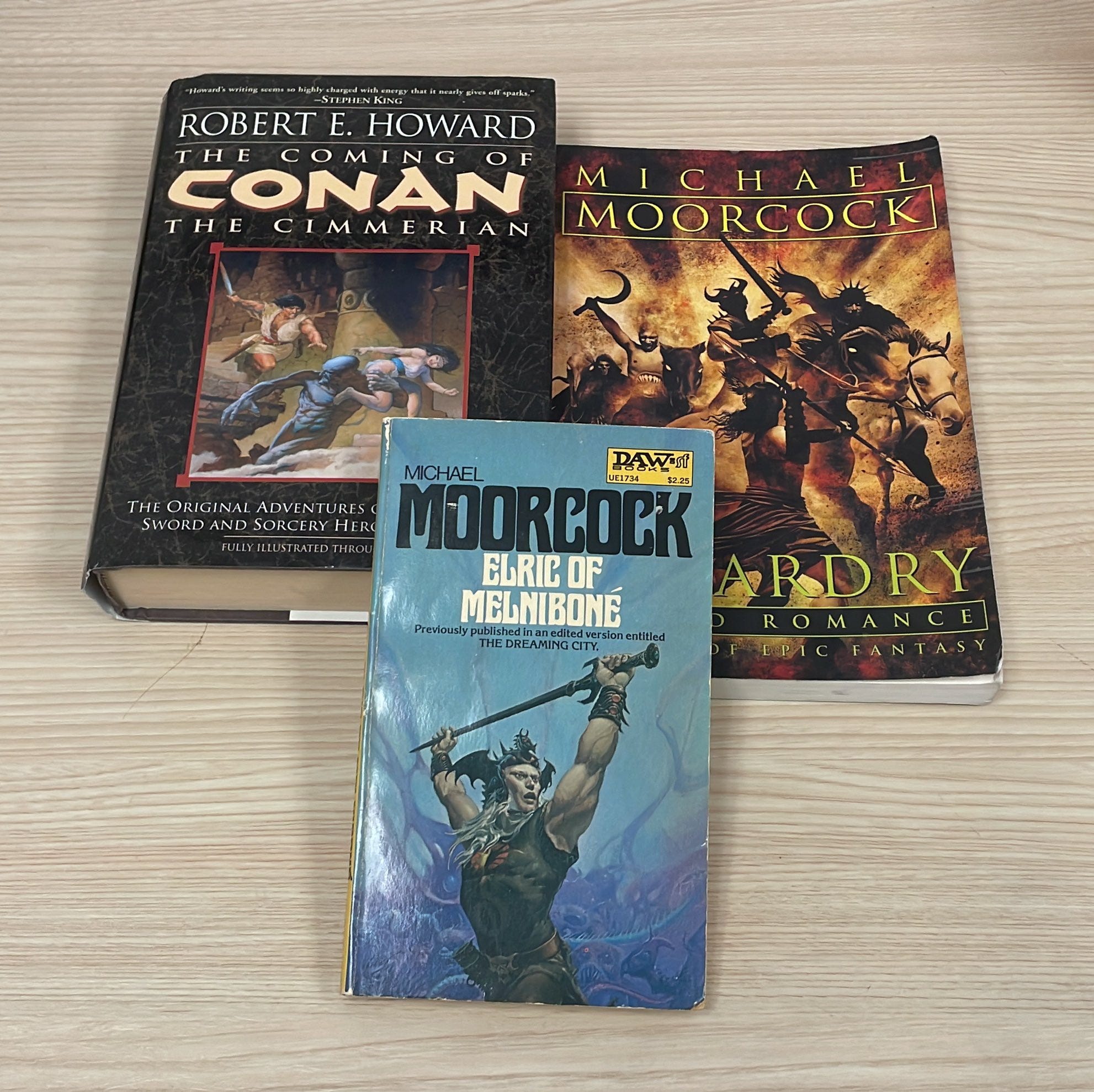
All of which is to say: I am not a neutral party here. Michael Moorcock is the benchmark by which I evaluate all fantasy, but I’ve been thinking about Elric of Melniboné again lately, and I want to make an argument that I think gets lost in most discussions of where Elric comes from and what his character really represents in the fantasy genre. In fact, I want to argue that he isn’t as much a deconstruction as people think, even as he is one of a particular sort. By the way, isn’t that Michael Whelan cover (above) super badass? You know you want to read that book. It is so much better than the graphic design stuff we see today.
People often talk about Moorcock as a critic of fantasy and many mistakenly think his critiques might apply to the writings of Robert E. Howard. They cite his essay “Epic Pooh” (which is available in an excellent Monkeybrain Books edition featured in the image above), his New Wave manifestos, his impatience with what he saw as reactionary fantasy, and they conclude that Elric is essentially a rebuke of Conan. After all, the sickly, introspective albino seems in many ways to be raised up specifically to knock the vital, uncomplicated barbarian off his pedestal. And there’s truth in the argument that Elric is a response to Conan, but thinking he is a critique misses something essential.
Moorcock was obviously, unmistakably, a massive Robert E. Howard fan. G.K. Chesterton is often misquoted as saying something similar to, “to make fun of a thing, you must love it,” when he really wrote (in his biography of Robert Browning), “A man must love a thing very much if he not only practises it without any hope of fame or money, but even practices it without any hope of doing it well. Such a man must love the toils of the work more than any other man can love the rewards of it.” Regardless of the authenticity of the quote, or the truth of the real one, I find myself agreeing with the manufactured quote. I cannot read Mark Twain’s deconstruction of James Fenimore Cooper’s Leatherstocking Tales without seeing the love emanating from each snide remark. The essay is a litany of the pedantry of the nerd, the deeply affectionate nerd. Sure, there’s a bit of parricide going on where Twain presents his work as more sincere and worthy of merit, but there is also a joyous appreciation that other fans of Hawkeye see immediately.
I am firmly of the opinion that you cannot write a worthwhile deconstruction of something you don’t love. A part of the problem with Rian Johnson’s The Last Jedi is that it references the original Battlestar Galactica than it does Star Wars. It is deconstructing something other than what it intended. It subverts expectations, to be sure, but only if your expectation was that Starbuck and Apollo were going to pull of their casino heist and rescue. It abandons Finn as a character, in an inexcusable way, and demonstrates a complete lack of understanding of the tropes of the franchise.
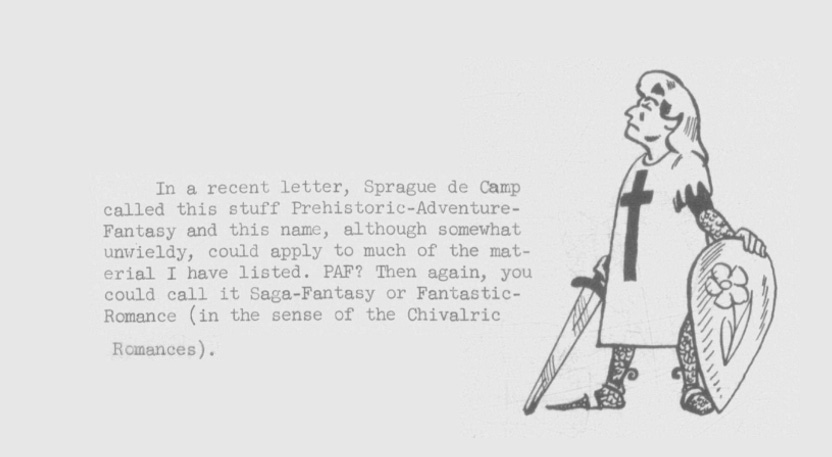
In the case of Moorcock, and Elric, the love is there on the page, and the evidence is not merely in the text. It’s in the historical record. In May of 1961, Moorcock was writing letters about the nature of Heroic Fantasy to Amra, the Conan fan community fanzine, debating genre definitions alongside Fritz Leiber and other luminaries of the field. He was, in other words, an active participant in the Conan fan community at the precise moment he was introducing Elric to the world in the pages of Science Fantasy.
He wasn’t standing outside the Howard tradition lobbing critical grenades. He was inside it, sleeves rolled up, arguing about what the genre meant and where it should go. Later, in Wizardry and Wild Romance, he would describe Conan with unmistakable affection and insight, writing that Howard’s barbarian was “forever at odds both with the respectable world and the occult world; forever detecting plots to seduce him.” This is a description that applies with equal precision to Elric, which is entirely the point.

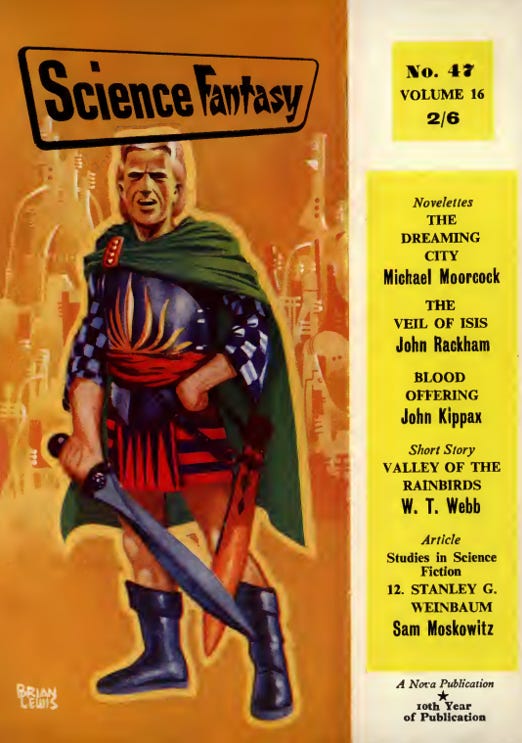
The evidence is also right there in the text of the very first Elric story Moorcock ever published. The character first appeared in “The Dreaming City,” in Science Fantasy magazine in 1961. Let’s compare the opening of Howard’s first Conan story, “The Phoenix on the Sword,” to Moorcock’s introduction of Elric eleven years earlier in internal chronology but just a year later in publication:
Howard gives us:
“KNOW, oh prince, that between the years when the oceans drank Atlantis and the gleaming cities, and the years of the rise of the Sons of Aryas, there was an Age undreamed of, when shining kingdoms lay spread across the world like blue mantles beneath the stars... Hither came Conan, the Cimmerian, black-haired, sullen-eyed, sword in hand, a thief, a reaver, a slayer, with gigantic melancholies and gigantic mirth, to tread the jeweled thrones of the Earth under his sandalled feet.”
And Moorcock answers with:
“For ten thousand years did the Bright Empire of Melnibone flourish—ruling the World... Such a one was the cynical, laughing Elric, a man of bitter brooding and gusty humour, proud Prince of ruins, Lord of a lost and humbled people; last son of Melnibone’s sundered line of kings. Elric, the moody-eyed wanderer—a lonely man who fought a world, living by his wits and his runesword Stormbringer... reckless reaver and cynical slayer—torn by great griefs and with a knowledge locked in his skull which would turn lesser men into babbling idiots.”
Read those two passages back to back and you are not reading a rejection. You are reading a conversation. Not just any conversation, but an intensely respectful one, conducted between two writers across time. This is the perfect articulation of T.S. Eliot’s argument in The Sacred Wood. In that piece, Eliot argues:
No poet, no artist of any art, has his complete meaning alone. His significance, his appreciation is the appreciation of his relation to the dead poets and artists. You cannot value him alone; you must set him, for contrast and comparison, among the dead. I mean this as a principle of aesthetic, not merely historical, criticism. The necessity that he shall conform, that he shall cohere, is not one-sided; what happens when a new work of art is created is something that happens simultaneously to all the works of art which preceded it. The existing monuments form an ideal order among themselves, which is modified by the introduction of the new (the really new) work of art among them. The existing order is complete before the new work arrives; for order to persist after the supervention of novelty, the whole existing order must be, if ever so slightly, altered; 45and so the relations, proportions, values of each work of art toward the whole are readjusted; and this is conformity between the old and the new. Whoever has approved this idea of order, of the form of European, of English literature, will not find it preposterous that the past should be altered by the present as much as the present is directed by the past. And the poet who is aware of this will be aware of great difficulties and responsibilities. — T.S. Eliot, The Sacred Wood
Every artist is in dialogue with the past and Moorcock is in dialogue with Howard in a beautiful and appreciative way. Elric is the mirror universe projection of Conan and you can see it in the prose. The architecture is identical. Both open with a sweep of lost civilizations, of ages before history, of drowned empires and vanished glories. Both pivot with that emphatic “hither” energy, here is your man, now let me tell you what he is, and both pile on compound epithets in the same bardic, Homeric rhythm. “Thief, reaver, slayer” becomes “reckless reaver and cynical slayer.” “Gigantic melancholies and gigantic mirth” becomes “bitter brooding and gusty humour.” Moorcock is not dismantling Howard’s template. He is playing it like an instrument, transposing it into a different key.
The differences in that transposition are where the philosophy lives, and they run deeper than Elric’s pallor and drug dependency (itself worthy of further exploration since he doesn’t have this dependency so long as he kills enough people with Stormbringer). To understand the differences and similarities of philosophy, it helps to look closely at what Howard was actually doing in The Phoenix on the Sword, which I’ve written about before in the context of Conan as a patron of the arts, and which repays attention here.
Conan the Patron of the Arts?

As a fan of pulp fiction, I am continually impressed with how Conan remains a resonant character for modern audiences. The character live in the psyche of the popular culture consciousness in a way t…
Conan in “The Phoenix on the Sword” is a barbarian who has come from outside civilization to conquer it, but Howard is careful to complicate what that means. What does it mean for Conan to “conquer” a civilization? For Howard, it means to reinsert vigor into it. The conspirators against Conan represent the corrupt products of civilization, the things that will cause it to rot and decay. Both Ascalante (the Machiavellian schemer who views everything as a tool) and Rinaldo (the poet and idealist who genuinely believes he is striking a blow for artistic culture against barbarism) represent forces that can destroy Aquilonia. Furthermore, what Ascalante says of Rinaldo tells us everything about how Howard views the civilized contempt for the arts versus the barbarian’s instinctive reverence for them. Ascalante describes Rinaldo as a “harebrained minstrel,” a blind idealist who “idealizes the king whom Conan killed to get the crown, remembering only that he occasionally patronized the arts, and forgetting the evils of his reign.” The irony Howard is turning here is that Rinaldo, the artist and champion of culture, is being manipulated by Ascalante, the cynical product of civilization who sees the poet as nothing but a useful puppet.
What of Conan, the barbarian who is supposedly the enemy of culture? He refuses to punish Rinaldo even as the poet’s songs are turning the people against him. “A great poet is greater than any king,” Conan tells Prospero. “His songs are mightier than my scepter; for he has near ripped the heart from my breast when he chose to sing for me. I shall die and be forgotten, but Rinaldo’s songs will live for ever.” Conan, who is the “rough-footed barbarian from the north,” the destroyer of the previous king who “occasionally patronized the arts”, turns out to be the truest defender of artistic value in the story. He is eventually forced to kill Rinaldo when the poet attacks him, and of all the twenty conspirators, only Rinaldo actually wounds the king. The poet, Howard seems to be saying, is genuinely dangerous not because art is threatening, but because misguided idealism in service of a corrupt nostalgia is one of the most destructive forces in any society.
Moorcock understood all of this and when he built Melniboné, he built a civilization that takes the question Howard raised and answers it with horrifying literalism. As a kid who lived through “The Blitz” and for whom the horrors of Nazi Germany are lived experience and not mere history, Moorcock understands how horrible a society that focuses on aesthetics over ethics can be. What does a society that claims to value art, but with no concern for morality, actually do with its Arts? Moorcock’s answer to that is horrifying and the most famous example is the court musician of Melniboné. That musician plays an organ (double meaning on purpose I’m sure) built of human slaves. Each of these slaves is surgically altered to produce only a single note that is expressed when they experience pain. They have been assembled into a living instrument that plays “art” through suffering. It is the most concise possible image of what happens when a civilization keeps the aesthetic form of culture while gutting its humane content. Melniboné has patronized the arts, all right. It has made art from the screams of its slaves, and called that refinement.
Where Conan’s predecessor king “occasionally patronized the arts” in a way that Rinaldo nostalgically misremembers as golden, Elric’s ancestors built an empire where art is indistinguishable from cruelty. The Melnibonéans are not philistines, they are connoisseurs. They are connoisseurs who horrify us because they have divorced aesthetic appreciation entirely from moral consideration. This is what Moorcock, the lover of the Urbane over the Bucolic, is arguing is what happens to any civilization that prioritizes tradition and hierarchy over individual conscience. It is decadence in the precise, original sense. It is not mere excess, but a civilization eating itself from the inside out, mistaking cruelty for sophistication. Moorcock makes similar arguments, from a different perspective, in his Hawkmoon and Corum stories. Moorcock loves urban communities, but he sees where they can fail.
This brings us to the deeper structural parallel between the two stories that most readers miss. Both The Phoenix on the Sword and Elric of Melniboné are, at their core, stories about what happens when civilizations decay and what kind of individual can survive, or even catalyze or accellerate, that decay. In Howard’s story, the decadent civilization is the one Conan has conquered and is trying to govern. The forces of decay are internal corruption and a nostalgic idealism that misremembers a corrupt past as a golden age. Conan comes from outside, and his barbarian vitality, his genuine respect for the arts and for justice, is what the decaying civilization actually needs even as it rejects him. Howard’s point is not that barbarism has some qualities that are necessary for civilization to thrive. This is because certain qualities like directness, authentic passion, and the refusal to be manipulated by sophistication are what civilizations lose as they decay, and what they need to be renewed.
Moorcock inherits this entire framework and then does something interesting with it as he deconstructs Howard’s hero. Melniboné is already the decayed civilization, already past its ten thousand years of dominance, already being superseded by the Young Kingdoms. These are human nations that, for all their comparative rawness, carry the individual fire that Melniboné has extinguished in its long decline. Standing against the Young Kingdoms, is another merely human nation. Pan Tang, the dark mirror of Melniboné is trying to recreate the old empire’s power. Moorcock’s invention of Pan Tang is instructive because it has the all cruelty, the chaos worship, the ambition of Melniboné, but it lacks the ten-thousand-year depth of tradition. It is a civilization that mistakes the forms of decadence for the substance of power, a cargo cult of imperial evil. The Young Kingdoms that will eventually supersede both are not notably more virtuous in the conventional sense, but they are more alive, more driven by individual passion and ambition of the kind that actually generates history.
This is, when you look at it squarely, the same argument Howard was making. Both writers believe that individual vitality, what we might call the Conan-principle, is what civilizations run on, and that when they lose it they begin to die regardless of how impressive their institutions and traditions remain. The difference is that Howard frames this as the story of a barbarian bringing that fire into a civilization from outside, while Moorcock frames it as the story of the last man in a dying civilization who sees that fire in the eyes of others and tries and fails to save what cannot be saved.
All of this makes the great irony of Moorcock’s own life all the more delicious. Here is a man who spent decades championing the urban over the bucolic, who wrote “Epic Pooh” to argue against the reactionary nostalgia for rural innocence. Moorcock built an entire literary multiverse on the thesis that the city, chaotic, corrupt, vital, generative, was where human meaning was made. And then, in the 1990s, he moved to Bastrop, Texas. He moved to this small town of around six or seven thousand people, about an hour outside Austin, to live in a Victorian house built by a Confederate governor with his then new bride. As an older man, he sits on his front porch in the evening with a cool drink and the scent of magnolias, watching hawks hunt his bird feeders and listening to owls in the oaks and pecans. He is, by any measure, living the bucolic life he spent his literary career arguing against.
He’s a Hobbit who likes to visit London, Paris, and Austin and then come home to his garden and his cats. He would probably argue, and this is the most Moorcock thing about it, that he moved there to have front row seats for what he called “the decline and fall of the Roman republic.” He would say that he chose a small Texas town as an act of political curiosity rather than pastoral retreat. Maybe, but the hawks don’t care about his reasons. The magnolias smell the same regardless of the ideological justification. There is something almost Elric-like about it: the man who argued most passionately for the vitality of the urban, undone in the end by an American wife’s health and a Victorian house he fell in love with immediately, finding himself in precisely the kind of settled, rooted, quietly beautiful life that his fiction consistently identifies as the thing that dies first when civilization needs saving.
The Eternal Champion, it turns out, eventually wants a porch, but of course we already knew that. Elric, like all the champions, seeks Tanelorn, that place outside of the eternal struggle between Law and Chaos. Tanelorn is Moorcock’s version of The Lost Horizon and like that book and film, it is and imagined place that is beautiful but unattainable.
None of this diminishes what Elric of Melniboné accomplishes, or the real depth of Moorcock’s philosophy. I find myself just as conflicted as he is. I love what the city has to offer. Los Angeles is one of my favorite places on Earth and I adore Chicago and Montreal. Yet here I am in Idaho, looking at wooded mountains and planning Spring Break trips to a Hobbit House in Eastern Washington.

Moorcock’s writing is vital. The Law/Chaos axis that Moorcock builds his multiverse around gave Dungeons & Dragons its moral alignment system, shaping how generations of gamers think about ethical categories. Stormbringer itself, the soul-drinking black blade that keeps Elric alive while destroying everyone he loves, remains one of the most effective metaphors in sword-and-sorcery. It represents power that extracts its true price only after you’ve become dependent on it. This is the central tension of Elric of Melniboné (the first novel in the series) and Elric as the reformer who is more ethical than the system he was born to administer, still carries real weight. His cousin Yrkoon, who schemes to take his throne, would actually make a perfectly serviceable ruler of the Bright Empire by every metric the Bright Empire respects. Elric knows this. It’s one of the things that makes him so fascinating and so miserable.
The novel isn’t without rough edges. The prose is efficient rather than beautiful. Moorcock was writing fast, for magazines, and it shows. The female characters exist almost entirely in relation to Elric’s doom rather than as people in their own right, a limitation Moorcock shared with Howard somewhat ironically given his later criticism of that tendency in Conan. Another time I might go into the similarities in the names of Elric’s and Conan’s wives as The Hour of the Dragon and Stormbringer share many parallels. As a kid the moment where Elric and Yrkoon bellow the names of their swords at each other (“Stormbringer!” “Mournblade!”) hit me as epic, but now I find it walks the knife’s edge between operatic and ridiculous. I land on operatic, but I understand those who don’t.
Underneath all of it is a conversation that Howard started and Moorcock continued: about what civilizations lose when they die, about what kind of individual passion can renew them or at least witness their end with dignity, about whether the artist who sings against power is a fool or a hero or both. Conan answers the question one way, by surviving and eventually thriving. Elric, at the end of this first novel, answers it with something more surprising: a fragile, hard-won equilibrium. The answer at the end of the final novel is a bit more depressing, but somehow beautiful.
At the end of the first book, Elric has defeated Yrkoon, the cousin who embodies everything Melniboné values and Elric rejects. He then, in the most un-Melnibonéan act imaginable, shows mercy. Elric doesn’t kill Yrkoon. He doesn’t torture him. He exercises the individual conscience that his civilization has spent ten thousand years breeding out of its rulers.
The parallel to The Phoenix on the Sword is sharper than it might first appear. Yrkoon is, in a sense, a single character who combines the two antagonists Howard split apart. Like Rinaldo, he has a sincere ideological conviction: he genuinely believes that Elric’s compassion and philosophical bent make him unfit to rule, that he himself represents the true Melnibonéan tradition, that he is the legitimate heir of a greatness Elric is squandering. Like Ascalante, he is a calculating opportunist who will say and do whatever the moment requires. When Yrkoon loses Mournblade and falls to his knees, only a fool reads his submission as sincere. Conan knew what it cost to stay his hand against Rinaldo, and was wounded for his mercy almost immediately, the poet attacking the moment Conan hesitated. Elric stays his hand against a man who is simultaneously more cynical than Rinaldo and more fanatical than Ascalante, and the reader who has followed Howard’s logic knows exactly what that mercy will eventually cost.
But Elric doesn’t know it yet. In this moment he believes he has found balance between who he is and what he was born to be. He can imagine a future for himself that looks something like Rackhir the Red Archer’s. Rackhir is a former Priest of Chaos who is now an independent wanderer who has stepped outside the machinery of Law and Chaos alike. Rackhir seeks Tanelorn, the perfect city that exists outside the wars of Law and Chaos, the place where the Eternal Champion might finally rest.
He is wrong, of course. The rest of the saga will dismantle that hope methodically and without mercy. But Moorcock earns the tragedy precisely because he lets Elric believe, here at the end of the beginning, that equilibrium is possible. The reader who comes to this novel first gets to share that hope before the later books take it away. In that sense, Elric of Melniboné is the one moment in the entire saga where the ending feels almost like Peter Jackson’s version of Tolkien’s saga, where the losses have been real but the protagonist walks away believing the worst can be avoided. Tolkien knew better, as readers of the Scourging of the Shire know well.
This is why I tend to agree with Tolkien’s answer. There is a grace beyond the circles of the world that redeems the losses, but I appreciate it more deeply because of the years I’ve spent reading Moorcock. I’ll tell you something else, knowing the tragic version first made the hopeful version feel less like consolation and more like genuine possibility. That’s not nothing. That might, in fact, be everything.
For that I thank Michael Moorcock more than Tolkien. He showed me the darkness that allowed me to better see the light. That is what great deconstructive fiction does and Elric of Melniboné is great deconstructive fiction.
I guess the only thing more perfect would have been if Moorcock had settled in Cross Plains. Anyway, thank you for a stirring piece -- you've made me want to reread the entirety of both Conan and Elric.