


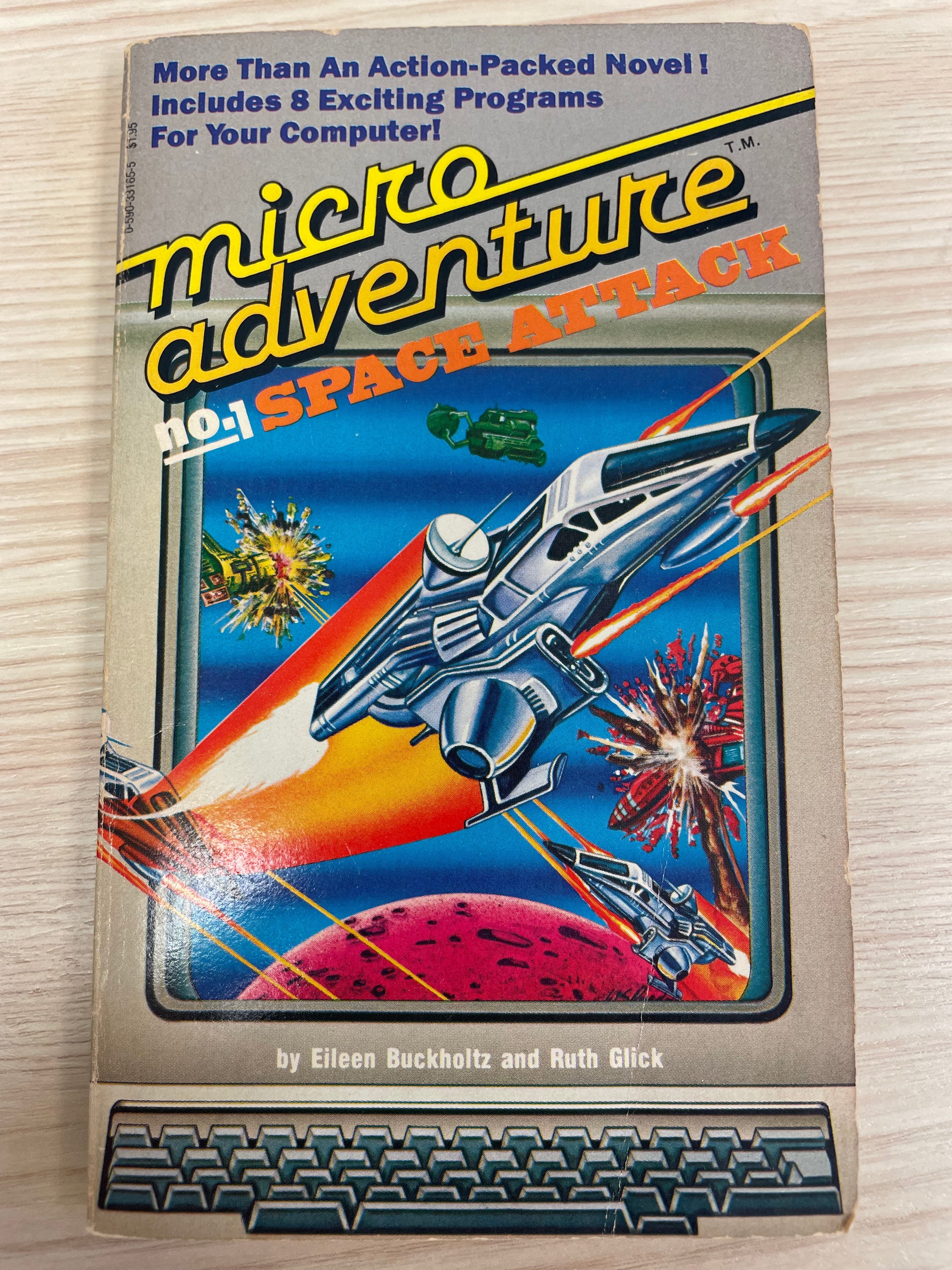
I don’t know when I first encountered P. J. (Connor) Hoover’s Turn to Page... Substack, but I am glad I did. It’s filled with wonderful entries discussing the magic that is printed gamebooks. P.J. is very passionate about the genre and has written 24 entries in her Pick Your Own Quest® line of interactive adventure books, as well as a number of “Write Your Own” books that are designed to get young people excited about writing. One of the more recent entries in her Pick Your Own Quest® line added some puzzle elements that transformed the book from solely interactive fiction to interactive gamebook fiction. These game elements were necessary because she based the new book, Castle of Doom (great name), on a video game she wrote in PASCAL back in 1990. That original game had over 4,000 lines of code and you can still play the game either by getting a floppy from her at a comic con or playing an online Scratch version of the game on her personal website.
As I’ve been reading her posts, I was reminded of a series sitting on my shelf that claimed to be a gamebook. I’ve shared before how important game books were for my journey as a gamer, but they were in one way just as important in guiding me toward learning to program in BASIC, Python, and R. Yes, that’s right, I’m one of those who values programming in BASIC for the same reasons that John Kemeny created it. It’s one of the best languages to teach young people the logic of high end computer languages, a skill that will continue to be valuable even as interacting with Claude Code becomes one of the primary ways newer programmers develop projects. Vibe coding is, in many ways, programming with an extremely high level language, but if you want the results of that coding to match your actual vision it’s better to have a great foundation in programming. The thing, for me, that separates BASIC from Python (which is also fantastic) is the use of PEEKs and POKEs that encourage users to think about the architecture underpinning the computer’s operation in the same way that pointers do for lower level languages. It gets you thinking about what the computer is doing and not just the output the computer creates. I talked about this a little when I wrote about the old CARDIAC paper computer.

Okay, okay, enough of the digression. Back to what is supposed to be a review of a “gamebook” that discusses what I loved and what I would change.
There’s a particular shelf in the mental library of any Gen-X or Millennial who grew up near a home computer. On that shelf, jammed in next to the Choose Your Own Adventure paperbacks and the dog-eared Dungeons & Dragons Endless Quest volumes, sits a strange hybrid called a “programming gamebook.” It’s a format that emerged from a specific technological moment where personal computers were common enough to show up in schools and homes, but still rare enough that being able to use one was a genuine skill that conferred status among kids. For me, it was an era where kids gathered around their school’s lone Apple IIGS, off in a dusty corner of the computer lab, having long been displaced by the shinier Macs and PCs the school had purchased. Those Macs and PCs were great if you wanted to play a game or write a paper, but the IIGS sat their asking you to make it do something. You turned it on, and all you got was a cursor daring you to tell it what to do.
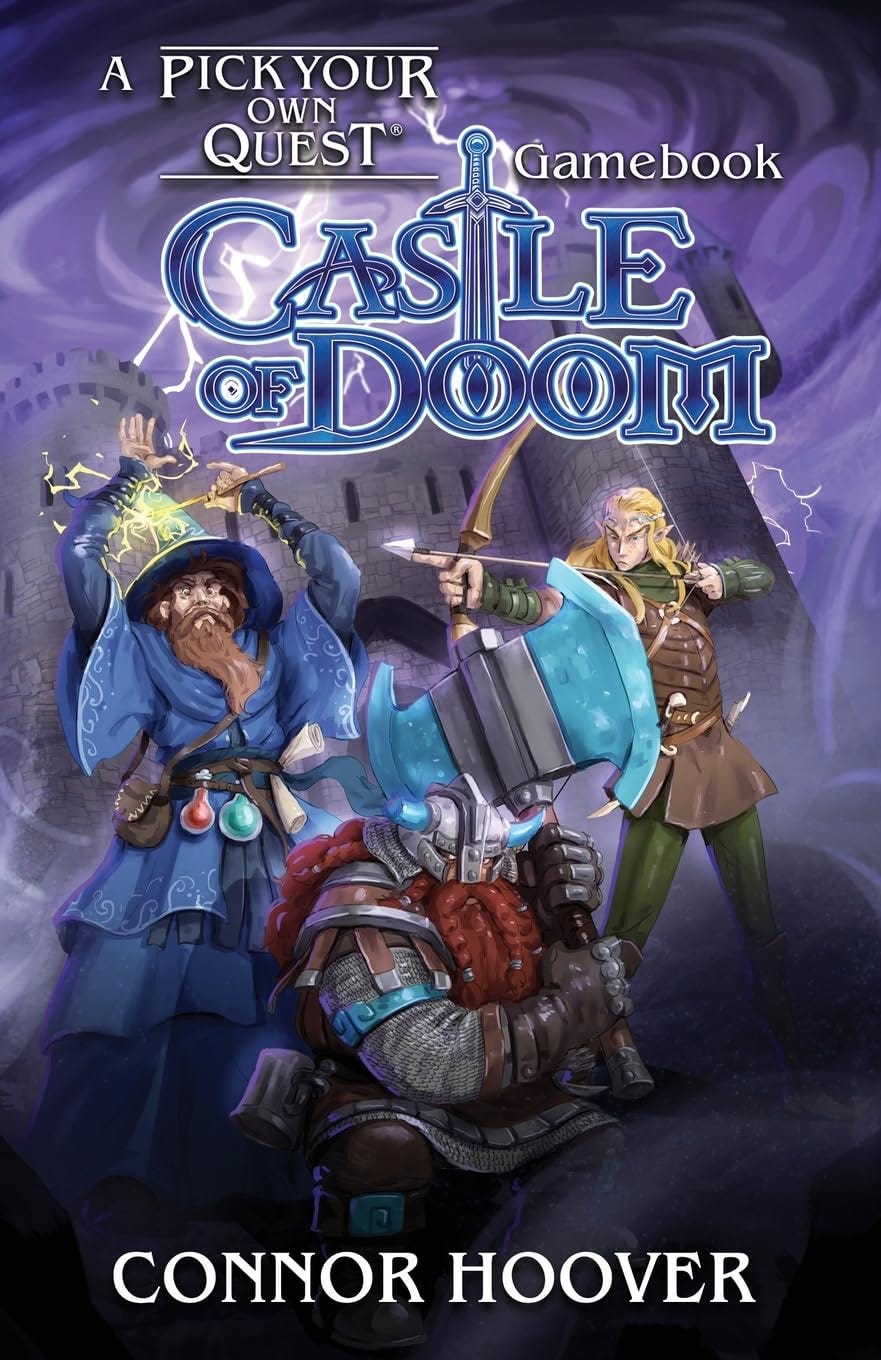
My high school library had copies of all kinds of gamebooks from the 1980s and among that collection was a really bizarre series, Scholastic’s Micro Adventure series. This series was launched in 1984 with Eileen Buckholtz and Ruth Glick’s Space Attack. That Eileen Buckholtz and Ruth Glick were chosen to write these books is probably a story in and of itself. Buckholtz was an employee of the Department of Defense (an possibly the NSA) at the time and had a degree in Computer and Information Science from Ohio State University. That she also wrote romance novels under the names Amanda Lee and Rebecca York, makes her biography good fodder for a Romancing the Stone style film. Ruth Glick was a Scholastic contract writer who began her writing career with a book about how to make dollhouse furniture. She too went on to write a number of romance novels, and by a number I mean A LOT.
The Micro Adventure series belongs to that small and strange subgenre that includes books that ask you to read a chapter, then turn to your Apple II or TRS-80 or Commodore 64 and type in a BASIC program before the story would let you continue. It’s a premise that sounds almost unreasonable by today’s standards, when you can download an emulator and have a functioning 1984 computer environment up and running in seconds. Reading it again now, I find myself simultaneously charmed by its ambition and a little frustrated by how much further it could have gone with the tools already sitting in its own hands. I may have written that the story doesn’t let you continue until you’ve run the program, but that’s not technically true. The story continues regardless, you just miss out on a pretty cool interaction.
The programming gamebook was never a dominant format. There were only a handful of series that attempted it, and most burned out after a few volumes. Scholastic’s gamebook lines were a mass-market offering meant to be sold in those magical book club flyers they used to hand out in class before most schools moved to the book fair model. You used these pamphlets to pre-ordered books that were then delivered to your classrooms, and book delivery day was magical. Not only did you get your books, but you could talk about them with your friends. I know you can do this with the book fairs, but the delivery day always felt a bit like Christmas where the book fair feels more Farmer’s Market.
As a gamebook, this odd mix of code training and YA novel, had to compete for shelf space with Choose Your Own Adventure (which was already an established juggernaut by 1984) and with the Endless Quest D&D tie-in series, which offered a more familiar fantasy-adventure fantasy hook without requiring you to have access to a computer. As P.J. mentioned in one of her essays, the great things about traditional gamebooks was that they are a substitute for video games so throwing in a book that requires a computer is a bit of a curve ball. After all, what made the Micro Adventure series different was its explicit marketing to the computer-literate. These weren’t books that happened to include code as a gimmick, the way a 1980s sci-fi novel might reference “the computer” as a plot device. These were books that assumed you had a machine, that you knew how to use it, and that you wanted the story to be an excuse to get your hands on that machine and do something real with it to learn. One of the author team had a degree in CIS after all and these books were going to teach you the basics of BASIC and decoding.
The first book in the series, Space Attack, puts you, in the role of “Orion,” a teenage member of ACT (aka the Adventure Connection Team). ACT is a sort of junior intelligence agency that recruits computer-literate kids for missions too sensitive for adult agencies to touch. One of the nice ways this is referenced in the book is that an X-Men comic book is referred to as the key to a book code. Within the first few pages you’re whisked from your bedroom terminal into a newspaper van, then a cargo plane, then a rocket, and finally onto Rodeo I, a secret U.S. space station under attack from the inside. It’s pure Saturday-morning spy fiction that is structurally indebted to everything from the Hardy Boys to the yet to be published Alex Rider series, and it fully commits to the genre without irony. There’s a colonel who designed the station’s weaponry and talks to broken laser cannons like they’re sick children. There’s a 70-year-old polyglot linguist who can’t remember if he’s eaten lunch but speaks 128 languages. There’s a traitor wearing someone else’s face, a zodiac-themed clue stamped on a forged ID badge, and a villain who delivers his ultimatum from behind a purple Lone Ranger mask. None of this is subtle, and none of it is trying to be. It’s pulp adventure fiction written at a brisk, propulsive clip, clearly engineered to be read in one or two sittings by a kid who’d rather be doing something other than homework, but doesn’t mind learning something along the way.
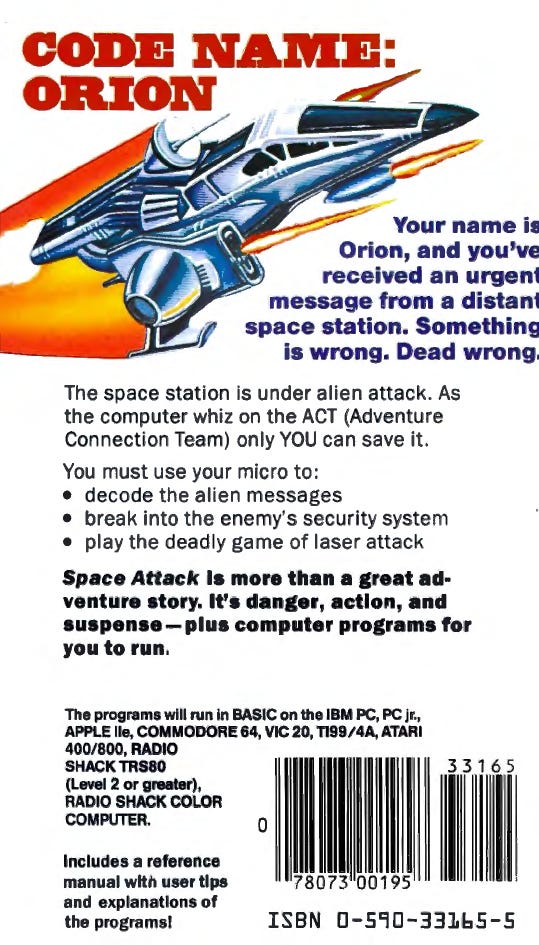
What sets the book apart from its gamebook contemporaries, of course, is the programming. Eight times across the book the narrative stops cold and hands you a BASIC listing or asks you to write your own code. When it gives you a listing, you are expected to type it in and run it because the fate of the mission depends on what comes out the other side. The first program is a decoder routine that breaks the cipher on a garbled distress message. There’s a countdown program, buggy as written, that has to be debugged before the rocket can launch without overheating on the pad. There’s a combination-lock program that opens an air lock door with seconds left before Dr. Macron suffocates inside it. There’s even a pretty cool frequency-analysis routine, also buggy and needing to be fixed, that eventually reveals that the “alien” signals harassing the station are BRUTE (those are the bad guys and I totally want to make an RPG based on this now) transmissions in disguise. By the time you reach Program 7, which is a turn-based missile-defense minigame standing in for the station’s disabled weapons system, the book has fully committed to the bit. You cannot finish the story without sitting down at an actual keyboard and doing actual, if simple, computer science. Technically, you can, but more on that later.

I want to be clear about how unusual this is, because it’s easy to undersell from this distance. This is not a book that gestures at computers the way so much mid-80s media did, with green screens full of meaningless scrolling text standing in for “hacking.” These are real, runnable BASIC programs, several of which contain real, findable bugs of the kind any working programmer would recognize: a time counter that counts up instead of doing a countdown, a sign error in an ASCII shift, an array index that got hardcoded to 1 instead of tracking the loop variable, a stray assignment statement that overrides user input the instant after it’s read. Check out the code below. Can you find the error?
10 N=10
20 IF N <= 0 THEN GOTO 90
30 PRINT "T MINUS "; N; " AND COUNTING"
40 N=N+1
50 IF N >= 100 THEN GOTO 110
60 FOR I=1 TO 300
70 NEXT I
80 GOTO 20
90 PRINT "BLAST-OFF"
100 END
110 PRINT "ROCKET HAS OVERHEATED ON THE LAUNCH PAD"
120 PRINT "THIS HAS BEEN YOUR FIRST AND FINAL ACT"
130 END
What’s more, the bugs are pedagogically intentional. The educational intent is the structure of the entire book. Two of the eight programs contain bugs that you’re explicitly asked to find and fix as part of the story. The other programs work as written, but the book’s narrative never lets you mistake what you’re doing for mere reading. You’re not being told that you fixed the rocket. Instead, you’re fixing it, seeing the countdown tick down correctly this time, and only then does the book acknowledge that you’ve done the work. Buckholtz and Glick clearly understood that the appeal of “be the team’s computer expert” had to be backed up with something a kid could actually type in and watch fail, then fix it, so you could eventually watch it successfully run when the fix was done properly.
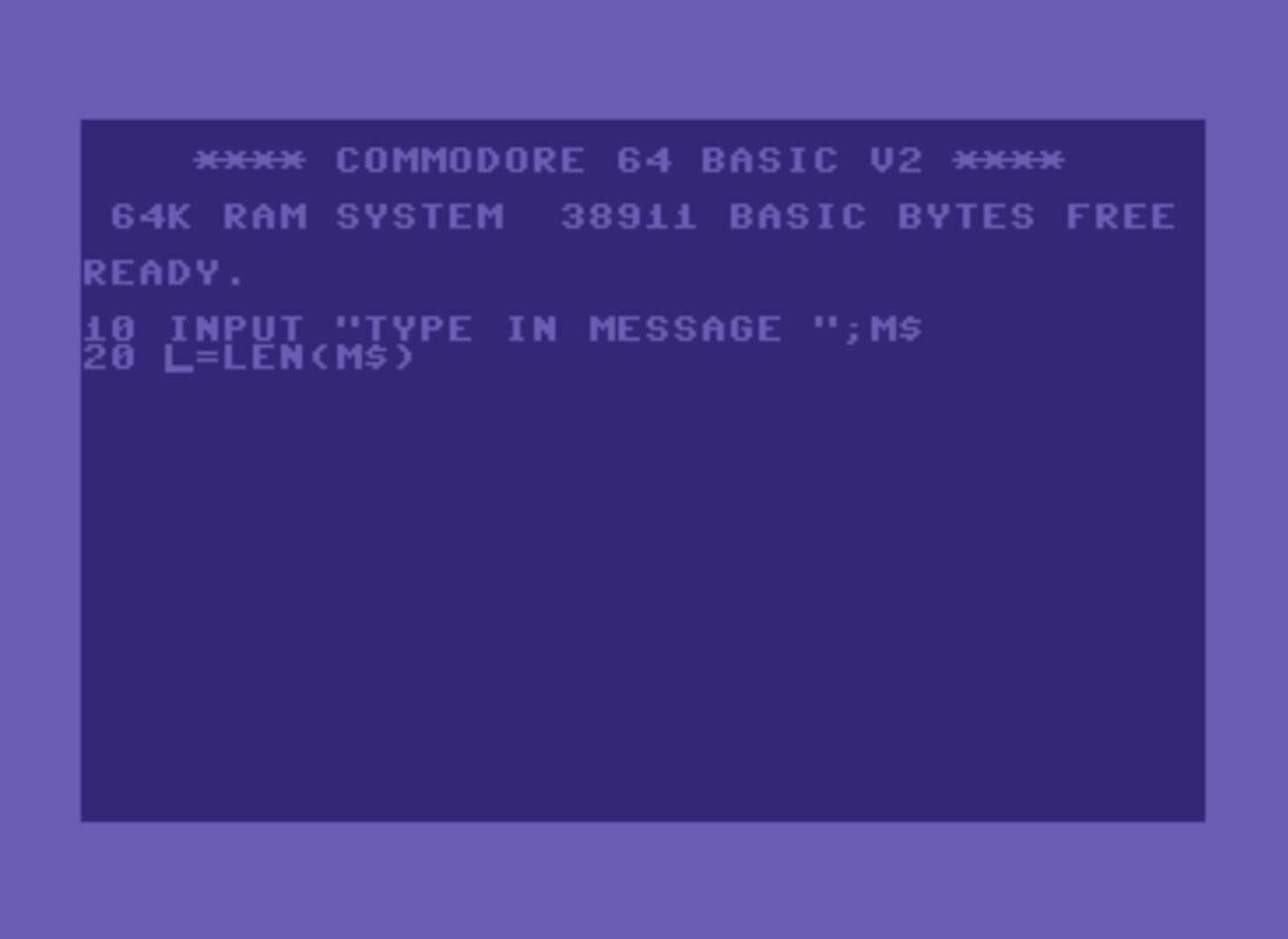
That’s a genuinely clever piece of pedagogy smuggled inside a spy thriller, and it holds up very well. The first program gives you a taste for how a program works, and the reference guide in the back gives you some details as to what is going on, but eventually you have to parse some logic yourself. I ran every one of these programs while putting this review together, bugs and all, and had a great time playing around with them. I did one of them on a C64 BASIC emulator online during a live stream, which did not help my subscription numbers let me tell you, only to be reminded of the unique way that keyboard works.
It was a ton of fun to run the programs and see how well they work. The countdown really does run away from zero and overheat the rocket. The frequency analysis really does report every count as zero until you find the one wrong array reference. The decoder genuinely shifts characters by the right amount. The keypad lock accepts the right combination and rejects the wrong one. Program 7’s missile-defense game actually tracks your hits and misses and calculates a final score. These are real programs that do real things when they are debugged correctly. Even better, the reference manual includes advice to get the program to work after you check an annotated cross-platform compatibility chart that shows which computers they’ll run on without modification. The notes for the changes needed are in the reference guide, and reading those notes helps you learn more about how basic works as a language. For a piece of 1984 mass-market children’s fiction, that’s pretty cool.
And yet, and here’s where I think the book fails to deliver on its full potential, the program-as-puzzle device sits almost entirely outside the story rather than woven into it. Every single program is gated behind a chapter break. You read prose, you hit a wall, the book tells you to go boot up your computer, and to return to the book only after you’ve typed in the listing and run it (successfully or not). The narrative then continues assuming that you solved it and moves on. There’s no branching like a traditional gamebook or pick a path adventure. There’s no moment where the program’s actual output, the specific combination you found, the specific garbled phrase you decoded, feeds back into a choice that alters the narrative. You don’t get to enter the wrong air lock combination and watch the story actually branch into “the alarm sounds, BRUTE finds you first.” The text just narrates the correct outcome regardless of what you typed, because there’s no mechanism for it to do otherwise. The computer work is real. The interactivity around it is almost entirely cosmetic.
That’s the missed opportunity that kept nagging at me as I read, because the bones of something much better were sitting right there, half-assembled. Micro Adventure is, after all, working in the shadow of the Choose Your Own Adventure format. This is the beautiful “turn to page 47 if you decide to...” branching that kids were familiar with, and gamers too thanks to Rick Loomis and Ken St. Andre. This was a mainstream gamebook convention by 1984, and CYOA itself had already been running for five years. Space Attack never makes that connective leap. Imagine a version of this book where, instead of a single hardwired path through each program, you had a genuine decision point before the keyboard ever came out. What if there was a paragraph that let you choose to ask Tinker for a second opinion on the door’s keypad before typing anything, with that choice unlocked a hint that shaved a guess or two off finding the combination? Or maybe the turncoat gives you bad advice that costs you a few precious seconds of Dr. Macron’s air supply. Imagine the frequency-analysis sequence branching on how many lines of sample intercept you, the reader, decided to bother typing in, with a CYOA-style page jump for “if you see no pattern, turn to page X” versus “if you saw a pattern in the code, turn to page Y.”
The missile-defense program is the clearest case of all, because it’s the one place in the book that’s already structured like a game and still doesn’t let that structure touch the surrounding narrative. As written, Program 7 tracks your hits and misses across ten rounds and prints a final score. It gives you ACT’s tally of blocked missiles against BRUTE’s tally of hits, but the story never asks what that score actually was. Whether you go three-for-ten or a clean sweep, the book moves on to the same next chapter, because there’s no page-branch keyed to your performance. A version of this puzzle built with gamebook logic in mind would have let a strong showing against the guidance system buy you something concrete two chapters later. Maybe your success results in fewer shots fired at the station during the climax, say, or an extra page of dialogue where the captain trusts your judgment a little further in the future. Maybe it gives you a new code to enter into the first program that gives you a secret ending, good or bad. None of that would have required more sophisticated programming exercises. It would only have required the book’s prose architecture to treat the programs as nodes in a branching tree instead of as toll booths on a single one-way road, with your actual inputs and outputs as the toll. The closest the book ever comes to making code and consequence the same object is Program 2’s countdown, which at least dramatizes failure (overheating on the pad) as a real narrative outcome if you don’t catch the bug before running it. Tellingly, that’s also one of the most memorable programs in the book, precisely because for once you can lose. I do also love the missile tracking program, even though the game is in solving the error more than playing the coded game.
What strikes me most about this missed opportunity is that the book is, on some level, already trying to teach debugging as a real skill. When you encounter a buggy program, the book doesn’t hand you a solution. It tells you to figure it out. There’s no accompanying section that says “here’s what’s wrong.” Instead, you have to actually look at the code, run it, watch it fail, form a hypothesis about what went wrong, and test your hypothesis by modifying the program and running it again. That’s the scientific method applied to code. That’s how real debugging works. But the book then throws away the pedagogical power of that approach by not letting your success or failure at debugging change anything about the story that follows. You’ve learned that you can read code and understand how it works, and that’s valuable. But you haven’t experienced as much as I’d like is that code-reading has consequences. The programs you write or fix actually affect the world around you in ways that matter. In a book explicitly framed around you being the team’s computer expert, not making that connection feels like a significant lost chance to reinforce what programming actually means: it’s not a puzzle you solve for points, it’s the mechanism by which you exert control over systems that affect other people’s lives.
None of this is a knock against what the book accomplishes within its chosen scope. For a piece of 1984 mass-market children’s fiction, getting eight genuinely functional BASIC programs onto the page, debugged correctly, annotated with a cross-platform compatibility chart for half a dozen contemporary home computers, is a real achievement, and one of the coolest “tie a story to a gimmick” ever attempted. Buckholtz and Glick, who wrote the entire eight-book Micro Adventure line together, clearly cared about teaching the code correctly, not just gesturing at pedagogy. I just keep wishing the narrative apparatus around the code had been built with the same level of craft as the code itself. I wish that the act of typing, running, and debugging a program had been allowed to actually matter to which page you turned to next, the way a Choose Your Own Adventure decision matters, rather than being a fixed-outcome detour the story takes for granted you’ll complete correctly.
What Space Attack represents, ultimately, is a fork in the road that never quite got taken. By 1984, the tools existed to create genuinely interactive fiction that treated code not as a detour but as the central spine of the narrative. It could have been a series where your program’s output fed directly into branching text, where a debugging failure had real consequences, where the act of writing or fixing code changed what happened next. The technology and the narrative structures were both available. Buckholtz and Glick had the craft to do it and the book was a mass-market gamebook from Scholastic, and Scholastic was in the business of selling books that worked like Choose Your Own Adventure. Which makes it all the more frustrating that the book doesn’t have branching components, a gamebook editor should have recommended it. Folding programming deeply into that branching logic would have required a fundamentally different editorial and design approach than what they went with, but I think it should have tried.
The programming gamebook as a format didn’t take hold, and by the late 1980s the Micro Adventure line had run its course. The gamebook market itself contracted sharply after the mid-1980s peak, squeezed on one side by video games that offered immediate interactivity at home, and on the other by the rising sophistication of RPGs and the growth of the hobby gaming industry. What remains is a small library of wonderful titles, Space Attack among them, that stand as weird, ambitious, slightly-off artifacts of a specific moment when personal computers were new enough to be exciting, but computing literacy hadn’t yet become the default assumption it is now. The book never became a classic or a foundational text for either gamebooks or computer education. But it should have been something more than it was. It had the pieces, but it just never quite brought them together.
If you want to experience the programs without digging up a Color Computer or an Apple II emulator, I built an interactive companion widget that lets you run all of the program. You can run them with or without the bugs and fixes right in your browser, dressed up with an appropriately retro green-phosphor terminal aesthetic. It won’t fix the branching problem I’ve spent the last few paragraphs complaining about, but it will let you feel, in about the time it takes to read this review, exactly what a 1984 kid felt staring at a CRT waiting to find out if BRUTE had won.

Space Attack is currently out of print, but used copies are available at very reasonable prices if you want to follow along at home, bugs and all.
Thank you so much! This is absolutely the best and I really appreciate it! I'm so glad to find people who are as excited about game books as I am. And I can't tell you how much fun I had bringing Castle of Doom into the new century 🙂
Fantastic write up. Wish I would have stumbled across this type of adventure book back in my Commodore days.