


I know that there are some Dungeon Masters who spend hours upon hours on prep-time and world-building. I admire these people for their creativity, but I’ve never been one of them. There is a part of me that believes that these people would be better served spending all of that energy on writing actual fantasy novels instead of campaign material and adventures for their players. A roleplaying session isn’t an opportunity for Dungeon Masters to watch their players act out their novels. A session is a time for collaborative and interactive storytelling where every participant, human and mechanical, works together to create an emergent story over time.
My two favorite roleplaying campaigns each lasted over a decade and neither had pre-planned story arcs. Sure, they had story kernels that became full-fledged narrative forests, but they all went in unplanned directions. More importantly, neither of them ended when one particular story came to an end. These were campaigns, and in my grognard mind campaigns only end when the group stops playing. The campaign can span generations of characters and the world can change significantly. I’ve long resisted the modern trend of calling an Adventure Path (that’s what they were called in the naughty aughts) a “campaign.” It isn’t. It’s part of a campaign. The campaign includes not only things that are happening outside the adventures the PCs are experiencing, but also includes stories and heroes/heroines who exist before and after that adventure is complete.
Those sentences shouldn’t be read as a critique of playing in a game that is player character focused with contained adventures. Rather, it is an assertion that those events are different from campaigns and those who think of “seasons” and stories as campaigns are missing out on something really special. I also understand that real campaigns are something rare. For a variety of reasons, which in my case tend to be the extraordinary time constraints of adult life, I spend most of my time running shorter adventures where the players make characters specifically for story arcs. I meant it when I said I am not critical of story arc gameplay, just that those are different from campaigns in my mind. I also happen to play a wide variety of game systems, so my games tend to be three or four shots rather than even a full “story.”
Since I don’t have a lot of prep time and have never been one who focuses on planning and plotting, I crowdsource my work. In actual campaigns, I’ve crowdsourced a lot to my players, but for shorter get-togethers, I look elsewhere. Sometimes I have found professionally published adventures very handy, but I largely use them for the launching points for adventures and rarely have my games stayed “on task” when I run them. I think I’ve started at least five gaming groups with B6 The Veiled Society and it has never told the same story twice. The villains have changed. The allies have changed. Heck, one run through the real villain was a Vampire Lord from Glantri sent to undermine the partnerships that Grand Duke Stefan was making with the three major families. All of this was based on me giving the players a seed and then running wild with their speculation rather than with the written text. Yes, I have had the adventure run once exactly as written and it was the third or fourth time I ran it, but it usually goes its own way.
I don’t always like to use published adventures though, because players have often read them and want their experience to align with the adventure as written. Sometimes, and the time I ran the original Dragonlance modules is one example, the players want the railroad. I don’t want that. I’ve read the books and enjoyed them, but the characters have their own voices in my mind and I don’t want to overwrite them with my players’ voices.
One of the things I do when I shift away from published adventures is to implement James Dunnigan’s Second Rule of Game Design from his Wargames Handbook: How to Play and Design Commercial Wargames. That rule?
“Plagiarize.”
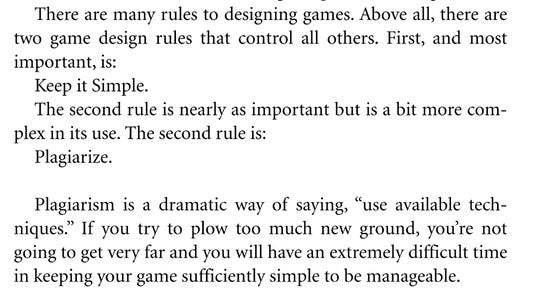
Dunnigan doesn’t mean to actually plagiarize by taking something and copying it verbatim. What he means is that you don’t need to reinvent the wheel when designing a new game. You can build on what has been done before. We Dungeon Masters can do something similar when we design the adventures run for our players. Role playing is a narrative storytelling experience, but not every DM can be Walter Gibson and crank out tens of thousands of words a week. That doesn’t mean that we DMs can’t be creative, but it does mean we have a plethora of sources available to us where we can apply the Second Rule of Game Design.
I’m particularly fond of using television and film. I’m also famous for giving my various gaming series names like “CSI Sharn” or “Invasion of the Brain Moles.” As I mentioned above, when applying the Second Rule of Game Design you shouldn’t copy something verbatim. Instead, use your source as inspiration for something new. The movie or TV show you’re thinking of didn’t have audience interaction, but your game will. Let your imagination, and the imagination of your players, take over.
Today I am offering you 10 films from outside the sword-and-sorcery aisle.
And before you read onward…This Way Be Spoilers.
10) You’re Next

Luke Y. Thompson wrote a thorough review of You’re Next back in 2013 in which he mentioned that it was the kind of horror film in which the victims have an opportunity to turn the tables on the bad guys. In some ways he understates the case, because the character of Erin (Sharni Vinson) clearly has character levels in a world filled with level-0 commoners. She’s not just a character in a film; she’s a player character (PC) with loads of experience who is more than happy to take bad guys to task.
You’re Next is a tale of a wedding anniversary that becomes a bloodbath when three masked home intruders make a violent visit. Family members drop one by one as they desperately attempt to survive the night. That may not sound like a good basis for a D&D adventure, but I think it is perfect in ways that are too often overlooked when we create sessions for our home games. Have your PCs made any NPC (non-player character) friends in their adventures? Are any of them engaged? Do your adventures take place in an urban setting where the players have developed connections in high (or low) places? If the answer to any one of those questions is yes, then you have your starting point. It also makes a great starting point for longer term play.
And before I give a brief synopsis of one way this film can be adapted, did I mention that one of the movie posters provides a bitchin’ map? Because it does, and you should use it.
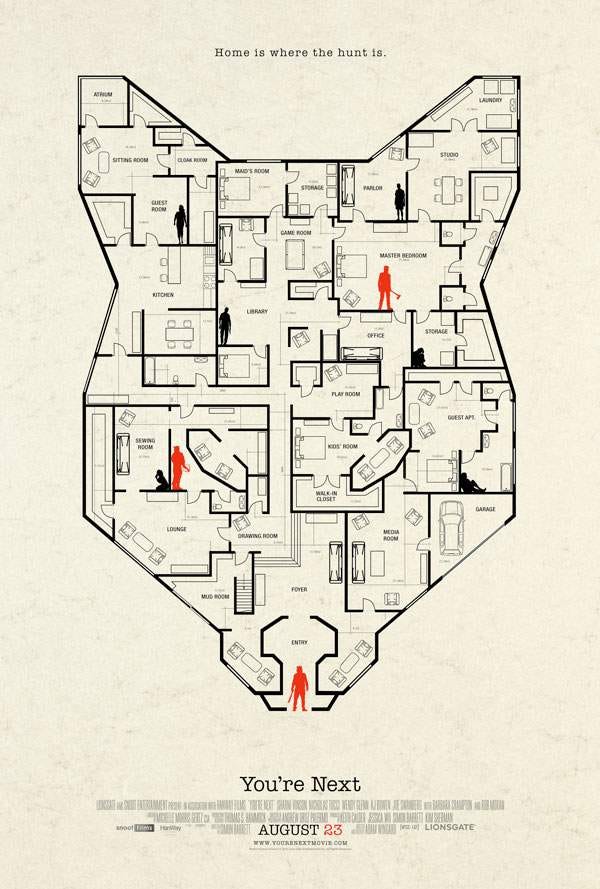
One possible adaptation of You’re Next is the following. The PCs have been invited to a celebration by an up and coming politician in Sharn who has been performing charitable acts deep in the Cogs. It has recently been announced that he or she has been selected for a position on the City Council and wanted to celebrate with friends, the PCs, who have worked with the politician at some point in the past. As the evening progresses, the PCs notice that there are some conflicts between some of the guests because several rival factions are present. Just as a major argument between a representative from House Cannith and House Ghallanda rises to a crescendo, one of the participants is shot with a crossbow from outside the event. The celebrants are politicians and not combatants and react accordingly. Some members of House Deneith (the bodyguard house) begin securing some of the participants.
Things escalate from here as the players soon discover that some of the bodyguards are in on the slaughterfest and have been hired by one of the evening’s participants. The players manage to get their friend to a secure location…only to find out that friend was the one responsible for the slaughter as the politician was unwilling to return on the money and favors owed to the many attendees. Where does this leave the PCs? What happens next?
This was one of the story arcs I used in my home game as a part of my CSI: Sharn campaign. That game lasted about three years with the characters starting off as criminal investigators and eventually becoming political actors in the city. At the time, I had the players use Aaron Allston-style Blue Books to tell me what their individual patrons were doing between sessions and combined that with Ken St. Andre inspired (from Arena of Khazan) NPC pool management. I’d probably have the players actively play the patrons, rather than report on them as vassals, in the future.
9) Escape Plan
Escape Plan may not be the best break out of prison film ever made, for my money that title goes to either Escape from Alcatraz or The Great Escape. It may not even be the best break out of prison movie starring Sylvester Stallone. I actually prefer the completely gonzo Lock Up over Escape Plan because it’s peak ’80s action film. What Escape Plan does have going for it is that it is quite simply the “most D&D” of all break out of prison films.
The hook for an adventure based on the film is that the Player Characters are experts hired by prisons to help them become more secure. In a Danger International or Espionage game the PCs might be hired by the CIA to test how secure a secret prison is only to discover it’s all a lure to take the “escape masters” out of action forever. So far that’s not exceptionally D&D, but when you add to it the fact that a pro-democracy hacker head of a secret organization that robs from the rich to give to the poor is (SPOILER) in the prison you’ve got some room for a great D&D adventure. It is especially good for a first adventure that can be used to launch a campaign.
If you are writing the adventure for D&D, rather than an espionage-based RPG, have the players make characters as normal. However, you have to make sure that at least one of the characters has some link to the main campaign city’s slums. Maybe the player characters are all employees of one of the Dragonmarked Houses of Eberron, or have some equivalent patron depending on the campaign, and have been hired by House Deneith to investigate House Kundarak’s claims that no prisoners in have ever escaped the Dreadhold. The players are merely supposed to go to the prison, hang out long enough to get to know some of the players, and find out if certain NPCs have found a way out. When they get the answer, they are supposed to give one of the guards a special code and that’s it. Except, that’s when things go wrong.
It turns out that one of the lieutenants of the PCs’ current patron has partnered with a rogue faction of House Deneith and is running illegal gladiatorial games in the Cogs. Remember this is an adaptation of a prison movie. The lieutenant fears that the PCs’ connection to the people who live in the slums might lead them to discovering the connection between them and the gladiatorial games. The lieutenant needs the PCs out of action quick and is using his Kundarak allies to get the PCs out of action. The Dreadhold is impossible to break out of and no one has a means of escape. Or do they?
Turns out that a key political figure had been sequestered to the Dreadhold and has some means of getting out of the impregnable prison. The only problem is that this political figure cannot trust anyone currently imprisoned. It is a prison filled with the worst of the worst, after all. Using contacts outside of the prison, this figure discovered that the PCs had a connection to the Cogs and were new hires working for one of the villains responsible for the political figure’s imprisonment. The politician is the person responsible for leaking the PCs connection to the slums and thus responsible for their imprisonment. Do they help the politician? Do they attempt to escape on their own? Either way, they’ve got an antagonist or two on their hands and you have a great D&D adventure. If you are a Mystara fan, and I am, you can use the Veiled Society as your villains as well.
8) Assault on Precinct 13 (Rio Bravo)
The situations in Assault on Precinct 13 and Rio Bravo are similar in some respects to that of You’re Next in that they involve an encounter with individuals attempting to invade a building and murder the inhabitants. There are some key differences, though, that provide rich fodder for adaptation. Each of these stories features a small, rag-tag group of protagonists who must defend a person or location against a much larger force. In Assault it is a small group of police officers holding off a large gang on a killing spree. In Rio Bravo, the protagonists are holding off a gang who seeks to break out a prisoner. One could easily add 3:10 to Yuma, Straw Dogs, The Alamo, or 300 to this mix of films for inspiration. These are all tales of a smaller force holding off a larger one, where You’re Next is a tale of surviving until you find out who is responsible for the mayhem.
The most difficult choice to make in adapting this into an adventure is picking between keeping the motivation of keeping a prisoner secure for transportation/protecting someone that is used in the two initial recommended films or focusing on another factor like merely staying alive or even dying valiantly for a cause. While I might typically choose the original motivation, not in small part because I am a huge Leigh Brackett fan, for this recommendation I’ll choose the merely staying alive motivation.
The adventure begins with the player characters entering the town of Waybridge. The characters quickly discover that people are fleeing Waybridge for the more fortified city of Holdfast because a horde of orcs has been cutting a murderous swath across the countryside and the townsfolk want to get to a safer location. What the PCs know, that the townsfolk do not, is that the Keep at Holdfast recently had a wall collapse during an earthquake and will be unable to protect the growing influx of desperate commoners.
Holdfast is two days travel from Waybridge and is home to 2,000 citizens. The players have to choose between attempting to stop the horde at Waybridge, or at least delaying it, and riding ahead of the fleeing civilians to report about the incoming horde to the Keep at Holdfast. Given the size of Holdfast’s population, even if the players deliver the news in time for Holdfast to evacuate it won’t matter. Marching the 2,000 citizens, plus a thousand or so more from surrounding villages, the ten days to the next large city would likely result in a great deal of death as the orcish horde picks off stragglers and harries the refugees.
Brave player characters will find themselves stuck in Waybridge and must find a way to stop or delay the horde. Thankfully orcs tend to disperse if their leader is killed. It isn’t that they become afraid when the leader is killed, it’s just that they lose focus and split up into conflicting factions. It takes a strong personality to keep an orcish horde together and Grimnor Wolfbred has such a personality. Can the player characters turn Waybridge into a murder gauntlet that would make the 13 Assassins nod in awe?
The second Daniel Craig entry in the long-lasting 007 series has received no small amount of criticism, but I think a lot of the criticism is misguided because many critics don’t understand what the actual narrative of the film is. This isn’t a movie about a secret agent who has seen the woman he loves die and then seeks revenge on the killers. That’s what the agency he works for thinks it’s about, but the problem is much larger than that. This film is about a secret agent who sees how vulnerable the head of the agency he works for, who is also a parental figure, is and decides to perform exploratory surgery throughout the global espionage community to find out who infiltrated that agency and how they did it. This is a film of investigating clues on a timeline of “needs to be known yesterday before M was attacked.” It is this narrative that makes for the perfect D&D adventure.
The PCs are celebrating a successful adventure and receiving acknowledgement from a noble or patron they have a close relationship with, either that or with a family member. During the celebration, their patron is attacked by his or her own bodyguards, characters the PCs know and trust. Maybe even characters the players have adventured with in the past. The players stop the attack with minimal damage, but as the attacker dies it is made clear that there are more murderers waiting in the shadows. The killers could be anyone, and the patron won’t be safe until the source of money and training is eliminated.
The PCs have only one small piece of information, a name, and must unravel the rest from there. In designing the adventure, pick four or five key locations you’d like to use, but don’t hesitate to riff off of the players’ ideas. Since anyone can be the enemy, let the players help you determine who it is. You can use Kenneth Hite’s ingenious Conspyramid as your framework filling it out as the narrative unfolds.
6) The Warriors
“Can you dig it?!” — Cyrus the Younger (Probably)
Every entry on this list so far has the player characters holding ground, taking a building, or climbing their way up a conspyramid. The Warriors turns things around. This time the characters have to get somewhere, and everywhere they turn it looks like the entire world wants them dead. They are deep in enemy territory with only one way out, and that’s to stick together and keep fighting through the gauntlet. They have to fight their way from the northern end of the Bronx all the way to the southern tip of Brooklyn.
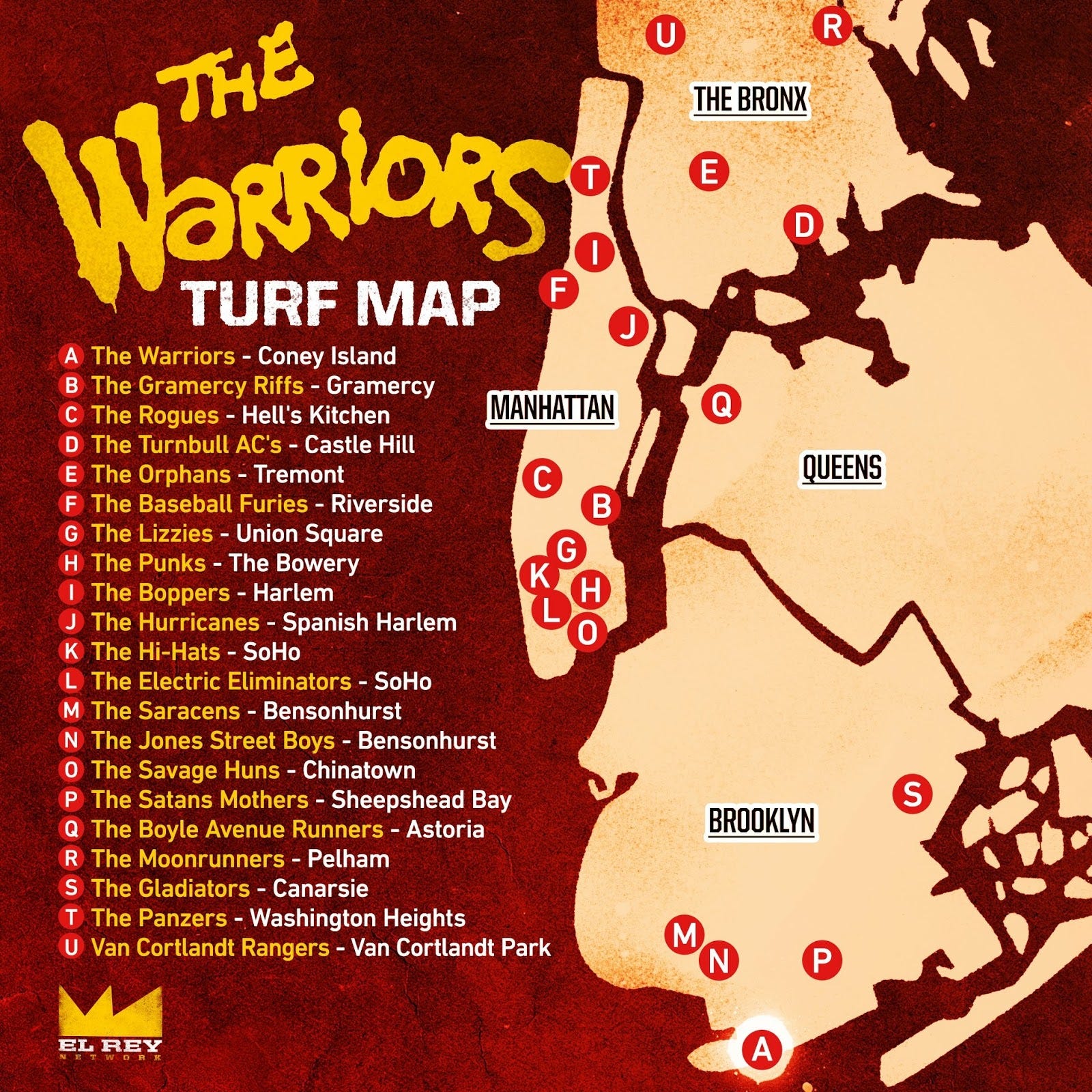
Walter Hill’s 1979 picture opens with every gang in New York called to a truce summit in the Bronx. The meeting was called by a charismatic figure named Cyrus who wants to unite all the gangs of New York to overthrow the police and create a new city controlled by the gangs. His vision is never realized because he is murdered mid-speech, and the Warriors get blamed for it. They’re from Coney Island, all the way on the southern tip of New York’s boroughs. Their home is the far end of the subway line, and the word of their “crime” goes out over the airwaves before they’ve gone a mile. Radio waves travel a helluva lot faster than people on foot, so the Warriors find themselves immediately under threat. For the rest of the film, the small band works its way across a city where every few blocks belongs to a new enemy, with new reasons to see them dead and collect the reward.
If the story sounds a bit more epic than you might expect from a low-budget gangsploitation film, especially one with a gang called The Baseball Furies, then your intuitions are correct. Sol Yurick’s 1965 novel was inspired by Xenophon’s historical work the Anabasis. The work recounts Xenophon’s leadership of ten thousand Greek mercenaries who found themselves stranded deep in Persian territory after the man who hired them dies in the first battle. Xenophon has to lead his ten thousand from Persia to the Black Sea coast and the Anabasis is an epic account of his men fighting their way back to the sea. If you ever wondered if ancient stories, or in this case actual events, can speak to modern viewers remember that one of the oldest surviving adventure narratives in Western literature was easily translated into a cult movie about a gang in matching vests.
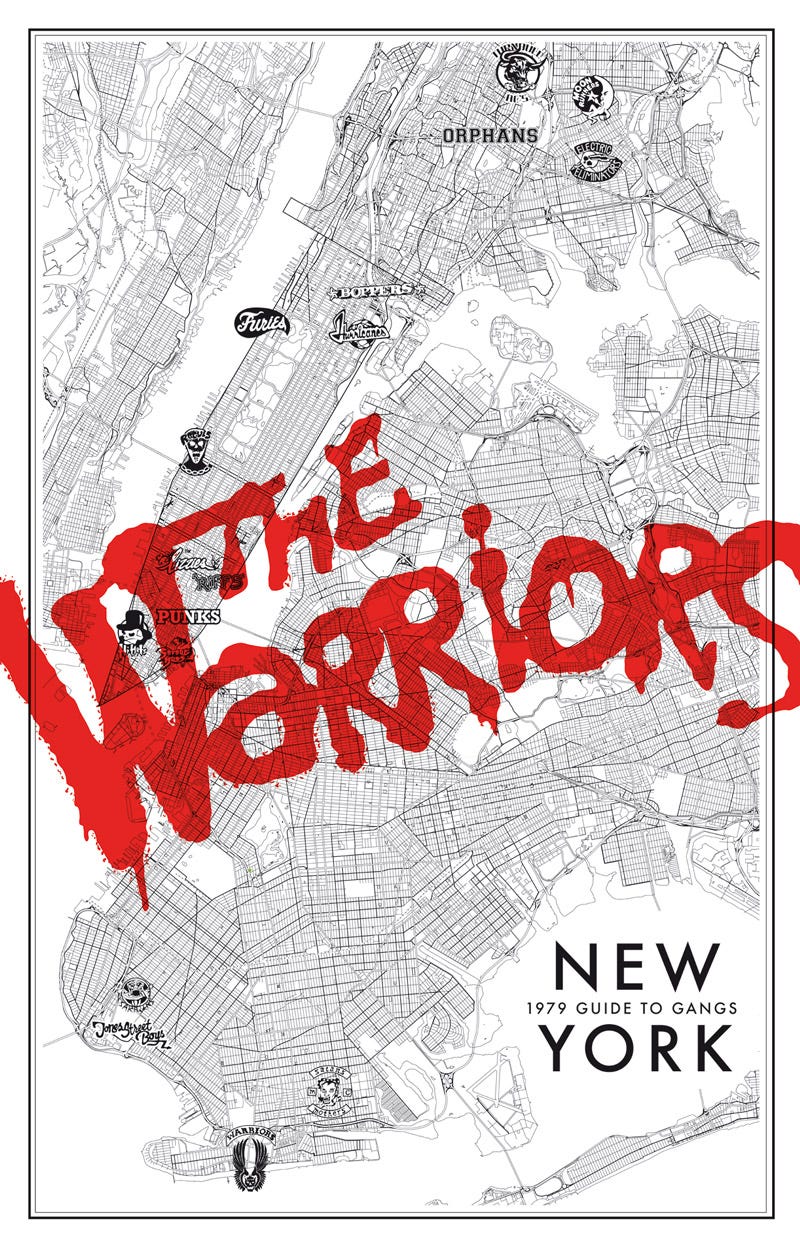
If I was running the game in D&D, I’d likely set it in the Mystaran city of Specularum. While Eberron’s Sharn, or Gygax’s City of Greyhawk, are also good fits, my love of The Veiled Society keeps me coming back to Specularum and its canonical organized crime set ups. In this adventure, the player characters are hired by Grand Duke Stefan Karameikos to observe a parley where every faction in the city, the Torenescu and the Radu and the Vorloi and whoever else you’ve been building up, have been called together to hear a pitch about taking the city (and Duchy) back from Duke Stefan. The envoy dies at the parley, publicly, and the PCs are immediately pointed to as the perpetrators. Within the hour the accusation is city-wide, and the PCs have to cross Specularum from the docks to whatever safe ground they’ve established in the campaign. The villain I’d choose is Baron Ludwig “Black Eagle” von Hendriks, who wins no matter what happens. It was unlikely that his emissary was going to unite all the factions, but if he can point to agents of the Grand Duke as assassins it might just work. The player characters have to find a way to stay alive and prove that von Hendrik’s notorious hatchet man Bargle is the real killer.
What makes this a fun run rather than a railroad-heavy slog is that every district is a different encounter design problem. So long as the Dungeon Master lets the players choose the route home, the key task is making each district of the city feel different and requiring different kinds of encounters to get through them. Sometimes it will be a combat encounter. Other times it will be a social encounter. At least one encounter should be an investigation-focused one where the PCs find out who the real villain is and a way to share the information. This is probably best run as a marathon rather than a sprint. A sprint is fine for a two-hour film, but the adventure will be a railroad if you make it a sprint. Maybe one area belongs to a gang who’ll only fight the party unarmed, because that’s their code. Another faction is a bought watch patrol that was allied with von Hendriks against Stefan. You will have to build six to eight districts and give each one something unique the party can encounter as well as clues to Bargle’s involvement in every district. That way, no matter what path they choose they can have the investigative encounter. It’s a great opportunity to let the map guide the adventure in a city setting rather than a dungeon one. You can make every waterworks, rooftop, and sewer matter in ways that make the city map work like a tactical encounter map.
5) Alien
As a source of inspiration for a D&D adventure, Alien is a perfect choice. It is a classic tale of man exploring the unknown and engaging in a monster hunt, with a touch of mistrust added in for good measure. One of the stories that inspired the film Alien, A.E. van Vogt’s Black Destroyer (the Black Gate magazine website has a nice overview of a collection that contains the story), has been an almost endless source of inspiration throughout science fiction and fantasy. In fact, it has had direct influence on D&D. The displacer beast, one of the iconic D&D monsters, is based on the coeurl as it is described in Black Destroyer. The classic Star Trek episode The Man Trap takes the coeurl and transforms it into a lonely shape-changing creature. Surprisingly, it’s not the monster hunt aspect that made me select Alien as a perfect film for adaptation. After all, most D&D adventures are monster hunts of a sort. Instead, it’s the vulnerability of the crew of the Nostromo that makes it ideal. It falls thematically in the liminal space between You’re Next, Escape Plan, and The Warriors.
I’ve run too many D&D adventures where the player characters are over-prepared for almost any obstacle. Between all the bags of holding, portable holes, pints of oil, 10′ poles, and vials of holy water, the player characters might as well be a wandering general store. It sometimes seems that there is no threat I can throw at the players that they haven’t already prepared for in some way. The question a Dungeon Master who is adapting Alien has to ask is “how do I separate my players’ characters from their stuff in a way they know is temporary, but which allows me to run a session that uses character vulnerability to create a sense of horror?” It’s a good question, but unlike in Alien this isn’t going to happen while on a foray into the unknown. That’s when PCs are most prepared and if you want to go that route you can use A4 In the Dungeons of the Slave Lords. PCs are least prepared when they feel safe and when they can be lulled into temporarily forfeiting their equipment.
So here’s how I’d adapt Alien:
The player characters are entering a relatively large village or city where the local constabulary requires that the characters leave their weapons and weapon-like equipment with the constabulary. All the weapons are stored at the town’s armory and this town has a reputation for being safe and lawful. It’s just standard operating procedure in the town, just like it was for Wyatt Earp when people entered Tombstone. It’s not that you’re not allowed to have weapons, just not in the protected areas of the city.
Here’s where one of the key components of the film Alien comes into play. In the film, the android Ash works against the interests of the crew and to the benefit of the monster. In the Star Trek episode, the monster can shape change. In the original story, the traditional means of restraining the monster are useless and interdepartmental rivalries prevent sufficient cooperation to handle the problem early. What we need is a traitor and a monster. Since I am a fan of The Man Trap and the original short story, let’s make the monster a vampire and let’s make it so that the constabulary is particularly resistant to the PCs getting their weapons back. This can be either because the constabulary doesn’t believe the PCs, or because they think they can handle the situation. How do the player characters battle a vampire without the use of their Sunswords and scads of vampire-hunting wares? What if the majority of their magical components were also confiscated? This is a great time for players to learn what the actual material components of their spells are, and the locating and acquiring of non-purchased versions of those components can be a nice subplot of its own.
4) Point Blank
John Boorman’s film Point Blank adapts Richard Stark’s novel The Hunter, about a crook named Parker who is betrayed by fellow criminal who wants to get the money he earned in a big score a few years ago. Stark’s Parker is the Mirror Universe version of your typical pulp action hero. He’s the anti-Continental Op, the goateed Philip Marlowe who lacks a traditional moral code. Yet, he does have a code and if it’s violated, those who betray him will be much the worse for wear.
As is typical of Parker adaptations, Parker has been renamed. This time he’s Walker. When Mel Gibson starred in Payback, he did so as Porter. I don’t know why they don’t use the character’s real name. Then again, when they have (I’m looking at you Statham), the results aren’t as good. In Boorman’s film, the setting is shifted from New York to Los Angeles, and I think this is a brilliant choice. To me, Los Angeles is the “noirest” of cities. Like New York, it is a place where people move to fulfill their dreams, but if things go wrong in New York, the train ride back to Hoboken is short and you probably won’t be able to afford a train ride home from LA. The myth of Hollywood entices people with bright glittering lights, only for those people to find out that the neon lights of Sunset Blvd. are a nuisance as they interrupt your attempts to sleep in the trash-strewn alleys.
Obviously, that’s an exaggeration of the grit of Los Angeles for most people. It is, in fact, my favorite city, but it is a city where hope can go to die. As the song Hotel California goes (there’s the urban myth that it was inspired by Camarillo State Hospital just outside the city which has now become Cal State Channel Islands), “you can check out any time you like, but you can never leave.” There’s a bit of that not being able to leave in Point Blank and the tension and darkness of the film are palpable. The final confrontation in San Francisco in this film should remind you of the end of John Wick stylistically.
What makes Point Blank so intriguing is that Walker comes back wanting exactly one thing: the $93,000 he’s owed. He doesn’t want a penny more and he climbs the Organization’s conspyramid one rung at a time. The action could stop at any time, except that every man he leans on tells him that the money’s with the guy above me until Walker is standing at the top of the pyramid and finds that there is no there there.
The thing I find to be the most interesting thing to steal is the ruthlessness, not the revenge. What inspires me is the existence of a ruthless man who wants the exact sum he’s owed and waves off any bonus offered with a bullet to the head. He’s as much an Avatar of Death as Javier Bardem’s Anton Chigurh and is a more unnerving NPC than any berserker, because he can’t be bought off or bargained with.
Here’s my attempt at an Eberron adaptation of the premise. The PCs performed a job for a patron they trusted, or possibly with an NPC they’ve adventured with in the past, and the relentless force that is the Walker proxy (let’s make him a Warforged for fun) was a part of that deal. In between that job and a later job the player characters do for the NPC, that same patron/trusted NPC did a job without them that also involved Walker. At the end of that deal the NPC took the whole take and put a crossbow bolt in Walker and left him in the Cogs to slowly die. The NPC didn’t tell the player characters that he killed Walker, but he did invite them to a new deal. At the end of that deal, the patron/partner split the money so that the PCs got exactly the amount of money he cheated Walker out of and left some evidence that the PCs had extorted him in the Walker deal. The problem for the PCs is that Walker lived and has returned for his share, exactly his share.
Walker knows they are connected to the old partner and thinks that they were behind the betrayal. He has already shaken down the patron/partner, who didn’t have the money and fingered them as the real culprits. Not only that he gave Walker directions to the evidence he planted against them. In reality, that “old friend” spent the money buying his way into the Boromar Clan to protect him from money he owed another gang. If the player characters want to live, they are going to have to pay Walker his money back. If you inserted this at the right time in the campaign, the player characters will no longer have the money and will have to collect it themselves. Walker is coming for them as a relentless force and they will have to be cunning and relentless to collect on their own. This means that the PCs will have to climb Sharn’s crime syndicate one boss at a time in pursuit of the money. Every capo the PCs squeeze points them one level up the conspyramid and every level up is glad to hand over the next name and no one has the money.
There is a twist to the whole adventure and that’s the fact that once the PCs reach the top, there’s no one home. The Boromar Clan is a name and a set of ledgers that are merely a way of moving coin from one place to another. There is no single villain at the top to kill for the satisfaction of it. What do the PCs do when they’ve clawed up the whole structure and there’s no throat to put a blade to in order to get the money? What happens when the PCs can’t pay Walker?
3) The Art of the Steal
The Art of the Steal is a fun movie, but not a great one. It’s a heist movie that lifts a lot of imagery from Guy Ritchie’s film Snatch, but it does have something that sets it apart. That’s its use of a prior failed heist to establish the background for the current adventure and that’s what makes it a perfect film to adapt to D&D. Many movies or stories are either the first time something has happened, or they reveal the background piecemeal throughout the film’s narrative arc. The Art of the Steal gives us all the background we need in the first ten minutes. Interestingly enough, when I first watched the film, I treated this background as mere fluff and it wasn’t until halfway through the film that I realized it had established the motivation for almost all of the action of the film. While The Art of the Steal isn’t a sequel, it provides a good structure for a DM to use as a means of creating adventures that are sequels to past gaming sessions.
Does your D&D campaign have recurring NPCs? I don’t mean recurring big bad villains. I mean NPCs who are a regular part of the PCs lives, and who are sometimes a bigger pain in the ass than they are a benefit? That’s what we need here. In my adaptation of The Art of the Steal, I’d have the adventure be a followup to the Escape Plan adventure I discussed earlier. What if the PCs escape, but they don’t let their betrayer know that they know they were betrayed? What if they treat their escape from the Dreadhold as if it went exactly as it was supposed to with only a minor blip regarding the lower-level guards not having known about the password? What if the player characters decided to convince their former patron that they were still “on board” and that they wanted a piece of the action of the underground fighting league that House Deneith was running? Greed can go a long way to convince someone you’re being truthful. Obviously, this isn’t an adventure that is custom made for a Paladin, but it is good for almost any other group. Have the PCs team up with legitimate law enforcement to bring down the fighting league, while simultaneously ensuring that their former patron is imprisoned and impoverished.
2) The Siege
Edward Zwick’s film The Siege is a pre-9/11 look at how the United States would react to terrorism. It is off-target in a few respects, but in others it is remarkably close to predictive. In the film, terrorist attacks in New York City led to the detention of American citizens and the widespread use of the military on American soil. The protagonist of the film is trying to find out who is responsible for the attacks, while also trying to advocate for the rule of law. It’s an interesting conflict that the film kind of awkwardly stumbles around, which leaves a lot of room for adaptation into a D&D adventure.
Were I to adapt this adventure, I’d likely place it in the World of Greyhawk and have the Scarlet Brotherhood implement a series of murders while making it appear to be the work of dissatisfied Rhennee. The Lord Mayor might react reasonably at first, but if the attacks target a specific nation’s embassy, this might lead that nation to request additional authority in the Free City. Let’s say that the Lord Mayor allows Keoland some additional latitude to protect its delegation and hires the player characters to investigate the attacks. The player characters would have to simultaneously negotiate with the Ambassador of Keoland who seeks to bring in a cohort of knights, the Lord Mayor who is happy to give Keoland some rights of self defense but not as much as they are taking, and the Scarlet Brotherhood. Can the player characters discover that the Brotherhood is behind the attacks in time to prevent a new outbreak of war across the Flanaess?
1) The Most Dangerous Game
The Most Dangerous Game is one of my favorite adventure stories. The basic premise is that an insane big game hunter arranges for people to become shipwrecked on his private island so that he can hunt them. One thing I have to say about us Dungeon Masters is we just don’t have villains actively hunt down player characters for sport near as often as we should. As I mentioned in the discussion of Alien, player characters rarely adventure unprepared. They’ve got magic items, spells, and all the equipment they need in order to go off on a quest. It seems like every time they meet an NPC, it’s because the NPC wants to hire them, beg them to save some one, or send them on some kind of adventure. What if you use that assumption against your players? Have them think they are being hired by a wealthy NPC to recover a lost magic item like Blackrazor, only to discover when they wake up from their slumber that they are in the middle of a hunting ground and without their beloved swag?
If you want great example of how to adapt this story well, and keep the team vibe, watch Disney Pixar’s The Incredibles. In that story Mr. Incredible is hired to help a “brilliant yet reclusive” scientist recover his robot gone wild, but that’s not what is really going on. What’s really going on is that Mr. Incredible is being hunted by Syndrome who wants to see him dead. This is what you should do with your player characters. Have them enter into a situation with either someone they trust from past experience, or who they hear about from another source. Have the NPC offer to hire the heroes to recover Blackrazor, which will make the players think they are playing in an updated version of White Plume Mountain as good cover for your nefarious plan, and then run from there.
The key here is to have the players try to survive without their gear and using their wits. There should be opportunities for them to acquire equipment, but they should start without any. Let this be a test of the player’s creativity. Give them opportunities like the one Kirk has in the original series episode Arena to get what they need to win but let them role play the desperation of not having their usual arsenal.
* * *
Those are only a few movies that can be adapted into D&D adventures. Any film is great source material. I’ve never designed an adventure based upon a Jane Austen novel, but I think one could work pretty easily.
What films do you think are ripe for ripping off?